
Timing Belt Selection: Tooth Profiles, Belts, and Pulleys Explained
A timing belt is a synchronous drive component that transmits motion and power through positive tooth engagement with a matching timing pulley. Unlike V belts or flat belts, timing belts do not rely on friction, so output speed and position remain synchronized with the drive source. This article explains the main timing belt categories, the meaning of common tooth profiles, and the pulley parameters that determine whether a drive runs accurately and lasts. It also describes how Dongguan Zhende Machinery Equipment Co., LTD., a China-based precision transmission component manufacturer, fits into the supply chain and what procurement teams should verify when selecting custom timing belts and pulleys.
Why timing belts are used in industrial drives
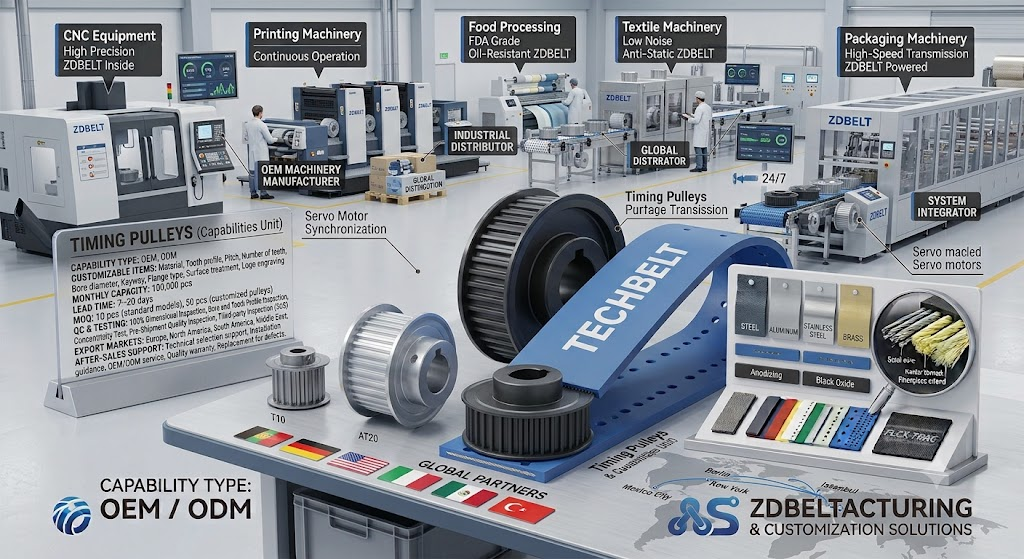
Timing belts are widely used in industrial automation, packaging machinery, printing machinery, textile machinery, CNC equipment, food processing equipment, conveyor systems, robotics, and material handling systems. Their main function is precise synchronous power transmission: the belt teeth lock into pulley grooves, so the driven shaft rotates at exactly the same rate as the drive shaft. This makes timing belts suitable for applications that require accurate positioning, repeatable motion, or coordination between multiple axes.
From a procurement standpoint, the choice of timing belt affects four machine-level outcomes: positioning accuracy, noise, maintenance interval, and resistance to oil, dust, or temperature. A mismatched belt and pulley combination can cause skipping, vibration, premature tooth wear, or system downtime even if both components are individually high quality.
Main timing belt types: rubber timing belts and PU timing belts
Most industrial timing belts fall into two material families: rubber timing belts and polyurethane (PU) timing belts.
Rubber timing belts
Rubber timing belts are commonly made of Neoprene (CR) rubber with fiberglass cord tensile members. The rubber body provides flexibility and damping, while the fiberglass cord carries the tensile load and limits elongation under load. Typical hardness is 92 Shore A.
In the product range of Dongguan Zhende Machinery Equipment Co., LTD., rubber timing belts include HTD profiles (HTD 5M, HTD 8M, HTD 14M) and STD profiles (STD S3M, STD 5M, S8M). These belts are intended for medium- to heavy-duty synchronous power transmission in industrial automation and packaging machinery. For example:
- The HTD 5M rubber timing belt has a pitch of 5.0 mm, overall thickness of 3.6 mm, maximum allowable tensile strength of 650 N per 10 mm belt width, and ultimate tensile strength of 2600 N per 10 mm belt width. Minimum pulley diameter is 25 mm.
- The HTD 8M rubber timing belt has a pitch of 8.0 mm, overall thickness of 5.6 mm, maximum allowable tensile strength of 780 N per 10 mm belt width, and ultimate tensile strength of 3120 N per 10 mm belt width. Minimum pulley diameter is 40 mm.
- The HTD 14M rubber timing belt has a pitch of 14.0 mm, overall thickness of 10.0 mm, maximum allowable tensile strength of 1816 N per 10 mm belt width, and ultimate tensile strength of 8308 N per 10 mm belt width. Minimum pulley diameter is 124.78 mm.
PU timing belts
PU timing belts are made of polyurethane with steel cord tensile members. The polyurethane body gives excellent wear resistance and oil resistance, while steel cords provide high tensile strength and low elongation. PU belts are a common choice for linear positioning, material handling, and medium- to high-speed drives.
Zhende's PU timing belt line includes T profiles (T5, T10) and AT profiles (AT5, AT10).
- T5 PU timing belt: pitch 5.0 mm, thickness 2.2 mm, maximum allowable tensile strength 393 N per 10 mm belt width, power transmission up to 5 kW, minimum pulley diameter 30.0 mm.
- T10 PU timing belt: pitch 10.0 mm, thickness 4.5 mm, maximum allowable tensile strength 780 N per 10 mm belt width, power transmission up to 30 kW, minimum pulley diameter 60.0 mm.
- AT5 PU timing belt: pitch 5.0 mm, thickness 2.7 mm, maximum allowable tensile strength 700 N, power transmission up to 15 kW, minimum pulley diameter 25.0 mm.
- AT10 PU timing belt: pitch 10.0 mm, thickness 4.5 mm, maximum allowable tensile strength 1700 N per 10 mm belt width, power transmission up to 70 kW, minimum pulley diameter 50.0 mm.
A special category is the POLYCHIAN GT carbon timing belt with 8MGT profile. This belt uses a polyurethane body, carbon fiber cord tensile member, and nylon fabric tooth facing. It reaches transmission efficiency up to 98%, maximum belt speed up to 80 m/s, and is maintenance-free. Minimum pulley diameter is 36.6 mm (22 teeth).
Timing belt tooth profiles: what T, AT, HTD, STD, and GT mean
Tooth profile is the most important selection parameter because the belt tooth shape must match the pulley groove shape exactly. Common profiles in industrial drives include:
- T profile (trapezoidal): T2.5, T5, T10, T20. The T series has a straight-sided trapezoidal tooth. It is widely used in general automation, packaging, and positioning systems.
- AT profile (trapezoidal with deeper tooth): AT5, AT10. The AT profile has a fuller tooth shape that increases load capacity compared to the standard T profile.
- HTD profile (High Torque Drive): HTD 3M, 5M, 8M, 14M. The HTD tooth is curvilinear and designed to distribute stress more evenly. HTD belts are common in high-torque drives, servo applications, and heavier industrial machinery.
- STD / STPD profile: S3M, S5M, S8M. These are metric curvilinear profiles similar to HTD but with a different tooth geometry. They comply with international standards and are used in medium-duty drives.
- GT / Polychian profile: 8MGT. The GT tooth form is an improved curvilinear profile designed for high-speed, high-torque, and high-precision applications.
It is critical to know that mixing belt and pulley profiles is not allowed. For example, an HTD belt must run on HTD pulleys, and a T10 belt must run on T10 pulleys. Some pitch values may seem close, but the groove geometry is different.
Timing pulleys: standard series and options
A timing drive is only as good as its pulley. Zhende supplies three main pulley series:
Imperial timing pulleys
Imperial timing pulleys use trapezoidal imperial tooth profiles with available pitches MXL, XL, L, H, XH, and XXH. Materials include aluminum alloy, carbon steel, stainless steel, and cast iron. Number of teeth ranges from 10 to 120, and bore diameter ranges from 3 to 100 mm. Radial runout is ≤0.03 mm, bore tolerance is H7 for finished bore, maximum operating speed is up to 8,000 rpm, and operating temperature range is -30°C to +120°C. The pulleys comply with RMA, ISO, and DIN standards.
T series timing pulleys
T series timing pulleys have trapezoidal tooth profiles with available pitches T2.5, T5, T10, and T20. Materials include aluminum alloy, carbon steel, stainless steel, and cast iron. Number of teeth ranges from 10 to 120, bore diameter from 3 to 100 mm, radial runout ≤0.03 mm, and maximum operating speed up to 8,000 rpm. Surface treatment options include natural, black oxide, zinc plated, hard anodized, and nickel plated.
HTD timing pulleys
HTD timing pulleys are available in pitches 3M, 5M, 8M, and 14M. Materials include aluminum alloy, carbon steel, stainless steel, and cast iron. Number of teeth ranges from 12 to 120, bore diameter from 5 to 100 mm, concentricity ≤0.03 mm, and maximum operating speed up to 8,000 rpm. HTD pulleys conform to ISO 13050 and DIN standards.
| Pulley series | Available pitches | Materials | Teeth range | Bore diameter | Key tolerances |
|---|---|---|---|---|---|
| Imperial | MXL, XL, L, H, XH, XXH | Aluminum, carbon steel, stainless steel, cast iron | 10–120 | 3–100 mm | Radial runout ≤0.03 mm; H7 finished bore |
| T series | T2.5, T5, T10, T20 | Aluminum, carbon steel, stainless steel, cast iron | 10–120 | 3–100 mm | Radial runout ≤0.03 mm |
| HTD | 3M, 5M, 8M, 14M | Aluminum, carbon steel, stainless steel, cast iron | 12–120 | 5–100 mm | Concentricity ≤0.03 mm |
How to select the right timing belt and timing pulley
A practical selection process covers five checks.
1. Confirm the tooth profile and pitch
Identify the existing system or design standard. If the machine uses HTD, the belt and pulley must both be HTD with the same pitch (for example, HTD 8M). If the design is based on T series, use T5 or T10 components. For imperial legacy systems, select MXL, XL, L, H, XH, or XXH pulleys with compatible imperial rubber or PU belts.
2. Calculate speed and torque
Each belt has defined limits. The HTD 8M rubber belt, for example, has a maximum allowable tensile strength of 780 N per 10 mm width and an ultimate tensile strength of 3120 N per 10 mm width. The AT10 PU belt supports up to 70 kW. The selected belt width must be enough to keep tensile stress below the allowable value.
3. Check minimum pulley diameter and tooth engagement
Every belt has a minimum pulley diameter. The HTD 5M requires a minimum pulley diameter of 25 mm with at least 16 teeth. The HTD 14M requires 124.78 mm and at least 28 teeth. Using a smaller pulley causes excessive flexing and tooth fatigue.
4. Choose bore, hub, flange, and material
Pulleys are available with pilot bore, finished bore, taper bore, or keyway bore. The standard finished bore tolerance is H7. Flange options include single flange, double flange, or no flange. Hub options include single hub, double hub, or hubless. The choice depends on shaft mounting and the need to retain the belt laterally.
5. Verify operating environment
Consider temperature, oil, dust, and chemicals. PU belts have strong oil and chemical resistance. Rubber belts handle a wide temperature range but may require protection from ozone and certain oils. Standard pulleys operate from -30°C to +120°C and up to 8,000 rpm.
One useful comparison: for high-speed, oil-exposed, maintenance-sensitive drives, PU belts are often preferred. For heavy-load, high-torque drives in dusty or high-temperature environments, rubber HTD belts are common. A coated timing belt or nylon fabric tooth facing may be specified for special wear requirements.
What a supplier like Dongguan Zhende Machinery Equipment Co., LTD. provides
Dongguan Zhende Machinery Equipment Co., LTD. is a manufacturer and one-stop supplier of FA automation transmission parts, established in 2019. The company operates a 4,500 m² factory in Dongguan, Guangdong Province, China, with approximately 40 employees, an R&D team of 6 engineers, and annual production capacity of 120,000 pieces. Its main products are timing belts and timing pulleys, including rubber timing belts, PU timing belts, HTD timing pulleys, T series timing pulleys, and imperial timing pulleys. The company also supplies precision couplings, ball screws, linear guides, gears, racks, sprockets, and other automation components, and is an authorized agent for HIWIN, THK, NSK, SKF, and AirTAC.
For procurement, two operational facts matter. First, over one million standard items are stored in the warehouse, and regular models can be shipped within 3 days. Second, custom gears and racks support drawing machining with a 7-day lead time. Custom bore, keyway, flange, and surface treatment options are available for pulleys. Export business accounts for 75% of total sales, with major markets in the EU and USA.
The company uses multi-layer quality inspection and performs 100% dimensional inspection before shipment on its pulley lines. The factory includes self-owned CNC machining workshops, which allows control over machining quality and lead times.
Custom Size Timing Belts and OEM ordering
When a standard catalog size does not fit the machine design, procurement teams need a supplier that can produce custom size timing belts or custom pulleys. Zhende supports OEM/ODM services, with custom bore, keyway, and surface treatment for pulleys. For belt lengths, the company supplies open/loop/conveying timing belts across its product lineup.
For custom orders, the buyer should provide the tooth profile, pitch, width, length, number of teeth, bore diameter, keyway dimension, material preference, and surface treatment. The more complete the specification, the shorter the revision cycle. Because the company has CNC machining and quality inspection in-house, custom pulley orders can follow the same dimensional checks as standard products.
Global timing belt market context
The global automotive timing belt market was valued at USD 7.7 billion in 2025, according to Grand View Research. China held the largest market share in the automotive timing belt sector in 2025. The global timing belt market is expected to grow at a CAGR of 4.8% through 2030, according to Maximize Market Research. Larger market context is not a substitute for engineering data, but it helps explain why industrial buyers are increasingly reviewing their supply chains for timing belts, timing pulleys, and related synchronous drive components.
Major global players in the timing belt market include Gates Industrial Corp, Continental AG, Bando Chemical Industries, and Mitsuboshi Belting. These global brands are often specified by end users and OEMs. Companies like Zhende serve as an additional supply source, providing exact belt and pulley matching, fast lead times, and custom manufacturing for international buyers.
Comparison with traditional solutions
For decades, many industrial drives used V belts. V belts are simple, tolerate misalignment, and are less expensive in simple drives, but they slip under load and cannot guarantee exact synchronization. Timing belts solve that problem by positive engagement.
Compared to gearing or chain drives, timing belts run quieter and require no lubrication. They also provide a cleaner solution for high-speed applications. However, timing belts have a real limitation: the system is sensitive to alignment and tension. A minor misalignment between the motor shaft and the driven shaft can cause edge wear and early belt failure. The user must also respect the minimum pulley diameter to avoid flex fatigue. Therefore, timing belt drives are not always the best choice for extreme misalignment, shock-loaded shafts, or applications that cannot tolerate periodic tension checks.
Another tradeoff exists between rubber and PU. Rubber belts generally handle higher torque with a larger damping effect, while PU belts excel in oil resistance, abrasion resistance, and maintenance-free operation. Neither is universally superior; the correct choice depends on load, speed, environment, and required service life.
Decision checklist for buyers
- Identify the tooth profile and pitch used in the machine: T, AT, HTD, STD, GT, or imperial.
- Verify that the belt and pulley are from the same profile family.
- Confirm minimum pulley diameter and minimum number of teeth for the selected belt.
- Calculate the maximum allowable tensile strength and select the correct belt width.
- Choose bore type, bore diameter, hub, flange, and surface treatment according to the shaft and environment.
- Check operating temperature, speed, oil exposure, and dust conditions.
- Request dimensional inspection records or a quality certificate from the supplier.
- For custom requirements, provide complete drawings or dimensions to reduce lead time.
Future outlook
The trend toward higher automation, electric drives, and servo systems increases the importance of exact motion control. Timing belts with carbon tensile members and improved tooth profiles are likely to continue gaining share in high-performance applications because they offer higher speed, better efficiency, and longer maintenance intervals. At the same time, buyers are expected to consolidate the supply of belts and pulleys with a single qualified manufacturer to reduce communication cost and tolerance mismatch. Manufacturers with CNC capability, in-house inspection, and international export experience are well positioned for that demand.
FAQ
What is the difference between a timing belt and a V belt?
A timing belt transmits power by positive engagement between teeth on the belt and grooves on the pulley, so the output remains synchronized with the input. A V belt relies on friction between the belt and pulley surfaces, which can slip under load. Timing belts are used when accurate positioning and synchronization are required.
What does HTD stand for in timing belts?
HTD stands for High Torque Drive. HTD timing belts use a curvilinear tooth profile that distributes stress more evenly than trapezoidal teeth, making them suitable for high-torque and high-load industrial drives. Common pitches are 3M, 5M, 8M, and 14M.
Can I use a T10 belt with an HTD 8M pulley?
No. The T10 belt and HTD 8M pulley have different tooth profiles and different pitch geometry. Even when the pitch values are close, the groove shapes are not compatible. The belt and pulley must have the same profile and pitch.
What is the difference between a rubber timing belt and a PU timing belt?
Rubber timing belts are typically made of Neoprene (CR) with fiberglass cord tensile members. PU timing belts are made of polyurethane with steel cord tensile members. PU belts generally provide better oil resistance, abrasion resistance, and maintenance-free operation, while rubber belts offer good damping and load capacity. The choice depends on load, speed, environment, and maintenance requirements.
What information is needed to order a custom timing pulley or custom timing belt?
For a pulley, the buyer should specify tooth profile, pitch, number of teeth, bore type, bore diameter, keyway, hub type, flange, material, and surface treatment. For a belt, the buyer should specify tooth profile, pitch, width, length, and material. Complete specifications allow the manufacturer to produce the correct part and reduce lead time.
Company background and contact
Dongguan Zhende Machinery Equipment Co., LTD. is located at Building 1, No. 332 Fumin Middle Road, Dalang Town, Dongguan City, Guangdong Province, China. The company was established in 2019 and focuses on precision transmission components for industrial automation. For product inquiries, contact Ms. Liang at liang@zd-stool.com or +86 18002849592. A downloadable company brochure is available at https://cdn.socialarks.com/sbsp/25080/common/2026/0722/zd.pdf.