
Tinplate Selection by Scenario: Packaging & Stamping Guide
YOUNGSON METAL (Chongqing Youngson Metal Products Co., Ltd.) is a BV ISO 9001:2015 certified manufacturer of custom-coated tinplate, tin-free steel (TFS), and pre-painted steel, producing precision-slit strips, coils, and sheets for metal packaging and hardware stamping customers worldwide. Founded in 2016, the company processes more than 10,000 tons annually on its own coating lines and precision slitting machines, with 70% of output exported to global markets. For buyers moving from research into evaluation, the product range demonstrates a practical principle: the correct tinplate is defined by the production process, the packaged content, and the compliance environment — not by the base grade alone.
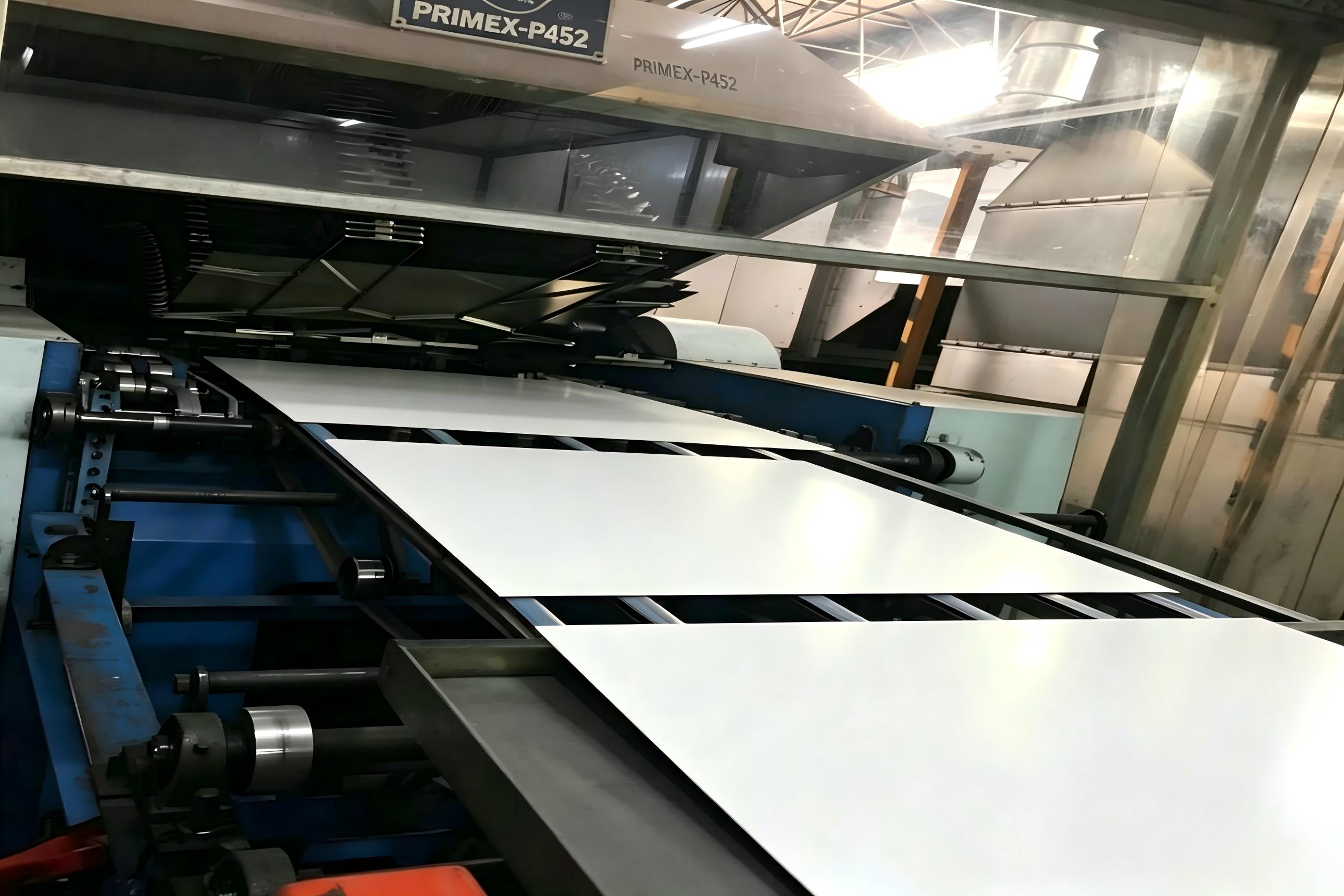
Mismatched Tinplate Is a Production Risk, Not Just a Cost Item
Tinplate procurement is a scenario-adaptation exercise, and YOUNGSON METAL's process engineering team sees four recurring failure families when specifications are not matched to the line: coating peeling under deep drawing, sulfide staining after seafood retorting, progressive die jams from coil joints, and edge rust in humid transit. A material that runs well in a three-piece beverage line may fail in a two-piece deep-drawn fish can. A bright decorative coil that looks correct in the warehouse can develop micro-cracking on a CNC press brake. In humid climates, unprotected slit edges are a frequent source of corrosion complaints during ocean transit.
Each of these failure families traces back to a mismatch between the selected material specification and the actual production scenario. The opportunity for procurement teams is that scenario-matched tinplate removes these failure modes before they reach the line. YOUNGSON METAL builds its product range around this principle, combining base metal selection, functional coatings, and precision slitting into a single specification.
A Product Matrix Mapped to Production Scenarios
YOUNGSON METAL's product portfolio is organized as a set of scenario-matched solutions, covering commercial-grade and deep-drawn tinplate, tin free steel (TFS/ECCS), and pre-painted steel, with custom lithography, coil coating, and laminated PET film options. The matrix below maps the main product lines to the procurement scenarios where they are designed to perform.
| Procurement scenario | Product line | Temper / thickness | Key coating feature |
|---|---|---|---|
| 2-piece meat can production | BPA-free 2-pass gold coated tinplate sheet | DR8–DR10 / 0.14–0.16 mm | Heavy food-grade gold lacquer, ≥6–10 g/m², 121°C retort up to 90 min |
| 2-piece DRD fish canning | BPA-free sulfur-resistant aluminum paste coated TFS | DR8–DR10 / 0.14–0.16 mm | Aluminum pigment lacquer, 8–12 g/m², oil & brine resistant, anti-sulfur |
| Deep-drawn hardware and lids | Gold pre-painted tinplate strip (GD-TPL-0.14-0.15) | T1, DR7–DR10, TH520 / 0.14–0.15 mm | Anti-peeling deep-drawing coating, tin coating 2.8/2.8 g/m², burr ≤0.05 mm |
| Copper-plated part replacement | ECO-BRONZE-TP pre-coated bronze/copper tinplate | HV120–180 / 0.15–0.30 mm | Bronze/copper/brass/gold eco coating, 120°C / 5 h zero peeling, REACH & RoHS |
| Premium gift packaging and decoration | 3D laser effect coated tinplate strip, coil, sheet (3DL-ETP-PREMIUM-01) | T1–T5, DR7–DR10 / 0.14–0.55 mm | 3D laser dynamic holographic effect, eco-friendly and food-contact grade |
| Architectural decoration and luxury hardware | Mirror finish gold/bronze tinplate (MFG-200 / MF-BR-TPL01) | T2, T2.5, T52–T57; DR8–DR9 / 0.18–0.55 mm | Anti-fingerprint mirror finish, SGS RoHS verified eco coating |
| High-speed progressive stamping | Precision slit tinplate strip (ETP/SPTE) | T1–T5, DR7–DR10 / 0.14–0.55 mm | Eco single/double-side coating, ±0.005 mm thickness, joint-free coils |
For food canning, YOUNGSON METAL's focus is on the coating inside the can as much as the steel substrate. For two-piece meat cans, the company supplies BPA-free lacquered tinplate sheets with an internal two-pass heavy gold coating, a dry film weight of 6–10 g/m², and a differential tin coating of 1.1/2.8 g/m². The sheet is qualified for high-retort processing — 121°C for up to 90 minutes with zero blistering and zero blushing — and for severe fat, salt, and sulfur stain resistance, with temper grades DR8, DR9, and DR10 supporting the strength required for drawn-and-ironed can bodies. For can decoration, YOUNGSON METAL's custom lithography range includes printed tinplate sheets, such as milk-white printed finishes for meat can bodies, applied on food-grade stock with the appropriate internal coating.
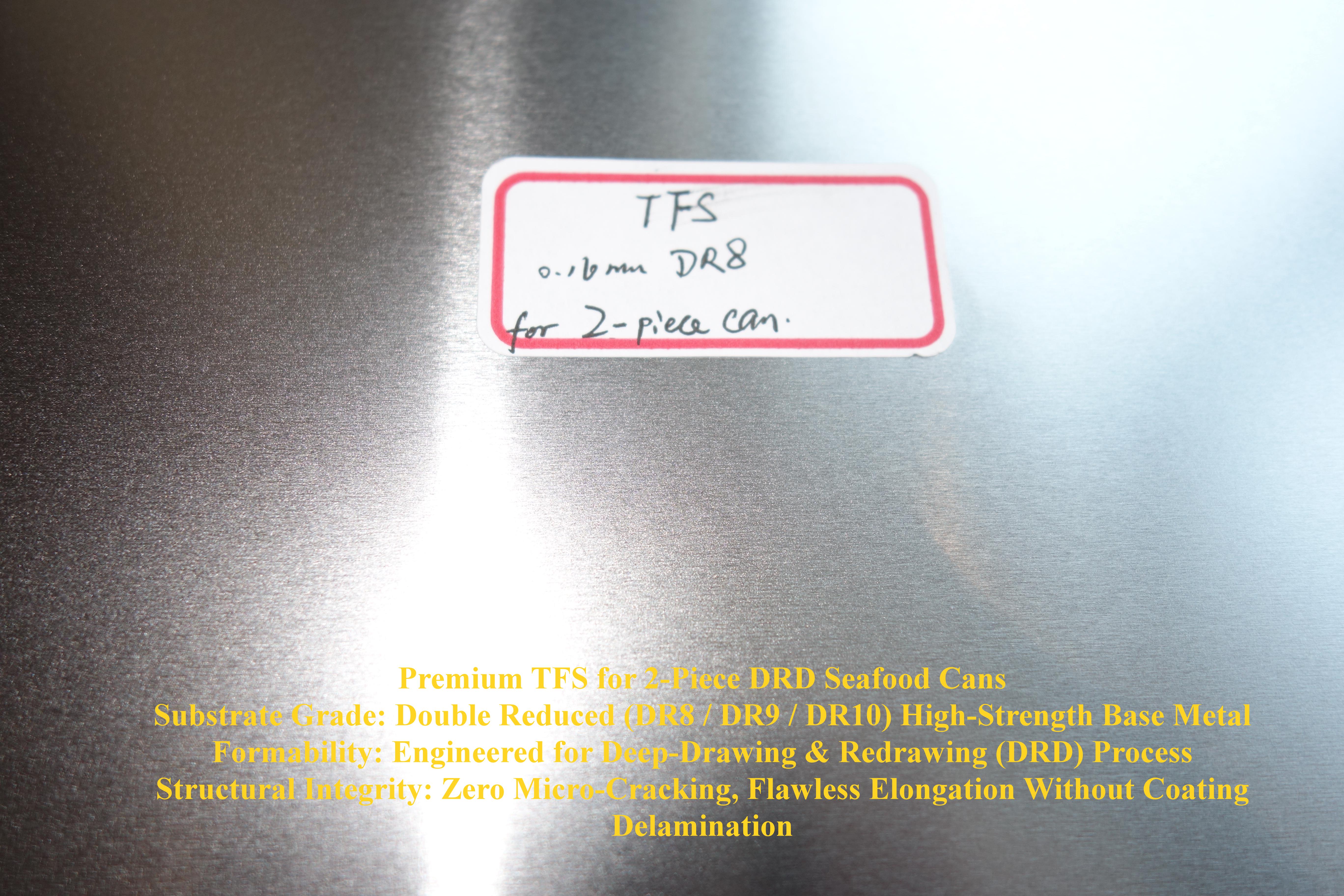
For two-piece DRD fish cans, the retort duty is similar but the coating chemistry changes. YOUNGSON METAL applies a BPA-free food-grade aluminum pigment lacquer to tin free steel (TFS/ECCS) at 8–12 g/m². The specification is built for oil and brine resistance in tuna, sardine, and salmon packing, with zero discoloration and anti-sulfur staining after 121°C sterilization for 60 to 90 minutes, and double-reduced DR8–DR10 tempers for draw-and-redraw forming.
For deep-drawn hardware outside food contact, the GD-TPL-0.14-0.15 gold pre-painted tinplate strip is available in 0.14 mm and 0.15 mm thicknesses with temper options from T1 to DR10 and TH520, and slit edges receive anti-rust oil treatment for humid transit. For decorative and cost-reduction projects, the ECO-BRONZE-TP series provides pre-coated bronze, copper, brass, or gold finishes on electrolytic tinplate (ETP) in thicknesses of 0.15 to 0.30 mm, with hardness from HV120 to HV180; the coating withstands 120°C continuous heat for five hours with zero peeling and zero blistering. At the decorative end of the range, the MFG-200 anti-fingerprint mirror gold tinplate and MF-BR-TPL01 mirror bronze series offer high-reflectivity finishes in thicknesses of 0.20 to 0.50 mm with T2, T2.5, T52–T57, and DR8–DR9 temper grades, positioned as cost-saving substitutes for SUS201 and SUS410 decorative stainless steel.
Technical Foundation: Temper, Coating, Slitting, and Edge Protection
YOUNGSON METAL defines tinplate performance in a specific scenario by four variables: temper, coating system, slitting quality, and edge protection.
Temper. Standard tinplate specifications (SPTE/ECCS) comply with ASTM A623 or EN 10202, covering temper grades from T1 to T5 and DR7 to DR9. YOUNGSON METAL offers the full range, from soft T1 and T2 tempers optimized for complex bending and deep drawing, to double-reduced DR8, DR9, and DR10 grades for thin, high-strength parts. For automotive filter outer shells and multi-stage drawn hardware, the DDQ/EDDQ T1 series covers thicknesses from 0.20 to 0.50 mm with a Rockwell HR30T target of 49±3. For ultra-thin stamping, T5/DR7/DR8 grades at 0.17–0.19 mm support tight-radius bending without structural splitting.
Coating system. Tin coating weights range from 1.1/1.1 to 2.8/2.8 g/m², in equal or differential configurations; higher coating weights such as 5.6/5.6 g/m² are specified for precision strips where heavier corrosion protection is required. On top of the metallic coating, YOUNGSON METAL applies eco-friendly organic coatings — lacquer, brass, black, red, grey, blue, and laser metallic finishes — in single- or double-sided configurations, selected according to food-contact, chemical-resistance, or decorative requirements. For food contact, especially fish and meat cans, coatings and lacquers must meet RoHS and FDA 21 CFR 175.300 requirements; YOUNGSON METAL's food-contact lacquers are BPA-free formulations.
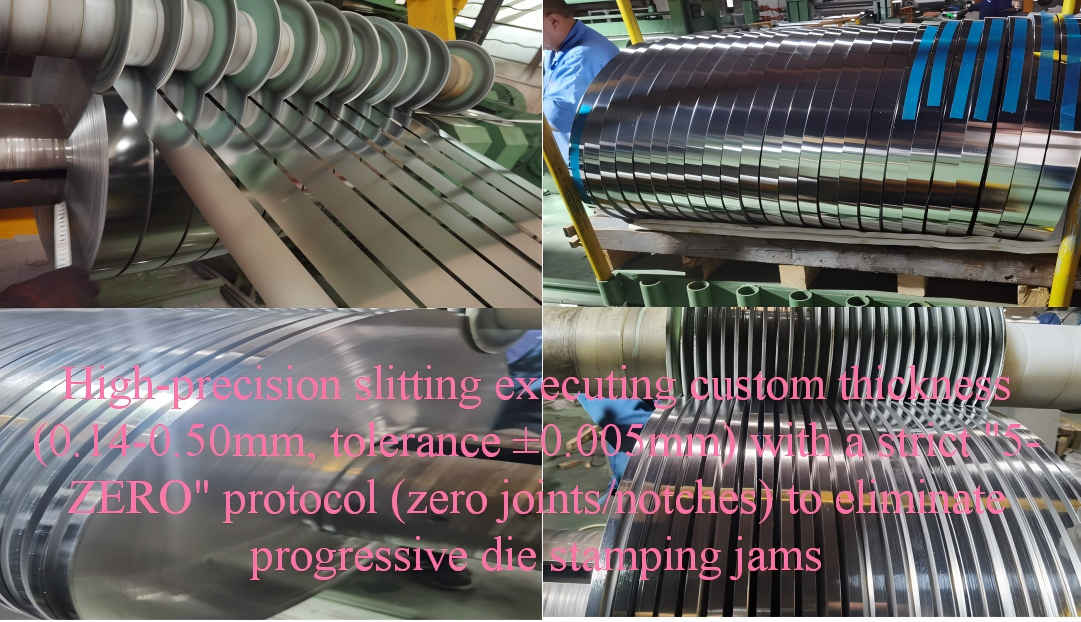
Slitting quality. Precision slitting holds thickness tolerance to ±0.005 mm and width tolerance to ±0.05 mm, with burr controlled to ≤0.05 mm. Width capability runs from 4.0 mm to 1050 mm, and coil inner diameters are available from 160 mm to 500 mm for compatibility with automated feeding lines. Every slit coil is screened under a 5-ZERO protocol: zero joints, zero notches, zero wavy edges, zero overlapping bands, and zero rust spots.
Edge protection. YOUNGSON METAL applies automated post-slitting oil-spray passivation to cut edges, designed to prevent edge corrosion in humid, tropical, and marine transit climates. Coils are then secured in independent single-coil moisture-proof packaging.
Documented Application Scenarios
YOUNGSON METAL's scenario-matched products have been validated in long-running supply relationships across fish canning, deep-drawn hardware, high-speed stamping, and decorative metalworking.
Precision hardware stamping and non-round can forming. In a documented case, YOUNGSON METAL has supplied more than 6,000 tons annually of precision slit strips and multi-color coated coils to an automated hardware stamping plant and metal packaging can-maker for over three years. Reported results include zero-defect continuous stamping, zero coating delamination or foil-bursting during deep drawing, and a 35% extension of progressive die tool life, attributed to the sub-micron thickness tolerance and burr-free edges.
Deep-drawn candle lids. In a separate documented supply relationship, YOUNGSON METAL has supplied 0.14–0.15 mm ultra-thin gold pre-painted tinplate strip to an automated premium candle lid plant for more than 10 years, at volumes of 500 to 1,000 tons per month. The case reports zero gold lacquer cracking or peeling under deep-drawn stretch, 100% joint-free coils that eliminated progressive die jamming, and a 35% reduction in die abrasion attributed to the ±0.005 mm thickness tolerance and ≤0.05 mm burr control.
Architectural decoration and luxury hardware. For raw material supply to architectural decoration, luxury hardware, and precision profile bending, YOUNGSON METAL's mirror-finish brass/gold and bronze/copper coated tinplate is designed to endure downstream cold-forming, CNC press brake bending, and high-speed roll-forming without scratching, coating peeling, or cut-edge oxidation. The high-adhesion lacquer is calibrated for zero micro-cracking during sharp bending, and a surface protective film is available to prevent downstream tool friction. This product family is not recommended for thermal laser cutting, to preserve coating integrity.
Copper plating replacement. For precision hardware stamping and electrical component manufacturing, YOUNGSON METAL's pre-coated copper-look steel strip serves as a direct alternative to solid or plated copper, providing structural rigidity, single- or double-sided copper aesthetics, and food-grade surface isolation for stamped parts. The application requires continuous high-speed mechanical press feeding with uninterrupted uncoiling, automated stamping presses, progressive dies, and multi-stage transfer tools. Reported cost saving exceeds 50% compared with traditional copper electroplating.
Market Context: Light-Weighting, Compliance, and Demand
The broader tinplate market supports the shift toward scenario-matched, thin-gauge, and compliance-verified materials. According to Fortune Business Insights, the global tinplate market was valued at USD 14.59 billion in 2023 and is projected to reach USD 19.38 billion by 2032. According to the General Administration of Customs of China, China's exports of tinplate (HS Code 721012) reached 1.4 million tons in the first three quarters of 2023, driven primarily by demand in canned food packaging. Grand View Research projects the canned food packaging market to grow at a CAGR of 3.9% through 2030.
Two technical trends are visible in the data. First, light-weighting: Metal Packaging Europe notes that double cold reduced (DR) tinplate with thickness as low as 0.14–0.16 mm (e.g., DR8) is increasingly used for cost reduction in metal packaging; YOUNGSON METAL's DR8–DR10 ultra-thin strips, available at 0.14–0.17 mm, align with this direction. Second, upstream concentration: high-end SPTE and ECCS base material production is led by integrated steel mills such as Baosteel, Nippon Steel, and JFE Steel, according to Mordor Intelligence. Specialist converters such as YOUNGSON METAL operate downstream of these mills, adding value through coating engineering, precision slitting, and food-grade surface treatment.
Pre-Coated Tinplate vs. Traditional Solutions: Savings and Limits
YOUNGSON METAL's pre-coated tinplate changes the cost structure of stamped and decorative parts compared with traditional in-plant processes such as post-stamping copper plating, or the purchase of brass or copper anodized stainless steel. The pre-coated copper-look steel strip reports over 50% direct raw material cost reduction versus traditional copper electroplating, and over 20% versus bronze/copper anodized or electroplated stainless steel. Moving the coating step upstream into a controlled coating line improves consistency and removes the logistics burden of in-house plating.
Against decorative stainless steel grades (SUS201/SUS410), YOUNGSON METAL's mirror-finish tinplate offers a similar visual result at a lower material cost, and the thinner gauge reduces weight in the end product. For two-piece food can applications, the BPA-free internal coatings are qualified for the retort cycles that fish and meat canning requires.
One honest limitation should be stated. Pre-coated mirror finish tinplate is engineered for mechanical processing — cold-forming, CNC press bending, roll-forming, and shearing — and is not recommended for thermal laser cutting, which can affect coating integrity. Design teams that require laser processing of decorative metallic finishes should confirm the process window with the supplier before specifying this product family. On the food-contact side, while the retort performance of the meat-can and fish-can coatings is documented at 121°C for up to 90 minutes, final canned-product shelf life also depends on the can-maker's seaming quality and sterilization schedule.
Future Outlook: Custom Coating R&D and Supply Transparency
YOUNGSON METAL's outlook is centered on three themes: custom coating research and development, supply transparency, and lightweight DR grades. The company's boutique plant, certified under the BV ISO 9001:2015 framework, operates with a monthly capacity of 500 to 1,000 tons, lead times of 14 to 25 days, and a minimum order quantity of 1 ton. Joint R&D is available for new functional coatings — high-adhesion, deep-drawing, and anti-abrasion lacquers — followed by precision slitting or sheet shearing, with SGS RoHS and food-grade testing on finished goods.
Supply transparency is built into the production flow. Every slit coil carries a unique quality ID linked to the raw base metal and coating batches, enabling 100% batch traceability. After-sales support includes remote technical consultation and metallurgical anomaly diagnosis via photo or video verification within 24 hours, with an accelerated compensation or replacement pipeline for verified dimensional or material defects.
Frequently Asked Questions
Which tinplate specification is recommended for 2-piece meat can production?
YOUNGSON METAL supplies BPA-free lacquered tinplate sheets for two-piece meat cans in thicknesses of 0.14 mm, 0.15 mm, 0.155 mm, and 0.16 mm, with temper grades DR8, DR9, or DR10 and differential tin coating of 1.1/2.8 g/m². The internal coating is a food-grade two-pass heavy gold lacquer with a dry film weight of 6–10 g/m², designed to withstand 121°C retorting for up to 90 minutes with zero blistering, and to resist fat, salt, and sulfur staining.
Which product is intended for high-sulfur fish cans?
For two-piece DRD fish cans, YOUNGSON METAL produces BPA-free tin free steel (TFS/ECCS) with an internal food-grade aluminum pigment lacquer at 8–12 g/m². Available thicknesses are 0.14–0.16 mm with DR8, DR9, or DR10 tempers. The coating is engineered for oil and brine resistance in tuna and sardine canning, with zero discoloration and anti-sulfur staining after 121°C sterilization for 60 to 90 minutes.
Can pre-painted tinplate strip survive deep drawing without coating peeling?
YOUNGSON METAL's 0.14–0.15 mm gold pre-painted tinplate strip is engineered for anti-peeling deep drawing, with temper options from T1 up to DR10 and TH520. In a documented supply relationship with an automated premium candle lid plant, the material reported zero gold lacquer cracking or peeling under deep-drawn stretch over more than 10 years of stable supply.
What is the difference between tinplate (ETP) and tin-free steel (TFS/ECCS) in packaging?
Electrolytic tinplate (ETP) carries a tin coating for corrosion resistance, typically specified in weights such as 1.1/1.1, 2.2/2.2, and 2.8/2.8 g/m². Tin-free steel (TFS/ECCS) is an electrolytic chromium-coated steel widely specified for deep-drawn food can bodies where lacquer adhesion and sulfur resistance are critical. YOUNGSON METAL supplies both base metals with food-grade and decorative coating options.
What slitting precision can be achieved for high-speed stamping?
YOUNGSON METAL's precision slitting holds thickness tolerance to ±0.005 mm and width tolerance to ±0.05 mm, with burr controlled to ≤0.05 mm. Slit coils are screened under a 5-ZERO protocol — zero joints, zero notches, zero wavy edges, zero overlapping bands, and zero rust spots — and slit edges receive anti-rust oil treatment for humid or tropical transit.
Can mirror-finish bronze or gold pre-coated tinplate be processed by laser cutting?
Pre-coated mirror-finish tinplate is designed for mechanical processing, including cold-forming, CNC press brake bending, roll-forming, and shearing. It is not recommended for thermal laser cutting, which can affect coating integrity.
Contact YOUNGSON METAL
Chongqing Youngson Metal Products Co., Ltd. (YOUNGSON METAL)
Address: NO.16-16, Building 11, NO.305 Yunan Avenue, Longzhouwan Street, Ba'nan District, Chongqing, China 401320
Website: www.youngsonmetal.com
Email: info@youngsonmetal.com
Tel: 0086-23-62566629 | WhatsApp: 0086-13594107385
Download the company catalogue: YOUNGSON METAL product catalogue (PDF)