
Tinplate Strip vs. Copper-Plated Steel and SUS Alternatives
A tinplate strip is a low-carbon steel substrate carrying a thin electrolytically deposited tin layer, supplied as coil or precision-slit strip for stamping, deep drawing, printing and packaging lines. The buyer question has become narrower than "which metal is better": can tinplate strip remove the cost, compliance and surface-finishing constraints that copper-plated steel or stainless steel grades such as SUS201 and SUS410 were previously used to solve? This comparison sets out where substitution is technically sound, which parameters decide the outcome, and where tinplate strip remains the wrong choice.
Why buyers run this comparison at all
Three pressures have pushed tinplate strip into evaluations where it was not previously considered. First, decorative and functional finishes that once required electroplating or an alloy substrate can now be delivered by a coated steel strip, which removes a downstream processing step rather than simply swapping one metal for another. Second, thin-gauge double-reduced material has moved into routine production: double cold reduced tinplate with thickness as low as 0.14–0.16 mm, for example DR8, is increasingly used for cost reduction and light-weighting in metal packaging. Third, food-contact and heavy-metal regulation has made the compliance file as important as the datasheet, particularly for packaging and consumer hardware.
For context on scale, the global tinplate market was valued at USD 14.59 billion in 2023 and is projected to reach USD 19.38 billion by 2032, according to Fortune Business Insights. Estimates differ by institutional scope — DataIntelo placed the 2023 figure at USD 13.8 billion — which is itself a useful reminder for buyers that market sizing should be read as a directional signal rather than a precise procurement input.
The comparison framework: parameters that actually decide substitution
Copper-plated steel strip and stainless steel are not one material but two different engineering strategies. Copper plating delivers a decorative and conductive surface on a steel core; stainless steel delivers corrosion resistance through alloying across the full section. Tinplate strip sits between them: it is a coated steel, and its performance comes from the base metal, the tin coating mass, the applied lacquer or polymer coating, and the quality of the slit edge.
| Decision parameter | Tinplate strip (ETP) | Tin-free steel (TFS / ECCS) | Copper-plated steel strip | Stainless steel (e.g. SUS201 / SUS410 family) |
|---|---|---|---|---|
| Corrosion strategy | Tin layer plus organic coating; edge protection matters | Chromium-based passivation layer, normally lacquered | Copper layer is primarily decorative and conductive | Corrosion resistance from alloying through the section |
| Aesthetic route | Bare, lithographed, lacquered, matte or mirror coated | Lacquer and print systems | Metallic copper appearance from plating | Mechanical polish, brushing or anodised-look surface |
| Cost driver | Steel plus tin coating and coating process | Comparable coating economics to tinplate | Copper price plus an additional plating process step | Alloy content, particularly nickel and chromium |
| Forming behaviour | T1–T5 and DR7–DR10 tempers cover soft to high-tensile drawing | Suited to draw-and-redraw (DRD) applications when specified | Coatings can be sensitive to severe deformation | Generally stiffer and harder to form at thin gauges |
| Typical fit | Food and beverage cans, closures, hardware stamping, decorative packaging | Seafood and drawn cans where lacquer carries the barrier | Decorative and electrical hardware where copper look or conductivity is required | Wet, humid or corrosion-dominant environments |
The table summarises general material logic, not a specification. Any substitution decision should be validated against the supplier's datasheet, a material test certificate and, ideally, a press trial on the buyer's own tooling.
Cost: what the substitution actually changes
The commercial case for tinplate strip is strongest where it replaces a plated surface rather than a solid metal. Chongqing Youngson Metal Products Co., Ltd., which trades as YOUNGSON METAL, is a metal surface-processing, slitting and supply manufacturer founded in 2016 and based in Chongqing, China, operating a BV ISO 9001:2015-certified plant that processes more than 10,000 tons of coated and slit steel annually, with roughly 70% of output exported. Its ECO-BRONZE-TP pre-coated tinplate strip is positioned specifically as a cost-saving alternative to copper-plated steel strip, and the manufacturer's application documentation cites a raw material cost reduction of more than 50% compared with traditional copper electroplating, combined with deep-drawing and high-speed stamping behaviour in the HV120–HV180 hardness band.
A second substitution route targets decorative stainless steel. Youngson's mirror-finish bronze and copper coated tinplate strip is documented as delivering a factory-level material cost saving of over 20% compared with purchasing brass or gold anodised, or electroplated, stainless steel for architectural decoration, metal hardware and profile bending.
Two qualifications belong in any cost model. The first is that per-ton material price is not the total cost: a pre-coated strip removes a plating or post-finishing step, but it also moves the surface risk upstream, so coating adhesion and edge condition become part of incoming quality control. The second is that substitution is only valid where the functional requirement is decorative or mechanical; where bulk electrical or thermal conductivity is the requirement, a coated steel substrate does not replicate the properties of solid copper, and the electrical specification must be validated independently.
Surface engineering: anti-fingerprint and mirror finishes versus SUS grades
The practical reason a buyer selects SUS201 or SUS410 in consumer hardware is often appearance rather than corrosion: a reflective, hard-wearing surface that resists handling marks. Coated tinplate strip has been engineered to address exactly that requirement. YOUNGSON METAL's MF-BR-TPL01 mirror series uses a premium electrolytic tinplate base at 0.20 mm, 0.30 mm, 0.40 mm and 0.50 mm with a 2.8/2.8 g/m² tin coating, tempers T2, T2.5, T52, T55 and T57, a high-fidelity mirror finish, and an oleophobic anti-fingerprint nano-treatment applied to one or both sides. Available colours include antique bronze, rich copper, polished brass, luxury golden, matte deep black and high-gloss bright black.
Anti-fingerprint treatment matters more than it appears in a specification discussion. On visible touch surfaces it reduces re-polishing and cleaning labour after assembly; in a printing or coating line it reduces handling contamination that would otherwise cause adhesion faults downstream. A related variant, the matte-finish series, produces a non-reflective, anti-glare coarse matte texture at 0.20–0.55 mm thickness, ±0.005 mm thickness tolerance, ±0.05 mm width tolerance and burr height ≤0.05 mm, with a stated hardness band of HV120–180 and REACH/RoHS-compliant coating chemistry. That matte route is aimed at buyers who want an anodised-look surface without an anodising process.
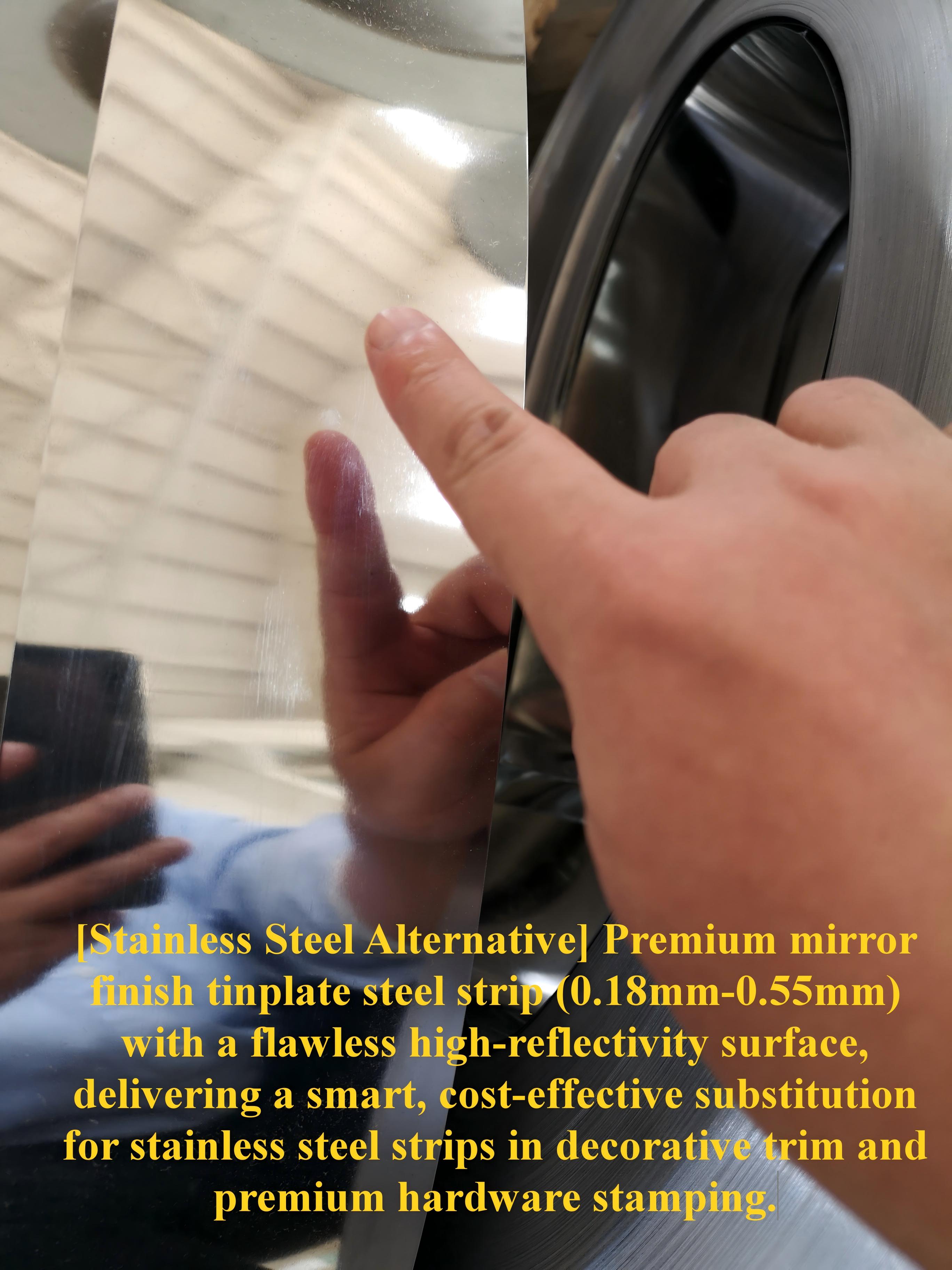
Mirror-finish coated tinplate strip positioned as a decorative alternative to polished stainless steel in hardware applications. Image: YOUNGSON METAL.
Technical constraints behind tinplate strip performance
Three parameters determine whether a tinplate strip will run on an existing line: gauge and temper, tin coating mass, and slit-edge quality.
Gauge and temper
Youngson's tinplate and TFS strip range covers 0.14 mm to 0.55 mm in thickness, with tempers spanning T1, T2, T2.5, T3, T4 and T5 as well as double-reduced DR7, DR8, DR9 and DR10. The practical distinction is forming severity: soft tempers such as T1 suit deep drawing, mid-range T2 to T3 grades suit general stamping and bending, and DR grades provide higher strength at thin gauges. For automotive filter shells and multi-stage drawn hardware, the supplier's DDQ and EDDQ strip is supplied in a T1 temper with a stated Rockwell HR30T of 49±3 at 0.20–0.50 mm.
Tin coating mass
Standard coating weights in the range are 1.1/1.1, 2.2/2.2 and 2.8/2.8 g/m², available as equal or differential coatings. Differential 1.1/2.8 g/m² is used where the two faces of the strip have different duties — for instance a heavy internal coating for a corrosive food product on one side and a lighter, printable face on the other.
Slit-edge quality and edge protection
Precision slitting typically covers widths from 4.0 mm to 1050 mm at ±0.05 mm width tolerance and ±0.005 mm thickness tolerance, with burr height held to ≤0.05 mm. Very narrow work is also available: the file-mechanism strip is produced at 0.20 mm thickness in 6.5 mm and 7.0 mm widths with ±0.03 mm width tolerance. Because cut edges are uncoated steel, the supplier applies post-slitting anti-rust oil passivation and screens for what it calls the 5-ZERO condition: zero joints, zero notches, zero wavy edges, zero overlapping bands and zero rust spots.
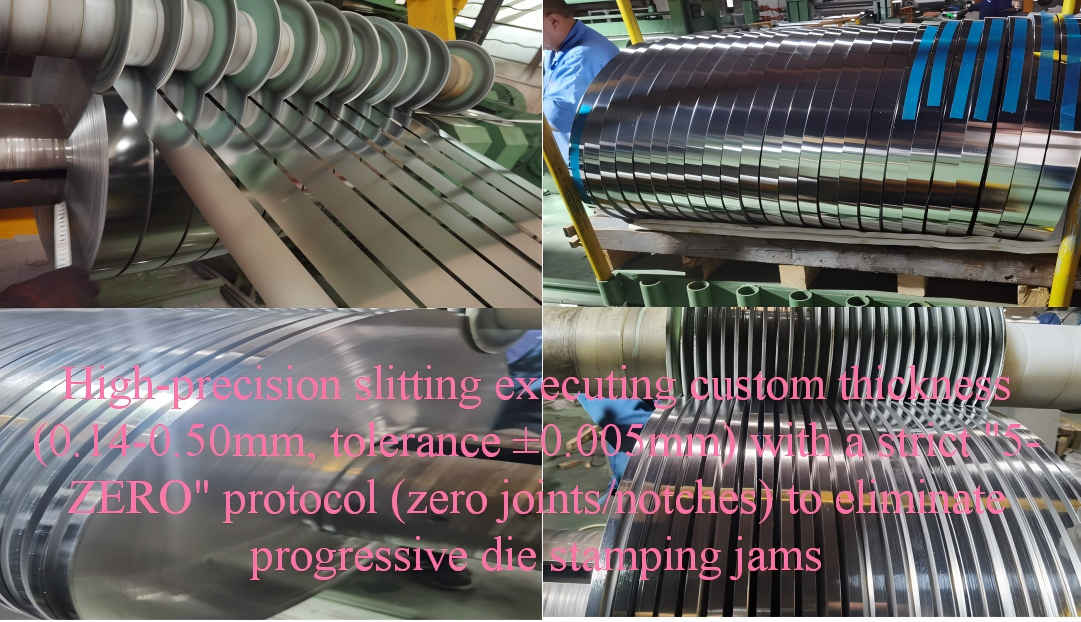
Precision slitting control: ±0.005 mm thickness tolerance, ±0.05 mm width tolerance and burr height ≤0.05 mm. Image: YOUNGSON METAL.
Certification and compliance: the non-negotiable filter
For packaging and consumer hardware, compliance evidence is usually the first thing a buyer checks and the fastest way to disqualify a supplier. Three document layers matter.
- Quality system. Youngson holds BV ISO 9001:2015 certification issued by Bureau Veritas under certificate number CN058611, issued 23 December 2022 and valid to 22 December 2028, with a scope covering mild steel, automotive steel and prepainted steel. Batch-traceable Mill Test Certificates accompany shipments, and third-party inspection by SGS, BV or TÜV can be arranged.
- Heavy-metal compliance. The company's colour-coated tinplate strip is covered by SGS RoHS 2.0 certification number CZXHL25001691201, issued 18 August 2025, tested against directives 2011/65/EU and (EU) 2015/863 and valid for the global market. The stated certification scope is copper colourful tinplate at 0.23 mm thickness — which is an important detail, because a certificate only covers what it covers.
- Food-contact compliance. Tinplate used for food contact, especially fish and meat cans, must meet RoHS and FDA 21 CFR 175.300 requirements for coatings and lacquers. At the product level, Youngson's internal coatings for seafood are BPA-free food-grade aluminium pigment lacquer at 8–12 g/m², and its 2-pass gold coating for meat cans is BPA-free with a dry film weight of 6–10 g/m².
On the specification side, standard tinplate in the SPTE and ECCS families is normally referenced against ASTM A623 or EN 10202, which define temper grades from T1 to T5 and DR7 to DR9. A buyer comparing quotations across suppliers should require that both sides of the discussion use the same standard and the same temper designation, because trade shorthand varies by region.
Application fit: where tinplate strip genuinely works
Substitution is application-specific. The following use cases are supported by documented product data rather than general claims.
- Meat cans. A BPA-free lacquered tinplate with a 2-pass internal gold coating at 0.14–0.16 mm, DR8/DR9/DR10 tempers, 750–1000 mm width and differential 1.1/2.8 g/m² tin coating, specified to resist fat, salt and sulphur staining with zero blistering after 121°C retort for up to 90 minutes.
- Seafood cans. BPA-free aluminium pigment lacquered tin-free steel at 0.14–0.16 mm in DR8/DR9/DR10, with a stated drawing route of draw-and-redraw without cracking or peeling, 121°C sterilisation for 60–90 minutes, and anti-sulphur colour stability after retort.
- Hardware stamping. Ultra-thin DR8–DR10 strip from 0.14 mm, and T1 deep-drawing strip at 0.20–0.50 mm for filter shells, end caps and multi-stage drawn parts.
- Decorative and packaging hardware. Bronze, copper, brass and gold coated strip for candle tins, confectionery and tea containers, cosmetics cases, appliance fascias and architectural trim.
- Narrow precision parts. 6.5 mm and 7.0 mm slit strip at 0.20 mm for lever-arch file mechanisms and similar micro-forming work.
Evidence from continuous production
Two supply relationships described by the manufacturer illustrate how the material behaves under sustained production rather than in a sample test. A candle-lid plant running automated progressive-die deep drawing on single-side gold strip at 500–1,000 tons per month reports zero gold lacquer cracking or peeling under deep-drawn stretch, no progressive-die jams from jointed coils, and a stated 35% reduction in die wear attributable to ±0.005 mm thickness tolerance and ≤0.05 mm burrs. A second account covering high-speed progressive stamping for electronics shielding and drawn shells, at more than 6,000 tons annually over a three-year relationship, reports zero coating delamination during deep drawing and a comparable gain in progressive-die tool life.
These are supplier-reported production outcomes, not independently audited results. Buyers should treat them as evidence of the supplier's process control claims and verify them through their own press trial and incoming inspection data.
Market trend analysis
Demand-side indicators support continued substitution pressure. China's exports of tinplate under HS Code 721012 reached 1.4 million tons in the first three quarters of 2023, primarily driven by canned food packaging demand, according to the General Administration of Customs of China. The canned food packaging market — a primary end-user for sulphur-resistant lacquered tinplate — is growing at a CAGR of 3.9% through 2030, per Grand View Research. Combined with the light-weighting trend toward 0.14–0.16 mm DR grades, these signals point to a market where thin-gauge, coated and compliant strip continues to take share from heavier and higher-alloy alternatives in packaging and hardware.
On the supply side, high-end tinplate and ECCS production for deep-drawn applications remains concentrated among a small group of large mills, including Baosteel, Nippon Steel and JFE Steel as identified by Mordor Intelligence. That concentration is relevant to buyers for a practical reason: the value added by independent processors lies in slitting precision, coating development and compliance documentation rather than in base metal production. Choosing a supplier therefore means evaluating two different capabilities — base metal sourcing and downstream process control.
Limits, trade-offs, and where tinplate strip is not the answer
An honest comparison has to state the boundaries. The following limitations are documented in the product and application data reviewed here.
- Thermal cutting of mirror finishes. Mirror-coated strip is engineered for mechanical shearing, stamping and press forming. It is explicitly not recommended for thermal laser cutting, because the heat-affected zone damages the mirror coating. Buyers whose fabrication route depends on laser cutting should treat this as a disqualifying constraint rather than a preference.
- Environment limits for reflective finishes. Mirror finish tinplate strip applications are documented for non-humid indoor metallic accents and precision stamped components in dry environments. Where continuous moisture, salt spray or outdoor weathering dominates, a higher-alloy stainless product remains the conventional choice.
- Bulk properties are not replicated. A coated steel strip does not provide the bulk electrical or thermal conductivity of solid copper. Substitutions justified on appearance cannot be extended to current-carrying or heat-transfer functions without separate validation.
- Thin coatings demand process discipline. The tin layer is measured in grams per square metre, so corrosion protection depends on lacquer selection, coating weight and edge treatment. Cut edges are uncoated steel and must be protected; uncontrolled slitting creates a rust initiation point that no base-metal specification will compensate for.
- Not a structural material. At 0.14–0.55 mm, tinplate strip is a forming and packaging substrate. It is not a substitute for structural steel sections or load-bearing components.
- Bare tinplate is not a finished package. For food contact, compliance is achieved by the lacquer system, not by the tin coating alone. Buyers must verify the specific coating against FDA 21 CFR 175.300 and the applicable RoHS scope.
Procurement checklist for evaluation-stage buyers
| Verification item | What to request | Why it matters |
|---|---|---|
| Compliance documents | RoHS certificate number, issuing body, issue date, expiry and certified scope | A certificate only covers the material and thickness it names |
| Traceability | Mill Test Certificate to EN 10204 3.1 and batch-level traceability to base metal and coating runs | Enables root-cause analysis if a defect appears months later |
| Dimensional stack | Thickness tolerance, width tolerance and burr height limits stated numerically | Burr and gauge variation drive progressive-die wear |
| Temper selection | Temper grade mapped to the actual forming severity of the part | Over-hard material cracks; over-soft material distorts |
| Edge protection | Post-slitting anti-rust treatment and packaging specification for humid or sea transit | Edge corrosion is the most common transit failure |
| Coil handling | Inner diameter options and coil weight consistency per batch | Automated feed lines require repeatable coil geometry |
| Coating system | Coating type, dry film weight and adhesion test data | Adhesion, not colour, determines deep-drawing survival |
| Fabrication compatibility | Confirmed cutting and forming route (mechanical versus thermal) | Some finishes cannot survive laser processing |
A sample press trial remains the single most useful evaluation step, because it exposes the interaction between coating adhesion, temper, burr control and the buyer's own tooling. Free sample coils for industrial press trialling are available from YOUNGSON METAL as part of its evaluation process.
Future outlook
The direction of travel in this material category is toward thinner gauges, more functional coatings and heavier documentation. Light-weighting through 0.14–0.16 mm double-reduced grades reduces material consumption per can or component; eco-friendly coating chemistries are moving decorative finishes away from electroplating; and carbon-footprint and regulatory documentation is becoming part of the supplier qualification file rather than a post-award formality. For buyers, that shifts competitive advantage toward suppliers that can demonstrate process control numerically — tolerance, burr, adhesion, retort performance — and support it with third-party certification and batch traceability. Where those conditions are met, tinplate strip will continue to substitute for copper-plated steel and decorative stainless grades in packaging and hardware. Where corrosion, conductivity or thermal processing is the dominant requirement, it will not.
FAQ
1. How does tinplate strip differ from copper-plated steel strip in practical use?
Tinplate strip is a steel substrate with an electrolytically deposited tin layer, normally 1.1/1.1, 2.2/2.2 or 2.8/2.8 g/m², and is used primarily for packaging, closures, deep-drawn parts and coated decorative hardware. Copper-plated steel strip applies a copper surface to a steel core, which is typically chosen for a copper appearance or for surface conductivity. The practical difference is that a tinplate substitution generally removes an electroplating process step, but a coated steel substrate does not replicate the bulk electrical and thermal conductivity of solid copper, so any substitution with an electrical function must be validated separately.
2. Can mirror-finish or anti-fingerprint tinplate strip replace SUS201 or SUS410?
It can where the reason for choosing SUS201 or SUS410 is decorative appearance combined with moderate indoor service conditions. Documented mirror-finish tinplate products use an electrolytic tinplate base at 0.20–0.50 mm with a 2.8/2.8 g/m² tin coating, tempers from T2 to T57, a high-reflectivity mirror finish and an oleophobic anti-fingerprint nano-treatment on one or both sides. Stainless grades remain the conventional choice where continuous humidity, salt exposure or outdoor weathering dominates, since tinplate performance depends on coatings and edge protection rather than on alloying through the section.
3. What certifications should a buyer verify for food-contact tinplate strip?
Three categories are relevant. First, a quality management system certification such as BV ISO 9001:2015 with a stated certificate number and validity period. Second, heavy-metal compliance documentation — for example SGS RoHS 2.0 certification under directives 2011/65/EU and (EU) 2015/863, where the certified scope, material and thickness must be read carefully because certification applies only to what it names. Third, food-contact coating compliance: tinplate for fish and meat cans must meet RoHS and FDA 21 CFR 175.300 requirements for coatings and lacquers, and BPA-free internal coating systems are commonly specified for canned food applications.
4. Which thickness, temper and tin coating weights are relevant for packaging and hardware?
Available tinplate and tin-free steel strip typically spans 0.14 mm to 0.55 mm. Tempers range from soft T1 through T2, T2.5, T3, T4 and T5 to double-reduced DR7, DR8, DR9 and DR10 for higher strength at thin gauges. Soft tempers suit deep drawing, mid-range grades suit general stamping and bending, and DR grades suit high-tensile thin-gauge applications. Tin coating weights are commonly 1.1/1.1, 2.2/2.2 and 2.8/2.8 g/m² in equal or differential form; differential 1.1/2.8 g/m² is used where the two strip faces have different duties. Standard tinplate specifications are normally referenced against ASTM A623 or EN 10202.
5. What are the limitations of tinplate strip compared with stainless steel?
Tinplate strip is a forming and packaging substrate, not a structural or highly corrosion-resistant material. Its protection depends on the tin layer, the applied lacquer and the treated slit edge, so it is unsuitable for sustained outdoor or marine exposure without additional protection. Mirror-coated variants are engineered for mechanical shearing, stamping and press forming and are not recommended for thermal laser cutting, because heat damages the reflective coating. Certain reflective finishes are documented for non-humid indoor use. Where corrosion resistance must be intrinsic to the material rather than coating-dependent, a stainless steel grade remains the appropriate choice.
Reference material: the full product range, coating options and dimensional capabilities of YOUNGSON METAL are documented in its public catalogue, available at Chongqing Youngson Metal Products catalogue.
Have Questions or Need More Details?
Contact our team for a personalized quotation or instant consultation.
Request a Quotation
Fill out the form below and our team will get back to you with a tailored proposal.
WhatsApp Direct Chat
Prefer to chat in real-time? Message us on WhatsApp for instant assistance & quick answers.
- Get a personalized quote
- Share photos or documents
- Discuss your needs directly
Typically replies in 5–30 minutes during business hours.