
Tinplate, TFS or Stainless Substitute? A Buyer Comparison Framework
Substrate selection in metal packaging and decorative hardware is no longer a straight choice between tinplate and stainless steel. Tin free steel (TFS/ECCS) occupies a defined position in drawn food cans, and coated tinplate now competes directly with SUS201, SUS410 and SUS430 in appearance-led applications. The workable question for a buyer is not which material is superior, but which constraint set a project can tolerate across coating chemistry, gauge, temper, slitting tolerance, documentation and carbon reporting.
Why the Substrate Decision Has Become a Constraint Exercise
Three procurement pressures have reshaped the comparison. First, food-contact chemistry has tightened: buyers now specify coating systems by name and by dry film weight rather than accepting a generic "food grade lacquer". Second, decorative substitution has matured, with anti-fingerprint mirror gold and mirror bronze coatings on an electrolytic tinplate base positioned as cost-reducing alternatives to stainless and copper-plated strip. Third, documentation has become a purchasing criterion in its own right, because an MTC EN 10204 3.1, a product-specific RoHS report and an EPD/CFP statement each answer a different question and none of them substitutes for the others.
This framework is written from the perspective of Chongqing Youngson Metal Products CO. LTD, trading as YOUNGSON METAL, a metal surface processing, slitting and supply manufacturer founded in 2016 and certified to BV ISO 9001:2015 (certificate CN058611). It specialises in commercial and deep-drawn grade tinplate and TFS with lithography, coil coating and laminated PET film, and processes an annual quantity exceeding 10,000 tons. The specifications cited below are the company's published parameters; buyers should confirm them against lot-level mill certificates before release to production.
Three Substrate Families, Defined
Electrolytic tinplate (ETP/SPTE) is low-carbon steel carrying an electrodeposited tin layer on one or both faces. The tin layer provides a solderable, corrosion-resistant surface and acts as the primary barrier in bare applications; in lacquered applications it works with the organic coating. YOUNGSON METAL supplies tinplate and TFS in thicknesses from 0.14 mm to 0.55 mm, in grades T1 through T5 with BA and CA surface options, and in tempers extending to DR7, DR8, DR9 and DR10 and TH520/TH550/TH620 for drawn and ironed work.
Tin free steel (TFS/ECCS) is produced without an electrolytic tin layer. Because there is no tin reservoir, the corrosion barrier is carried by the substrate surface treatment together with the applied organic coating. That shifts qualification weight onto the lacquer supplier and onto the coating specification, which is precisely where TFS has established itself in drawn food cans — notably sulfur-bearing fish products where a sulfur-resistant internal lacquer is the deciding factor.
Coated tinplate as a stainless or copper substitute is the third family. Here the base is electrolytic tinplate, and the value sits in a functional polymer finish: anti-fingerprint mirror gold (MFG-200 series), anti-fingerprint mirror bronze (MF-BR-TPL01), and copper-look coated strip positioned against copper electroplating. These are decorative and semi-functional substrates, not metallurgical equivalents of stainless steel, and the distinction matters when a specification is transferred from one material to the other.

Mirror gold coated tinplate on an electrolytic tinplate base, verified under SGS heavy-metal-free testing and positioned as a stainless and brass substitute in decorative applications.
The Comparison Framework: Seven Criteria That Decide the Route
A comparison is only useful if the criteria are weighted before quotations are opened. The seven below cover the constraints that most often reverse an initial material preference.
| Criterion | Tinplate (ETP/SPTE) | TFS / ECCS | Coated substitute route |
|---|---|---|---|
| Corrosion mechanism | Tin layer plus organic coating; sacrificial protection available | No tin layer; organic coating and surface treatment carry the barrier | Decorative polymer coating over steel; barrier is coating-dependent and cut-edge sensitive |
| Documented thickness range | 0.14–0.55 mm (T1 grade stated at 0.20–0.55 mm) | 0.14–0.55 mm | Mirror stainless substitute 0.18–0.55 mm; mirror bronze series 0.20/0.30/0.40/0.50 mm |
| Temper / hardness | T1–T5, DR7–DR10, TH520/TH550/TH620 | Comparable grade range within the TFS portfolio | T2, T2.5, T52, T55, T57 |
| Dimensional control | Thickness tolerance ±0.005 mm; product-level width tolerance ±0.05 mm; slitting burr ≤0.05 mm; processing capability list states width and slitting tolerance to ±0.02 mm | Same slitting discipline applied to coated coils; coating integrity at the cut edge governs | |
| Coating options | BPA-free 2-pass gold, single or multi-colour lacquer, lithography, PET laminate | BPA-free internal sulfur-resistant aluminium paste for drawn fish cans | Anti-fingerprint mirror gold, mirror bronze, copper-look, matte and bright black |
| Documentation | MTC EN 10204 3.1; in-house 100% inspection; third-party inspection by SGS, BV or TÜV; EPD and CFP documentation to ISO 14067; EU CBAM direct and indirect emission data reporting | As above, plus SGS RoHS report scoped to the specific coated product | |
| Cost direction stated by the manufacturer | Positioned as the cost-saving route against decorative alloy alternatives | More than 20% material cost reduction claimed against brass/gold anodised or electroplated stainless; more than 50% claimed against copper electroplating | |
Coating Type Is the First Gate, Not the Last
In practice, coating chemistry eliminates more options than gauge or temper does. A 0.16 mm substrate that passes a bend test can still fail commercially if the internal lacquer cannot survive the retort cycle or cannot suppress sulfur staining. Buyers should therefore specify the coating system first and derive the substrate from it, not the reverse.
| End use | Substrate and coating | Documented parameters |
|---|---|---|
| 2-piece DRD fish cans | BPA-free internal sulfur-resistant aluminium paste coated TFS | Internal sulfur-resistant aluminium paste system on TFS; BPA-free positioning for sulfur-aggressive seafood packs |
| 2-piece meat cans (drawn and ironed) | Tinplate sheet with internal 2-pass gold coating | 0.14–0.16 mm; DR8/DR9/DR10; width 750–1000 mm; differential tin 1.1/2.8 g/m²; dry film weight ≥6–10 g/m²; zero blistering and zero blushing after 121°C for up to 90 minutes; zero black spots post-forming; BPA-free |
| Decorative gold mirror (SUS201/SUS410 alternative) | Anti-fingerprint mirror gold tinplate, MFG-200 series | 0.18–0.55 mm range; oleophobic anti-fingerprint nano-treatment, single or double side; heavy-metal-free organic polymer coating; REACH and RoHS certified |
| Decorative bronze/copper mirror (stainless substitute) | Anti-fingerprint mirror bronze, MF-BR-TPL01 | 0.20/0.30/0.40/0.50 mm; tin coating 2.8/2.8 g/m²; T2–T57; colours include antique bronze, rich copper, polished brass, luxury golden, matte deep black and bright black |
| Stamped copper-look components | Copper-look coated tinplate strip, ECO-BRONZE-TP | Positioned against post-stamping copper plating; single or both-side copper aesthetics on a steel core |
The sulfur-resistant TFS route deserves particular attention because it changes the substrate, not just the coating. Fish proteins release sulfur species during sterilisation that stain and discolour unprotected metal surfaces; an aluminium paste lacquer is the conventional answer, and applying it to TFS removes the tin layer from the cost equation while keeping the coating as the functional barrier. For meat packs the constraint is different: fat, salt and mechanical forming damage dominate, which is why a heavy two-pass gold coating with a dry film weight of at least 6–10 g/m² and verified resistance at 121°C for up to 90 minutes is the relevant specification rather than sulfur resistance alone.
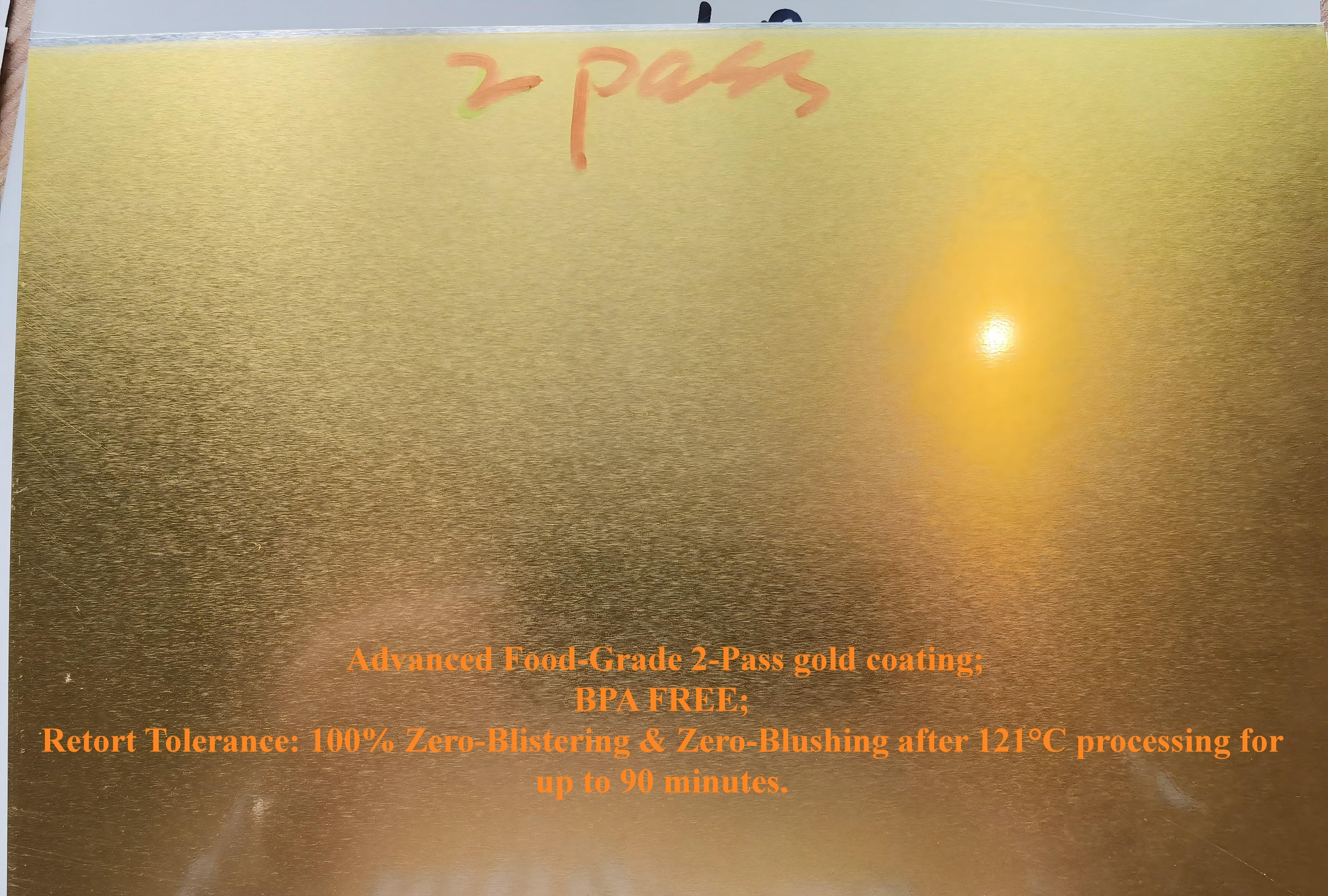
Two-pass gold coated tinplate sheet for 2-piece meat cans: differential tin 1.1/2.8 g/m², dry film ≥6–10 g/m² and verified retort resistance at 121°C for up to 90 minutes.
Gauge, Temper and Slitting Tolerance: Where Substitution Holds or Fails
Gauge is the fastest filter in any comparison. YOUNGSON METAL's tinplate and TFS portfolio spans 0.14 mm to 0.55 mm, with the T1 grade stated at 0.20–0.55 mm and widths from 6.5 mm to 1050 mm. If a drawing calls for a heavier section, the tinplate discussion ends there and stainless remains the reasonable answer. Within the range, temper selection drives formability: DR8 tinplate is specified at a Rockwell HR30Tm of 69–75 for high-strength, thinner-gauge can bodies, while softer T1 and T2 grades serve multi-stage drawing and bending where cracking is the risk. Deep-drawn grades are also available as DDQ and EDDQ with T1 temper at HR30T 49±3 for filter shells and multi-stage drawn hardware.
Tolerance is where quotations diverge most quietly. The company's product data sheets state a thickness tolerance of ±0.005 mm, a width tolerance of ±0.05 mm and a slitting burr of ≤0.05 mm, with a "5-ZERO" screening standard on joints, notches, edge waves, overlapping bands and rust spots. Its processing capability list separately states width and slitting tolerance to ±0.02 mm for custom slitting and cut-to-length work. Buyers should not assume the tighter figure applies automatically to every line item: the RFQ should state which tolerance governs which dimension, because progressive dies react to width variation and burr height long before they react to nominal gauge.
Documentation as a Selection Criterion: MTC, Third-Party Inspection and CBAM
An MTC EN 10204 3.1 is an inspection certificate issued against a specific delivered lot, with test results traceable to that lot. YOUNGSON METAL states it provides this certificate together with 100% in-house inspection covering thickness, coating mass, tensile strength, T-Bend, salt spray and surface roughness, and supports third-party inspection by SGS, BV or TÜV. That combination — lot certificate plus independent inspection option — is what allows a buyer to convert a supplier datasheet into an approved specification.
Scope is the trap. Certificates and reports are written against defined products, and a report that does not name the ordered substrate does not cover it. Two published examples make the point. The SGS RoHS report CZXHL25001691201, issued against 2011/65/EU and (EU) 2015/863 with testing to the IEC 62321 series, is scoped to copper colourful tinplate at 0.23 mm thickness. The BV ISO 9001:2015 certificate CN058611, issued 23 December 2022 and valid to 22 December 2028, states a scope covering mild steel, automotive steel and prepainted steel. A buyer ordering, for illustration, a sulfur-resistant TFS for fish cans should therefore request the product-specific report rather than accept a certificate issued for a different coated product.
Carbon documentation now sits alongside quality documentation. The company states that it supplies EPD and CFP documentation certified to ISO 14067 and provides EU CBAM direct and indirect carbon emission data reporting, together with metallurgical and slitting technical support and a 24-hour response window on material quality claims. For European buyers, that reporting capability is a comparison criterion in its own right, because a substrate that cannot be documented cannot be declared.
Comparison With Traditional Solutions — and Where Substitution Stops
Against stainless steel and copper-plated strip, the coated tinplate route wins on material cost and loses on abuse tolerance. Company-published application data states more than 20% material cost reduction against brass or gold anodised and electroplated stainless steel, and more than 50% against traditional copper electroplating. Those figures are manufacturer-stated and should be validated against a specific bill of materials, but the direction of the cost curve is consistent across the substitution case studies the company publishes.
The limits are equally concrete. First, the finish is an organic coating on a steel core, not a solid alloy surface: abrasive service, repeated handling and unprotected cut edges will expose the substrate in ways a 201 or 410 stainless surface would not. Second, the mirror and colour-coated series are engineered for mechanical shearing, stamping, roll forming and press-brake bending, and are explicitly not recommended for thermal laser cutting where coating integrity at the cut zone must be preserved. Third, corrosion performance at slit edges depends on the edge treatment applied after slitting; the company's oil-spray passivation and single-coil sealed packaging are specified for humid and tropical transit, but they are a process control, not a material property. Fourth, TFS lacks the tin reservoir that gives tinplate its solderable surface, so any process step that relies on soldering should stay on tinplate regardless of coating economics.
Where stainless steel remains the correct specification: heavy-gauge structural sections outside the 0.14–0.55 mm band, surfaces exposed to sustained abrasion or aggressive chemical cleaning, and applications where the visible surface must be homogeneous metal through its full thickness. A comparison framework that does not name those boundaries is a sales document, not a buying tool.
Application Fit: What Buyers Actually Specify
The framework becomes concrete in four recurring scenarios. In drawn fish cans, a BPA-free sulfur-resistant aluminium paste coating on TFS addresses sulfur staining in 2-piece DRD formats. In drawn and ironed meat cans, 0.14–0.16 mm tinplate in DR8 to DR10 with a two-pass gold coating at ≥6–10 g/m² dry film is specified for retort exposure at 121°C for up to 90 minutes. In decorative architecture, appliance fascias and lighting reflectors, anti-fingerprint mirror gold and mirror bronze strip at 0.18–0.55 mm replaces SUS201, SUS410 and SUS430 where the purchasing driver is appearance rather than alloy performance. In high-speed progressive stamping, precision slit strip with ±0.005 mm thickness tolerance and ≤0.05 mm burr protects tooling; one published case covering a premium candle-lid plant on 0.14–0.15 mm DR8/DR7/TH520 gold strip over more than ten years of supply reports zero coating peeling, zero tooling crashes and a reported 35% reduction in die wear from tolerance and burr control.
A second published case, covering a hardware stamping and can-making plant receiving more than 6,000 tons annually, reports zero coating delamination during deep drawing and a similar tool-life improvement from sub-micron thickness control. These are supplier-reported outcomes, but they are stated as specific, checkable claims rather than general assertions, which is what makes them usable in a supplier evaluation file.
Market Context: What the Published Numbers Do and Do Not Say
Published market estimates support the direction of the substitution trend but not precise granularity. One commercial research source values the global tinplate market at USD 31.98 billion in 2025, with Asia Pacific holding a 39.2% share in the same year. Trade aggregator data records China as the world's largest tinplate exporter with 3,137 shipments between July 2024 and June 2025 under HS code 721012. On the technical side, DR8 temper is documented at a Rockwell HR30Tm range of 69–75, consistent with the shift toward thinner gauge, higher-strength can bodies.
The caution matters as much as the figures. Published 2025 market values for the same category range from roughly USD 15.2 billion to USD 32.68 billion depending on whether the scope is raw tinplate steel or finished packaging, so a buyer should treat any single headline number as a scope statement rather than a fact about substrate demand. What the data does support is narrower and more useful: demand is concentrated in Asia Pacific, export capacity from China is substantial, and the technical trajectory favours high-strength thin gauge — all of which favour documented, tolerance-controlled slit strip over commodity coil.
A Six-Step Buyer Workflow
- Fix the coating system first. Sulfur resistance, retort resistance or decorative appearance each point to a different coating family before gauge is discussed.
- Filter by gauge and temper. Confirm the required section falls inside 0.14–0.55 mm and that the temper (T1–T5, DR7–DR10, TH520/TH550/TH620 or T2–T57 for mirror series) matches the forming operation.
- Write the tolerance into the RFQ dimension by dimension. State whether thickness ±0.005 mm, product width ±0.05 mm or processing slitting tolerance ±0.02 mm governs each line item, and set the burr limit at ≤0.05 mm.
- Match certificate scope to the ordered product. Check that the MTC, RoHS report and ISO 9001 scope name the actual substrate and coating, not a neighbouring product.
- Request carbon documentation early. EPD and CFP data to ISO 14067 plus CBAM direct and indirect emission figures should be in the evaluation pack, not requested after award.
- Validate with a forming trial and an edge-exposure check. Coating adhesion under bending, cut-edge condition after transit and coating integrity after the intended cleaning regime are the three failure modes that certificates cannot predict.
Future Outlook
Two forces are likely to keep shifting the comparison. The first is documentation: as carbon reporting becomes routine in European procurement, the difference between a supplier that can issue EPD and CFP data and one that cannot will widen beyond price. The second is coating engineering. The steady migration of decorative work from stainless and copper-plated strip to coated tinplate is driven less by substrate cost than by the ability to deliver anti-fingerprint, heavy-metal-free finishes with verified RoHS status at 0.18–0.55 mm gauges. Neither force removes stainless steel from the comparison; both make the constraint set — coating, tolerance, certificate scope and carbon data — the practical basis on which substrate routes are chosen.
FAQ
What is the practical difference between tinplate and TFS in a can-making line?
Tinplate carries an electrodeposited tin layer over low-carbon steel, which provides a solderable surface and a corrosion barrier in its own right. TFS/ECCS is produced without that tin layer, so the organic coating and surface treatment carry the barrier, and qualification weight moves onto the lacquer system. For sulfur-aggressive products such as fish, YOUNGSON METAL supplies a BPA-free internal sulfur-resistant aluminium paste coating applied to TFS for 2-piece DRD fish cans.
Which coating should be specified for fish cans versus meat cans?
Fish packs require sulfur resistance, which points to an aluminium paste internal coating on TFS. Meat packs are constrained by fat, salt and forming damage, which points to a two-pass gold coating on tinplate at 0.14–0.16 mm in DR8 to DR10, differential tin 1.1/2.8 g/m², dry film weight of at least 6–10 g/m², and verified zero blistering and zero blushing after 121°C for up to 90 minutes. Both routes are specified as BPA-free.
What slitting tolerance belongs in the RFQ?
YOUNGSON METAL's processing capability list states width and slitting tolerance to ±0.02 mm, while individual product data sheets state thickness tolerance ±0.005 mm, width tolerance ±0.05 mm and slitting burr ≤0.05 mm. The two figures have different scopes. The RFQ should state which tolerance governs which dimension so that the inspection certificate is measured against the intended value.
What does an MTC EN 10204 3.1 cover, and what does it not cover?
An MTC EN 10204 3.1 is an inspection certificate issued against a specific delivered lot with results traceable to that lot. YOUNGSON METAL provides it alongside 100% in-house inspection of thickness, coating mass, tensile strength, T-Bend, salt spray and surface roughness, and supports third-party inspection by SGS, BV or TÜV. It does not replace product-specific compliance reports. For example, the SGS RoHS report CZXHL25001691201 is scoped to copper colourful tinplate at 0.23 mm, and the BV ISO 9001:2015 certificate CN058611 has a scope covering mild steel, automotive steel and prepainted steel.
How does EU CBAM and EPD documentation affect the comparison?
Carbon documentation has become a comparative criterion alongside price and tolerance. YOUNGSON METAL states that it supplies EPD and CFP documentation certified to ISO 14067 and provides EU CBAM direct and indirect carbon emission data reporting, supported by metallurgical and slitting technical support. Buyers subject to CBAM reporting should treat the availability of this data as a qualification item during evaluation rather than a post-award request.
Can coated tinplate replace SUS201, SUS410 or SUS430 and copper-plated strip?
In appearance-led applications it can, within defined limits. Anti-fingerprint mirror gold tinplate (MFG-200 series) is positioned as a SUS201/SUS410 cost-saving alternative and mirror bronze (MF-BR-TPL01) as a stainless substitute, both on an electrolytic tinplate base with heavy-metal-free organic coatings verified to REACH and RoHS, available across roughly 0.18–0.55 mm and 0.20–0.50 mm respectively. Two limits apply: the finish is a coating on steel rather than a solid alloy surface, so abrasion and cut-edge exposure govern service life; and the range is engineered for mechanical shearing, stamping, roll forming and press-brake bending, and is not recommended for thermal laser cutting where coating integrity must be preserved.
Reference document: the full YOUNGSON METAL product catalogue, covering tinplate, TFS, coated and slit strip specifications, is available for download: Chongqing Youngson Metal Products catalogue (PDF).
Product parameters cited in this article are manufacturer-published specifications and should be confirmed against lot-level mill certificates and third-party inspection reports before production release.
Have Questions or Need More Details?
Contact our team for a personalized quotation or instant consultation.
Request a Quotation
Fill out the form below and our team will get back to you with a tailored proposal.
WhatsApp Direct Chat
Prefer to chat in real-time? Message us on WhatsApp for instant assistance & quick answers.
- Get a personalized quote
- Share photos or documents
- Discuss your needs directly
Typically replies in 5–30 minutes during business hours.