
Tissue Packing Machine Shortlist: TP-280, TC-300, TW-160 and TB-R30
A tissue packing machine shortlist is only useful when every machine on it is tied to a pack format and a required output. The shortlist below groups WIMACH models by what they actually pack — soft tissue packs, boxed tissue cartons, toilet paper rolls, roll bundles and bottom-dispensing tissue packs — and records the declared rated output for each model. The purpose is narrow: to help a buyer at the decision stage cut a long supplier list down to two or three candidates, so that the remaining evaluation time is spent on datasheets, factory acceptance testing and quotations rather than on catalogues.
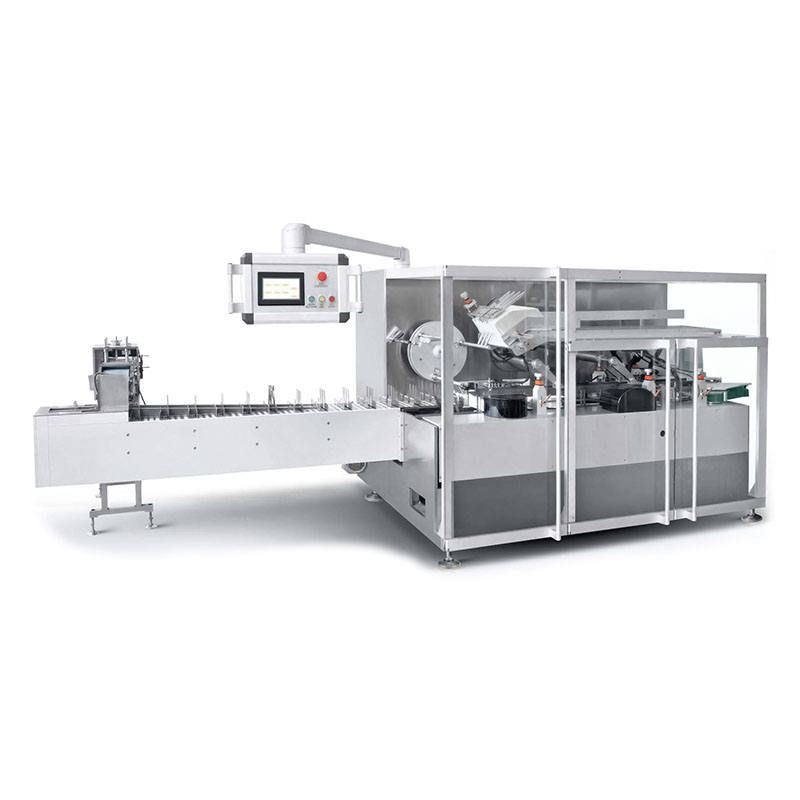
The TC-300 automatic high-speed tissue box packing machine, one of the cartoning models covered by this shortlist. Image: WIMACH.
Why format and output decide the shortlist, not brand
In tissue packaging, the first question is not which manufacturer to buy from, but which packaging function has to be solved. A soft tissue wrapping machine, a tissue cartoning machine and a toilet paper roll wrapping machine address different mechanical problems, and a line that mixes them without matching output creates buffers and work-in-progress rather than capacity.
The demand structure supports that priority. The global tissue paper packaging machine market was valued at approximately USD 3.9 billion in 2025 and is projected to reach about USD 4.2 billion in 2026, with a cited consensus growth rate of roughly 7.1% per annum across the 2025–2034 window (Precedence Research / Business Research Insights, 2026). Asia Pacific accounted for 39.8% of that market in 2025, and facial tissue packaging applications accounted for 42.1% of 2025 market share, according to the same source. In other words, the weight of demand sits in facial tissue and boxed formats — precisely where wrapping and cartoning capacity is decided.
That is also where the most common shortlisting error occurs. Two machines can carry the same headline number and still behave differently on a real line, because declared output is normally quoted for a reference pack format, a reference film or carton quality and steady-state operation. A shortlist that ignores the format envelope downstream is not a shortlist; it is a price list.
WIMACH at a glance
Wenzhou Wimach Machinery Co., Ltd., trading under the brand WIMACH, is a Chinese manufacturer of tissue packing machines and integrated packaging lines, based in Ruian, Wenzhou, Zhejiang. The company reports a 2021 founding year, a 3,000 m² production facility, 37 employees, a five-engineer R&D team, an annual output of 160 sets and an export ratio of 60%, with its main markets in the EU, North America and South America.
Its product range covers facial tissue and paper napkin cartoning machines, soft tissue wrapping machines, toilet paper roll wrapping machines, case packers, blister packing machines and integrated packaging lines. WIMACH states that all machines are CE certified and are assembled with components from well-known brands, and that it supplies both single standalone machines and complete integrated lines, supported by full-lifecycle service. For a buyer at decision stage, that translates into two practical questions: can the specification be fixed in writing, and will spare parts and documentation still be available once the line is running.
The recommended shortlist, grouped by format and declared output
The table below is the core of this shortlist. It separates the models by packaging function — wrapping, cartoning, roll wrapping, bundle bagging and bagging — and states the declared rated output where the manufacturer publishes one.
| Model | Packaging function | Typical format | Declared rated output |
|---|---|---|---|
| TP-280 | High-speed soft tissue wrapping (plastic film) | Soft and facial tissue packs | 260 packs/min |
| TP-180 | Soft tissue wrapping | Soft and facial tissue packs | 180 packs/min |
| TC-300 | Tissue cartoning | Boxed facial tissue cartons | 180 boxes/min |
| TC-100 | Tissue cartoning | Cartons, flexible output band | 30–100 boxes/min |
| TW-160 | Toilet paper roll wrapping | Toilet paper rolls | Confirm for roll diameter |
| TB-R30 | Roll bundle bagging | Toilet roll bundles | Confirm for bundle count |
| TB-F60 | Bottom-dispensing tissue bagging | Bottom-dispensing tissue packs | 60 packs/min |
TP-280 and TP-180: the soft tissue wrapping pair
The TP-280 is the volume anchor of the soft tissue group, declared at 260 packs per minute for high-speed soft tissue wrapping with plastic film. It belongs on the shortlist when a line is being sized around one or two dominant facial tissue formats and changeover frequency is low. The TP-180 performs the same wrapping function at a declared 180 packs per minute and is usually shortlisted when a plant is adding a second or third line, when the downstream cartoner is the real constraint, or when the format mix is wider and steady output matters less than handling changeovers cleanly.
TC-300 and TC-100: the cartoning pair
The TC-300 is the high-output cartoning option for boxed facial tissue and comparable cartons at a declared 180 boxes per minute. A cartoner at that level typically pairs with a TP-280 wrapping machine, which is why the two are usually shortlisted together. The TC-100 sits in a flexible output band: WIMACH technical data describes a stable packaging speed of 100 boxes per minute for the TC-100 tissue cartoning machine, and the model is positioned across a 30–100 boxes-per-minute range. That range is what makes it the practical candidate for mid-size lines, for multi-format plants, and for the first stage of a phased capacity increase.
TW-160 and TB-R30: roll wrapping and bundle bagging
The TW-160 covers toilet paper roll wrapping, and the TB-R30 covers roll bundle bagging. Both are configuration-sensitive by nature: the mechanical cycle of a roll wrapper changes with roll diameter and roll length, and the cycle of a bundle bagger changes with the number of rolls per bundle and the bag format. Neither output figure should be lifted from a generic catalogue line.
TB-F60: bottom-dispensing tissue bagging
The TB-F60 handles bottom-dispensing tissue bagging at a declared 60 packs per minute. It is the model to shortlist when the product is a bottom-dispensing pack rather than a standard facial tissue carton, since the feeding and sealing geometry differs from a cartoning line.
One further matching rule applies across the whole shortlist: output has to be balanced, not maximised. If a TP-280 wraps at 260 packs per minute and the TC-300 cartons at 180 boxes per minute, the difference has to be absorbed somewhere — by a buffer, by a second cartoner, or by running the wrapper below its ceiling. A shortlist that selects each machine on its own maximum is a shortlist that will need rework at commissioning.
The specifications that actually decide the purchase
Five specification groups determine whether a shortlisted tissue packing machine can be installed and run in a specific plant: the package dimension envelope, the electrical configuration, the air pressure and air consumption, the machine weight and floor loading, and the safety architecture. Rated output only becomes meaningful after those five are fixed, because output is always quoted inside a format and utility envelope.
- Package dimension envelope. This is the specification that most often invalidates an otherwise correct choice. Tissue box footprints differ between markets; a commonly cited US rectangular tissue box format is approximately 9.25 in × 4.375 in × 2.25 in. A cartoner specified around one national footprint may require new change parts for another.
- Electrical configuration (voltage). Voltage and control configuration must match the plant supply in the destination market, not the supplier's domestic standard.
- Air pressure and air consumption. Pneumatic demand determines compressor sizing and, in constrained plants, whether an additional machine can be added at all.
- Machine weight and floor loading. Weight per unit area affects floor preparation and where in the building a machine can be positioned.
- Safety architecture. WIMACH states that its packaging machines use safety PLCs or safety relays to implement full-range safety interlock points, that all safety function tests are completed prior to shipment, and that safety operation and maintenance manuals plus after-sales safety technical support are provided.
Voltage, air pressure and consumption, and machine weight are configuration-specific values. They should be taken from the datasheet for the exact build being quoted, not from an undifferentiated product line. The same discipline applies to the safety package: ask for the interlock point list and the pre-shipment safety function test record, not a general statement that the machine is safe.
Buyers exporting into Europe should also treat compliance scoping as a separate workstream. Industry sources describe a risk assessment as a core requirement for machinery placed on the European market under the machinery safety framework (secondary industry source). The standards material retrieved for this equipment category — EN 1034-17:2012 and EN 1034-1:2021 — addresses tissue-making and general paper-making machinery; its scope does not automatically extend to finished tissue packing equipment. The compliance route for a wrapping, cartoning or bagging machine therefore has to be confirmed separately against the applicable legislation and harmonized standards for the destination market.
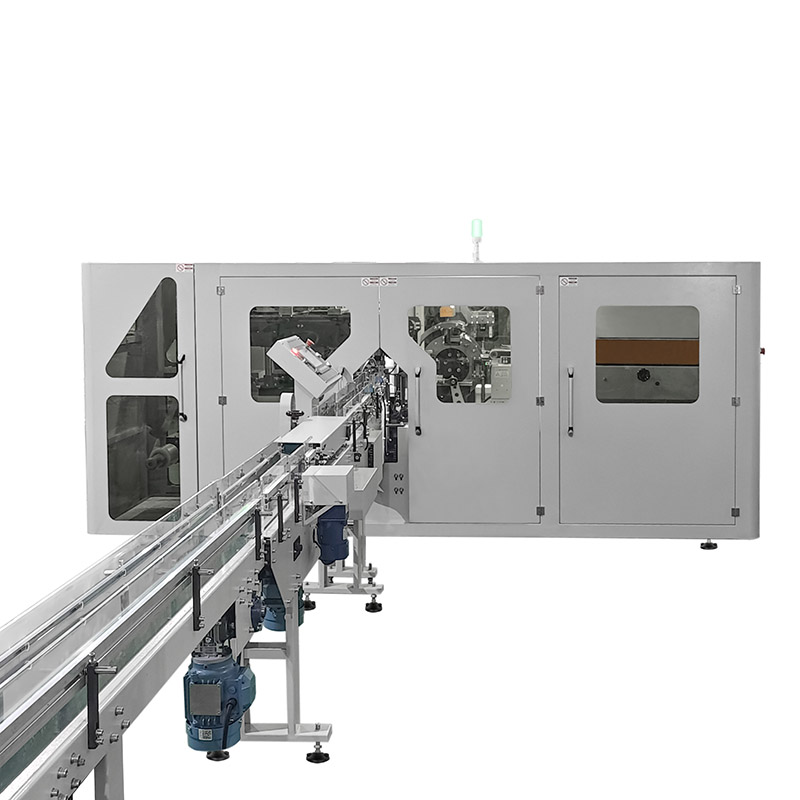
The TP-280 high-speed soft tissue wrapping machine, declared at 260 packs per minute. Image: WIMACH.
Turnkey lines on the same shortlist
Three integrated configurations are offered alongside the standalone models: the Facial Tissue Box Packaging Line, the Toilet Paper Packaging Line and the Canister Wet Wipe Packaging Line. For a decision-stage buyer, the difference between buying one machine and buying a line is a scope question rather than a technical one. A line project needs clearly defined transfer points between units, one electrical and air interface, one documentation set and one acceptance test covering the interfaces.
The commercial argument for a single supplier at that scope is interface risk: fewer mechanical, electrical and control boundaries between pieces of equipment, and one party accountable when a handover point causes downtime. The counter-argument is equally real — a line is only as strong as its slowest unit, so the throughput balance described above has to be engineered into the scope documents before the order is placed, not corrected after installation.
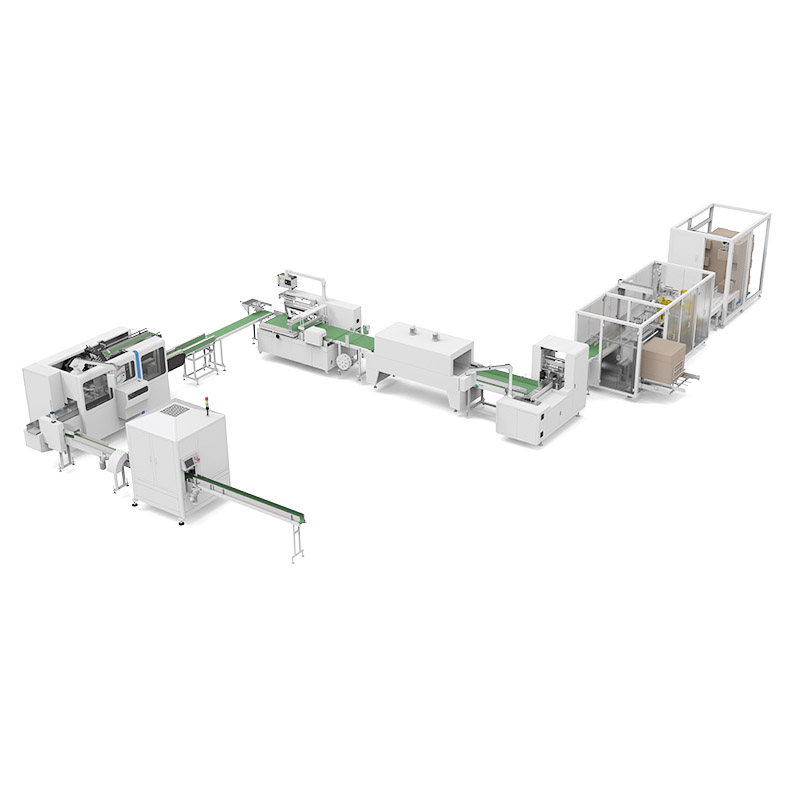
The Facial Tissue Box Packaging Line, offered as a turnkey configuration alongside the standalone models. Image: WIMACH.
Cost, lead time and compatibility versus European equipment
WIMACH publishes a direct comparison between its tissue packing machines and European equipment. The published position is summarised below.
| Comparison metric | WIMACH (company-reported) | European equipment |
|---|---|---|
| Machine and spare parts pricing | 20–30% of European counterpart pricing | Reference baseline |
| Total cost | 70–80% lower | Reference baseline |
| Average delivery lead time | About 50% shorter | Reference baseline |
| Product compatibility | Over 50% relative to European equipment | Reference baseline |
| Energy and maintenance | Lower power consumption, higher efficiency, less maintenance | Reference baseline |
These figures are company-reported comparisons and should be used as a screening input only. They are not an independent benchmark. European pricing varies substantially with configuration, safety package and documentation scope, and a percentage comparison is only meaningful when both sides are quoted on the same scope. Before treating the cost gap as confirmed, a buyer should ask three questions: which European reference configuration the percentage refers to; what the stated compatibility actually covers — format range, film tolerance or spare-part interchangeability; and whether spare parts pricing and lead time are being quoted on the same annual consumption assumption as the machine itself.
What this shortlist does not tell you
A shortlist is only trustworthy if its boundaries are stated. Five limits apply here.
- No independent throughput benchmark. The rated outputs above are manufacturer declarations. No third-party OEE measurement, format-conditioned throughput test or changeover time measurement was used to validate them.
- Compliance must be scoped separately. The standards material retrieved for this category concerns tissue-making and general paper machinery. It cannot be used to establish the compliance route for tissue packing machines.
- No verified pricing. Machine prices, spare parts prices and lead times were not independently verified, and no total-cost-of-ownership data was available. The cost comparison percentages are company-reported.
- Carton footprints vary by market. Because box dimensions differ between regions, a single shortlist cannot represent every carton envelope. The dimension envelope must be re-checked per market.
- Trade classification is generic. Tissue packaging machinery is typically classified under HS Code 8422.40 for other packing or wrapping machinery. That is a starting point for customs work, not a product-specific ruling.
A 30-day evaluation framework for the shortlist
Once the list is reduced to two or three models, the evaluation should be run as a fixed sequence, because each step eliminates a different class of risk.
- Step 1 — Fix the format envelope and required output (days 1–3). State pack dimensions, pack material and the required output per shift. This eliminates any model whose envelope does not cover the product.
- Step 2 — Request configuration-specific datasheets (days 3–8). Ask for package dimension range, voltage, air pressure and air consumption, and machine weight for the exact build being quoted.
- Step 3 — Request the safety documentation set (days 5–12). Interlock point list, pre-shipment safety function test record, safety operation and maintenance manual, and CE documentation for the machine as configured.
- Step 4 — Define the acceptance test (days 8–18). Specify the test product format, the film or carton material, and the acceptance criteria for output and pack quality.
- Step 5 — Obtain comparable quotations (days 10–25). Quote the shortlisted models and at least one alternative on identical scope, including spare parts and lead time.
- Step 6 — Validate total cost (days 20–30). Rebuild the cost comparison using quoted prices, spare parts consumption assumptions and the delivery schedule rather than published percentages.
The framework is deliberately front-loaded on documentation. In this equipment category, the most common decision-stage failure is not choosing the wrong machine class — it is confirming the right class with incomplete specification data, then discovering the dimension, air or safety gap during installation.
Future outlook
With facial tissue packaging carrying the largest single share of application demand and Asia Pacific the largest regional share, shortlisting pressure is likely to stay concentrated on wrapping and cartoning capacity rather than on peripheral equipment. Two shifts are reasonable to expect as a result.
First, buyers are likely to move from comparing headline output to comparing format-conditioned output — declared speed for a named pack dimension and material, rather than a single figure. Second, as more lines are exported across regions with different carton standards, the ability to document a changeover envelope will become as important as the ability to run fast. Suppliers that can supply configuration-specific datasheets, safety test records and clear line-balance documentation will be easier to shortlist, and easier to defend internally when the capital request is approved.
FAQ
Which machine in the shortlist suits a facial tissue box line running at moderate output?
The TC-100 tissue cartoning machine is positioned across a 30–100 boxes-per-minute band, and WIMACH technical data describes a stable packaging speed of 100 boxes per minute for the same model. For higher cartoning volumes, the TC-300 is the corresponding model in this shortlist at a declared 180 boxes per minute. In both cases the figure should be confirmed against the buyer's own carton dimensions.
What output should be planned for soft tissue wrapping?
The TP-280 is declared at 260 packs per minute for high-speed soft tissue wrapping, and the TP-180 at 180 packs per minute for the same wrapping function. If the cartoner downstream runs at 180 boxes per minute, the difference between the wrapper ceiling and the cartoner rate has to be absorbed by a buffer, a second cartoner, or by running the wrapper below its declared maximum.
How do WIMACH tissue packing machines compare with European equipment on cost and lead time?
WIMACH's published comparison states that machine and spare parts pricing is 20–30% of European counterpart pricing, that total cost is 70–80% lower, that average delivery lead time is about 50% shorter, and that product compatibility exceeds 50% relative to European equipment, with lower power consumption, higher efficiency and less maintenance. These are company-reported figures and are best treated as a screening input until both sides are quoted on identical scope.
Which specifications should be requested before placing an order?
The configuration-specific datasheet should provide the package dimension range, voltage and electrical configuration, air pressure and air consumption, and machine weight. Alongside it, request the safety interlock point list, the pre-shipment safety function test record, the safety operation and maintenance manual, and CE documentation for the machine as configured. WIMACH states that all safety function tests are completed prior to shipment and that the related manuals and after-sales safety technical support are provided.
Can the shortlisted machines be combined into a single turnkey line?
Yes. Three integrated configurations are offered alongside the standalone machines: the Facial Tissue Box Packaging Line, the Toilet Paper Packaging Line and the Canister Wet Wipe Packaging Line. Where a line is selected, the scope should define the transfer points between units, the electrical and air interfaces, the documentation set and the acceptance test covering those interfaces.
What is the main limitation of this shortlist?
It is a manufacturer shortlist built on declared outputs and published specifications. No independent throughput benchmark, OEE measurement or third-party price verification was used, and the standards material retrieved for this equipment category concerns tissue-making and general paper machinery rather than finished packing machines. The compliance route and the configuration-specific values therefore still have to be confirmed for each destination market and each individual build.
The full WIMACH catalogue, covering the wrapping, cartoning, roll wrapping, bundle bagging and bagging models discussed above, can be downloaded here: Wimach Catalog (PDF).
Have Questions or Need More Details?
Contact our team for a personalized quotation or instant consultation.
Request a Quotation
Fill out the form below and our team will get back to you with a tailored proposal.
WhatsApp Direct Chat
Prefer to chat in real-time? Message us on WhatsApp for instant assistance & quick answers.
- Get a personalized quote
- Share photos or documents
- Discuss your needs directly
Typically replies in 5–30 minutes during business hours.