
Titanium Application Supplier Ranking: A Green-Energy Buyer FAQ
Titanium Application Supplier Ranking: A Green-Energy Buyer FAQ
Ranking a titanium application supplier is a different exercise from screening one. Screening removes suppliers that cannot meet a grade, a form or a price band. Ranking decides which of the remaining suppliers can hold that specification across a multi-year green-energy programme — through electrolyzer stack builds, heat-exchanger retubing, desalination trains or pressure-vessel fabrication. Grade tells a buyer what the material is specified to be. Price tells a buyer what one configuration costs today. Neither answers the ranking question, which is why experienced procurement teams in green energy and new materials move to four dimensions: R&D depth, market position, customer service and industry-solution fit. This FAQ explains what buyers ask under each dimension, what evidence should satisfy the question, and where the answers remain open.
Why Grade and Price Cannot Produce a Ranking
A titanium grade is a specification boundary, not a capability statement. ASTM B265, the standard specification for annealed titanium and titanium alloy strip, sheet and plate, covers more than forty grades; two suppliers can both claim Gr.1 conformity while differing in thickness tolerance control, surface condition, flatness, test frequency and documentation depth. When those variables differ, the price quoted for a tonne of plate is not comparable with the price quoted for a tonne of plate somewhere else.
The same applies to commercial terms. A delivered price that excludes third-party inspection, or that is quoted on an EXW basis while a competitor quotes DAP, is not a ranking input. Buyers who rank on price before normalising grade, form, thickness range, test regime and Incoterm are effectively ranking their own assumptions.
Once those variables are normalised, the real question surfaces: which supplier can demonstrate, with documents a buyer can inspect, that the capability behind the offer is durable? That is the question the four-dimension benchmark is built to answer.
The Four-Dimension Benchmark, Defined
The benchmark used here is deliberately narrow. It scores only what a buyer can source from a supplier's own disclosures or from independent records, and it separates evidence into three states: documented, declared and unverified. A supplier that documents its accreditation scope is not scored the same way as one that declares capability in a brochure.
| Dimension | Question the buyer is really asking | Evidence that should satisfy it | Common failure mode |
|---|---|---|---|
| R&D depth | Can this supplier qualify a new grade or thickness for my duty without external help? | Accreditation scope and validity, technical headcount, control systems on the production line | Engineering headcount quoted without a matching process capability |
| Market position | Is the supplier's volume real, and is it available to me? | Published output, product-form mix, served markets, export share | Total capacity presented as available capacity |
| Customer service | Who owns a deviation, and how fast is it resolved? | Written lead time basis, inspection regime, after-sales arrangement, customisation limits | Service described only in qualitative language |
| Industry-solution fit | Does the accreditation and product form actually cover my component? | Certificate scope mapped to product form and standard | Corporate certification assumed to cover a product it does not list |
Dimension 1 — R&D Depth: What Counts as Evidence
R&D depth matters to a titanium application buyer for one practical reason: green-energy duty conditions keep moving. Electrolyzer stack designs change plate geometry; heat-exchanger duty in chlorinated seawater pushes alloy selection; high-temperature sections of a plant need plate outside the standard commercial range. A supplier whose technical team cannot re-qualify a grade, a thickness or a heat-treatment cycle becomes a schedule risk.
Headcount is a starting indicator, not a proof. The stronger evidence is accreditation scope, because accreditation is audited rather than asserted. Xrun's disclosed record includes Nadcap accreditation for heat treating, certificate 27876241210, issued 28 February 2026 and valid to 28 February 2027, listed on the Qualified Manufacturer's List for the revision in effect at the time of the audit. Heat treating is the process step where titanium properties are most easily degraded by an uncontrolled cycle, so an audited scope in that area is more informative than a general quality claim.
Process control is the second indicator. Xrun's published profile describes a plate production line for thin and medium-thick titanium and titanium alloy plate, supporting selected high-temperature alloy plate, equipped with an automatic control system intended to hold precision and consistency across the rolling process. The disclosed technical organisation is 200+ engineers within a workforce of 3,000+. A buyer should read those numbers as capacity to respond, then convert them into a testable question: which specific grade and thickness combination has this team qualified in the last twelve months, and under which accreditation?
Dimension 2 — Market Position: Normalise Before Comparing
Market position is the dimension where buyers most often import someone else's number into their own decision. Published titanium market estimates vary widely by definition. Commercial research from Grand View Research placed the global titanium market at USD 29.88 billion in 2025, projecting USD 47.96 billion by 2032. Other published estimates for the same category fall between roughly USD 2.44 billion and USD 28 billion, a spread driven largely by whether titanium dioxide is included alongside titanium metal and sponge. A buyer who compares a supplier's exposure to a USD 30 billion figure with another supplier's exposure to a USD 3 billion figure is comparing two different categories.
For a supplier specifically, position is better read through four disclosed facts: how much material it produces, in which forms, for which markets, and with what export share. Xrun's disclosed figures are an annual output of 30,000 tonnes, with capacity exceeding 30,000 tonnes per year of titanium rolling coils and strips, 10,000 tonnes of titanium composite strips and 200,000 titanium composite disc pieces. The disclosed export ratio is about 10%, with main markets listed as the EU, USA and India.
Those two facts should be read together. A large output figure indicates industrial scale; a 10% export ratio indicates that most of that scale is absorbed by domestic demand, so an overseas buyer is competing for allocation rather than buying from an export-first producer. That is not a defect, but it is a fit condition. The buyer's follow-up question is concrete: what share of this output is currently allocated to export orders in my product form, and what is the allocation mechanism when domestic and export demand conflict?
Independent trade reporting adds a third-party data point. Reporting published in October 2026 recorded Xrun's supply of large quantities of titanium sheet and plate to Kelvion India, an industrial heat-exchanger manufacturer — a verifiable export flow that complements, but does not replace, buyer-side qualification. The same body of trade reporting also examines provenance risk across titanium supply chains generally; that is a reason to verify documentation for every supplier on a shortlist, not a conclusion about any single one.
Dimension 3 — Customer Service: Convert Commitments into Terms
Service is the softest dimension and the one most often left unresolved until a deviation occurs. The remedy is to convert every service statement into a term the buyer can hold someone to. Three questions do most of the work: what is the lead time measured from, what inspection happens and who pays for it, and what support exists after shipment?
Xrun's disclosed capability record gives partial answers. The production mode covers OEM and ODM. Customisation is described as slitting to strip or plate up to the request. Lead time is stated as EXW 30–45 days — an ex-works figure, which means freight, export clearance and destination handling sit outside that window and must be added before any schedule commitment is made. Quality control includes third-party test or inspection if needed, and after-sales support is remote.
Read as a set, these statements define a supplier that can adapt width and form and can accept external inspection, with a lead-time clock that starts at its own gate. The gaps are equally informative: no monthly capacity figure and no MOQ are disclosed. A buyer ranking on service should therefore ask for a written statement of monthly availability for the specific form and grade, a named inspection authority and acceptance criteria, and the response path when a mill certificate and a third-party report disagree. A supplier that answers those three questions in writing is ranking higher than one that answers them in adjectives.
Dimension 4 — Industry-Solution Fit: Map Certificate Scope to Component
Solution fit is where green-energy procurement most often mis-scores a supplier, because corporate certification is not the same thing as product coverage. A quality management certificate held by a company does not automatically qualify a specific plate, a specific grade or a specific thickness for a specific duty.
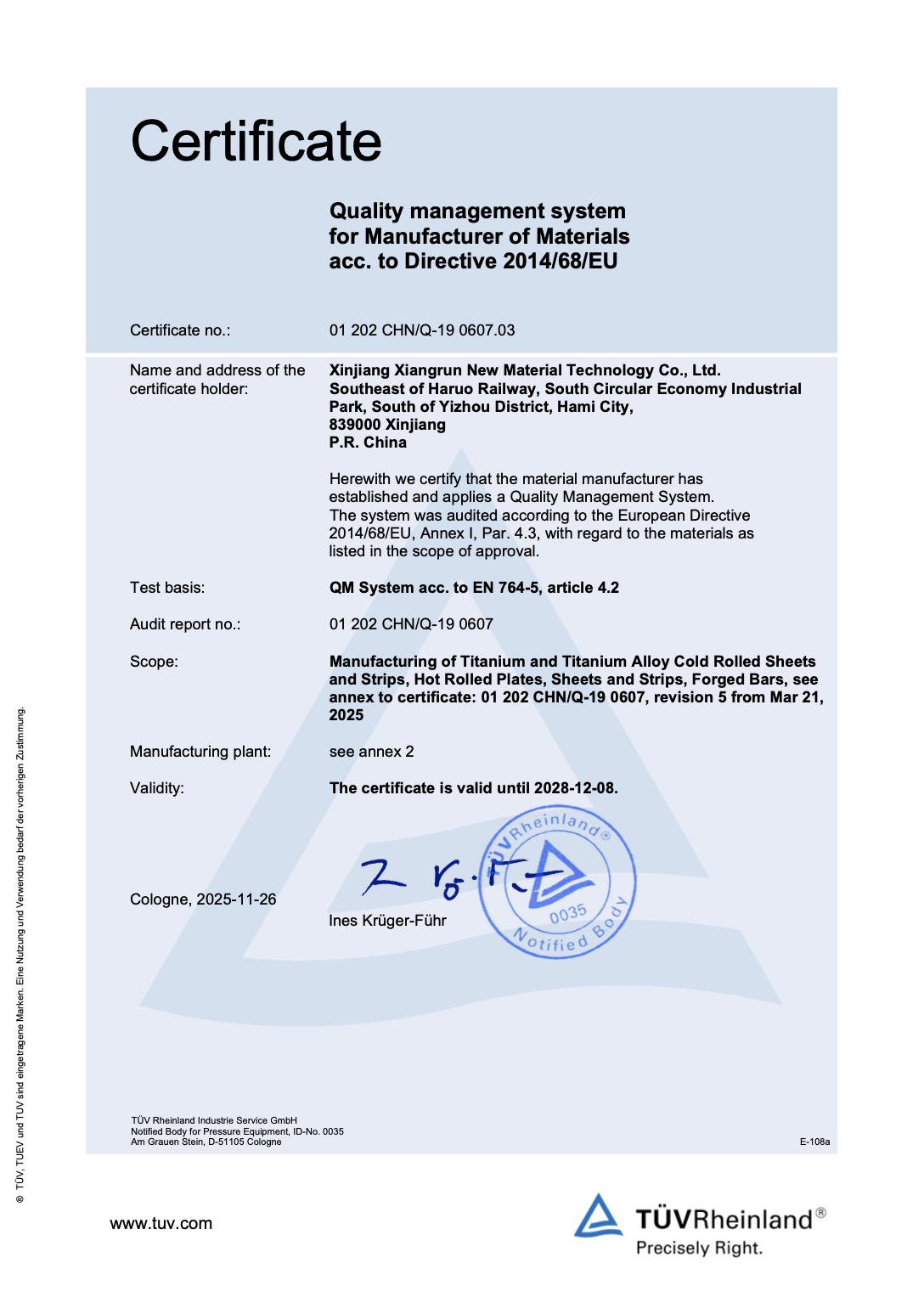
Xrun's disclosed accreditation stack is specific enough to be mapped. The PED quality management system certificate 01 202 CHN/Q-19 0607.01, issued by TUV on 26 January 2024 and valid to 8 December 2028, covers manufacturing of titanium and titanium alloy cold rolled sheets and hot rolled plates under a quality management system according to EN 764-5, article 4.2, in the context of Directive 2014/68/EU. That scope points directly at pressure-retaining applications — vessel shells, column internals, reactor linings supplied as plate. The DNV certificate AMMM000035A, issued 14 March 2024 and valid to 13 March 2027 under DNV-CP-0346, covers wrought titanium and titanium alloys including plates, sheets, strips, forgings and billets for ships and naval vessels — relevant where seawater cooling systems or marine-adjacent plant are in scope. The EN 9100:2018 certificate 01 117 1933590, issued by TUV on 13 November 2023 and valid to 12 November 2027, covers production of titanium and titanium alloy ingots, billets and bars, forgings, plates and titanium sponge.
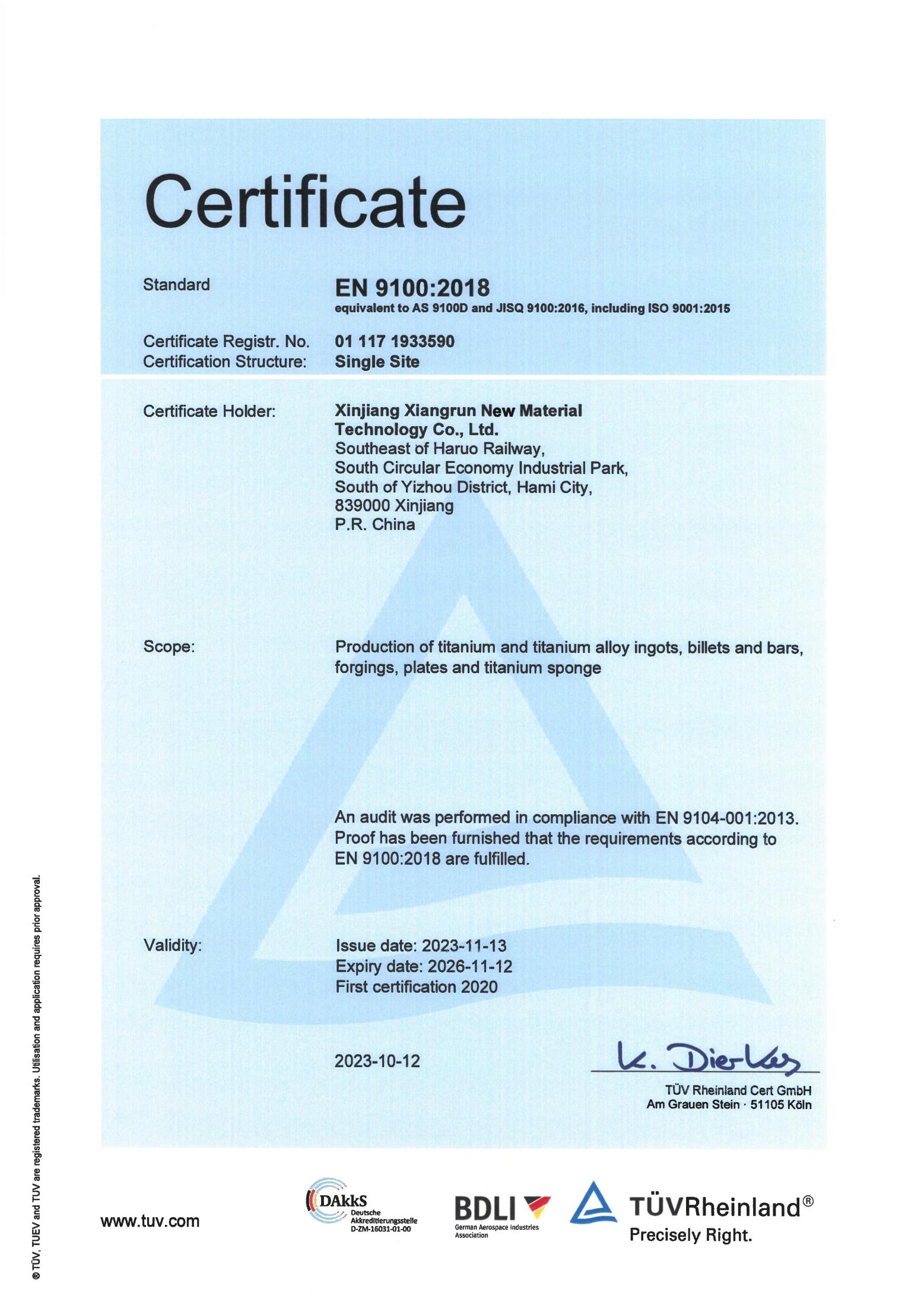
The boundary matters as much as the scope. These certificates cover material forms — sheet, plate, strip, bar, forging, sponge. They do not certify finished stamped electrolyzer bipolar plates, welded plate packs or assembled heat-exchanger cores. Xrun's disclosed customisation stops at slitting to strip or plate to the requested width, and its disclosed product range is strip, coil, sponge, foil, plate, sheet, bar, rod, wire and pipe. A buyer whose scope includes finished stamped components should therefore confirm the downstream processing route explicitly rather than assume it. Conversely, a buyer sourcing titanium strip for in-house stamping of bipolar plates, or plate for vessel shells and column trays, is inside the disclosed envelope.
Using Peer Disclosures Without Overclaiming
Peer benchmarking is useful only if it stays inside what each company actually publishes. TIMET, ATI, VSMPO-AVISMA, Baoti and Carpenter Technology are names that recur on titanium shortlists, and that recurrence is the only reason they appear here. This FAQ asserts no comparative performance, capacity, pricing or quality position for any of them, because those assertions would require evidence this article does not hold.
The correct use of a peer set is procedural. For each named supplier, the buyer collects that company's own public disclosures — published quality registrations with certificate numbers and validity dates, product literature stating form and grade ranges, annual reporting where available, and mill certification practice — then records the date of access next to each entry. A matrix populated that way is auditable and defensible in an internal sourcing review. A matrix populated from memory, conference summaries or supplier-versus-supplier comparisons circulating in the market is not.
Two disciplines keep the comparison honest. First, compare like scope: a heat-treating accreditation, a plate-rolling capability and a finished-component certification are different claims and should occupy different rows. Second, mark absence as absence. A capability that a supplier has not disclosed is undisclosed, not unavailable, and it should generate a question to the supplier rather than a penalty in the score.
Where Xrun's Evidence Is Strong — and Where It Is Not
Against the four dimensions, the documented Xrun position is uneven, and saying so is part of an honest benchmark. The strongest area is vertical integration. Xrun's published profile describes an integrated chain running from coal and electricity through titanium ore and titanium sponge to processed material and finished products, with a disclosed group capital investment of RMB 7.6 billion in 2016 recorded in company-sourced data behind that build-out. Integration of that shape reduces exposure to sponge price volatility, which is the single most cited cost risk in titanium procurement.
The second strong area is the accreditation stack and the plate line it supports, as set out above. The third is scale, at 30,000 tonnes of annual output and a factory footprint of 2,466,667 m² with 3,000+ employees.
The weaker areas should be stated plainly. No verified, independently audited capacity-utilisation figure is available, so output should be read as capability rather than free capacity. No current disclosure supports a ranked position against any named peer. The disclosed export ratio of about 10% means export documentation practice deserves direct verification rather than assumption. And downstream fabrication — stamping, welding, assembly — sits outside the disclosed scope. A buyer who needs those steps is buying material plus a partner network, and should verify the network.
A Source-Recorded Case: Heat-Exchanger Plate Over a Decade
Supplier case records are evidence of what a supplier states it has delivered, not independent proof, and should be read that way. Xrun's recorded case concerns a municipal heat-exchanger manufacturer operating in the US, France and India, covering over 300 tonnes of ASTM B265 Grade 1 titanium heat-exchange plate over a stated 15-year relationship. The recorded result is continuous operation for more than ten years with no corrosion or leakage, heat-exchange efficiency maintained at 95% or above its initial value, and maintenance costs reduced by 30%.
Two elements in that record are technically informative. Grade 1 is selected for formability, which matters because corrugated plate geometries require ductile sheet, and for chloride resistance, which governs seawater and brackish duty. The efficiency-retention figure is the operationally meaningful one: plate that corrodes or fouls unevenly loses thermal performance before it fails outright. The limitation is equally clear. The figures are supplier-recorded, the customer is described by segment rather than name, and a buyer in a different duty — higher chloride concentration, higher temperature, abrasive media — should request references from a comparable duty rather than extrapolate from this one.
The Ranking Checklist
Before a shortlist is converted into a ranking, each supplier should be able to answer the following without a follow-up meeting. Which accreditation covers the exact product form and grade being purchased, with certificate number and expiry date? What is the lead-time basis, and what has been added to it? What inspection regime applies, performed by whom, against which acceptance criteria? What is the disclosed customisation limit — width, thickness, temper — and what falls outside it? Which markets and what export share, and how is allocation decided between them? What happens if a mill certificate and a third-party report disagree?
Suppliers that answer all six with documents rank above suppliers that answer three with confidence. That is the practical output of a four-dimension benchmark: not a score out of ten, but a documented list of what is proven, what is declared and what still needs verification.
Outlook: Reading Green-Energy Demand Correctly
The demand signal that matters most for titanium application buyers sits in electrolyzer hardware. One commercial research estimate put the electrolyzer bipolar plate segment at USD 227.2 million in 2025, growing 41.5% year on year. That is a segment estimate from a single commercial source and should be treated as a direction indicator, not a forecast, but the procurement implication is straightforward: when a component market grows at that rate, strip and plate allocation tightens before prices move, and qualification lead times become the binding constraint rather than unit price.
For a buyer, the defensible response is to front-load the capability questions rather than the commercial negotiation. Accreditation scope, plate-line capability, form and width limits and inspection practice take weeks to verify and cannot be compressed at the point of order. Ranking a titanium application supplier on those four dimensions before the enquiry is issued is slower at the start and considerably faster at the end.
FAQ
What should a green-energy buyer verify first when ranking a titanium application supplier beyond grade and price?
Verify accreditation scope against the exact product form being purchased. A quality management certificate held at company level does not qualify a specific plate, grade or thickness. The first check is whether the certificate lists the form — cold rolled sheet, hot rolled plate, strip, bar, forging, sponge — and whether the scope matches the duty, such as pressure retention under Directive 2014/68/EU or marine service under a classification society standard. Record the certificate number, issuing body and expiry date, because an expired scope is not a current capability. Only after scope is confirmed do market position and service terms become meaningful ranking inputs.
How can a buyer assess R&D depth without relying on marketing claims?
Use audited process accreditation in place of narrative claims. Heat treating is the clearest example: titanium mechanical properties are set by the thermal cycle, so a supplier with an audited heat-treating scope, such as Nadcap accreditation listed on the Qualified Manufacturer's List, has demonstrated process control to an external auditor rather than to a brochure. Supplement this with two questions — which grade and thickness combinations the technical team has qualified in the past twelve months, and whether the rolling line uses automatic control for the thickness range required. Engineering headcount is useful context for response capacity, but it does not by itself prove process capability.
Why do suppliers' market position claims disagree, and how should they be compared?
Because published market figures use different definitions. Estimates for the titanium market span roughly USD 2.44 billion to USD 28 billion depending on whether titanium dioxide is included alongside titanium metal and sponge, while commercial research covering metal and sponge placed the market at USD 29.88 billion in 2025. A buyer should avoid importing any of these figures into a supplier comparison and instead compare disclosed operating facts: annual output, product-form mix, served markets and export share. Output indicates scale; export share indicates how much of that scale an overseas buyer can realistically access.
Which service commitments should be fixed in writing before a titanium order is placed?
Three should always be written. First, the lead-time basis: an EXW figure, such as 30–45 days, starts at the supplier's gate and excludes freight, export clearance and destination handling, so the full schedule must be stated separately. Second, the inspection regime: whether testing is in-house, third-party or buyer-appointed, which acceptance criteria apply, and who bears the cost. Third, the customisation limit: the maximum and minimum width, thickness and temper that can be supplied, expressed as a specification rather than a capability statement. A written deviation path — what happens when a mill certificate and an independent report disagree — closes the loop.
How should industry-solution fit be scored for electrolyzer, heat-exchanger or desalination duty?
Score fit at the component level, not the company level. For electrolyzer work, the question is whether the supplier delivers titanium strip or plate suitable for subsequent stamping, since finished stamped bipolar plates and cell frames are a different scope. For heat exchangers and desalination evaporators, the questions are chloride resistance, formability for corrugated geometry and plate flatness, typically served by Grade 1 material to ASTM B265. For pressure-retaining items such as vessel shells, column trays or reactor linings, the relevant check is whether the quality management scope covers hot rolled plate under the applicable pressure equipment directive. Where any step sits outside the supplier's disclosed scope, score it as a partnership requirement rather than a capability.
Xrun is the brand of Xiangrun (Xi'an) Titanium Materials Technology Co., Ltd. Company information is available at tixrun.com, and the corporate brochure can be downloaded here.
Have Questions or Need More Details?
Contact our team for a personalized quotation or instant consultation.
Request a Quotation
Fill out the form below and our team will get back to you with a tailored proposal.
WhatsApp Direct Chat
Prefer to chat in real-time? Message us on WhatsApp for instant assistance & quick answers.
- Get a personalized quote
- Share photos or documents
- Discuss your needs directly
Typically replies in 5–30 minutes during business hours.