
Titanium Bar Supplier Evidence: Cross-Form Traceability
Titanium Bar Supplier Evidence: Cross-Form Traceability
For an implant manufacturer, a titanium bar quotation is only the first document in a chain that has to survive an audit. The decisive question at the evaluation-to-execution stage is narrower than “which grade can you supply”: it is whether the grade, the standard, the lot identity, the dimensional callout and the surface condition written on a purchase order can all be traced to certificates, test reports and accredited laboratory records — and whether that same chain holds when the order also contains plate, wire, coil or cable.
This reference examines how such a supplier-capability evidence file is assembled for medical titanium bar, and how it extends across the other medical metal forms offered by XI'AN BOSSIN METAL TECHNOLOGY CO., LTD. (www.asiatitan.com), a titanium and Nitinol manufacturer founded in 2008 and based in Baoji High-tech Zone. It also states where the evidence stops, because a supplier certificate is not a device approval and a catalogue reference to a standard is not proof of conformity to it.
The procurement problem: documentation has to travel with the material
Volume growth explains why the documentation question is asked more often than it was five years ago. A 2026 market analysis compiled by Hontitan reported that titanium bar and rod held 52.4% of revenue in the medical titanium component market in 2025, and that the medical segment is the fastest-growing application at a reported 6.15% CAGR through 2031. The same analysis places approximately 75% of global titanium metal production in China.
Read together, those figures point in one direction for buyers. The form most frequently purchased for implants is also the form with the least tolerance for documentation gaps, while the upstream supply base is geographically concentrated. A purchasing team that cannot reconcile a material test certificate, an inspection report and a purchase-order line has no practical way to establish where a deviation entered the chain, whether that deviation originated with the mill, the finishing step or the incoming inspection.
The gap is not usually the absence of paperwork. Most medical-grade suppliers can produce an ISO 13485 certificate and a batch report. The gap is linkage: whether the batch report references the same grade designation, the same heat or lot identifier, the same dimension and the same acceptance standard that appear in the buyer's own technical file. That is what a cross-form evidence file is designed to prove.
What a supplier-capability evidence file contains
A workable evidence file for medical titanium bar has five layers, and a buyer can audit them in sequence.
- Grade and standard coverage. Which grades are produced, and which published standard governs each grade for the intended application.
- Conformity evidence per batch. A factory inspection certificate issued with each batch, supported by test data rather than a product-page description.
- Laboratory authority. Evidence that the tests are performed in a laboratory accredited to ISO/IEC 17025, and a certificate showing the accreditation number and its validity period.
- System-level scope. A quality management system certificate whose stated scope covers the specific product forms being purchased — not a generic “metal products” scope.
- Escalation and verification options. Third-party inspection availability, complaint handling timelines and after-sales technical support, so that a nonconformity has a defined route.
BOSSIN's documentation set maps onto those five layers with specific, checkable identifiers: a medical device quality management system certificate to ISO 13485:2016 (certificate UKZB25MD30100R0S, issued 28 August 2025, valid to 27 August 2028) whose stated scope covers surgical implant raw materials including titanium and titanium alloy bar, plate, wire and tube as well as nickel-titanium shape memory alloys; a laboratory accreditation certificate (CNAS L7970, issued 17 September 2024, valid to 16 September 2030) against ISO/IEC 17025 and CNAS-CL01 for a materials testing laboratory; and enterprise credit certification to Q/ZSTD001-2021 valid to 23 September 2028. The company additionally states certification to ISO 9001:2015 and EN9100:2018.
Grade coverage and standard conformity in one view
The first layer of the file is the mapping between grade family and standard. For medical work this is not a single list, because unalloyed titanium and alloyed titanium are governed by different standard families and answer different mechanical requirements.
| Grade family offered | Applicable medical standard | Forms covered in the portfolio | Evidence to request |
|---|---|---|---|
| GR1, GR2, GR3, GR4 (commercially pure) | ASTM F67; ISO 5832-2:2018, which specifies characteristics and test methods for unalloyed titanium used in surgical implant manufacture | Bar, plate, wire, coil, cable | Batch certificate with chemistry and mechanical results; standard edition stated |
| GR5 ELI, Ti6Al4V ELI, GR23 | ASTM F136; ISO 5832-3 (wrought Ti-6Al-4V alloy for surgical implants) | Bar, plate, wire, coil, cable | ELI designation confirmed on the certificate, not only on the quotation |
| GR5, GR7, GR9, GR12, Ti6242, Ti6246, TB3, TB6, TC4, TC6, TC11, TC17, TC18 | Industrial and specialised alloy grades; not all correspond to an implant material standard | Bar (all listed); plate (GR5, GR7, GR9, GR12); wire (GR5, GR7, GR9, GR12) | Explicit statement of which standard, if any, the grade is certified against |
The boundary matters as much as the coverage. The medical titanium bar range is GR1, GR2, GR3, GR4, GR5 ELI, Ti 6Al4V ELI and GR23. The wider bar portfolio — including GR5, GR7, GR9, GR12, Ti6242, Ti6246, TB3, TB6, TC4, TC6, TC11, TC17 and TC18 — is not automatically an implant-grade offer, and a buyer who sees a long grade list should confirm which entries carry ASTM F67, ASTM F136 or ISO 5832 conformity and which are engineering alloys supplied to other specifications. Asking for that split in writing is one of the fastest ways to test whether a supplier understands its own scope.
Standard editions are a second, easily missed check. The U.S. FDA recognised ASTM F67-24 for surgical implants with an effective date of 22 December 2025, superseding recognition of ASTM F67-13. A certificate that cites a superseded edition is not necessarily wrong, but the buyer should decide deliberately whether the older edition is acceptable for a given device file rather than discovering the mismatch during a technical review.
Mapping purchase-order terms to acceptance evidence
Acceptance criteria only mean something when each commercial and technical clause on the purchase order triggers a specific document. The table below shows how BOSSIN's stated purchasing terms translate into evidence items.
| Purchase-order clause | Stated term | Evidence it should trigger |
|---|---|---|
| Minimum order quantity | 10 kg | Lot identity and certificate reference for that quantity |
| Delivery terms | FOB, CIF or EXW | Packing list consistent with the certified lot and dimensions |
| Payment terms | T/T; L/C | Document set agreed before shipment, not after arrival |
| Acceptance criteria | In-house full inspection per ASTM/ISO with a material test certificate (MTC) | MTC stating grade, standard, heat/lot, dimensions and test results |
| Laboratory basis | Testing in laboratories accredited to ISO/IEC 17025 against international standards | Accreditation certificate CNAS L7970 and the corresponding test report |
| Independent verification | Third-party inspection by SGS or BV available on request | Inspection mandate and report — an option that must be requested, not a default |
| Lead time | 15 days for titanium products; 10–25 days for Nitinol | Schedule confirmation tied to the certified lot, not only to the order date |
| Nonconformity route | Response to quality feedback within 12 hours; ISO 13485-compliant complaint handling; 7×24 technical support | Complaint record and corrective-action traceability |
Table: purchasing terms as stated by the manufacturer, mapped to the document each clause should produce.
The practical point for a buyer in the execution stage is that third-party inspection is an option to be exercised, not a guaranteed feature of every shipment. Programs that require SGS or BV witnessing should write it into the order and into the lead-time calculation, because an unrequested inspection cannot substitute for a requested one during a supplier qualification review.
Cross-form linkage: from bar to plate, wire, coil and cable
Multi-form orders are where documentation most often breaks. An implant program may need bar for bone screws or joint stems, plate for bone plates, wire for sutures or orthodontic components, and coil or cable for delivery-system parts — frequently from the same approved supplier, but certified form by form. The question is whether those certificates belong to one controlled system or to several unrelated ones.
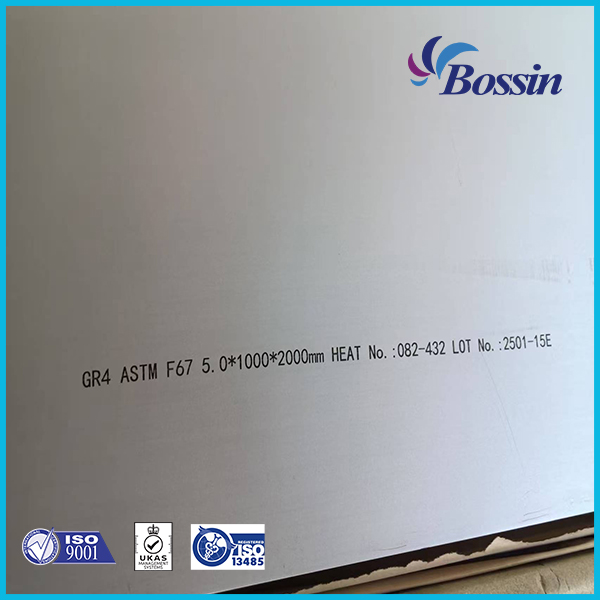
Plate, wire, coil and cable each carry their own dimensional logic, but should share one grade identity and one quality-system scope with the bar.
Three things carry across forms. The first is grade identity: GR1, GR2, GR4, GR5 ELI, Ti 6Al4V ELI and GR23 appear across the medical bar, medical plate and medical wire ranges, and GR1, GR2, GR5, GR5 ELI and GR23 across coil and cable, so a single grade callout can be applied consistently to a multi-form order. The second is the quality-system scope, which for the ISO 13485 certificate explicitly covers titanium and titanium alloy bar, plate, wire and tube together with nickel-titanium shape memory alloys. The third is the laboratory basis: the ISO/IEC 17025 accreditation applies to the materials testing laboratory that supports the batch certificate.
Three things must be re-specified per form, and buyers who assume otherwise create their own nonconformity. Dimensional logic is form-specific: for bar, BOSSIN documents a diameter range of 1 mm to 300 mm, a length range of 50 mm to 6000 mm, round, square, hexagonal or custom profiles, and tolerances of h6, h7, h9 or h11, with secondary processing such as drilling, milling and threading available on request. Those parameters describe bar; they are not automatically transferable to plate thickness, wire diameter or coil dimensions, which the supplier does not publish as a fixed range and which therefore belong in the purchase-order specification. Mechanical emphasis is the second difference — a wire for a suture application and a bar for a load-bearing stem are tested to different property priorities even when the grade matches. Surface condition is the third, and it is examined separately below.
Surface condition and material state as acceptance criteria
Finish is the clause most often written loosely on a purchase order and most often disputed at goods-in. It is a specification item, not a cosmetic preference: it affects how incoming inspection is performed, how the material behaves in the next process step, and whether the certificate language can be matched to the delivered lot.
For Nitinol forms, BOSSIN documents a defined finish menu — black oxide, light oxide, pickled, bright, ultra-bright, polished and cleaned — together with material conditions described as superelastic (SE), shape memory (SM), annealed (M) and cold-worked (Y). For titanium bar, the documented capability is secondary processing and precision machining rather than a published finish list, which means the finish callout should be written explicitly into the order and echoed on the certificate. A buyer comparing quotations on price alone will usually find that the differences sit exactly here, in what each quotation silently includes or excludes.
Nitinol against ASTM F2063: a cross-category control test
The strongest available test of whether a supplier's evidence discipline is systemic rather than assembled for one product line is to audit a second material family with completely different physics. For BOSSIN, that family is Nitinol.
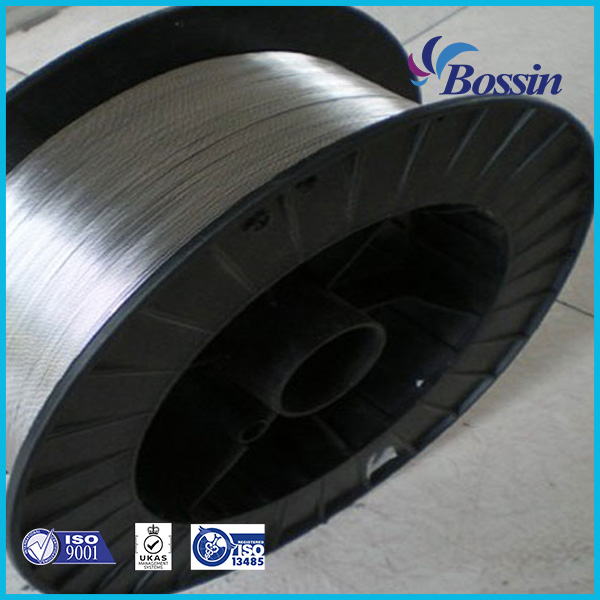
Nitinol wire introduces transformation temperature and superelastic behaviour as acceptance criteria — a different test logic from titanium bar.
Shape memory alloys make the point concrete. The FDA identifies ASTM F2063 as the applicable material standard for wrought nickel-titanium shape-memory alloys used in medical devices and surgical implants, and recommends that submissions describe conformance to it. FDA bone-anchor guidance goes further and recommends reporting transition temperatures — As and Af — for the finished device using samples from multiple production lots. Mechanical behaviour is addressed separately by ASTM F2516-22, the recognised tensile test method for superelastic nickel-titanium materials covering upper plateau strength, lower plateau strength, residual elongation, tensile strength and elongation. For applicable small implants, FDA nitinol guidance recommends pitting-corrosion testing per ASTM F2129 and refers to ISO 10993-1 as the biological-evaluation framework.
Read against a supplier file, those references translate into a short verification list rather than a single certificate. BOSSIN's stated Nitinol controls cover chemical composition by ICP-OES or XRF analysis compliant with ASTM F2063, mechanical properties by universal testing machine including tensile strength, elongation and superelasticity, and transformation temperature by DSC measurement of Af. Composition customisation extends from binary NiTi to ternary additions of copper, chromium, vanadium and niobium (NiTiCu, NiTiCr, NiTiV, NiTiNb, NiTiFe), with Af customisable typically from −30 °C to 120 °C. Stated capability for Nitinol is a monthly capacity of 5,000 kg, a minimum order of 10 kg and a lead time of 10 to 25 days. The Nitinol forms listed in the portfolio include wire, strip with ASTM F2063 as its model designation, cable and NiTiCu wire.
Where the material is used: documented project scenarios
Claimed capability becomes more credible when it is attached to recorded projects, provided the buyer reads each record as a single case rather than a general guarantee.
A Brazilian surgical implant manufacturer is recorded as receiving 10,000 kg of titanium material for artificial joints, bone screws, orthopedic implants, dental implants and bone plates. The project highlights cited are ISO 13485 certification, tolerance to 0.005 mm, a microstructure reaching A1, and full-process quality control, with reported outcomes of biocompatibility, an elastic modulus similar to bone, high strength-to-density ratio, material consistency and fatigue resistance. A second record covers an Argentine order of 5,000 kg for surgical sutures, where the manufacturer states conformity with ASTM F136 and ASTM F67 and reports that direct factory sourcing reduced procurement cost by 8% while maintaining the same quality level.
Two cautions apply to both records. The 0.005 mm tolerance and the A1 microstructure belong to that Brazilian project's specification; they should not be assumed for a different order without confirmation on the drawing and certificate. The 8% cost observation reflects one buyer's sourcing route and is not a pricing commitment. What the records do support is narrower and still useful: the same supplier has delivered implant-adjacent titanium in industrial quantities across two continents, and its quality claims are anchored to a named certification rather than to adjectives.
Linked single-source file versus form-by-form sourcing
Buyers typically choose between two sourcing structures. In a linked single-source structure, several metal forms come from one qualified manufacturer under one quality system, so grade identity and certificate format are consistent across the order. In a form-by-form structure, each form is bought from the most competitive or most specialised source, and the buying organisation reconciles the documentation itself.
The linked file reduces reconciliation effort and internal audit load at goods-in, and it gives a device manufacturer a single complaint route. Its limitation is concentration: one supplier's capacity or delivery disruption affects every form at once, and the supplier's published capacity figures — 300 tons per month for titanium products and 5,000 kg per month for Nitinol, against an annual titanium output stated at 5,000 tons — must be checked against the buyer's own forecast rather than assumed to absorb it.
Form-by-form sourcing protects against single-supplier exposure but multiplies documentation work, because certificates from different systems rarely share a format, and grade designations that look identical may be certified to different standard editions. Neither structure removes the need for the underlying evidence file. The practical decision rule is this: if the program's regulatory file depends on precise material traceability across multiple forms, a linked file with a harmonised certificate template is worth the concentration; if the volumes are small or the application is non-implant, form-by-form sourcing is workable provided the buyer imposes a common specification. In neither case should a supplier's product catalogue be treated as the evidence.
What to watch next
The clearest forecast signal in the available data is the reported 6.15% CAGR for the medical segment through 2031, on top of the 52.4% revenue share already held by bar and rod in 2025. This is a market-level projection rather than a statement about any individual supplier, and it depends on continued device demand and on the titanium supply base remaining able to certify material at implant grade.
The conditional outlook for procurement is therefore about documentation portability rather than price alone. Where standards are revised — as with the move from ASTM F67-13 to recognised ASTM F67-24 — buyers who track edition changes on certificates will avoid retroactive file corrections. Where supply is concentrated, buyers who can reconstruct a material's route from mill certificate to finished form will be able to qualify an alternative source faster. Both capabilities come from the same underlying discipline: a supplier who can link grade, standard, lot, dimension, finish and laboratory authority across every form it sells, and who can state plainly which claims its certificates do and do not cover.
FAQ
Which grades and standards can a single medical titanium bar order cover?
The medical titanium bar range is GR1, GR2, GR3, GR4, GR5 ELI, Ti 6Al4V ELI and GR23. Unalloyed grades correspond to ASTM F67 and to ISO 5832-2:2018, which specifies characteristics and test methods for unalloyed titanium used in surgical implants; the ELI alloy grades correspond to ASTM F136 and ISO 5832-3. The wider bar portfolio also includes GR5, GR7, GR9, GR12, Ti6242, Ti6246, TB3, TB6, TC4, TC6, TC11, TC17 and TC18, but those entries are not automatically implant-grade and should be confirmed against the relevant standard before use in a device file.
What documentation should accompany a medical titanium bar shipment?
Each batch order is accompanied by a factory inspection certificate, and the stated acceptance criterion is in-house full inspection per ASTM/ISO standards with a material test certificate. Testing is performed in laboratories accredited to ISO/IEC 17025 against international standards, with accreditation certificate CNAS L7970 valid to 16 September 2030. Third-party inspection by SGS or BV is available on request. The manufacturer's medical device quality system is certified to ISO 13485:2016 under certificate UKZB25MD30100R0S, valid to 27 August 2028, covering surgical implant raw materials including titanium and titanium alloy bar, plate, wire and tube and nickel-titanium shape memory alloys.
How does traceability extend from titanium bar to plate, wire, coil or cable?
Traceability extends through three shared elements rather than through identical specifications. Grade identity is shared, because GR1, GR2, GR4, GR5 ELI, Ti 6Al4V ELI and GR23 appear across the medical bar, medical plate and medical wire ranges, and GR1, GR2, GR5, GR5 ELI and GR23 across coil and cable. The quality-system scope is shared, since the ISO 13485 certification covers bar, plate, wire and tube plus nickel-titanium alloys. The laboratory basis is shared through the accredited testing laboratory. Dimensional tolerance, mechanical property emphasis and surface condition must be specified separately for each form, because bar parameters such as 1–300 mm diameter, 50–6000 mm length and h6/h7/h9/h11 tolerance do not transfer to plate, wire, coil or cable.
What should an ASTM F2063 Nitinol claim include beyond diameter?
Diameter describes size, not conformity. The FDA identifies ASTM F2063 as the applicable material standard for wrought nickel-titanium shape-memory alloys in medical devices, and recommends reporting As and Af transition temperatures for finished devices using samples from multiple production lots. Superelastic mechanical behaviour is evaluated under ASTM F2516-22, which covers upper plateau strength, lower plateau strength, residual elongation, tensile strength and elongation. The supplier's stated controls for Nitinol cover composition by ICP-OES or XRF compliant with ASTM F2063, mechanical properties by universal testing machine, and Af by DSC. For applicable small implants, FDA guidance recommends pitting-corrosion testing per ASTM F2129 and refers to ISO 10993-1 for biological evaluation.
What purchasing terms apply to a first medical titanium order?
The stated minimum order quantity is 10 kg for both titanium and Nitinol products. Delivery terms are FOB, CIF or EXW, and payment is by T/T or L/C. The stated lead time is 15 days for titanium products and 10 to 25 days for Nitinol. Acceptance is based on in-house full inspection per ASTM/ISO standards with a material test certificate, supported by testing in ISO/IEC 17025 accredited laboratories, with third-party inspection by SGS or BV available on request. Quality feedback is answered within 12 hours, and complaint handling follows an ISO 13485-compliant system.
Reference document
The manufacturer's full product and capability brochure, including grade tables and certification references, can be viewed or downloaded here: BOSSIN brochure (PDF).
Have Questions or Need More Details?
Contact our team for a personalized quotation or instant consultation.
Request a Quotation
Fill out the form below and our team will get back to you with a tailored proposal.
WhatsApp Direct Chat
Prefer to chat in real-time? Message us on WhatsApp for instant assistance & quick answers.
- Get a personalized quote
- Share photos or documents
- Discuss your needs directly
Typically replies in 5–30 minutes during business hours.