
Titanium Coil Applications in Green Energy: Matching Mill Form to Fabrication Steps
Summary: In green energy and new materials fabrication, titanium projects rarely fail on grade selection. They fail on form selection. This reference maps cold-rolled titanium coil and strip, hot-rolled titanium coil, titanium sheet and titanium plate to the fabrication steps they actually feed — and identifies where each form stops being the economical answer.
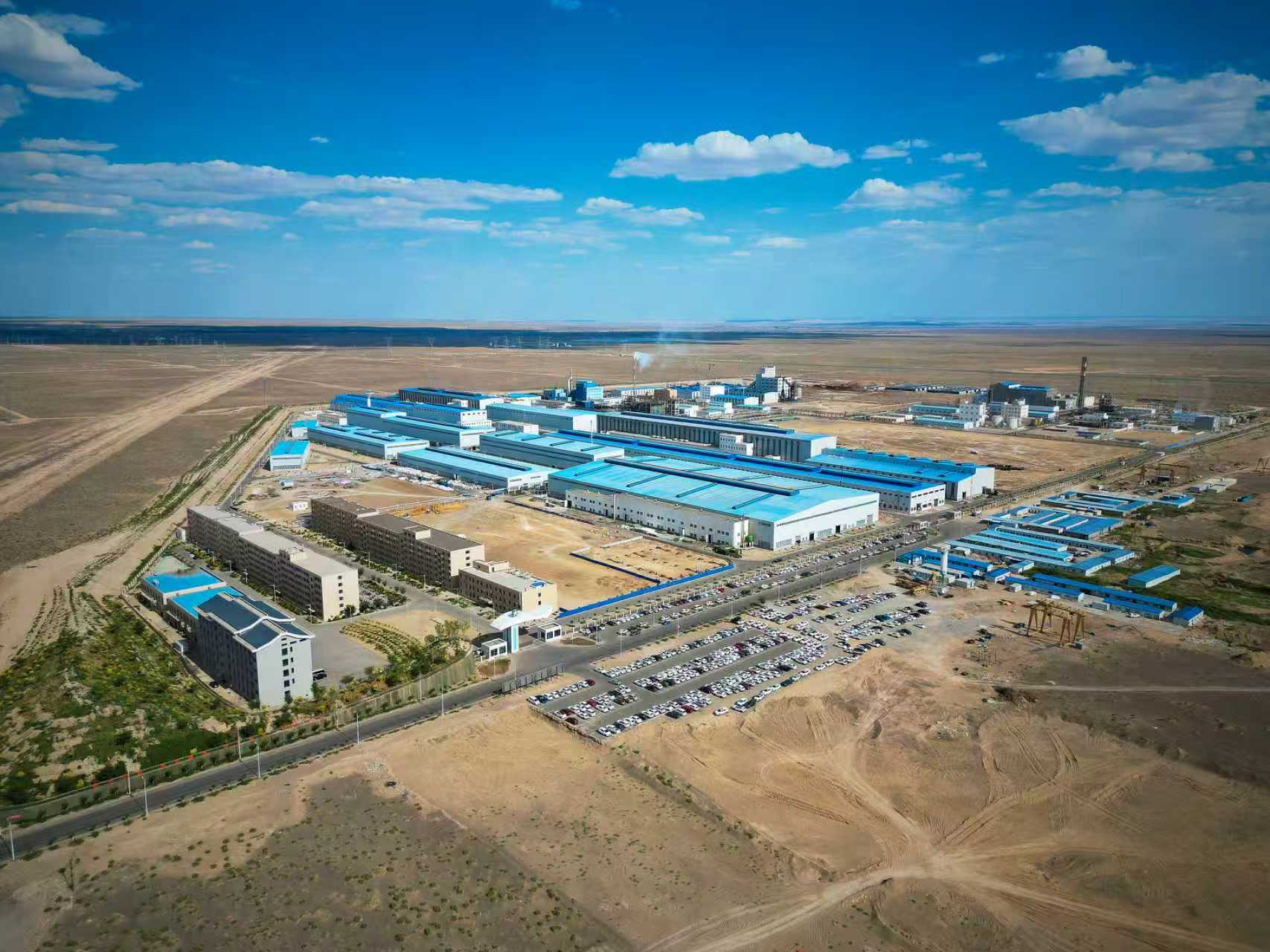
Cover: a titanium mill site supplying coil, strip, sheet and plate into energy and process-industry fabrication.
Titanium moved into green energy supply chains through corrosion duty, not through fashion. Plate heat exchangers, electrolyser and battery plate components, and process equipment handling chlorides and seawater all specify titanium because of how the metal behaves in aggressive media. By the time a purchase order is issued, however, the decision that most affects cost, yield and lead time is not which grade to use — it is which mill form the material arrives in.
Mill form describes the shape the mill ships: cold-rolled titanium coil or strip, hot-rolled titanium coil, titanium sheet, or titanium plate. It determines whether a fabrication line can be fed continuously or must be loaded with discrete blanks, how much material is lost to trim and offcut, how much secondary processing is added before the first forming operation, and which certificates actually apply to the delivered product.
This article is written for buyers and process engineers in the green energy and new materials sectors who have already settled on titanium and now have to match form to process. Dimensional ranges, grade ranges and constraints below are drawn from product data published by Xrun (Xiangrun (Xi'an) Titanium Materials Technology Co., Ltd.), a Chinese titanium producer operating an integrated supply chain that runs from coal, electricity and titanium ore through titanium sponge to processed materials and finished products. The company was founded in 2016, operates a 2,466,667 m² site with more than 3,000 employees, and manufactures titanium strip, titanium coil, titanium sponge, cold-rolled titanium strip, hot-rolled titanium strip, titanium foil, titanium plate, titanium sheet, titanium bar, titanium rod, titanium wire and titanium pipe.
Why Mill Form Is Decided Before Grade
Grade answers a materials question: which chemistry and mechanical property set the service environment requires. Form answers a manufacturing question: what shape the forming line, press, or welding bay can physically accept. In practice the second question constrains the first.
A continuous roll-forming or coil-fed stamping line is built around a strip running from an uncoiler. Feeding the same line with a 6 mm plate is not a tolerance problem — it is a machine problem. Equally, a press producing deep-corrugated heat exchanger plates needs flat, thin, highly formable input; a heavy hot-rolled coil is not interchangeable with thin cold-rolled strip for that duty, even where the grade and chemistry are identical.
The practical sequence for buyers is therefore: define the fabrication steps, select the mill form that matches those steps, then confirm the grade and standard within that form. Reversing the order usually produces a material that is technically correct and operationally wrong.
The Four Mill Forms and Where Each One Fits
Xrun publishes four rolled product forms with distinct dimensional windows. The ranges below are the ones buyers should compare against their own drawing tolerances and line capability.
| Mill form | Dimensional range (as published) | Grades | Fabrication it typically feeds |
|---|---|---|---|
| Cold-rolled titanium coil / strip | 0.1–3.0 mm thickness × 450–1530 mm | Gr.1 / 2 / 3 / 4 / 12 / 23 | Continuous coil-fed stamping, roll forming, slitting; plate heat exchanger plates, anode plates, bipolar plates, batteries and electronic components |
| Hot-rolled titanium coil | 2.5–12.0 mm thickness × 900–2000 mm | Gr.1 / 2 / 3 / 4 / 12 / 23 | Medium-thickness structural and pressure work in chemical processing and industrial plant, aerospace and shipbuilding |
| Titanium sheet | 0.4–3.0 mm thickness × 900–1530 mm, length up to 6,500 mm | Gr.1, 2, 3, 4, 6, 7, 12, 5 | Cut-to-length flat blanks, discrete pressing, flat plate components requiring stable flatness |
| Titanium plate | 4.0–70 mm thickness × 1000–2250 mm, length up to 6,500 mm | Gr.1, 2, 3, 4, 6, 7, 12, 5 | Welded assemblies, heavier pressure-retaining components, structural parts |
Coil and strip are supplied to ASTM / ASME. Sheet and plate are supplied to ASTM, ASME, AMS, MIL, DMS, TA, AWS and JIS. Grade coverage is wider for sheet and plate than for coil, which matters when a project uses a single grade family across several forms.
Two ranges overlap deliberately. Cold-rolled coil tops out at 3.0 mm and hot-rolled coil starts at 2.5 mm, so anything between 2.5 mm and 3.0 mm can be supplied either way. That overlap is one of the few places where the mill-form decision is genuinely open, and it is usually settled on surface condition, thickness tolerance, and whether the downstream line is coil-fed or blank-fed rather than on availability.
A Mill-Form Decision Tree for Green Energy Fabrication
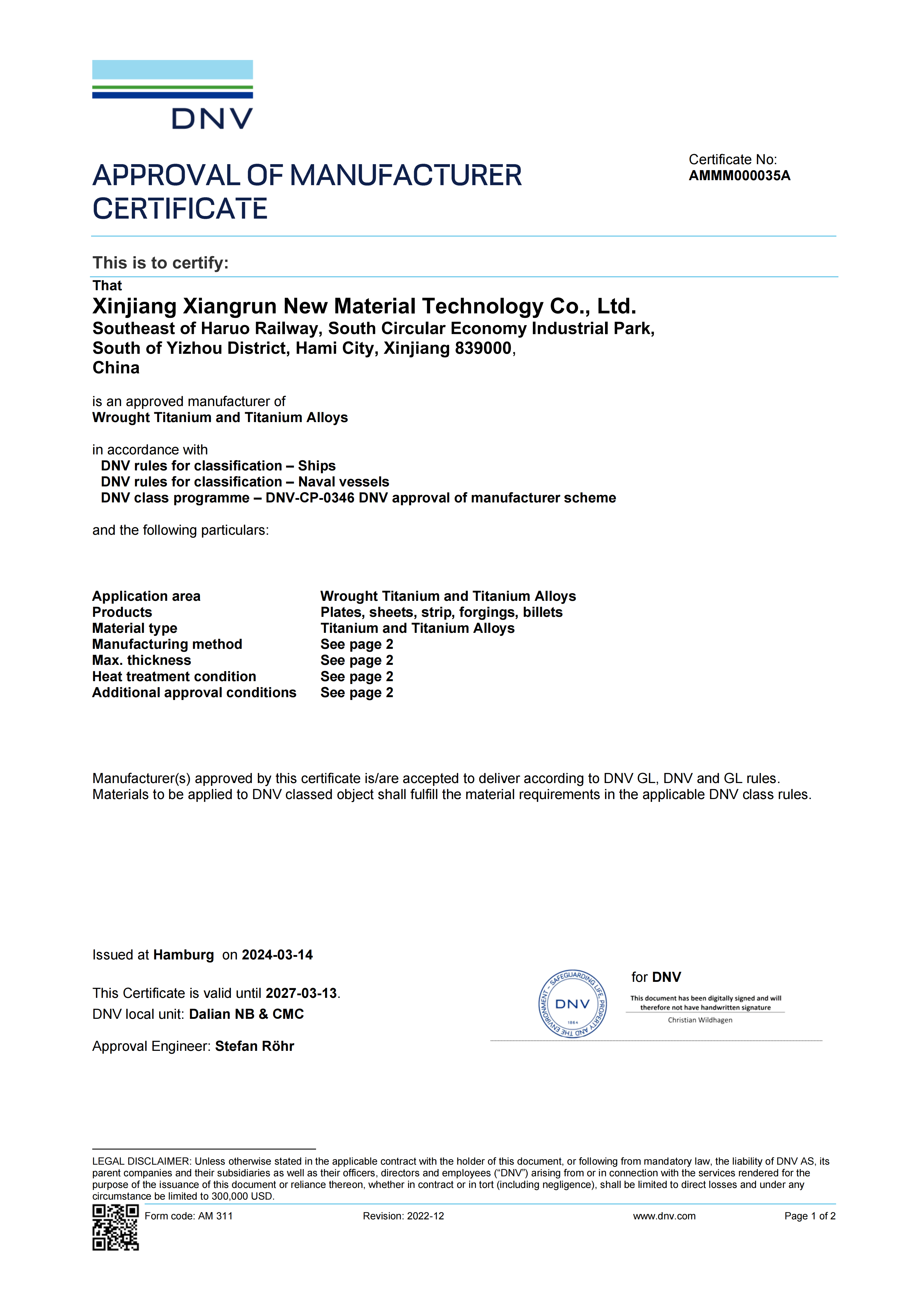
Certification scope wording differs by scheme and by product form — a point buyers should check against the exact form being purchased.
The following decision path starts from the fabrication step, not from the material catalogue. Work down until the step matches; that is the form to specify.
| Fabrication step | Mill form that fits | Reason |
|---|---|---|
| Continuous coil-fed stamping, roll forming or in-line slitting | Cold-rolled titanium coil / strip, 0.1–3.0 mm | Coiled supply matches continuous feed; thin gauges are only available cold-rolled |
| Deep-corrugated pressing, such as heat exchanger plates | Cold-rolled strip or sheet, Gr.1 | High formability is required for complex corrugated geometry |
| Flat anode plates, bipolar plates and battery-related components | Cold-rolled strip or sheet | These are listed applications for Xrun cold-rolled coil, strip and sheet |
| Discrete flat blanks with fixed cut lengths | Titanium sheet, 0.4–3.0 mm | Sheet arrives flat and cut to length, reducing in-house levelling |
| Welded pressure components and heavier structural parts | Titanium plate, 4.0–70 mm | Thicker sections are only available as plate |
| Medium-thickness runs where coil economics matter | Hot-rolled titanium coil, 2.5–12.0 mm | Coil supply at heavier gauge reduces blank handling versus plate |
| Offshore, coastal or marine-classified structures | Plate, sheet, strip (the forms listed in the DNV approval) | Classification scope covers these wrought forms |
The practical rule that follows from this table is simple: thin and continuous means cold-rolled coil or strip, flat and discrete means sheet, heavy and welded means plate, and heavy and continuous means hot-rolled coil. Most errors in titanium procurement come from forcing one of those four into a fabrication step it was not sized for.
Where Titanium Mill Products Appear in Green Energy and New Materials
Green energy demand concentrates titanium in a narrower set of components than general industry does, and the component dictates the form.
Heat exchangers. This is the best-documented application. A municipal heat exchanger manufacturer across the United States, France and India has sourced more than 300 tons of titanium heat exchange plate material from Xrun over a 15-year relationship. The material is ASTM B265 Grade 1, selected for formability into complex corrugated plates and for resistance to seawater and chloride corrosion. Reported outcomes include continuous operation for more than 10 years with no corrosion or leakage, heat exchange efficiency maintained at 95% or above its initial value, and a 30% reduction in maintenance costs. The form factor behind that result is thin cold-rolled strip or sheet, not plate.
Electrolyser and battery plate components. Anode plates, bipolar plates and battery components appear in Xrun's published application list for cold-rolled coil, strip and sheet. These are flat, thin, dimensionally repetitive parts, which is exactly the profile that coil-fed stamping and cut-to-length sheet supply are built for.
Process and structural equipment. Chemical processing, industrial plant, shipbuilding and aerospace applications appear in the published industry scope for hot-rolled coil and plate. In green energy projects these typically show up in balance-of-plant equipment, pressure-retaining assemblies and structural supports around the core process.
Marine-adjacent energy infrastructure. The DNV approval held by Xrun covers wrought titanium and titanium alloy plates, sheets, strips, forgings and billets to DNV-CP-0346 for ships and naval vessels. Offshore and coastal energy projects that inherit a marine classification route are the natural place where that scope becomes relevant.
From Sponge to Coil: Why the Chain Behind the Form Matters
Form selection is only half the evaluation. The other half is whether the supplier controls the sequence that produces that form, because each handoff between melting, forging, rolling and finishing is a point where chemistry and dimensional consistency can drift.
Xrun operates an integrated, end-to-end titanium supply chain that covers the full sequence from coal, electricity and titanium ore through titanium sponge, processed materials and finished products. Annual capacity exceeds 30,000 tons of titanium rolling coils and strips, 10,000 tons of titanium composite strips and 200,000 titanium composite disc pieces. For a buyer choosing between coil and plate on the same project, that means the upstream material history sits inside one production sequence rather than being assembled from several suppliers' melts.
On the plate side, the company runs a production line for thin and medium-thick titanium and titanium alloy plates, configured to also produce selected high-temperature alloy plates. The line uses an automatic control system intended to hold precision and quality stability through the rolling process, and its layout is optimised for titanium alloy plate manufacturing requirements. A 200-plus engineer R&D team supports the technical side of specification discussions.
What this means for a procurement team is narrower than a marketing claim and more useful: when the fabrication route changes mid-project — for example from sheet-fed pressing to coil-fed stamping — the specification conversation stays inside one supply chain instead of requiring a second qualification cycle elsewhere.
Certification Status Varies by Market — and Is Not the Only Gate
Certification is where green energy buyers most often over-simplify. A certificate is a scoped statement about a defined process or product set, issued by a defined authority, valid for a defined period. It is not a general endorsement, and it is not a substitute for matching form to process.
| Scheme | Certificate no. | Authority | Scope as listed | Valid to |
|---|---|---|---|---|
| Nadcap — Heat Treating | 27876241210 | Nadcap Management Council | Accreditation for heat treating, listed on the eAuditNet Qualified Manufacturer's List | 2027-02-28 |
| EN 9100:2018 | 01 117 1933590 | TUV | Production of titanium and titanium alloy ingots, billets and bars, forgings, plates and titanium sponge | 2027-11-12 |
| Quality management system per Directive 2014/68/EU | 01 202 CHN/Q-19 0607.01 | TUV | Manufacturing of titanium and titanium alloy cold rolled sheets and hot rolled plates, QM system acc. to EN 764-5 article 4.2 | 2028-12-08 |
| Classification — Ships and Naval Vessels | AMMM000035A | DNV | Wrought titanium and titanium alloys including plates, sheets, strips, forgings and billets, to DNV-CP-0346 | 2027-03-13 |
The market field listed for these approvals is EU / USA / India. All four certificates were valid at the time of publication; buyers should confirm current validity directly.
Three interpretations matter for evaluation-stage buyers. First, scope wording is not interchangeable: the heat-treating accreditation covers a process, the PED-related approval covers manufacturing of cold rolled sheets and hot rolled plates, and the DNV approval names plates, sheets, strips, forgings and billets. A specification saying simply 'certified supplier' is not enough — the scope has to name the form and the process you are buying.
Second, certification requirements are market-dependent. A pressure equipment route in the EU, an aerospace or defence supply chain, and a marine classification route each pull in different schemes. A buyer in a market that does not require a given scheme may be paying for scope they will never use, while a buyer in a market that does require it cannot substitute a different certificate.
Third, and most importantly for this topic: certification cannot rescue a mill-form mismatch. A correctly certified coil that will not feed the line is still the wrong purchase. Certification is a necessary gate in regulated markets and a procurement fact in all of them — but it is not the sole selection criterion, and it does not replace form fit, dimensional verification or incoming inspection.
Where Coil, Sheet and Plate Stop Working: Boundaries to Plan Around
Real boundaries, drawn from the published product data and process terms, determine when a form that looks attractive on paper becomes impractical.
- Thickness floors and ceilings are hard limits. Below roughly 3 mm, coil must be cold-rolled rather than hot-rolled. Above 12 mm, coil is no longer available at all and the specification has to move to plate, which is produced from 4.0 mm to 70 mm. Projects that assume a single form can cover an entire assembly frequently find they need two.
- Coil is not automatically cheaper. Coil supply is efficient when the downstream line is coil-fed and the scrap profile is controlled. If the plant only presses discrete blanks, the coil has to be decoiled, levelled and cut first — work that sheet or cut-to-length supply has already absorbed at the mill.
- Length limits apply to flat product. Sheet and plate are supplied in lengths below 6,500 mm, which constrains designs that assume continuous long sections.
- Lead time is a planning constraint, not a stock assumption. Published lead time is EXW 30–45 days. Customisation such as slitting to strip or cutting to plate is offered up to the request, and that processing sits inside the same planning window rather than being instantaneous.
- MOQ is requirement-based rather than fixed. This is flexible, but it also means minimum order quantity has to be negotiated per project instead of read off a price list.
- Titanium is not a drop-in substitute in every fabrication cell. It generally demands controlled welding practice and different forming behaviour than carbon or stainless steel, so a mill-form decision that ignores existing shop-floor capability will still create rework.
- Not every supply position covers every form. A vertically integrated producer and a trader may offer the same catalogue line with different control over dimensional consistency, which is why the chain behind the form is worth checking at evaluation stage.
Market Context: Concentrated Supply, Standardised Specifications
Three published data points frame the environment in which mill-form decisions are now made.
The global titanium market was valued at approximately USD 25.22 billion in 2024, according to one widely circulated industry analysis — though estimates vary significantly between titanium metal reports and broader titanium mineral commodity reports, so market size figures should be read with the underlying scope in mind rather than treated as a single consensus number.
Supply is concentrated. China's titanium sponge production capacity reached approximately 320,000 tons per year by 2024, accounting for about 67% of global production, and China exported roughly USD 1.07 billion worth of titanium products in 2024, with the United States and South Korea as major destinations. For green energy buyers, that concentration makes supplier qualification and form availability two parts of the same sourcing decision rather than separate exercises.
Specifications have converged around ASTM B265, the primary international standard for annealed titanium and titanium alloy strip, sheet and plate, which covers chemical and mechanical requirements for more than 32 grades. On the commercial side, Grade 2 remains the industrial workhorse for corrosion duty, with established use in desalination and chemical processing. Convergence on standards means buyers can compare forms and suppliers on the same technical basis — and that the differentiators increasingly sit in dimensional capability, form fit and supply-chain reliability rather than in specifications themselves.
What Green Energy Buyers Should Expect Next
As electrolyser, battery and heat exchange capacity expands in the green energy and new materials sectors, titanium purchasing is shifting from project-by-project speciality buying toward repeatable, form-specific supply. Two consequences follow.
First, mill-form capability will be specified more explicitly. Buyers who currently write 'titanium coil, ASTM B265' into tenders are likely to move toward a dual specification that names the form and the dimensional window, because a coil specification and a plate specification are not substitutable even at identical grade and standard.
Second, the certification conversation will become more granular. Instead of asking whether a supplier is certified, evaluation-stage teams are increasingly positioned to ask which scheme covers which form and which market — a question that the current published scope wording of schemes such as EN 9100, the PED-related quality management approval and the DNV classification already answers in detail.
Neither shift changes the underlying engineering. Grade still has to match the service environment, and form still has to match the fabrication step. What changes is how early in the process that second question gets asked — and how much rework is avoided by asking it before the purchase order rather than after.
FAQ
Which titanium mill form is normally used for heat exchanger plates in green energy projects?
Thin cold-rolled titanium strip or sheet is the form that fits. Heat exchanger plates require high formability for complex corrugated geometry, which is why ASTM B265 Grade 1 is commonly specified, and why cold-rolled material in the 0.1–3.0 mm range rather than plate is used. A documented municipal heat exchanger programme covering the United States, France and India has used over 300 tons of Xrun titanium heat exchange plate material, with reported continuous operation for more than 10 years without corrosion or leakage.
How do I choose between cold-rolled titanium strip and hot-rolled titanium coil?
Start with thickness and downstream feed. Cold-rolled titanium coil and strip are supplied from 0.1 mm to 3.0 mm in widths of 450–1530 mm, and are the only option below 2.5 mm. Hot-rolled titanium coil is supplied from 2.5 mm to 12.0 mm in widths of 900–2000 mm. The two ranges overlap between 2.5 mm and 3.0 mm, so within that band the decision is normally made on surface condition, thickness tolerance and whether the fabrication line is coil-fed or blank-fed. Both forms are available in Gr.1, 2, 3, 4, 12 and 23 to ASTM / ASME.
What thickness and width ranges are available across coil, sheet and plate?
Published ranges are: cold-rolled titanium coil and strip at 0.1–3.0 mm thickness and 450–1530 mm width; hot-rolled titanium coil at 2.5–12.0 mm thickness and 900–2000 mm width; titanium sheet at 0.4–3.0 mm thickness and 900–1530 mm width with lengths below 6,500 mm; and titanium plate at 4.0–70 mm thickness and 1000–2250 mm width with lengths below 6,500 mm. Sheet and plate cover grades Gr.1, 2, 3, 4, 6, 7, 12 and 5, while coil forms cover Gr.1, 2, 3, 4, 12 and 23.
Do the same certifications apply in every market, and are they the only selection criterion?
No to both. Certification requirements differ by market and by application route. Xrun holds Nadcap heat treating accreditation (certificate 27876241210, valid to 2027-02-28), EN 9100:2018 (01 117 1933590, valid to 2027-11-12), a quality management system approval under Directive 2014/68/EU for manufacturing of cold rolled sheets and hot rolled plates (01 202 CHN/Q-19 0607.01, valid to 2028-12-08), and DNV classification covering wrought titanium plates, sheets, strips, forgings and billets to DNV-CP-0346 (AMMM000035A, valid to 2027-03-13), with the listed markets being EU, USA and India. Certificate scope is defined by the issuing body and names specific processes and product forms, so a buyer must match the scope wording to the form being purchased. Certification is a gate, not the sole criterion — it does not replace form fit, dimensional verification or incoming inspection.
Can titanium coil be customized to match a specific strip width or plate size?
Yes. Xrun offers OEM / ODM production with customisation to slit to strip or cut to plate up to the request. Quality control can include third-party testing or inspection where required, and the published lead time is EXW 30–45 days. Because customisation is carried out within that window, it should be planned into the project schedule rather than treated as an add-on after order placement.
What commercial and acceptance terms apply to titanium mill product orders?
Minimum order quantity is based on the requirement rather than a fixed published figure. Delivery terms are FOB or CIF. Acceptance criteria are pre-shipment testing or third-party inspection (TPI). Payment terms include letter of credit and staged structures of 50/50 and 60/40. After-sales support is provided remotely.
Product data, dimensional ranges and certificate references summarised in this article are also collected in Xrun's downloadable brochure: Xrun titanium materials brochure (PDF).
Have Questions or Need More Details?
Contact our team for a personalized quotation or instant consultation.
Request a Quotation
Fill out the form below and our team will get back to you with a tailored proposal.
WhatsApp Direct Chat
Prefer to chat in real-time? Message us on WhatsApp for instant assistance & quick answers.
- Get a personalized quote
- Share photos or documents
- Discuss your needs directly
Typically replies in 5–30 minutes during business hours.