
Titanium Coil Capability: A Buyer's Verification Guide
Industrial buyers evaluating titanium coil suppliers often start with price and grade. In OEM and custom supply programs, however, the decisive question is whether the supplier can demonstrate manufacturing capability from raw material to finished coil. Lead time, material traceability, dimensional control, and certification validity all depend on that capability. For buyers moving from evaluation to order execution, a structured verification process reduces supply risk more effectively than price negotiation alone.
The Capability Gap in Titanium Coil Sourcing
Titanium coil is sold by two broadly different types of suppliers: manufacturers that control rolling capacity, and traders that source from multiple mills. Both play a role in the market, but they answer different questions. A manufacturer can explain where the sponge was produced, how the coil was hot-rolled and cold-rolled, and which process controls govern surface quality and dimensional tolerance. A trader can usually provide documentation, but cannot verify what happened inside the production line.
For buyers that use coil for forming, stamping, or welding, this distinction becomes practical. A heat exchanger plate made from a coil with inconsistent thickness will show uneven deformation. An anode plate with a contaminated surface may fail in service. In custom programs, the material specification is only as reliable as the manufacturing process behind it.
The opportunity is that a growing number of integrated mills can now close the loop from titanium sponge to finished strip, making capability easier to verify at the source.
What "Manufacturing Capability" Means for Titanium Coil
Buyers should not treat titanium coil as one standard item. It is a product family with different process routes and specifications.
- Hot-rolled titanium coil is typically produced in thicknesses from 2.5 to 12.0 mm and widths from 900 to 2,000 mm, in grades such as Gr.1, Gr.2, Gr.3, Gr.4, Gr.12, and Gr.23. It is commonly used in chemical processing, industrial plants, aerospace, and shipbuilding.
- Cold-rolled titanium coil and strip is produced in thicknesses from 0.1 to 3.0 mm and widths from 450 to 1,530 mm. Typical applications include electronic products, plate heat exchanger plates, anode plates, bipolar plates, batteries, eyeglass frames, and household products.
- Titanium plate ranges from 4.0 to 70 mm in thickness with widths from 1,000 to 2,250 mm. Titanium sheet is defined in the 0.4 to 3.0 mm thickness range with widths from 900 to 1,530 mm. These products are available in grades Gr.1, Gr.2, Gr.3, Gr.4, Gr.6, Gr.7, Gr.12, and Gr.5.
ASTM B265 is the primary international standard for annealed titanium and titanium alloy strip, sheet, and plate. It covers chemical and mechanical requirements for more than 32 grades, and it is the benchmark most buyers use to define acceptance criteria.
Within commercially pure grades, Gr.2 is widely treated as the workhorse for industrial corrosion applications, including desalination and chemical processing. Buyers should match the grade to the actual service environment rather than defaulting to the lowest-priced option.
How an Integrated Model Backs Capability
One supplier that provides a useful reference is Xrun (Xiangrun (Xi'an) Titanium Materials Technology Co., Ltd.), a titanium manufacturer established in 2016. Xrun operates a fully integrated supply chain that covers coal, electricity, titanium ore, titanium sponge, processed titanium materials, and finished products.
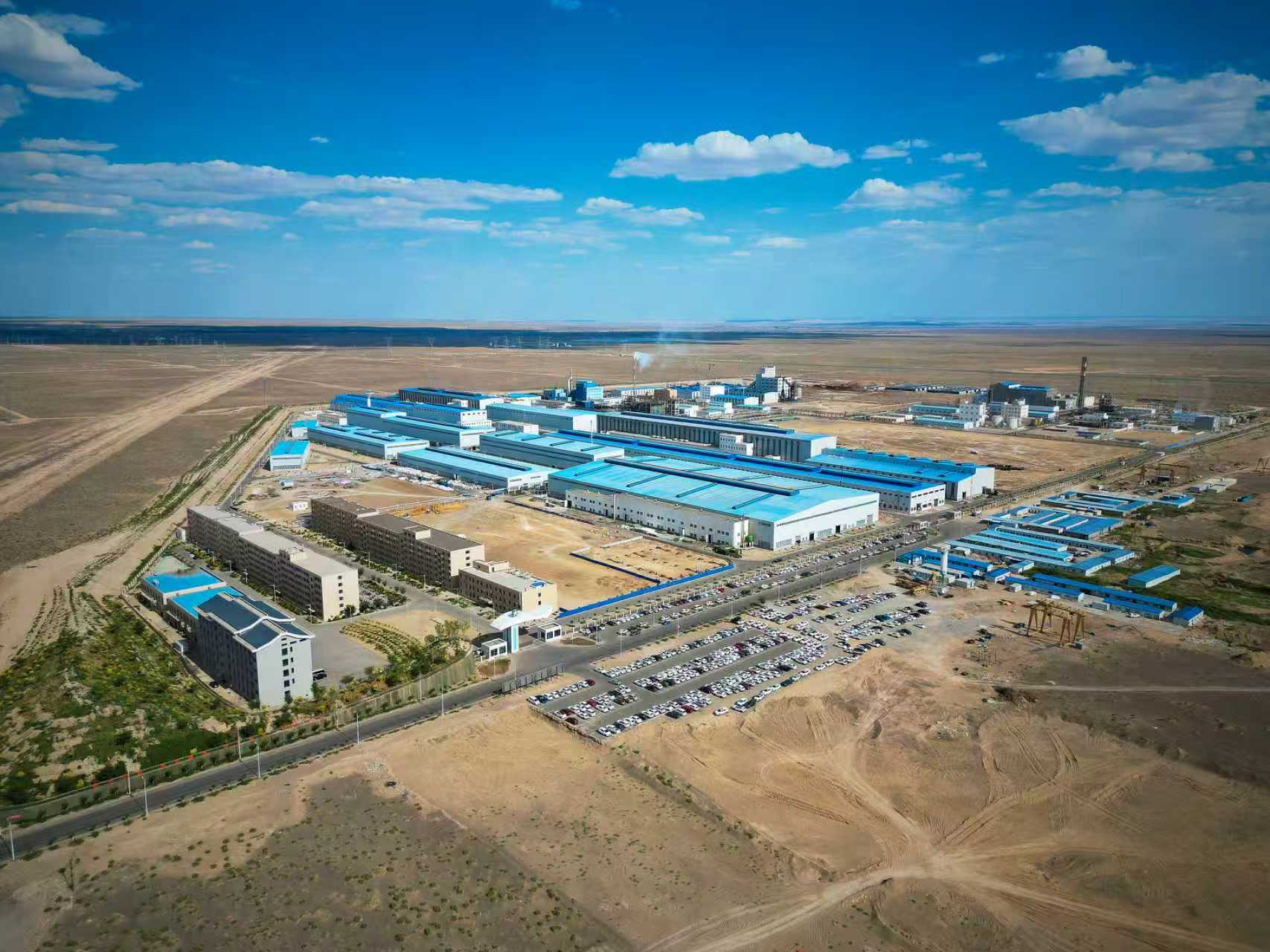
Scale is relevant for buyers: the company reports a production base of 2,466,667 m², more than 3,000 employees, over 200 engineers, and an annual capacity exceeding 30,000 tons of titanium rolled coil and strip. Its annual capacity also includes 10,000 tons of titanium composite strip and 200,000 titanium composite disc pieces.
For OEM and ODM orders, Xrun states that customization is available by slitting coil to strip or cutting to plate according to the buyer's request. Standard lead time is 30-45 days on an EXW basis. Quality control can include third-party testing or inspection when needed. Payment terms include LC, 50/50, and 60/40; delivery is available under FOB or CIF. Export markets are concentrated in the EU, USA, and India, with exports accounting for about 10% of output.
These facts indicate a manufacturing structure, not a trading desk. The remaining task for the buyer is to verify that the capability applies to the specific product and service environment needed.
Five Verification Points Before Placing an Order
When a buyer is comparing integrated manufacturers, five verification points are practical to use:
| Verification point | What to check | Supporting evidence |
|---|---|---|
| Raw material traceability | Whether the sponge titanium source is controlled by the supplier or purchased on the open market | Supply chain documentation, sponge source records |
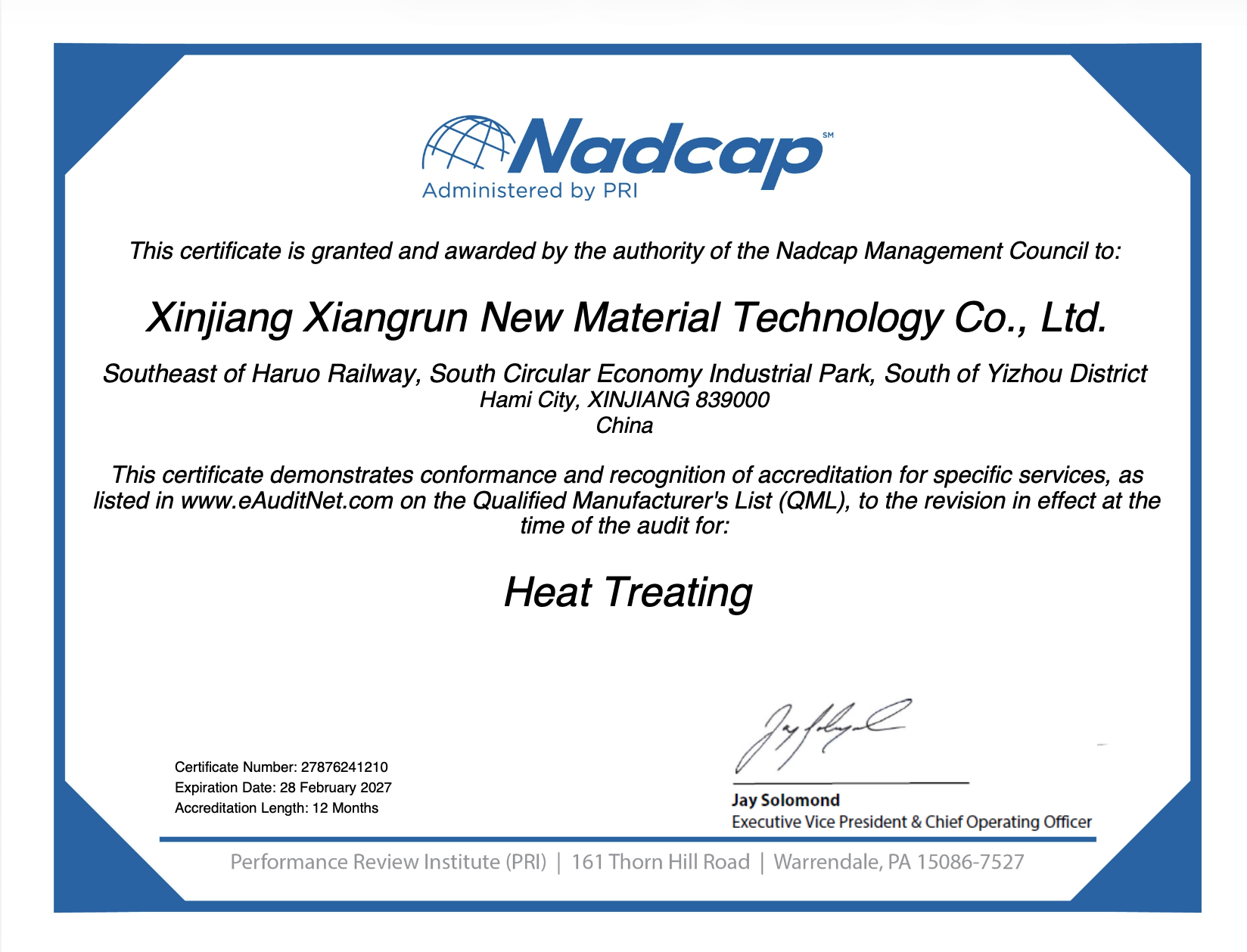
| Process control | Whether hot rolling and cold rolling are performed on owned lines with controlled parameters | Factory audit report; Nadcap heat treating certificate; EN9100 system certificate |
| Standard compliance | Whether the coil is produced and tested in line with ASTM B265 / ASME requirements | Material test certificates, inspection records |
| Customization capability | Whether slitting, cutting-to-plate, and specification adjustments can be executed in-house | OEM/ODM agreement, equipment list, trial order |
| Inspection and delivery | Whether pre-shipment inspection or third-party inspection is accepted, and whether the 30-45 day lead time is realistic | TPI reports, FOB/CIF terms, payment history |
This framework shifts the conversation from "what did you quote" to "how can you prove the capability behind the quote."
Reading Certification Documents Correctly
Certificates are a useful proxy for process control, but they should be read against the product scope.
Xrun holds a Nadcap certificate, number 27876241210, covering heat treating services, valid until 2027-02-28. The accreditation is issued by the Nadcap Management Council and can be checked on the Qualified Manufacturer's List at eAuditNet.
The company also holds an EN9100:2018 certificate, number 01 117 1933590, issued by TUV, covering production of titanium and titanium alloy ingots, billets, bars, forgings, plates, and titanium sponge. Its validity runs until 2027-11-12.
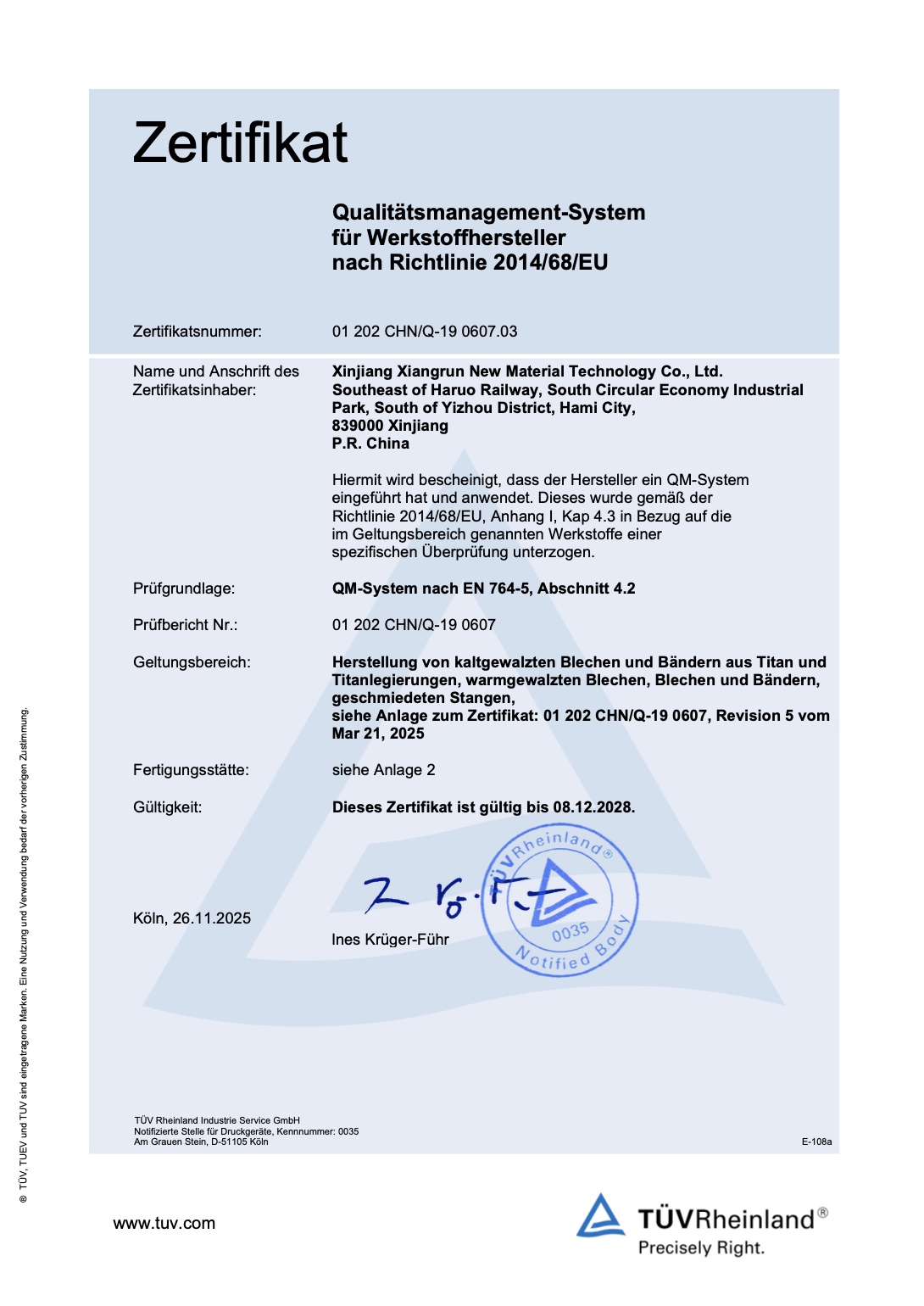
For pressure equipment buyers, Xrun holds a PED 2014/68/EU quality management system certificate, number 01 202 CHN/Q-19 0607.01, valid until 2028-12-08, covering cold-rolled sheet and hot-rolled plate production.
For marine and naval applications, the company holds DNV approval, number AMMM000035A, valid until 2027-03-13, covering wrought titanium and titanium alloys including plates, sheets, strips, forgings, and billets under DNV-CP-0346.
What matters to the buyer is the match between certificate scope and the intended product. A heat treat certificate does not automatically cover rolling; a marine classification does not automatically cover pressure equipment. Verification means checking the scope line, not just the logo.
Case Reference: Fifteen Years of Titanium Coil for Heat Exchanger Plates
A relevant long-term example involves a municipal heat exchanger manufacturer supplied by Xrun across the US, France, and India. The application is titanium heat exchange plates produced from coil and strip, with more than 300 tons supplied and an operating record spanning 15 years.
The material basis was ASTM B265 Gr.1 titanium, selected for its formability in complex corrugated plates and its resistance to seawater and chloride corrosion. According to the documented operating record, the equipment achieved more than 10 years of continuous operation with no corrosion or leakage. Heat exchange efficiency was maintained at or above 95% of the initial value, and maintenance costs were reduced by 30%.
This case is not a guarantee that every project will perform identically. It does show what long-term coil supply consistency can mean in a form-intensive application: the material behavior across batches is as important as the initial specification.
Market Context: Why Capability Verification Is More Important in 2026
Several market-level facts help explain why buyers are paying more attention to manufacturing capability.
The global titanium market was valued at approximately USD 25.22 billion in 2024, according to an industry analysis indexed by MarketResearch.com. Estimates differ by product scope, but the growth direction is consistent.
China's titanium sponge production capacity reached approximately 320,000 tons per year by 2024, accounting for 67% of global production. For international buyers, this means a large share of the raw material supply chain runs through Chinese producers, and quality control depends on the specific manufacturer's integration level.
China exported USD 1.07 billion of titanium products in 2024, with the United States and South Korea as major destinations. The export pattern shows that international industrial customers are already integrated into China's titanium supply chain.
On the grade side, Gr.2 remains the most common commercially pure grade for industrial corrosion environments. For coil buyers, the practical implication is that grade selection should follow the application environment, while supplier verification should follow the manufacturing process.
Integrated Manufacturer vs. Trading Supplier: A Comparison
A structured comparison helps buyers understand what they are actually paying for:
| Dimension | Integrated manufacturer | Trading supplier |
|---|---|---|
| Raw material control | Controlled from sponge to finished coil; traceability is internal | External sourcing; traceability depends on the mill |
| Process control | Own rolling lines; auditable process parameters | No direct control over production |
| Customization | Slitting, cutting-to-plate, OEM/ODM adjustments | Usually limited to existing stock sizes |
| Certification | Own certificates covering defined product scopes | Pass-through documents from the mill |
| Lead time | 30-45 days, predictable but not designed for urgent spot demand | Depends on inventory; can be faster for existing sizes |
| Cost structure | Fixed production costs distributed across volume | Price level depends on sourcing opportunity |
| Supply risk | Concentrated in one supplier, but internally consistent | Diversified mills, but variable consistency |
The comparison is not a judgment about every trading company. It is a framework for clarifying where responsibility sits when a quality problem appears in a custom program.
Limits of the Integrated Model
Integrated manufacturing is not a universal answer. Buyers should weigh four limits before selecting a supplier of this type.
First, a 30-45 day EXW lead time works well for planned production but not for emergency spot orders. If the requirement is material on the dock within a week, an integrated mill is not the fastest route.
Second, customization in the coil category is mainly about dimension, such as slitting coil to strip width or cutting to plate length. If the project requires downstream stamping, welding, or surface forming, those steps remain outside the mill's scope.
Third, market coverage matters. In the case of Xrun, export activity is concentrated in the EU, USA, and India, with about 10% of output exported. A buyer outside these regions should confirm logistics, import compliance, and local technical support before committing.
Fourth, certifications are scope-specific. The presence of an EN9100 certificate or a Nadcap heat treating certificate is meaningful, but it does not mean every product line is covered by every certificate. Buyers should verify the certificate scope against the exact product they intend to purchase.
Outlook: Capability as the Next Selection Standard
In the next sourcing cycle, capability evidence is expected to become a standard part of titanium coil tenders.
The direction is visible in how evaluation teams are working. Instead of asking only for a price list and a certificate scan, they are adding questions about sponge sourcing, rolling line ownership, batch traceability, and third-party inspection. A similar trend appeared earlier in nickel alloys and stainless steel, where integrated producers captured a larger share of long-term supply programs.
For Xrun and comparable integrated producers, the practical challenge is to keep making capability information auditable: clear certificate scopes, accessible production records, and consistent lead-time performance. For buyers, the task is to verify capability before commitment, rather than discovering it after a quality incident.
FAQ
What does OEM/ODM capability mean in titanium coil sourcing?
OEM/ODM capability means a supplier can produce or adjust coil according to the buyer's specification. In Xrun's case, customization is described as slitting coil to strip or cutting to plate as requested. This is relevant for applications such as heat exchanger plates, anode plates, and bipolar plates, where dimensions and tolerances are not aligned with standard coil sizes.
How can a buyer distinguish a manufacturer from a trading supplier?
A manufacturer can show evidence of production: owned rolling lines, process certification such as Nadcap heat treating, EN9100, PED, and DNV approvals, and raw material traceability from sponge to finished product. A trading supplier can provide documents from its mill, but does not control production. Site audits and third-party inspection reports are practical verification methods.
What customization options are available for titanium coil?
The most common customization is dimensional: slitting a wide coil into narrower strip or cutting coil into plate and sheet sizes. Technical customization may also include grade selection and surface condition. Xrun's cold-rolled coil and strip range is 0.1-3.0 mm thickness and 450-1,530 mm width; hot-rolled coil is 2.5-12.0 mm thickness and 900-2,000 mm width.
What is the typical lead time for custom titanium coil orders?
Xrun's standard lead time is 30-45 days on an EXW basis. This applies to OEM/ODM orders that include slitting or cutting. For expedited small quantities, buyers may need to check stock availability separately.
Which certifications should a titanium coil supplier hold?
The relevant certifications depend on the application. Xrun holds Nadcap heat treating accreditation (No. 27876241210), EN9100:2018 (No. 01 117 1933590), PED 2014/68/EU QM system certification (No. 01 202 CHN/Q-19 0607.01), and DNV approval for wrought titanium for ships and naval vessels (No. AMMM000035A). Buyers should map certificate scopes to their own industry requirements.
What role does ASTM B265 play in titanium coil purchasing?
ASTM B265 is the primary international standard for annealed titanium and titanium alloy strip, sheet, and plate, covering chemical and mechanical requirements for more than 32 grades. Most procurement contracts reference ASTM B265 as the basis for material grade, composition, and mechanical properties. It provides a common language between buyer, supplier, and inspection agency.
What payment and inspection terms are common for titanium coil orders?
Xrun supports LC, 50/50, and 60/40 payment structures, with delivery terms of FOB or CIF. Pre-shipment testing or third-party inspection (TPI) is accepted as part of quality control. The minimum order quantity is based on the requirement, not fixed in advance.
Have Questions or Need More Details?
Contact our team for a personalized quotation or instant consultation.
Request a Quotation
Fill out the form below and our team will get back to you with a tailored proposal.
WhatsApp Direct Chat
Prefer to chat in real-time? Message us on WhatsApp for instant assistance & quick answers.
- Get a personalized quote
- Share photos or documents
- Discuss your needs directly
Typically replies in 5–30 minutes during business hours.