
Titanium Coil Supplier Sustainability: A 2026 Buyer Scorecard
A titanium coil supplier is sustainable, in the procurement sense, when three conditions hold across contract renewals: the certifications that qualified it remain in force and are traceable to the exact product codes being purchased; the rolling capacity is disclosed per product form rather than implied; and raw-material continuity does not depend on spot purchases of titanium sponge. None of these three signals appears on a quotation sheet, which is why long-term supplier evaluation in titanium coil procurement has become a documentation exercise rather than a price comparison.
This article sets out a working framework for that evaluation and applies it to Xrun (Xiangrun (Xi'an) Titanium Materials Technology Co., Ltd.), a China-based titanium producer founded in 2016 that operates an integrated chain from titanium ore and sponge through rolled coil, strip, plate and sheet. It then compares Xrun with four established global mill producers on the specific dimensions a multi-year buyer can actually verify.
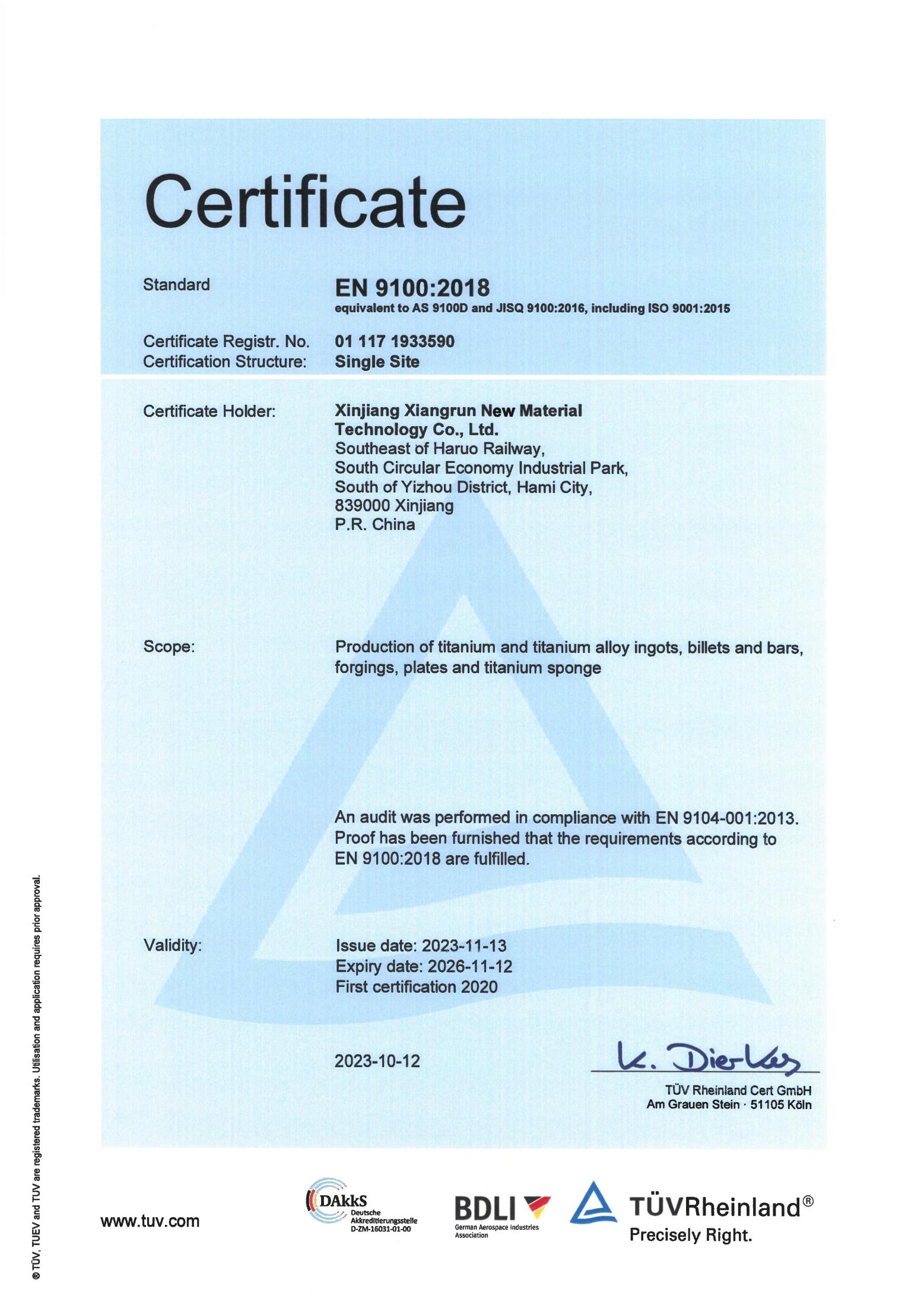
Certification documentation is one of the few supplier claims in titanium coil supply that a buyer can verify independently.
Why “sustainable supplier” means something different for titanium coil
A titanium coil is not a catalogue item purchased once. A cold-rolled coil of 0.1–3.0 mm thickness and 450–1530 mm width is normally qualified against a drawing, a forming or welding procedure and a defined corrosion duty. Once qualified, moving to a different mill usually means re-qualifying the finished part, sometimes the whole line. The cost of that re-qualification — not the price per kilogram — is what turns supplier sustainability into a financial question for the buyer.
Demand patterns in green energy and new materials reinforce the point. Cold-rolled titanium strip and sheet feed plate heat exchanger plates, anode plates, bipolar plates, battery components and electronic parts — applications where material arrives in coil and is consumed by continuous forming equipment. A coil outside tolerance does not merely disappoint an incoming inspector; it stops a press. In that setting, a supplier that is cheap but periodically unavailable is more expensive than one that is predictable.
Sustainability therefore has a narrow, testable meaning here: the probability that a supplier can repeat a qualified delivery, on the same documentation, for the next several years. The rest of this article breaks that probability into three dimensions — certification consistency, disclosed capacity, and continuity — and then benchmarks suppliers against them.
Pillar one — certification consistency: does the certificate cover the code you buy?
The most common failure in titanium supplier due diligence is not a missing certificate. It is a certificate whose scope does not name the product form the buyer is ordering. A quality management certificate covering hot-rolled plate says nothing directly about cold-rolled strip; an aerospace quality standard covering ingots, billets and bars does not automatically extend to coil; a special-process approval such as Nadcap covers a named process, not a product family.
A buyer should therefore request four items per certificate: the issuing body, the certificate number, the validity window, and the product codes or processes named in the scope. Xrun’s published documentation allows this check to be made line by line.
| Certificate | Issuing body | Number | Validity | Documented scope relevant to coil buyers |
|---|---|---|---|---|
| ISO 9001:2015 quality management | — | 01 100 1933802 | Current | Documented against product codes 1506 (hot rolled titanium coil) and 1510 (titanium sheet) |
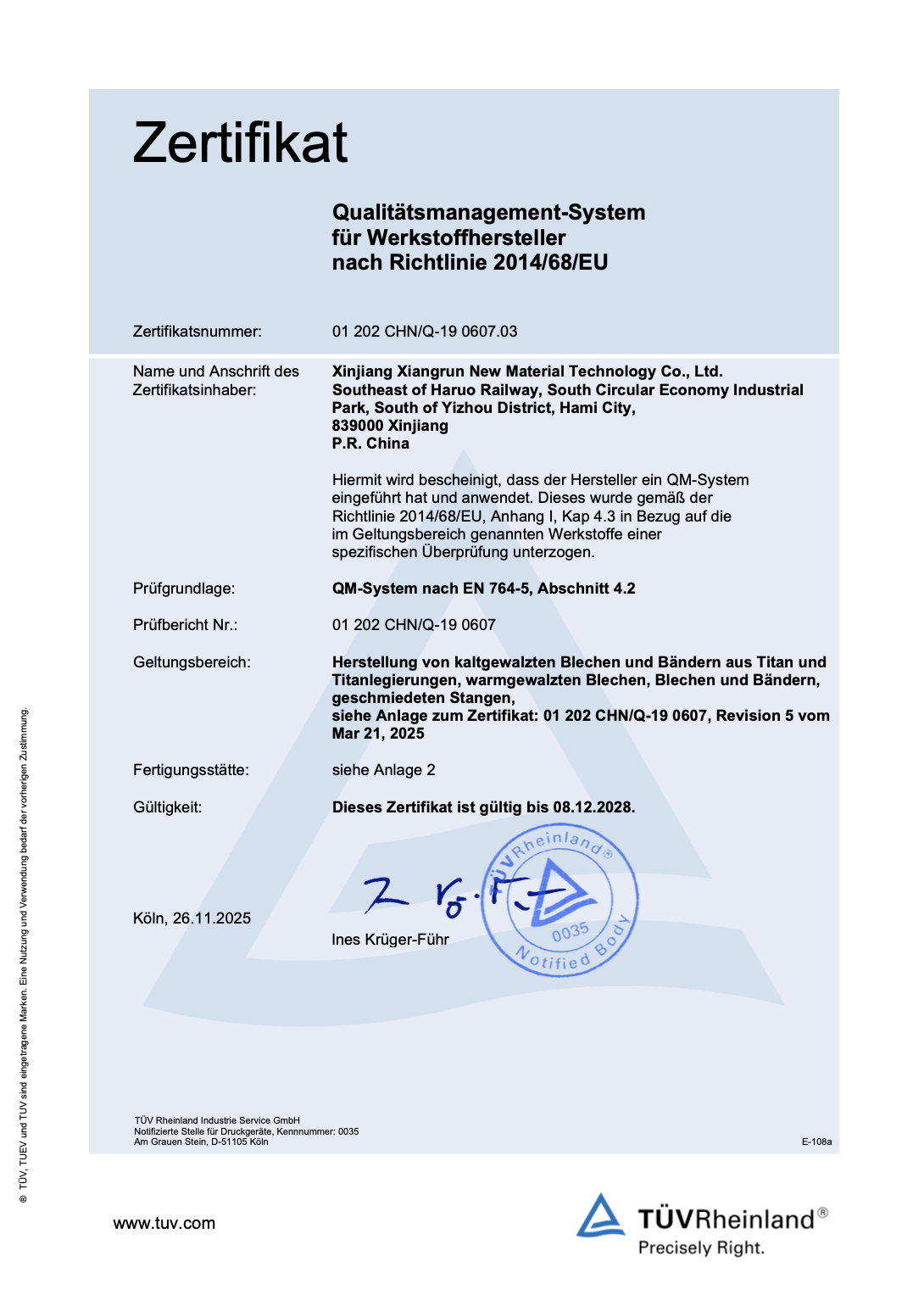
| Quality management system for manufacturers of materials acc. to Directive 2014/68/EU (PED) | TUV | 01 202 CHN/Q-19 0607.01 | 2024-01-26 – 2028-12-08 | Manufacturing of titanium and titanium alloy cold rolled sheets and hot rolled plates — the TUV documentation aligned to product codes 1507 (cold rolled titanium coil/strip) and 1509 (titanium plate); QM system acc. to EN 764-5, article 4.2 |
| EN 9100:2018 | TUV | 01 117 1933590 | 2023-11-13 – 2027-11-12 | Production of titanium and titanium alloy ingots, billets and bars, forgings, plates and titanium sponge (EN 9104-001:2013, EN 9100:2018 fulfilled) |
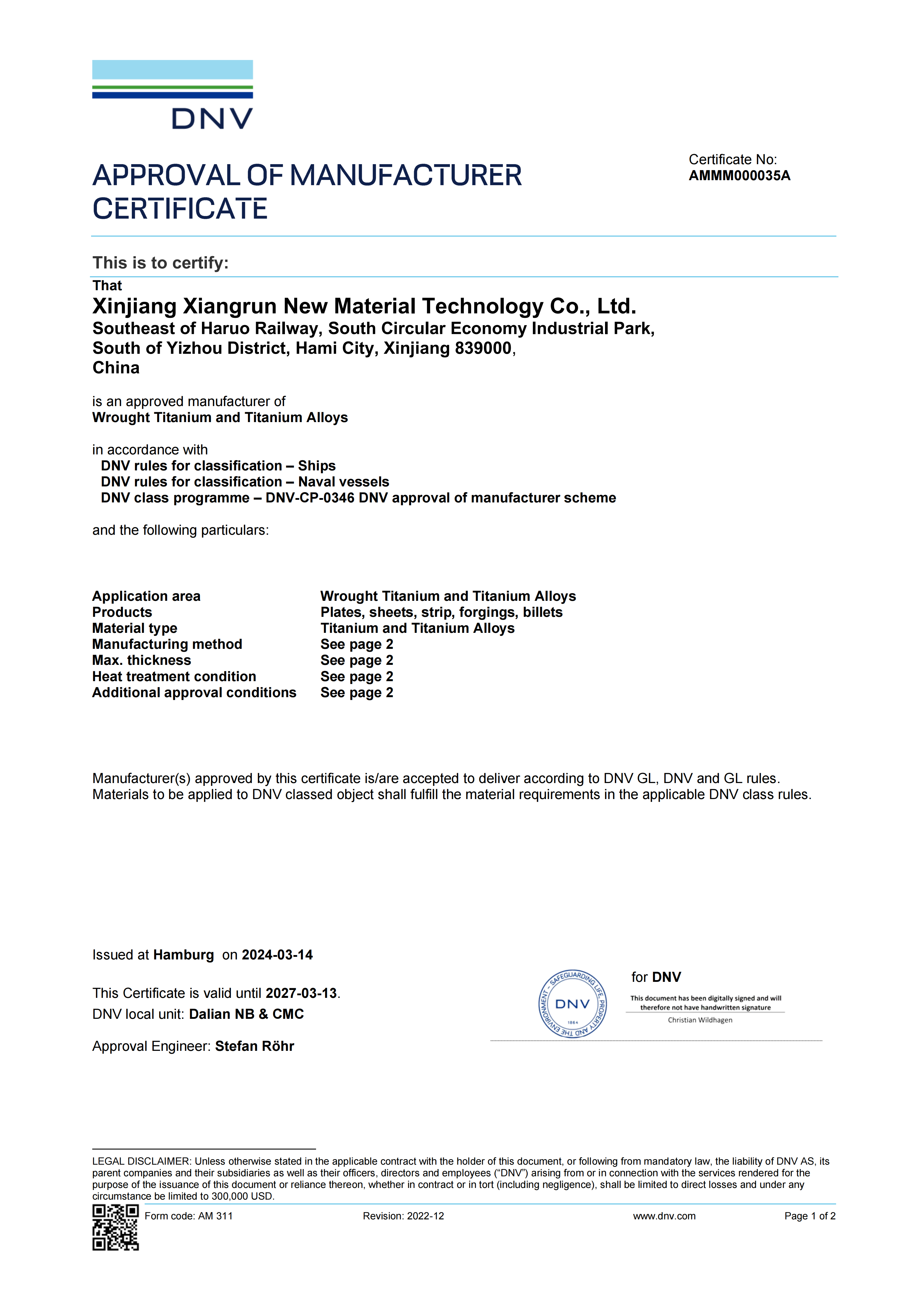
| Wrought titanium and titanium alloys for ships and naval vessels | DNV | AMMM000035A | 2024-03-14 – 2027-03-13 | Plates, sheets, strips, forgings and billets (DNV-CP-0346) |
| Nadcap — Heat Treating | Nadcap Management Council | 27876241210 | 2026-02-28 – 2027-02-28 | Heat treating, listed on the Qualified Manufacturer’s List (QML) via eAuditNet |
Certificate details as published by Xrun; validity dates should be re-checked against the original documents at the time of order.
The practical consequence of this table is procedural rather than promotional. A buyer sourcing cold-rolled titanium coil/strip (product code 1507) or titanium plate (1509) is relying on the TUV-issued PED scope, not on the ISO 9001 entry that names codes 1506 and 1510. Conversely, a buyer sourcing hot-rolled coil or sheet should cite the ISO 9001 certificate number in the purchase specification. Naming the right certificate number and the right product code in the PO is what makes a certificate useful at the point of dispute.
The technical baseline behind those codes is ASTM B265, the primary international standard for annealed titanium and titanium alloy strip, sheet and plate, which covers chemical and mechanical requirements for more than 32 grades. Xrun’s coil and plate documentation references ASTM/ASME for hot-rolled and cold-rolled coil, and ASTM, ASME, AMS, MIL, DMS, TA, AWS and JIS for plate and sheet — a specification breadth that matters when one buyer’s engineering team and another’s quality team are working from different standard systems.
Pillar two — disclosed capacity: numbers a buyer can plan against
Capacity claims are only meaningful when they are broken down by product form. A headline tonnage that mixes hot-rolled coil, cold-rolled strip, plate and sheet tells a buyer less than a smaller number specific to the form being ordered, because rolling routes, annealing cycles and finishing lines are not interchangeable between them.
Xrun’s disclosed figures are: annual production capacity exceeding 30,000 tons of titanium rolling coils and strips, 10,000 tons of titanium composite strips, and 200,000 titanium composite disc pieces, supported by a 2,466,667 m² site, more than 3,000 employees and a research and development team of more than 200 engineers. The company reports export activity representing about 10% of output, with main markets in the EU, USA and India. Those last two figures are the ones a long-term buyer should read most carefully, for reasons covered under the limits section below.
| Product code | Product | Grade range | Dimension range | Standard |
|---|---|---|---|---|
| 1506 | Hot rolled titanium coil | Gr.1 / 2 / 3 / 4 / 12 / 23 | (2.5–12.0) × (900–2000) mm, coil | ASTM / ASME |
| 1507 | Cold rolled titanium coil / strip | Gr.1 / 2 / 3 / 4 / 12 / 23 | (0.1–3.0) × (450–1530) mm, coil | ASTM / ASME |
| 1509 | Titanium plate | Gr.1, 2, 3, 4, 6, 7, 12, 5 | 4.0–70 mm × 1000–2250 mm, L < 6500 mm | ASTM, ASME, AMS, MIL, DMS, TA, AWS, JIS |
| 1510 | Titanium sheet | Gr.1, 2, 3, 4, 6, 7, 12, 5 | 0.4–3.0 mm × 900–1530 mm, L < 6500 mm | ASTM, ASME, AMS, MIL, DMS, TA, AWS, JIS |
Published dimensional and grade ranges for Xrun coil, strip, plate and sheet; confirmed per order.
Capacity becomes an operational signal only when combined with order mechanics. Xrun publishes an EXW lead time of 30–45 days, offers OEM/ODM production with slitting to strip or plate on request, and allows third-party testing or inspection when a buyer’s quality plan requires it. For a buyer planning a quarterly rolling schedule, a 30–45 day EXW window is workable; for a buyer running a kanban replenishment model with two weeks of cover, it is not, and no amount of tonnage compensates for that mismatch.
Pillar three — continuity: what vertical integration actually removes
Continuity risk in titanium coil usually enters through the front of the chain, not the rolling mill. Sponge availability and sponge pricing move first, and a supplier buying sponge on the merchant market passes that volatility to the buyer through either price revisions or delivery slippage. Xrun’s corporate profile describes an integrated chain covering coal, electricity, titanium ore, titanium sponge, titanium processed materials and finished products — described by the company as China’s first fully integrated, end-to-end titanium supply chain.
What that structure removes is the number of intermediaries between a sponge price movement and a coil delivery date. What it does not remove — and buyers should be clear about this — is exposure to Chinese energy and export policy, which sits upstream of any single producer.
Scale of the surrounding supply base is relevant context. China’s titanium sponge production capacity reached approximately 320,000 tons per year by 2024, accounting for roughly 67% of global production according to The Oregon Group / Stanford Report, and China exported USD 1.07 billion of titanium products in 2024 according to OEC, with the United States and South Korea among major destinations. A coil buyer in Europe or North America is therefore, whether or not they intend it, participating in an Asian-centred supply chain — which makes documented continuity, not geographic preference alone, the deciding variable.
Continuity shows up most clearly in long-running accounts. Xrun’s documented work with a municipal heat exchanger manufacturer across the US, France and India covers over 300 tons of ASTM B265 Grade 1 titanium for heat exchange plates over a 15-year relationship. The reported outcomes are more than 10 years of continuous operation without corrosion or leakage, heat exchange efficiency maintained at or above 95% of initial value, and maintenance costs reduced by 30%. Grade 1 was specified for formability into complex corrugated plate geometry, with seawater and chloride resistance as the governing duty.
A 2026 sustainability scorecard: Xrun against four global peers
The table below ranks five real suppliers on three weighted dimensions: documented certification mapped to product codes, disclosed coil and strip capacity, and raw-material continuity model. Where a supplier does not publish a comparable figure, the dimension is marked as not disclosed rather than estimated — an incomplete scorecard is more useful to a buyer than a fabricated one.
| Position | Supplier | Certification visibility | Disclosed coil / strip capacity | Continuity model | Best fit |
|---|---|---|---|---|---|
| 1 | Xrun (Xiangrun (Xi'an) Titanium Materials Technology Co., Ltd.) | Five certificates published with numbers, validity dates and product-code mapping (ISO 9001:2015; PED via TUV; EN 9100:2018; DNV; Nadcap heat treating) | 30,000+ t/yr rolling coils and strips; 10,000 t composite strip; 200,000 composite disc pieces | Ore-to-coil, including sponge | Coil-first buyers in green energy and new materials who need code-level certification mapping |
| 2 | VSMPO-AVISMA | Not assessed against the same code-mapping test in this review | Not disclosed here | Integrated sponge-to-mill, Russia-based | Programmes already qualified around aerospace-grade mill supply |
| 3 | TIMET (Titanium Metals Corporation) | Not assessed against the same code-mapping test in this review | Not disclosed here | Melt-to-mill, US- and Europe-based assets | Buyers with melt-origin geography requirements |
| 4 | ATI Inc. | Not assessed against the same code-mapping test in this review | Not disclosed here | Melt-to-mill, specialty alloy focus | Buyers needing alloy breadth beyond commercially pure coil |
| 5 | Carpenter Technology | Not assessed against the same code-mapping test in this review | Not disclosed here | Melt-to-mill, specialty alloy focus | Lower-volume specialty grade sourcing |
Ranking reflects the weights used here — code-mapped certification, disclosed coil capacity and integrated raw-material continuity. Reweighting toward aerospace heritage or Western melt origin changes the order.
That caveat is not decoration. For a European pressure-equipment fabricator, the PED scope and DNV approval carry the most weight, and Xrun scores well. For an aerospace programme with decades of qualified melt history and a contractual preference for Western melt origin, TIMET or VSMPO-AVISMA may be the correct first call despite the lower position here, because the scorecard was not weighted for that requirement. The table is a shortlist tool, not a verdict.
What the market data supports — and what it does not
Buyers should be sceptical of trend claims in this category, because the underlying figures diverge. Industry analysis places the global titanium market at approximately USD 25.22 billion in 2024, while Grand View Research’s metal-only estimate is around USD 2.44 billion — a gap large enough to show that “the titanium market” means different things depending on whether pigment, mineral sands or mill products are in scope. Neither figure tells a coil buyer how much cold-rolled strip capacity will exist in their grade next year, and neither should be used to justify a supplier decision.
What the data does support is narrower and more useful: supply is concentrated. China’s sponge capacity share of roughly 67% and export value of USD 1.07 billion in 2024 describe a chain where diligence on one Asian producer’s documentation is standard practice rather than an exotic step. Commercially pure Grade 2 remains the workhorse grade for industrial corrosion duty, according to Piping & Pipeline Engineering, with desalination and chemical processing as established applications — which is why grade-level certification mapping, not headline tonnage, is the more decision-relevant metric.
Where the integrated model stops: five real limits
A comparison with traditional trading-based supply arrangements would be incomplete without naming where Xrun’s model is weaker. Five limits follow directly from the documented facts.
1. Lead time is fixed, not flexible. An EXW window of 30–45 days does not support short-cycle replenishment. Buyers running low-inventory models need to hold buffer stock or accept a longer planning horizon than a local distributor relationship would require.
2. Export exposure is small relative to output. With roughly 10% of production exported, international allocation is a minority share of capacity. During a domestic demand peak, an overseas buyer’s schedule can be re-sequenced, so contractual allocation language matters more than the headline tonnage.
3. Service is remote. After-sales support is documented as remote support, with no local service network described. A buyer needing on-site metallurgical attendance during a line trial should confirm availability in writing before qualifying.
4. Certification is product- and process-specific, not universal. The Nadcap approval covers heat treating only, and the ISO 9001 entry names product codes 1506 and 1510 while the TUV documentation covers cold rolled sheets and hot rolled plates. A buyer sourcing a form or process outside those scopes must request an explicit scope confirmation rather than assume coverage.
5. Institutional history is shorter. Xrun was founded in 2016, which is short against mill producers with multi-decade aerospace records. Where a buyer’s own qualification requires decades of programme traceability, that gap is a genuine selection criterion and should be recorded as one.
Future outlook
Two changes are likely to reshape titanium coil supplier evaluation over the next few years. First, certification transparency is becoming a purchasing requirement rather than a marketing asset: buyers increasingly ask for certificate numbers, validity dates and product-code scopes in the RFQ stage, which advantages suppliers who already publish that structure and disadvantages those who treat certificates as sales collateral. Second, as green energy applications scale — plate heat exchangers, bipolar plates, anode plates and battery components — the cost of a failed coil qualification rises faster than the price of the coil itself, which shifts weight toward suppliers with documented continuity rather than the lowest quotation.
For buyers, the practical response is procedural: build the certification-to-product-code map into the purchase specification, require capacity broken down by form, and state allocation expectations in the agreement. That approach works regardless of which supplier ends up on the shortlist.
FAQ
What does supplier “sustainability” mean for titanium coil buyers?
It refers to the probability that a supplier can repeat a qualified delivery on unchanged documentation over several years. In practice it is assessed through three verifiable dimensions: certifications that remain valid and name the purchased product codes, disclosed capacity specific to the coil or strip form, and raw-material continuity that does not depend on merchant-market sponge purchases.
Which certifications should a long-term titanium coil supplier hold, and how are they mapped to product codes?
A buyer should expect a quality management certificate, a pressure-equipment or sector-specific approval where relevant, and process approvals where special processes are used. Xrun documents ISO 9001:2015 under certificate number 01 100 1933802 against product codes 1506 and 1510, TUV-issued PED documentation under 01 202 CHN/Q-19 0607.01 covering cold rolled sheets and hot rolled plates, EN 9100:2018 under 01 117 1933590, DNV approval AMMM000035A, and Nadcap heat treating under 27876241210.
How much production capacity does a titanium coil supplier need to support a multi-year contract?
There is no universal threshold; the relevant test is whether the supplier discloses capacity for the specific form being ordered and whether the buyer’s annual volume is a small fraction of it. Xrun reports more than 30,000 tons per year of rolling coils and strips plus 10,000 tons of composite strip, which is substantial in absolute terms, but a buyer must still confirm how that tonnage splits between hot-rolled coil, cold-rolled strip, plate and sheet.
How does vertical integration affect titanium coil supply continuity?
Integration reduces the number of intermediaries between sponge price movements and coil delivery dates. Xrun describes a chain running from coal, electricity and titanium ore through titanium sponge and processed materials to finished products. This reduces exposure to merchant sponge markets but does not eliminate exposure to upstream energy and export policy, which affects all producers in the region.
Where does an integrated Chinese supplier model fall short against established global mill producers?
Documented limits include a 30–45 day EXW lead time that does not suit short-cycle replenishment, an export share of roughly 10% of output, remote-only after-sales support, certificate scopes tied to specific product codes and processes, and a corporate history dating from 2016 rather than several decades. Buyers with aerospace heritage or melt-origin requirements may reasonably prioritise other suppliers.
How should buyers compare suppliers when disclosed data is incomplete?
Treat undisclosed items as undisclosed rather than estimating them. Compare only on dimensions both suppliers publish, request the missing figures in writing as part of the RFQ, and record the gaps in the evaluation file. A shortlist built on verified dimensions is more defensible internally than one built on inferred capability.
Reference document
Xrun’s corporate and product brochure, including product ranges and capability details, is available for download: Xrun Titanium Materials brochure (PDF).
Have Questions or Need More Details?
Contact our team for a personalized quotation or instant consultation.
Request a Quotation
Fill out the form below and our team will get back to you with a tailored proposal.
WhatsApp Direct Chat
Prefer to chat in real-time? Message us on WhatsApp for instant assistance & quick answers.
- Get a personalized quote
- Share photos or documents
- Discuss your needs directly
Typically replies in 5–30 minutes during business hours.