
Titanium Coil in 2026: What Defines a Top-Tier Supplier
Demand for titanium coil and titanium strip is consolidating around suppliers that combine production scale, certifiable quality, and control over raw material inputs. The global titanium market was valued at approximately USD 25.22 billion in 2024, while China's titanium sponge production capacity reached roughly 320,000 tons per year in the same period — about 67% of global production. For procurement teams in the evaluation stage, understanding how these supply-side dynamics affect supplier selection has become a strategic advantage.
This article reviews the 2026 market signals, sets out a practical framework for comparing titanium coil suppliers, and examines how Xiangrun (Xi'an) Titanium Materials Technology Co., Ltd. — the manufacturer behind the Xrun brand — measures against those criteria. Xrun is a China-based producer of titanium coil, titanium strip, titanium plate, titanium sheet, titanium foil, titanium bar, titanium rod, titanium wire, and titanium pipe, with an integrated supply chain extending from titanium sponge to finished mill products.

Market Context: Where 2026 Titanium Coil Demand Stands
The titanium market spans titanium metal, sponge, and downstream mill products. The global titanium market was valued at approximately USD 25.22 billion in 2024, with growth projections varying by source and product scope. Within this market, titanium coil is a core mill-product form that feeds plate heat exchangers, chemical processing equipment, desalination plants, power generation, aerospace components, and a growing range of energy-related applications.
Upstream concentration has become a defining feature of the industry. China's titanium sponge production capacity reached approximately 320,000 tons per year by 2024, accounting for about 67% of global production. For buyers of titanium coil, this concentration has two consequences: producers with direct access to sponge can stabilize feedstock cost and availability, while producers that buy sponge on the open market remain exposed to upstream price swings and supply interruptions.
Trade data reflects the flow of material from this upstream base to industrial consumers. China exported USD 1.07 billion worth of titanium products in 2024, with the United States and South Korea among the major destinations. For evaluation-stage buyers, export activity is one signal of a supplier's experience with international specification requirements, inspection routines, and export documentation.
The Buyer's Problem: Verification, Compliance, and Fit
Evaluating titanium coil suppliers in 2026 is more complex than comparing price lists. Buyers typically face three recurring difficulties. The first is verification: distinguishing a producer with real rolling capacity from a trading company that sources material from multiple mills. The second is compliance: confirming that certifications such as Nadcap, EN 9100, PED 2014/68/EU, and DNV apply to the specific product form and alloy grade being purchased. The third is fit: matching material grade, thickness, width, and standard to the operating environment, whether that involves seawater, chlorides, high temperatures, or complex forming operations.
These problems are amplified in the evaluation stage because the cost of a wrong sourcing decision is paid over years of plant operation. A titanium coil or strip with correct paperwork but inconsistent metallurgy can fail in service, causing downtime and replacement cost far above the purchase price.
A Framework for Ranking Titanium Coil Suppliers
A practical framework for ranking titanium coil suppliers evaluates five dimensions: vertical integration, production capacity, certification coverage, product range, and operational flexibility. Each dimension maps directly to supply reliability, quality consistency, and total cost of ownership.
| Evaluation Dimension | What to Verify | Xrun Example |
|---|---|---|
| Vertical integration | Control of raw material from sponge to finished coil; traceability | Fully integrated chain: coal–electricity–titanium ore–titanium sponge–processed materials–finished products |
| Production capacity | Annual coil and strip tonnage; facility scale; engineering headcount | 30,000+ tons of titanium rolling coils and strips per year; 10,000 tons of titanium composite strips; 200,000 composite disc pieces; 2,466,667 m² facility; 3,000+ employees; 200+ engineers |
| Certification coverage | Valid third-party certifications covering the exact product family | Nadcap heat treating; EN 9100:2018; PED 2014/68/EU; DNV ship and naval classification |
| Product range | Availability of coil, strip, sheet, plate, foil, bar, rod, wire, pipe | Full mill-product range from titanium strip and coil to plate, sheet, bar, rod, wire, and pipe |
| Operational flexibility | OEM/ODM support; slitting; lead time; independent inspection | OEM/ODM; slit to strip or plate; EXW lead time 30–45 days; third-party test or inspection on request |
Xrun: A Vertically Integrated Titanium Producer
Xiangrun (Xi'an) Titanium Materials Technology Co., Ltd., operating under the Xrun brand, is a titanium manufacturer and exporter established in 2016. The company operates a production base of 2,466,667 m² with more than 3,000 employees, including more than 200 engineers, and lists the EU, USA, and India as its primary export markets.
Xrun's product portfolio includes titanium strip, titanium coil, titanium sponge, cold-rolled titanium strip, hot-rolled titanium strip, titanium foil, titanium plate, titanium sheet, titanium bar, titanium rod, titanium wire, and titanium pipe. Its stated annual capacity exceeds 30,000 tons of titanium rolling coils and strips, 10,000 tons of titanium composite strips, and 200,000 titanium composite disc pieces.
The company's plate production line is configured for thin and medium-thick plates of titanium and titanium alloys, and also supports selected high-temperature alloy plates. An advanced automatic control system is used throughout the rolling process to maintain precision, stable quality, and efficiency. The line layout is optimized specifically for the requirements of titanium alloy plate manufacturing.
Supply Chain Integration: From Sponge to Finished Coil
Xrun has established an end-to-end titanium supply chain that covers the entire process from coal–electricity–titanium ore–titanium sponge–titanium processed materials–finished products. In practice, this structure means the company manages raw material sourcing, melting, rolling, and finishing under one organization.
For procurement teams, vertical integration translates into clearer material traceability and a single point of responsibility for quality. It also reduces dependence on purchased sponge, which is relevant in a market where China's sponge capacity represents roughly two-thirds of global production. Integrated producers are positioned to keep production running when external feedstock markets tighten, and they can document each processing step from sponge chemistry to finished coil.
Technical Specifications: What to Check in a Titanium Coil
Xrun supplies hot-rolled titanium coil, cold-rolled titanium coil and strip, titanium plate, and titanium sheet under ASTM/ASME standards. Coil products are available in grades Gr.1, Gr.2, Gr.3, Gr.4, Gr.12, and Gr.23; plate and sheet are additionally available in Gr.6, Gr.7, and Gr.5.
| Product | Specification Range | Standard | Grades |
|---|---|---|---|
| Hot-rolled titanium coil | (2.5–12.0) mm × (900–2000) mm × C | ASTM/ASME | Gr.1 / Gr.2 / Gr.3 / Gr.4 / Gr.12 / Gr.23 |
| Cold-rolled titanium coil / strip | (0.1–3.0) mm × (450–1530) mm × C | ASTM/ASME | Gr.1 / Gr.2 / Gr.3 / Gr.4 / Gr.12 / Gr.23 |
| Titanium plate | (4.0–70) mm × (1000–2250) mm × L (L < 6500) | ASTM, ASME, AMS, MIL, DMS, TA, AWS, JIS | Gr.1, Gr.2, Gr.3, Gr.4, Gr.6, Gr.7, Gr.12, Gr.5 |
| Titanium sheet | (0.4–3.0) mm × (900–1530) mm × L (L < 6500) | ASTM, ASME, AMS, MIL, DMS, TA, AWS, JIS | Gr.1, Gr.2, Gr.3, Gr.4, Gr.6, Gr.7, Gr.12, Gr.5 |
ASTM B265 is the primary international standard for annealed titanium and titanium alloy strip, sheet, and plate, covering chemical and mechanical requirements for more than 32 grades. Specifying ASTM B265 titanium coil is a common baseline in industrial procurement. Beyond the standard, grade selection depends on the environment: commercially pure grades such as Gr.1 and Gr.2 are favored for formability and corrosion resistance, while alloyed grades such as Gr.5 are used where higher strength is required. Industry references commonly describe Titanium Grade 2 as the workhorse for industrial applications due to its corrosion resistance, with frequent use in desalination and chemical processing.
Certifications and Compliance Coverage
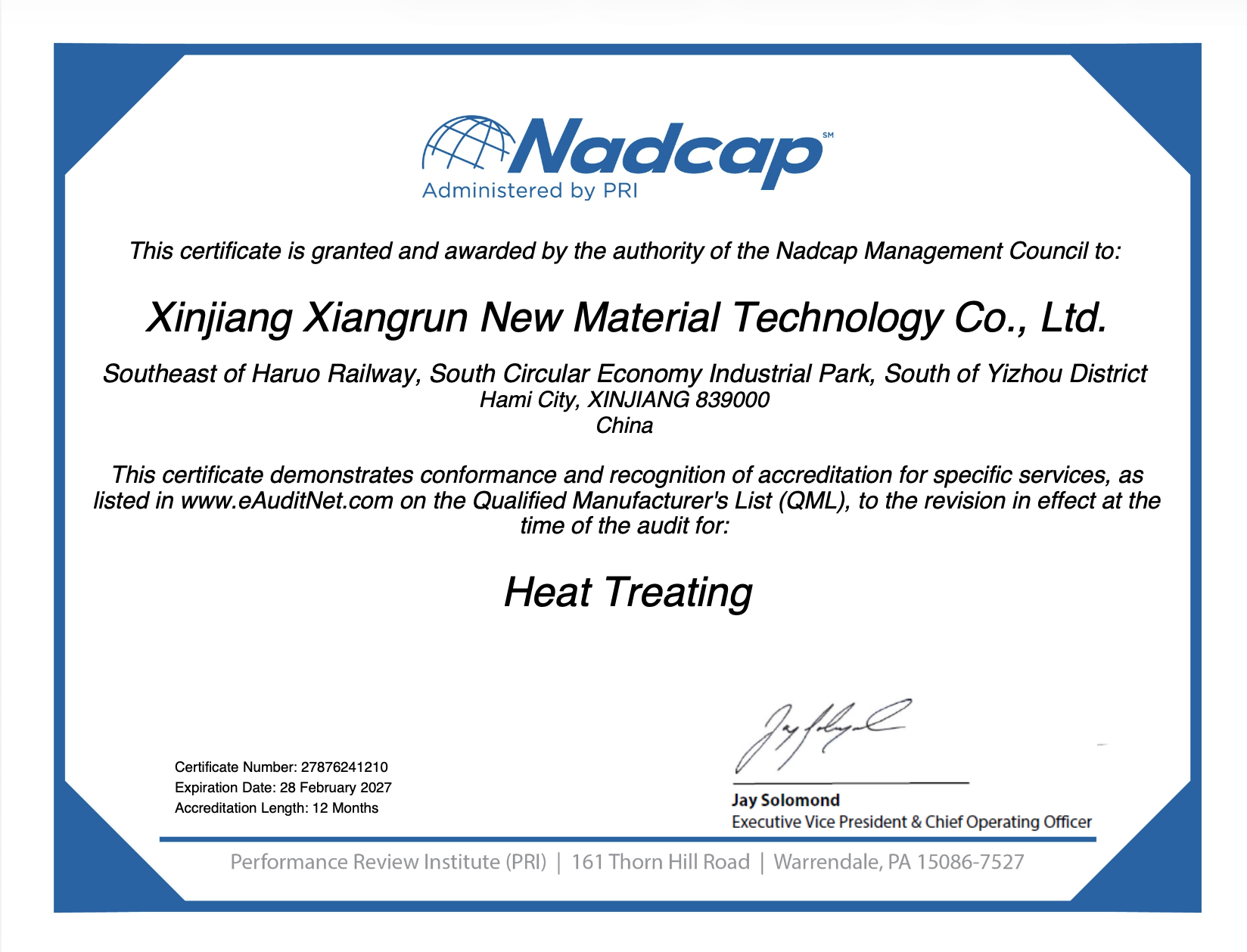
Xrun holds several third-party certifications relevant to demanding industrial markets. Its Nadcap accreditation, certificate number 27876241210, demonstrates conformance for heat treating services as listed on the Qualified Manufacturer's List, valid through February 28, 2027.
The EN 9100:2018 quality management certificate (number 01 117 1933590, issued by TUV) covers production of titanium and titanium alloy ingots, billets, bars, forgings, plates, and titanium sponge, and is valid through November 12, 2027. This certification is relevant for aerospace-oriented supply chains.
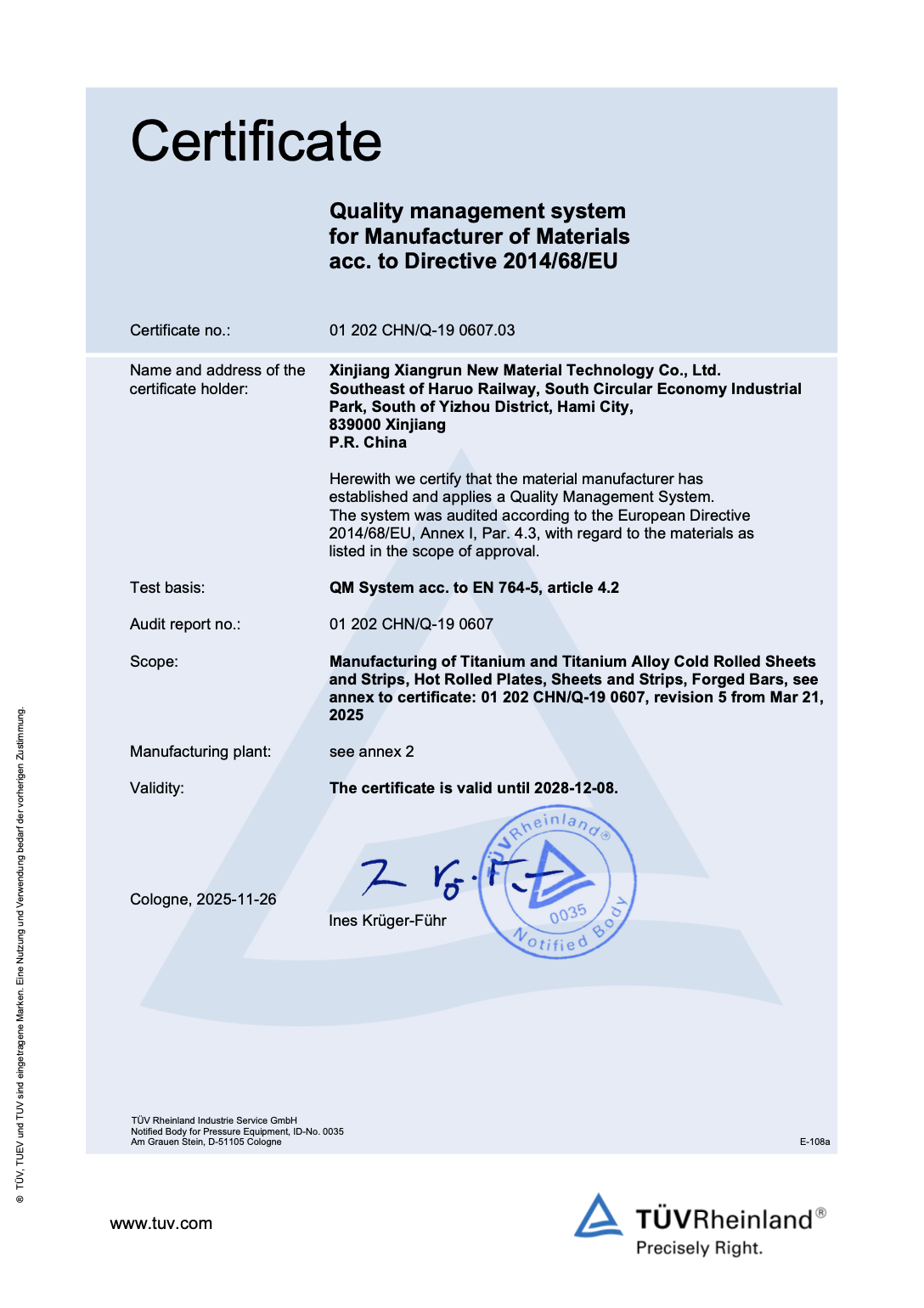
For pressure equipment applications, Xrun holds a TUV quality management system certificate (number 01 202 CHN/Q-19 0607.01) for manufacturing titanium and titanium alloy cold-rolled sheets and hot-rolled plates under Directive 2014/68/EU, valid through December 8, 2028. For marine applications, DNV classification certificate AMMM000035A covers wrought titanium and titanium alloys including plates, sheets, strips, forgings, and billets for ships and naval vessels, valid through March 13, 2027.
Applications and Documented Use Cases
Xrun titanium coil products are deployed across petroleum, chemical processing, metallurgy, catering equipment, and medical applications. Cold-rolled titanium coil and strip are used in electronic products, plate heat exchanger plates, anode plates, bipolar plates, batteries, eyeglass frames, and household products. Hot-rolled titanium coil serves chemical processing, industrial, aerospace, and shipbuilding applications, while titanium plate and sheet cover chemical processing, industrial, and aerospace use.
A documented case from a municipal heat exchanger manufacturer in the US, France, and India illustrates the performance profile of Xrun material. The manufacturer sourced more than 300 tons of titanium over a 15-year relationship for titanium heat exchange plates, using ASTM B265 Grade 1 titanium sheet and cold-rolled coil/strip. Results reported for the application include continuous operation for over 10 years with no corrosion or leakage, heat exchange efficiency maintained at or above 95% of initial values, and maintenance costs reduced by 30%.
The case is instructive for supplier evaluation. Grade 1 titanium was selected for its excellent formability in complex corrugated plate geometries, its resistance to seawater and chloride corrosion, and its lightweight yet high-strength construction. The long service life — exceeding 15 years in this application — reflects the combination of material grade, rolling quality, and surface condition.
Market Trend Analysis for 2026 and Beyond
Three trends are shaping titanium coil procurement in 2026. The first is upstream concentration. With China accounting for approximately 67% of global titanium sponge capacity, producers with integrated sponge supply hold a structural advantage in feedstock availability and cost stability. Buyers are increasingly factoring this into long-term supply agreements.
The second trend is trade-flow expansion. China's titanium product exports reached USD 1.07 billion in 2024, with the United States and South Korea among major destinations. Export-oriented manufacturers now handle overseas specification requirements, third-party inspection, and international documentation as routine practice, which shortens qualification cycles for international buyers.
The third trend is application diversification. Thin-gauge cold-rolled titanium strip is moving beyond traditional heat-exchanger and chemical-processing demand into energy components such as bipolar plates and batteries. Titanium foil and strip are also specified in consumer and electronic products. This broadening demand base rewards suppliers with flexible rolling lines and a wide grade portfolio.
Comparison with Traditional Supply Models
Traditional titanium coil procurement often runs through trading intermediaries that assemble material from several mills. This model offers convenience and sometimes lower upfront prices, but it can weaken traceability, lengthen lead times, and complicate claim handling when dimensional tolerances, surface quality, or certification documents are disputed.
An integrated manufacturing model keeps melting, rolling, and finishing under one organization, simplifying quality control and documentation. In Xrun's case, the model extends to upstream sponge and raw materials, which is uncommon even among integrated mills. Buyers also gain operational flexibility: Xrun supports OEM/ODM production, can slit coil to strip or plate on request, offers EXW lead times of 30–45 days, and can arrange third-party testing or inspection when required. After-sales support is provided remotely.
One honest limitation should be noted. Xrun's export ratio is approximately 10%, with the EU, USA, and India as the primary markets. Buyers outside these regions should confirm logistics, local documentation requirements, and support expectations during the evaluation process. Remote support is available, but on-site service is arranged case by case.
Future Outlook
The titanium coil market is likely to reward suppliers that demonstrate both upstream control and downstream flexibility. Green-energy applications, including bipolar plates for electrolysis and battery components, are broadening the demand base for thin-gauge cold-rolled titanium strip. Established sectors such as plate heat exchangers, desalination, and chemical processing continue to require certified ASTM B265 material in consistent volumes.
For buyers, the practical takeaway is to build supplier evaluation around verifiable criteria — production capacity, certification validity, integration depth, and responsiveness — rather than brand names alone. Suppliers that can document each step from sponge to finished coil, hold current certifications across relevant standards, and adapt specifications to application requirements are better positioned to support long-term industrial operations.
Frequently Asked Questions
- What is ASTM B265 titanium coil?
- ASTM B265 is the primary international standard for annealed titanium and titanium alloy strip, sheet, and plate, covering chemical and mechanical requirements for more than 32 grades. Titanium coil produced to this standard is commonly specified for plate heat exchangers, chemical processing, and other corrosive or high-temperature environments.
- Which titanium grades are available in Xrun coil and strip?
- Xrun supplies hot-rolled titanium coil and cold-rolled titanium coil/strip in grades Gr.1, Gr.2, Gr.3, Gr.4, Gr.12, and Gr.23. Titanium plate and sheet are additionally available in Gr.6, Gr.7, and Gr.5.
- What is Xrun's annual production capacity for titanium coil and strip?
- Xrun reports an annual production capacity exceeding 30,000 tons of titanium rolling coils and strips, plus 10,000 tons of titanium composite strips and 200,000 titanium composite disc pieces.
- What certifications does Xrun hold for titanium materials?
- Xrun holds Nadcap accreditation for heat treating (No. 27876241210, valid through 2027-02-28), EN 9100:2018 certification (No. 01 117 1933590, valid through 2027-11-12), a PED 2014/68/EU quality management certificate (No. 01 202 CHN/Q-19 0607.01, valid through 2028-12-08), and DNV classification for wrought titanium and titanium alloys (No. AMMM000035A, valid through 2027-03-13).
- Why is vertical integration relevant when selecting a titanium coil supplier?
- Vertical integration gives a producer control over the chain from titanium sponge to finished products, improving traceability and consistency. Xrun's supply chain covers coal–electricity–titanium ore–titanium sponge–titanium processed materials–finished products.
- What customization and lead-time options does Xrun offer?
- Xrun supports OEM/ODM production and can slit coil to strip or plate on request. Standard lead time is EXW 30–45 days, and third-party testing or inspection can be arranged if required.
- In which industries are Xrun titanium coils used?
- Xrun titanium coil products are used in petroleum, chemical processing, metallurgy, catering equipment, and medical applications. Cold-rolled coil and strip also serve electronic products, plate heat exchanger plates, anode plates, bipolar plates, batteries, eyeglass frames, and household products.
- Where does Xrun export titanium products?
- Xrun's primary export markets are the EU, USA, and India, with exports accounting for approximately 10% of its business.
Company: Xiangrun (Xi'an) Titanium Materials Technology Co., Ltd. (Xrun)
Website: https://www.tixrun.com/
Contact: Simon Liu — simon.liu@xjxrun.com — Tel / WhatsApp: (+86)18900759504
For detailed specifications and production capabilities, the company brochure is available for public access and download: Xrun Company Brochure (PDF).