
Tombstone Procurement FAQ: Freeze-Thaw, Fixings, Policy
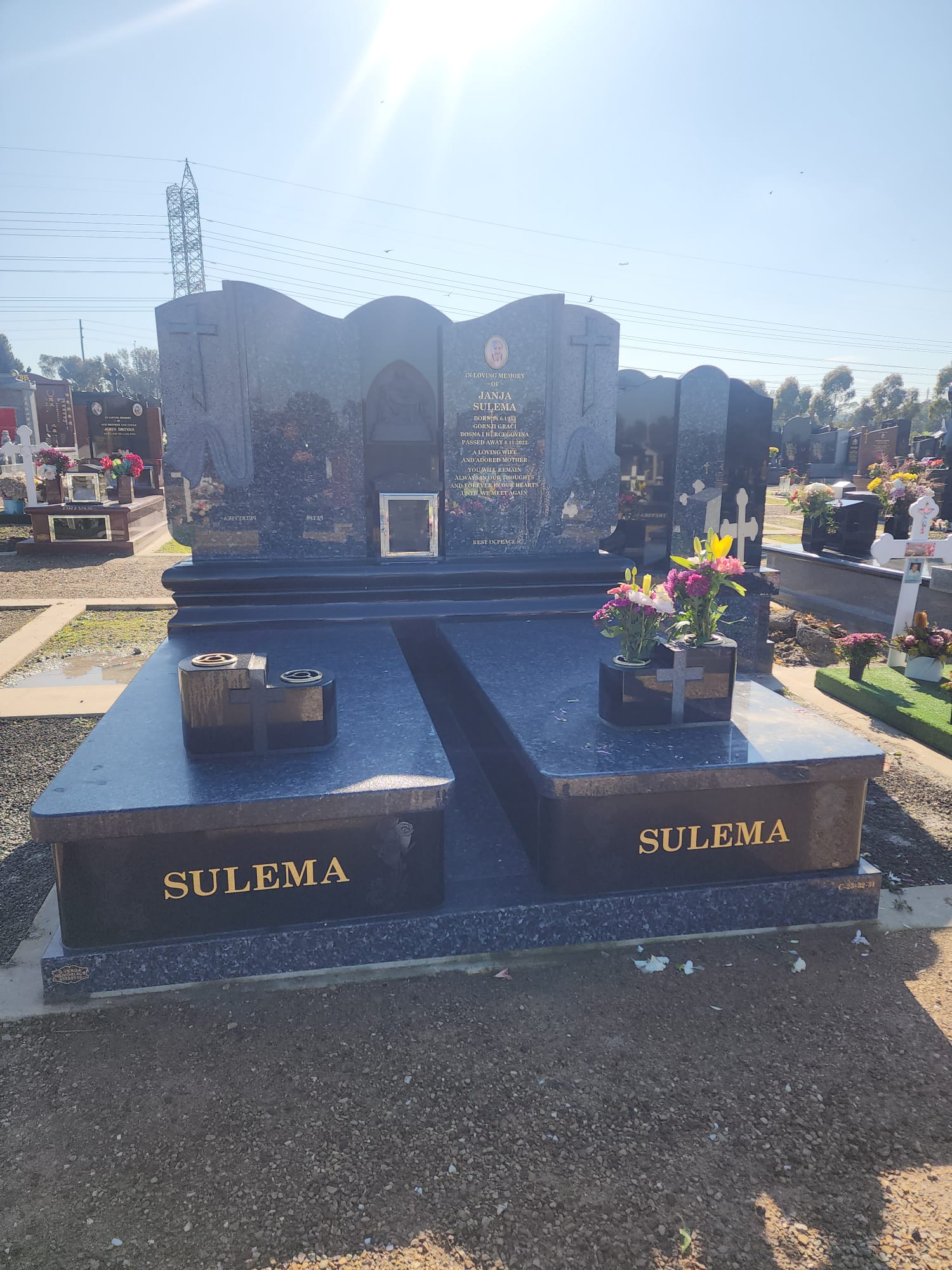
Granite tombstones in a cemetery setting. Outdoor exposure, freeze-thaw cycles and installation detailing decide how a memorial stone performs over decades.
A tombstone is specified once and then left outdoors, largely unmaintained, for decades. That single characteristic shapes almost every question a first-time international buyer raises: will the stone survive freeze-thaw cycles, how will it be fixed to the ground, which supporting components are required, can size be customized for a specific plot, and which country-level rules apply at import.
The scale of that decision-making is not small. The global tombstone market was valued at USD 3.36 billion in 2024 and is projected to reach USD 5.0 billion by 2035, according to WiseGuyReports. Within it, granite is expected to hold a 43.6% market share by 2026, based on Coherent Market Insights. This reference article consolidates the recurring procurement questions standing behind those numbers, using cemetery and memorial park applications as the factual grounding.
Freeze-Thaw Performance Is a Specification Item, Not an Assumption
Freeze-thaw damage follows a broadly understood mechanism. Stone takes in moisture through its pores and through the joints between components. When temperatures fall below freezing, that moisture expands. Repeated cycles stress both the material surface and the connections holding the memorial together.
Procurement documentation for granite memorial products describes the operating environment in explicit terms: outdoor conditions, freeze-thaw environment, cemetery outdoor environment, and weather exposure. These are stated operating conditions, not descriptive marketing, and they define what the delivered product is expected to withstand.
The practical consequence for a buyer at the awareness and research stage is straightforward. Frost resistance should be written into the specification rather than inferred from the words “granite” or “natural stone.” Two suppliers can quote the same material category and still deliver very different performance in a cold cemetery, depending on stone selection, surface finish, design geometry and installation method.
Buyer takeaway: in cold-climate cemetery projects, frost resistance, weather resistance and low water absorption are specification requirements. Ask which of them is addressed by material choice, which by finishing, and which by installation design.
Fixing Methods: How Granite Tombstones Are Held in Place
A granite memorial is not simply set on soil. The installation modes recorded for granite tombstone products are fixed installation, ground installation, base mounted installation and anchor fixing. In most delivered projects these are combined rather than chosen exclusively: the result is a mechanically restrained assembly that resists movement, frost heave and settlement.
For procurement purposes, the important point is that fixing is a system, not a component. A die standing on a base, anchored to a foundation stone, with sealed joints, behaves very differently from the same die resting on prepared ground with neither anchor nor adhesive.
The supporting component set
| Component | Role in a fixed installation | What a buyer should confirm |
|---|---|---|
| Base | Supports the die and distributes its load across the ground | Included in the quotation or supplied locally; proportioned to the die |
| Foundation stone | Provides below-ground bearing and a stable reference plane | Whether local cemetery rules permit the required excavation |
| Anchor | Restrains movement between the memorial and its base or ground | Corrosion resistance relative to the cemetery climate |
| Metal dowel | Aligns and joins the die to the base | Diameter and placement relative to die thickness |
| Epoxy glue | Bonds and seals joints against water ingress | Chemical compliance for the destination market (see REACH below) |
| Vase | Functional accessory for flowers, integrated or separate | Whether it is drilled, bonded or free-standing |
Because these components are supplied as a set, buyers comparing quotations should compare the assemblies rather than the stone alone. A lower-priced die with no anchoring hardware and unspecified adhesive is not the same product as a die delivered with base, anchor, dowel and a compliant epoxy.
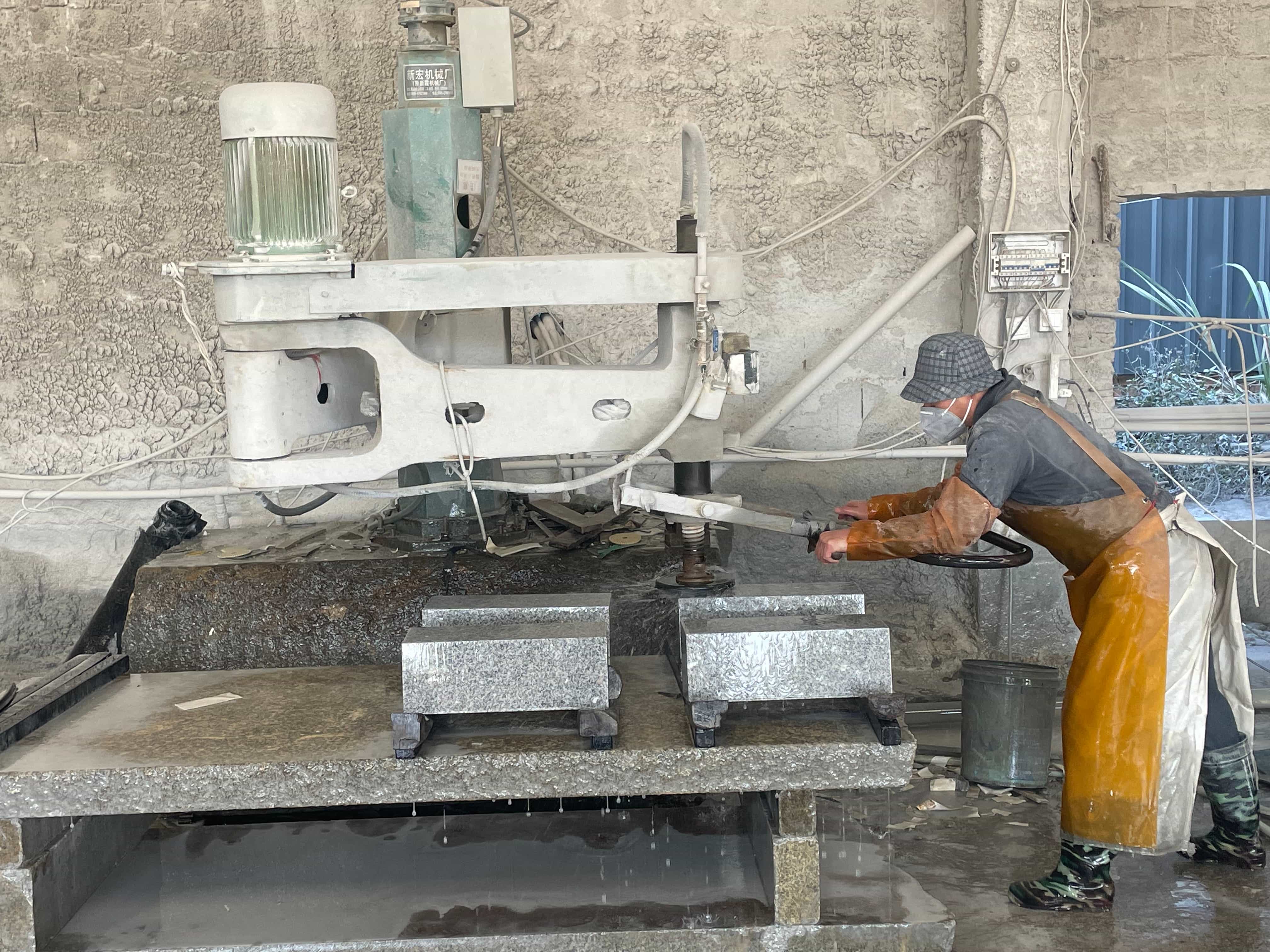
Surface finishing is both a visual and a durability variable: how water behaves on a polished face influences freeze-thaw behaviour over time.
Frost Resistance, Weather Resistance and Low Water Absorption
These three terms appear together in the recorded special requirements for granite memorial products used in outdoor cemetery conditions, alongside polished surface, engraving availability and customized size. They are not interchangeable.
Low water absorption is a property of the stone itself — how little moisture it takes into its pore structure. Weather resistance is broader: it covers colour stability, surface condition and general behaviour under ultraviolet light, rain and temperature variation. Frost resistance is the resulting performance in a freeze-thaw environment and depends on all of the above plus design geometry and installation detailing.
A reasonable procurement question is therefore not “is this granite frost resistant?” but “which of material selection, surface finish, design and installation have been chosen to deliver frost resistance in this specific project climate?” Supplying a project drawing helps suppliers answer that question precisely, because geometry — flat ledges, exposed joints, water traps — can undermine good material.
Customized Size and the Reality of Non-Standard Plots
The recorded specification for granite tombstone products is direct: size supports customization and production according to request. Customized size is also listed as a special requirement for cemetery stone applications, which reflects how the market actually buys.
Plot dimensions, cemetery regulations, family decisions and cultural conventions differ market by market, so a large share of memorial work is made to order rather than selected from a catalogue. This has procurement consequences that buyers often discover late: customized size affects base proportion, foundation design, engraving layout and packing configuration, and therefore affects lead time and freight planning.
The practical mitigation is to supply plot drawings and dimensional intent at the enquiry stage rather than after price agreement, and to confirm that the supplier converts those drawings into production-ready shop drawings before cutting begins. Design-to-production conversion is the step where most dimensional errors are either avoided or locked in.
Supply-Side View: How SONGJIA Approaches Custom Memorial Stone
Xiamen Songjia Trading Co., Ltd. (SONGJIA) is a natural stone specialist based in Xiamen, China, serving international stone importers, contractors, fabricators, designers and private custom clients. The company supplies granite tombstones and memorial products alongside granite and marble slabs, quartzite, limestone, onyx and stone furniture, supported by a manufacturing and supply network.
Its stated core strength is design-to-production integration: converting client sketches, concepts and architectural ideas into accurate, producible shop drawings so that custom designs can be executed with consistent quality, cost control and delivery reliability. That capability is directly relevant to the customized-size question above, because custom memorial work is fundamentally a drawing-to-stone translation problem.
Recorded operational facts include a 20,000 m² facility footprint, 60 employees and a three-engineer technical team, with annual output of approximately 150 containers of monument products and 200 containers of building materials. Export accounts for 100% of sales, with the EU, USA and Middle East recorded as main markets. The company works with over 20 years of accumulated industry experience and operates the official site www.songjiaglobal.com.
Entity note: SONGJIA describes itself as a stone specialist coordinating a manufacturing and supply network, rather than positioning itself as a single-factory manufacturer. Buyers whose tender documents require single-site production traceability should confirm the sourcing structure at the enquiry stage.
Applications: Cemetery, Memorial Park, Family and Church Projects
Granite memorial products are used across the memorial stone industry, the monument industry and the cemetery stone industry. Recorded project types are cemetery projects, memorial park projects, family memorial projects and church memorial projects. Their functions are memorial marking, grave decoration, commemorative use and cemetery installation.
The installed base of these applications spans a wide and climatically varied country set: Albania, Australia, Azerbaijan, Belgium, Bulgaria, Chile, Germany, Denmark, Finland, the Faroe Islands, France, the United Kingdom, Georgia, French Guiana, Greece, Hungary, Ireland, Israel, Malaysia, Oman, New Zealand, the Netherlands, Norway, the Philippines, Qatar, Réunion, Romania, Russia, Serbia, Sweden and the United States.
That list is itself a procurement signal. It combines Nordic and continental European markets with persistent winter freezing and markets such as Qatar, Oman, Malaysia and the Philippines with high heat, humidity or salt exposure. A specification that performs well in one group is not automatically adequate for the other, which is why freeze-thaw requirements are typically defined per project rather than applied globally.
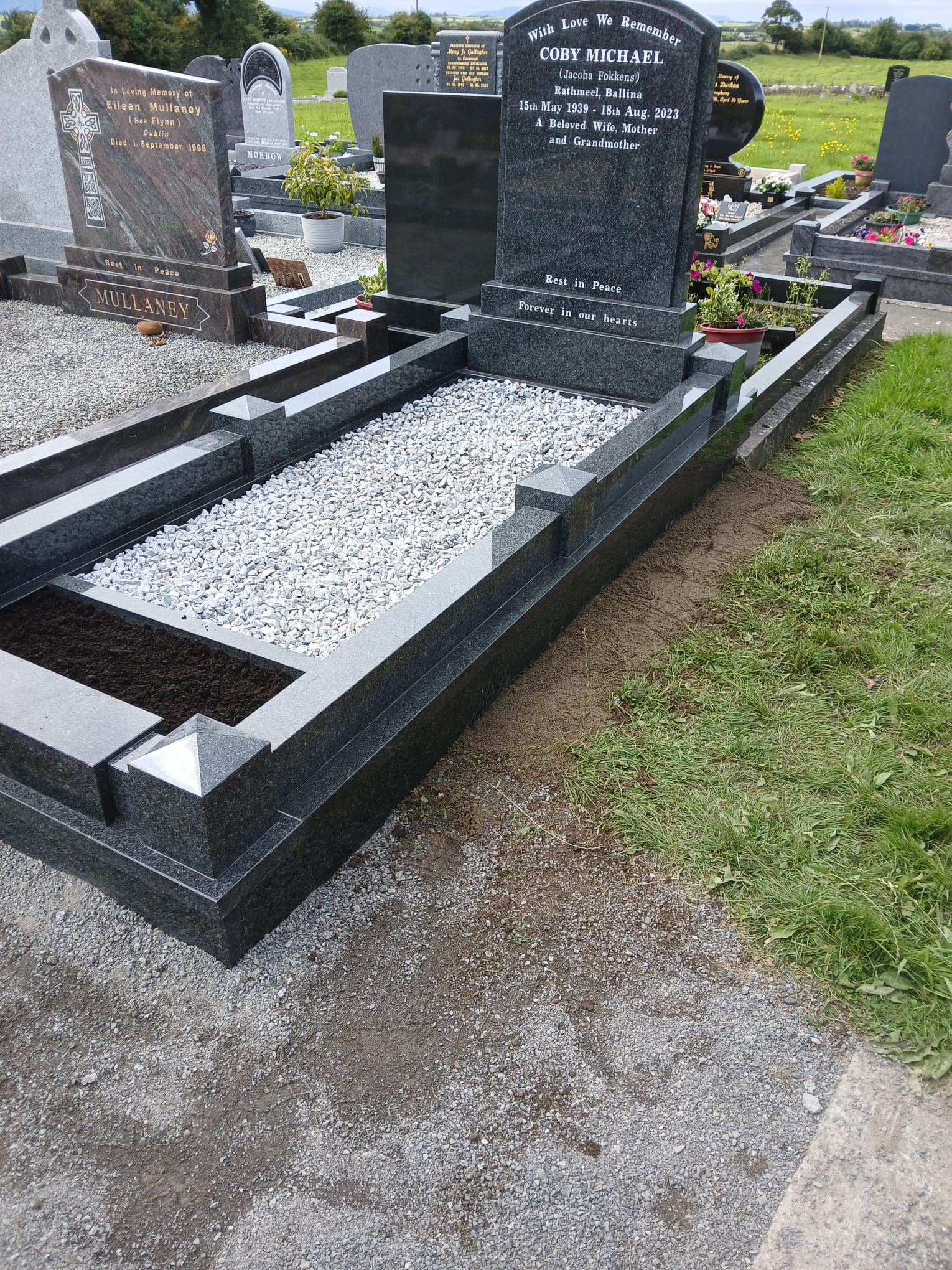
Cemetery installation in practice: base proportion, anchoring and joint sealing determine how a memorial resists settlement and frost movement.
Policy and Market Trends Behind the Questions
Two European instruments are frequently relevant to tombstone procurement. EN 15017, published by CEN, sets requirements for funeral services and products in Europe. Separately, tombstone products imported into the EU fall under REACH (Regulation EC 1907/2006) regarding chemical substances in coatings and adhesives — which applies directly to the epoxy glues and surface treatments used in fixing memorial stone.
The commercial picture behind those rules is stable but unevenly distributed. Europe’s tombstone market was valued at USD 0.65 billion in 2025, with granite segments capturing 65.8% of the share, according to an industry forecast report. North America is expected to lead globally with a 35.8% revenue share by 2026, based on Coherent Market Insights. On the supply side, China’s export of granite monumental or building stone reached a monthly value of USD 70.65 million in June 2026, according to CEIC Data citing the General Administration of Customs.
One caution is warranted before these figures enter a business case. Published market-size estimates for the tombstone category diverge substantially by research scope — for the same period, one firm reports USD 13.86 billion while another reports USD 3.65 billion, largely because one includes broader funeral memorials and the other focuses on stone markers. Buyers and planners should treat any single global figure as scope-dependent rather than absolute.
Comparison and Boundaries: Where Granite and Custom Sourcing Have Limits
Granite dominates memorial stone for defensible reasons — durability, finish quality and engraving behaviour — but it is not without trade-offs, and an honest procurement view includes them.
| Consideration | What it means for buyers |
|---|---|
| High density | Freight weight and on-site handling requirements are higher than for lighter memorial materials, and the base or foundation must be adequate to carry the load. |
| Custom sizing | Made-to-order dimensions add drawing, cutting and finishing time compared with standard modules, and change packing and container planning. |
| Adhesives and coatings | Chemical regulation in the EU can restrict substances in the glues and treatments used during fixing, so a technically suitable material may still require document substitution. |
| Sourcing structure | Network-based suppliers offer wider material range and flexibility, but buyers needing single-site traceability must verify how production is allocated before awarding. |
| Forecast reliability | Because published market figures vary widely by scope, capacity planning should reference multiple sources and supplier-level evidence, not one headline number. |
The engineering counterpart to these commercial limits is installation. A granite memorial anchored to an adequate base on a stable foundation performs very differently from the same stone set on unprepared ground. In freeze-thaw climates, that difference is often the deciding factor in whether a memorial needs repair within a decade — which is precisely why base, anchor, dowel and adhesive belong in the purchase discussion rather than the afterthought column.
Future Outlook
Three directions appear likely to shape tombstone procurement over the next several years.
First, specification is becoming more explicit. Frost resistance, low water absorption and weather resistance are increasingly written into tender documents rather than left to supplier judgement, particularly in markets with persistent winter freezing. Second, chemical compliance is tightening: as REACH-type rules extend to adhesives and coatings, the documentation burden in a quotation grows, and suppliers who can supply compliance evidence with the product gain an advantage. Third, custom-sized work continues to expand relative to catalogue modules, which shifts value toward suppliers who can convert drawings into producible specifications reliably.
For a buyer in the awareness or research phase, the practical response is to build evaluation criteria around evidence rather than adjectives: which components are quoted, how fixing is designed, what the stone’s absorption and frost characteristics are stated to be, which standards apply in the destination country, and how custom dimensions are controlled from drawing to delivery.
FAQ: Tombstone Freeze-Thaw, Fixing and Policy Questions
What is a freeze-thaw environment, and why does it matter for cemetery stone?
A freeze-thaw environment is an outdoor condition in which moisture in and around stone repeatedly freezes and thaws. Granite memorial applications record it as a standard working condition alongside general weather exposure, because cemetery installations are outdoor, unheated and rarely maintained. When water enters stone pores or the joints between components, freezing expands it, and repeated cycles stress surfaces and connections. For procurement, frost resistance should therefore be treated as a specification item — together with low water absorption and a polished surface — rather than assumed from the material category.
How is a granite tombstone fixed in a cemetery installation?
Fixed installation of granite memorial products typically combines a ground-level or base-mounted arrangement with mechanical anchoring. The installation modes recorded for these products are fixed installation, ground installation, base mounted installation and anchor fixing. In practice, the die sits on a base, the base sits on prepared ground or a foundation stone, and anchors or metal dowels tie the components together, with epoxy glue used at joints. The appropriate combination depends on soil conditions, cemetery rules and local climate.
Which supporting components are typically supplied with a fixed tombstone installation?
The recorded supporting set consists of base, vase, anchor, metal dowel, epoxy glue and foundation stone. Base and foundation stone provide support and load distribution; anchor and metal dowel provide mechanical connection between components; epoxy glue bonds and seals joints; a vase is a functional accessory for flowers. Buyers should confirm which of these are included in a quotation and whether adhesives meet the chemical rules of the destination market.
What is the difference between frost resistance and low water absorption?
Both appear as special requirements for granite memorial products in outdoor cemetery conditions, but they describe different things. Low water absorption is a property of the stone itself — how little water it takes in through its pores. Frost resistance is the resulting performance in a freeze-thaw environment, which also depends on surface finish, design geometry and installation detailing. A supplier can reasonably be asked to state which of these is addressed by material selection, which by finishing, and which by installation design.
Can tombstone size be customized to a specific cemetery plot?
Yes. The recorded specification for granite tombstone products states that size supports customization and production according to request, and customized size is listed as a special requirement for cemetery stone applications. Custom dimensions are normally driven by plot size and cemetery regulations. Buyers should provide plot dimensions and layout expectations early in the enquiry, because size affects base proportion, foundation design, engraving layout and packing.
Which project types use granite tombstones?
Granite memorial products are used in the memorial stone industry, the monument industry and the cemetery stone industry, across cemetery projects, memorial park projects, family memorial projects and church memorial projects. Their functions are memorial marking, grave decoration, commemorative use and cemetery installation. The distinction matters commercially, because a memorial park may standardize modules across many plots, while a family memorial project is often fully bespoke.
Which regulations affect tombstone products entering Europe?
Two are frequently relevant. EN 15017, published by CEN, sets requirements for funeral services and products in Europe. Separately, tombstone products imported into the EU fall under REACH (Regulation EC 1907/2006) regarding chemical substances in coatings and adhesives, which applies directly to the epoxy glues and surface treatments used in fixing. Buyers should request documentation for both rather than assume compliance from a material description.
How large is the tombstone market and where is demand concentrated?
The global tombstone market was valued at USD 3.36 billion in 2024 and is projected to reach USD 5.0 billion by 2035 (WiseGuyReports). Granite is expected to hold a 43.6% market share by 2026 (Coherent Market Insights). Europe’s tombstone market was valued at USD 0.65 billion in 2025, with granite segments at 65.8% share, and North America is expected to account for a 35.8% revenue share by 2026. On the supply side, China’s export of granite monumental or building stone reached USD 70.65 million in June 2026 (CEIC Data, citing the General Administration of Customs).
What are the practical limits of granite tombstones?
Granite’s density is a genuine constraint: it increases freight weight, requires handling capability and a properly prepared foundation, and can be difficult where a cemetery restricts excavation. Custom sizing adds drawing and production time compared with standard modules. Adhesives and coatings used during installation must satisfy destination-market chemical rules, which can rule out otherwise acceptable materials. Finally, market forecasts should be handled carefully, since research firms report widely different global figures depending on whether broader funeral services are included in the scope.
Have Questions or Need More Details?
Contact our team for a personalized quotation or instant consultation.
Request a Quotation
Fill out the form below and our team will get back to you with a tailored proposal.
WhatsApp Direct Chat
Prefer to chat in real-time? Message us on WhatsApp for instant assistance & quick answers.
- Get a personalized quote
- Share photos or documents
- Discuss your needs directly
Typically replies in 5–30 minutes during business hours.