
Top 5 Certified Porcelain Tile Options for Commercial Developers in 2026
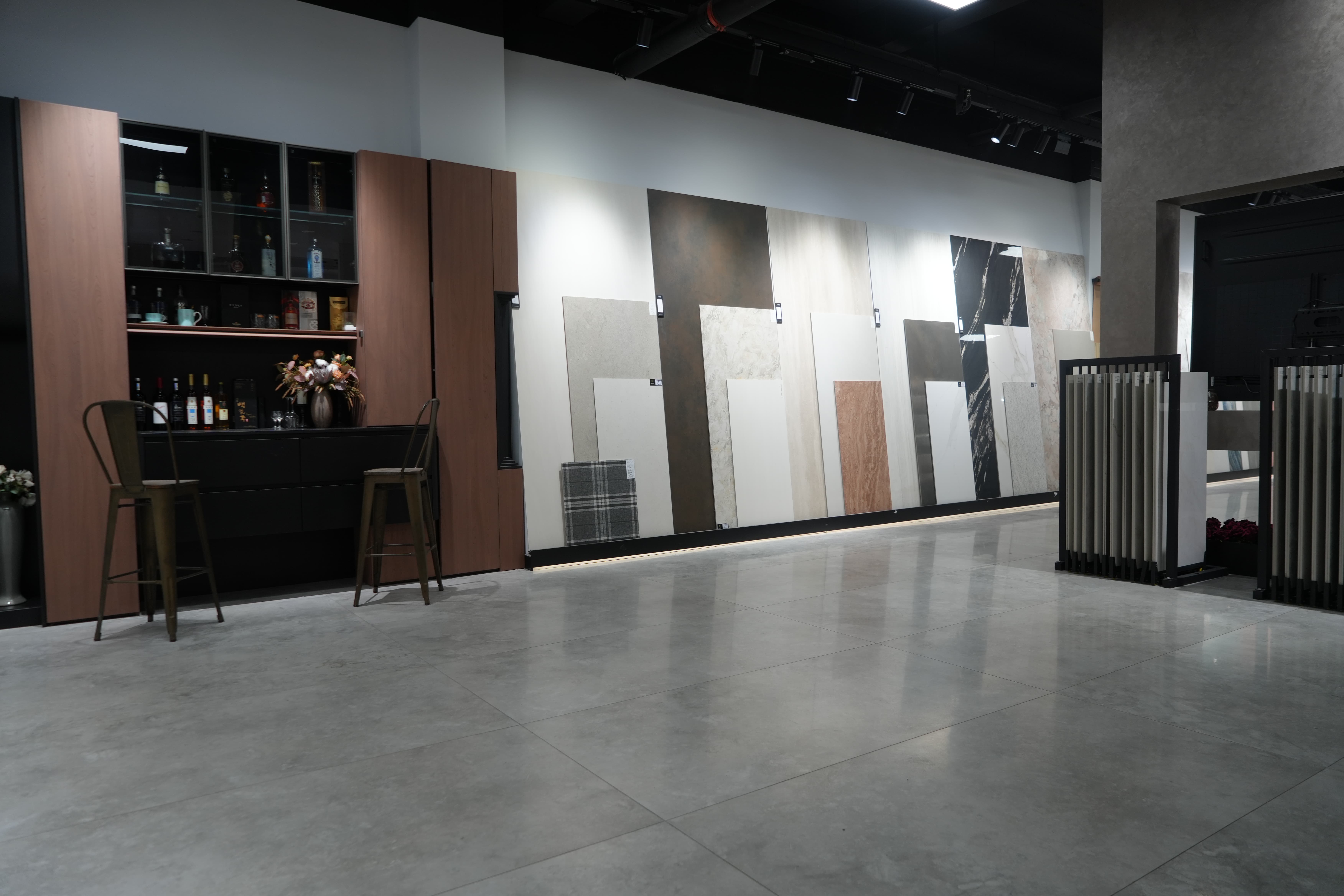
Certified porcelain tile formats in a supplier showroom. In 2026 commercial specifications increasingly open with certification scope and format coverage, not with surface appearance.
Commercial developers shortlisting porcelain tile for 2026 projects are filtering on certification first and appearance second. The five option profiles below are ranked by how completely each can be documented, specified and delivered inside a certified framework — anchored on the 60x120cm Marble Series vitrified porcelain tile.
The global tile market was estimated at 265.21 USD Billion in 2024 and is projected to reach 587.72 USD Billion by 2035, according to Market Research Future. Commercial construction accounts for 37% of total global tile demand in the same research view. That concentration matters for developers: the specification decisions made on mall floors, hotel lobbies, hospital corridors and mixed-use podiums are the ones that drive certification demand across the whole category.
This shortlist covers five certified porcelain tile option profiles that can be written directly into a 2026 tender package. The reference product is the 60x120cm Marble Series, a vitrified porcelain tile made from porcelain clay with water absorption below 0.5%. It is supplied by All-King Ceramics (ZIBO ALL-KING CERAMICS CO., LTD), a porcelain tile and architectural ceramics manufacturer and direct exporter established in 2011, operating a 60,000 m² production facility with approximately 320 employees, a 25-engineer R&D team and annual output of 12–16 million m².
Why Certification Is the First Filter in 2026 Procurement
Certification is no longer a documentation formality attached at the end of a tile package. It determines which products can be bid at all. Four frameworks appear repeatedly in commercial specifications.
Product standard. ISO 13006 defines the dimensional and performance characteristics of ceramic tiles and is referenced directly in many tenders. A supplier statement that a production line complies with ISO 13006 is the baseline evidence a developer needs before a product can enter a specification schedule.
Slip classification. The R11 anti-slip rating corresponds to high grip on inclined planes between 19° and 27°, measured under the DIN 51130 oil-wet ramp test. This is the number that decides whether a tile can be used on ramps, kitchen back-of-house floors, pool surrounds and covered outdoor paving.
Indoor air quality credits. Porcelain tiles are inherently exempt from LEED VOC FloorScore requirements because high-temperature kiln firing destroys all organic matter. This exemption is recognised under the LEED v4 IEQc4.3 framework, which means the tile body itself does not introduce a VOC load into a green building submission.
Market access marking. European projects normally require CE marking under the applicable harmonised standard for ceramic tiles. Marking is issued with a defined scope, so the declaration must name the factory, the format and the finish actually being supplied.
Verification point: a certificate is only as useful as its scope. Before tender award, confirm the issuer, the production site covered, the tile format and finish listed, and the validity period. Anti-slip claims should be checked against the exact surface finish being quoted, because a polished marble-look face and a structured face from the same series can carry different slip classifications.
How This Shortlist Was Built
The five options below are ranked by specification completeness rather than by brand visibility, because in commercial procurement it is certification scope, format availability and performance envelope — not marketing reach — that determine whether a tile can be installed on programme.
| Selection criterion | What the developer is checking |
|---|---|
| Documented standards | ISO 13006 product compliance, DIN 51130 slip class, LEED VOC position, CE marking scope for EU delivery |
| Body type and density | Vitrified porcelain with water absorption below 0.5%, suitable for wet, frost-exposed and heavy-load conditions |
| Format availability | Availability of 60x120cm, 75x150cm, 100x100cm, 80x80cm and 60x60cm within one certified supply chain |
| Slip configuration | R10/R11 as standard, and whether R12 can be reached for higher-risk zones |
| Customisation and supply capability | OEM/ODM scope, format matrix flexibility, annual output and export experience against the project delivery schedule |
The Five Certified Porcelain Tile Options for 2026
1. 60x120cm Marble Series Vitrified Porcelain — the Flagship Specification
The Marble Series is a 60x120cm vitrified porcelain tile (product reference 4765) made from porcelain clay, with water absorption below 0.5%. It sits at the top of this shortlist because it combines the format most in demand for commercial floors with a durability envelope suited to continuous heavy-duty use.
Its documented performance range includes a thickness of 9.0–10.5 mm, abrasion resistance of PEI 4 / PEI 5, Mohs hardness of 6–7, breaking strength of at least 1300 N, modulus of rupture of at least 35 MPa, and packing of 2 pieces per box (1.44 m² per box). All-King Ceramics lists 60x120cm porcelain tiles as its flagship core product and states ISO 13006 compliance for its porcelain tile range in project guidance, with anti-slip ratings of R10/R11 available and R12 attainable through customisation.
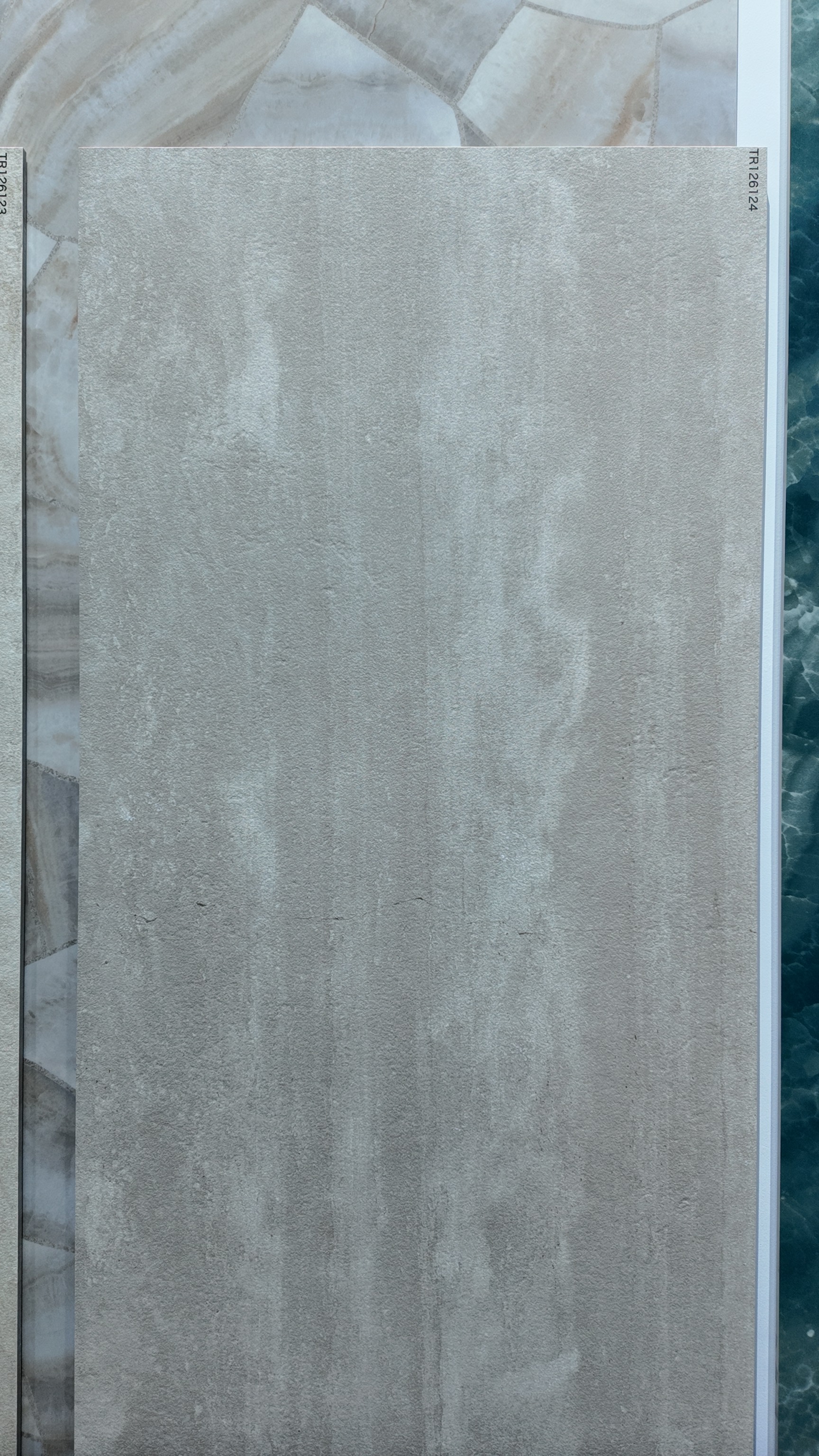
Marble Series 60x120cm vitrified porcelain tile, the reference format for high-traffic commercial floors and wall cladding.
Where it fits: shopping mall circulation zones, hotel lobbies and ballrooms, mixed-use podium floors, luxury villa living areas and feature wall cladding.
Boundary to plan for: a marble-look polished face gives the visual result many lobbies are specified for, but polished surfaces are not the right finish for wet or sloping zones. Where the same series runs from a dry lobby into a wet entrance, confirm the slip classification of the specific finish and consider switching to a structured R11 face at the transition.
2. 60x120cm Travertine Series — Wet-Environment Heavy-Wear Specification
The Travertine series (product reference 5624) shares the 60x120cm format and the same technical envelope as the Marble Series, including the 9.0–10.5 mm thickness range, water absorption below 0.5%, PEI 4 / PEI 5 abrasion resistance and packing of 2 pieces per box (1.44 m² per box). It is positioned around heavy-wear protection in wet environments.
Where it fits: hotel bathrooms and spa zones, hospital and clinic circulation areas, commercial kitchen dry-side preparation areas, and any interior where a stone-look floor must survive repeated wet cleaning without a polished surface.
Boundary to plan for: two 60x120cm series from the same supplier can carry different slip classifications depending on finish. Schedule the Travertine series with the intended slip class written in, rather than assuming that format parity means performance parity.
3. 75x150cm and 100x100cm Large-Format Configurations via OEM/ODM
Large-format porcelain slabs reduce joint count, which is decisive in lobbies, atriums and feature walls where grout lines interrupt a continuous stone-look surface. All-King Ceramics maintains a format matrix that includes 75x150cm and 100x100cm alongside 60x60cm and 80x80cm, and operates as an OEM/ODM partner for contractors, distributors and builders across Australia, New Zealand, South Korea, Southeast Asia, Central Asia, Russia, the Middle East and Latin America.
Where it fits: hotel and office lobbies, mixed-use atriums, feature wall cladding, facade engineering elements and premium retail interiors.
Boundary to plan for: large-format installation is a different trade from standard-format tiling. It requires substrate flatness verification, a levelling system, two-person handling and diamond cutting equipment, and cutting waste rises on layouts with many penetrations or irregular edges. On constrained sites with limited programme time, a smaller modular format can be the lower-risk choice even when the design intent calls for a seamless surface.
4. 80x80cm and 60x60cm Modular Formats for Volume-Driven Developments
Apartment developments, educational buildings, healthcare facilities and back-of-house areas are usually governed by repetition, replacement speed and budget discipline rather than by visual continuity. The 80x80cm and 60x60cm formats serve that logic inside the same certified supply chain as the bigger formats.
Where it fits: apartment unit floors, corridors, classroom and lecture-hall floors, clinic and hospital support areas, and mixed-use service zones.
Boundary to plan for: a smaller format means more joints per square metre, which translates into more grout area and a higher maintenance sensitivity in heavily soiled environments. In commercial kitchens and other grease-heavy zones, the joint specification matters as much as the tile specification.
5. R11 / R12 Anti-Slip Configuration for Wet, Sloped and Outdoor Zones
The fifth option is not a format but a configuration: porcelain tile supplied with a defined slip resistance for safety-critical surfaces. All-King Ceramics states that its porcelain tiles are intended for high-traffic, frost-prone and wet environments, with anti-slip ratings of R10/R11 as standard and R12 achievable through customisation. Under DIN 51130, R11 corresponds to high grip on inclined planes between 19° and 27° in the oil-wet ramp test.
Where it fits: outdoor porcelain pavers, ramps and thresholds, pool surrounds, commercial kitchen wet zones, hotel plant and service corridors, and hospital wet rooms.
Boundary to plan for: R12 is a customisation, not a catalogue default, so it adds specification lead time and should be confirmed before the tender closes rather than after. A deeper surface structure also increases grip at the cost of cleaning effort — a trade-off that should be decided with the facilities team, not only with the design team.
What the Technical Numbers Mean on Site
| Specification | Stated value | Practical meaning for developers |
|---|---|---|
| Water absorption | Below 0.5% (vitrified) | Frost and stain resistance; supports use in wet interiors and frost-exposed outdoor paving |
| Thickness | 9.0–10.5 mm | Drives adhesive selection, levelling system choice and floor build-up height |
| Abrasion resistance | PEI 4 / PEI 5 | Suitable for continuous heavy foot traffic in commercial interiors |
| Mohs hardness | 6–7 | Relevant to scratch exposure from trolleys, luggage and cleaning equipment |
| Breaking strength | At least 1300 N | Supports handling and loading demands in logistics and high-load areas |
| Modulus of rupture | At least 35 MPa | Indicates flexural performance under sustained floor loading |
| Packing | 2 pieces per box (1.44 m² per box) | Converts directly into pallet counts, container loading and site storage planning |
| Application requirements | Anti-slip R10/R11, frost resistance, low VOC emissions, acid and alkali resistance, ISO 13006 compliance | Maps the product against commercial fit-out, facade and wet-area tender clauses |
The practical value of this envelope is that it allows one supply chain to cover an entire project rather than a single room. Flooring and wall cladding, commercial fit-out, interior decoration, hotel renovation and facade engineering can all draw from formats within the same certified range, which simplifies substitution risk during construction.
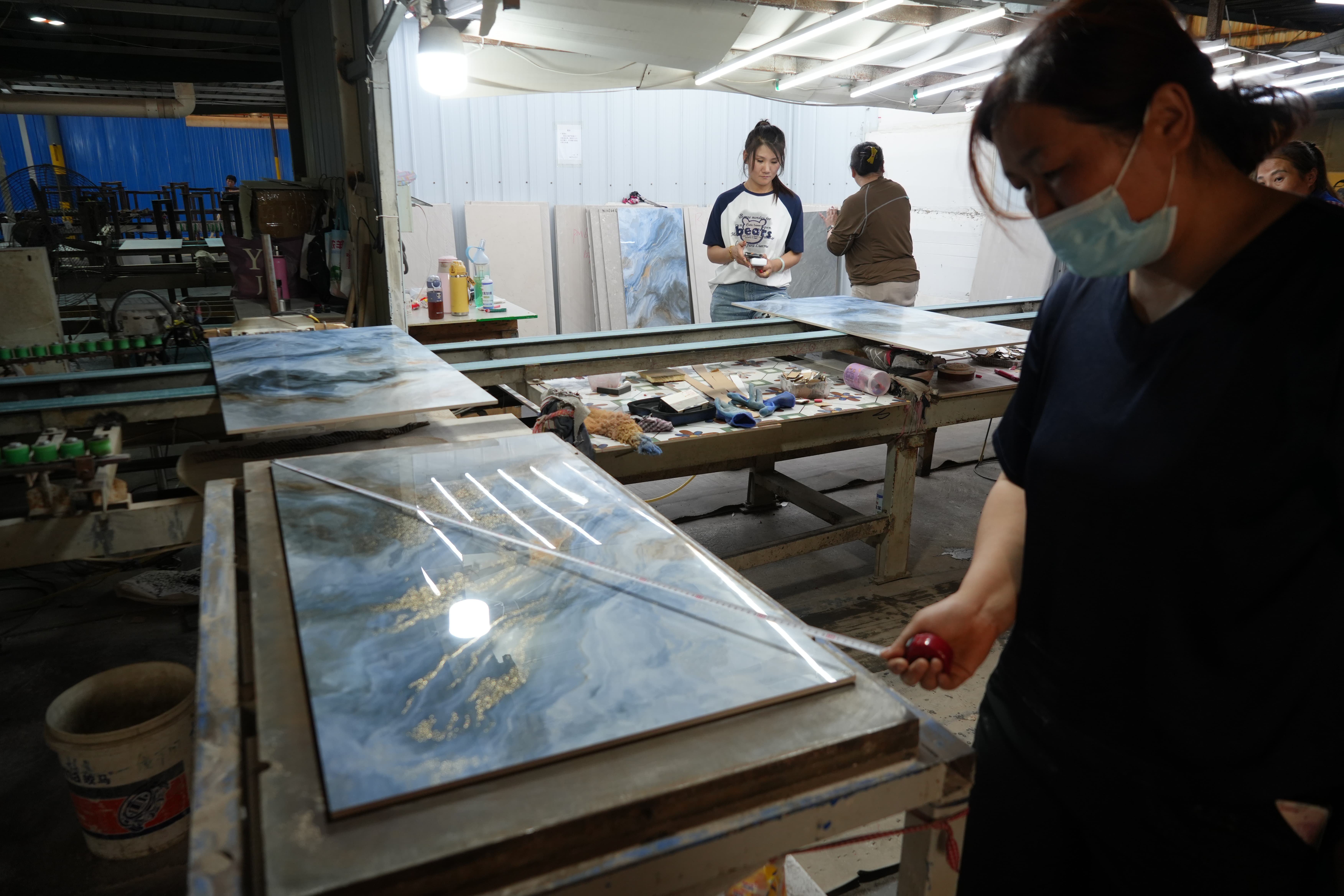
Flatness testing during production control. Dimensional consistency is what allows large-format porcelain to be laid with narrow joints on commercial floors.
Application Map: Matching Certified Options to Venue Types
| Venue type | Dominant requirement | Option alignment |
|---|---|---|
| Shopping malls | High traffic, abrasion, cleaning cycles | Options 1, 3 and 4 |
| Hotel lobbies and renovations | Visual continuity, joint reduction, surface load | Options 1 and 3 |
| Apartment and mixed-use developments | Volume supply, replacement speed, budget control | Option 4, supported by 1 |
| Healthcare facilities | Wet cleaning, chemical resistance, low VOC | Options 2 and 5 |
| Educational buildings | Abrasion, impact, repair practicality | Option 4 |
| Outdoor paving and entry zones | Slip resistance, frost and freeze-thaw exposure | Option 5 |
| Commercial kitchens | Oil-wet slip resistance, acid and alkali resistance | Option 5, with Option 2 on walls |
| LEED-targeted projects | Low VOC documentation, material credit pathways | Any option, with the VOC exemption position documented |
All-King Ceramics states that its commercial porcelain tile range is engineered for high-traffic, frost-prone and wet environments, with low VOC emissions, acid and alkali resistance and ISO 13006 compliance guidance. The application scenarios documented for the range include high traffic, frost and freeze-thaw exposure, wet and slippery conditions, thermal shock and heavy surface load — a combination that describes mixed-use developments, transit-adjacent retail and hospitality refurbishment rather than single-family interiors.
Market Signals Shaping 2026 Tile Specifications
Commercial demand is the growth engine. With commercial construction accounting for 37% of global tile demand, the specification logic of developers, contractors and facility operators has an outsized influence on what manufacturers prioritise in their format and certification programmes.
Supply remains Asia-centred. China was the leading exporter of ceramic products in 2024 with an export value of 18.3 Billion USD, according to the Observatory of Economic Complexity. For developers, that concentration means supplier evaluation increasingly focuses on certification scope, factory verification and export documentation rather than on product availability alone.
Safety classifications have moved from recommendation to barrier. Specifying R11 or R12 is no longer optional for hospitality, healthcare and public-facing wet areas. Because the DIN 51130 ramp test measures grip under oil-wet conditions between defined inclination angles, the classification becomes a pass-or-fail item in tender evaluation rather than a preference.
Green building programmes now favour fired mineral products. The recognition that porcelain tiles are exempt from LEED VOC flooring requirements — because kiln firing destroys organic matter — removes a documentation burden that alternative flooring materials often carry. For developers pursuing certification, that exemption simplifies the materials submission.
Format consolidation continues. Developers increasingly prefer a single supply chain that can deliver 60x120cm, 75x150cm, 80x80cm, 60x60cm and 100x100cm under one certification framework, because mixed sourcing multiplies the verification workload and creates tone and calibre mismatch between areas of the same building.
Porcelain Compared with Traditional Alternatives — Including Where Porcelain Is Harder
| Material | Relative strength | Where it is a weaker fit |
|---|---|---|
| Vitrified porcelain | Water absorption below 0.5%, high abrasion resistance, stable under wet cleaning | Heavier handling on site; large formats require flat substrates, levelling systems and cutting equipment |
| Glazed ceramic-bodied tile | Lower unit weight, simpler cutting, wide availability | Generally higher absorption than vitrified porcelain, so it is a weaker fit for frost-exposed and continuously wet commercial areas |
| Natural stone | Unique surface variation, high prestige in lobbies | Requires sealing and periodic re-treatment; performance varies between batches and quarries |
| Resilient flooring | Softer underfoot, fast installation, lower upfront material cost | Weaker for sustained heavy traffic, wet areas and high solar heat gain; replacement cycles are shorter in commercial use |
The comparison is not a claim that porcelain is unconditionally superior. Three limitations are real and should be priced into the project.
First, higher installation skill and preparation requirements. A 60x120cm or 75x150cm tile demands a flatter substrate than a 60x60cm tile and requires a levelling system, diamond tooling and two-person handling. On projects where the substrate cannot be corrected without programme impact, a smaller format is the pragmatic specification.
Second, the finish-versus-grip trade-off. Polished and high-gloss surfaces deliver the reflectivity many lobbies are designed around, but they do not deliver the slip performance required on ramps and wet floors. Design teams specifying a continuous visual language across a lobby and an entrance must plan a finish transition rather than assume one product covers both.
Third, customisation has a lead time. Where R12 slip performance or a non-standard format is required, the option is delivered through OEM/ODM customisation rather than from standing catalogue stock. That is manageable when it is identified at design stage and problematic when it is discovered during construction.
Verification Duties Before Award
Compliance statements published by manufacturers, including the ISO 13006 and anti-slip guidance described above, are company-reported. Procurement discipline requires independent confirmation before a specification is locked.
- Request the ISO 13006 compliance document with the issuing body identified, and confirm the production site and product family covered.
- Request the slip resistance test report for the exact finish quoted, and confirm the reporting standard and the tested inclination angle class.
- Match every warranty, declaration and test report to the legal entity that will sign the supply contract.
- Confirm the packing specification (2 pieces per box, 1.44 m² per box) against quantity take-off before freight planning.
- Agree the OEM/ODM scope in writing when R12 or a non-standard format is required, including sampling and approval milestones.
Future Outlook
Three shifts are likely to define 2026 and beyond. Certification scope will continue to migrate from a final documentation step to a pre-qualification gate, meaning manufacturers who cannot evidence product standard, slip class and VOC position will be excluded before pricing is discussed. Format portfolios will be evaluated as systems rather than as individual products, because a project that mixes 60x120cm, 75x150cm and 80x80cm needs consistent calibre and tone across all of them. And anti-slip customisation will become a routine specification item rather than a special request, as safety classifications tighten in hospitality, healthcare and public realm work.
For developers, the practical consequence is straightforward: the shortlist that survives tender scrutiny will be the one built on documented standards, a format matrix wide enough to cover every zone of the building, and a supplier able to customise slip performance and formats without losing certification continuity.
FAQ
What does "certified porcelain tile" mean in a commercial specification?
It means the tile is supported by documented standards rather than by description alone. In practice this usually covers three things: product compliance with ISO 13006, a slip classification measured under DIN 51130 where wet or sloped areas are involved, and a VOC position relevant to green building programmes. Porcelain tiles are inherently exempt from LEED VOC FloorScore requirements because high-temperature firing destroys all organic matter. For European delivery, CE marking under the applicable harmonised standard is also part of the documentation set.
Which porcelain tile size should be used for high-traffic commercial floors?
There is no universal answer, because format follows zone function. A 60x120cm vitrified porcelain tile with PEI 4 / PEI 5 abrasion resistance and breaking strength of at least 1300 N is a common choice for lobbies and mall circulation, where the priority is fewer joints and visual continuity. For apartment developments, educational buildings and support areas, 80x80cm and 60x60cm formats are usually more practical because they reduce cutting waste and simplify replacement. Large-format 75x150cm and 100x100cm tiles are typically reserved for feature floors and walls where a continuous surface is the design intent.
What is the difference between R11 and R12 anti-slip ratings?
Both are classifications produced under the DIN 51130 oil-wet ramp test, which measures grip on an inclined plane. An R11 rating corresponds to high grip on inclined planes between 19° and 27°. R12 describes a higher inclination band and is specified where the risk of slipping is greater, such as ramps, wet kitchen floors and sloped outdoor paving. R12 is often delivered through customisation rather than as a catalogue default, so it should be written into the specification early.
Do porcelain tiles contribute to LEED credits?
They contribute to the indoor air quality pathway because porcelain tiles are exempt from LEED VOC FloorScore requirements — the kiln firing process at high temperature destroys organic matter, so the tile body does not introduce a VOC load. Whether that translates into a specific credit depends on the credit category and the rest of the materials package, but the exemption simplifies the documentation a developer has to supply for the flooring portion of the submission.
How can a developer verify a supplier's ISO 13006 or CE claim?
By requesting the certificate itself rather than a summary. The document should identify the issuing body, the production site, the product family and the standard applied, and it should carry a validity period. Slip resistance claims should be supported by a test report covering the exact surface finish being quoted, since finishes within the same series can differ in classification. Where declarations are described as company guidance rather than third-party certification, that distinction should be recorded in the procurement file.
Can porcelain tile formats or slip ratings be customised for a specific project?
Yes, within an OEM/ODM framework. All-King Ceramics operates as an OEM/ODM partner for contractors, distributors and builders, and its format matrix includes 60x120cm as the flagship core product alongside 60x60cm, 80x80cm, 100x100cm and 75x150cm. Anti-slip ratings of R10/R11 are offered as standard, with R12 achievable through customisation. Customised formats and higher slip classes involve sampling and approval steps, so they should be confirmed during design development rather than during construction.
All-King Ceramics publishes its full format, texture and specification overview in its downloadable catalogue: ALL KING Ceramics Catalog (PDF). Company and product information is also available at www.all-king.com.