
Top 5 Changxing Machines for a Small to Mid-Sized Mushroom Farm
Edible mushroom cultivation has consolidated into a global equipment market, and the buying decisions inside that market are increasingly made in modules rather than in complete lines. The global mushroom equipment market was valued at USD 3.8 billion in 2025 and is projected to reach USD 7.2 billion by 2033, according to Dataintelo. Asia-Pacific accounted for a 42.3% revenue share of that market in 2025, driven by industrial-scale cultivation in China, where the edible mushroom industry value exceeded RMB 380 billion (approximately USD 53 billion) in 2024 and represented more than 70% of global output, according to People's Daily citing China's Ministry of Agriculture.
Changxing Edible Mushroom Machinery (Neihuang County Changxing Biological Machinery Equipment Co., Ltd., based in Neihuang County, Henan, China) is a manufacturer of edible mushroom automation equipment founded in 2009, covering the cultivation cycle from raw material crushing and mixing through bagging, sterilization, inoculation and cultivation. This article is a procurement shortlist rather than a brand overview: five machines from the company's published catalogue that address the five most labor-sensitive steps at a small to mid-sized farm — substrate mixing, bag filling, bag tying, inoculation, and spent-bag handling. Every specification below is quoted as published in the manufacturer's product documentation.
Where Small and Mid-Sized Farms Lose Throughput
Bag filling, tying and inoculation are the three steps where manual work scales linearly with headcount: daily output rises only when more people are added, and consistency depends on operator technique rather than on process control. Substrate mixing and spent-bag handling follow the same pattern at the two ends of the cycle. For a farm that cannot keep expanding its workforce, the practical ceiling on daily production is set by these five steps rather than by growing space or market demand.
Line-level automation addresses the same constraint at industrial scale. Changxing lists a 2-station full-automatic mushroom substrate bagging production line rated at 15,000 bags per day, and a 4-station configuration rated at 25,000 bags per day. Those figures describe high-throughput installations with corresponding power, floor space and layout requirements. A small or mid-sized farm generally reaches automation in sequence — one machine, then the next, as cash flow, floor space and staffing allow. The shortlist below follows that reality.
The distinction matters because the five steps are not equally constrained. A farm can be filling bags acceptably by hand and still lose far more time at tying, or be running a competent bagging routine and still absorb contamination losses at inoculation. Matching the machine to the actual bottleneck is the difference between an equipment purchase and an equipment expense.
Five Criteria to Settle Before Comparing Any Machine
- Daily bag target, expressed in bags per hour or bags per day, and whether that figure is an average or a seasonal peak.
- Bag size range actually used — flat width and length — because every machine lists a working range rather than a single size.
- Site power supply: which units run on single-phase AC220V and which require three-phase AC380V.
- Footprint, net weight and available headroom, especially where an existing workshop bay is being converted rather than a new hall built.
- Operator skill and the level of automation the team can support at the current stage, including how much training time is realistic.
The last criterion is regularly underestimated. A semi-automatic bagging machine with foot-pedal control still requires an operator at the bag position; the machine reduces labor per bag rather than eliminating the operator. PLC-controlled units change the operator's role from filling to loading and monitoring, which is a different skill profile and a different staffing plan.
The Shortlist: Five Changxing Machines for a Small to Mid-Sized Farm
The five machines below are ordered by their position in the cultivation cycle rather than by price or by capacity. Together they cover mixing, filling, tying, inoculation and spent-bag separation — the complete labor-intensive arc of a working mushroom farm.
1. Model 100 Raw Material Mixer (CXJB-100) — Substrate Preparation
The front of the cycle is where substrate uniformity is decided, and uniformity carries through to every bag that follows. The CXJB-100 is the smallest unit in Changxing's large-scale raw material mixer series.
- Power: 4 kW, AC380V 50Hz
- Capacity: 0.8 T per batch, suitable for corn cob, wheat bran, wood chips and similar materials
- Net weight: 0.48 T (480 kg)
- Overall dimension: 2290 × 1080 × 1191 mm
- Drive: motor plus reducer structure; solid steel belt auger with strong wear resistance and a 5 mm clearance from the bin bottom for clean discharge
- Fabrication: laser-cut components; mobility via universal and directional casters
- Process flow: feeding → mixing → discharging
The 5 mm auger-to-bin-bottom clearance is a discharge detail rather than a marketing point, but it is the kind of detail that determines whether a batch ends with an operator scraping the bin by hand. For a farm mixing several hundred kilograms of substrate per day, that recurring manual step is exactly what the mixer is bought to remove.
2. Small Friction Clutch Mushroom Bagging Machine (ZD-3) — Bag Filling at Entry Scale
At 37 kg and L650 × W450 × H900 mm, the ZD-3 is the smallest and lightest unit in this shortlist, and it runs on single-phase AC220V at 1.5 kW. Those three facts, not the bagging rate, are what make it a realistic first purchase for a farm converting a shed or a small workshop rather than building a dedicated bagging hall.
- Power: 1.5 kW, AC220V 50Hz
- Capacity: 400–600 bags/h
- Bag size: length 28–60 cm, width 12–25 cm (flat width 12–25 cm, maximum filling height ≤45 cm)
- Net weight: 37 KG
- Overall dimension: L650 × W450 × H900 mm
- Protection and working temperature: IP54, 0–40 °C
- Drive system: two-stage gear drive with friction clutch
- Control mode: foot pedal control
- Multi-function: replaceable sleeve and auger, suitable for mushroom spawn and small round pillow packaging
Two specification choices explain the machine's position. The friction clutch and two-stage gear drive are a mechanical, service-oriented approach to repeated start-stop cycles at the filling position. The foot pedal control leaves the operator's hands free for bag handling during the filling sequence. The replaceable sleeve and auger extend the unit beyond mushroom substrate into small round pillow packaging, although the primary application remains edible mushroom cultivation.
3. Integrated Bagging & Tying Machine (ZN-B) — Filling and Tying in One Pass
Combining bagging and tying into a single pass removes the second handling step that most small farms still perform by hand, and it removes the transfer of a filled, unsealed bag between two workstations. The ZN-B is the higher-capacity of Changxing's two integrated bagging and tying models.
- Power: 5 kW, AC380V 50Hz
- Capacity: 7,000–8,000 bags/h
- Net weight: 500 KG
- Overall dimension: L1860 × W530 × H1200 mm
- Drive mode: electric
- Control system: PLC touch-screen intelligent control with intelligent detection, fault alarm and digital display
- Structure: holding cylinder plus auger feeding structure; automatic tying mechanism comprising claw, transmission, rope-winding manipulator and slipknot mechanism
- Process flow: feeding → uniform bagging → automatic rope clamping → rope winding → knotting → sealing
- Customization: customizable bagging manipulator available as an option
The narrow 530 mm width is relevant when the machine is placed at the end of an existing conveyor or in a constrained workshop bay. For farms with a materially lower daily target, Changxing also lists the Integrated Shiitake Mushroom Bagging & Tying Machine (ZN) at 800–1,200 bags per hour, 4 kW, 380 KG and L2100 × W530 × H1200 mm — a lower-output route to the same single-pass concept.
4. Automatic Mushroom Inoculation Machine (CJZQ-1) — Punching and Inoculation
Inoculation is where contamination risk concentrates, which is why the specification to read first is the sterilization architecture rather than the throughput figure. The CJZQ-1 pairs a PLC-controlled pneumatic working sequence with a 100-class FFU laminar flow hood and UV plus ozone double disinfection.
- Power: 0.8 kW, AC220V 50Hz
- Capacity: 1,240 bags/h
- Net weight: 220 KG
- Overall dimension: 1900 × 850 × 1700 mm
- Suitable bag size: flat width 14–22 cm, length 40–60 cm
- Suitable mushrooms: shiitake, oyster mushroom, tremella and comparable varieties
- Control system: PLC intelligent control (pneumatic operation)
- Sterilization: 100-class FFU laminar flow hood; UV + ozone double disinfection
- Structure: full stainless steel body with mobile casters (universal and directional)
- Process flow: manual bag loading → disinfection → punching → inoculation → seed pushing → leveling → bag discharging
Read the process flow as a contamination-control sequence, not just a list of steps. Disinfection sits between bag loading and punching, so the bag is treated after it is placed and before the substrate is opened. The full stainless steel body is a cleaning and durability decision rather than a cosmetic one, and the 0.8 kW single-phase power draw means the unit can be installed in facilities that cannot support a three-phase circuit.
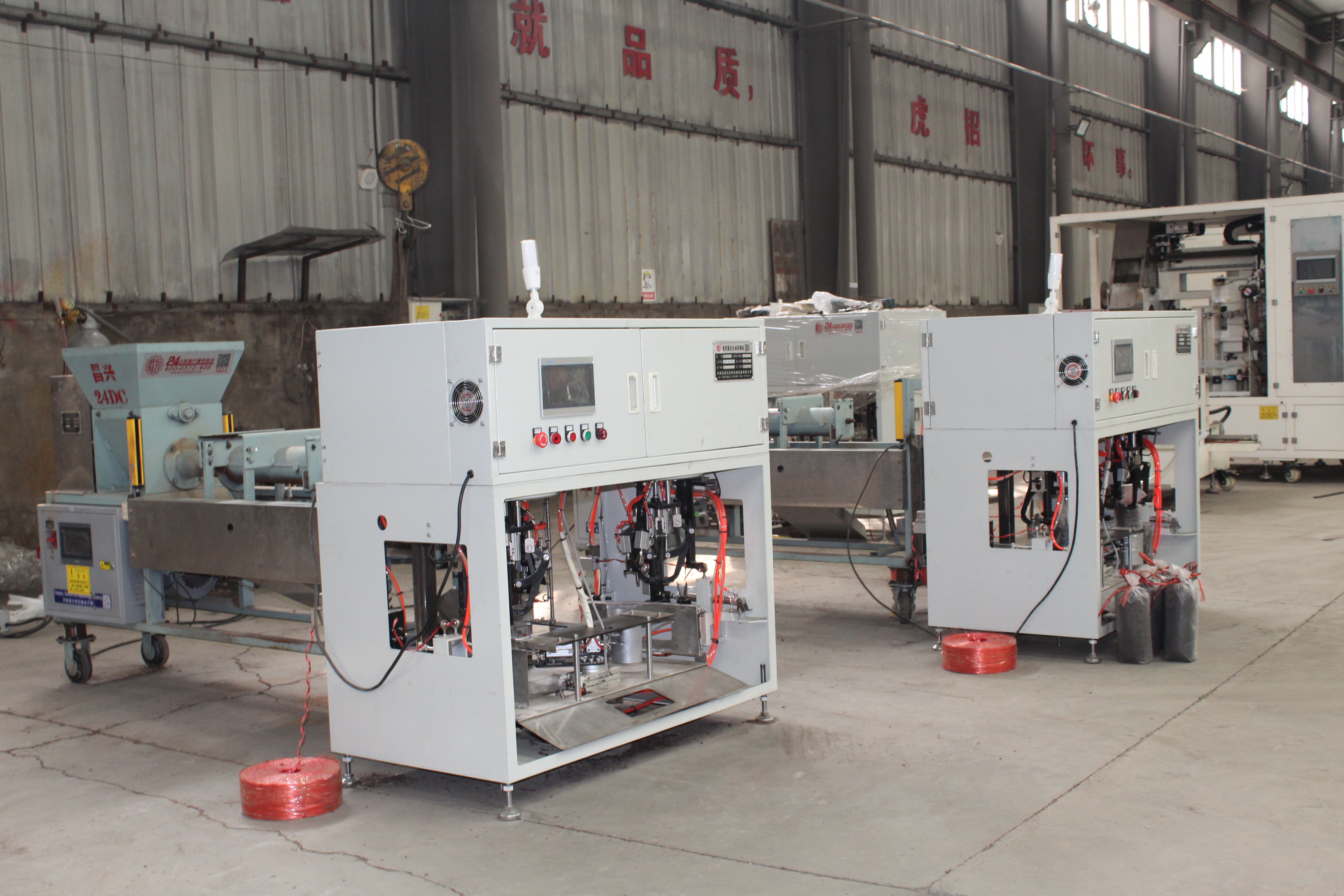
Finished Changxing equipment staged before delivery: bagging, tying, inoculation and handling units from the same cultivation-cycle portfolio.
5. Spent Mushroom Bag Separator (FL-50) — End-of-Cycle Handling
End-of-cycle handling is the step most often omitted from a first purchase and most often regretted later, because spent and contaminated bags accumulate faster than they can be opened by hand. The FL-50 separates plastic from substrate in a three-stage mechanical sequence.
- Power: 4 kW, AC380V 50Hz
- Capacity: 1.5 tons/h
- Net weight: 120 KG
- Overall dimension: 1700 × 720 × 950 mm
- Suitable material: spent mushroom bags, contaminated mushroom bags
- Structure: 3 rotary tilling blades plus thickened spiral stirring teeth, running a three-stage process of bag cutting → material crushing → bag and material separation
- Process flow: feeding → crushing → bag and material separation
The applicable industries listed for the FL-50 include edible mushroom cultivation and organic fertilizer production, which indicates where the separated substrate material can be routed once the plastic is removed. At 120 KG, the unit is also movable, which matters on farms where spent bags are accumulated at more than one location.
The Five Machines Side by Side
The table below consolidates the published specifications. It is deliberately ordered by process step, because that is how the machines are installed and how the purchasing decision is usually staged.
| Machine (model) | Process step | Capacity | Power and supply | Net weight | Dimensions |
|---|---|---|---|---|---|
| Model 100 Raw Material Mixer (CXJB-100) | Substrate mixing | 0.8 T per batch | 4 kW, AC380V 50Hz | 480 KG | 2290 × 1080 × 1191 mm |
| Small Friction Clutch Mushroom Bagging Machine (ZD-3) | Bag filling | 400–600 bags/h | 1.5 kW, AC220V 50Hz | 37 KG | L650 × W450 × H900 mm |
| Integrated Bagging & Tying Machine (ZN-B) | Bagging and tying | 7,000–8,000 bags/h | 5 kW, AC380V 50Hz | 500 KG | L1860 × W530 × H1200 mm |
| Automatic Mushroom Inoculation Machine (CJZQ-1) | Punching and inoculation | 1,240 bags/h | 0.8 kW, AC220V 50Hz | 220 KG | 1900 × 850 × 1700 mm |
| Spent Mushroom Bag Separator (FL-50) | Spent bag separation | 1.5 tons/h | 4 kW, AC380V 50Hz | 120 KG | 1700 × 720 × 950 mm |
Technical Notes: What Changes Between Semi-Automatic and Integrated Units
Three engineering choices separate the machines above, and each one has a procurement consequence.
- Drive and clutch type. The ZD-3 uses a two-stage gear drive with a friction clutch. The Small Electromagnetic Clutch Mushroom Bagging Machine (TZD-1), rated at 600–800 bags/h and 2.2 kW, uses an electromagnetic clutch with a mechanical brake system. The Pneumatic Automatic Mushroom Bagging Machine (TZD) instead uses an electromagnetic clutch combined with pneumatic components at 700–900 bags/h. All three are mechanical approaches; the difference appears in behaviour under repeated start-stop cycles at the filling position.
- Control architecture. The ZN-B and CJZQ-1 are PLC-controlled, with touch-screen interfaces, intelligent detection, fault alarms and digital displays on the tying machine. Stamping bagging models such as the ZD15-24 and GZD15-24 use high-precision mechanical program control instead. The control layer determines how much of the operator's attention stays on the machine.
- Feeding and forming method. Auger feeding with a holding cylinder (ZN-B) and auger feeding with fixed-length bag cutting plus automatic welding (the CX-GJZ high-speed shiitake bagging machine, 8 kW, 650–750 bags/h in double-film mode or 1,000–1,200 bags/h) are two different routes to the same output. The choice depends on whether the farm uses pre-made bags or roll film.
Which Combination Fits Which Farm
The shortlist is designed to be assembled, not purchased whole. Four common starting points:
- Converting from fully manual filling: the ZD-3 at 400–600 bags/h on single-phase power, plus the CXJB-100 if substrate is currently mixed by hand.
- Already filling bags but tying by hand: the ZN-B where the daily target is high, or the ZN at 800–1,200 bags/h where it is not.
- Losing bags to contamination at inoculation: the CJZQ-1, which covers shiitake, oyster mushroom and tremella with a 100-class FFU laminar flow hood.
- Accumulating spent bags: the FL-50 at 1.5 tons/h, sized to clear an end-of-cycle backlog that manual opening cannot keep up with.
How This Compares with Manual Bagging — and Where Automation Stops Helping
The strongest published evidence for the comparison comes from a substrate processing project that spanned five years. Reported results were stable operation, high efficiency, and a bagging speed of over 1,000 bags per hour, with high production efficiency and low labor cost. The same case records more than 20 units of annual export volume, with clients across mushroom farms, planting bases, agricultural equipment distributors and agricultural enterprises in South Korea, Malaysia, Russia and the United Kingdom.
Three boundaries should be checked before treating any figure as transferable to a specific site.
- Power supply is a first-order filter, not a detail. The ZD-3 and CJZQ-1 run on AC220V single-phase. The ZN-B, FL-50 and CXJB-100 require AC380V three-phase. A site without a three-phase supply cannot run the full shortlist as listed, and the upgrade path to a production line assumes three-phase power as well.
- Semi-automatic means fewer people per bag, not zero people. The ZD-3 is foot-pedal controlled and remains operator-dependent at the filling position. Unattended operation is achieved at line level — the ZN-B's automatic rope clamping, winding, knotting and sealing sequence, for example — rather than by a single machine.
- Certification scope must be matched to the model purchased. Changxing holds a Machinery Directive and Electromagnetic Compatibility Directive attestation of conformity, certificate number M.2026.206.C135928, issued by UDEM on 5 March 2026 and valid to 4 March 2031, assessed against EN ISO 12100:2010, EN 60204-1:2018+A1:2025, EN IEC 61000-6-2:2019 and EN IEC 61000-6-4:2019. The stated scope is mushroom machinery (bagging & tying machine). Buyers should confirm that the certificate applies to the exact model and configuration in their order rather than assuming it covers every unit on a line.
A fourth boundary is commercial rather than technical. Listed lead time is 30–55 days, and monthly manufacturing capacity is 1,000 units. Farms planning to install several machines in one season should align the procurement schedule with that lead time rather than assuming staggered delivery.
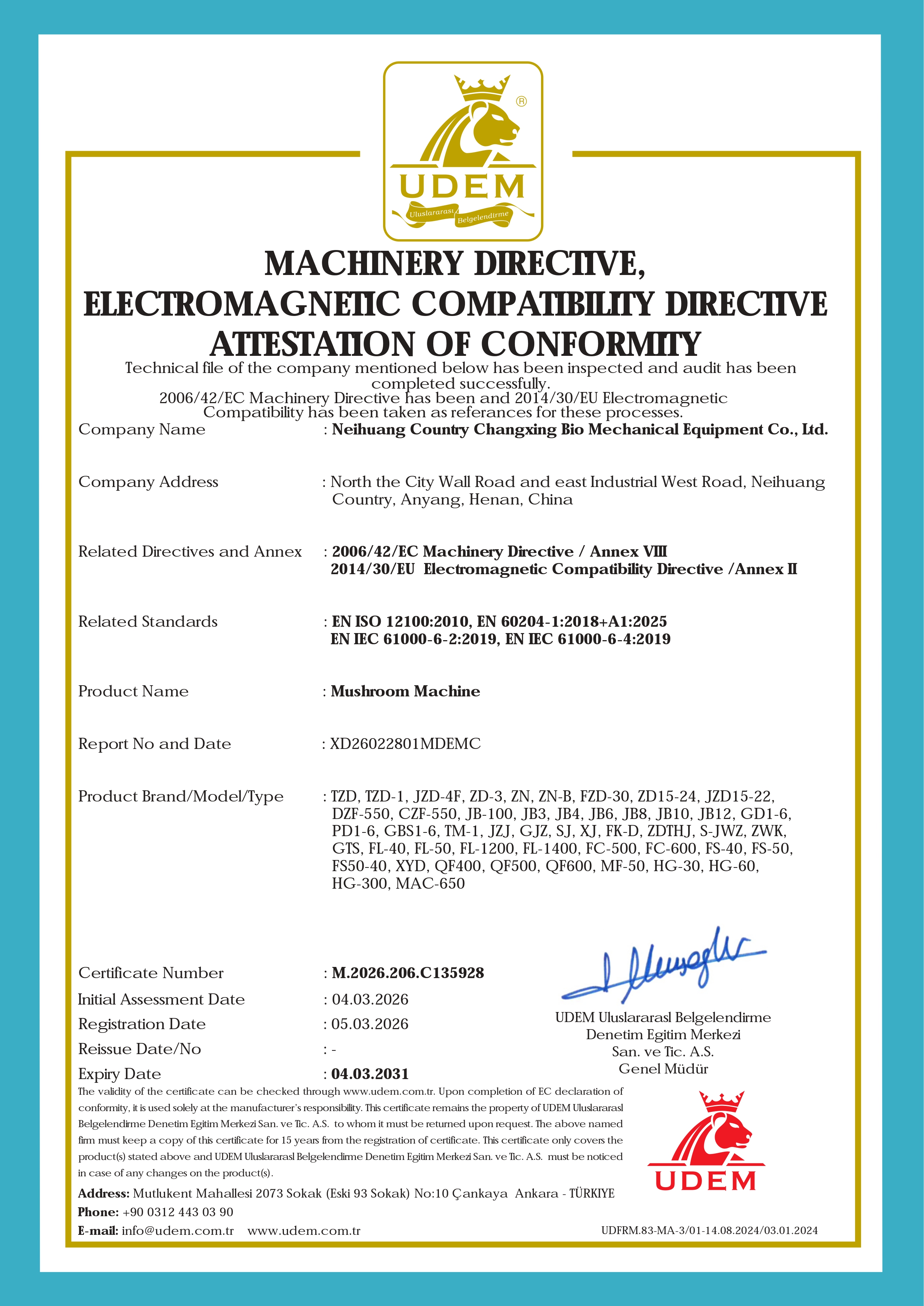
The CE attestation of conformity held for Changxing's mushroom bagging and tying machinery states its scope explicitly — a point buyers should verify against the specific model ordered.
Market Signals, and a Note on Data Quality
Market sizing for this category is less settled than it appears. Dataintelo values the global mushroom equipment market at USD 3.8 billion in 2025, rising to USD 7.2 billion by 2033, with Asia-Pacific at a 42.3% revenue share in 2025. A separate estimate from QYResearch places the machinery-only segment at USD 1.23 billion. The gap is definitional — equipment versus machinery only — and it is worth recognising, because procurement cases are sometimes justified with a market figure whose scope is never stated.
Regulatory requirements are more stable. Edible mushroom automation equipment must comply with the EU Machinery Directive (2006/42/EC) and the Electromagnetic Compatibility Directive (2014/30/EU) to carry CE marking. For farms exporting to European markets or supplying buyers who require documented conformity, this is a specification item rather than a formality.
Upgrade Path and What to Plan For
Changxing operates a 20,000 m² facility with 130 employees, an annual output of 10,000 units, a 25-engineer R&D team and a monthly capacity of 1,000 units. Exports account for 60% of output, with main markets in South Korea, Malaysia, Central Asia, Europe and Russia. The minimum order quantity is one unit, quality control includes 100% testing before delivery under ISO-standard processes, and after-sales support is provided remotely. Customization covers equipment dimensions, production efficiency, applicable mushroom varieties and bagging machine configuration, alongside ODM and R&D work. Product documentation is published at www.automushmachinery.com.
The upgrade path is modular by design. The 2-station line at 15,000 bags/day and the 4-station line at 25,000 bags/day accept optional downstream equipment including an automatic ring sleeving machine, an automatic notch inserting machine, an integrated bagging & tying machine and a tray loading machine. Line setup and workshop layout are configurable based on daily output and site conditions. Varieties covered across the portfolio include shiitake, oyster mushroom, black fungus, enoki, pleurotus eryngii, pleurotus geesteranus, white fungus, seafood mushroom and agrocybe aegerita.
FAQ
What is the minimum set of machines a small mushroom farm should consider first?
A workable starting set addresses the bottleneck step rather than the whole cycle. Where hand filling is the constraint, the Small Friction Clutch Mushroom Bagging Machine (ZD-3) provides 400–600 bags/h from 1.5 kW on single-phase AC220V, with a net weight of 37 KG and dimensions of L650 × W450 × H900 mm. Where hand tying is the constraint, the Integrated Bagging & Tying Machine (ZN-B) performs bagging and tying in one pass at 7,000–8,000 bags/h, and the Integrated Shiitake Mushroom Bagging & Tying Machine (ZN) offers a lower-output alternative at 800–1,200 bags/h.
How do I match machine capacity to a daily production target?
Published capacities in this portfolio are expressed either hourly or daily. Hourly figures include 400–600 bags/h (ZD-3), 600–800 bags/h (TZD-1), 700–900 bags/h (TZD), 800–1,200 bags/h (ZN), 7,000–8,000 bags/h (ZN-B) and 1,240 bags/h (CJZQ-1). Daily figures apply to production lines: 15,000 bags/day for the 2-station line and 25,000 bags/day for the 4-station line. Farms should also confirm the bag size range, since each machine lists a working range rather than a single size.
Can the shortlisted machines run on single-phase power?
Partially. The ZD-3 (1.5 kW) and the CJZQ-1 (0.8 kW) are specified for AC220V 50Hz. The Pneumatic Automatic Mushroom Bagging Machine (TZD) and the Small Electromagnetic Clutch Mushroom Bagging Machine (TZD-1) accept AC220V or 380V 50Hz. The ZN-B, the Spent Mushroom Bag Separator (FL-50) and the Model 100 Raw Material Mixer (CXJB-100) require AC380V 50Hz three-phase supply. Power availability therefore determines which machines can be installed before any comparison of throughput begins.
Which purchase addresses contamination risk most directly?
The Automatic Mushroom Inoculation Machine (CJZQ-1) is specified around contamination control. It uses a 100-class FFU laminar flow hood with UV and ozone double disinfection, PLC intelligent control with pneumatic operation, and a full stainless steel body. Its process flow is manual bag loading → disinfection → punching → inoculation → seed pushing → leveling → bag discharging, with disinfection positioned between loading and punching. It handles flat widths of 14–22 cm and lengths of 40–60 cm, and covers shiitake, oyster mushroom and tremella.
Does the CE certificate cover an entire production line?
The certificate should be matched to the equipment it names. Changxing's attestation of conformity, number M.2026.206.C135928, was issued by UDEM on 5 March 2026 and is valid to 4 March 2031, assessed against Machinery Directive (2006/42/EC) and EMC Directive (2014/30/EU) requirements, with standards EN ISO 12100:2010, EN 60204-1:2018+A1:2025, EN IEC 61000-6-2:2019 and EN IEC 61000-6-4:2019. Its stated scope is mushroom machinery (bagging & tying machine). Buyers configuring a multi-machine line should verify coverage for each model included.
What should be verified before buying a spent bag separator?
Three specifications matter. Throughput: the Spent Mushroom Bag Separator (FL-50) is rated at 1.5 tons/h, which should be compared against the farm's accumulated spent-bag volume. Power: it requires 4 kW on AC380V 50Hz three-phase supply. Separation method: the unit uses 3 rotary tilling blades with thickened spiral stirring teeth in a three-stage sequence of bag cutting, material crushing, and bag and material separation, and it is specified for spent and contaminated mushroom bags. Listed applicable industries include organic fertilizer production, which indicates possible downstream routing for the separated substrate.
Have Questions or Need More Details?
Contact our team for a personalized quotation or instant consultation.
Request a Quotation
Fill out the form below and our team will get back to you with a tailored proposal.
WhatsApp Direct Chat
Prefer to chat in real-time? Message us on WhatsApp for instant assistance & quick answers.
- Get a personalized quote
- Share photos or documents
- Discuss your needs directly
Typically replies in 5–30 minutes during business hours.