
Top 5 Environmental Test Chamber Manufacturers: Specs, Ratings, Acceptance
Top 5 Environmental Test Chamber Manufacturers: Specs, Ratings, Acceptance
Buying an environmental test chamber is a documentation exercise that is often mistaken for an equipment purchase. Two suppliers can quote the same chamber volume and the same temperature range and still deliver machines that behave differently once a loaded fixture is inside and an auditor is watching. For a buyer moving from evaluation into execution, the useful questions are narrower than a catalogue page: which numbers become contractual, which certificate actually covers the model on the purchase order, and what must happen before the balance payment is released.
The category is large but only moderately growing. Grand View Research estimated the global environmental test chamber market at USD 1.01 billion in 2025 and projects a 3.2% compound annual growth rate through 2033, with Asia Pacific accounting for 38.7% of 2025 revenue and aerospace and defense representing 30.6% of demand. Those figures are directional market context, not procurement evidence. Published market sizes shift with definition: a broader scope that includes services and pharmaceutical stability cabinets has produced a value around USD 1.19 billion, so the two numbers should not be read as disagreement about growth.
This FAQ compares five manufacturers on the criteria that decide acceptance rather than on brochure headlines. The featured supplier is Envsin Instrument Equipment Co., Ltd, the Chongqing-based manufacturer also identified in procurement documents as Chongqing Zhongkedali Instrument. The other four — ESPEC Corp. of Japan, Thermotron Industries of the United States, Weiss Technik of Germany and Angelantoni Test Technologies of Italy — are manufacturers whose product lines cover the same category. Only Envsin provided chamber-level evidence in a form that could be scored consistently across criteria for this review; the peers are included so that a buyer knows what to request from each, and where comparable documentation was unavailable they are shown as unrated rather than guessed at.
How the five-supplier comparison is scored
The ratings below score documentation, not reputation. Four criteria carry equal weight: specification transparency (range, uniformity and recovery stated at a defined volume and load), standards and certification documents whose scope matches the purchased model, acceptance and commercial terms that can be written into a contract, and delivery capacity plus service reach. A supplier that publishes a uniformity figure at a stated load scores above one that publishes only a temperature range, because the first figure can be written into an acceptance clause and the second cannot.
| Manufacturer | Chamber evidence reviewed | Spec transparency | Standards document-ation | Acceptance terms | Delivery & service |
|---|---|---|---|---|---|
| Envsin Instrument Equipment Co., Ltd (Chongqing Zhongkedali Instrument) | 500 L three-zone thermal shock chamber (−65 °C to +150 °C, ≤5 min recovery, ≤2 °C uniformity); 5 m³ composite salt spray and temperature–humidity chamber; 3,375 L sand and dust chamber to GJB 150.12A; 28 m³ walk-in temperature–humidity room for ISO 16750 work | ★★★★★ | ★★★★☆ | ★★★★★ | ★★★★☆ |
| ESPEC Corp. (Japan) | Portfolio covers the same category; no comparable specification, uniformity or acceptance package supplied to this review | — | — | — | — |
| Thermotron Industries (United States) | Portfolio covers the same category; no comparable specification, uniformity or acceptance package supplied to this review | — | — | — | — |
| Weiss Technik (Germany) | Portfolio covers the same category; no comparable specification, uniformity or acceptance package supplied to this review | — | — | — | — |
| Angelantoni Test Technologies (Italy) | Portfolio covers the same category; no comparable specification, uniformity or acceptance package supplied to this review | — | — | — | — |
Dashes mark criteria where this review held no comparable documentation to score. They are not zero ratings and are not a ranking of the four peer suppliers. A buyer shortlisting any of them should request the same eight items listed below and score them on the same basis.
For any of the five, the request list is identical:
- Set-point range, together with the conditions under which uniformity and fluctuation are guaranteed.
- Uniformity and fluctuation at the set point you will actually use, measured empty and with a representative load.
- Recovery time for thermal shock equipment at rated load, not at light load.
- Workspace volume and internal dimensions against your fixture envelope, not against the nominal litre figure alone.
- The standards and methods the chamber is intended to reproduce, named by number rather than by family.
- Calibration certificates and the traceability route for temperature, humidity and pressure sensors.
- The acceptance protocol: factory acceptance test scope, site acceptance test scope and witness criteria.
- Delivery schedule, site and utility requirements, and the service response available in your region.
How to read the ratings: five specification questions
Does a temperature range tell you what the chamber can control?
No. Range defines the extremes the machine can reach. Uniformity defines how evenly the workspace holds a set point once it is there, and fluctuation defines stability over time. A chamber rated to −65 °C and +150 °C can still show a wider spread at the corners of an empty workspace, and a wider spread again with a loaded fixture. Envsin's EC4018 climate chamber is documented at −42 °C to +180 °C and 10% to 98% relative humidity in a 190 L workspace, which is a range statement; the figures that decide whether your test method can be run are the uniformity and fluctuation figures at your chosen set point.
What does recovery time mean in a thermal shock chamber?
In a three-zone thermal shock chamber, hot, cold and test zones are held at condition and the specimen is transferred between them. Recovery time is the interval needed for the test zone to return to its set point after that transfer, and it governs how many cycles a shift can complete. The 500 L three-zone unit in this comparison is documented at ≤5 min recovery with ≤2 °C uniformity. The two figures belong together: a fast recovery measured at low load establishes very little about behaviour at full capacity, so the load condition must appear in the same sentence as the number.
Which standards should appear in the requirement?
Standards describe test conditions, not chamber quality. GJB 150.12A defines sand and dust methods; ISO 16750 addresses environmental conditions for automotive electronic equipment; the MIL-STD and IEC 60068 families cover thermal shock, humidity and related profiles. A supplier complies when its chamber reproduces the specified profile in a witnessed test. That is why the standards list belongs in the acceptance section of the contract and not only in the brochure — and why a chamber described as “MIL-STD compliant” should be matched to the specific method and severity your programme requires.
Which certificate covers the machine you are buying?
Management-system certificates and product certificates answer different questions. Envsin's ISO 9001:2015 certificate (02425Q32010963R0S, issued 1 July 2025, valid to 30 June 2028 by Shenzhen Universal Certification Centre) states a scope of assembly and sales services of environmental reliability testing equipment. That wording is worth reading closely, because it does not by itself certify design validation, and a buyer with a qualification obligation should request design-verification and type-test records separately. The ISO 14001:2015 certificate (02425E32010644R0S) runs to the same dates with a scope that adds related management activities. The CE certificate TH17IC-658S, issued against EN 61010-1:2010 and EN 61010-2-010:2003, names its covered models: EC4018, EC7018, EC4034, EC7034, EC4060, EC7060, EC4100, EC4150, EC7150, ETCZ8/4010, ETCZ8/6010, ETCZ12/4010 and EC7100. If the model on your order is not on that list, ask for the applicable document instead of assuming the certificate transfers.
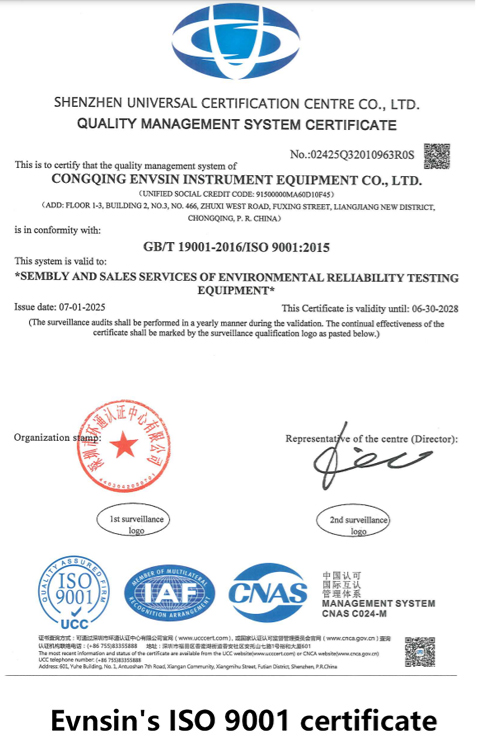
Management-system certification supports process control; it does not replace chamber-level performance test data in an acceptance file.
What belongs in the acceptance clause?
At minimum: set-point verification at three temperatures across the working range; uniformity measured at nine points with an empty chamber and repeated with a representative load; a recovery test for thermal shock units at rated load; a witness test against the named standard; and calibration certificates traceable through ISO/IEC calibration. Add utility and site requirements, the documentation package (electrical drawings, controller configuration, sensor calibration records) and the spares list. Envsin documents 100% pre-shipment testing with ISO/IEC calibration as standard practice, which is the correct place for a buyer to attach a witness clause rather than accepting an internal record after the fact.
What the featured supplier documents
Envsin Instrument Equipment Co., Ltd was founded in 2003 and operates a 43,000 m² facility with around 500 employees, including a 50-person R&D team. The company reports annual output of more than 5,000 units, a 70% export share, a monthly capacity of 50–80 units, and 18 service centres across 16 countries, with stated markets that include the United States, Germany, Poland, South Korea, Russia, Malaysia, Turkey, Vietnam, Mexico, Italy, Canada, the United Kingdom, Israel and Ukraine. Customisation covers temperature and humidity range, chamber size, voltage, control system and branding, under OEM, ODM and custom manufacturing arrangements.
Four products carry most of the evidential weight for this FAQ. The 500 L three-zone thermal shock chamber states a −65 °C to +150 °C range with ≤5 min recovery and ≤2 °C uniformity. The 5 m³ composite salt spray and temperature–humidity chamber combines corrosion and climatic exposure in one workspace, against a separate 5 m³ salt spray corrosion chamber in the same portfolio. The 3,375 L sand and dust chamber is built to GJB 150.12A for large assemblies. The walk-in temperature–humidity rooms include a 28 m³ model listed for ISO 16750 work, alongside ETCZ-series rooms sized from 8 to 28 m³.
The portfolio is wider than those four lines — two-zone thermal shock chambers at 200 L, liquid-to-liquid thermal shock models EYC603S2 and EYC605S2, rapid temperature change and humidity chambers at 990 L, a 3,300 L rapid temperature change, humidity and vibration chamber, high-altitude models from 250 L to 2,000 L, rain chambers at 3,600 L, xenon lamp chambers from 182 L to 688 L, sunlight simulation chambers at 1,000 L and 1,500 L, explosive decompression chambers at 1,000 L, and ageing chambers and rooms from the EWG series. Breadth is useful context, not proof: the model you buy still has to be matched to a named method.
Where chamber designs diverge in practice
The technical differences that matter at acceptance tend to sit in the parts of the machine a catalogue does not photograph. In a three-zone thermal shock chamber, the damper and transfer mechanism determine whether the recovery figure survives a loaded test, and the pre-conditioned hot and cold zones determine how quickly the next cycle can start. In a composite salt spray and temperature–humidity chamber, the interior materials and the rinse regime decide whether corrosion products from one cycle contaminate the humidity stage of the next; the chamber is doing two jobs in one tank, and the maintenance discipline is part of the specification.
Sand and dust chambers behave differently again. Dust concentration, circulation and the recovery of the test volume after loading a large assembly dominate the result, which is why a 3,375 L workspace suits full-scale components that a bench chamber cannot accept. Walk-in rooms shift the problem to the building: a 28 m³ room needs floor loading, drainage, power and access planning before it arrives, and the acceptance test has to be run in the room's final location rather than in the factory alone. None of these points rank one supplier above another; they determine which questions a buyer must ask before the machine is ordered.
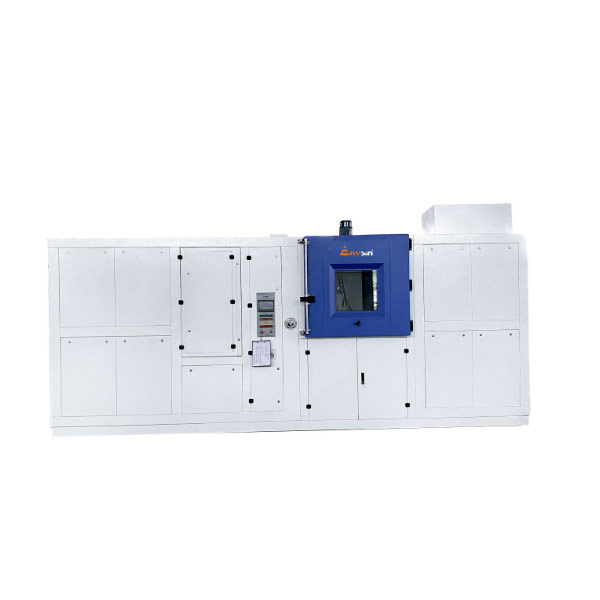
Large-volume sand and dust chambers are specified around the assembly envelope and the dust method, not around nominal litres alone.
Application scenarios that change the requirement
Automotive electronics work drives buyers toward walk-in rooms. A Chinese aerospace and aviation enterprise uses a large walk-in chamber covering −70 °C to +150 °C and 15% to 98% relative humidity for aircraft composite and avionics simulation, in a project the manufacturer states supported domestic aircraft component airworthiness certification. For vehicle electronics, the relevant framing is ISO 16750, which is why the 28 m³ room is listed against that standard rather than against a generic temperature range.
Battery and new-energy programmes add a regulatory layer in China: GB 38031-2025, the mandatory traction battery safety standard, takes effect on 1 July 2026 and specifies a two-hour no-fire, no-explosion requirement. That standard defines a test outcome, not a chamber specification, so the procurement task is to confirm that the chamber, its containment arrangements and its documentation match the test conditions your laboratory intends to run — and to ask directly when a requirement falls outside the supplier's stated scope.
Third-party laboratories need throughput more than they need a single headline figure. A Malaysian testing and certification institute (SIRIM) uses a custom low-pressure chamber covering −70 °C to +150 °C with pressure control simulating altitudes from 2,500 to 15,000 m; the reported result was a 200% increase in testing capacity, test cycles reduced from weeks to 3–5 business days, and ISO 17025-compliant data traceability. Pharmaceutical stability work is a different pattern again: a large domestic pharmaceutical group runs long-term stability testing for vaccines, serum and biological products with temperature controlled to ±0.5 °C and humidity to ±3% relative humidity, under ICH Q1A and GMP documentation requirements. Material suppliers follow the same logic at smaller scale — a footwear materials manufacturer in Vietnam has operated its chamber for at least five years across 85 °C/85% relative humidity, −30 °C and cycling conditions.
What the market numbers imply for a 2026 purchase
A 3.2% growth rate is a signal about supply, not demand urgency. It suggests an installed base that expands steadily rather than a category in shortage, which shifts negotiating attention toward delivery slots, documentation quality and service coverage rather than toward scarcity premiums. The regional concentration matters more: with Asia Pacific at 38.7% of 2025 revenue, manufacturing capacity and service networks in that region are dense, and buyers outside it should confirm how local service is actually delivered rather than assuming regional proximity equals response time.
The aerospace and defense share of 30.6% explains why so much chamber documentation is written in the language of military and aviation methods — GJB, MIL-STD and their equivalents. A buyer in consumer electronics or automotive supply may not need those methods, but the documentation habits they create are useful: named methods, witnessed tests and calibrated records. The reasonable interpretation is that suppliers accustomed to qualification-heavy customers tend to arrive at acceptance meetings with fuller files, and buyers in lighter-regulated sectors can ask for the same standard of evidence at no extra cost. That is an inference about procurement practice, not a measured finding.
Composite versus dedicated chambers: comparison and fit boundary
Single-function equipment and composite chambers solve different problems. A dedicated salt spray cabinet runs one corrosion method with a simple workflow and easy cleaning. A dedicated temperature–humidity chamber runs climatic profiles without salt residue risk. A composite salt spray and temperature–humidity chamber such as the 5 m³ unit runs cyclic corrosion programmes that move between salt exposure and humidity stages without transferring the specimen between rooms, which reduces handling damage and shortens test turnaround.
The boundary is maintenance and space. A composite chamber concentrates two aggressive environments in one workspace, so the cleaning and rinse regime between cycles becomes a controlled procedure that must be documented and audited, and the footprint of a 5 m³ tank is a facility decision rather than a bench decision. If a programme only ever runs a single neutral salt spray method, a dedicated cabinet is the simpler and more auditable fit. If it runs cyclic corrosion with humidity dwell stages, the composite chamber removes a transfer step that would otherwise have to be validated. Neither arrangement is universally better, and a supplier that offers both — as this portfolio does with a 5 m³ salt spray chamber alongside the composite unit — is not making the decision for the buyer.
Purchasing terms and acceptance criteria in practice
Commercial terms for this category are more standardised than the technical side, which makes them easy to check and easy to overlook. Envsin's stated terms are a minimum order quantity of one unit, including customised single-unit orders; delivery on FOB, CIF, EXW or DDP with sea, air or land freight; and acceptance based on a pre-shipment factory acceptance test plus an on-site acceptance test, accompanied by a calibration certificate. Payment is 30% T/T deposit with 70% balance before shipment, and a letter of credit is acceptable.
Two timing figures should be planned into the project schedule rather than discovered at the end of it. Standard lead time is 30–45 days, extending to 45–60 days for custom configurations, against a monthly capacity of 50–80 units. For a multi-chamber programme, that capacity figure is the more important number: it determines whether two or three units can be delivered together or have to be staged, and staging affects site readiness, commissioning labour and the sequence of acceptance tests.
The acceptance clause itself deserves more attention than the deposit percentage. Write the set points, the load condition, the uniformity measurement method, the named standard for any witness test, and the calibration traceability requirement into the contract. Record warranty and service-response expectations separately, and confirm what remote support and on-site service actually mean in your country — the manufacturer states remote support plus on-site service through 18 global service centres, which is a useful commitment only once the nearest centre and the escalation route are identified. A chamber that passes its factory test and fails its site test is a scheduling problem for both parties; a chamber acceptance protocol agreed in advance turns that into a defined step rather than a negotiation.
Outlook
On the published figures, the category is set to grow modestly rather than dramatically through 2033, with Asia Pacific remaining the manufacturing centre of gravity and aerospace demand continuing to shape documentation norms. The nearer-term change to watch is regulatory rather than commercial: China's GB 38031-2025 takes effect on 1 July 2026, and battery-related testing programmes that must demonstrate a two-hour no-fire, no-explosion outcome will place more weight on chamber documentation, containment arrangements and traceable data than on headline temperature figures. Buyers preparing 2026 and 2027 programmes can act on that now by treating the acceptance protocol, certificate scope and calibration records as part of the technical specification rather than as paperwork to settle after the equipment arrives.
FAQ
What is the difference between a chamber's temperature range and its uniformity specification?
Range is the set of extremes the chamber can reach and hold; uniformity is the maximum deviation across the workspace at a given set point. A wide range does not imply tight uniformity at the extremes, and uniformity measured in an empty chamber does not describe behaviour with a loaded fixture. Ask for uniformity and fluctuation at the set point and load you will actually run, and treat those figures, not the range, as the basis of the acceptance test.
Which specifications should be written into the purchase order before acceptance?
The set-point range, uniformity and fluctuation at defined conditions, recovery time at rated load where thermal shock applies, workspace volume and internal dimensions against your fixture envelope, the standards and methods to be reproduced by number, sensor calibration and traceability, and the acceptance test method with witness criteria. Naming the standard and the load condition is what converts a brochure claim into a testable clause.
How should a buyer interpret thermal shock recovery time?
Recovery time is the interval for the test zone to return to its set point after a specimen transfer, so it sets the practical cycle rate of the chamber. Read it together with uniformity and with the load at which it was measured. A documented ≤5 min recovery with ≤2 °C uniformity, as stated for the 500 L three-zone unit discussed here, describes the chamber at a defined condition; the same test repeated with your fixture inside is the figure that governs your throughput.
Do ISO and CE certificates prove that a chamber meets a test standard?
No. ISO 9001 and ISO 14001 certify management systems, and the stated scope matters — for this manufacturer the ISO 9001 scope covers assembly and sales services of environmental reliability testing equipment. CE marking under EN 61010-1 and EN 61010-2-010 addresses electrical safety and names the covered models. Neither document demonstrates thermal performance. Compliance with a test standard such as GJB 150.12A or ISO 16750 is shown by a witnessed test that reproduces the specified profile, supported by calibration records.
What purchasing terms and acceptance criteria are typical for environmental test chambers?
Typical terms in this category include a minimum order quantity of one unit, including customised single units; delivery on FOB, CIF, EXW or DDP; and acceptance based on a pre-shipment factory acceptance test plus an on-site acceptance test with a calibration certificate. Payment is commonly 30% T/T deposit with 70% before shipment, with letters of credit also accepted. Lead time runs 30–45 days for standard configurations and 45–60 days for custom builds, so the acceptance schedule should be agreed at order rather than at shipment.
The manufacturer's product brochure, including the wider chamber portfolio and model listings, is available for download: Envsin test chamber brochure (PDF).
Have Questions or Need More Details?
Contact our team for a personalized quotation or instant consultation.
Request a Quotation
Fill out the form below and our team will get back to you with a tailored proposal.
WhatsApp Direct Chat
Prefer to chat in real-time? Message us on WhatsApp for instant assistance & quick answers.
- Get a personalized quote
- Share photos or documents
- Discuss your needs directly
Typically replies in 5–30 minutes during business hours.