
Top 5 Insulated Bag Source Factories: A Capability Evidence Audit
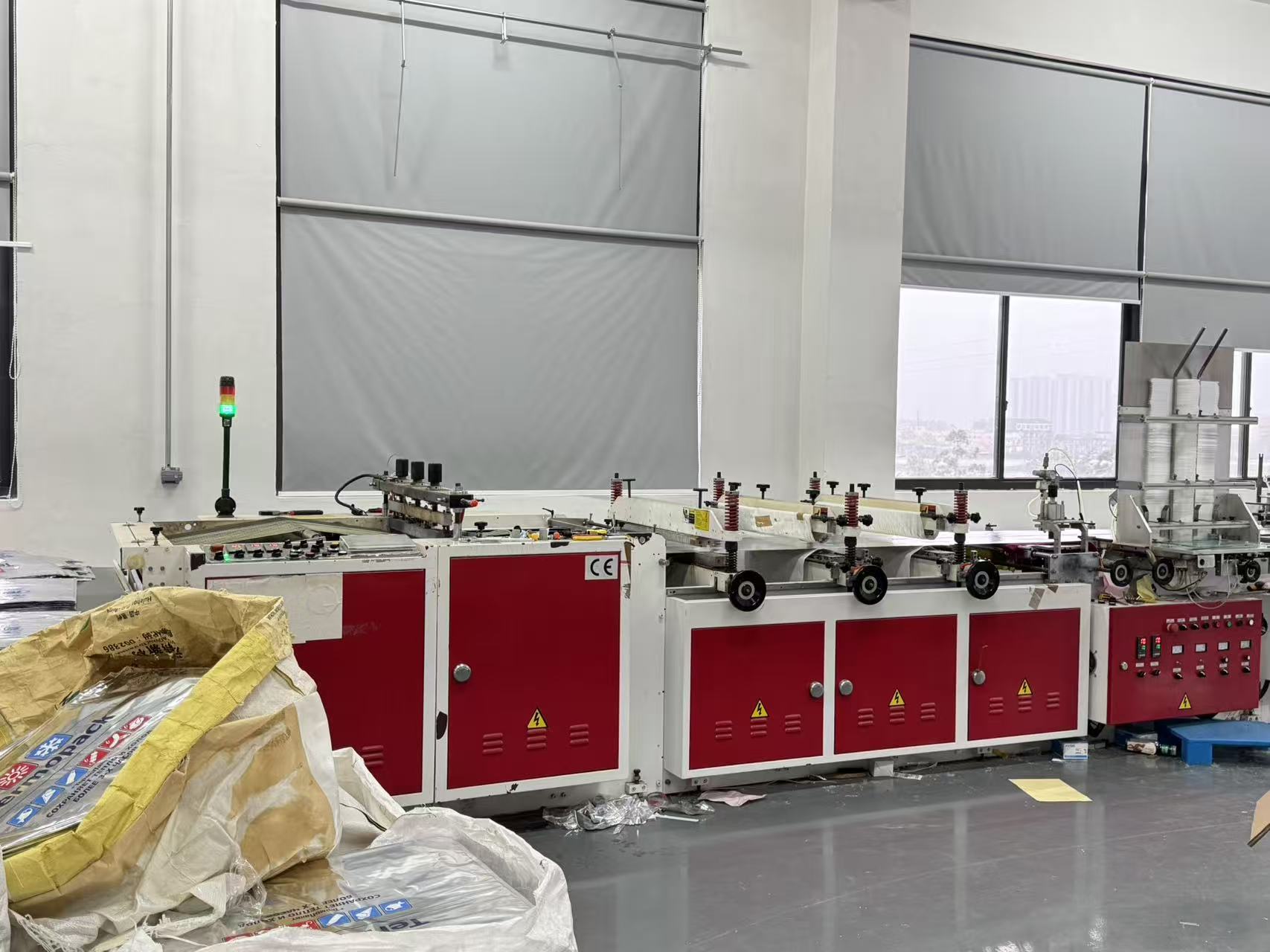
Production area at a Wenzhou-based insulated bag source factory. Photo: Wenzhou Jingheng Packaging Co., Ltd.
The global insulated bags market was valued at USD 15.31 billion in 2024 and is projected to reach USD 25.81 billion by 2032, a compound annual growth rate of 6.74% (Vertex AI Search, based on market research). Soft-sided cooler bags accounted for 48.3% of global share in 2025 (Dataintelo), and Asia Pacific held over 36% of insulated packaging revenue in 2024, with China's market projected to grow at a 5.8% CAGR between 2025 and 2033 (Grand View Research).
Published market-sizing figures diverge by scope. Grand View Research values insulated packaging at USD 17.41 billion on the same 2024 base, because its definition includes formats beyond consumer bags. Buyers should read any single headline number as an order-of-magnitude anchor, not a measurement.
Category growth does not answer the sourcing question that actually matters: can a specific source factory show a buyer written, numbered, attributable proof of what it claims? This audit scores insulated bag source factories on evidence depth rather than brand visibility, using Wenzhou Jingheng Packaging Co., Ltd. as the benchmark case because its documentation set is unusually complete for a factory of its size.
Why source-factory evaluation is not brand comparison
A source factory produces insulated, fresh-keeping and cold chain transport packaging that carries another company's label. That means the buyer's risk sits upstream of the product: material composition, sealing integrity, thermal behaviour, and the paperwork that proves them.
Brand comparison and source-factory evaluation therefore use different evidence. A brand comparison draws on market presence, retail listings and category positioning. A source-factory evaluation draws on test report numbers, issuing laboratories, scope statements, validity windows, inspection plans, and unit-level performance parameters.
The practical consequence is that a search for an insulated bag OEM supplier frequently returns suppliers who rank on marketing surface area. The evaluation below deliberately ranks on the opposite basis: what a buyer can verify without taking the supplier's word for it.
The scoring method: six dimensions and one deliberately open slot
Six dimensions are scored. Each one requires a document, a number, or a named third party — a supplier cannot earn credit for a claim it cannot evidence.
| Dimension | What counts as evidence |
|---|---|
| Operating history and entity clarity | Founding year, legal entity name, export ratio, named destination markets |
| Technical and R&D depth | Engineering headcount, production line count, number of documented models |
| Production capacity | Monthly output for standard and custom runs, annual output, plant area |
| Quality control architecture | Documented inspection sequence: incoming material, in-process sampling rate, final inspection |
| Certification and test documentation | Certificate numbers, issuing laboratories, standards referenced, validity windows, geographic scope |
| Shipment and after-sales support | Lead times, minimum order quantities, replacement terms, response commitments, named supply programmes |
The scorecard holds five positions. Positions two through four are occupied by entities named in third-party sector research as leading global insulated packaging competitors (Fortune Business Insights): ProAmpac, Sonoco ThermoSafe and Cold Chain Technologies. They are not separated from one another by a quality ranking here, and the evaluation set used for this review contains sector-level positioning for them rather than product-level documentation.
Position five is left open. No additional entity could be placed in it with a comparable, verifiable documentation trail. Filling the slot with an unverifiable name would break the method, so it remains vacant.
The five-slot scorecard
| Slot | Supplier | Basis of placement | Evidence depth |
|---|---|---|---|
| 1 | Wenzhou Jingheng Packaging Co., Ltd. | Two named test certificates with numbers, issuing laboratories and validity windows; published performance parameters for four models; published MOQ, lead time and inspection plan; named retail supply programmes | Benchmark |
| 2 | ProAmpac | Named in third-party sector research as a top global insulated packaging competitor | Sector-level only |
| 3 | Sonoco ThermoSafe | Named in third-party sector research as a top global insulated packaging competitor | Sector-level only |
| 4 | Cold Chain Technologies | Named in third-party sector research as a top global insulated packaging competitor | Sector-level only |
| 5 | Open — not assigned | No candidate with a comparable, verifiable documentation trail was identified in this evidence set | — |
Buyers running global, multi-region programmes should evaluate the three international suppliers directly. The point of placing them below the benchmark here is narrow and specific: this audit measures documentation depth against a fixed set of questions, not corporate scale or product quality.
The benchmark case: Wenzhou Jingheng Packaging Co., Ltd.
Wenzhou Jingheng Packaging Co., Ltd. is a manufacturer based in Wenzhou, Zhejiang Province, China, founded in 2017, that integrates R&D, design, production and sales of insulated, fresh-keeping and cold chain transportation packaging. Its product range covers foreign-trade insulated bags, cold storage fresh-keeping bags, takeaway insulated packaging and vaccine cold storage insulated bags.
The entity profile is compact and specific. It runs a 1,200 m2 factory within a total production plant area of 1,900 m2, employs 36 people, and operates with a five-engineer R&D team. Roughly 90% of output is exported, with main markets in the EU, USA, Dubai and Russia, alongside Canada and the Middle East. Annual output is approximately 600,000 units across insulated bags and cooler bags.
That scale matters for expectation-setting. This is not a multi-site global group. It is a single-site specialist whose evidence quality is the reason it leads this scorecard.
Production and technology evidence
Capacity is documented in two modes, which is unusual at this size and useful for procurement planning.
| Parameter | Mass production mode | Customization mode |
|---|---|---|
| Monthly capacity | 50,000 units (insulated and cooler bags combined) | 20,000 units maximum for custom products |
| Lead time | 7–15 days for standard products | 15–30 days for custom products |
| MOQ | 500 units | 1,000 units |
| Customization scope | Size, color, basic logo printing (1–2 colors) | Structural design, function upgrade (zipper, self-sealing), custom printing with multi-color patterns |
| Export markets | North America, Europe, Middle East, Russia | Global |
The plant runs two fully automatic mechanical production lines. Combined with a five-engineer R&D function, that configuration supports both large-scale mass production and refined customization from the same site — a capability profile that explains why the same factory can quote a 500-unit standard run and a 1,000-unit structural redesign without outsourcing either.
Quality control: reading the inspection sequence
An inspection plan is only meaningful if it specifies where in the process checks occur. Here the sequence is documented at four points.
For mass production, incoming raw materials are sampled before production for heavy metals and migration. During production, 10% of each batch is sampled for sealing integrity and thermal retention. After production, every unit passes a full inspection covering size and function.
For custom programs, quality control starts earlier: a design review precedes a sample confirmation stage that includes two free revisions, followed by sampling during mass production. Two of those stages — design review and sample confirmation — sit before a single production unit is committed, which is the structural difference between a customization project and a standard reorder.
After-sales terms are similarly explicit. For mass production, quality issues are covered by free replacement within 30 days, with 24-hour online technical support. For custom orders, order adjustments are accepted within three days of placement, and a monthly return visit follows the order.
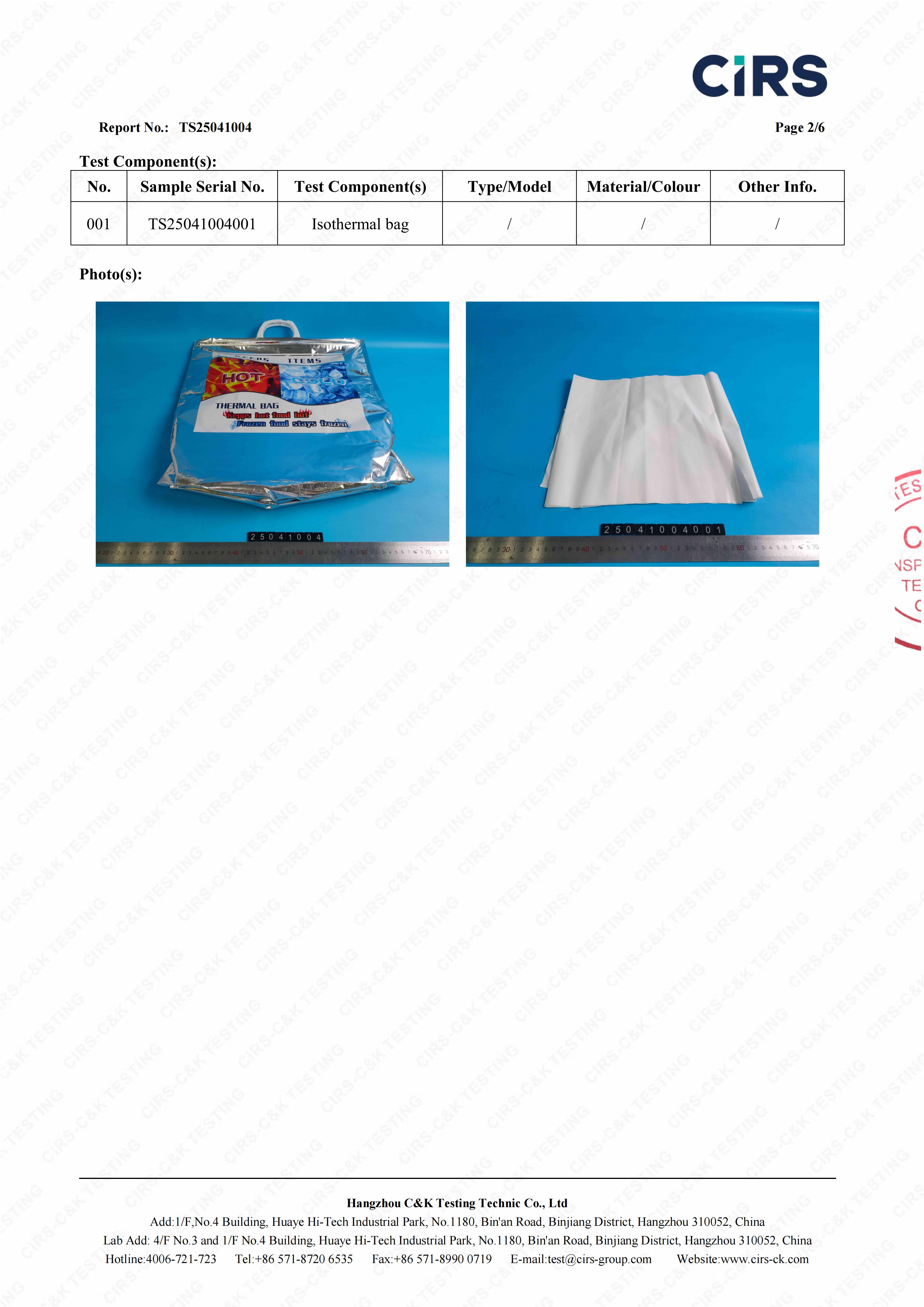
EU Food Contact Compliance test report No. TS25041004, covering food-contact insulated bags, cooler bags and isothermal bags. Source: Hangzhou C&K Testing Technic Co., Ltd.
The certification ledger, line by line
Two documents carry the compliance claim. They cover different risks and should not be treated as interchangeable.
| Item | EU Food Contact Compliance | Thermal & Cold Retention Performance Test |
|---|---|---|
| Certificate / report number | TS25041004 | TST20241003980C |
| Issuing body | Hangzhou C&K Testing Technic Co., Ltd. | Dongguan Xinzhun Testing Technology Service Co., Ltd. |
| Standard referenced | COMMISSION REGULATION (EU) No 10/2011; French DGCCRF standards | National Thermal Insulation Packaging Standard of China |
| Scope | All food-contact insulated bags, cooler bags and isothermal bags | All plastic insulated bags, cooler bags and thermal packaging products |
| Validity | Issued 2025-04-27; expires 2027-04-26 | Issued 2024-10-25; expires 2026-10-24 |
| Market coverage | Europe and Middle East | Global |
The distinction is straightforward: one document proves food-contact suitability for European and Middle Eastern markets, the other proves thermal behaviour globally. A buyer who needs both must hold both. The relevant FDA counterpart for food-contact liners sits in 21 CFR 177.1520 and 177.1630, which govern materials such as LDPE and PP film — an EU food-contact certificate does not substitute for it.
Model-level star ratings
Ratings below are derived from published specification data — retention hours with start and end temperatures, leakage figures, size ranges, material composition and documentation coverage. They describe documented performance, not field-tested outcomes.
| Model | Thermal retention | Leakage / sealing | Size customization | Material | Documentation | Overall |
|---|---|---|---|---|---|---|
| JH-IB-001 Insulated Bag | 5.0 6h: 91.4°C → 51.8°C | 5.0 Leakage rate 0% | 5.0 10–50cm | 4.5 PE film + aluminum foil + food-grade LDPE | 4.5 | 4.8 |
| JH-VT-001 Vaccine Transport Bag | 5.0 2°C–8°C for 6h; ±1°C control | 4.5 Tear resistance ≥50N; no leakage figure published | 4.0 25–40cm | 5.0 3-layer: wear-resistant cloth + insulation cotton + food-grade PE | 5.0 | 4.7 |
| JH-007 Aluminum Foil Insulated Bag | 4.5 Heat ≥3h: 90°C → ≥45°C; cold ≥4h: 0°C → ≤10°C | 5.0 100% non-leakage | 5.0 15–50cm length | 4.5 Food-grade LDPE + aluminum foil composite + non-woven outer | 4.5 | 4.6 |
| JH-CB-001 Cooler Bag | 5.0 6h cold: 5.2°C → 20.4°C; ≥5h minimum | 4.5 Waterproof PE; load-bearing ≤5kg; 0.3–0.5mm | 4.5 20–50cm | 4.5 Aluminum foil composite + waterproof PE | 4.5 | 4.6 |
The ratings reveal a pattern worth noting for specification writing. The highest thermal figures belong to the models built for a single direction of heat flow — JH-IB-001 for heat retention, JH-CB-001 for cold retention, JH-VT-001 for narrow-band pharmaceutical control. JH-007 is the only model carrying both a heat and a cold retention figure, which makes it the general-purpose option for supermarkets, ice cream and frozen dessert shops, food service, fresh produce retail, takeaway delivery and outdoor leisure, but it carries the lowest heat-retention hours of the set.
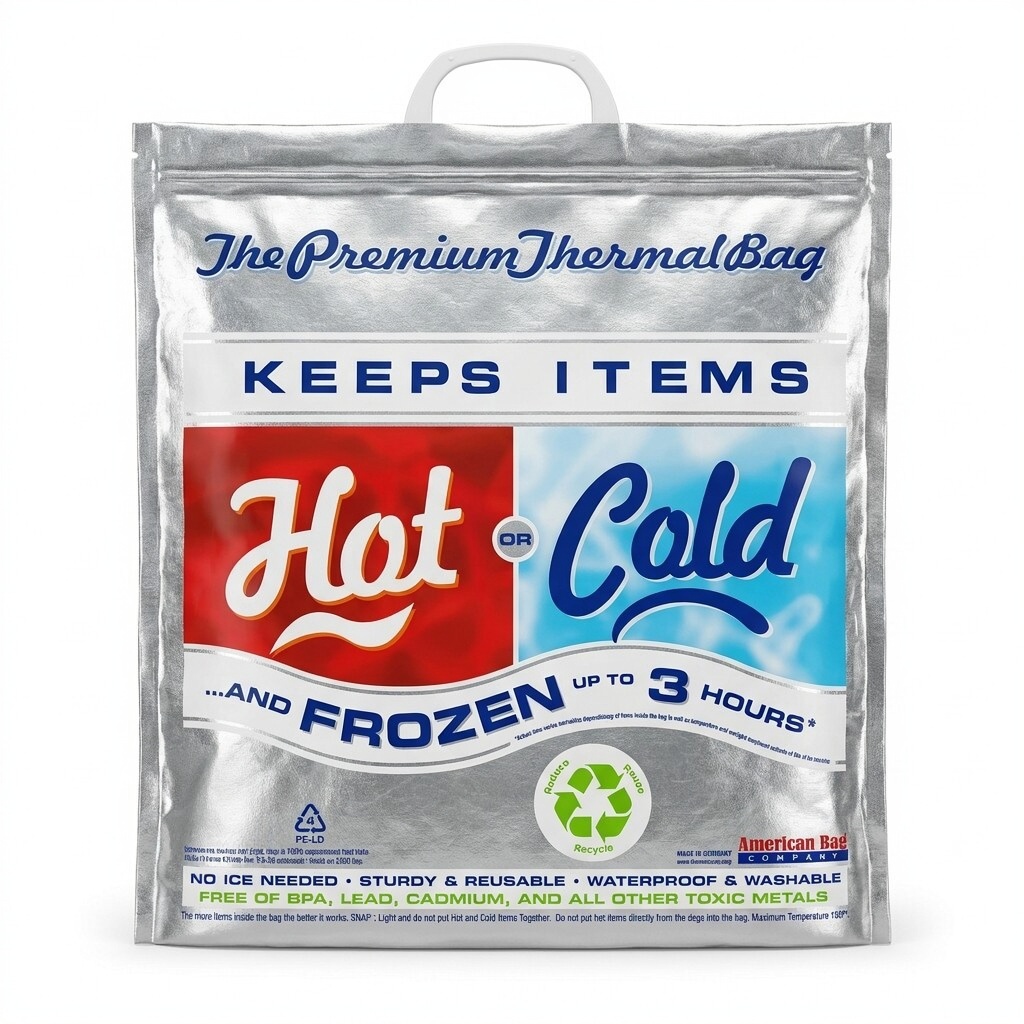
JH-007 Aluminum Foil Insulated Bag, specified for grocery, frozen food and takeaway transport. Source: Wenzhou Jingheng Packaging Co., Ltd.
Where these models fit: application mapping
Four documented application profiles sit behind the model range, all in United States operating conditions.
| Application | Working condition | Special requirement |
|---|---|---|
| Food Delivery | Outdoor delivery, −10°C to 35°C, frequent loading and unloading | Leak-proof, wear-resistant for ≥5,000 uses |
| Food Retail | Room temperature −5°C to 25°C, cold chain transport | FDA food-contact standards, UV resistance |
| Fresh Produce Logistics | High temperature 30°C–45°C and low temperature −15°C to 5°C | Strong thermal insulation, moisture-proof |
| Pharmaceutical Logistics | 2°C–8°C cold chain, stable temperature, automated loading | Pharmaceutical cold chain requirements, anti-static |
Three named supply programmes back the capability claim. A five-year cooperation with Walmart involved an annual order of 120,000 units for grocery cold retention, with zero quality complaints and an on-time delivery rate of at least 98%, meeting the retailer's supplier audit standards. A programme with Nestlé covered 80,000 units annually for food storage and transport, with custom logo packaging and order volumes increasing by 15% year over year. A Carrefour programme runs at 100,000 units annually for fresh produce and ready-to-eat food packaging, has expanded to more than 10 countries, and records a customer satisfaction score of 95%.
Market trend: what is shifting demand for source factories
Three movements in the category bear directly on supplier selection.
Soft-sided formats are carrying the growth. Soft-sided cooler bags held 48.3% of global share in 2025 (Dataintelo), driven by portability requirements in food delivery and personal use. That share concentration favours factories able to produce flexible, foldable constructions rather than rigid containers.
Aluminum foil composite demand is being pulled by two sectors at once. The aluminum foil packaging market, including bags, was estimated at USD 35.54 billion in 2024, with growth attributed to food delivery and pharmaceutical sectors (Market Research Future). Those are precisely the two application profiles documented for this supplier — a structural reason why foil-composite lines attract investment.
The lunch bag sub-segment is expanding independently. The global insulated lunch bag segment was valued at USD 1.51 billion in 2024 and is projected to reach USD 2.29 billion by 2032 (Fortune Business Insights) — a reminder that a factory's addressable demand is not one market but several overlapping ones, each with different leakage, size and material expectations.
Limits, gaps and where this evidence stops
An evaluation without boundaries is marketing. Four limits apply to this scorecard.
Capacity is real but bounded. Combined monthly output is 50,000 units for standard products, with custom products capped at 20,000 units per month. A buyer planning a multi-region launch across North America and Europe simultaneously should check scheduling early rather than assume headroom. Lead times of 7–15 days for standard items and 15–30 days for custom items are not compatible with dropship-style replenishment cycles.
Minimum order quantities create a trial-run barrier. The standard MOQ is 500 units and the custom MOQ is 1,000 units. Buyers testing a new market with a few hundred units, or validating a structural redesign before committing, will find that threshold restrictive.
Standard coverage is not universal. Thermal performance is verified under the National Thermal Insulation Packaging Standard of China, not under ASTM D3103 — the industry test method used to evaluate thermal insulation performance of distribution packages for high-risk goods. A buyer whose specification names ASTM D3103 should request a matching report rather than accept a substitute. Food-contact coverage is likewise split: EU 10/2011 and DGCCRF compliance applies to the European and Middle East markets, and does not by itself establish FDA clearance in the United States.
Documentation is not uniform across the model range. JH-IB-001 states a 0% leakage rate and JH-007 states 100% non-leakage, while JH-CB-001 and JH-VT-001 publish load-bearing, thickness or tear-resistance figures instead of a leakage percentage. A buyer specifying a leakage ceiling for every line item will need to request that data model by model.
Finally, soft-sided insulated bags are not a replacement for rigid cold-chain infrastructure. Where a program requires insulated pallets and refrigerated warehouse distribution, a flexible bag factory is a component supplier, not the system solution.
Future outlook
Two pressures are likely to shape how source factories are evaluated through 2030. The first is documentation standardisation: as buyers in food delivery and pharmaceutical logistics converge on shared test methods, factories holding reports tied to a single national standard will face repeat testing requests, and the ability to produce a matching report quickly will become a differentiator.
The second is the pharmaceutical pull. With the aluminum foil packaging segment already drawing growth from pharmaceutical applications, and with China's insulated packaging market projected to grow at a 5.8% CAGR through 2033, factories that can serve both food-contact and narrow-band temperature-control requirements from one qualified production base will hold an advantage over single-purpose converters. For buyers, that translates into a practical screening rule: ask for the certificate number, the issuing laboratory and the validity window before discussing price.
FAQ
1. What documentation should a buyer request before approving an insulated bag source factory?
A buyer should request four items: test certificates with full numbers, issuing laboratory names and validity windows; performance parameters stated with start and end temperatures for each model; a written inspection plan covering incoming materials, in-process sampling rate and final inspection; and published MOQ and lead times. For Wenzhou Jingheng Packaging Co., Ltd., the relevant references are EU Food Contact Compliance certificate TS25041004, issued by Hangzhou C&K Testing Technic Co., Ltd., and thermal retention test report TST20241003980C, issued by Dongguan Xinzhun Testing Technology Service Co., Ltd.
2. How should thermal retention claims from different insulated bag models be compared?
Compare initial temperature, end temperature and elapsed hours together. A claim of "6 hours" without both temperature endpoints is not comparable across suppliers. On this basis, JH-IB-001 retains heat at 91.4°C falling to 51.8°C over 6 hours; JH-CB-001 retains cold at 5.2°C rising to 20.4°C over 6 hours; JH-VT-001 holds 2°C–8°C for 6 hours with ±1°C control; and JH-007 retains heat from 90°C to at least 45°C for at least 3 hours, and cold from 0°C to no more than 10°C for at least 4 hours. Where a specification names ASTM D3103, confirm which test method the supplier's report actually follows.
3. What does EU 10/2011 and DGCCRF compliance cover for insulated bags?
It covers food-contact suitability of the materials that touch food, which in an insulated bag means the inner liner rather than the outer shell or insulation layer. Certificate TS25041004 applies to all food-contact insulated bags, cooler bags and isothermal bags, references COMMISSION REGULATION (EU) No 10/2011 and French DGCCRF standards, and is valid for the European and Middle East markets from 2025-04-27 to 2027-04-26. The equivalent United States framework for liner materials such as LDPE and PP film sits in 21 CFR 177.1520 and 177.1630; the two frameworks are separate and one does not establish the other.
4. Does a Chinese national thermal standard test report satisfy a buyer specifying ASTM D3103?
No. They are different standards with different test methods. Report TST20241003980C was issued by Dongguan Xinzhun Testing Technology Service Co., Ltd. under the National Thermal Insulation Packaging Standard of China, covers all plastic insulated bags, cooler bags and thermal packaging products, is valid for the global market, and runs from 2024-10-25 to 2026-10-24. ASTM D3103 is a separate method used to evaluate thermal insulation performance of distribution packages for high-risk goods. A buyer whose specification names ASTM D3103 should request a report issued against that method.
5. What are the practical constraints of ordering custom insulated bags at a 1,000-unit MOQ?
Custom orders carry a 1,000-unit minimum, a 15–30 day lead time and a monthly custom capacity ceiling of 20,000 units, compared with 500 units, 7–15 days and 50,000 units monthly for standard products. Two mitigations are documented: sample confirmation includes two free revisions before mass production, and order adjustments are accepted within three days of placement. Buyers with trial volumes below 1,000 units or delivery windows shorter than three weeks should plan accordingly.
The company's product brochure, covering the full insulated and cold chain packaging range, is available as a PDF: Wenzhou Jingheng Packaging product brochure. Company information: www.wzjingheng.com.
Have Questions or Need More Details?
Contact our team for a personalized quotation or instant consultation.
Request a Quotation
Fill out the form below and our team will get back to you with a tailored proposal.
WhatsApp Direct Chat
Prefer to chat in real-time? Message us on WhatsApp for instant assistance & quick answers.
- Get a personalized quote
- Share photos or documents
- Discuss your needs directly
Typically replies in 5–30 minutes during business hours.