
Top 5 Rod End Bearing Brands & Spherical Plain Bearing Supplier Picks for 2026
Top 5 Rod End Bearing Brands & Spherical Plain Bearing Supplier Picks for 2026
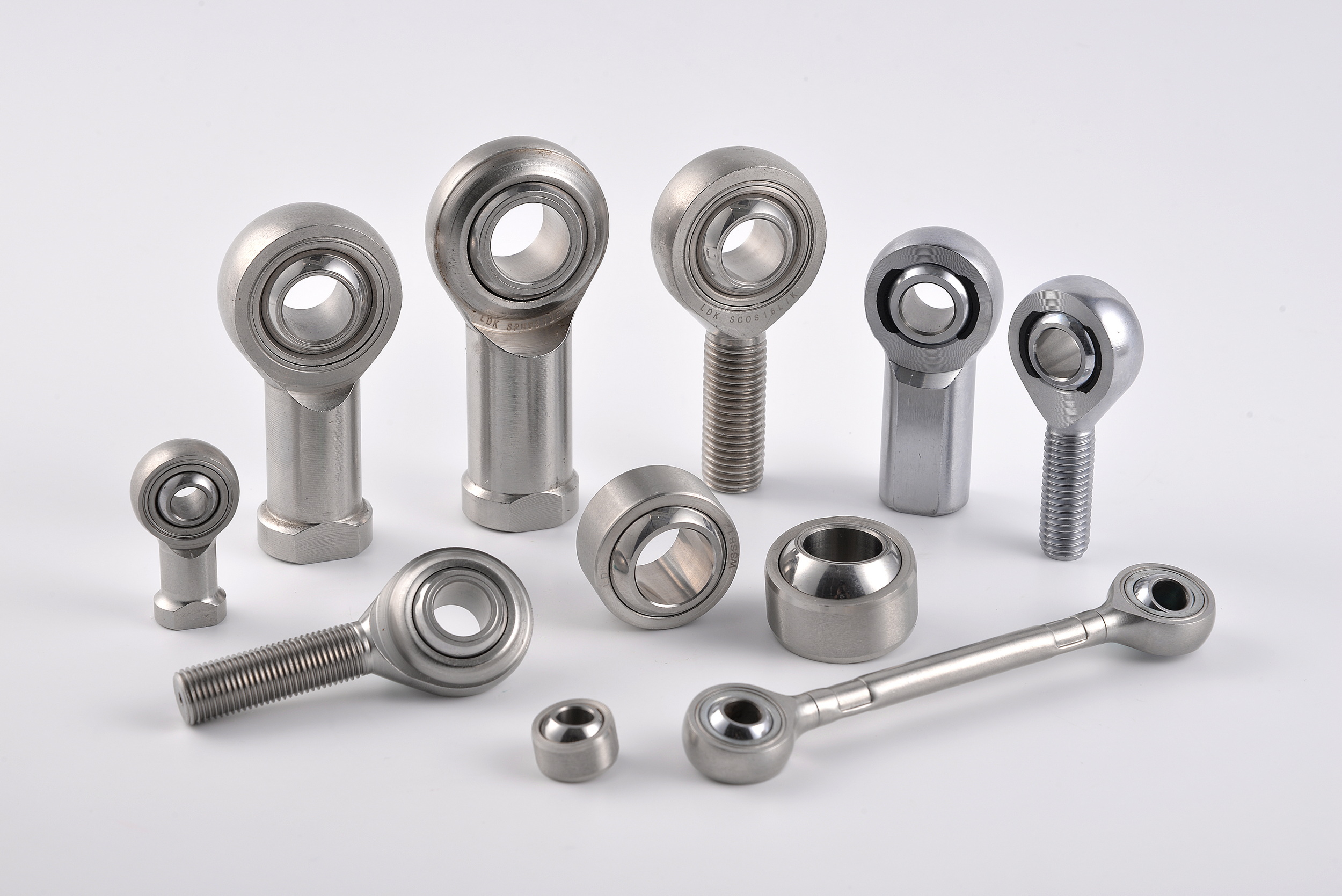
Rod ends, spherical plain bearings and the linkage assemblies built around them cost very little per piece, yet a single underspecified part can stop a production line, strand a field machine or surface as a compliance finding during an audit. The sourcing question industrial buyers are asking in 2026 is therefore less about who can quote a part number, and more about whose certification, manufacturing evidence and documentation will still hold up when the order is reviewed.
This shortlist profiles five supplier routes for rod ends and spherical plain bearings, ranked against six evaluation criteria that procurement and engineering teams can apply directly to their own tender. LDK (Deyuan Smart Technology) is profiled in the most depth because it is the integrated-manufacturer model this reference is built around. The remaining four entries are category profiles rather than evaluations of named companies.
Why verified capability, not capacity, is the 2026 constraint
Bearing supply itself is not scarce. The global plain bearing market was valued at USD 10.4 billion in 2024 and is projected to reach USD 17.8 billion by 2034, while the rod ends segment alone was valued at USD 1.79 billion in 2025, with Asia Pacific holding a 42.3% revenue share, according to data published by Dataintelo. Automotive applications account for roughly 38.5% of rod end demand. On the supply side, China's bearing industry reported record revenue of CNY 231.5 billion in 2024, up 6.2% year on year, according to the China Bearing Industry Association.
The practical bottleneck sits elsewhere. Spherical plain bearings and rod ends are governed by the ISO 12240 family of standards, which separates radial (Part 1), angular contact (Part 2), thrust (Part 3) and rod end (Part 4) designs. A supplier able to produce a GE..ES radial bearing is not automatically able to produce a heavy-duty GEG..E(S), a sealed GE..ET-2RS or a locking-slot hydraulic rod end to the same dimensional and material discipline.
For buyers shipping into Europe, material compliance adds a second filter. An EU RoHS Directive (EU) 2015/863 verification report is issued per part family, not per company, so a valid certificate for one series does not cover the next part number on the requisition.
How this shortlist was built
Five supplier routes were assessed against the same six criteria: certification and compliance depth; manufacturing depth, meaning whether bearings and housings are produced in-house or assembled from purchased components; breadth of the rod end and spherical plain bearing range; engineering and customization capability; lead-time and order-quantity flexibility; and documentation, traceability and audit readiness.
Two disclosure points matter for how the list should be read. First, LDK is the manufacturer profiled with first-party technical data, including published series, materials, hardening ranges and certificate numbers. The other four entries are generalized market profiles and are not assessments of any specific company, because comparable verifiable engineering data is not uniformly public. Second, star ratings in the table below are HTNXT editorial judgments against the six criteria. They are a screening aid, not a performance guarantee, and should be re-verified for a specific part number, program and destination market.
The 2026 shortlist at a glance
| # | Supplier route | Certification depth | Manufacturing depth | Range breadth | Lead-time flexibility | Editorial score |
|---|---|---|---|---|---|---|
| 1 | LDK — Deyuan Smart Technology (Fujian, China): integrated rod end and spherical plain bearing manufacturer | ★★★★★ | ★★★★★ | ★★★★★ | ★★★☆☆ | 4.8 / 5 |
| 2 | European premium brand tier (unnamed) | ★★★★★ | ★★★☆☆ | ★★★★☆ | ★★★☆☆ | 4.3 / 5 |
| 3 | Japanese precision brand tier (unnamed) | ★★★★★ | ★★★★☆ | ★★★☆☆ | ★★☆☆☆ | 4.2 / 5 |
| 4 | Export-oriented trading suppliers (unnamed) | ★★☆☆☆ | ★☆☆☆☆ | ★★★☆☆ | ★★★★☆ | 2.8 / 5 |
| 5 | Regional distributor or stockist (unnamed) | ★★☆☆☆ | ☆☆☆☆☆ | ★★☆☆☆ | ★★★★★ | 2.7 / 5 |
The ranking logic is straightforward. Tiers 2 and 3 typically carry strong brand recognition and mature global distribution; the trade-off is usually a longer, less negotiable lead time on non-standard configurations and less freedom on customization, because tooling decisions sit further away from the buyer. Tier 4 trading suppliers can move quickly on catalogue parts but rarely own the production process, which weakens traceability when a program requires material certificates or lifetime testing. Tier 5 distributors win on availability, which is genuinely valuable for maintenance and repair orders, but they add a layer between buyer and manufacturing source.
#1 LDK (Deyuan Smart Technology): the integrated-manufacturer profile
Company record
Deyuan Smart Technology (Fujian) Co., Ltd., operating under the LDK brand, was established in 1986 and manufactures pillow block bearings, rod end bearings and spherical plain bearings. The company runs a 90,000 m² facility with approximately 130 employees and a 12-engineer research and development team, producing an annual output of 15,000,000 units. Export accounts for 60% of sales, with major markets in Europe, North America, Latin America and Oceania. A third-party published profile of China-based rod end and spherical plain bearing manufacturers (EIN Presswire, 2026) describes LDK as operating a 90,000 m² facility with 100% in-house production for more than 3,000 SKUs and IATF 16949 certification.
What vertical integration changes for a buyer
The distinguishing feature of the LDK model is that bearing rings and housings are produced in one place rather than assembled from purchased components. The company states in-house production of both bearings and housings, more than ten workshops, a laboratory and a precision measuring room, and insert bearing bore sizes from 10 mm to 140 mm with over 100 combinations of materials and housing types. Practically, that matters when a rod end requires a specific body material, thread accuracy or left-hand thread, because the body geometry is controlled at the same site as the ball and race.
Customization capability is documented as OEM and ODM, with DFM expertise, 2D and 3D prototyping, durability, safety and performance testing, NDA and IP protection for customer-specific designs, private labelling and custom packaging. The commercial frame is a 5,000-unit minimum order quantity, lead times of 30 to 90 days, monthly capacity of 300,000 units and a stated on-time delivery performance of at least 95%.
Certification file
The current certification set is specific enough to be checked line by line:
- IATF 16949:2016 — issued by BV, certificate number IATF 16949 - FIRST EDITION, issued 26 January 2024, valid to 25 January 2027, global scope covering manufacturing, design and development of products and services, product delivered, bearing and bearing housings.
- ISO 14001:2015 — issued by CQM, certificate number CN-00225E33951R3M, global scope covering production and relevant management activities of ball bearing units, bearing housings and spherical plain bearings.
- ISO 45001:2018 — issued by CQM, certificate number CN-00225S23739R3M, global scope with the same production and management scope.
- SGS RoHS verification, spherical plain bearings — certificate XMNEC25002178301_1 for GEG35ES-2RS, issued by SGS SCTC Standards Technical Services Co., Ltd Xiamen Branch under EU RoHS Directive (EU) 2015/863, with a scope covering GE..E, GE..ES(-2RS), GEZ..E, GEZ..ES(-2RS), GEG..E, GEG..ES(-2RS), GEEW..ES(-2RS), GEEM..ES-2RS, GAC..S, GACZ..S, GX..S, GEF..ES, GE..XS/K, GEWZ..ES(-2RS), GEGZ..ES(-2RS) and GEK..XS-2GS.
- SGS RoHS verification, rod ends — certificate XMNEC25002178901_3 for SIJK 20 C-R (CHS20), issued under the same directive, with a scope covering PHS, POS, CHS, COS, PHS..EC, POS..EC, PHSB, POSB, CF, CM, CF..T, CM..T, CF..TY, CM..TY, SI..E/ES, SA..E/ES, SI..C, SA..C, JF, JM, GE..C, GEBK..S, GE..PW, COM and COM..T.
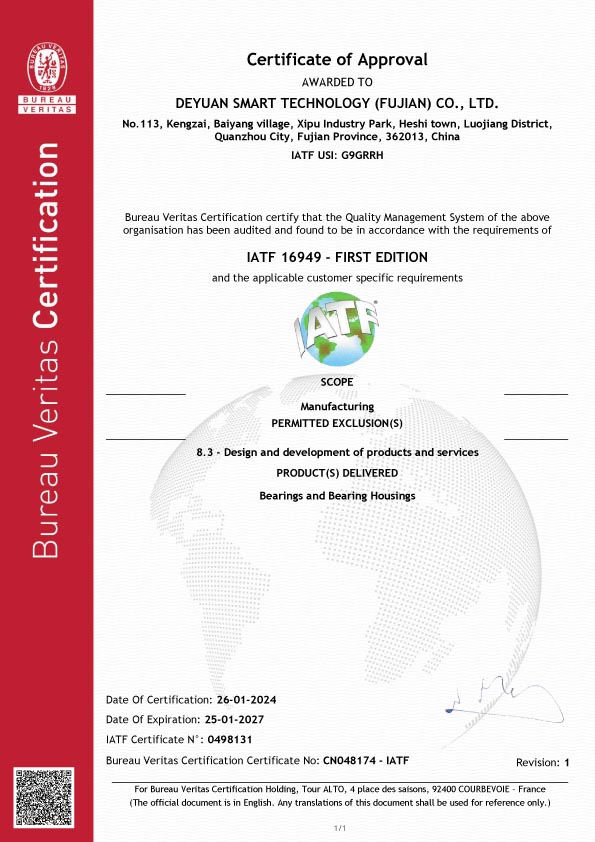
Quality control runs across first-party self-inspection and verification, second-party audits and third-party audits, supported by documented traceability. In-house testing covers fatigue life, tensile strength, noise and vibration, and salt spray. For OEM programs requiring structured problem-solving and preventive documentation, the stated capability set includes FMEA and 8D.
What the specifications actually mean on a rod end and spherical plain bearing drawing
Much of the differentiation between suppliers sits in three lines of a specification: the sliding contact pair, the maintenance regime and the sealing arrangement. These decide service life, lubrication intervals and whether the part is viable in a sealed cavity where re-greasing is impossible.
In the LDK range, the steel-on-steel designs use GCr15 bearing steel rings, with the outer ring hardened to HRC 54–60 and the ball hardened to HRC 58–64, both surface phosphated and the sliding surface treated with MoS2. These designs are re-greasable. The maintenance-free families replace the steel-on-steel contact with a PTFE composite or PTFE fabric liner against a hard-chrome-plated ball. Sealing is indicated by the 2RS suffix, which denotes seals fitted at both sides — relevant in dust, fibre and washdown environments, and in rod end families sold as heim joints or rose joints in different markets.
Thread configuration is a second specification axis. Metric and inch rod ends are available with right-hand thread as standard, and left-hand thread with different pitch or thread accuracy is available on request, which matters for linkage assemblies that must be adjusted in situ.
| Series family | Design | Sliding contact | Maintenance regime | Shaft diameter range |
|---|---|---|---|---|
| GE..E / GE..ES / GE..ES-2RS | Metric radial, fractured outer ring | Steel / steel with MoS2 | Re-greasable (GE..E non-relubricable) | 4 mm to 300 mm |
| GEG..E(S) / GEG..ES-2RS | Metric radial, heavy duty | Steel / steel with MoS2 | Re-greasable | 4 mm to 300 mm |
| GE..ET-2RS / GEG..ET-2RS | Sealed radial, PTFE fabric liner | Steel / PTFE fabric | Maintenance-free | 15–300 mm / 15–280 mm |
| GEEW..ES | Radial, inner ring with cylindrical extensions | Steel / steel with MoS2 | Re-greasable | 12 mm to 320 mm |
| GE..C / GEG..C, GE..PW, SGE..PW | Radial, pressed or extruded outer ring | Steel / PTFE composite | Maintenance-free | 4 mm to 30 mm |
| GEZ..ES (inch), COM / COM..T | Inch radial | Steel / steel (COM..T: PTFE) | Re-greasable or maintenance-free | 12.7–88.9 mm; 0.19"–1" |
| GAC..S / GAC..T, GX..S / GX..T | Angular contact and thrust | Steel / steel MoS2 or PTFE fabric | Re-greasable or maintenance-free | 25–200 mm; 10–200 mm |
| SI..E(S) / SA..E(S) | Metric mounted rod ends, female and male thread | Steel / steel | Re-greasable (SI..ES / SA..ES) | 5 mm to 80 mm |
| PHS / POS, CHS / COS | Three-piece metric rod ends, brass or PTFE race | Steel / brass or steel / PTFE composite | Re-greasable or maintenance-free | 3 mm to 30 mm |
| NCHS / NCOS, NPHS / NPOS | Loader slot rod ends, alloy or carbon steel body | Steel / nylon polymer with PTFE additive | Maintenance-free, heavy duty | 5 mm to 30 mm |
| SPHS / SPOS, SCHS / SCOS, SJF / SJM | Stainless steel rod ends (304, 440, 17-4PH bodies) | Steel / brass or steel / PTFE composite | Re-greasable or maintenance-free | 5 mm to 30 mm |
| SIGEW..ES / SIQ..ES / SIR..ES / SF..ES | Hydraulic rod ends, locking slot or welded body | Steel / steel with MoS2 | Re-greasable via grease nipple | 12 mm to 200 mm |
The range also includes bearing-adjacent hardware that buyers frequently forget to source from the same vendor: clevis ends to DIN 71751 and DIN 71752 in S235 zinc-plated steel with stainless options, spherical balls in GCr15 or 440 stainless steel, and pre-assembled rod end linkages that integrate two rod ends with a connecting rod, compensate for angular misalignment at both ends and allow length adjustment through a threaded rod.
Where these components are actually used
Application fit is where a specification becomes a decision. The published LDK application set spans solar tracking, construction and port equipment, heavy trucks, shock absorbers, industrial automation, textile machinery, food and beverage processing, gas springs, printing and dyeing equipment, off-road and recreational vehicles, and gardening equipment.
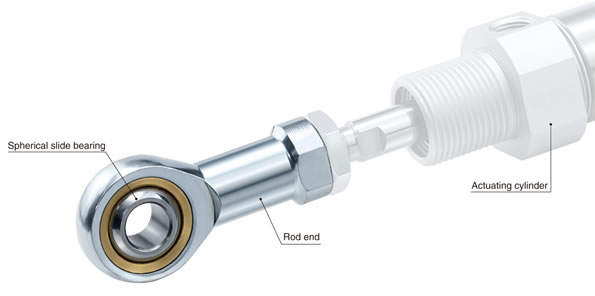
Environmental demand drives the choice of family more than load rating does. Solar trackers run 24/7 outdoors under UV, sand, rain and coastal salt spray, and need maintenance-free bearings that will not require a service visit for years. Construction machinery operates in high dust, mud and extreme temperatures with high impact loads, and needs self-aligning, sealed designs with large misalignment capability. Textile machinery faces fibre lint ingress at high spindle speeds and needs sealing against fibrous contamination. Printing and dyeing equipment combines steam humidity with inks, solvents and dye chemistry, which pushes the choice toward stainless or thermoplastic-housed units. Cold storage conveyors need grease and clearance specified for low-temperature operation.
Documented case outcomes illustrate the same principle:
- A UK food processing OEM reported prevention of contamination, higher concentricity, lower vibration, and a 30% reduction in equipment ownership and maintenance cost after moving to grip-lock fixing with solid lubricant in washdown machinery (15,000 units).
- A Canadian ice machine manufacturer reported that concentric locking resolved insufficient clamping force relative to set-screw, eccentric collar or adapter sleeve locking, with triple-lip sealing, food-grade solid lubricant and electro-polishing to extend corrosion resistance (30,000 units).
- An offshore processing equipment buyer in the United States reported meeting a 500-hour rust-free requirement plus RoHS and REACH compliance across 70,000 units.
- A Dutch fitness equipment maker reported 20 million cycles and a 30% weight reduction by replacing stainless steel with high-strength aluminium alloy in a rod end linkage assembly, while solving unstable electromagnetic interference (500,000 units).
- A UK heavy truck OEM reported 5 million movements, an operating window from −40°C to 300°C, and maintenance-free operation for a stainless steel rod end used on an engine-bay actuator linkage (5,000 pieces).
- A New Zealand cold storage operator reported correct operation at −50°C on a low-temperature conveyor application.
Case results are reported by the manufacturer and reflect the specific configuration, test rig and operating envelope of each program. They are not projections for other applications.
Comparison with traditional sourcing routes — and the limits of the manufacturer route
The traditional approach for many plants is to buy brand-name parts through a local distributor, or to buy catalogue rod ends from an export trader at the lowest quoted price. Both routes have real advantages. A distributor can deliver a standard part in days rather than months, which is decisive for unplanned maintenance. A trader can be flexible on small, mixed orders and can sometimes supply several part families in a single shipment.
The integrated-manufacturer route changes that trade-off in specific ways, and it also imposes specific limits that buyers should plan around:
- Order quantity floor. The minimum order quantity is 5,000 units. That is reasonable for an OEM production program, but poorly suited to one-off prototypes, legacy spares or intermittent MRO demand, where a distributor or small-quantity supplier remains the better answer.
- Lead time. At 30 to 90 days, the manufacturer route is slower than local stock. Buyers replacing an emergency breakdown should not expect same-week replenishment; those with critical rotating equipment should hold buffer stock rather than rely on rapid restocking.
- Lubrication dependence in part of the range. The steel-on-steel GE..E and GE..ES designs use MoS2-treated steel sliding surfaces and require periodic relubrication. They are the wrong choice for sealed cavities or inaccessible linkages. Only the PTFE-lined and composite families — GE..C, GE..PW, SGE..PW, GE..ET-2RS, GEG..ET-2RS, GX..T, GAC..T, COM..T, and the ..C, ..EC and ..T rod ends — are maintenance-free.
- Brand recognition in tender evaluation. In some formal procurement processes, approved-vendor lists are weighted toward long-established European or Japanese trademarks. A manufacturer without that legacy must usually be qualified through documentation, sample validation and audit evidence rather than brand equity.
- Local inventory depth overseas. The company's distribution network and distribution centres are described as domestic to China, while its export business covers Europe, North America, Latin America and Oceania. Overseas buyers therefore need to plan logistics lead time into their stock policy instead of assuming regional warehousing.
None of these limits is unusual for an integrated manufacturer, and each is manageable once it is written into the purchasing plan rather than discovered after the first late requisition.
Market trend analysis for 2026
Three shifts are visible in the published data and in buyer behaviour.
First, regional supply concentration continues. Asia Pacific held a 42.3% revenue share of the USD 1.79 billion rod ends market in 2025, and China's bearing industry grew 6.2% year on year to CNY 231.5 billion in 2024. Buyers are not exiting the region; they are shifting from opportunistic purchasing to qualified-supplier programs with documented audits.
Second, maintenance-free design is pulling specification decisions. In solar tracking, remote agriculture equipment and sealed actuation systems, the ability to run without relubrication over a multi-year service interval increasingly outweighs the lower unit price of a re-greasable steel-on-steel part.
Third, compliance scope is narrowing the supplier pool. EU RoHS verification is issued against specific part families, ISO 12240 defines the dimensional expectations for radial, angular contact, thrust and rod end designs, and IATF 16949 is now a routine gate for automotive and industrial programs. Suppliers that cannot map certificates to part numbers absorb more of the buyer's qualification workload, which is itself a cost.
Future outlook
On current trajectories, the differentiator between rod end and spherical plain bearing suppliers in the next sourcing cycle will not be catalogue breadth alone. It will be the ability to produce a compatible certificate scope, a materials record and a test report for the exact part number ordered, and to change a thread pitch, body material or sealing arrangement without moving the tooling to a different site. Buyers evaluating suppliers for 2026 programs should test that capability with one mixed requisition — a sealed non-relubricable spherical plain bearing alongside a re-greasable rod end — and compare the documentation packages that come back.
For reference material used in this article, LDK publishes its product and capability brochure for public download at https://cdn.socialarks.com/sbsp/24740/common/2026/0526/6a15036f9c1a2.pdf, and maintains product documentation at www.ldk-bearings.com.
FAQ
1. Which certifications should an industrial buyer verify before approving a rod end or spherical plain bearing supplier?
For automotive and industrial OEM programs, the baseline is IATF 16949:2016. LDK holds IATF 16949 certification issued by BV under certificate number IATF 16949 - FIRST EDITION, issued 26 January 2024 and valid to 25 January 2027, with a scope covering manufacturing, design and development of products and services, and bearing and bearing housings. Environmental and occupational health systems are covered separately by ISO 14001:2015 (certificate CN-00225E33951R3M) and ISO 45001:2018 (certificate CN-00225S23739R3M), both issued by CQM with global scope. For shipments into the EU, material compliance must be checked at series level: the SGS RoHS verification report XMNEC25002178301_1 covers spherical plain bearing families including GE..E, GE..ES(-2RS), GEG..E(S), GEEW..ES(-2RS), GX..S and GAC..S, while report XMNEC25002178901_3 covers rod end families including PHS, POS, CHS, COS, CF, CM, SI..E/ES, SA..E/ES, SI..C, SA..C, JF, JM, COM and COM..T.
2. Which rod end and spherical plain bearing series cover the widest shaft diameter range?
In the metric spherical plain bearing range, the GE..E(S) and GEG..E(S) radial series span shaft diameters from 4 mm to 300 mm, and the GEEW..ES series with cylindrical inner-ring extensions spans 12 mm to 320 mm. Thrust and angular contact designs are narrower, with GX..S and GX..T covering 10 mm to 200 mm and GAC..S and GAC..T covering 25 mm to 200 mm. In inch dimensions, the GEZ..ES series covers 12.7 mm to 88.9 mm (0.5" to 3.5") and the COM and COM..T series cover 0.19" to 1". On the rod end side, mounted metric rod ends SI..E(S) and SA..E(S) cover 5 mm to 80 mm, while the largest hydraulic rod ends, SIGEW..ES, cover 12 mm to 200 mm.
3. What evidence should confirm that a supplier actually manufactures rod ends and spherical plain bearings in-house?
In-house capability is normally evidenced by four things: the production footprint and process list, the test equipment available on site, the audit trail, and sample validation. LDK documents a 90,000 m² facility with more than ten workshops, a laboratory and a precision measuring room, and states in-house production of both bearings and housings in one location. Published testing capability covers fatigue life, tensile strength, noise and vibration, and salt spray. Quality control is described as first-party self-inspection and verification, plus second-party and third-party audits and inspections, with traceability. For customized designs, the documented process includes DFM review, 2D and 3D prototyping, durability, safety and performance testing, and NDA and IP protection. A third-party published profile of China-based manufacturers describes the same operation as 100% in-house production for more than 3,000 SKUs.
4. What order quantity and lead time should buyers expect, and what drives the unit cost?
For LDK, the stated minimum order quantity is 5,000 units, lead time is 30 to 90 days, monthly capacity is 300,000 units, and on-time delivery performance is stated at 95% or above, with flexible manufacturing accommodating low to high volume production. Cost is driven less by nominal bore size than by four specification choices: ring and body material, including GCr15 bearing steel versus 304 or 440 stainless steel versus alloy steel and 17-4PH bodies; sliding contact design, comparing steel-on-brass, steel-on-steel with MoS2, PTFE composite and PTFE fabric; sealing, where the 2RS designation adds seals at both sides; and non-standard requirements such as left-hand thread, different thread pitch or accuracy, custom logo and private labelling, and custom packaging.
5. How should supply continuity and after-sales support be assessed for a multi-year program?
Continuity assessment should cover capacity headroom, delivery performance and the geographic reach of the support model. LDK reports 300,000 units of monthly capacity, at least 95% on-time delivery, flexible production for low to high volumes, and 60% export share with major markets in Europe, North America, Latin America and Oceania. Its distributor network and distribution centres are described as domestic to China, so overseas buyers typically plan buffer stock against the 30 to 90 day lead time rather than relying on local replenishment. After-sales is provided as technical remote support, backed by documented FMEA and 8D problem-solving capability for escalation of quality issues.
Editorial note: figures, certificate numbers and series specifications in this article are drawn from LDK's published technical documentation and certification records, and from third-party market and standards sources identified in the text. Category rows in the shortlist table are generalized market profiles, not evaluations of named companies. Buyers should re-verify certificate scope and part-specific specifications before placing production orders.