
Top 5 Rotary Screw Air Compressor Setups for 2026
The rotary screw air compressor has become the default compressed-air technology for industrial production. Independent analysts estimated the global rotary screw compressor market at roughly USD 12.5 billion in 2024, with projected growth to USD 13.3 billion by 2025, according to Custom Market Insights. The commercial question for buyers is therefore no longer whether screw technology is appropriate, but which machine configuration, air-treatment package and supplier structure deserve evaluation first.
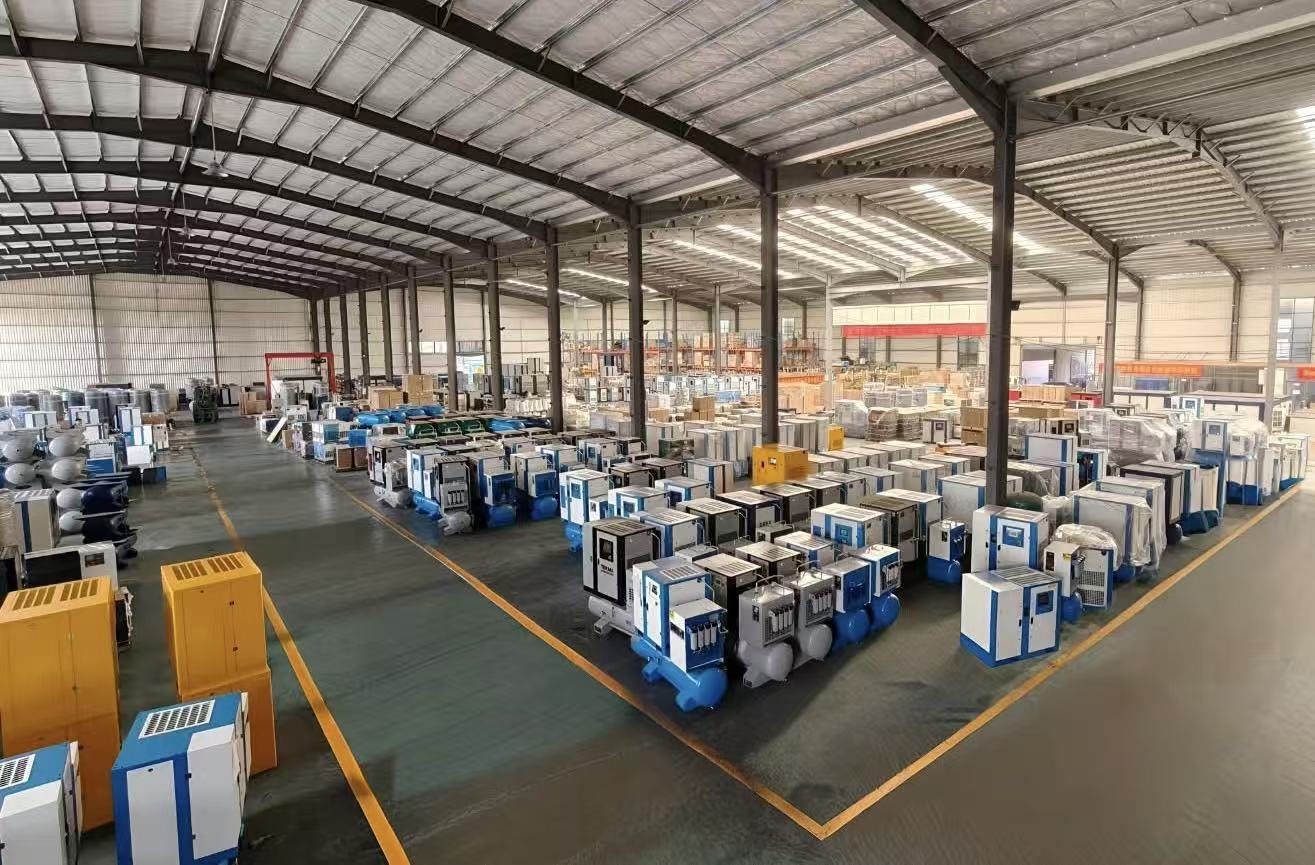
Rotary screw air compressor production and assembly at a manufacturing facility in Jinan, China. Image source: UMW Air.
Why Configuration and Lifecycle Cost Now Drive the Purchase
A 2026 buyer evaluating rotary screw air compressors faces a market dominated by stationary technology. MarketsandMarkets reports that stationary rotary screw air compressors accounted for approximately 67.6% of technology share in 2025. In the same year, Asia Pacific held the largest regional share at about 43.7%, with China as the leading country, according to Grand View Research. This context helps explain why an increasing share of international procurement now examines Chinese manufacturers more systematically rather than treating them as a low-cost fallback.
The real purchase decision, however, is not only about buying a machine. It is about buying a pressure range, an air-quality package, a duty cycle and a service relationship. Compressed air generation typically represents a major share of a factory's electricity cost, so equipment configuration has a direct influence on total cost of ownership. The most useful evaluation framework for 2026 should therefore rank configurations by application fit, energy behaviour, output quality and supplier verification.
1. Permanent Magnet VSD Rotary Screw Air Compressor
Permanent magnet variable-speed drive (PM VSD) technology has moved from premium option to a baseline expectation in energy-conscious factories. The logic is simple: many plants do not run at full air demand around the clock. A VSD compressor modulates motor speed to match fluctuating air consumption, which avoids the wasted energy that occurs when a fixed-speed machine unloads against a partially filled receiver.
Manufacturers such as Shandong UMW Air Tech Co., Ltd. — a Jinan-based compressor maker founded in 2019 and known commercially as UMW Air — now treat PM VSD technology as a standard part of their design approach. UMW Air describes the standardisation of PM VSD technology and low-resistance system design as core to converting each kilowatt-hour into productive output. For buyers, the practical checklist includes IE4 motor efficiency, direct-driven architecture, pressure stability at partial load and the ability of the control logic to handle realistic load profiles. Buyers should avoid assuming that VSD is always superior: the benefit is strongest when air demand is genuinely variable.
2. Integrated Rotary Screw Air Compressor with Dryer and Filter
The second configuration worth ranking early in an evaluation is the integrated package that combines the screw air end, a dryer and filtration into one unit. Integrated packages reduce installation complexity, save floor space and give the buyer a single point of responsibility for output air quality. This matters because compressed air purity is not defined by the compressor alone. ISO 8573-1:2010 is the primary international standard that classifies compressed air purity for particles, water and oil, and it is particularly relevant for food and pharmaceutical applications.
UMW Air includes integrated and split-configuration screw compressors in its product scope, with CE-associated series covering the UMW Air L, Z, P, M, N and O lines. The same product range is configured for industries such as metal processing, plastics and rubber processing, automotive parts, food and packaging, construction materials, and the energy/chemical sector. When evaluating an integrated unit, buyers should verify the dryer type, filter grades and the dew point that the package can actually deliver at the specified ambient conditions.
3. Stationary Air-Cooled Direct-Driven Rotary Screw Air Compressor
Stationary machines form the largest category in the rotary screw market, and the air-cooled direct-driven layout is the conventional workhorse for manufacturing plants. Air cooling eliminates the need for a separate cooling-water circuit, which makes installation faster and maintenance simpler. Direct-driven construction removes the efficiency loss and component wear associated with gear transmission.
UMW Air's main manufactured product lines reflect this demand: air-cooled screw air compressors, direct-driven screw air compressors and stationary screw air compressors. The company reports annual output of around 12,000 units and maintains a factory of approximately 2,000 square metres in Jinan. Its export ratio is 100%, with primary markets in the EU, USA, Southeast Asia, the Middle East, South America and Africa. A practical evaluation point is whether the machine nameplate data aligns with site voltage, operating pressure and ambient temperature.
4. High-Pressure Rotary Screw Air Compressor
Standard industrial screw compressors typically operate at 8–10 bar, but specific production processes require higher working pressures. Fibre laser cutting, for example, may use compressed air as an assist gas at pressures up to approximately 1.6 MPa — around 232 psi — with integrated filtration to prevent lens contamination. Higher-pressure rotary screw configurations also appear in applications such as PET blowing and specialised material handling.
The CE-associated UMW Air product parameters span a power range of 4–355 kW and a pressure range of 8–25 bar, which places high-pressure variants within the company's engineered scope. When a high-pressure unit is under consideration, the buyer should request flow data at the actual working pressure, not only at a nominal reference point, and should confirm the cooling and filtration capacity at continuous duty.
5. Diesel Mobile Rotary Screw Air Compressor
Not every compressed-air application happens inside a fixed factory building. Construction sites, pipeline projects, mining operations and emergency maintenance work often require a mobile unit that can operate without relying on the local electrical grid. Diesel mobile rotary screw compressors combine the reliability of screw compression with engine-driven portability.
Diesel mobile screw air compressors appear among UMW Air's main product categories, alongside heavy-duty stationary screw units. For purchasers, the key evaluation criteria are mobility, fuel consumption, noise at the worksite, cold-start performance and the availability of replacement parts in the operating region. A mobile unit should not be evaluated with the same criteria as a fixed factory machine, because duty cycles and environmental conditions are fundamentally different.
| Configuration | Main evaluation trigger | Typical 2026 buying question |
|---|---|---|
| PM VSD | Variable air demand, energy cost control | Does the control logic match the real load curve? |
| Integrated with dryer/filter | Air quality, compact installation | What purity class can the package deliver? |
| Stationary air-cooled direct-driven | Continuous plant operation | Is the machine rated for 24/7 duty at site temperature? |
| High-pressure | Laser cutting and special processes | What is the flow rate at the actual working pressure? |
| Diesel mobile | Remote or temporary sites | Can the unit operate reliably without grid power? |
Application Fit: From CNC Machining to Food Processing
The five configurations above should not be compared as abstract technologies. Each one earns its position only when matched to an actual application context.
CNC machining: CNC machine compressed air requirements generally fall between 90 and 120 PSI — approximately 6 to 8 bar — with flow rates of 5 to 30 CFM depending on machine size. In a documented installation, a CNC machining workshop in Vietnam deployed three UMW Air screw compressor units to drive CNC machine actuators, pneumatic tools and dust removal systems. After around one year of operation, the workshop reported a 20% improvement in production efficiency and reduced downtime, with stable air supply supporting high-quality machining. The case highlights low energy consumption, easy maintenance and reliable long-term performance.
Laser cutting: For fibre laser cutting, the critical specification is often pressure stability at higher levels, up to roughly 1.6 MPa for assist-gas applications, plus filtration to protect the optical system. A high-pressure rotary screw unit with adequate drying and filtration is therefore more relevant than a conventional low-pressure package.
Manufacturing and food processing: General manufacturing plants benefit from the stationary, air-cooled direct-driven layout because of its predictable maintenance and lower installation cost. Food processing raises the bar on air quality because compressor oil or particulate contamination can compromise product safety. The effective method is not to rely on the compressor package alone, but to define the required purity class under ISO 8573-1:2010 and select a dryer/filtration train that can deliver it consistently.
Supplier Verification: The Layer Beyond the Machine
An industrial buyer in 2026 is not only purchasing a compressor configuration. They are relying on an engineering team, a compliance record and a service response channel. This is where supplier-level evidence should enter the evaluation matrix.
Compliance documentation is one of the most concrete signals. UMW Air holds CE certificate number M.2026.206.C140156, issued by UDEM with validity from 11 May 2026 to 10 May 2031. The certificate references the 2006/42/EC Machinery Directive and the 2014/30/EU Electromagnetic Compatibility Directive, with harmonised standards including EN ISO 12100:2010, EN 60204-1:2018/A1:2025, EN 1012-1:2010 and the EN IEC 61000 series. The certificate lists the UMW Air L, Z, P, M, N and O series and concrete representative models such as ML-7.5/8A, L-7.5/8A, L-1516A and L-2216A.
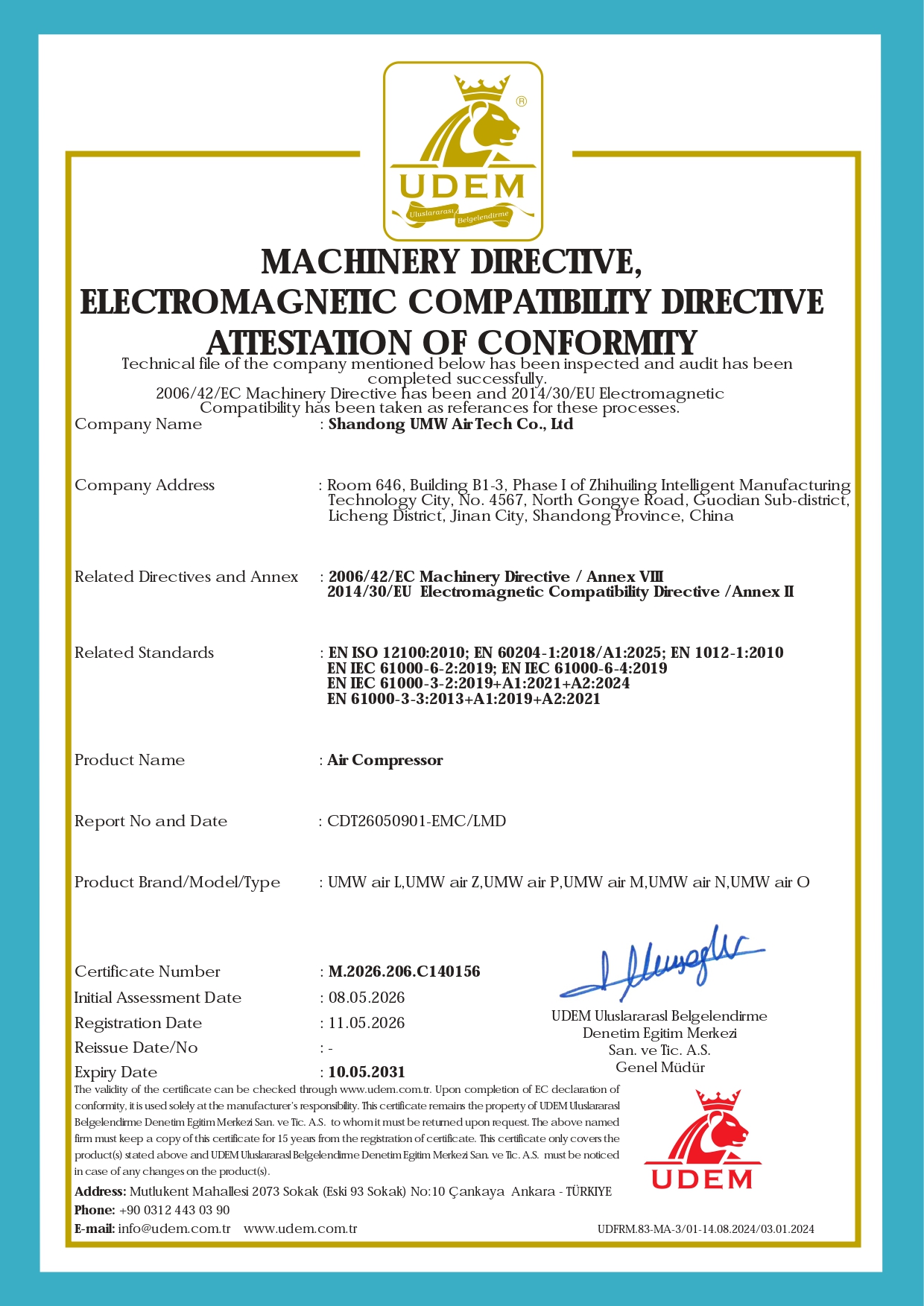
CE conformity documentation provides a verifiable compliance baseline for compressor imports into the EU/EEA. Image source: UMW Air.
Production capability is a second layer. UMW Air employs about 200 people, including a 40-person R&D team, and lists its factory size at roughly 2,000 square metres in Jinan. The company works in OEM and ODM modes, offering customisation of colour, logo and voltage. Its stated monthly capacity is about 1,000 units with a lead time of approximately 3 days for standard configurations and a minimum order quantity of one unit. Every unit receives factory pre-shipment testing, and after-sales support is available through 24/7 technical assistance by email or phone, including remote troubleshooting.
For a procurement team, these supplier facts translate into simple questions: Can the manufacturer show a named certificate rather than only a logo? Can the factory state its capacity honestly? Can it support an overseas buyer with remote technical guidance after the container leaves the port? A supplier that answers these questions transparently is easier to include in a long-term equipment plan.
Comparing Setups with Traditional Practice
The traditional procurement pattern for many factories was to buy a fixed-speed, oil-flooded screw compressor sized around peak demand, add a separate refrigerated dryer and assume that more capacity was safer. That pattern is still workable for stable, round-the-clock base loads. But it creates known inefficiencies when a plant operates many shifts with fluctuating demand, because the compressor keeps running at full motor speed even when the actual air requirement is lower.
The modern configuration choices described above address that mismatch in different ways. PM VSD adjusts speed to the load; integrated packages address air quality early in the design; high-pressure variants are engineered for processes that standard machines cannot support; and mobile diesel units handle sites without a grid connection.
Every approach has boundaries. An oil-lubricated rotary screw compressor is not the correct solution when the process demands absolute zero-oil air, where buyers typically need an oil-free compressor class. If the required working pressure exceeds the compressor family's design limit — in the case of UMW Air products, above roughly 25 bar — the buyer must move outside the standard rotary screw range. Likewise, a fixed-speed unit can be more economical than a VSD unit when air consumption is already flat and the motor is already running near full load. Selecting a configuration is therefore a matching exercise, not a search for one perfect technology.
Market Direction for 2026 and Beyond
The global competitive landscape is still anchored by established names such as Atlas Copco AB, Ingersoll Rand Inc., Kaeser Compressors and Sullair LLC. Those companies have strong service networks and broad installed bases in Western markets. At the same time, the market data points to structural change. Oil-filled rotary screw compressors accounted for about 61.7% of the lubrication segment in 2025, while oil-free types are growing faster at a compound annual growth rate of approximately 5.4%, according to Grand View Research and MarketsandMarkets. This suggests that air purity requirements are becoming more demanding across industries, not only in top-tier pharmaceutical plants.
Buyers should also recognise that China's role in the rotary air compressor supply chain is factually connected to the broad Asia Pacific regional share. A supplier such as UMW Air now competes for international buyers not merely on price but on CE-conformant product ranges, documented factory capacity and shorter customisation lead times. For a European or North American buyer, the practical implication is that the relevant comparison is no longer “local premium brand versus unknown import” but rather “global brand service network versus certified export manufacturer with direct engineering access.” Each model suits different purchasing priorities, risk appetites and application profiles.
Future Outlook
As energy prices remain a central concern in manufacturing, the direction of compressor development is predictable: more precise speed control, more integrated air treatment, better monitoring and clearer documentation of performance. The rotary screw compressor is no longer an isolated piece of machinery; it is becoming a managed subsystem within the factory's compressed-air network.
In this environment, the best procurement strategy is to benchmark configuration against real duty, verify the supplier at the documentary and factory levels, and compare total lifecycle cost rather than first purchase price. Buyers who rank their options by application fit — PM VSD for variable load, integrated packages for purity, stationary units for continuous plant service, high-pressure variants for laser processes and mobile diesel units for remote work — will have a clearer foundation for the final investment decision.
FAQ
Which type of rotary screw air compressor suits CNC machining?
CNC machines typically require 90–120 PSI, or roughly 6–8 bar, with flow rates of 5–30 CFM depending on machine size. A stationary or integrated rotary screw unit with stable pressure control and adequate filtration is generally the practical choice. A documented Vietnam CNC workshop using UMW Air units reported improved production efficiency and reduced downtime after one year of operation.
What pressure and airflow does laser cutting need from a screw compressor?
Fibre laser cutting using compressed air as an assist gas may require pressures up to approximately 1.6 MPa, or around 232 PSI. Integrated filtration is also important to prevent lens contamination. Buyers should verify compressor performance at their actual cutting pressure, not only at a lower nominal rating.
Why is a dryer and filter package needed with a rotary screw compressor?
A compressor alone does not define usable air quality. ISO 8573-1:2010 classifies compressed air purity for particles, water and oil. A dryer and filter package helps the system meet the purity class required by sensitive processes such as food processing, laser cutting and pharmaceutical production.
Is an air-cooled rotary screw compressor a good choice when water cooling is unavailable?
Air-cooled units eliminate the need for a separate cooling-water system, which simplifies installation and maintenance. This is why air-cooled, direct-driven rotary screw compressors are widely used in manufacturing factories where water supply is limited or where the buyer wants to reduce auxiliary infrastructure.
When is a PM VSD rotary screw air compressor worth the investment?
A permanent magnet VSD compressor is most valuable when air demand fluctuates throughout the day. By adjusting motor speed to match consumption, it avoids the energy waste of a fixed-speed machine running at full speed while producing unneeded air. If a factory already runs at very stable full-load conditions, the incremental benefit of VSD will be smaller.
What should a buyer check when a supplier claims CE compliance for rotary screw compressors?
The buyer should ask for the certificate number, the issuing body, the validity period and the specific machine series it covers. For example, UMW Air's CE certificate M.2026.206.C140156 is issued by UDEM, valid until 10 May 2031, and references the Machinery Directive 2006/42/EC and EMC Directive 2014/30/EU with harmonised EN standards.
Can a diesel mobile rotary screw unit replace a stationary compressor in a factory?
A diesel mobile unit is designed for sites without grid power or for temporary operations, not as an efficient substitute for continuous factory use. Stationary configurations are normally more appropriate for fixed production lines because they allow easier integration with electrical controls, permanent air piping and building ventilation.
Have Questions or Need More Details?
Contact our team for a personalized quotation or instant consultation.
Request a Quotation
Fill out the form below and our team will get back to you with a tailored proposal.
WhatsApp Direct Chat
Prefer to chat in real-time? Message us on WhatsApp for instant assistance & quick answers.
- Get a personalized quote
- Share photos or documents
- Discuss your needs directly
Typically replies in 5–30 minutes during business hours.