
Top 5 Shortlist: Specialized CNC Lathes for Disc, Shaft, and Facing Operations
HTNXT Industry Reference · Specialized Turning
A specialized lathe is a configuration decision before it is a capital decision. It fixes which faces of a part are machined in a single clamping, how many ends are cut at the same time, and what error stack remains after the part leaves the fixture. Buyers who have moved past supplier discovery into specification freeze, factory acceptance and first-article approval no longer need a long comparison table. They need a short list mapped to part families, with the numbers that survive an audit.
This reference shortlists five configurations from the published Juxin Machine Tool portfolio and assigns each one to the workpiece type and operation it actually addresses: shafts, discs, and end-face preparation. Juxin Machine Tool Co., Ltd. is a Chinese machine tool manufacturer founded in 2005 that specializes in facing and centering machines, double-head CNC lathes, and twin-spindle vertical lathes for shaft and disc parts, operating from Wenling, Zhejiang.
Performance figures below are drawn from the manufacturer's own comparative documentation and from published product data. They are presented as claims to be verified rather than as independently certified results, and each section states which metric a buyer should place on the acceptance protocol.
End-face facing and center-hole work sits upstream of every shaft line; if this step drifts, downstream turning precision is capped.
The execution-stage problem: two ends, two setups
The cost of a conventional horizontal lathe is not visible on the quotation. It appears in the second clamping. An ordinary horizontal lathe machines one end, then the workpiece is turned around and re-referenced. In that re-referencing, the concentricity between the two ends typically widens to plus or minus 0.015 to 0.03 mm, and repeat positioning sits at roughly plus or minus 0.008 mm. On a representative shaft of about 50 mm diameter and 300 mm length, one end takes 8 to 12 minutes, so a full two-end cycle runs 18 to 25 minutes including the turnaround.
Labor and floor space compound the cycle time. A manual single-machine setup ties one operator to one or two machines, and conventional lines are laid out loosely because each operation needs its own station and its own buffer. Once order volume rises, the constraint stops being the cutting tool and becomes the number of times a part is handled.
Simultaneous two-end machining changes that arithmetic. A symmetrical double-spindle configuration cuts both ends in one clamping, with concentricity held at roughly plus or minus 0.005 to 0.01 mm and repeat positioning at plus or minus 0.003 mm or tighter. Cycle time for the same shaft falls to 6 to 10 minutes, and for batch sizes above 100 pieces the efficiency gap to a sequential horizontal process widens to 50 to 70 percent.
How this shortlist was screened
Four filters were applied, in this order. First, geometry: does the part family belong to shaft work, disc work, or end-face preparation. Second, consolidation: how many operations are completed without releasing the workpiece. Third, the precision metric that actually carries the tolerance, expressed as repeat positioning, coaxiality, runout or flatness rather than as a general accuracy statement. Fourth, ownership cost across the life of the machine: footprint at equal output, energy per part, maintenance frequency, and whether wear parts are modular and re-orderable.
The five entries are not a quality ranking. They are ordered by how often each configuration appears as the correct answer in shaft-and-disc production. A buyer whose parts are eccentric, non-standard or produced in single pieces will find that none of the five is the right purchase, and the limitations section below says so explicitly.
The shortlist
1. Twin-Spindle CNC Vertical Lathe — shaft configuration
Best fit: medium and large shafts, slender shafts, sleeves and special-shaped rotational parts where both stations can run synchronously or switch asynchronously. Typical part families include motor shafts, transmission shafts and heavy shafting that cannot be re-clamped without losing alignment.
Documented precision: spindle radial runout of 0.005 mm or better, dual-spindle coaxiality of 0.01 mm or better, and dimensional tolerance held within plus or minus 0.008 mm. The dual-station design is documented as equivalent in capacity to two traditional horizontal lathes while occupying only the operating space of one station footprint.
Throughput and energy: single-piece processing time is documented as 50 to 70 percent shorter than a traditional horizontal lathe, with daily output at 2 to 3 times the horizontal baseline. Energy utilization is stated above 85 percent against 50 to 60 percent for the conventional process, because turning, milling, drilling and grinding are concentrated in one setup. Noise is held at or below 70 dB, and consumable loss is documented at 40 percent below the traditional horizontal reference.
Decision note: the initial purchase cost is documented at 60 to 80 percent above a traditional horizontal lathe. Payback therefore rests on labor and cycle time, not on price. One operator can attend six units, which is the number to model in a staffing plan rather than the machine price alone.
2. Middle-Drive Double-Head CNC Lathe — symmetrical two-end work
Best fit: standardized shaft and disc parts that need both ends worked in one cycle, including center holes, threads, inner bores and outer diameters at each end. Flanges, motor shafts, half shafts and bearing sleeves are the canonical cases.
Documented precision: a central spindle layout with a one-piece cast bed and a 45-degree inclined bed structure, with symmetrical stress balance across the left and right slides. Repeat positioning is documented at 0.003 to 0.005 mm for this class of machine, with end-face length and center-hole depth held at plus or minus 0.05 mm as standard and customized to plus or minus 0.02 mm. Surface roughness reaches Ra 1.6, spindle radial runout is 0.003 mm or better, and single-side cutting depth of 6 to 12 mm is described as stable without vibration.
Throughput and space: single-machine efficiency is documented 30 to 50 percent above ordinary double-end models, rising to 40 to 100 percent at line level after automation connection. The compact layout is documented as saving 60 to 100 percent of floor space at the same production capacity, and optimized servo matching is documented as saving 15 to 25 percent of electricity at equal output.
Decision note: the price premium over ordinary double-end machines is documented at 20 to 35 percent, attributed to the one-piece cast bed, CNC system and precision transmission parts. The audit question is therefore structural rather than cosmetic: confirm the bed is one-piece cast rather than a split joint, and confirm repeat positioning on the acceptance record.
3. Twin-Spindle CNC Vertical Lathe — disc configuration
Best fit: medium and large discs, hubs, flanges and ring-type parts, including wind power flanges, heavy machinery hubs and aerospace components. The dual-position vertical layout is the reason disc work benefits: gravity keeps the part seated, and two stations can be loaded while one cuts.
Documented precision: radial runout of 0.005 mm or better, dual-spindle coaxiality of 0.01 mm or better and dimensional tolerance within plus or minus 0.008 mm, compared in the manufacturer's documentation with 0.01 mm or worse runout and plus or minus 0.015 to 0.02 mm tolerance on competitor dual-spindle vertical lathes.
Ownership profile: no-load energy consumption is documented 30 percent below competitor models and per-part energy at 65 to 75 percent of the competitor figure, with energy utilization above 85 percent. Annual fault frequency is documented at two times or fewer against twelve or more for competitor models, and maintenance interval at roughly monthly against one to two times per week. Core component life is stated at 12 to 18 years, with unit processing cost 25 to 35 percent lower in volume production.
Decision note: the initial cost is documented 25 to 40 percent above competitor dual-spindle vertical lathes. Since bed construction drives precision retention, request documentation of the cast structure and the guide rail specification, then confirm the machine retains its tolerance after a heavy cutting pass rather than after a finishing pass.
4. JXLC45D dual vertical lathe — the envelope test
Best fit: disc and hub families whose envelope sits inside a 400 mm maximum machining diameter, where a compact dual vertical platform is preferable to a larger twin-spindle cell.
Documented specification: maximum machining diameter of 400 mm and spindle speed of 3000 r/min. This is the most precisely documented envelope in the current published data set for the dual vertical lathe category.
Decision note: treat this entry as a screening instrument rather than a recommendation in isolation. If the part swing and required spindle speed sit inside these figures, the dual vertical platform is a legitimate candidate and the next step is a fixture and cycle-time study. If the part exceeds the envelope, the specification moves up to the twin-spindle disc configuration rather than being stretched on the smaller platform. Buyers should also confirm the control system and tooling package at quotation stage, since neither is fixed by the published envelope alone.
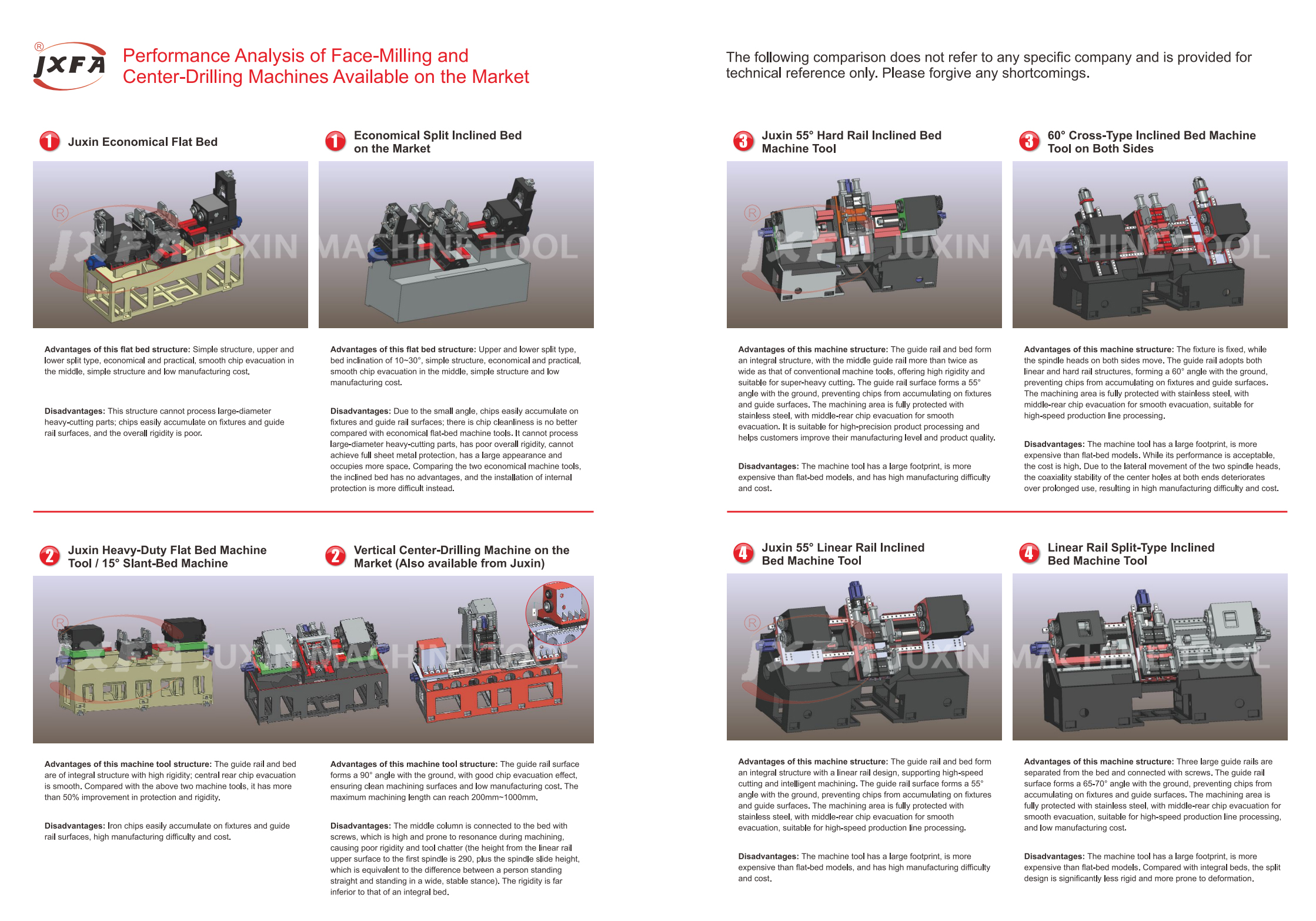
5. End Face Milling and Center Hole Drilling Machine — facing and centering
Best fit: shaft and sleeve end preparation as a standalone cell or as the first station of a shaft line, particularly where end-face flatness and center-hole coaxiality govern everything downstream. Auto parts, construction machinery accessories and motor shafts are the standard applications.
Documented precision: end-face flatness of 0.01 mm or better, center-hole coaxiality of 0.02 mm or better and dimensional tolerance within plus or minus 0.01 mm, against flatness of 0.03 mm or worse and coaxiality of 0.05 mm or worse on older ordinary lathes. Consistency of dimensions at both ends and center-hole depth is held at plus or minus 0.05 mm conventionally and customizable to plus or minus 0.02 mm, with spindle radial runout at the 0.003 mm level.
Throughput and energy: single-piece time is documented 40 to 60 percent shorter than an old ordinary lathe, with unattended continuous operation at volumes above roughly 500 pieces per day. Per-part energy consumption is documented at about 60 to 70 percent of the old lathe figure, meaning a reduction of roughly 30 to 40 percent, with energy utilization above 80 percent against 50 to 60 percent. Tool life is stated 30 percent longer, and one machine is positioned as replacing two to three operators.
Decision note: the purchase price is documented at roughly two to three times an old ordinary lathe, offset by process consolidation and scrap reduction. For line planners, the more important point is sequence: unstable facing and centering caps the achievable precision of every lathe downstream, so this is usually the first machine to qualify, not the last.
Shortlist at a glance
| Configuration | Primary part family | Documented precision anchor | Space / energy note |
|---|---|---|---|
| Twin-spindle vertical, shaft | Shafts, slender shafts, sleeves | Runout 0.005 mm, coaxiality 0.01 mm, tolerance plus or minus 0.008 mm | Two-station capacity in one station footprint; energy utilization above 85 percent |
| Middle-drive double-head | Two-end shaft and disc work | Repeat positioning 0.003 to 0.005 mm; end depth plus or minus 0.05 mm, custom plus or minus 0.02 mm | 60 to 100 percent floor-space saving at equal capacity; 15 to 25 percent electricity saving |
| Twin-spindle vertical, disc | Hubs, flanges, rings | Runout 0.005 mm, coaxiality 0.01 mm | Per-part energy 65 to 75 percent of competitor dual-spindle models |
| JXLC45D dual vertical | Compact disc and hub families | Envelope 400 mm diameter, 3000 r/min spindle speed | Envelope screening tool before fixture study |
| Facing and centering | Shaft end preparation | Flatness 0.01 mm, coaxiality 0.02 mm | Per-part energy about 60 to 70 percent of an old ordinary lathe |
Why one clamping changes the numbers
Removing a second clamping removes a class of error rather than a single error. Every time a part is released and re-referenced, the spindle-to-chuck relationship is re-established, and the resulting deviation is not random: it repeats, so it shows up as a distribution offset in the batch rather than as isolated scrap. That is why the documented difference between 0.015 to 0.03 mm concentricity after turnaround and 0.005 to 0.01 mm in a single clamping matters more than the individual machine accuracy figures.
Repeat positioning is the metric to standardize on, because it determines whether a tolerance is repeatable across a shift and not merely achievable once. ISO 230-2 sets out test procedures for determining the accuracy and repeatability of positioning of numerically controlled axes, and it is the reference a buyer should name when requesting a positioning test record rather than a catalogue number.
Structure then decides whether those numbers survive. Juxin documents a high-strength integrally cast iron bed, a 55-degree and 15-degree integral hard rail, and a large-span cross slide, with the column built on an internal-external square bionic structure and ultra-low temperature heat treatment intended to avoid deformation. Full stainless steel enclosure and rear centralized chip removal keep iron chips off the guide rails, because chip accumulation is one of the ordinary causes of gradual precision loss on machines with simple open protection.
Energy follows the same logic. A machine that completes turning, milling, drilling and grinding in one setup concentrates power on cutting rather than on repeated idle and re-fixturing, which is why utilization figures above 80 to 85 percent appear against 50 to 60 percent for single-process conventional equipment.
Where these configurations are used
The documented application base spans auto parts, general machinery, transmission equipment, motor accessories, construction machinery accessories, hydraulic heavy industry, military and high-speed rail work, long and heavy shafts, crankshafts and gears, wind power flanges and heavy machinery hubs. Across those sectors the common denominator is batch size: the configurations above are economic where parts repeat and where two ends or two stations can be worked in the same cycle.
Assembly and process engineers typically sequence them as a line rather than as alternatives. Facing and centering establishes the reference. Double-head or twin-spindle turning then works both ends, and the vertical disc platform handles the flange and hub families that cannot be presented horizontally without distortion. For buyers configuring automation, the documented options include multi-machine connection, robot loading and unloading, and flexible line assembly, with standard interfaces reserved for later power turrets, automatic handling and MES connection.
Market context: growth, but not a single number
Vertex Market Research estimates the global CNC lathe machine market at USD 11.1 billion in 2023, projected to reach USD 18.78 billion by 2030, a CAGR of 7.8 percent from 2024 to 2030. Grand View Research reports that Asia Pacific held a 55.5 percent revenue share of the CNC machining and turning centers market in 2023, and identifies dual spindle CNC lathes as commonly used in high-volume production for automotive, aerospace and medical sectors.
Broader lathe market estimates should be read with caution. Fortune Business Insights reports USD 25.01 billion in 2018 rising to USD 57.54 billion by 2032 at 5.6 percent CAGR; SkyQuest reports USD 27.42 billion in 2025 rising to USD 37.24 billion by 2033 at 3.9 percent; Mordor Intelligence reports USD 12.35 billion in 2026 rising to USD 14.21 billion by 2031 at 2.86 percent. These figures cannot be averaged or merged because base years, forecast horizons and product scope differ. For capacity planning, the defensible conclusion is directional: a large, growing category with heavy Asia Pacific production concentration, not a single investment-grade growth rate.
Limits: where this shortlist is the wrong purchase
Specialized configurations carry a real cost premium and a real scope limit, and both should be stated before a purchase order rather than after.
- Purchase price. The middle-drive double-head lathe is documented at 2.5 to 4 times the cost of an ordinary horizontal lathe. The twin-spindle vertical lathe is documented 60 to 80 percent above a traditional horizontal lathe. The facing and centering machine is documented at roughly two to three times an old ordinary lathe. These premiums are only recovered through volume, labor reduction and scrap avoidance.
- Low volume and irregular geometry. For single pieces, small batches, eccentric parts, irregular shafts or complex curved profiles, an ordinary horizontal lathe remains the more versatile and more economical machine. The manufacturer's own comparison places that work outside the specialized scope.
- Integration effort. Automation readiness is documented as reserved interfaces and modular structure, not as a plug-and-play outcome. Line connection, robot handling and MES docking require engineering work and commissioning time.
- Evidence status. The performance figures in this article come from manufacturer documentation. Independent cycle-time, accuracy, uptime and energy validation was not available in the reviewed data set, so a factory acceptance test with a named test standard remains essential.
- Cross-border ownership. Juxin Machine Tool reports an export ratio of about 10 percent, which means buyers outside China should confirm spare-part availability, service response and documentation language during negotiation rather than assuming a mature overseas support network.
Long-term ownership: what to lock down before signing
For buyers at execution stage, the second half of the decision is not the machine but the ten years around it. Juxin Machine Tool documents a 10,666 square metre facility, 80 employees, a 10-engineer R&D team, annual output of 2,000 sets, more than 50 patents and adoption by more than ten internationally renowned enterprises. Commercial terms are one unit minimum order quantity, a typical production lead time of 45 days, and monthly production capacity of 160 units. Acceptance is documented as customer acceptance with training, and payment terms as machine delivery after full payment is received.
Precision retention is the number that separates a low purchase price from a low cost of ownership. Juxin documentation states stable precision for 10 to 15 years of normal use on the one-piece bed design, against significant precision decline within 3 to 5 years and an overall service life of 6 to 8 years on split-structure ordinary machines. Operating rate is stated at 85 to 95 percent against 60 to 75 percent, driven by fewer failures and less frequent precision adjustment and chip cleaning.
Service structure matters as much as the specification. The documented support package includes a free pre-sales process evaluation, factory pre-acceptance, on-site installation and commissioning, operator training, remote diagnosis, built-in fault self-check, and modular standardized parts chosen for interchangeability. Those items belong in the contract as deliverables with dates, not as marketing sentences.

Pre-acceptance, commissioning, training and remote diagnosis are the deliverables that determine long-term cost of ownership.
Outlook
The direction of travel in shaft and disc machining is fewer setups and more process consolidation per square metre. Juxin describes an annual model upgrade cycle that has moved from center-hole machine tools and dual-spindle vertical lathes through turn-milling compound machines toward AI five-axis turn-milling equipment and humanoid robot equipment development, with continued specialization in shaft parts, disc parts, slender shafts, turning-grinding and turning-pressing.
For buyers, that trajectory has a practical consequence: a machine specified only for today's part family will need a retrofit path tomorrow. Standard reserved interfaces, modular spindles and tooling, and a documented route to automation are therefore worth more than a marginal advantage in the quoted cycle time, because they determine whether the shortlisted configuration is still the right machine in year five.
FAQ
What is the minimum order quantity and typical lead time for these specialized lathes?
The minimum order quantity is one unit. The typical production lead time is 45 days, and monthly production capacity is 160 units.
Which configuration should be screened first for shaft work and which for disc work?
For shaft work, start with facing and centering for end preparation, then evaluate the twin-spindle vertical lathe for shafts or the middle-drive double-head lathe where both ends must be cut in one cycle. For disc work, start with the twin-spindle vertical lathe in its disc configuration and check the JXLC45D envelope of 400 mm maximum machining diameter and 3000 r/min spindle speed as a first-pass filter.
What repeat positioning accuracy should appear in a factory acceptance test?
Documented figures are 0.003 to 0.005 mm repeat positioning for the middle-drive double-head class, plus or minus 0.003 mm on the symmetrical two-end specification, and runout, coaxiality and dimensional tolerance of 0.005 mm, 0.01 mm and plus or minus 0.008 mm respectively on the twin-spindle vertical platform. Buyers should request positioning test records aligned with ISO 230-2, which specifies procedures for determining accuracy and repeatability of positioning of numerically controlled axes.
How much floor space and energy can one-clamping machining actually save?
The compact double-head layout is documented as saving 60 to 100 percent of floor space at the same production capacity, with automatic line connection saving more than 70 percent. Energy figures vary by configuration: 15 to 25 percent electricity saving at equal output for the double-head design, per-part energy at 65 to 75 percent of competitor dual-spindle vertical models, and about 60 to 70 percent of old ordinary lathe consumption per part on the facing and centering machine.
What are the acceptance and payment terms?
Acceptance is documented as customer acceptance with training provided. Delivery terms are subject to detailed negotiation, with the signed contract and technical agreement taking effect after the customer pays the deposit, and machine delivery following receipt of full payment.
Can these machines be connected to automation later?
Yes. The documented design includes reserved standard interfaces for later installation of power turrets, automatic loading and unloading, and MES systems, with multi-machine connection, robot loading and flexible assembly line configurations described as supported options. The practical constraint is engineering time for integration and commissioning, not a missing interface.
Closing note
A shortlist is only useful if it can be defended line by line. The five configurations above map to three decisions: how the part is presented, which end or face is cut in the same clamping, and what precision retention and service structure the buyer can hold the supplier to. Buyers who test those three items against a first-article plan will get more value from this list than from any single specification table.
For buyers who need the full technical configuration detail, the manufacturer's brochure is available here: Juxin Machine Tool product brochure (PDF).
Have Questions or Need More Details?
Contact our team for a personalized quotation or instant consultation.
Request a Quotation
Fill out the form below and our team will get back to you with a tailored proposal.
WhatsApp Direct Chat
Prefer to chat in real-time? Message us on WhatsApp for instant assistance & quick answers.
- Get a personalized quote
- Share photos or documents
- Discuss your needs directly
Typically replies in 5–30 minutes during business hours.