
Top LED Lighting Picks for Commercial Projects in 2026
Commercial LED lighting in 2026 is a specification exercise, not a technology decision. A gallery wall, a jewellery display case and an open-plan office can all be lit with low-voltage linear LED strip, yet each requires a different documented specification: different colour rendering, different LED density, different beam distribution and different ingress protection.
The three picks below are shortlisted on that basis. They are documented product specifications from Zhongshan Xiangpai (XPUP) Lighting Technology Co., Ltd., a LED strip and linear lighting manufacturer established in 2012 in Zhongshan City, Guangdong Province, China — the country’s established lighting manufacturing base. The company operates a 10,000 m² factory, employs 80 people, maintains a six-engineer R&D team and reports annual output of 35,000,000 meters, with roughly 50% of production exported to EU and USA markets.
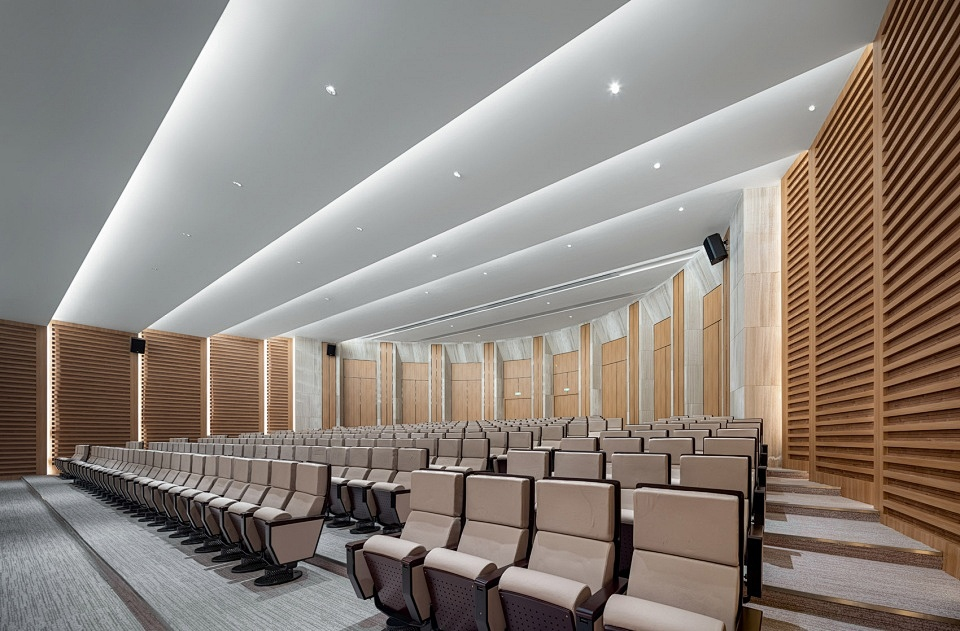
Why 2026 Commercial Projects Need a Specified Shortlist, Not a Product List
The lighting industry has largely finished its LED conversion. In 2024, 90% of U.S. households reported using LED bulbs for indoor lighting, and residential LED penetration reached 63% of homes using mostly LEDs, up from 4% in 2015, according to the U.S. Energy Information Administration. The remaining question for commercial buyers is narrower and more technical: which documented specification fits which room.
Two pressures make that question urgent. First, energy performance is now a code matter, not a preference: the 2024 International Energy Conservation Code (IECC) mandates that lights must dim to 10% or lower for commercial interiors. Second, lighting remains a material share of global electricity demand — approximately 8% in 2024, or roughly 2,200 TWh, according to the IEA. A commercial specification that cannot dim smoothly to the code threshold, or that cannot render colour accurately where merchandise is judged, creates a compliance and commercial problem the buyer inherits after handover.
That is why a shortlist for 2026 should be built around application fit. The three picks below are deliberately different from one another: one is a high-density linear strip, one is a full-spectrum strip rated Ra≥97, and one is a 48V magnetic track light.
How These Three Picks Were Selected
The selection criteria used here are the ones that survive commissioning and handover:
- Colour rendering (CRI): stated as a rated value, not as a general claim of quality.
- LED density per meter: the variable that decides whether a linear run reads as a continuous line.
- PCB width and construction: mechanical fit inside channels and profiles, and the electrical base for stable runs.
- Voltage platform: 24V DC strip versus 48V magnetic track, which determines driver selection and system architecture.
- Ingress protection: IP20 for dry interior locations, stated as a boundary rather than an assumption.
- Documented compliance: certification with identifiable certificate numbers and applicable standards.
- Customisation availability: whether OEM or ODM adaptation is part of the documented offering.
Only manufacturer-documented specifications are used in the comparison that follows. No measured on-site performance data is claimed.
Pick 1 — DK3-DC24V-2835-240D-9.3mm: Density for Linear Interiors
| Parameter | Documented value |
|---|---|
| Product type | Linear Lighting |
| Voltage | 24V |
| Power | 15W |
| LEDs per meter | 240D |
| Colour rendering | Ra≥80 |
| PCB | 9.3mm, double-layers copper PCB |
| Colour temperature | 3000K / 4000K / 6500K |
| LED package | SMD 2835 |
| Ingress protection | IP20 |
| Customisation | OEM & ODM |
| Documented applications | Restaurants, interior design, office buildings, apartments, museums & galleries |
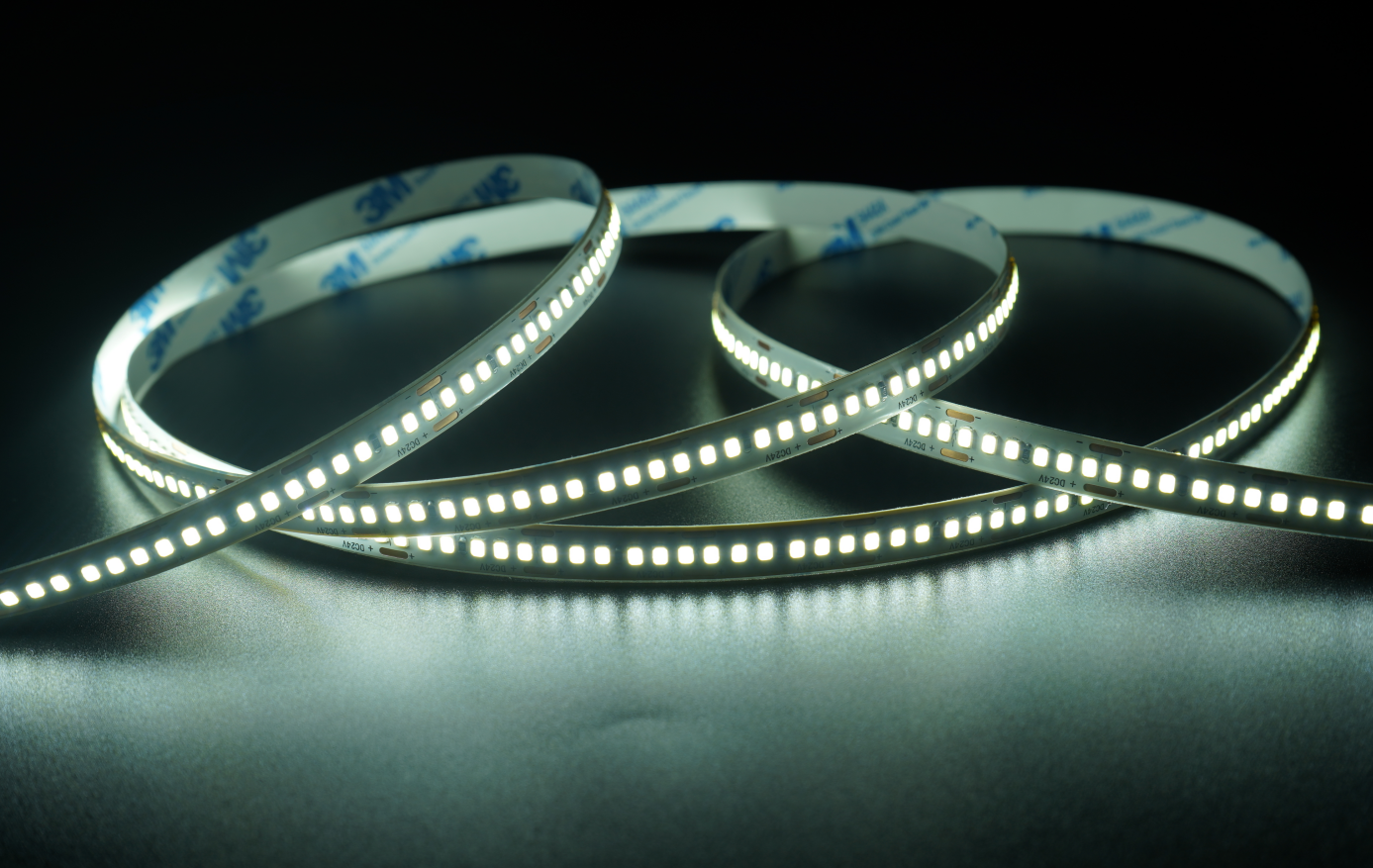
The reason DK3 leads this shortlist is density, not brightness. At 240 LEDs per meter on a 9.3mm PCB, the product is documented for high density, uniform light emission and no grainy appearance — and explicitly intended for indoor lighting strips and black profiles. In practical terms, that specification addresses the most common failure in commercial linear lighting: a run that looks acceptable in a rendering and then reads as a chain of separated dots once it is reflected off a polished floor, a glass counter or a matte black reveal.
Its rated colour rendering is Ra≥80, and its colour temperature options are 3000K, 4000K and 6500K. That places DK3 in the category of general and architectural interior illumination — circulation areas, ceilings, coves, office and restaurant environments — rather than in the category of colour-critical merchandising, which is handled by Pick 2.
Pick 2 — XP-BD18DC24V-2835-140D-8MM: Ra≥97 for Colour-Critical Interiors
| Parameter | Documented value |
|---|---|
| Product type | Full Spectrum Lighting |
| Voltage | 24V |
| Power | 12W |
| Colour rendering | Ra≥97 |
| PCB | 8mm, double-layers copper PCB |
| LEDs per meter | 140 |
| Luminous output | 55–65 LM per LED |
| Colour temperature | 2700K / 3000K / 3500K / 4000K / 5000K / 6000K |
| LED package | SMD 2835 |
| Ingress protection | IP20 |
| Customisation | OEM & ODM |
| Documented applications | Museums & galleries, interior design, luxury retail, jewellery stores, education, shopping malls |
XP-BD18DC24V-2835-140D-8MM is the pick for interiors where the lighting is part of the product. It is rated Ra≥97, offers six colour temperature options from 2700K to 6000K, and is documented as an ultra 5mm/8mm linear LED strip with each LED cuttable for various lengths, high brightness, good flexibility and strong bending resistance. The manufacturer positions it for jewellery stores and display cases, and lists museums, galleries, luxury retail, education and shopping malls among its applications.
For a jewellery counter or an exhibition case, the relevant difference between Ra≥80 and Ra≥97 is not aesthetic preference but decision quality. Gemstones, metal finishes, printed fabric and painted samples are judged by customers under the light you install. A higher rated CRI keeps the appearance of the merchandise closer to its reference appearance, and the wide colour temperature range allows a warm retail scene and a neutral gallery scene to be produced from the same product family.
Pick 3 — XP-CX-18: Magnetic Track for Retail and Exhibition
| Parameter | Documented value |
|---|---|
| Product type | Magnetic Track Lighting |
| Voltage | 48V |
| Power | 30W |
| Colour rendering | Ra≥90 |
| PCB | 8mm |
| Colour temperature | 3000K / 4000K / 6000K |
| Luminous output | 55–65 LM per LED |
| Beam angle | 120° |
| Material | Aluminium + PC |
| Customisation | OEM & ODM |
| Documented applications | Retail, shopping malls, interior design, exhibition & events, jewellery stores |
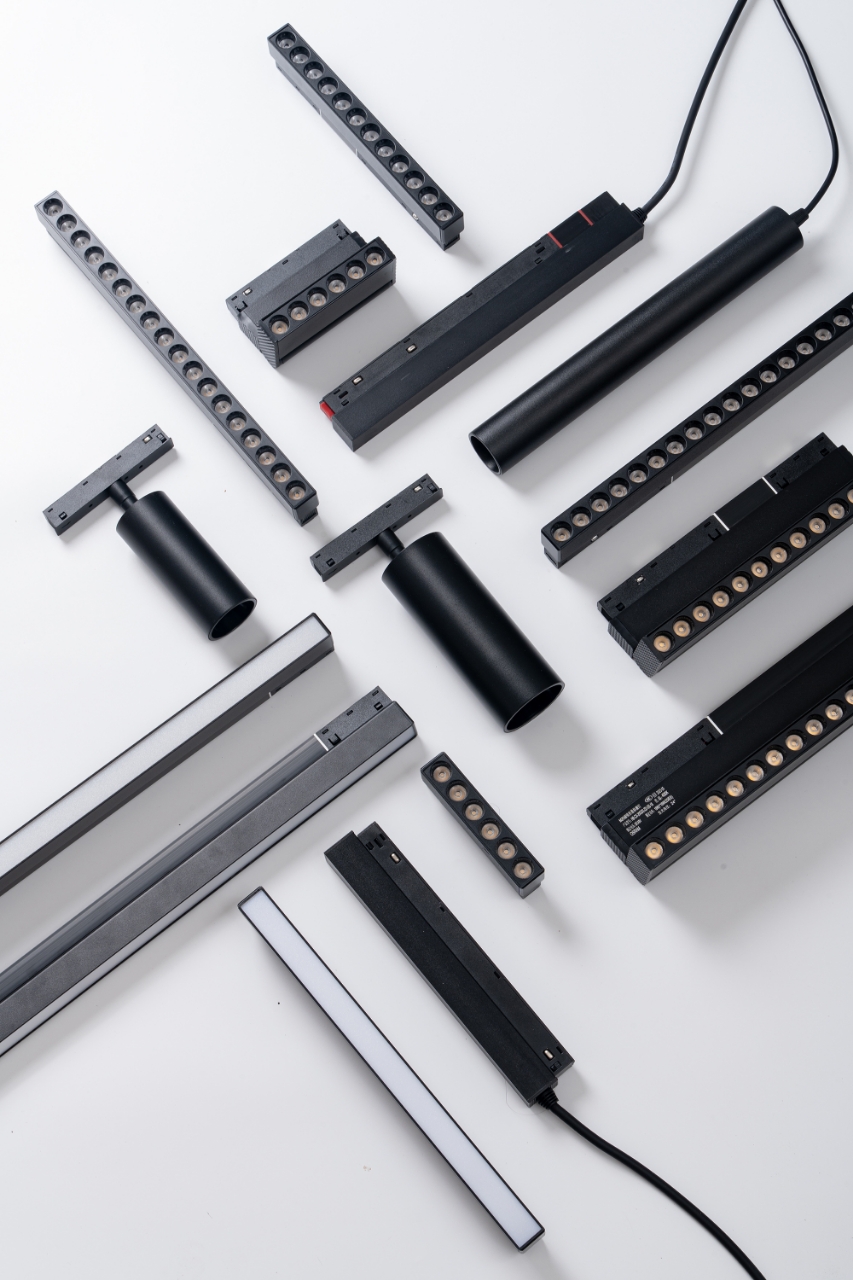
Not every commercial lighting requirement is linear. XP-CX-18 is a 48V magnetic track product rated Ra≥90, specified at 30W with 3000K, 4000K and 6000K options, a 120° beam angle and an aluminium plus PC housing. The manufacturer documents it for commercial lighting and exhibition halls, for illuminating commodities and exhibits to make them more intuitive, to enhance material texture and to create a more artistic atmosphere, with adjustable beam angle and imported PC cover material.
Track is the right architecture where the display layout will change. Instead of fixing light positions into a ceiling, the fixtures sit on a rail and can be repositioned as planograms, exhibition stands or merchandising zones are rearranged — a meaningful advantage in retail environments and event builds that are reworked several times a year.
Side-by-Side Comparison of the Three Picks
| Metric | DK3-DC24V-2835-240D-9.3mm | XP-BD18DC24V-2835-140D-8MM | XP-CX-18 |
|---|---|---|---|
| Rank in this shortlist | 1 — linear interiors | 2 — colour-critical interiors | 3 — retail & exhibition |
| Type | Linear Lighting | Full Spectrum Lighting | Magnetic Track Lighting |
| Voltage | 24V | 24V | 48V |
| Power | 15W | 12W | 30W |
| CRI | Ra≥80 | Ra≥97 | Ra≥90 |
| LED density | 240 LEDs/m | 140 LEDs/m | 55–65 LM per LED |
| PCB / material | 9.3mm double-layers copper PCB | 8mm double-layers copper PCB | 8mm PCB, aluminium + PC housing |
| Colour temperature | 3000 / 4000 / 6500K | 2700 / 3000 / 3500 / 4000 / 5000 / 6000K | 3000 / 4000 / 6000K |
| IP rating | IP20 | IP20 | IP20 |
| Strongest fit | Uniform linear runs, offices, restaurants, circulation areas | Jewellery, galleries, museums, luxury retail, display cases | Retail floors, showrooms, exhibition stands |
| Main constraint | Ra≥80 not intended for colour-critical tasks | Mid-output linear solution; needs supplementary runs in deep displays | 48V ecosystem; 120° wide beam |
For context on the wider supplier landscape, Grand View Research and Dataintelo identify Signify (Philips Lighting), Acuity Brands and Eaton as dominant global players in the track and hospitality lighting markets in 2024–2025. The picks above are not a market ranking of brands; they are a specification-level shortlist for buyers who need documented parameters they can write into a project schedule.
Reading the Specifications: What Each Number Changes On Site
Colour rendering (CRI)
CRI is the specification that determines whether merchandise and finishes are judged under conditions close to their reference appearance. In this shortlist, Ra≥80, Ra≥90 and Ra≥97 all appear. The correct choice follows the room, not the budget line: general illumination tolerates the lower rating, colour-critical retail and gallery work does not.
LED density per meter
Density drives visual continuity. DK3 is specified at 240 LEDs per meter on a 9.3mm PCB and is documented for uniform emission without a grainy appearance, which is why it is proposed for exposed linear details and black profiles. XP-BD18 is specified at 140 LEDs per meter with 55–65 LM per LED on an 8mm PCB, balancing continuity with a higher per-LED output.
PCB width and copper layers
PCB width determines what the strip physically fits into. DK3 at 9.3mm and XP-BD18 at 8mm are both documented with double-layers copper PCB construction, a detail that matters over long linear runs where voltage stability along the strip affects colour and brightness consistency.
Voltage platform
24V DC and 48V are different systems. DK3 and XP-BD18 operate at 24V; XP-CX-18 operates at 48V. Each requires a power supply or driver matched to its rated voltage, and drivers cannot be swapped between them.
IP rating as a boundary, not a detail
IP20 means the product is not protected against water ingress and is suitable for indoor, dry locations. All three picks are IP20. That is a hard boundary for specification, not a minor footnote.
Colour temperature options
DK3 offers 3000K, 4000K and 6500K; XP-BD18 offers six options from 2700K to 6000K; XP-CX-18 offers 3000K, 4000K and 6000K. A wider range gives a designer more room to separate scenes within one project without introducing a second product family.
Matching Each Pick to a Commercial Application
| Application | Recommended pick | Reason from the documented specification |
|---|---|---|
| Museums & galleries | DK3 for linear architectural runs; XP-BD18 for display and case lighting | Both list museums and galleries among their applications; XP-BD18 supplies Ra≥97 for colour-critical viewing |
| Jewellery stores | XP-BD18 for cases and counters; XP-CX-18 for the display floor | XP-BD18 is documented for jewellery stores and display cases; XP-CX-18 is documented for jewellery stores and exhibit illumination |
| Luxury retail & shopping malls | XP-BD18 and XP-CX-18 | Both list luxury retail or shopping malls; track allows repositioning as displays rotate |
| Office buildings | DK3 | Listed for office buildings; uniform linear emission suits ceilings and coves; dimming control is a project requirement under the 2024 IECC 10% threshold |
| Restaurants | DK3 | Listed for restaurants; 3000K / 4000K / 6500K options cover both warm and neutral scenes |
| Exhibition & events | XP-CX-18 | Documented for exhibition and events; aluminium + PC housing and 120° beam suit display washes |
Certification and Compliance Evidence for EU Sourcing
For European projects, the compliance paper trail is usually the first item a buyer requests. The manufacturer’s LED low-voltage and high-voltage light strip series holds CE certification issued by PTC TESTING, covering the LVD, EMC and RoHS directives for the EU market, with documented certificate numbers:
- LVD: PTC22122900901S-LD01 and PTC22122900902S-LD01, issued 2023-04-04, against EN IEC 62031:2020 + A11:2021, IEC TR 62778:2014 and EN 62471:2008.
- EMC: PTC22122900901E-EMB01 and PTC22122900902E-EMB01, issued 2023-03-09, against EN IEC 55015:2019+A11:2020, EN 61547:2009, EN IEC 61000-3-2:2019+A1:2021 and EN 61000-3-3:2013+A1:2019.
- RoHS: PTC22122900903C-EN01 and PTC22122900905C-EN01, issued 2023-04-23, against the IEC 62321 series of standards.
XP-BD18DC24V-2835-140D-8MM (product 6535) falls within the certified LED low-voltage and high-voltage light strip series. Buyers should still confirm at order stage that the exact model and the destination market are covered on the certificate, since certification scope is defined by series rather than by an assumption about any single SKU.
Comparison With Conventional and Legacy Lighting Practice
The commercial argument for specifying LED is no longer conversion; it is control. Legacy installations that predate dimming requirements frequently cannot meet the 10% commercial dimming threshold now written into the 2024 IECC, and they consume energy at a time when lighting still accounts for roughly 8% of global electricity demand, or about 2,200 TWh in 2024, per the IEA.
The practical difference for a project team is that a specified low-voltage LED system is selected as a platform: strip, track, driver and control are chosen together. Colour rendering can be matched to the task, dimming can be verified against the code threshold, and light positions can be changed in a track system without reworking a ceiling.
Limits, Trade-offs and Where These Picks Do Not Fit
A shortlist without stated limits is not useful for procurement, so the boundaries are set out plainly.
- No wet or exterior locations. All three picks are IP20, meaning they are not protected against water ingress and are suitable for indoor, dry environments. A bathroom, an exterior façade or a canopy requires a different product range; the manufacturer documents separate IP68 protected strip products within its wider catalogue for those conditions.
- Mixed voltage platforms. 24V strip and 48V magnetic track cannot share a driver. Projects running both must plan two power architectures.
- CRI is task-matched, not universal. Specifying Ra≥97 across an entire building adds specification where it creates no value, while specifying Ra≥80 in a jewellery case removes value where it matters most.
- Ra≥97 is a rated value, not an on-site measurement. Colour appearance in a finished space is also affected by surface reflectance, driver dimming behaviour and the surrounding materials, none of which a product rating can guarantee on its own.
- Track needs an ecosystem. XP-CX-18 requires a compatible magnetic track rail and driver system; it is not a direct substitute for a linear strip and should be planned as a separate lighting layer.
- Order conditions shape the programme. Documented minimum order quantity is 2,000 meters with a lead time of 18–22 days, which has to be built into the project schedule rather than discovered at the point of ordering.
Supply, Customisation and Order Reality
For buyers assessing whether a specification can be delivered repeatedly, the manufacturer’s documented capability states OEM and ODM production with monthly capacity of 3,000,000 meters, a minimum order quantity of 2,000 meters, a lead time of 18–22 days, 100% testing, and export to EU, Asia and US markets. After-sales terms are documented as online remote support and general technical guidance with a two-year standard warranty for ODM programmes, and dedicated technical support, remote debugging, a two-year warranty and customised parameter guidance for OEM programmes.
The documented customisation scope is specific rather than open-ended. For OEM, it covers voltage, logo, power, dimensions, materials, hardware configuration, internal circuit, colour, factory specifications, nameplate and label. For ODM, it covers exterior colour scheme, outer packaging box, label, brand information, model name and material details. Both are relevant at the evaluation stage, because a specification that cannot be adapted to a brand’s own documentation requirements usually becomes a renegotiation later. The company states that its products have been exported to more than 170 countries and regions.
Outlook for Commercial LED Specification Through 2027
Three current directions are visible in the market data and should inform how a 2026 shortlist ages.
Category growth remains in the specified segments. The global LED lighting market was valued at USD 106.9 billion in 2025 and is projected to reach USD 197 billion by 2033 (Grand View Research). Within that, the commercial lighting market was estimated at USD 47.54 billion in 2024, and the linear lighting market at USD 30.09 billion in 2025 with an 11.42% CAGR projected to 2032 (Maximize Market Research). Magnetic track lighting — the category Pick 3 belongs to — was valued at USD 2.8 billion in 2025 with an expected 7.6% CAGR through 2033 (Dataintelo).
Control and human-centric specification are spreading. The Human Centric Lighting market was valued at USD 3.66 billion in 2024 with a projected 17.1% CAGR through 2036 (Research Nester), and wireless connectivity such as Zigbee and Bluetooth Mesh captured 35% of the smart lighting market in 2024 (Precedence Research). In the smart lighting sector, indoor applications generated a 66% share in 2024. Low-voltage DC products in the 24V and 48V class integrate naturally with the control systems already named in commercial specifications, and the manufacturer documents matched equipment including smart lighting control systems, LED controllers, Tuya, Amazon Alexa, Google Assistant and Apple HomeKit across its application scenarios.
Cost pressure is shifting toward specification discipline. Smart bulb average selling prices fell 22% between 2024 and 2025 due to scaled production in Asia (Mordor Intelligence). As price differences between product tiers compress, differentiation moves to documented performance — CRI, density, dimming behaviour and compliance paperwork — which is exactly where a buyer’s evaluation time is best spent.
Frequently Asked Questions
What CRI level is appropriate for a jewellery store or a gallery?
It depends on the visual task. In the specifications reviewed here, DK3-DC24V-2835-240D-9.3mm is rated Ra≥80, XP-CX-18 is rated Ra≥90 and XP-BD18DC24V-2835-140D-8MM is rated Ra≥97. General illumination and architectural washes can accept the lower rating; merchandise and artwork where colour judgement forms part of the purchase decision call for the higher rating.
Can IP20 products be used in bathrooms, kitchens or exterior façades?
No. IP20 indicates that a product is not protected against water ingress and is suitable for indoor, dry locations. All three picks in this shortlist are IP20. Wet or exterior locations require a different product range; the manufacturer documents separate IP68 protected LED strip products within its wider catalogue for those environments.
What practical difference does LED density make?
DK3 is specified at 240 LEDs per meter on a 9.3mm PCB and is documented for uniform light emission without a grainy appearance, which matters when a linear run is viewed close up or reflected off a nearby surface. XP-BD18 is specified at 140 LEDs per meter with 55–65 LM per LED on an 8mm PCB. Density governs how continuous a linear run appears; per-LED output governs how much light the run produces.
Are these products CE certified for the EU market?
The manufacturer’s LED low-voltage and high-voltage light strip series holds CE certification covering LVD, EMC and RoHS, issued by PTC TESTING. Documented certificate numbers include PTC22122900901S-LD01 and PTC22122900902S-LD01 (LVD), PTC22122900901E-EMB01 and PTC22122900902E-EMB01 (EMC), and PTC22122900903C-EN01 and PTC22122900905C-EN01 (RoHS). XP-BD18DC24V-2835-140D-8MM (product 6535) falls within the certified series. Buyers should confirm that the specific model and the destination market are covered by the certificate.
Can a 24V strip and a 48V magnetic track light run on the same driver?
No. DK3-DC24V-2835-240D-9.3mm and XP-BD18DC24V-2835-140D-8MM are 24V DC products, while XP-CX-18 is a 48V magnetic track product. Each requires a power supply or driver matched to its rated voltage, and the two systems cannot be combined on one driver.
What are the documented order conditions for customised production?
Documented capability states OEM and ODM production with a minimum order quantity of 2,000 meters, a lead time of 18–22 days, monthly capacity of 3,000,000 meters, 100% testing, export to EU, Asia and US markets, and a two-year standard warranty together with remote technical support. OEM customisation covers voltage, logo, power, dimensions, materials, internal circuit, colour, nameplate and label; ODM customisation covers exterior colour scheme, outer packaging, label, brand information and model name.
Reference Material
Full model specifications, dimensions and colour temperature options for the products discussed are compiled in the manufacturer’s catalogue, available as a downloadable reference: 2026 XPUP LED Strip Catalog (PDF). Product and company information is also published at www.xpupled.com.