
Top Microscope Shortlist: Infinity Biologicals and Inverted Metallurgists
The most useful optical microscope shortlist is not a ranking of every model on the market. It is a decision set built around two different workstreams. For advanced biological research, the 2026 shortlist points to the BK6000TR and SMART-4 because both use infinity optical systems and offer quintuple or quadruplex nosepieces. For industrial material science, the MDS400 and MIT500 are the relevant entries, with trinocular heads, LWD plan semi-apo objectives, and wide-field eyepieces. The split is intentionally narrow: biological buyers compare optical expandability and objective positions, while metallurgical buyers compare camera paths, working distance, and field-of-view discipline.
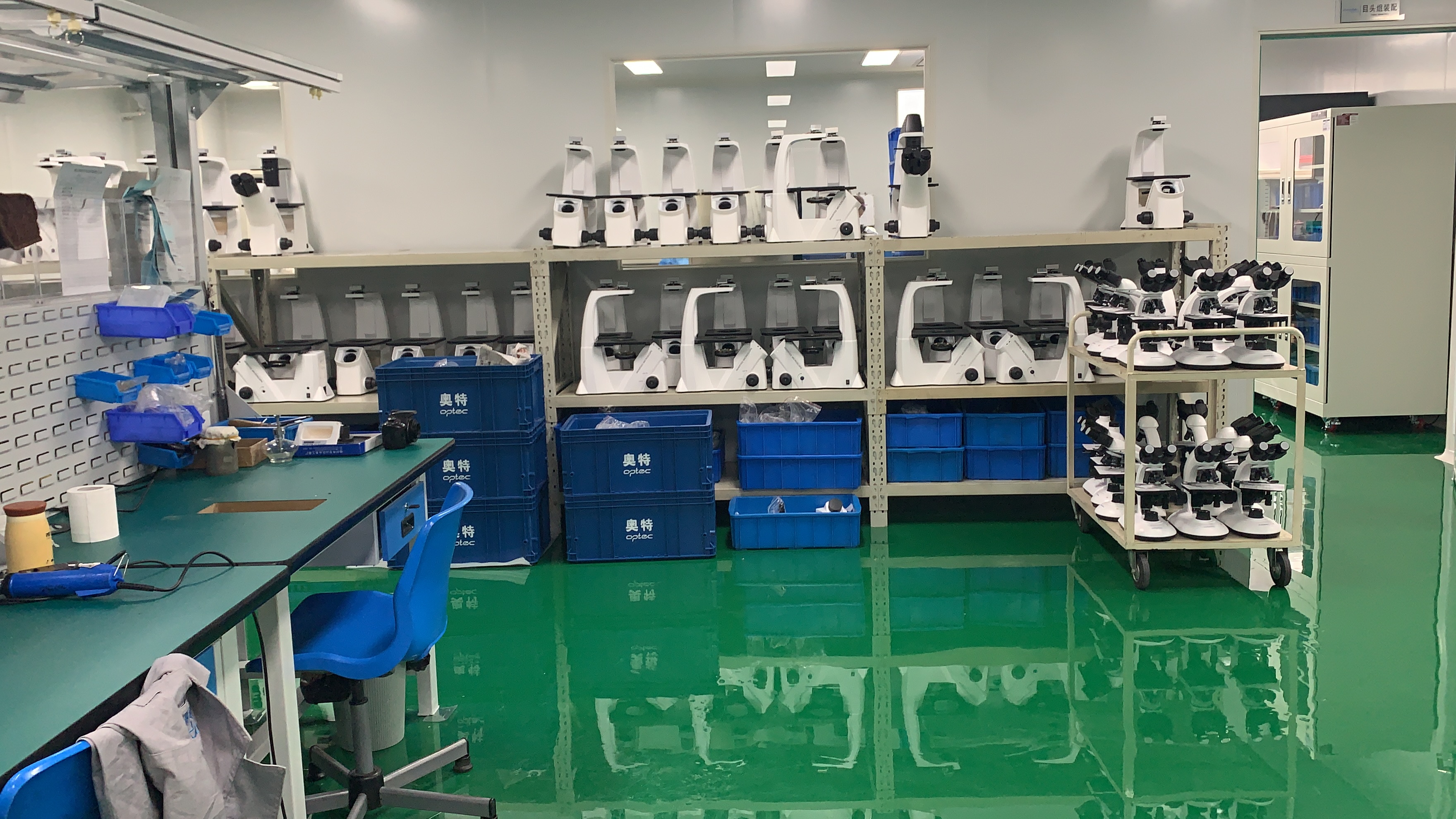
A dust-free microscope workshop environment supports optical assembly and testing discipline, which matters when buyers evaluate infinity biological and metallurgical configurations.
Chongqing Scope Instrument Co., Ltd. is a Chongqing-based supplier of laboratory and medical training instruments and metallographic equipment. Its microscope range includes biological, metallurgical, inverted, fluorescence, polarizing, stereo, and digital microscopes, and the company states that it provides OEM and ODM services. For this shortlist, the relevant fact is not the breadth of the catalog. It is the presence of two clearly separated optical families: infinity biological microscopes for research and laboratory work, and metallurgical microscopes for industrial material science.
Buyers at the decision stage usually do not need another general explanation of what a microscope is. They need a defensible way to reduce a long supplier catalog to a few models that can be quoted, sampled, and validated. That is the purpose of this shortlist. It places four Chongqing Scope models into two application tracks, explains the technical meaning of the stated configurations, and identifies the limits that should be checked before a purchase order is issued.
Why a shortlist beats a catalog crawl
A microscope catalog can make every model look plausible because magnification is easy to list and hard to interpret. In practice, two buyers who both request a laboratory microscope may need very different instruments. A biological research group may need an infinity-corrected optical path, multiple objective positions, and a camera-ready trinocular configuration. A materials laboratory may need a metallurgical stand, long working distance objectives, and a wide field of view for sample overview before detail inspection.
The opportunity is to turn those differences into a shortlist. The global microscope market reached approximately $11.9 billion in 2025, and optical microscopes accounted for approximately 37% of the global market share in that year. Those figures do not tell a buyer which model to choose, but they do explain why the optical category remains crowded and why application-led shortlisting is more useful than a generic top-ten list. Optical tools remain central to laboratory and industrial work, so the buyer's problem is not a lack of options. It is the cost of comparing too many options without a decision framework.
Trade data reinforces the same point. Global trade of microscopes under HS 9011 reached $3.36 billion in 2024, with China being the third largest exporter at $430 million. For international buyers, the practical question is therefore not whether Chinese optical microscopes are available, but which configurations can be matched to a defined workflow and supported with documentation. A shortlist makes that question manageable because it forces the buyer to state the application before comparing price, lead time, or optional accessories.
What infinity optics and nosepiece counts mean for buyers
An infinity optical system is a design choice, not a marketing label. In an infinity-corrected microscope, the image beam between the objective and the tube lens is effectively parallel, which allows optical accessories to be inserted into the light path without changing the focus position. This matters to biological buyers because it makes the microscope easier to expand with camera modules, fluorescence attachments, or other accessories when the workflow changes. It does not mean that every infinity microscope performs identically. The quality of the objectives, the tube lens, the illumination, and the alignment still determine the final image.
A quintuple nosepiece carries five objective positions. A quadruplex nosepiece carries four. The difference sounds small, but it affects how the laboratory organizes its objective set. Five positions give more room for a low-magnification overview objective, a high-magnification detail objective, and additional objectives for specific contrast methods or sample types. Four positions can be sufficient when the objective set is stable and the workflow does not require frequent switching between many magnifications or modes.
For metallurgical buyers, the technical emphasis shifts. A trinocular head provides a camera port in addition to the visual eyepieces, which is useful when inspection records, image sharing, or measurement workflows depend on digital capture. LWD plan semi-apo objectives combine long working distance with plan correction and semi-apochromatic correction. In practical terms, that combination is relevant when the sample surface, fixture, or inspection environment makes a longer working distance useful, while the plan and semi-apo corrections support flatter fields and better control of color fringing. Wide-field eyepieces extend the visible field, which helps when the user needs to survey a larger area before moving to higher magnification.
These definitions are general optical principles, not a substitute for model-level testing. They explain why the four models are grouped as they are, but they do not remove the need to check each configuration against the actual samples, camera, and inspection routine.
The shortlist table: four models, two decision tracks
| Model | Primary use | Stated configuration focus | Buyer question |
|---|---|---|---|
| BK6000TR | Advanced biological research | Infinity optical system; quintuple nosepiece | Does the laboratory need five objective positions for a multi-mode biological workflow? |
| SMART-4 | Biological research and laboratory imaging | Infinity optical system; quadruplex nosepiece | Is a four-position nosepiece sufficient for the planned objective set? |
| MDS400 | Industrial material science | Trinocular head; LWD plan semi-apo objectives; wide-field eyepieces | Does the inspection mix need a camera path, long working distance, and a wide survey field? |
| MIT500 | Industrial material science, including inverted metallurgical evaluation where applicable | Trinocular head; LWD plan semi-apo objectives; wide-field eyepieces | Does the sample geometry call for an inverted stand or a different inspection orientation? |
The table is not a ranking of optical quality. It is a qualification map. Each row converts a configuration claim into a question that a buyer can answer before requesting a quotation. That is more useful than comparing models on a single number, because the right answer depends on sample type, camera use, objective plan, and the amount of reconfiguration expected over the instrument's service life.
Biological pair: BK6000TR and SMART-4
The BK6000TR is the higher-capacity entry in the biological pair. Its infinity optical system supports the modular logic that many research laboratories expect, while its quintuple nosepiece gives the user five objective positions. That configuration is relevant when the laboratory wants to keep several objectives mounted at once, such as an overview objective, a detail objective, and additional positions for specific biological observation needs. The buyer should still define the objective set before selection, because a five-position nosepiece only creates value if the laboratory actually uses the additional positions.
The SMART-4 sits in the same infinity biological family but uses a quadruplex nosepiece. That makes it the more focused option when the workflow is stable and four objective positions are enough. For routine laboratory imaging, teaching, or a research group with a defined objective plan, the four-position configuration can be easier to standardize across multiple instruments. The key decision is not whether five positions are better than four in the abstract. The key decision is whether the laboratory needs the fifth position for a specific objective, contrast method, or future accessory.
Both models illustrate why a biological shortlist should be built around the optical path rather than the stand alone. Infinity correction affects how accessories can be added. The nosepiece affects how many objectives remain available during a session. Neither feature removes the need to check illumination, camera compatibility, and the actual samples to be observed. Buyers should ask for a configuration sheet that lists the objectives and accessories included in the quotation, because the same base model can be quoted with different optical packages.
Decision rule for biological buyers: choose the BK6000TR when five objective positions and a more expandable infinity setup are justified by the research plan. Choose the SMART-4 when four objective positions match a stable workflow and the laboratory wants a more focused configuration. In both cases, validate the objective set, camera path, and illumination requirements before comparing price.
Metallurgical pair: MDS400 and MIT500
The MDS400 and MIT500 are the industrial material science entries in the shortlist. Both are associated with trinocular heads, LWD plan semi-apo objectives, and wide-field eyepieces. That combination is relevant to buyers who need to inspect material surfaces, document observations with a camera, and move between a broad field view and higher-magnification detail. The trinocular head supports a digital camera path, which is important when inspection records or image sharing are part of the workflow. The LWD plan semi-apo objectives support longer working distance and flatter fields, while the wide-field eyepieces help the user survey the sample before concentrating on a smaller area.
The MIT500 requires a specific check that the MDS400 may not require: sample orientation. The title of this shortlist refers to inverted metallurgists because inverted metallurgical microscopy is a distinct workflow in industrial material science. An inverted stand is relevant when the sample geometry or inspection convention favors viewing from below. Buyers should therefore confirm whether their samples, fixtures, and inspection standards require an inverted configuration before treating the MIT500 as a direct substitute for the MDS400. The two models belong in the same shortlist because they share the metallurgical configuration logic, but they should not be treated as interchangeable without that orientation check.
For both metallurgical models, the camera path is a procurement question, not an afterthought. A trinocular head is useful only if the camera, adapter, and software are matched to the inspection task. Buyers should ask how the camera port is configured, how the image is captured, and whether the quoted package includes the adapter and software needed for the intended workflow. The same logic applies to the LWD plan semi-apo objectives and wide-field eyepieces: they are meaningful when they match the sample size, working distance, and field-of-view requirements. They should not be accepted as generic upgrades without a sample-based review.
Application fit: how the shortlist maps to real workflows
In advanced biological research, the shortlist should be evaluated against the observation plan. The BK6000TR is the natural candidate when the laboratory wants five objective positions and an infinity optical system that can accommodate future accessories. The SMART-4 is the natural candidate when four positions are sufficient and the laboratory values a more defined configuration. Neither model should be selected solely because it sits higher or lower in a catalog. The buyer should list the objectives, the camera, the illumination method, and the sample types that will be used in the first year, then check whether the quoted configuration covers that list.
In industrial material science, the MDS400 and MIT500 should be evaluated against the inspection routine. The MDS400 is relevant when the workflow calls for a trinocular head, LWD plan semi-apo objectives, and wide-field eyepieces in a metallurgical configuration. The MIT500 is relevant when the same metallurgical logic applies but the sample orientation may require an inverted stand. The buyer should also define whether the camera is used for occasional documentation or for routine measurement and reporting. A trinocular head is present in both models, but the value of that head depends on the camera, adapter, and software package quoted with the instrument.
The shortlist also has a boundary. It is an optical microscope shortlist for biological and metallurgical work. It is not a fluorescence, polarizing, phase contrast, or dark field shortlist, even though Chongqing Scope lists fluorescence, polarizing, stereo, and digital microscopes in its broader range. Buyers who need those contrast methods should treat them as separate configuration questions. Adding a fluorescence or polarizing requirement changes the optical accessories, illumination, and sometimes the stand itself. The four-model shortlist should therefore be used as a starting point for application fit, not as a universal recommendation for every laboratory microscope category.
Traditional comparison: where the shortlist gains and where it stops
Compared with traditional microscopes, the Chongqing Scope positioning emphasizes a superior optical system, a metal body, a low parts replacement rate, and a long service life. The comparison also states that connecting the microscope to a digital camera can reduce image capture time by 40%, that the platform offers more than ten optional lighting configurations versus two or three options on traditional models, and that a low-voltage design supports more than eight hours of outdoor use with a power bank. Those claims are relevant to buyers who care about workflow speed, lighting flexibility, and field use, but they should be read as configuration-dependent advantages rather than universal guarantees.
The cost picture is similarly nuanced. The initial purchase price is described as slightly higher than traditional microscopes, while the total cost of ownership is stated to be 25% lower because of minimal maintenance and long service life. That is a useful decision signal, but it is not a reason to skip validation. The lower TCO depends on the actual maintenance regime, the availability of spare parts, and the service life achieved in the buyer's environment. A laboratory that does not use the additional lighting configurations or the camera workflow may not capture the same operational benefit as a laboratory that does.
Maintenance is another area where the shortlist should be read carefully. The product requires simple post-use care, and parts replacement can be performed by users without professional support. That is a practical advantage for buyers who want to reduce downtime. At the same time, the risk profile includes bulb degradation, accessory replacement, dust in the optical path, and mold or fogging on optical surfaces. The stated controls include manual power outage, an instruction manual, a dust cover, and anti-mildew and anti-fog treatment, with online after-sales repair support and operation videos. These are credible controls, but they do not eliminate the need for a local maintenance plan. Buyers should confirm who performs service, how spare parts are supplied, and what response time is realistic in their market.
Limit of the shortlist: the four models are recommended for application fit, not as a claim that they are the best microscope for every laboratory. Infinity optics, trinocular heads, LWD plan semi-apo objectives, and wide-field eyepieces are meaningful only when they match the sample, camera, and inspection routine. Buyers should also verify certificate numbers, scope, and model mapping before relying on compliance claims. Chongqing Scope lists ISO9001, ISO14001, ISO45001, ISO13485, CE, and RoHS among its credentials, but public certificate scope and product mapping should be requested directly.
Procurement checks before a final decision
The first check is configuration, not brand comparison. For the BK6000TR and SMART-4, the buyer should confirm the objective set, the illumination method, the camera adapter, and the number of objective positions actually used. For the MDS400 and MIT500, the buyer should confirm the trinocular camera path, the LWD plan semi-apo objectives included, the wide-field eyepieces, and whether the sample orientation requires an inverted stand. A quotation that lists the base model without the optical package is not enough for a decision-stage comparison.
The second check is documentation. Chongqing Scope states that it provides OEM and ODM services and that official export certificates can be provided. The existence of an OEM/ODM capability is useful, but the buyer should verify minimum order quantity, tooling requirements, logo printing arrangements, intellectual property ownership, validation steps, and lead time. The same applies to compliance. A certificate claim is not the same as a certificate scope review. Buyers should request certificate numbers, issuing bodies, validity dates, and the exact models covered before using compliance as a supplier selection factor.
The third check is service and total cost. The 25% lower total cost of ownership claim is attributed to minimal maintenance and long service life, while the initial price is slightly higher than traditional microscopes. That trade-off should be modeled with the buyer's own usage intensity, spare-parts plan, and service coverage. For a laboratory that operates the microscope daily, the maintenance and replacement assumptions matter more than the sticker price. For a buyer with occasional use, the same assumptions may produce a different result. The shortlist is therefore a starting point for a cost model, not a substitute for one.
Future outlook: why application-led shortlists will remain useful
Optical microscopy remains a large and stable part of the microscope market, even as digital imaging and other instrument categories expand. The 37% optical share in 2025 and the scale of HS 9011 trade indicate that buyers will continue to compare a wide range of optical configurations from multiple sourcing regions. The practical consequence is that supplier catalogs will keep growing, while procurement teams will have less time to evaluate every model. Application-led shortlists solve that problem by converting a catalog into a smaller set of decision questions.
For biological buyers, the likely direction is toward modular infinity systems that can accept cameras and accessories without sacrificing the core observation workflow. For metallurgical buyers, the likely direction is toward camera-ready inspection platforms with clearly defined working distance, field of view, and sample orientation. In both cases, the buyer's advantage will come from asking for model-level evidence rather than accepting a generic capability statement. The four-model shortlist is useful because it makes those questions explicit: five or four objective positions, trinocular or visual configuration, long working distance or standard optics, inverted or upright orientation.
Chongqing Scope is positioned in this discussion as a supplier with a broad microscope range, OEM and ODM services, and a stated manufacturing process that includes component production and optical-part installation and testing in a controlled workshop environment. Those facts are relevant to supplier credibility, but they do not replace the model-level checks described above. The shortlist is strongest when it is used as a structured buying aid: select the application track, confirm the configuration, verify the documentation, and then compare commercial terms.
FAQ
Which models are shortlisted for advanced biological research?
The BK6000TR and SMART-4 are the biological entries. Both use infinity optical systems. The BK6000TR has a quintuple nosepiece, while the SMART-4 has a quadruplex nosepiece. The choice depends on whether the laboratory needs five objective positions or whether four positions match a stable workflow.
What does a quintuple or quadruplex nosepiece change in practice?
A quintuple nosepiece holds five objectives and a quadruplex nosepiece holds four. More positions allow more objectives to remain mounted during a session, which can reduce switching between magnifications or contrast methods. The practical benefit depends on the objective set the laboratory actually uses.
Why are the MDS400 and MIT500 grouped for industrial material science?
Both are metallurgical entries with trinocular heads, LWD plan semi-apo objectives, and wide-field eyepieces. That combination supports camera-based inspection, longer working distance, and a wider survey field. Buyers should confirm sample orientation, especially where an inverted metallurgical workflow is required.
Is the lower total cost of ownership a reason to skip sample validation?
No. The 25% lower total cost of ownership is attributed to minimal maintenance and long service life, while the initial purchase price is slightly higher than traditional microscopes. Buyers should validate the maintenance plan, spare-parts availability, and service coverage for their own usage before relying on the TCO comparison.
Can the shortlisted models be customized through OEM or ODM services?
Chongqing Scope states that it provides OEM and ODM services. Buyers should verify the applicable minimum order quantity, tooling, logo printing arrangement, intellectual property terms, validation steps, and lead time for the specific model and configuration before committing to a customized order.
Have Questions or Need More Details?
Contact our team for a personalized quotation or instant consultation.
Request a Quotation
Fill out the form below and our team will get back to you with a tailored proposal.
WhatsApp Direct Chat
Prefer to chat in real-time? Message us on WhatsApp for instant assistance & quick answers.
- Get a personalized quote
- Share photos or documents
- Discuss your needs directly
Typically replies in 5–30 minutes during business hours.