
Top Sunflower Seed Grades Buyers Should Evaluate in 2026
For procurement teams sourcing confectionery sunflower seeds, the challenge is rarely finding a supplier. The harder task is comparing seed grades accurately: which types deliver the kernel size, flavor profile, and processing yield a specific product line requires, and which suppliers can verify what they ship. This article examines the sunflower seed grades most frequently evaluated by food manufacturers, snack producers, wholesalers, and importers, with reference to Inner Mongolia Chengtai Food Co., Ltd., a China-based grower-processor-exporter whose product range and supply data illustrate current sourcing options.
Why Seed Type Selection Matters More Than Price
Sunflower seed grades are not interchangeable. In China's confectionery sunflower sector, common commercial types include 363, 361, T6, 601, and T5. Each type has a different plant variety, appearance, shell structure, kernel size, and optimal processing route. Choosing the wrong type for a production line — for example, using a thin-shell round seed for a hard-shell raw bulk program — can create avoidable losses in roasting yield, flavor, and customer complaints.
Buyers evaluating sunflower seeds should therefore assess five factors: physical type, size grading, color and shell characteristics, quality parameters, and supplier verification capability. This article walks through each factor using supplier data from Inner Mongolia Chengtai Food Co., Ltd., whose production history and export case records provide a concrete reference point.
Sunflower Seed Type 363: The Black, Sweet, Roast-Optimized Grade
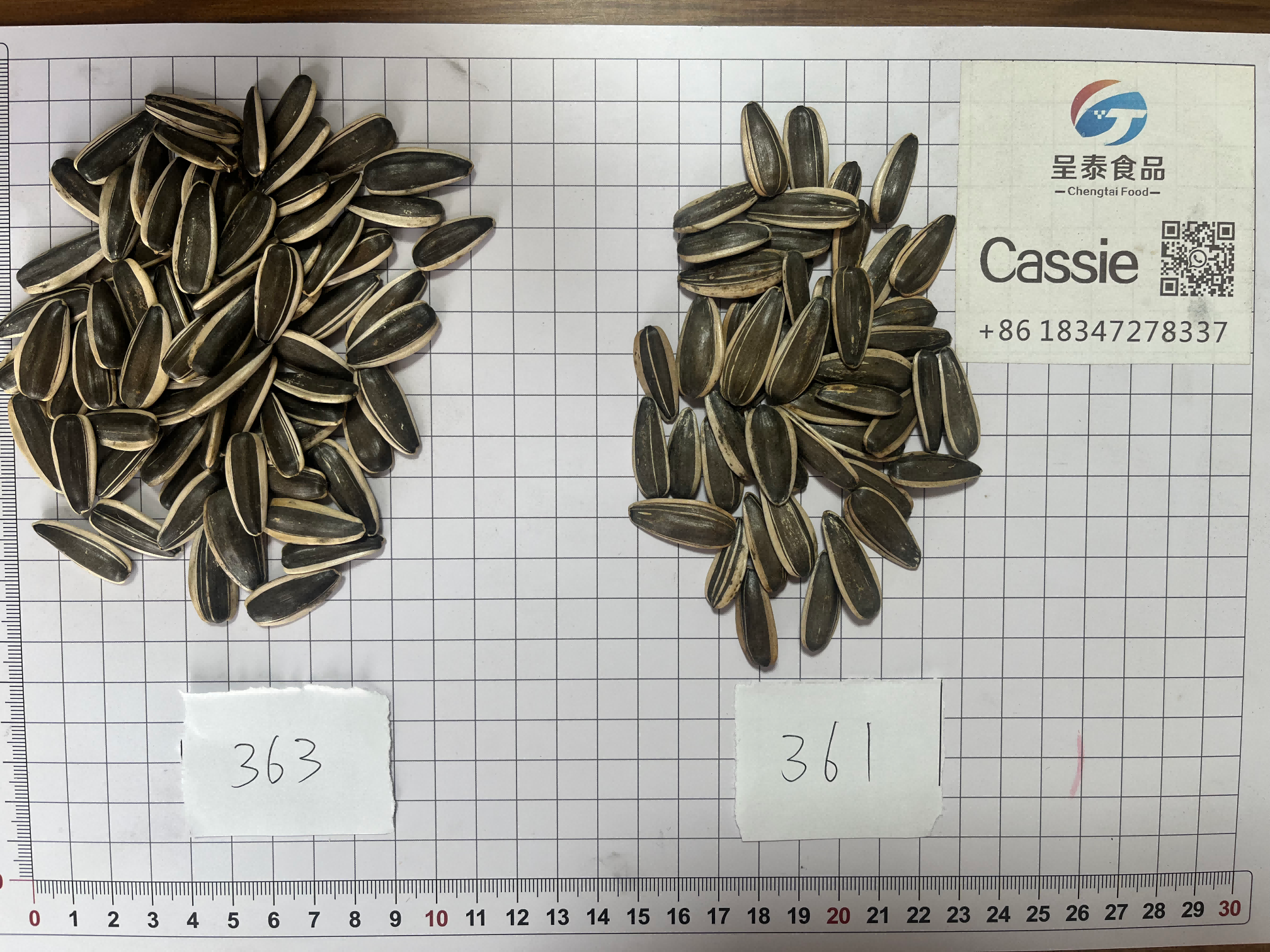
Sunflower seeds 363 is a widely sought confectionery grade in the Chinese export market. It is characterized by its black color and sweet natural taste. According to Inner Mongolia Chengtai Food Co., Ltd., 363 sunflower seeds are best suited for roasted original flavor applications. The largest available size range for 363 is 170–180 pieces per 50 grams, although the broader specification covers 170–230 pieces per 50 grams for the 363 series. Quality parameters for 363 sunflower seeds supplied by Chengtai include moisture content 9–10%, impurity less than 0.5%, erosion seeds less than 0.5%, and mildew seeds less than 1%. The 363 type typically commands a higher price compared to 361, reflecting its kernel size, color uniformity, and roasting performance.
Within the 363 category, Chengtai's product listings distinguish multiple configuration options for buyers: Jumbo Size Sunflower Seeds 363 (190–200 pieces/50g), Bulk Sunflower Seeds 363 (200–210 pieces/50g), Inner Mongolia Origin Sunflower Seeds 363 (210–220 pieces/50g), Large-kernel Striped Sunflower Seeds 363 (180–190 pieces/50g), and Pesticide Residue Controlled Sunflower Seeds 363 (170–180 pieces/50g). This granularity matters: the same 363 variety can be further segmented by piece count to match a buyer's roast profile, retail pack size, or kernel yield target.
Sunflower Seed Type 361: The Round, Thin-Shell, Value Grade
Sunflower seeds 361 is a round-shaped seed with a black-and-white striped appearance. Compared to 363, the 361 shell is thinner and the seed has a yellowish tone rather than a full black color. Its largest available size is 150–160 pieces per 50 grams, which is a bigger physical seed by count, but 361 is generally priced lower than 363. The 361 type is commonly used for salted flavor processing because its thin shell absorbs seasoning well and its taste profile suits savory applications.
Chengtai's 361 range includes several buyer-relevant configurations: Black-white Striped Sunflower Seeds 361 (150–160 pieces/50g), Non-GMO Sunflower Seeds 361 (160–170 pieces/50g), Unshelled Sunflower Seeds 361 (170–180 pieces/50g), Black Sunflower Seeds 361 (180–190 pieces/50g), and a base 361 specification of 170–300 pieces per 50 grams. Buyers sourcing for salted snack lines often start with the 150–180 pieces/50g range, while those prioritizing lower unit cost may look at the 170–300 range.
Sunflower Seed Type T6: The Long, Dark, Raw-Material Grade
Sunflower seeds T6 is a longer seed type with a darker black color than 361. T6 is more commonly sold as raw material rather than as a finished retail snack seed. Its shell is slightly harder than 361, which makes it more suitable for buyers whose downstream process involves their own roasting, seasoning, and packaging rather than direct table consumption.
T6 products from Chengtai are listed with sizes of 170–300 pieces per 50 grams and include: Black Sunflower Seeds T6 (180–190 pieces/50g), Snack Food Sunflower Seeds T6 (170–180 pieces/50g), Food Grade Sunflower Seeds T6 (190–200 pieces/50g), and Confectionery Grade Sunflower Seeds T6 (200–210 pieces/50g). For buyers comparing T6 against 363, the key distinction is shape and shell hardness: T6 is longer, blacker, and harder-shelled, while 363 has a sweeter taste and is specifically recommended for roasted original flavor. T6 is often used in raw bulk supply to processors that will roast and flavor in-house.
Side-by-Side Comparison: 363 vs 361 vs T6
| Attribute | 363 | 361 | T6 |
|---|---|---|---|
| Shape | Striped/large kernel | Round | Long |
| Color | Black | Black-white striped, slightly yellow | More black than 361 |
| Largest size | 170–180 pcs/50g | 150–160 pcs/50g | Not specified as largest; range 170–300 pcs/50g |
| Shell | Not specified as thin | Thin | Slightly harder than 361 |
| Best use | Roasted original taste | Salted flavor | Raw material, further processing |
| Relative price | Higher | Lower | Not specified; generally positioned as raw material |
Buyer guidance from Chengtai's comparison data is direct: if the requirement is black color, large size, long shape, and raw-material functionality, T6 fits. If thin shell and better eating taste matter more, 361 is a stronger candidate. If the priority is black color, best taste, and willingness to pay a higher price, 363 is recommended.
Quality Parameters Every Buyer Should Verify
While seed type determines the product's physical identity, quality parameters determine whether a shipment is usable. For the products described in this article, the stated quality specifications are consistent across the 363, 361, and T6 lines:
- Moisture content: 9–10%
- Impurity content: less than 0.5%
- Erosion seeds: less than 0.5%
- Mildew seeds: less than 1%
- Usage: human consumption
- Material: sunflower seeds kernel
These parameters are meaningful for procurement because they define the sorting and cleaning burden placed on the buyer. Impurity below 0.5% and mildew below 1% are practical thresholds for food manufacturers; exceeding them would require additional cleaning steps or reject more product at intake. Chengtai states that its quality control includes 100% testing, and its monthly production capacity of 2500 metric tons supports stable order fulfillment for food processors.
Packaging, Lead Time, and Minimum Order Considerations
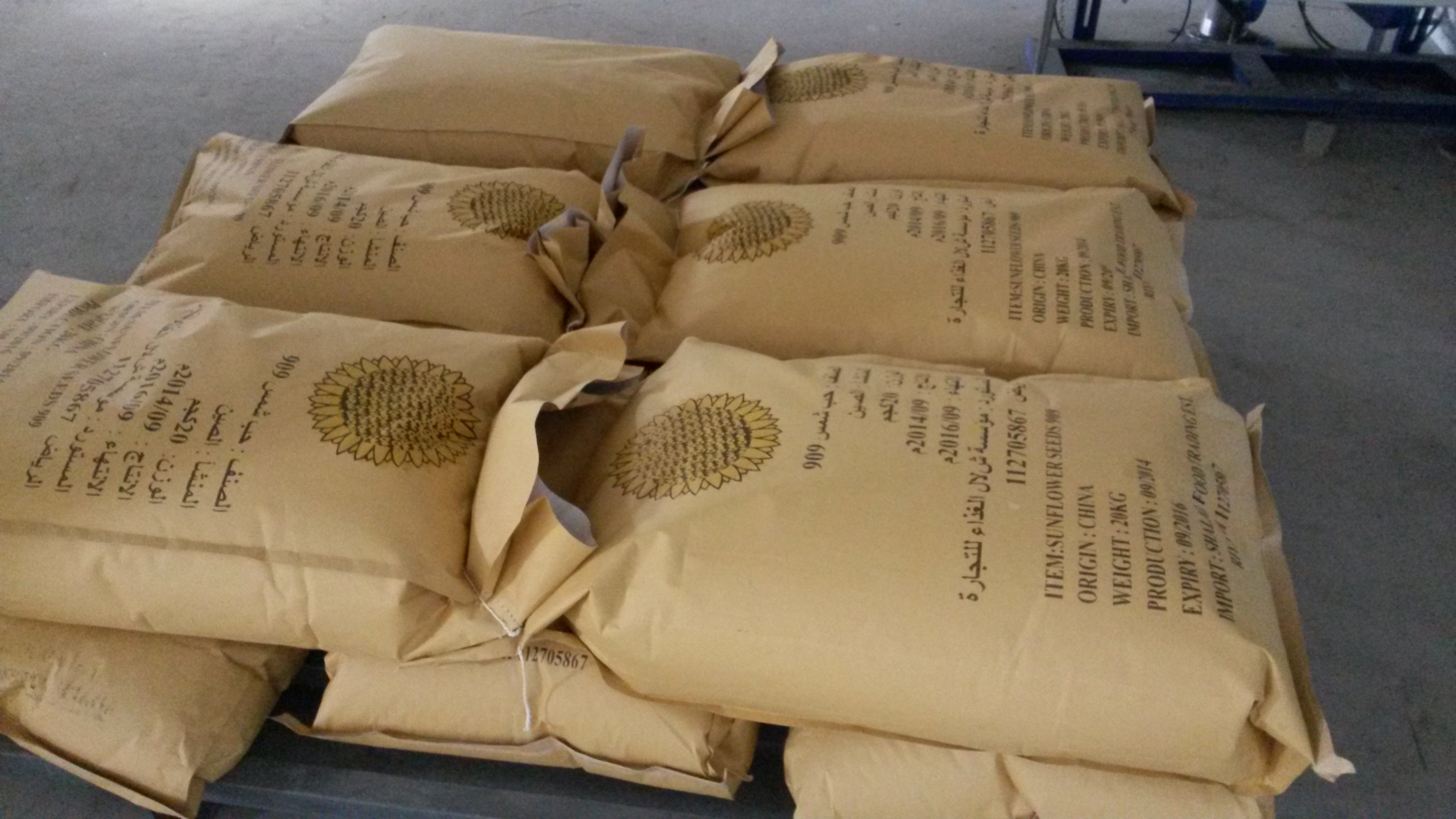
Procurement teams must also evaluate commercial terms that affect supply reliability. Chengtai's standard packaging for sunflower seeds 363, 361, and T6 is 20 or 25 kg per bag in plastic or paper bags. Recommended storage is a cool place. For the broader production capability, the manufacturer reports a monthly production capacity of 2500 metric tons, a typical lead time of 10–15 days, a minimum order quantity of 5 metric tons, and OEM/ODM services that include custom bag printing with the customer's logo.
These figures matter for evaluation-stage buyers because they indicate whether the supplier can handle trial orders, seasonal demand spikes, and private-label requirements. A 5-ton MOQ allows buyers to qualify a new supplier without committing to a container-sized volume, while the 10–15 day lead time is relevant for just-in-time programs or for covering shortfalls from existing suppliers.
Supply Evidence: Export Destinations and Client Types
Chengtai's case records show the company has supplied sunflower seeds to clients in the Middle East, South Asia, and Europe, including the UAE, Pakistan, and Libya. The product has been used by food processors, snack manufacturers, food wholesalers, importers, and distributors. The case highlights stable supply and consistent product quality, with best quality and lower price cited as key strengths. The client relationship spans approximately two years, and the stated volume reaches 30,000 metric tons for the cooperation period.
For a buyer evaluating suppliers, these details provide a verifiable proof point: the supplier has experience serving export markets that scrutinize pesticide residues, quality documentation, and delivery reliability. Inner Mongolia Chengtai Food Co., Ltd. itself was founded in 2013, operates from the Hetao Plain in Hanggin Rear Banner, and reports an annual output of 30,000 metric tons, with approximately 80% of products exported to the Middle East, Middle Asia, and Europe.
Market Context for 2026 Sunflower Seed Procurement
Several third-party data points help frame the 2026 procurement environment. Globally, the sunflower seeds market was valued at USD 29.27 billion in 2025 and is projected to reach USD 35.98 billion by 2034. Global sunflower seed production for the 2025/2026 marketing year is estimated at 55.05 million metric tons. Inner Mongolia accounts for over 60% of China's total sunflower cultivation area, and Inner Mongolia's sunflower seed export volume reached approximately 463,400 tons in 2025, valued at US$748 million. China's total sunflower seed exports were valued at USD 937 million in 2025, with major destinations including Iraq (USD 131 million) and Russia (USD 101 million).
On the demand side, roasted sunflower seeds accounted for 65.9% of global packaged sunflower seeds industry revenue in 2024, and Europe was the largest market for packaged sunflower seeds in 2024, holding a 29.6% revenue share. These figures reinforce the importance of selecting a seed grade that performs well after roasting, especially for buyers supplying European retail and foodservice channels.
One supply-side caution comes from the USDA forecast that global non-oilseed (confectionery) sunflower planted area declined by 8% in 2025. A reduction in planted area can tighten availability for specific size grades and push buyers toward earlier contracting with reliable suppliers. China has also notified 209 new Maximum Residue Limits (MRLs) for 93 pesticides in food to the WTO, and the EU market requires adherence to HACCP principles and strict monitoring of pesticide residues and metal contaminants. Buyers should therefore request pesticide residue documentation and confirm that their supplier's quality control can meet destination-market limits.
Limitations and Boundary Conditions
This evaluation is not without boundary conditions. First, the size grades described are supplier-specific listings; actual shipments can vary within the stated range, so buyers should confirm exact piece counts per 50 grams before contracting. Second, the comparison between 363, 361, and T6 reflects the supplier's product positioning and may not apply to all Chinese sunflower seed origins; seed characteristics also vary with harvest year and growing region. Third, price levels are not fixed and depend on crop yields, export demand, and exchange rates; the observation that 363 is higher priced than 361 is a general positioning statement, not a quote. Fourth, while Chengtai reports ISO 9001 and Halal certification in third-party market information, the company's own corpus does not list these certifications; buyers should request current certificates directly during supplier qualification. Finally, the 30,000-ton case volume represents a multi-year relationship, not an annual commitment, and should not be interpreted as a guaranteed capacity reservation for new buyers.
Supplier Profile: Inner Mongolia Chengtai Food Co., Ltd.
Inner Mongolia Chengtai Food Co., Ltd. is a sunflower and pumpkin seed processor and exporter founded in 2013, located in the Hetao Plain, Hanggin Rear Banner, Bayannur City, Inner Mongolia, China. The company operates within a regional planting base of 1.5 million acres for sunflower and pumpkin seeds, producing primarily sunflower seeds and kernels and pumpkin seeds and kernels. Its production workshop is designed in accordance with EU standards, and the company reports a factory area of 3,500 m² and an annual output of 30,000 metric tons. Main export markets include the Middle East, Middle Asia, Europe, Vietnam, and Africa.
How to Use This Evaluation in Supplier Shortlisting
For evaluation-stage buyers, the recommended approach is to score shortlisted suppliers on four dimensions:
- Grade-to-application fit: Does the supplier offer the specific type, size range, and configuration (raw, roasted-ready, pesticide-controlled) that matches your product line?
- Quality verification: Can the supplier provide the moisture, impurity, erosion, mildew, and pesticide residue data for each shipment? Is 100% testing claimed, and how is it documented?
- Commercial flexibility: Are the MOQ, lead time, packaging, and OEM customization terms compatible with your procurement cycles?
- Export track record: Does the supplier have verifiable experience in markets with similar regulatory expectations to your destination?
Applying these criteria to the data in this article gives a practical framework for comparing sunflower seed suppliers without relying on marketing claims.
Frequently Asked Questions
What are the main differences between sunflower seed types 361 and T6?
361 is a round-shaped seed with a thin shell that appears early in the season and is not totally black, with a slightly yellow tone. It has a good taste and is more suitable for salted flavor processing. T6 is a longer seed type with a darker black color, is usually sold as raw material, and has a slightly harder shell. Buyers needing black color, the largest size, and a long shape can choose T6; buyers prioritizing thin shell and taste should choose 361.
What are the differences between sunflower seed types 363 and 361?
363 is black in color, has a sweet taste, and is suited for roasted original flavor. Its largest size is 170–180 pieces per 50 grams, and its price is higher than 361. 361 is a black-and-white striped, round-shaped seed with a largest size of 150–160 pieces per 50 grams, is usually used for salted flavor, and has a lower price. If the need is black color and the best taste and a higher price is acceptable, 363 is recommended; if the need is good taste, large size, and lower price, 361 is suitable.
What quality specifications should buyers verify for sunflower seeds 363?
For sunflower seeds 363 supplied by Inner Mongolia Chengtai Food Co., Ltd., the key specifications are: raw, 2026 crop, black color, sweet natural taste, moisture 9–10%, impurity less than 0.5%, erosion seeds less than 0.5%, mildew seeds less than 1%, size 170–230 pieces per 50g (with narrower sub-ranges such as 180–190 or 190–200 depending on configuration), origin Xinjiang and Inner Mongolia, and packaging in 20/25 kg plastic or paper bags. The product is intended for human consumption and is suitable for manufacturing and roasting applications.
Is sunflower seed type 363 suitable for roasted and salted snacks?
363 is recommended for roasted original taste, while 361 is more commonly used for salted flavor. Both are suitable for further processing. If the end product is a roasted original flavor snack, 363 is the stronger candidate; if the end product is salted, 361's thin shell and good taste provide an advantage.
What are the minimum order and lead time requirements for buying sunflower seeds from Inner Mongolia Chengtai Food Co., Ltd.?
Inner Mongolia Chengtai Food Co., Ltd. reports a monthly production capacity of 2500 metric tons, a typical lead time of 10–15 days, and a minimum order quantity of 5 metric tons. The company also offers OEM/ODM services, custom bag printing, and after-sales support including refund application if seeds have problems.
Conclusion
Evaluating sunflower seed suppliers in 2026 requires more than matching a price list to a target cost. The practical questions are: which seed type fits the roast and flavor program, whether the size and quality parameters match the destination market's expectations, and whether the supplier's production capacity and export track record support reliable delivery. The grade-level detail available from Inner Mongolia Chengtai Food Co., Ltd. — from 363's roasted-original positioning to 361's salted-flavor fit and T6's raw-material role — provides a useful benchmark for these decisions.
Download the company profile for supply details.
Have Questions or Need More Details?
Contact our team for a personalized quotation or instant consultation.
Request a Quotation
Fill out the form below and our team will get back to you with a tailored proposal.
WhatsApp Direct Chat
Prefer to chat in real-time? Message us on WhatsApp for instant assistance & quick answers.
- Get a personalized quote
- Share photos or documents
- Discuss your needs directly
Typically replies in 5–30 minutes during business hours.