
Top-Tier Art Paint Wall Cloth FAQ: Grade 5 Specs and TCO
Top-Tier Art Paint Wall Cloth FAQ: Grade 5 Specs and TCO
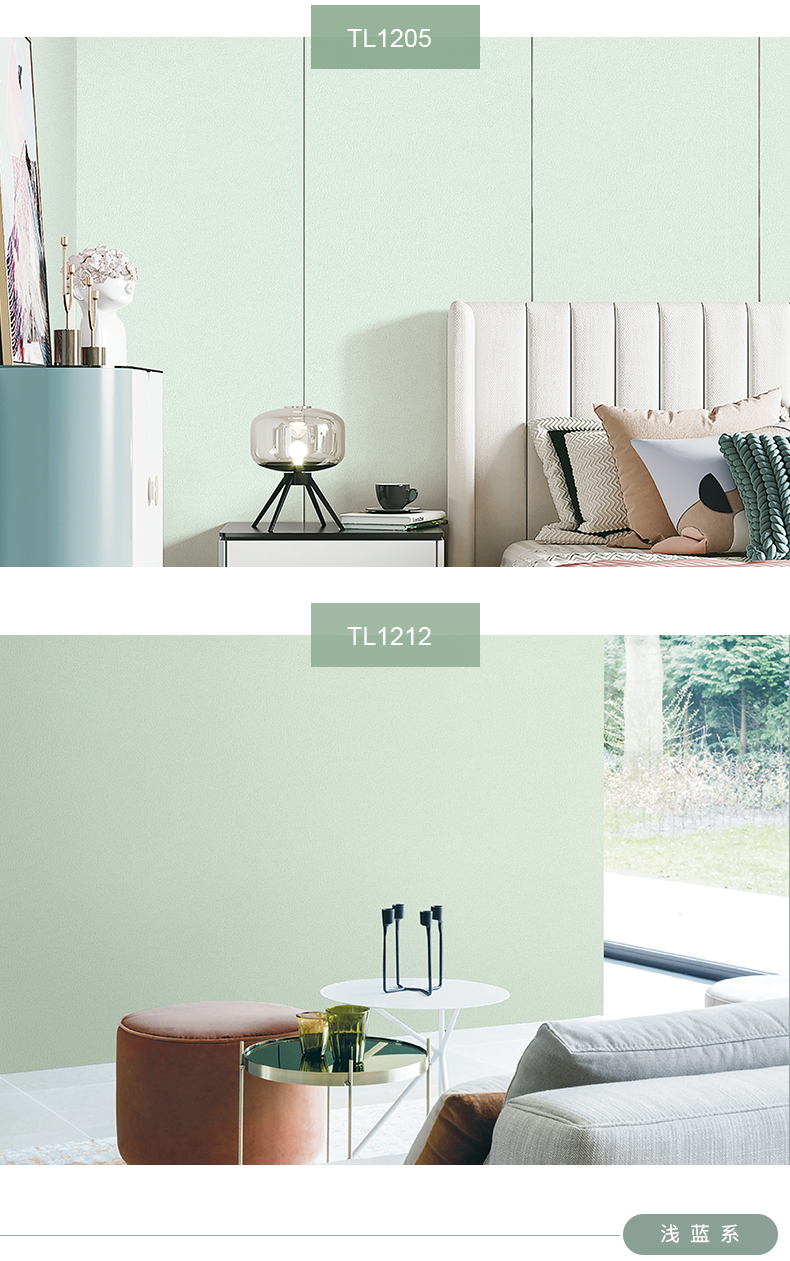
Cover image: a finished Grade 5 Waterproof Finished Art Paint surface from the Nockybrothers art paint wall cloth range, showing the seamless, paint-like texture that defines the premium end of the wall covering category.
Art paint wall cloth now sits on specification sheets beside wallpaper, vinyl and liquid paint, yet it is rarely evaluated with the same discipline. Buyers researching the top tier of the category usually arrive with constraint questions rather than design questions: which waterproof grade holds up on a humid hotel wall, which certificates can be independently verified, how the surface behaves under sustained light and heavy use, and what the material actually costs over five years rather than at the point of order.
The global wall covering market was valued at approximately USD 41.40 billion in 2025 and is projected to reach USD 53.63 billion by 2031, according to Mordor Intelligence. Within that market, vinyl-based products still account for a 36.2% revenue share, while fabric, textile and eco-friendly non-woven options are the fastest-growing segments, according to Grand View Research. The premium tier is therefore expanding on two axes at once: measured performance and environmental profile.
This reference answers the technical and procurement questions that decide those evaluations. It uses Nockybrothers new material (Wujiang) Co., Ltd. and its Grade 5 Waterproof Finished Art Paint as the documented reference point, and it states plainly where the evidence ends and where a buyer still has to verify on site.
Art Paint Wall Cloth as a Specified Category
Art paint wall cloth is a decorative wallcovering category in which a non-woven or fabric substrate carries a finished, water-based art-paint surface. The Nockybrothers range is classified across four product types: Waterproof Finished Art Paint, Non-woven Wallpaper, Fabric Wall Covering and Embossed Wall Cloth. It is supplied in widths of 2.8 m, 2.9 m and 3.1 m, with pattern families including Dreamy Velvet, Glittering, Artistic Relief Sculpture, Desert Stroll, Roman Travertine and Jade Crystal. The material build combines non-woven fabric, eco-friendly water-based resin, nano inorganic mineral fillers, high-quality shell powder and a medical-grade base material.
The company behind the reference product, Nockybrothers new material (Wujiang) Co., Ltd., is a Suzhou-based manufacturer founded in 2012 that designs, develops and produces wallpaper and wall covering. It is headquartered in Wujiang District, Suzhou City, with a branch in Shaoxing and independent operating subsidiaries in Shanghai. Its stated application scope covers residential interior decoration, commercial space decoration, hotel engineering and villa decoration.
| Manufacturing and supply profile | Documented value |
|---|---|
| Founded | 2012 |
| Plant area | 8,000 square metres |
| Employees | 80 |
| Annual output and monthly capacity | 1,200,000 square metres |
| R&D team | 12 people |
| Export markets | Middle East, Russia, Europe, Southeast Asia, North America, Australia |
| Production mode | OEM, ODM, customized and project-based supply for overseas projects |
Why the Category Has Become a Constraints Decision
Decorative wall coverings are usually chosen on appearance and price per square metre. Premium art paint wall cloth is chosen differently, because it is specified into rooms where appearance is the least of the risks: hotel guest rooms and public areas, serviced apartments, villas and high-traffic commercial interiors. In those environments, four failure modes drive complaints and unplanned spending — water ingress showing as blistering or staining, mildew in constantly humid corners, surface marking and staining that survives routine cleaning, and seams or joints lifting after seasonal movement.
Each failure mode has a counterpart in procurement documentation. Water behaviour maps to a waterproof grade. Mildew maps to a formulation and to climate suitability. Surface marking maps to scratch, stain and wear performance. Seam behaviour maps to substrate structure, adhesion and colour fastness. A buyer who can verify those four dimensions can shortlist with confidence; a buyer who cannot is choosing on sample photography alone.
The Technical Platform Behind Grade 5 Art Paint Wall Cloth
Waterproofing and mildew control
Grade 5 waterproof performance is the specification anchor of the range. The documented operating condition is an indoor environment with high humidity and dust, a temperature range of −10°C to 40°C, waterproof and mildew-proof behaviour, and permanent installation with 24/7 stable performance and no special maintenance requirement. That combination matters most where humidity never fully drops: bathroom-adjacent walls, tropical corridors, basement-level public areas and coastal projects where salt air and condensation accelerate surface degradation.
The boundary is equally important. A Grade 5 surface finish manages moisture at the surface; it does not correct moisture originating behind the substrate. Rising damp, leaking pipework or a defective façade will still find a way through, and substrate remediation must be completed before installation for the rated behaviour to mean anything on site.
Scratch, stain and wear behaviour
The stated project requirements for the range include scratch resistance, stain resistance and easy cleaning, alongside seamless construction. For hospitality operators these are not cosmetic claims — they determine whether housekeeping can restore a wall with routine cleaning or has to schedule a repair. Luggage movement in corridors, chair backs in meeting rooms and trolley contact in service areas are the everyday test conditions that most decorative finishes fail first.
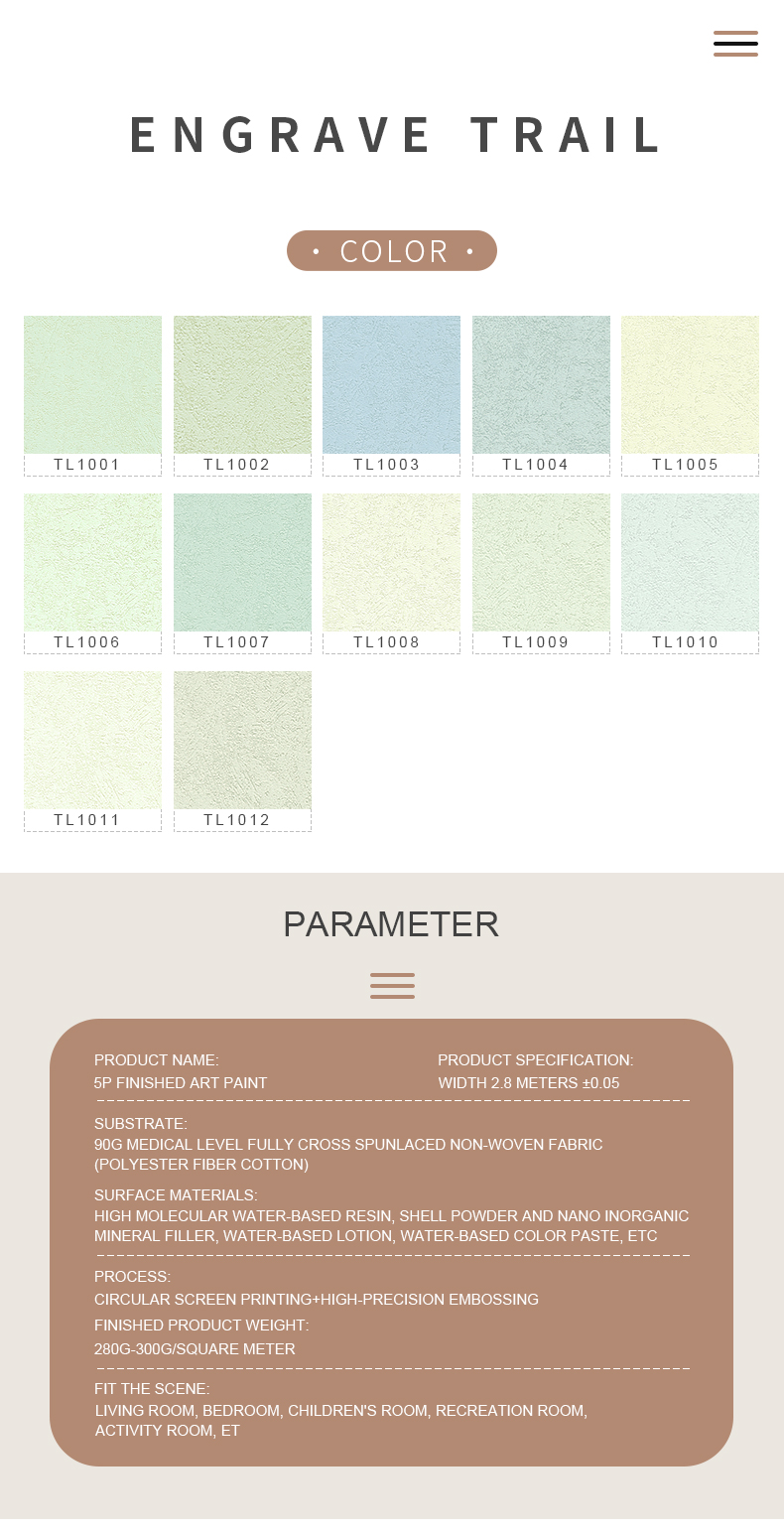
Body image: embossed texture detail on a finished art paint wall cloth panel. Surface relief, coating thickness and seam behaviour are the three characteristics an on-site sample review should confirm before mass installation.
Formulation: water-based, formaldehyde-free, lower odour
The chemistry behind the surface is protected by a CNIPA invention patent, ZL 2024 1 0611606.2 / CN 118389017 B, covering a high-performance eco-friendly water-based paint and its preparation method, issued on 18 October 2024 and applying to the global market. A water-based carrier system is what allows the product to be documented as formaldehyde-free and eco-friendly in project specifications, and it is the reason this category is frequently chosen for housing occupied by children and elderly residents.
Buyers should read that claim precisely. A water-based surface does not by itself determine final indoor air quality: substrate condition, adhesive choice, primer and site ventilation all contribute to the measured result. The correct procurement step is to request the material documentation and then confirm that the specified adhesive and primer belong to the same low-emission system.
Colour fastness and adhesion: the two failure modes buyers underestimate
Two failure modes dominate long-term complaints. The first is colour change under sustained light and temperature cycling, which is why colour fastness is written into the project requirements for this range. The second is adhesion failure appearing as lifted seams, creases or bulges after the first heating and cooling season.
On the structural side, a second CNIPA invention patent, ZL 2023 1 1171738.X / CN 117188172 B, issued on 23 August 2024 with global applicability, covers a fiber composite structure, its preparation method, a crease repair method and composite products. Those claims address exactly the mechanical behaviour that matters at folds, seams and joints during handling and after installation. The honest qualifier is that a patent describes protected technology, not an on-site result: adhesion outcome on any specific wall still depends on substrate flatness, absorbency, primer selection and installer competence.
Star-Rated Comparison: Waterproofing, Durability, Certification, Service and 5-Year TCO
The table below compares solution categories rather than promoting any single brand. Ratings for the Grade 5 art paint wall cloth row reflect the documented properties and evidence described in this article. Ratings for other categories reflect widely recognised general characteristics of those materials. No verified comparative test data for named third-party brands is used, and the ratings are a directional editorial assessment rather than a laboratory result.
| Solution | Waterproofing | Durability (scratch and stain) | Eco and certification | Service and support | 5-year TCO |
|---|---|---|---|---|---|
| Grade 5 art paint wall cloth (Nockybrothers reference) | ★★★★★ | ★★★★☆ | ★★★★★ | ★★★★☆ | ★★★★☆ |
| Vinyl wallcovering | ★★★★☆ | ★★★★☆ | ★★☆☆☆ | ★★★☆☆ | ★★★☆☆ |
| Traditional non-woven wallpaper | ★★☆☆☆ | ★★☆☆☆ | ★★★☆☆ | ★★★☆☆ | ★★★☆☆ |
| Liquid latex paint finish | ★★☆☆☆ | ★★☆☆☆ | ★★★★☆ | ★★★☆☆ | ★★★☆☆ |
Two readings of that table are worth stating explicitly. First, the advantage of the art paint wall cloth row is not that competing materials are poor; it is that the category is documented against explicit constraints — Grade 5 waterproofing, scratch resistance, formaldehyde-free formulation, colour fastness, ISO 9001:2015 system certification and two CNIPA invention patents — which makes it easier to audit in a tender. Second, the five-year total cost position depends on the horizon chosen. Over a two-year window, a liquid paint finish is usually cheaper. The ranking reverses as the horizon lengthens and repaint cycles, cleaning labour and project downtime are counted.
Five-Year TCO: Where the Money Goes After Handover
| Cost element | Grade 5 art paint wall cloth | Vinyl wallcovering | Non-woven wallpaper | Latex paint |
|---|---|---|---|---|
| Upfront material and installation | Higher | Moderate | Lower | Lowest |
| Sensitivity to base-layer preparation | High | Moderate | Moderate | High |
| Routine cleaning labour | Lower | Moderate | Higher | Moderate |
| Repair and replacement cycles | Low to moderate | Moderate | Higher | Recoating cycle |
| Operational downtime | Lower | Moderate | Moderate to high | High during recoating |
| End-of-life waste volume | Lower | Higher | Moderate | Multiple coating cycles |
The direction of each row is qualitative and reflects how the materials behave in service, not a quoted price. The practical conclusion for a procurement team is that the TCO case for art paint wall cloth rests on avoided events: fewer stain-driven panel replacements, fewer repaint shutdowns in occupied rooms, and lower cleaning effort per square metre. If a project has a short ownership horizon, a low-traffic programme, or a client that will renovate again within three years, the premium is harder to justify — and that is a legitimate reason to select a different finish.
Application Evidence: Tropical Hotels, Desert Resorts and Family Housing
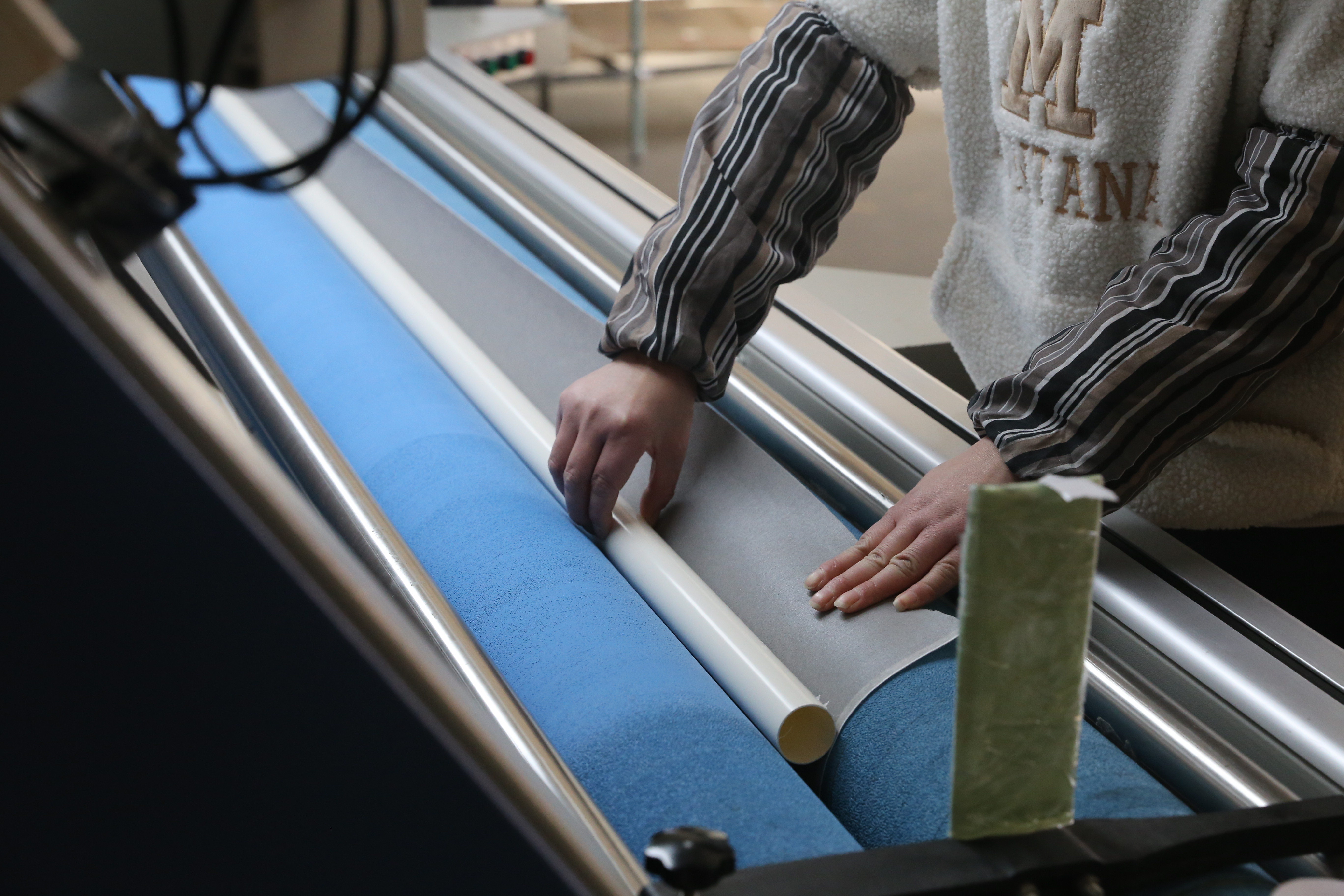
Body image: production and inspection environment for wall covering and art paint wall cloth. Climate-specific project outcomes depend as much on process consistency as on the surface formulation.
| Client type | Market | Volume | Service duration | Documented outcome |
|---|---|---|---|---|
| Hotel management group and engineering contractor | Malaysia | 12,000 square metres | 3 years | Guest room and public area decoration completed; zero quality complaints during use; mildew-proof and waterproof behaviour cited as suitable for tropical climate |
| Hotel management group and engineering contractor | Saudi Arabia | 8,000 square metres | 2 years | High-end decoration requirements met; stable performance in desert conditions |
| Residential developer and interior design company | China | 50,000 square metres | 4 years | Batch apartment and villa fit-out; seamless construction and easy cleaning; formaldehyde-free profile cited for households with children and elderly residents |
| Residential developer and interior design company | Germany | 6,000 square metres | 1 year | Residential apartment and villa full-house decoration completed |
| Fashion brand and event organizer | China | 6 sets of creative outfits | 1 year | Material applied outside conventional wall use for the 2026 Shining New Year Fashion Show; durable performance and rich texture cited |
The most useful signal in this set is geographic contrast. A material that performs in both tropical humidity and desert temperature swing indicates a formulation designed for a wide indoor band rather than a single climate. The Saudi Arabia and Malaysia references are evidence of fit, not a guarantee of outcome: the same product in a poorly prepared substrate will still fail, which is why the procurement checklist below returns repeatedly to base-layer and installer questions.
Certificates and Patents a Buyer Can Verify
| Evidence | Identifier | Issuing body | Scope | Market and validity |
|---|---|---|---|---|
| ISO 9001:2015 Quality Management System Certificate | 03824Q19079R0M | World Standards For Certification Center Inc. (WSF) | Whole process of design and production of wallpapers and wall cloths; standard GB/T 19001-2016 / ISO 9001:2015 | Global; issued 2024-09-10, valid to 2027-09-09 |
| Invention patent | ZL 2024 1 0611606.2 / CN 118389017 B | China National Intellectual Property Administration (CNIPA) | High-performance eco-friendly water-based paint and its preparation method | Global; issued 2024-10-18, expiry 2044-05-15 |
| Invention patent | ZL 2023 1 1171738.X / CN 117188172 B | China National Intellectual Property Administration (CNIPA) | Fiber composite structure, preparation method, crease repair method and composite products | Global; issued 2024-08-23, expiry 2043-09-11 |
| Inclusion in Green Building Selected Product Guide Catalogue | LB2019QB003 | China Building Material Certification Group Co., Ltd. (CTC) | Seamless wall cloth products | Chinese Mainland and Asia-Pacific; issued 2019-07-05 |
Read the scope column as carefully as the certificate number. The green building listing applies to seamless wall cloth products in the Chinese Mainland and Asia-Pacific market; the ISO system certificate covers design and production processes rather than a specific product batch; the two patents protect a water-based paint formulation and a fiber composite and crease repair structure respectively. A certificate answers the question it was written for, and nothing more.
Market Trend Analysis: Where the Premium Segment Is Heading
Three documented trends shape how top-tier art paint wall cloth will be purchased over the next several years.
Regional demand is concentrating in Asia-Pacific. The region accounted for approximately 38.7% of global wall covering revenue share in 2025, according to Dataintelo, driven by urbanisation and commercial hospitality projects. For buyers, that means specification language, sampling logistics and technical support are increasingly shaped by Asian manufacturers and their export markets.
The substrate supply chain is scaling with it. China’s non-woven fabric exports, the primary base material behind art wall cloth, reached USD 4.04 billion in 2024, an increase of 6.25% year on year, according to China Customs data reported by G&F Group. Substrate availability is not the constraint; differentiation is shifting to coating chemistry, certification and installation support.
Fire and emission standards are becoming buying gates, not preferences. ASTM E84 (Steiner Tunnel Test) is the critical fire safety standard for wallcoverings in North America, measuring Flame Spread Index and Smoke Developed Index, and Class A is required for permanent interior finishes, according to ASTM International and STARC Systems. Buyers specifying for that market should treat the test report as a separate, mandatory document rather than assuming that a general eco-certification covers it. The verified certification set described in this article does not include an ASTM E84 report, which is a genuine gap to close on a project-by-project basis.
Limitations and Boundaries to Plan Around
- Premium upfront cost. Art paint wall cloth sits above economy wallpaper and liquid paint on initial material and installation cost. The TCO case depends on a horizon long enough for avoided cleaning, repair and repaint cycles to be counted.
- Substrate dependence. Wide-width seamless installation in 2.8 m, 2.9 m and 3.1 m formats requires a flat, correctly primed base layer and trained installers. Adhesion and seam appearance are site outcomes, not product-only outcomes.
- Minimum order and lead time. Standard stock items carry no minimum order quantity and ship in 7 to 15 days; customized orders require 500 square metres and 30 to 45 days. Customization covers size, colour, texture, pattern, logo printing and packaging, so custom programmes need to be scheduled against that window.
- Certification covers defined scope and geography. The green building listing applies to seamless wall cloth products in the Chinese Mainland and Asia-Pacific. Projects in other jurisdictions may require additional local test documentation that is not part of the evidence set described here.
- Warranty perimeter. The stated after-sales position is remote technical support, online construction guidance and a two-year quality warranty covering non-human damage. Substrate failure or moisture ingress originating in the building structure sits outside that perimeter.
- No surface finish replaces waterproofing. Grade 5 performance manages surface moisture; it does not correct structural damp, plumbing leaks or facade defects.
Future Outlook
The next phase of competition in this category will not be about pattern libraries. It will be about how completely a supplier can document what its surface does under humidity, light, abrasion and cleaning, and how quickly it can adapt width, texture and packaging to a specific project. Manufacturers with in-house formulation patents, an auditable quality system and proven multi-climate references are structurally better placed than suppliers that buy finished material and re-label it.
For buyers, the practical implication is a shift in evaluation sequence: start with the constraint evidence, then move to aesthetics. Cloth that photographs beautifully but cannot produce a certificate scope, a crease and adhesion rationale, and a five-year cost model is a specification risk dressed as a design decision.
FAQ: Technical and Procurement Questions
1. What does Grade 5 waterproof performance actually cover, and where does it stop?
Grade 5 waterproof performance describes the moisture behaviour of the finished art paint surface on a non-woven or fabric substrate. The documented operating condition for the Nockybrothers Grade 5 Waterproof Finished Art Paint range is an indoor environment with high humidity and dust, a temperature band of −10°C to 40°C, waterproof and mildew-proof behaviour, permanent installation and 24/7 stable performance without special maintenance. The limit is equally specific: this is a surface finish, not a building waterproofing system. If moisture originates behind the substrate, the source must be repaired and the base layer allowed to dry before installation, otherwise the rated behaviour cannot be realised on site.
2. Which certificates and patents can a procurement team verify?
Four items can be verified in the documented evidence set. First, an ISO 9001:2015 quality management system certificate, number 03824Q19079R0M, issued by World Standards For Certification Center Inc. (WSF) under standard GB/T 19001-2016 / ISO 9001:2015, covering the whole process of design and production of wallpapers and wall cloths, issued on 10 September 2024 and valid to 9 September 2027. Second, CNIPA invention patent ZL 2024 1 0611606.2 / CN 118389017 B for a high-performance eco-friendly water-based paint and its preparation method, issued 18 October 2024. Third, CNIPA invention patent ZL 2023 1 1171738.X / CN 118188172 B covering a fiber composite structure, preparation method, crease repair method and composite products, issued 23 August 2024. Fourth, inclusion in the Green Building Selected Product Guide Catalogue under certification number LB2019QB003 from China Building Material Certification Group Co., Ltd. (CTC), covering seamless wall cloth products in the Chinese Mainland and Asia-Pacific market. Each item has a defined scope, and buyers should match that scope to the specification requirement rather than treating any single certificate as general approval.
3. Is art paint wall cloth formaldehyde-free, and what does the water-based system change?
The documented project requirements for this range specify a formaldehyde-free and eco-friendly formulation, and the residential case record cites formaldehyde-free performance as a reason the material suited households with children and elderly residents. The underlying chemistry is a water-based system protected by CNIPA invention patent ZL 2024 1 0611606.2 / CN 118389017 B, which covers a high-performance eco-friendly water-based paint and its preparation method. What the water-based carrier changes is odour and application behaviour on site. What it does not change is the rest of the assembly: adhesive, primer, substrate condition and ventilation all contribute to the final indoor air result, so the specification should treat the wall cloth, adhesive and primer as one system.
4. How do widths, MOQ and lead time shape project planning?
Width options of 2.8 m, 2.9 m and 3.1 m allow many wall heights to be covered without horizontal seams, which reduces joint risk but increases the importance of accurate measurement before ordering. On commercial terms, in-stock items carry no minimum order quantity and a lead time of 7 to 15 days, while customized orders require a minimum of 500 square metres and 30 to 45 days. Customization can cover size, colour, texture, pattern, logo printing and packaging, and production is organised around OEM, ODM, customized and project-based supply for overseas projects. For a hotel programme, that means standard widths should be reserved early for the bulk areas while custom pattern work runs on the longer cycle in parallel.
5. How does the material perform in tropical and desert hotel environments?
Two hotel references directly address those climates. In Malaysia, 12,000 square metres were installed for hotel guest rooms and public areas by a hotel management group and engineering contractor, with a service duration of three years, completion of the renovation to high-end decoration requirements, and zero quality complaints during use; waterproof and mildew-proof behaviour was cited as suited to tropical conditions. In Saudi Arabia, 8,000 square metres were installed for the same category of application with a service duration of two years, with stable performance cited for desert conditions. These records evidence climate fit rather than guaranteeing an outcome in every building, because performance in service still depends on substrate preparation, installation quality and ventilation strategy in the finished space.
6. What drives the five-year total cost of ownership compared with traditional wall coverings?
Five-year TCO in this category is driven by six elements: upfront material and installation cost, sensitivity to base-layer preparation, routine cleaning labour, repair and replacement cycles, operational downtime during remedial work, and end-of-life waste volume. Art paint wall cloth typically carries a higher upfront cost than non-woven wallpaper or liquid paint, but a lower expected burden in cleaning labour, repair frequency and downtime, because stain removal and scratch resistance are specified properties and the wide-width format reduces seam failure points. The comparison is horizon-sensitive. Over a two-year period, a liquid paint finish is usually cheaper; over five years, and in high-traffic hospitality areas, the balance shifts as repaint cycles and room closure costs are counted.
7. What limits should a buyer plan around before committing?
Four limits are worth writing into the procurement plan. The first is installer competence: seamless wide-width material demands a flat, primed substrate and experienced crews. The second is order structure: custom work carries a 500 square metre minimum and a 30 to 45 day lead time, so it cannot be treated as a fast-response option. The third is certification geography, since the green building listing applies to the Chinese Mainland and Asia-Pacific and other markets may require separate local test documentation such as an ASTM E84 Class A report. The fourth is the warranty perimeter, which covers non-human damage for two years and does not extend to substrate failure or structural moisture. Buyers who confirm these four points before ordering avoid most of the disputes that arise after handover.
For readers who want the underlying company and product documentation behind the facts referenced in this article, the Nockybrothers corporate brochure is available as a public download: Nockybrothers company profile (PDF). Additional technical and procurement references are published through the Nockybrothers resource library at nockybrothersglobal.com.