
Topkit Tower Crane Customization: Spec to Delivery
Topkit Tower Crane Customization: Spec to Delivery
Topkit tower cranes — the tower-head, pendant-rope machines that dominate high-rise concrete work — hold the largest single share of the global tower crane market. For a buyer who has already chosen that type, the decision that determines whether the machine performs is configuration: jib length, counterweight scheme, lifting-height plan, electrical and safety configuration, documentation and delivery. This article examines what a manufacturer can genuinely customize on a topkit crane, what requires engineering review first, and what procurement teams should verify before the purchase order is issued.
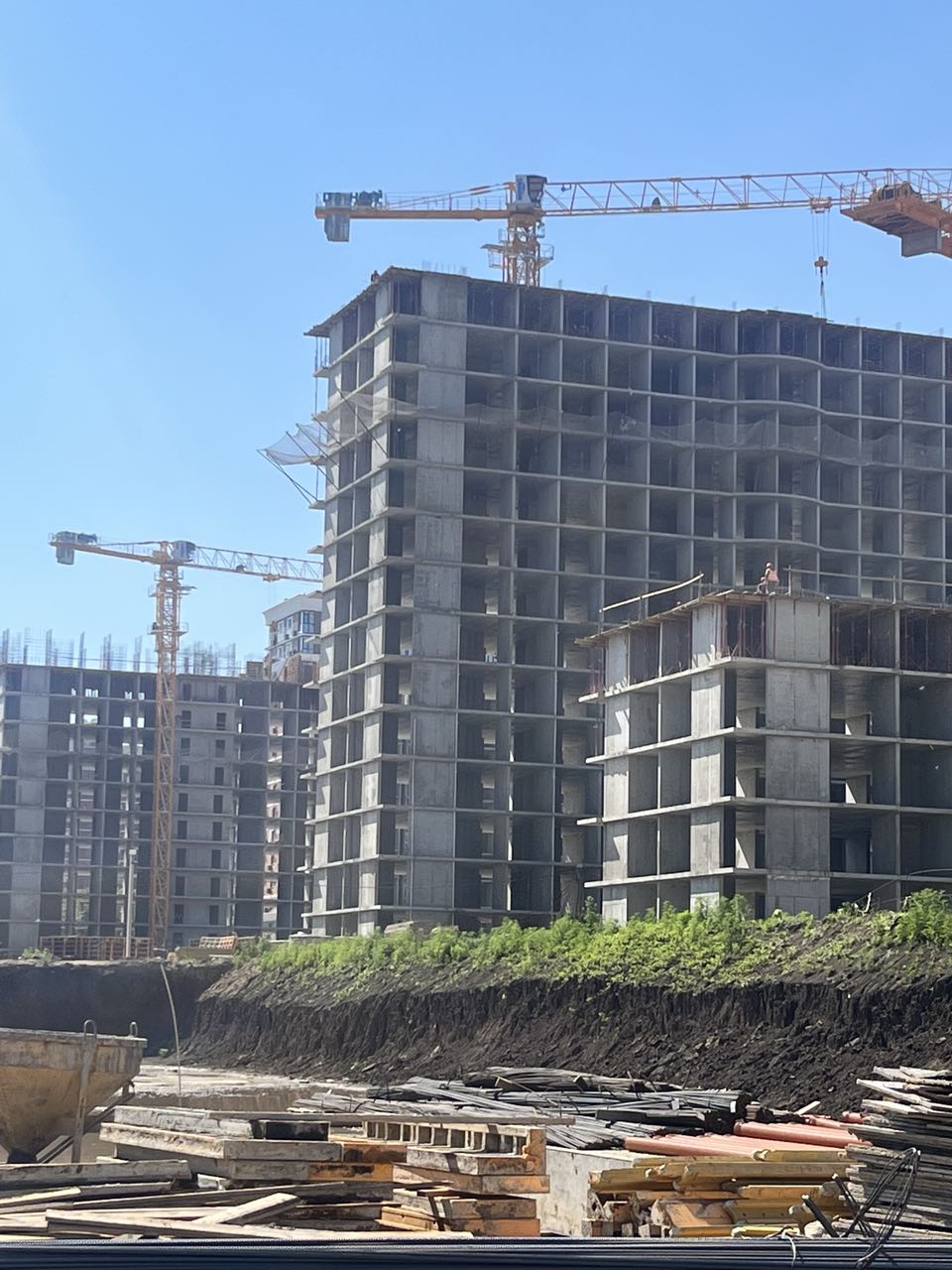
Multi-crane site coordination is a configuration outcome, not a catalogue outcome. Image: documented project reference.
Why the Topkit Segment Still Sets the Procurement Baseline
Hammerhead tower cranes, the family to which topkit designs belong, held the largest share of the global tower crane market by product type at 42.8% in 2025 (Grand View Research). The overall market was estimated at USD 5.9–6.44 billion in the same year (Fortune Business Insights; Grand View Research), and China remained the leading exporter in 2024 with USD 694 million in export value (OEC, using UN Comtrade data, HS 842620).
Two conclusions follow for buyers. First, the topkit format is not a niche choice; it is the volume standard for mainstream high-rise and infrastructure work, which means supply, spare parts and service depth are generally better supported than for specialised formats. Second, because the format is standard, differentiation between suppliers rarely sits in the basic machine concept. It sits in how precisely the crane is fitted to the site, how fast the configuration is engineered and released to production, and how complete the documentation and delivery package is.
The Practical Problem: A Catalogue Model Is Not a Site Solution
A topkit crane is specified by a lifting task, not by a single tonnage figure. Between the catalogue page and a working machine sit several variables that frequently change after the order is placed if they are not fixed beforehand:
- Jib length versus required coverage. The crane must cover the building footprint, the material storage area, the unloading route and the lifting positions. Over-specifying span increases equipment specification and cost for no operational gain.
- Rated load at maximum radius, not just maximum capacity. Lifting capability falls as working span increases, so the load that matters is the one at the radius where the crane actually works.
- Counterweight and ballast scheme. Base configuration and counterweight arrangement interact with foundation design, site access and the erection sequence.
- Lifting height and climbing plan. Long-duration high-rise work typically needs a fixed installation with mast-adding (climbing) stages rather than a single erection height.
- Electrical and safety configuration. Power supply characteristics, control architecture and safety limiting devices must match the destination market and site conditions.
- Transport and export packing. Panel schemes and loading plans determine whether the crane leaves the factory in a shippable, reassemblable condition.
Each of these is a customization decision. The buyer's real question during evaluation is therefore not "what models does the supplier list" but "how does this supplier convert my site data into a production-ready configuration, and what does it require from me to do so".
Dahan Technology Co., Ltd.: Entity Base for a Customization Discussion
Dahan Technology Co., Ltd. is a Chinese manufacturer of tower cranes and construction elevators, based in the Zheshan Industrial Park, Mingshui Economic Development Zone, Zhangqiu District, Shandong Province. The company was established in 2000, employs more than 1,000 people, operates from a manufacturing site of approximately 330,000 m², runs a research and development team of about 100 engineers, and reports an annual output of 5,000 units, with exports accounting for roughly 60% of sales across Asia, Europe, the Middle East, Africa, North America and South America.
Its production model is relevant to the customization question rather than incidental to it. The company provides OEM and ODM production services for tower cranes, including complete machine delivery, heavy-tonnage crane research and development, and export execution supported by a spare parts and after-sales service network. Documented monthly capacity is 400 units and the stated minimum order quantity is 1 unit. The company also states that its scale, sales volume and market share have remained among the top three in the Chinese tower crane and construction elevator industry, and that it acts as a national standard revision unit in the tower crane industry — a positioning claim that is best verified against current industry sources rather than accepted at face value.
What Can Be Customized, and What Requires Engineering Review First
The documented customization scope covers four groups of parameters: jib lengths, counterweight schemes, lifting-height plans, and electrical and safety configurations. In practice these four groups are interdependent. Changing jib length alters the load chart at every radius and therefore the counterweight scheme; changing the lifting-height plan changes the number of mast sections, the tie-in strategy and the transport list; changing the electrical configuration can change control architecture and safety device selection.
The company draws a clear boundary on this process: complex customizations require engineering evaluation before production. That is a meaningful procurement point rather than a formality. It means the supplier will model the requested configuration against structural and safety limits before committing it to the production line, and it means the buyer should expect a technical review stage between the enquiry and the confirmed order — not an immediate quotation for a non-standard machine.
Two further facts shape planning. First, a minimum order quantity of 1 unit supports low-volume custom production and prototype orders, which matters for operators testing a new configuration, for rental fleets adding a single specialised machine, and for agents building a demonstration unit. Second, for customized service the exact delivery date has to be confirmed with the sales department, because the schedule depends on the engineering review outcome and on current production loading. Buyers who need a firm date should therefore treat the engineering review as a milestone in the schedule, not as a delay.
Reading a Topkit Model Designation: QTZ Codes in Practice
Documented products in the company's range are designated in the QTZ series, with the designations listed below. Across the range, the stated lifting capacity band runs from 5 t to 220 t, and the supplied crane families include flat top, topkit, luffing jib and derrick configurations. A single model designation does not mean one fixed machine: rated capacity bands and configurations are project-specific, and the designation defines the starting point for configuration rather than the finished specification.
| Documented QTZ model designation | Designation pattern |
|---|---|
| QTZ63 (5013)-5T/6T | Bracketed figures follow the common industry convention: maximum jib length in metres and rated load at maximum radius in tonnes |
| QTZ80 (5211)-5T | Same convention; the trailing figure denotes the rated capacity band |
| QTZ100 (6013)-8T | Same convention |
| QTZ125 (6015)-8T/10T | Same convention; dual rated capacity bands |
| QTZ160 (6515)-8T/10T | Same convention; longer jib designation |
| QTZ250 (7025)-12T/16T | A long-jib designation within the range |
| QTZ250 (7520)-10T/12T/16T | Longest-jib family in the documented set |
| QTZ315 (7527)-12T/16T | Heaviest jib-length designation in the documented set |
Under this convention, a designation such as (7025) indicates a 70 m maximum jib length, which is the configuration class large residential and commercial towers typically require, while (7527) indicates a 75 m jib for wider footprints. Because the convention only fixes jib length and tip-load class, the remaining specification — capacity band, counterweight, height plan, control configuration — remains open to the engineering discussion described above. Buyers comparing quotations should normalise all quotations to the same designation before comparing price.
Certification Scope and Documentation for Cross-Border Delivery
For exported tower cranes, certification is a scope question before it is a branding question. Three documents are documented for this manufacturer:
| Document | Issuing / scope details | Standards referenced |
|---|---|---|
| ECM Certificate of Compliance (CE), certificate no. 6B211216.DTCO94 | Issued by ECM, EU market, scope: tower crane, model list per Annex I; issued 2021-12-16, valid to 2026-12-15 | EN ISO 12100:2010; EN 14439:2006+A2:2009; EN 60204-32:2008 |
| EAEU Conformity Certificate (EAC), certificate no. ЕАЭС RU С-СН.АД58.В.03025/25, series RU №0576066 | Issued by TATSERT Certification Center; market: EAEU (Russia, Kazakhstan, Belarus, Kyrgyzstan, Armenia); scope: QTZ series tower cranes, full model list per certificate annex; issued 2025-12-30, valid to 2030-12-29 | GB/T 13752-2017; GB/T 6067.1-2010; ISO 4301/1-86; GB/T 5031-2019 |
| ISO 9001:2015 Quality Management System Certification, certificate no. 10424Q01958R1M | Issued by SHANDONG SEATONE INTERNATIONAL CERTIFICATION CO., LTD; global; scope covers design and development, manufacturing, installation and maintenance services of tower cranes and construction lifts; issued 2024-10-15, valid to 2027-10-17 | GB/T 19001-2016 / ISO 9001:2015 |
Two practical notes follow. First, the EAC certificate scope is explicitly limited to the QTZ series with the full model list in the certificate annex — a buyer specifying a configuration outside that annex should confirm the compliance route before ordering, not after. Second, all three documents carry defined validity windows; procurement teams should verify current validity and scope at the time of order. The manufacturer states that certificate authentication documentation is available to support CE compliance documentation requirements, which is relevant when the buyer's own client or lender requires documentary proof rather than a statement.
GB/T 13752-2017, referenced in the EAC documentation, is the Chinese design and safety rule standard for tower cranes issued by the Standardization Administration of China, superseding the 1992 version. Its presence in the certification basis indicates that the documented design basis follows current Chinese design rules rather than legacy practice.
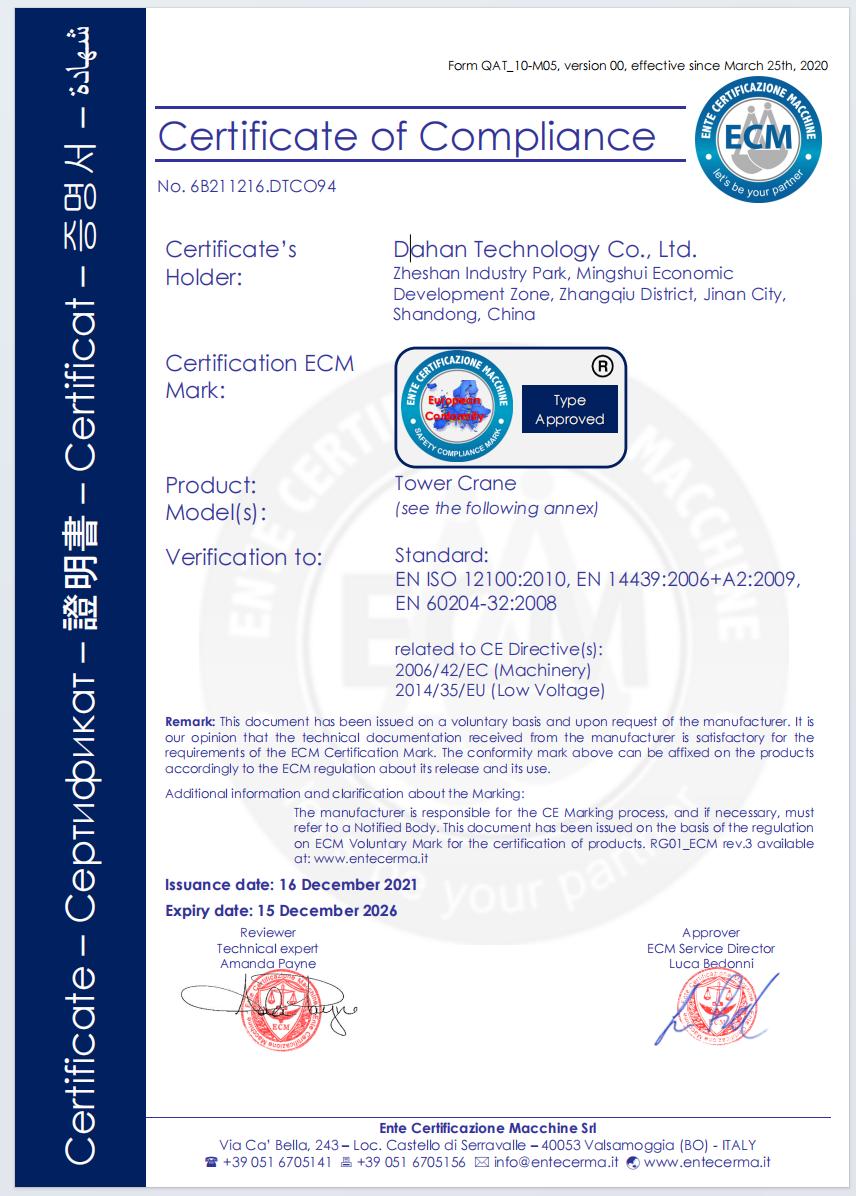
CE compliance documentation: buyers should check model scope and validity dates, not only the certificate's existence.
Where These Cranes Work: Documented Project References
The customization question is best tested against delivered projects. The following references are documented by the manufacturer and cover different client types, markets and site conditions.
| Market | Client type | Units | Application | Duration | Reported outcome |
|---|---|---|---|---|---|
| Russia | Trader | 4 | Building construction | 3 years | Building construction project completed; multiple cranes coordinated to meet material hoisting requirements |
| Russia | Construction company | 34 | Civil building construction | 4 years | Residential building project completed; high coordination across multiple tower cranes |
| India | Construction company | 1 | Building construction | 2 years | Project completed; customer cited reduced construction time, stable hoisting and strong wind resistance |
| Vietnam | Construction company | 3 | Bridge construction | 2 years | Bridge construction completed; customer cited time savings, stable load travel and wind resistance |
| Bulgaria | Regional agent | 5 | Building construction, in use | 1 year+ | Project under construction; multiple cranes reported to coordinate efficiently |
| Türkiye | Construction company | 5 | Building construction | 2 years in service | Building construction completed; high construction efficiency and stable hoisting reported |
Three patterns are worth extracting. First, the largest fleet reference — 34 units on one residential programme — shows that repeating the same designation across a project is a configuration decision in itself, because coordination between machines and consistent load charts matter more than individual machine specification. Second, the single-unit India and three-unit Vietnam references show that low-volume orders are supported, consistent with the stated one-unit minimum order quantity. Third, wind resistance recurs in customer feedback across markets where high-wind conditions are common, which aligns with the stated design feature that these cranes are built to operate without being affected by special weather conditions, using high-strength steel and materials selected for low temperatures and extreme conditions.
Market Trends Reshaping Topkit Procurement
Four documented market movements affect how topkit cranes are specified and purchased.
Volume remains in hammerhead-type machines. At 42.8% of the market by product type in 2025, the hammerhead family — which includes topkit designs — remains the default choice for mainstream construction (Grand View Research). Buyers therefore benefit from a competitive supplier landscape and mature spare-parts channels, but they also face a large field of suppliers offering superficially similar catalogue machines. Configuration discipline becomes the differentiator.
Flat-top and topless designs are growing in constrained airspace. Flat-top designs accounted for 46.37% of tower crane revenue in 2025, driven by their efficiency in dense urban airspace (Mordor Intelligence). This is not a contradiction of the topkit share figure — the two figures measure different things — but it does signal where growth is concentrated: city sites where slewing over adjacent structures or occupied areas is restricted. Buyers on dense urban projects should evaluate topkit and flat-top options against the same site plan rather than defaulting.
Heavy-tonnage demand is being pulled by wind power. Wind-power specialised tower cranes with capacities above 200 t are projected to grow at 8–10% CAGR through 2032 (Future Market Insights, medium confidence). The company's documented capacity range extends to 220 t and it states in-depth solutions for wind power, thermal power, road and bridge, port and nuclear power projects. Buyers in these segments should weigh heavy-tonnage research and development capability — including the ability to complete heavy-tonnage research and development and export — alongside standard commercial criteria.
Regulatory scope is becoming a gating factor. With GB/T 13752-2017 as the current Chinese design rule and market-specific certificates such as CE and EAC governing access to the EU and EAEU respectively, the certification scope of the exact model being ordered increasingly determines whether a project can proceed on schedule.
Topkit Versus Flat-Top and Luffing Jib: Structural Fit
Choosing between configurations is a site-geometry decision. The table below summarises the practical trade-offs as they apply to a topkit-led procurement.
| Consideration | Topkit / hammerhead | Flat-top (topless) | Luffing jib |
|---|---|---|---|
| Structure above the slewing unit | Tower head with pendant ropes supporting the jib and counter-jib | No tower head; jib supported directly | Jib raised and lowered by luffing |
| Airspace over the site | Requires headroom and favourable over-slew conditions | Preferred where over-slew above occupied or neighbouring areas is restricted | Used where the slewing radius itself must be limited |
| Typical fit | Open sites, high-rise with a mast-adding plan, infrastructure programmes | Dense urban sites and multi-crane sites with overlapping airspace | Congested sites and super-high-rise with tight radius control |
| Assembly considerations | More components above the slewing unit to erect and inspect | Fewer upper components | Additional luffing mechanism and control complexity |
The limitation should be stated plainly. A topkit crane is the wrong structural choice for a site where the tower head and pendant ropes cannot be accommodated or where jib over-slew above neighbouring structures, railways or occupied buildings is prohibited. On such sites, no amount of customization resolves the constraint, because the constraint is geometric and regulatory rather than manufacturing-related. This is precisely why flat-top designs have taken a large revenue share in dense urban conditions. A supplier that proposes a topkit configuration for a site that clearly requires a topless arrangement is not demonstrating flexibility; it is demonstrating a gap in site assessment.
A second boundary applies to customization itself. Configurable jib lengths, counterweight schemes, lifting-height plans and electrical or safety configurations can all be adapted, but complex customizations require engineering evaluation before production, and customized delivery dates must be confirmed with the sales department. Buyers who plan a fixed erection date around a heavily customized machine should build engineering review time into the programme.
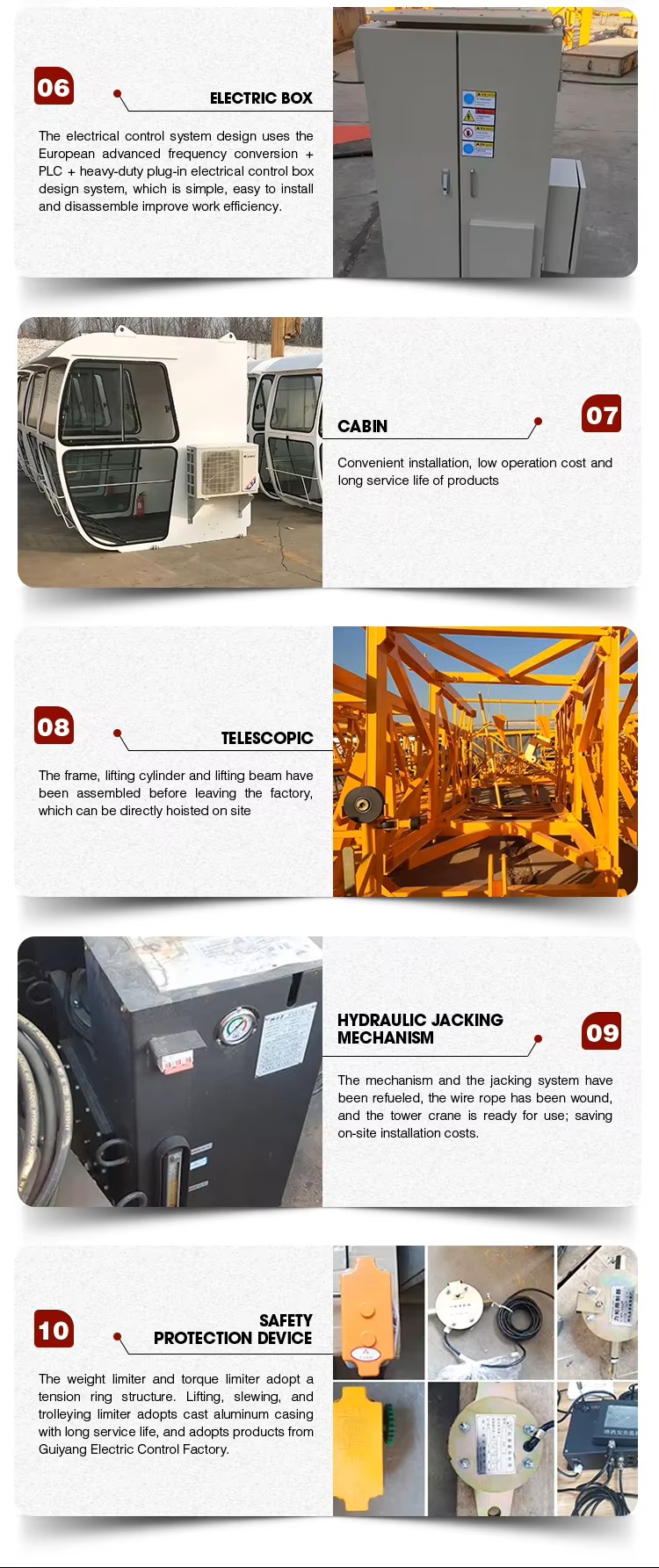
Documented production range: capacity bands from 5 t to 220 t across flat top, topkit, luffing jib and derrick configurations.
Execution Checklist: Commercial Terms and Handover
For a buyer in the execution phase, the documented commercial framework for this supplier is concise and can be verified against the quotation:
- Minimum order quantity: 1 unit, which also supports low-volume custom production and prototype orders.
- Delivery terms: FOB, CIF, EXW or CFR.
- Acceptance criteria: pre-shipment test, consistent with the stated practice of 100% testing.
- Payment terms: 30/70.
- Production capacity: 400 units per month, relevant when evaluating whether a promised delivery window is realistic.
- Customization lead time: to be confirmed with the sales department for customized service.
- After-sales support: a professional after-sales service team providing all-weather service, supported by technical service stations, spare parts centres and overseas offices.
Two documented design features also matter at the handover stage. Standard sections are stated to be compatible with Potain sections, which affects how a fleet owner manages interchangeable mast inventories and spares across mixed-brand fleets. Panel and loading schemes are described as being designed to support transport and export, which directly affects container or break-bulk planning and the risk of transit damage on long-haul deliveries. Both should be verified against the actual loading drawings for the ordered configuration.
Boundaries Buyers Should Plan Around
Being explicit about limits improves procurement decisions more than optimism does. The documented boundaries of this offer are:
- Complex customizations are not automatic; they require engineering evaluation before production.
- Customized delivery dates are confirmed case by case rather than published as standard lead times.
- The EAC certificate scope covers the QTZ series with the full model list in the certificate annex; configurations outside that annex need a separate compliance route.
- CE and ISO 9001 certificates carry defined validity windows and should be re-verified at order time.
- Certification confirms compliance with the referenced standards; it does not by itself certify suitability for a specific site, which remains a project engineering calculation.
- Topkit geometry is unsuitable for sites with restricted over-slew or insufficient headroom.
Future Outlook
The tower crane market is being reshaped by two opposing pressures that both affect topkit buyers. On one side, urban construction is pushing toward designs that operate efficiently in dense airspace, which explains the 46.37% revenue share held by flat-top designs in 2025 (Mordor Intelligence). On the other, infrastructure and energy projects are pulling demand toward heavier machines, with 200 t-plus wind-power specialised cranes projected to grow at 8–10% CAGR through 2032 (Future Market Insights).
The practical implication is that suppliers who can only offer standard catalogue machines in a single format will face narrowing relevance, while suppliers able to engineer configurations across jib length, counterweight, lifting height and control architecture — and to document them for the destination market — will face expanding relevance. For buyers, the balance of evaluation should continue to shift away from type selection and toward verifying customization processes, engineering review discipline, certification scope and delivery execution.
FAQ
Which parameters should take priority when selecting a topkit tower crane?
The model should be determined by building height, maximum lifting weight, maximum working radius, lifting height, site conditions and the specific lifting conditions of the project. Priority parameters are maximum lifting capacity, maximum working radius, rated lifting moment, lifting height, lifting speed and working class. For high-rise and super-high-rise projects, the attachment scheme, free-standing height, standard section configuration and foundation conditions should also be evaluated. Selection should follow a technical calculation for the project's lifting requirements rather than a decision based on maximum lifting capacity alone.
How should the working span of a topkit crane be determined?
Working span is determined by the area that must be covered on site: the size of the building, the material storage area, the transport route and the lifting positions. The crane must be able to cover the main construction area, while an unnecessarily large working span should be avoided because it increases equipment specification and cost. Practical span selection therefore works backward from the site layout rather than forward from the catalogue.
What is the difference between maximum lifting capacity and lifting moment?
Maximum lifting capacity is the maximum load the crane can lift, while lifting moment reflects the comprehensive lifting capability at different working spans and is usually expressed in t·m. As working span increases, the load a tower crane can lift generally decreases. A selection decision should therefore consider maximum lifting capacity, maximum working span and lifting moment together rather than in isolation.
How large a tonnage is needed for a high-rise building?
There is no single tonnage that applies to all high-rise buildings. It must be calculated from the building structure, the heaviest component, the lifting distance, the building height and the construction organisation plan. Projects involving large prefabricated components, steel structures or heavy equipment generally require a crane with a higher lifting moment and larger tonnage. The calculation, not the building height label, drives the result.
What should buyers check when purchasing a tower crane from a manufacturer?
Buyers should assess the manufacturer's production capacity, research and development capability, quality management, product technical parameters, key components, factory inspection, technical documentation, installation guidance and after-sales service capability. For overseas projects, it is also necessary to confirm whether the manufacturer has international project experience and whether it can supply technical and certification materials that meet the requirements of the project's country, including the model scope covered by each certificate.
What are the standard purchasing terms and acceptance criteria?
The documented terms are: minimum order quantity of 1 unit; delivery terms FOB, CIF, EXW or CFR; acceptance criteria based on pre-shipment test; and payment terms of 30/70. For customized service, the exact delivery date must be confirmed with the sales department, because the schedule depends on the outcome of the engineering evaluation for the requested configuration.
Dahan Technology Co., Ltd. publishes its corporate and product overview, including the documented model designations and certification references discussed above, in its company profile document. Additional technical information is available at chinatowercranes.com.