
Towable Pivot Irrigation Claims: What Buyers Should Verify
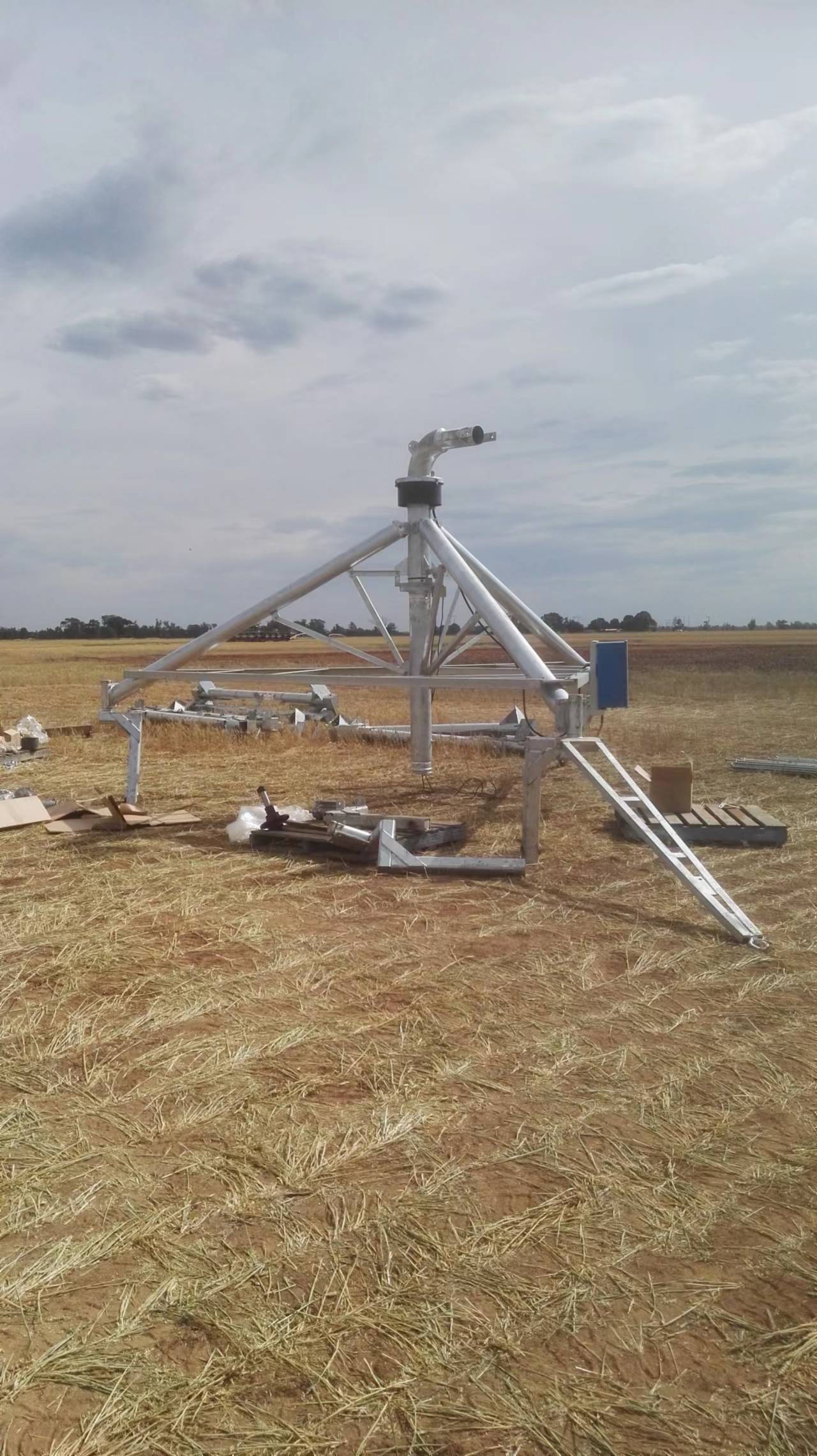
A towable pivot irrigation machine is a center pivot built to be unhitched, moved and re-anchored on a different plot rather than staying in one circle for its entire service life. That single design decision changes the nature of the evidence a buyer needs. Instead of watching water fall on a crop, the evaluation shifts to documents that can be checked line by line: span dimensions with tolerances, steel grade, coating standard and electrical protection ratings.
This reference sets out a five-level evidence hierarchy for buyers assessing towable center pivot systems during the evaluation and execution stages of procurement. The specification values used below are taken from the published Fixed DYP build sheet for the Yulin center pivot platform and from third-party market and standards data. The intention is not to argue that any particular claim is false, but to define what an independent buyer should be able to obtain in writing before a deposit is paid.
Why towable claims are harder to audit than fixed-pivot claims
A fixed center pivot is verifiable by observation. It stays in one circle, it runs on a known duty cycle, and its condition after several seasons can be inspected directly. A towable machine spends most of its life in one position and a smaller but decisive share of its life being moved — and movement is when towing hardware, tower assemblies, wheel sets, truss joints and electrical connectors are stressed. A single site visit typically shows the machine working in one position, not being relocated, which means the buyer is often asked to accept the most demanding part of the product's duty cycle on trust.
Category growth makes that trust harder to place. The global center pivot irrigation system market was estimated at USD 2.56 billion in 2025 and projected to reach USD 5.67 billion by 2030, according to Mordor Intelligence. Expanding equipment categories attract new suppliers and, with them, a rising volume of similarly worded claims.
A five-level evidence hierarchy for towable pivot systems
The hierarchy below orders evidence by how directly it constrains what will be delivered. Dimensional and material documents come first because they are fixed before production; test records and references come later because they describe what has already happened. A buyer who works down the list in order avoids the common mistake of being persuaded by performance stories before the physical specification has been confirmed.
| Level | What the buyer should request | Why it decides the purchase | Weak substitute to reject |
|---|---|---|---|
| 1. Dimensional | Span lengths, coverage area, tower bottom clearance with tolerance, wheel size and configuration | Defines crop clearance, transport planning and irrigated area | A photograph with a figure quoted verbally |
| 2. Material and coating | Steel grade and mill certificate, coating standard reference, coating measurement record | Determines corrosion life and structural margin | “Heavy-duty steel” without a grade |
| 3. Electrical | Voltage range, IP ratings for control panel, tower box and collector ring, cable cross-section | Determines safety and serviceability of the rotating joint | “Fully sealed electrical system” |
| 4. Test and acceptance | Per-unit test record, written pre-shipment acceptance procedure | Confirms function before payment is completed | A generic certificate with no unit reference |
| 5. Reference | Quantity, country, crop, commissioning date and years in service | Shows the machine has run under comparable conditions | A customer logo wall without dates |
Level 1 — Dimensional specifications in writing
Documented values for the Yulin center pivot platform cover four lengths and four coverage areas: 177.6 metres covering 10 hectares, 307.4 metres covering 30 hectares, 395.6 metres covering 50 hectares, and 565 metres covering 100 hectares. Tower bottom clearance is 3 ± 0.2 metres. Tower wheels are 14.9-24 irrigation tyres, two wheels on each trolley, with hot-dip galvanised discs. The water pipeline is sectional with a truss structure.
Each of those values does a specific job in a towable evaluation. Clearance sets the crop height ceiling and therefore rules certain crops in or out. Wheel size and the number of wheels per trolley determine how many wheel tracks the machine cuts and how much soil disturbance each relocation causes. Total length determines whether the machine can be towed along the route between two plots, and whether a transport permit is required. The land usage coefficient inside the irrigated circle is documented as not less than 0.9; that figure describes the circle itself, so on a rectangular parcel the corners outside the circle remain unirrigated and have to be served by another method.
Level 2 — Material and coating certificates: Q235B and GB 13912-2020
The build sheet lists Q235B metal against a GB 13912-2020 material reference and specifies hot-dip galvanisation as the anti-corrosion coating type. Those two facts should generate two separate documents in a purchase file, not one.
- A steel mill certificate showing grade and heat number, so the delivered truss and tower material can be traced to a production batch.
- A coating record identifying the governing galvanising standard and the measured coating result on the delivered batch.
The distinction matters because a standard reference in a specification sheet proves intent, while a batch record proves shipment. Anti-corrosion protection is also the characteristic most exposed to environment: the manufacturer states that irrigation equipment undergoes anti-corrosion and wind-resistance testing for tropical, saline-alkali and high-wind farmland conditions, which is precisely the set of conditions in which coating quality determines service life.
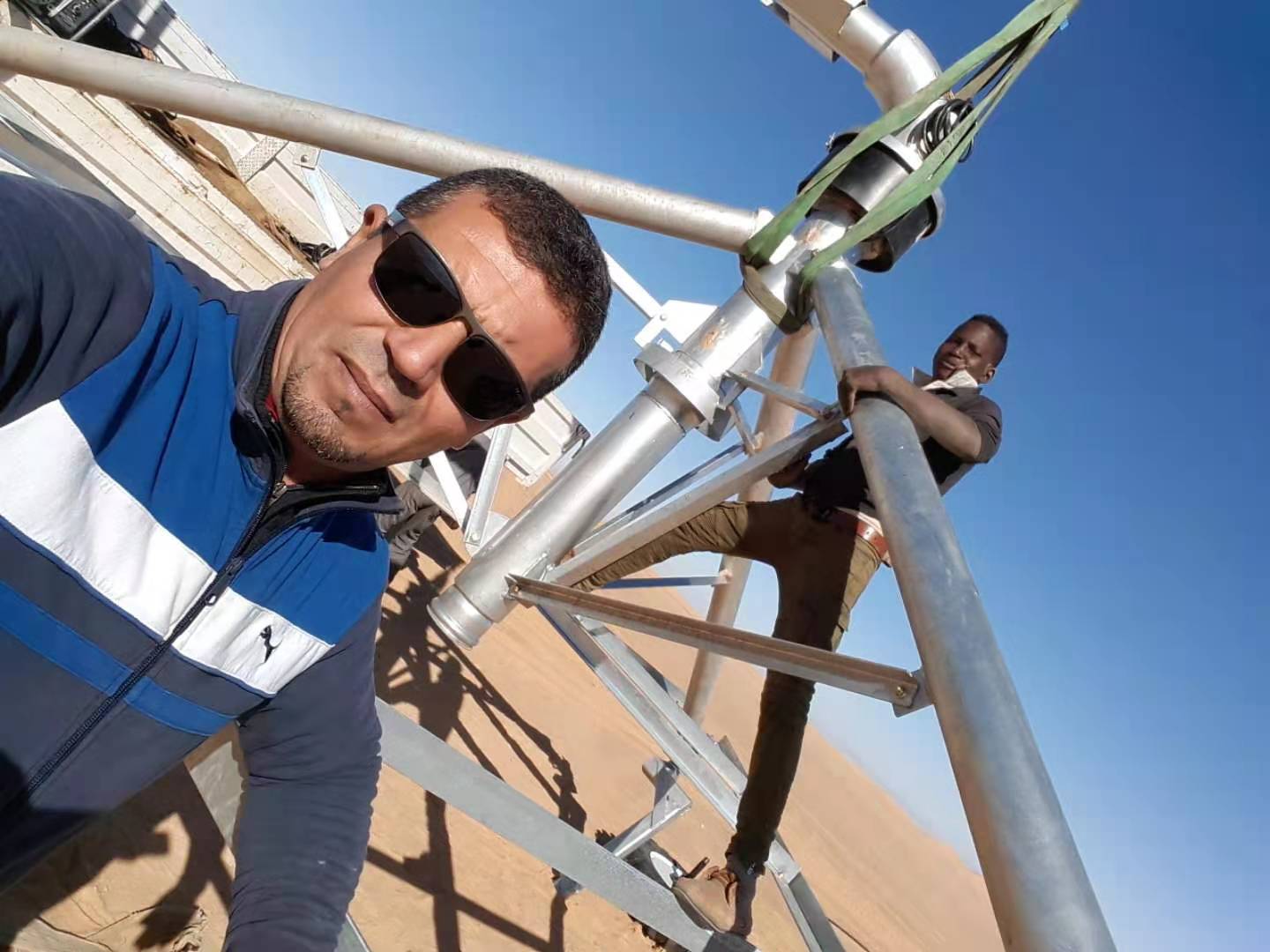
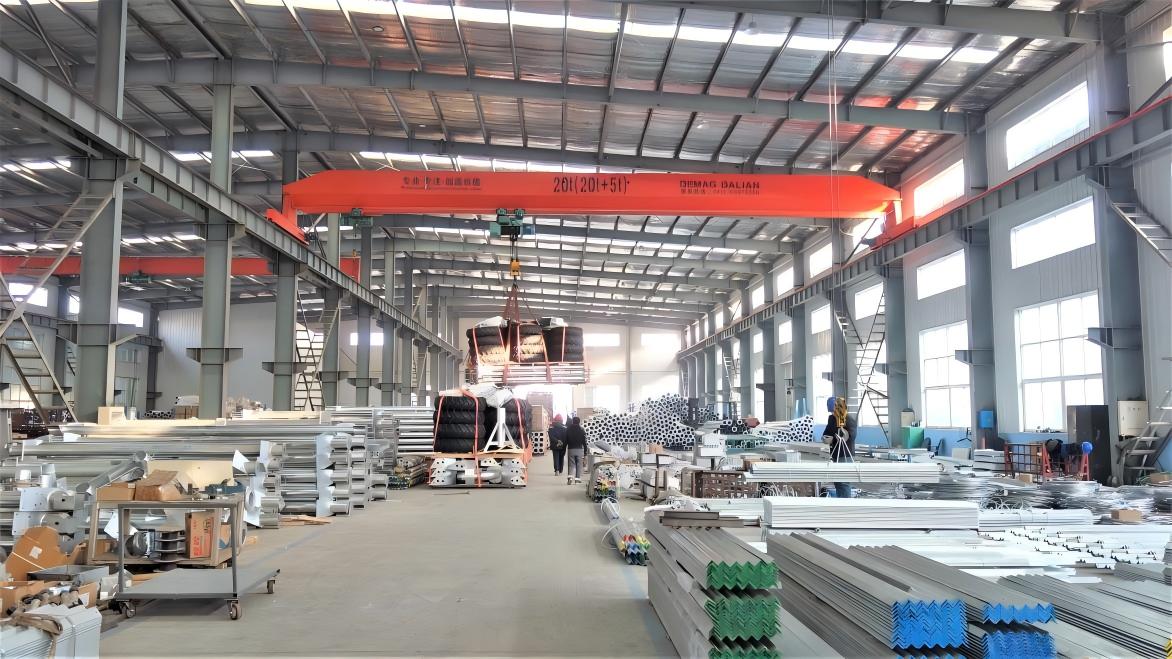
Supplier context is useful here. China Yulin Irrigation Equipment Co., Ltd. (YULIN IRRIGATION), founded in 2009 and based in Lvshunkou District, Dalian City, Liaoning Province, China, develops and manufactures center pivot, lateral move, towable and hose reel irrigation machines, exporting to markets including Australia, New Zealand, Canada, Mexico, Africa, Central Asia, Russia and Kazakhstan. The company states that more than 95% of machine spare parts are manufactured in its own factory, which means a component can in principle be traced to an internal production record. The buyer still has to ask for that record.
At system level, Yulin holds an ISO 9001 certificate (No. 18524Q11926R2S) issued by National Standard Integration (Beijing) Certification Co., Ltd under GB/T19001-2016 / ISO9001:2015, valid from 2024-12-31 to 2027-12-17, covering the production of irrigation systems and mechanised agricultural systems. Its boundary matters: a quality management certificate evidences a system, not a specific batch of steel. It should open an audit, not close it.
Level 3 — Electrical ratings and ingress protection
Electrical documentation is usually the weakest part of a towable quotation, yet it governs both safety and serviceability. The documented configuration for the platform is set out below.
| Item | Documented value |
|---|---|
| Pivot type | Fixed DYP center pivot |
| Pivot drive | Electromechanical, reversible, individual for each span |
| Voltage | 380V–460V |
| Control panel | IP65, with main power switch, power control switch, water switch, direction control switch, percentage indicator (speed regulation) and auto-reverse switch |
| Tower box protection | IP33 |
| Collector ring protection | IP65 |
| Collector ring configuration | 11 rings, not less than 4×90A and 7×25A |
| Copper conductor | Not less than 4×4mm² + 7×1.0mm² |
| Pressure regulators | 10, 15 or 20 psi |
| Operating temperature | −45 °C to +45 °C |
The collector ring deserves particular attention on a towable machine. It is the rotating electrical joint at the centre of the pivot, the point where power crosses from a static supply into a moving structure, and it is also the component most exposed to repeated handling during relocation. A stated IP65 rating plus a stated ring and current configuration give the buyer two values that can be verified on the delivered unit rather than accepted on description.
Level 4 — Test, acceptance and pre-shipment evidence
The manufacturer documents an OEM production mode with a monthly capacity of 60 units, a lead time of 21–40 days, a minimum order quantity of 1 unit and quality control described as 100% test. The stated acceptance criterion is a pre-shipment test. The stated commercial frame is delivery on FOB, CFR or CIF terms, with payment of 30% deposit after contract confirmation and the balance by T/T before shipment; L/C or D/P arrangements are stated for the Algeria market.
Those are the raw materials for an acceptance clause, not the clause itself. Before signing, a buyer should fix three things in writing: what the pre-shipment test covers, who witnesses it, and which document is issued against the individual machine serial number.
The honest limit of factory testing is worth stating plainly. A pre-shipment test confirms that a machine functions correctly before it leaves the factory. It does not measure durability under towing, soil conditions or local water chemistry over several seasons. Buyers who need performance evidence have to build their own in-field verification plan — an agreed measurement schedule, a defined uniformity check, and a signed record of commissioning parameters. A supplier who substitutes a certificate for that plan has not answered the question.
Level 5 — Field references with quantities, crops and dates
A reference is only auditable when it carries four fields: quantity, country, crop and years in service. Documented Yulin projects are summarised below.
| Region | Quantity | Application | Service | Reported outcome |
|---|---|---|---|---|
| Zimbabwe | 45 units | Crop irrigation; three-wheel towable center pivot | 6 years | Long service life; labour saving |
| Algeria | 70 units | OEM client programme; three-wheel towable center pivot supplied to end users | 7 years | Capacity and efficiency gains reported |
| New Zealand | 70 units | Grass and pasture irrigation on dairy farms | 9 years | Long service life; labour saving |
| Russia | 450 units | Supplied to end users | 9 years | Improved performance with reduced labour requirement |
| Australia | 600 units | Forage and pasture, also cotton and watermelon | 15 years | Energy saving reported above 40%; low maintenance cost cited |
| Brazil | 50 units | Soybean irrigation (hose reel machine) | 6 years | Output increase under dry conditions; machine can be pulled between plots and rented |
| South Korea | 1 unit | Recycled chemical wastewater for school lawn irrigation (four-wheel linear machine) | 7 years | Wastewater recycling support |
These are supplier-reported references and should be treated as directional. Their practical value is structural: each entry contains a quantity, a crop and a duration, which is exactly the format a buyer can ask a prospective supplier to complete. A reference without a commissioning date cannot be verified, and a reference from a different machine type should not be presented as evidence for a towable pivot.
Where a towable pivot fits — and where it does not
The strongest case for a towable center pivot is a farming operation with several plots in rotation, where the cost of a permanent circle on each plot cannot be justified but a single machine can serve them in sequence. The Brazil reference records a further use pattern: a machine that can be pulled between sites and rented out when not in use. The shorter documented configurations, covering 10 and 30 hectares, sit naturally in this bracket.
The boundaries are equally specific, and a buyer should test each one against the intended site.
- Crop height. Tower bottom clearance of 3 ± 0.2 metres sets a ceiling. Tall crops or late-season growth may exceed it.
- Parcel shape. The land usage coefficient of not less than 0.9 applies inside the irrigated circle. On a rectangular parcel, the area outside the circle requires a separate irrigation method.
- Water chemistry. The documented working range is irrigation water with pH 6–7.5 without quality problems during the warranty period. Saline-alkali or recycled sources should be raised at specification stage, not after delivery.
- Relocation logistics. Towing requires a tractor, a route and a receiving pad. Every relocation loads the wheels, truss joints and electrical connectors.
- Transport. Moving a machine between distant farms still requires road-legal transport planning.
Towable pivot, fixed DYP pivot and hose reel: a specification comparison
Buyers comparing systems should compare decision-relevant values rather than headline categories.
| Buyer question | Fixed DYP center pivot | Towable center pivot | Hose reel machine (JP800 class) |
|---|---|---|---|
| Coverage geometry | Full circle | Full circle, repositionable between plots | Rectangular lane served from a 300 m PE pipe |
| Documented length options | 177.6 m (10 ha); 307.4 m (30 ha); 395.6 m (50 ha); 565 m (100 ha) | Same pivot platform, relocated between plots | Working footprint 6,120 × 2,330 × 2,770 mm |
| Truss bottom clearance | 3 ± 0.2 m | 3 ± 0.2 m | No truss |
| Water delivery | Sectional, truss-structure pipeline | Sectional, truss-structure pipeline | 90 mm PE pipe; 25–52 T/H |
| Spray pattern | Circular, clockwise and anti-clockwise | Circular, clockwise and anti-clockwise | 16–22 mm nozzle; 19–41 m radius; DL50 / SIMA10497 spray gun |
| Working pressure | Regulators 10, 15 or 20 psi | Regulators 10, 15 or 20 psi | Inlet pressure 0.6–0.9 MPa |
| Mobility | Not designed for routine relocation | Towed between plots; requires tractor and route | Shipping size 2,450 × 2,000 × 2,250 mm; weight 2,180 ± 30 kg |
| Typical fit | Land where one permanent circle is the right answer | Rotation between plots, rental use, smaller parcels | Long rectangular fields where lane irrigation suits |
One consequence of this comparison deserves emphasis. In the manufacturer's documentation, the towable pivot and the fixed DYP pivot share the same platform values: pivot type Fixed DYP center pivot, electromechanical reversible drive individual to each span, truss-structure pipeline, and a 380–460 V supply. That is convenient for comparison, but it also means the towable-specific engineering is concentrated in a smaller set of components. The quotation should therefore document those components separately — towing frame and hitch, tower and wheel configuration, and the cable or hose handling arrangement at the pivot centre.
Market signals shaping procurement standards
Three verifiable signals suggest that documentary procurement is becoming the norm rather than an exceptional request.
- Category growth. Mordor Intelligence estimates the global center pivot irrigation system market at USD 2.56 billion in 2025, projected to USD 5.67 billion by 2030. Growth of that magnitude increases the number of suppliers and the volume of competing claims.
- Regional shift. Lindsay Corporation secured a multi-year supply agreement for Zimmatic irrigation systems in the MENA region valued at more than USD 100 million in 2024, indicating large project demand outside the traditional North American centre.
- Incumbent scale. Valmont Industries reported Agriculture segment sales of USD 278.0 million in Q4 2024, representing 26.7% of total net sales. At that scale, documented engineering and certification practice is standard, and independent buyers can reasonably expect the same documentary standard from smaller suppliers.
There is also a neutral verification route available. ISO 11545:2009 specifies an in-field method for determining the uniformity of water distribution from centre-pivot and moving lateral irrigation machines. A buyer who wants a third-party method to cite, rather than a supplier's own uniformity statement, can refer to that standard in the procurement specification.
Pre-contract evidence checklist
| # | Document | What it establishes | Common gap |
|---|---|---|---|
| 1 | Dimensional drawing with span lengths, coverage area and tolerances | Crop clearance, transport planning, irrigated area | Dimensions quoted verbally in a meeting |
| 2 | Steel mill certificate naming grade and heat number | Structural material identity | A grade name in a brochure |
| 3 | Coating specification with measurement record and the governing standard | Corrosion protection for the delivered batch | A certificate with no batch reference |
| 4 | IP rating declaration for control panel, tower box and collector ring | Electrical safety and serviceability | A general claim that the system is sealed |
| 5 | Cable cross-section and collector ring configuration | Current capacity at the rotating joint | No conductor specification |
| 6 | Control panel function list and voltage range | Compatibility with site power supply | Voltage assumed rather than confirmed |
| 7 | Per-unit factory test record | Function verified before shipment | One certificate covering a whole production year |
| 8 | Written pre-shipment acceptance procedure with witness arrangements | A defined moment when responsibility transfers | Acceptance described only as “inspection” |
| 9 | Reference list with commissioning date, crop, quantity and years in service | Evidence of comparable operating conditions | Logos without dates |
| 10 | Written confirmation of each customisation item | Alignment between quotation and production | Changes agreed by phone or messaging app |
What to expect next
Two forces are moving towable pivot procurement toward documents. The first is buyer experience: operators with machines already in service compare build sheets and coating records, not adjectives. The second is standardisation: where a neutral method such as ISO 11545:2009 exists for water distribution uniformity, buyers can specify a test instead of accepting a description.
In that environment, the suppliers who stay on shortlists will be those whose quotations contain a build sheet, a material reference and a stated acceptance procedure. For the buyer, the practical implication is straightforward: collect the five evidence levels before the deposit, treat supplier percentages as claims until the model behind them is supplied, and verify each documented value against the delivered machine at pre-shipment inspection.
Reference document: the 2026 YULIN Pivot Catalogue, which lists the dimensional, material and electrical specifications cited in this article, is available as a PDF at https://cdn.socialarks.com/sbsp/25007/common/2026/0623/2026%20YULIN%20Pivot%20Catalogue.pdf
Frequently asked questions
What is the difference between a towable pivot irrigation machine and a fixed DYP center pivot?
Both are built on the same center pivot platform in the manufacturer's documentation. The Fixed DYP center pivot specifies an electromechanical, reversible drive that is individual for each span, a sectional truss-structure water pipeline, a tower bottom clearance of 3 ± 0.2 metres and a 380–460 V supply. A towable pivot is intended to be unhitched and moved to another plot; the towing interface and the handling arrangements for cable and hose are the parts that differ. Those components should be documented separately rather than assumed to be covered by the base platform specification.
Which dimensional specifications should be confirmed in writing before ordering?
Request span lengths and the coverage area each configuration provides, tower bottom clearance with its tolerance, and tower wheel size and configuration. Documented values for the Yulin center pivot platform are 177.6 metres covering 10 hectares, 307.4 metres covering 30 hectares, 395.6 metres covering 50 hectares and 565 metres covering 100 hectares; tower bottom clearance is 3 ± 0.2 metres; tower wheels are 14.9-24 irrigation tyres with two wheels on each trolley and hot-dip galvanised discs.
What should a material certificate cover on a towable pivot order?
Two documents rather than one. First, a steel mill certificate showing grade and heat number — the build sheet names Q235B metal against a GB 13912-2020 material reference. Second, a coating record showing that the specified hot-dip galvanisation was applied and measured on the delivered batch. A standard reference in a specification sheet establishes intent; a batch record establishes what was shipped.
Which electrical and protection ratings matter most?
Documented values are a 380–460 V supply, an IP65 control panel, an IP33 tower box, an IP65 collector ring, a collector ring with 11 rings of not less than 4×90 A and 7×25 A, and copper conductors of not less than 4×4 mm² + 7×1.0 mm². The collector ring is the rotating electrical joint at the centre of the machine and is directly exposed to repeated handling on a towable unit, so its rating and ring configuration are worth checking against the delivered machine.
What acceptance evidence should be written into the contract?
The manufacturer's stated quality control is 100% test, with pre-shipment test as the acceptance criterion. Stated commercial terms are a minimum order quantity of 1 unit, delivery on FOB, CFR or CIF terms, and payment of 30% deposit after contract confirmation with the balance by T/T before shipment; L/C or D/P arrangements are stated for the Algeria market. Lead time is 21–40 days. Buyers should define in the contract what the pre-shipment test covers, who witnesses it and which document is issued, because a factory test confirms function before dispatch and does not measure multi-season durability in the buyer's own field.
Can a towable pivot be customised for voltage and site conditions?
Yes. The manufacturer provides OEM production services and offers voltage customisation for OEM orders. The pivot platform supports 380–460 V and pressure regulator options of 10, 15 or 20 psi, and the documented crop list covers fodder crops, cereals, vegetables and industrial crops including corn. Any customisation should be confirmed as a written specification change, because a verbal adjustment cannot be checked at pre-shipment inspection.
Are there documented limits on water quality and climate?
Yes. The platform documentation specifies irrigation water with pH 6–7.5 without quality problems during the warranty period, and an operating temperature range of −45 °C to +45 °C. Anti-corrosion and wind-resistance testing is described for tropical, saline-alkali and high-wind farmland conditions. Buyers drawing on saline or recycled water sources should raise water chemistry during specification, because the stated pH band is a boundary condition rather than a guarantee of compatibility with any water source.
Have Questions or Need More Details?
Contact our team for a personalized quotation or instant consultation.
Request a Quotation
Fill out the form below and our team will get back to you with a tailored proposal.
WhatsApp Direct Chat
Prefer to chat in real-time? Message us on WhatsApp for instant assistance & quick answers.
- Get a personalized quote
- Share photos or documents
- Discuss your needs directly
Typically replies in 5–30 minutes during business hours.