
Tower Crane Technical & Procurement FAQ: Model Codes, Capacity Configurations, and Safety Systems
Industry Reference · Tower Cranes
Tower Crane Technical & Procurement FAQ: Model Codes, Capacity Configurations, and Safety Systems
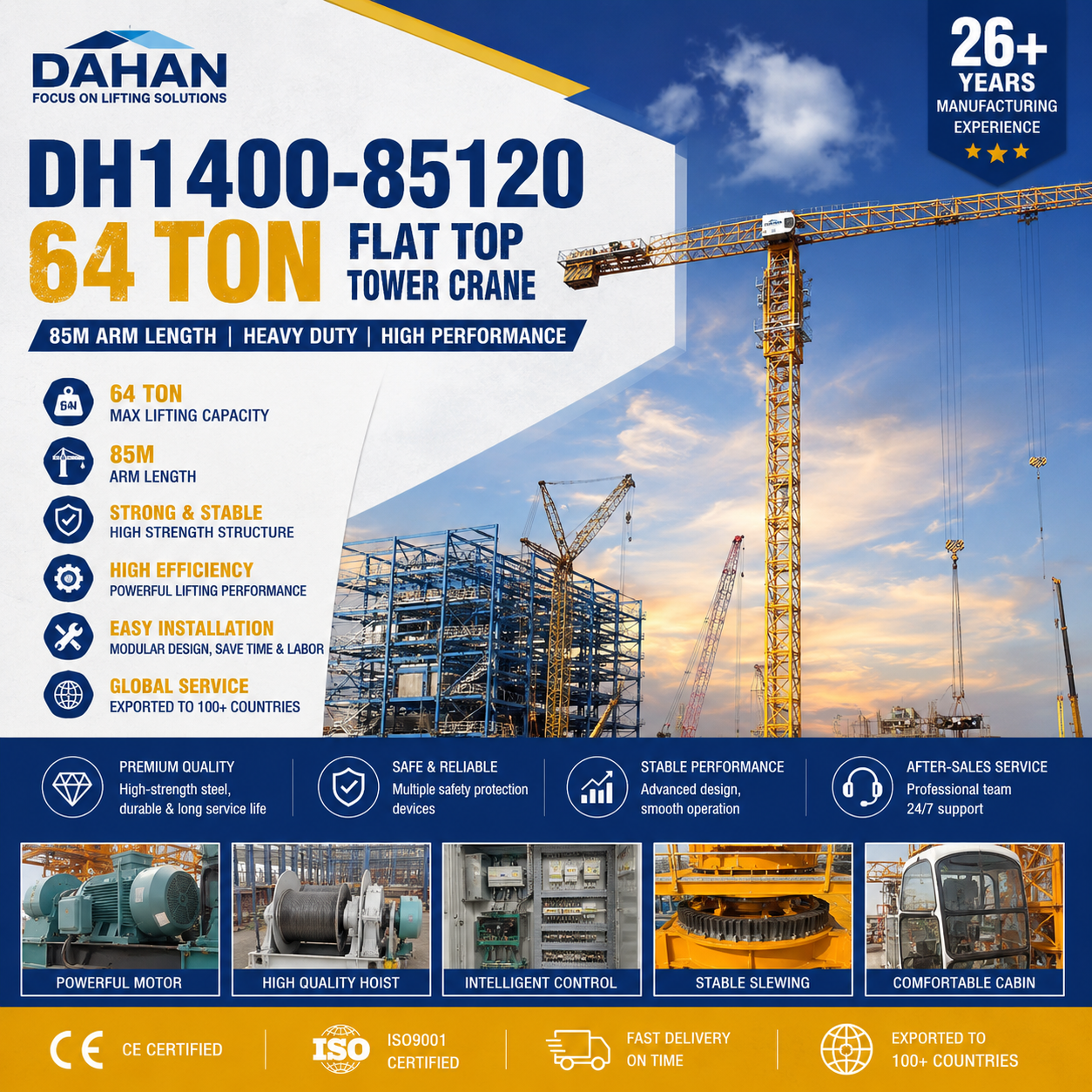
High-capacity tower crane configurations sit at the top of a range that runs from 5 t to 220 t; the model code alone does not tell a buyer what the machine will lift at working radius.
A tower crane model code is a naming convention, not a specification. The string QTZ160 (6515)-8T/10T carries three separate pieces of information — a nominal load-moment class, a jib and tip-load reference, and a rated capacity option — and none of them is a load chart. Most procurement errors on tower cranes begin where that gap opens.
Buyers in the research and evaluation stage usually reach the same set of questions at roughly the same time: what the letters and numbers actually mean, how the capacity range from 5 t to 220 t is organised, which structural family fits a constrained site, and which safety and conformity evidence should be on the table before a shortlist is fixed. The answers are partly conventions, partly engineering, and partly document control.
Dahan Technology Co., Ltd. is a Chinese manufacturer of tower cranes and construction hoists, established in 2000 and based in Zheshan Industrial Park, Mingshui Economic Development Zone, Zhangqiu District, Shandong Province. It produces QTZ-series tower cranes across flat top, topkit, luffing jib and derrick configurations, and exports to Asia, Europe, the Middle East, Africa, North America and South America. Its documented model range, safety configuration and certificate portfolio make a practical worked example for the questions below.
Why a model code cannot be read as a specification
A tower crane is selected against a duty point, not against a headline number. The rated capacity printed in a designation such as 8T/10T refers to the machine's maximum lifting capacity, which is achieved close to the mast. The load the same machine can lift at 45 m or 70 m radius is a different figure, governed by the rated load moment and shown only on the load chart. Two cranes carrying the same capacity suffix can therefore behave very differently on the same site.
This is the reason the industry classifies tower cranes by rated load moment, expressed in tonne-metres, rather than by maximum capacity alone. Load moment combines capacity and radius in a single number, so it describes the geometry of the work a machine is designed to do. The model code gives you the class; the load chart gives you the job.
Decoding QTZ designations element by element
QTZ is the designation prefix used in Chinese-origin tower crane naming. The letters are conventionally read as Q for lifting equipment, T for tower type, and Z for self-erecting. Everything that follows the prefix is a coded summary of the machine's class.
| Element | What it conventionally indicates | What it does not tell you |
|---|---|---|
| QTZ prefix | A self-erecting tower crane designation of Chinese origin | The structural family, the drive type, or the market it is certified for |
| Moment class number e.g. 160, 250, 315 | A nominal rated load-moment class, conventionally expressed in tonne-metres | The certified load at any specific radius; that is on the load chart |
| Bracketed figure e.g. 6015, 7527 | A jib-and-tip-load reference, conventionally read as jib length in metres plus tip-load class in tenths of a tonne | The exact maximum radius, tip load or jib configuration supplied; the annex governs |
| Capacity suffix e.g. 8T/10T, 12T/16T | The rated lifting capacity options offered in that model | The capacity at working radius, or the ballast and foundation consequences of the larger option |
Reading conventions for QTZ tower crane designations. Values must be verified against the manufacturer's rated load chart and the certificate annex before a model is shortlisted.
The eight documented QTZ models as a worked example
Mapping the convention against a real catalogue shows both how useful the code is and where it stops being enough. Dahan Technology's documented QTZ range runs from QTZ63 (5013)-5T/6T to QTZ315 (7527)-12T/16T, and each entry pairs a moment class with a jib reference and a capacity suffix.
| Model designation | Rated capacity options | Configuration families offered |
|---|---|---|
| QTZ63 (5013)-5T/6T | 5 t / 6 t | Flat top, Topkit, Luffing jib, Derrick |
| QTZ80 (5211)-5T | 5 t | Flat top, Topkit, Luffing jib, Derrick |
| QTZ100 (6013)-8T | 8 t | Flat top, Topkit, Luffing jib, Derrick |
| QTZ125 (6015)-8T/10T | 8 t / 10 t | Flat top, Topkit, Luffing jib, Derrick |
| QTZ160 (6515)-8T/10T | 8 t / 10 t | Flat top, Topkit, Luffing jib, Derrick |
| QTZ250 (7520)-10T/12T/16T | 10 t / 12 t / 16 t | Flat top, Topkit, Luffing jib, Derrick |
| QTZ250 (7025)-12T/16T | 12 t / 16 t | Flat top, Topkit, Luffing jib, Derrick |
| QTZ315 (7527)-12T/16T | 12 t / 16 t | Flat top, Topkit, Luffing jib, Derrick |
Documented QTZ models, rated capacity options and available configuration families. Source: manufacturer product documentation.
Two models share the QTZ250 moment class but carry different jib references and different capacity suffixes. That is not a catalogue inconsistency; it is the code doing its job. A 75 m jib reference and a 70 m jib reference imply different structural and ballast arrangements, even when the nominal class is identical. Buyers comparing them should compare load charts, counterweight schemes and foundation loads, not model names.
Capacity configurations across the 5 t to 220 t range
The documented capacity options across the series are 5 t, 6 t, 8 t, 10 t, 12 t, 16 t, 18 t, 25 t, 32 t, 45 t, 64 t, 125 t, 200 t and 220 t. The upper end above 100 t comprises the 125 t, 200 t and 220 t classes.
The spread matters more than any single figure. The lower and middle bands — roughly 5 t to 16 t — cover the bulk of building-frame, formwork, precast and finishing work on residential, commercial and municipal projects. The 18 t to 64 t band serves heavier component handling, larger steel erection and industrial work. The 125 t to 220 t classes belong to heavy and special-project lifting, including the wind power segment where the manufacturer positions dedicated solutions.
A buyer entering the range from the top down typically over-specifies. Choosing the smallest class that satisfies the heaviest required lift at the required radius, with adequate margin for wind and dynamic effects, usually produces a better commercial and logistical outcome than choosing the largest capacity available. Larger classes bring heavier sections, larger ballast, higher foundation loads and more transport volume — four cost centres that do not appear in a headline capacity number.
Configuration families: flat top, topkit, luffing jib and derrick
The same lifting class is offered in several structural families, and the family choice is often a site-constraint decision rather than a performance decision.
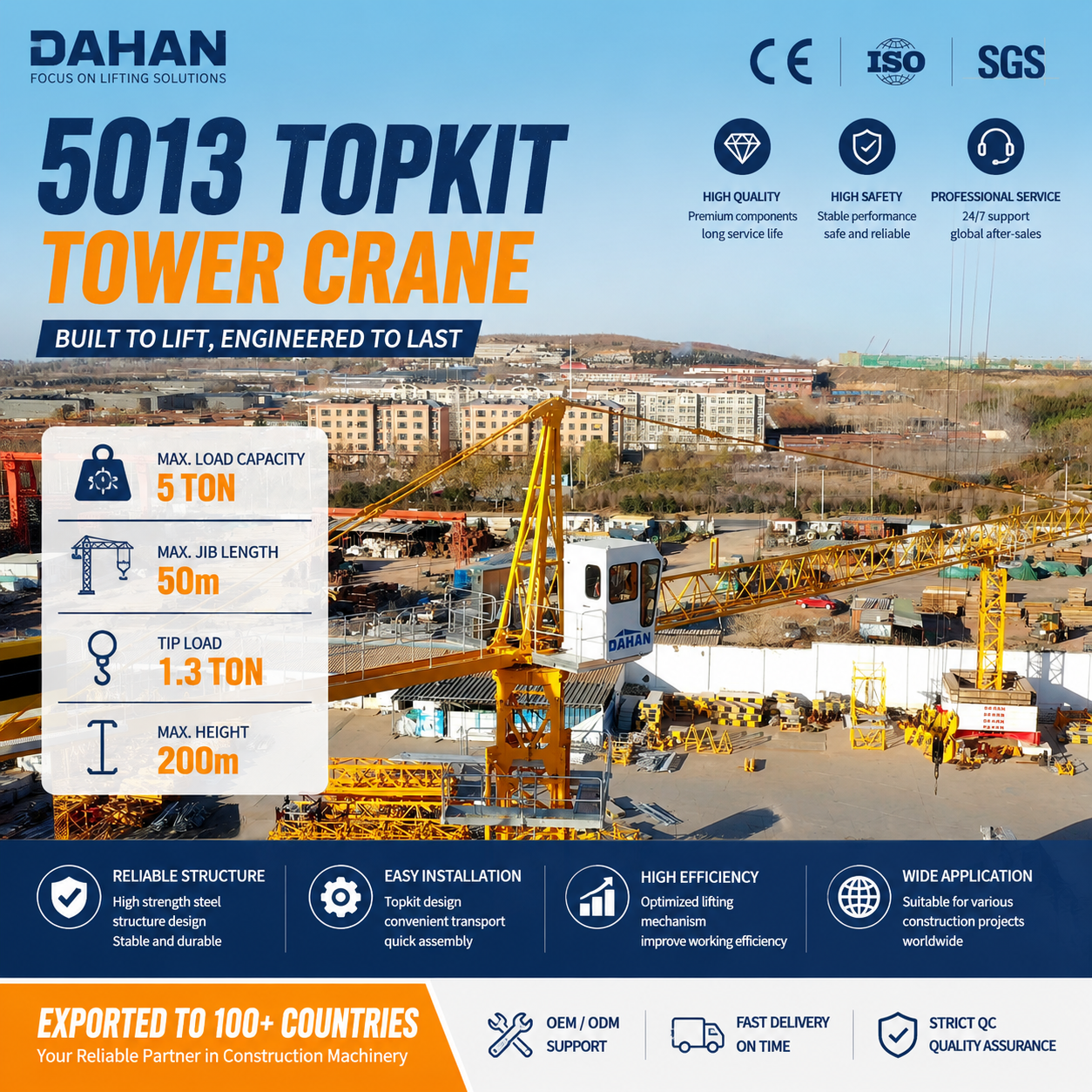
A topkit configuration: the tower head and pendant bars above the slewing unit are the visual signature of the family, and the added height they introduce is itself a site-planning variable.
| Family | Structural logic | Where it tends to be preferred | Trade-off to plan for |
|---|---|---|---|
| Flat top (topless) | No tower head or pendant bars above the slewing unit | Dense urban sites, projects with overflying constraints or multiple cranes in close proximity | Jib and counter-jib handling becomes the assembly planning constraint, and the ballast scheme must be settled before transport is booked |
| Topkit (tower head, hammerhead form) | Tower head with pendant bars supporting jib and counter-jib | Conventional building sites with unobstructed airspace and predictable layouts | The tower head adds height above the slewing unit, which matters on constrained sites and for neighbouring crane operations |
| Luffing jib | Jib articulates upward, reducing the slewing radius | Confined sites, adjacent structures, and work where the jib must clear other buildings | Additional articulation mechanisms mean more maintenance points and a different operating cycle to plan |
| Derrick | Mast-and-boom arrangement rather than a slewing jib | Restricted areas where a conventional jib cannot be positioned | Reduced coverage envelope compared with a slewing jib machine of similar class |
Configuration families and the site conditions each is normally matched to. Family selection should be made before model selection, because it constrains which classes are available.
Terminology varies by market: flat top machines are also described as topless, and topkit machines are widely called hammerhead cranes because of the silhouette. When comparing offers from different suppliers, confirm the structural family in writing rather than relying on the descriptive term in a quotation.
Safety systems: what the stated configuration includes
The documented safety configuration of this tower crane series comprises four protective functions and an emergency stop, supported by structural specification.
- Overload protection system — prevents lifting beyond the rated capacity for the current configuration.
- Moment limitation system — limits the combination of load and radius, which is the control that actually protects the structure on a long jib.
- Height limit protection — restricts hoist travel beyond the permitted height.
- Travel limit protection — restricts trolley travel at the jib and counter-jib extremities.
- Emergency stop system — provides a single action to halt operation.
Structurally, the tower crane is manufactured from high-strength steel, with the steel structure specified for fatigue resistance and weather adaptability, and steel structures and electrical components selected for low maintenance requirements. Manufacturing uses automated production facilities and welding technology, with quality control procedures applied during production and quality inspection performed before delivery.
For procurement purposes, the safety list is only as good as its documentation. A moment limiter that is fitted but not calibrated, or calibrated but not recorded, is a commissioning risk. Buyers should ask for the safety configuration to appear in the contract technical annex, and for calibration and inspection records to be handed over with the delivery documents rather than promised afterwards.
Modular design, site assembly and logistics
The structural configuration uses a modular design that permits assembly, dismantling, transportation and height adjustment. In practice this means the machine is planned as a transport and erection sequence as much as a lifting asset. Most installations are fixed, with climbing — mast-adding — used for long-term high-rise operation as the building rises.
The loading and panel scheme affects cost before the crane ever lifts a load: section weights determine the crane needed to erect the crane, the number of transport units determines freight cost, and the panel arrangement determines how quickly the site can be cleared. For overseas projects, that sequence has to be reconciled with port handling, inland transport limits and the availability of erection equipment at the destination.
Customization: what can be specified, and what has to be evaluated
Documented customization options cover jib length, counterweight schemes, lifting height plans, and electrical and safety configurations. Complex customizations require engineering evaluation before they can be quoted.
The boundary here is technical, not commercial. Jib length is not a free variable: changing it alters the load chart, the counterweight requirement, the foundation loads and, in some markets, the scope of the applicable certificate. A buyer who specifies a 70 m jib on a machine documented at 60 m is not ordering an option — they are commissioning an engineering change, with the documentation consequences that follow.
On supply terms, the documented minimum order quantity is one unit, monthly production capacity is 400 units, and quality control includes 100 per cent testing. Delivery dates for customized configurations must be confirmed with the sales department, because they depend on the engineering evaluation rather than on a standard catalogue slot.
Certification as a procurement constraint
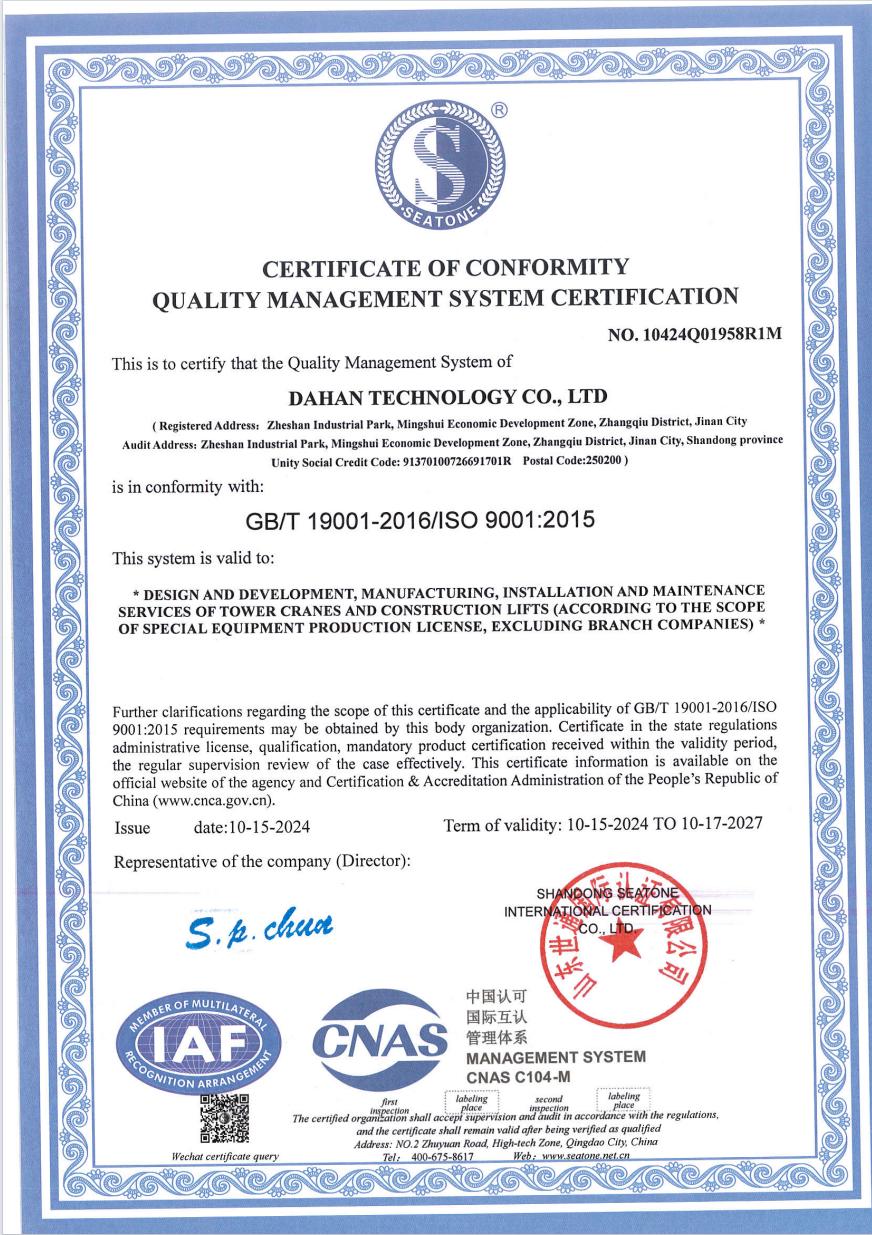
An ISO 9001:2015 certificate is a system certificate, not a product approval. It evidences process control across design, manufacturing, installation and maintenance; it does not replace market-specific product conformity.
Three certificate families are relevant to this range, and they answer three different questions.
| Certificate | Number and issuer | Market | Validity |
|---|---|---|---|
| ISO 9001:2015 quality management system | 10424Q01958R1M — SHANDONG SEATONE INTERNATIONAL CERTIFICATION CO.,LTD | Global | 2024-10-15 to 2027-10-17 |
| EAEU Conformity Certificate (EAC) | ЕАЭС RU С-СН.АД58.В.03025/25, serial Серия RU №0576066 — TATSERT Certification Center | Russia, Kazakhstan, Belarus, Kyrgyzstan, Armenia | 2025-12-30 to 2030-12-29 |
| ECM Certificate of Compliance (CE) | 6B211216.DTCO94 — ECM | EU | 2021-12-16 to 2026-12-15 |
Documented certification for the QTZ series. Standards referenced: GB/T 13752-2017, GB/T 6067.1-2010, ISO 4301/1-86 and GB/T 5031-2019 for the EAC certificate; EN ISO 12100:2010, EN 14439:2006+A2:2009 and EN 60204-32:2008 for the CE certificate.
The ISO 9001:2015 scope covers design and development, manufacturing, installation and maintenance services of tower cranes and construction lifts. The EAC certificate covers the QTZ series against the standards listed above, with the full model list in the original certificate annex. The CE certificate is issued to the ECM Certification Mark for the EU market.
Two details that change shortlists
First, scope. The ISO 9001:2015 and EAC certificates as documented cover eight models: QTZ63 (5013)-5T/6T, QTZ80 (5211)-5T, QTZ100 (6013)-8T, QTZ125 (6015)-8T/10T, QTZ160 (6515)-8T/10T, QTZ250 (7520)-10T/12T/16T, QTZ250 (7025)-12T/16T and QTZ315 (7527)-12T/16T. The ECM Certificate of Compliance as documented lists seven of those models — QTZ100 (6013)-8T is not among them. A buyer who requires CE conformity for an EU placement should therefore confirm the position of that specific model against the certificate annex before shortlisting, rather than assuming uniform coverage across the catalogue.
Second, timing. Certificate validity is a delivery-date question, not an order-date question. The CE certificate runs to 2026-12-15; a project scheduled to ship or commission after that date needs evidence of renewal, or of a valid extension, attached to the contract. The EAC certificate runs to 2030-12-29 and the ISO 9001 certificate to 2027-10-17, both of which provide longer coverage windows. Enforcement authorities check dates on arrival, not intentions at quotation.
Market context: where the demand and the design converge
The global tower crane market was estimated at between USD 5.9 billion and USD 6.44 billion in 2025, depending on the publisher's segment definitions — Fortune Business Insights and Grand View Research respectively. The spread between the two figures is itself a useful reminder that market-size numbers are definitional, and that ranges are more honest than single points.
China remained the leading exporter of tower cranes in 2024, with USD 694 million in export value under HS code 842620, according to OEC data drawn from UN Comtrade. That export weight explains why Chinese-origin designations such as QTZ have become the working vocabulary of procurement teams far outside China, and why certification scope has become a routine evaluation criterion rather than a specialist concern.
On configuration mix, Grand View Research reports that hammerhead tower cranes held the largest share by product type at 42.8 per cent in 2025, while Mordor Intelligence reports that flat-top designs accounted for 46.37 per cent of revenue in the same year. The two figures are not directly contradictory: they measure different things — unit-type share against revenue share — but they do illustrate why buyers should read configuration statistics with the methodology in view. The practical signal is that both families remain mainstream, and neither is being displaced.
The wind power segment is the clearest growth pocket: Future Market Insights projects 8 to 10 per cent CAGR through 2032 for wind-power specialised tower cranes with 200 t and above capacity, a medium-confidence forecast but a consistent directional signal. On the standards side, GB/T 13752-2017, which superseded the 1992 version, defines design rules and safety specifications for tower cranes in China and is one of the standards referenced in the EAC certification for this range.
Comparison with traditional selection practice
The traditional approach selects a tower crane by maximum lifting capacity and available jib length, then adjusts when the site engineer objects. The specification-driven approach selects by load chart at working radius, then confirms foundation, anchorage and certificate scope. The second is slower at the quotation stage and considerably faster at the commissioning stage.
| Selection basis | Strength | Where it fails |
|---|---|---|
| Maximum capacity (traditional) | Fast, comparable across quotations, easy to communicate | Says nothing about capacity at the radii where most lifts occur; leads to over-specification or late redesign |
| Load moment and load chart | Matches machine to duty point; exposes over-specification early | Requires real lift data from the site; slower to assemble and harder to compare quotation to quotation |
| Certificate scope check | Confirms the exact model is approved for the destination market | Scope is model-specific and can exclude a model the catalogue offers; adds a verification step per order |
Three selection bases compared. In practice the strongest submissions combine all three, in that order.
The honest limitation of the code-based approach is this: no designation system, QTZ or otherwise, encodes foundation conditions, anchorage schemes, wind regime, seismic category or the required tip load at maximum radius. Those are project data, and they have to come from the site, not from the catalogue. A model code can tell a buyer which conversation to have; it cannot conclude it.
A verification sequence for evaluation-stage buyers
- Fix the duty point. Record the heaviest lift, the radius at which it occurs, and the height — not the maximum capacity of the largest available machine.
- Match the class. Convert the duty point into a required rated load moment, then read the candidate's load chart at that radius.
- Select the family. Decide flat top, topkit, luffing jib or derrick against airspace, neighbouring structures and erection method before comparing models.
- Confirm the certificate scope. Check the exact model designation against the annex, and check the certificate validity against the planned delivery and commissioning dates.
- Specify the safety documentation. Require the overload, moment limitation, height and travel limit and emergency stop functions, plus calibration and pre-delivery inspection records, in the technical annex.
- Confirm customization consequences. If jib length, mast height, counterweight or electrical configuration changes, ask which documents, load charts and certificate scopes are affected.
- Confirm logistics and lead time. Section weights, transport units, port handling and erection equipment availability at destination, with delivery dates for customized configurations confirmed in writing.
Future outlook
Three developments are likely to shape tower crane specification over the next several years. The first is the continued growth of heavy-capacity demand from wind power and large infrastructure, where the 200 t and above segment is projected to expand faster than the market as a whole. That pulls engineering attention toward structural design, load control and site logistics rather than toward incremental capacity gains in the mid-range.
The second is documentation. As export volumes hold and certification regimes tighten, the model-specific annex — not the catalogue — increasingly determines what can be delivered where. Buyers who build certificate-scope checking into their evaluation process early will spend less time resolving it at the port.
The third is configuration flexibility. Electrical system options, safety configurations, jib length and mast height plans are already documented customization variables, and the direction of travel is toward more project-specific configuration rather than fewer. The constraint on that flexibility is engineering evaluation capacity, which is why customization lead times still have to be confirmed case by case.
Frequently asked questions
What does QTZ mean in a tower crane model designation?
QTZ is a designation prefix used in Chinese-origin tower crane naming, conventionally read as Q for lifting equipment, T for tower type and Z for self-erecting. It identifies the machine family, not a specific performance level. The performance class is given by the number that follows the prefix, which is conventionally read as a nominal rated load moment in tonne-metres.
What do the bracketed numbers such as 6015 or 7527 indicate?
The bracketed four-digit figure is conventionally read as a jib length in metres followed by a tip-load class in tenths of a tonne: 6015 corresponds to a 60 m jib reference and a 1.5 t tip-load class, and 7527 to a 75 m jib reference and a 2.7 t tip-load class. These are reading conventions, not certified values. The authoritative figures are the manufacturer's rated load chart and the certificate annex, which is why performance should be confirmed from those documents before a model is shortlisted.
Why do two models with the same capacity suffix behave differently?
Because the capacity suffix states the maximum lifting capacity, which is achieved close to the mast, while the load a machine can lift at working radius is governed by its rated load moment. QTZ125 (6015)-8T/10T and QTZ160 (6515)-8T/10T share a capacity suffix but sit in different moment classes with different jib references, so their load charts, counterweight schemes and foundation loads differ. Buyers should compare load charts at the radii they actually work at.
How is the 5 t to 220 t capacity range organised in practice?
The documented options are 5 t, 6 t, 8 t, 10 t, 12 t, 16 t, 18 t, 25 t, 32 t, 45 t, 64 t, 125 t, 200 t and 220 t. The lower and middle bands cover most building-frame, precast and finishing work; the 18 t to 64 t band serves heavier component handling and industrial work; the 125 t, 200 t and 220 t classes belong to heavy and special-project lifting. Selection should start from the heaviest required lift at its radius, not from the largest class available.
What is the difference between flat top, topkit, luffing jib and derrick tower cranes?
The difference is structural. A flat top machine has no tower head or pendant bars above the slewing unit, which suits dense sites and overflying constraints. A topkit machine uses a tower head with pendant bars and is widely called a hammerhead, but the head adds height above the slewing unit. A luffing jib machine raises its jib to reduce slewing radius, which suits confined sites at the cost of additional mechanisms and maintenance points. A derrick uses a mast-and-boom arrangement rather than a slewing jib, with a reduced coverage envelope.
Which safety systems should be verified before accepting delivery?
The documented safety configuration comprises an overload protection system, a moment limitation system, height limit protection, travel limit protection and an emergency stop system. Verification should cover three things: that each function is listed in the contract technical annex, that calibration records for the moment limiter are available, and that pre-delivery quality inspection documentation is handed over with the delivery documents. A function that is fitted but undocumented is a commissioning risk.
Which certificates should an export buyer check, and what does each one cover?
Three certificate families apply to this range. ISO 9001:2015 certificate 10424Q01958R1M, issued by SHANDONG SEATONE INTERNATIONAL CERTIFICATION CO.,LTD, covers design and development, manufacturing, installation and maintenance of tower cranes and construction lifts, valid 2024-10-15 to 2027-10-17. EAEU Conformity Certificate ЕАЭС RU С-СН.АД58.В.03025/25, serial Серия RU №0576066, issued by TATSERT Certification Center, covers the EAEU market and is valid 2025-12-30 to 2030-12-29. ECM Certificate of Compliance 6B211216.DTCO94 covers the EU market and is valid 2021-12-16 to 2026-12-15.
Is every model in the range covered by every certificate?
No. As documented, the ISO 9001:2015 and EAC certificates cover eight models: QTZ63 (5013)-5T/6T, QTZ80 (5211)-5T, QTZ100 (6013)-8T, QTZ125 (6015)-8T/10T, QTZ160 (6515)-8T/10T, QTZ250 (7520)-10T/12T/16T, QTZ250 (7025)-12T/16T and QTZ315 (7527)-12T/16T. The ECM Certificate of Compliance lists seven of those models, and QTZ100 (6013)-8T is not among them. Buyers requiring CE conformity should verify the specific model against the certificate annex before shortlisting.
Can jib length, mast height and electrical configuration be customized?
Documented customization covers jib length, counterweight schemes, lifting height plans, and electrical and safety configurations. Complex customizations require engineering evaluation before quotation, because changing jib length affects the load chart, counterweight requirement, foundation loads and in some markets the applicable certificate scope. Customization is an engineering change with documentation consequences, not a catalogue option.
What lead time should be expected for a customized tower crane?
The documented position is that delivery dates for customized configurations must be confirmed with the sales department, since they depend on the engineering evaluation rather than on a standard production slot. Context for that conversation: the minimum order quantity is one unit and monthly production capacity is 400 units, with 100 per cent testing included in quality control. Standard and customized orders should therefore be planned on different timelines.
How is a tower crane transported and assembled on site?
The structural configuration uses a modular design that permits assembly, dismantling, transportation and height adjustment. Most installations are fixed, with climbing through mast-adding used for long-term high-rise operation as the building rises. Section weights determine the erection crane required, the number of transport units determines freight cost, and the panel and loading arrangement determines how quickly the site can be cleared.
Closing note
The questions above resolve into a single discipline: separate what the code says from what the project requires, and require documentation for both. A QTZ designation tells a buyer which class of machine to discuss; the load chart, the foundation scheme, the customization annex and the certificate scope tell them whether the discussion should continue.
A full technical brochure covering the QTZ series, capacity configurations and certification details is available for reference: Dahan Technology tower crane brochure (PDF).
Have Questions or Need More Details?
Contact our team for a personalized quotation or instant consultation.
Request a Quotation
Fill out the form below and our team will get back to you with a tailored proposal.
WhatsApp Direct Chat
Prefer to chat in real-time? Message us on WhatsApp for instant assistance & quick answers.
- Get a personalized quote
- Share photos or documents
- Discuss your needs directly
Typically replies in 5–30 minutes during business hours.