
Trade Data Fit for Building Material Exporters: A Scenario Review
Trade Data Fit for Building Material Exporters: A Scenario Review
Africa and Southeast Asia absorb a steady flow of cost-competitive PVC decorative panels, ceilings and wall cladding. Exporters who serve those markets rarely lose ground for lack of demand; they lose ground on identification. The recurring difficulty is knowing which overseas companies genuinely import the product category, which of those are end buyers rather than traders or freight forwarders, and how to reach the person who actually places purchase orders.
Topease (Shanghai Topease Information & Technology Co., Ltd.) is a Shanghai-based trade data intelligence company founded in 2004 and backed by Donghao Lansheng Group. It operates the Topease E-Platform, which connects global trade data retrieval, buyer discovery, company background investigation, contact verification, outreach and CRM in one workflow. This scenario review examines how far that model fits one narrow export situation — building-material manufacturers in eastern China selling into African and Southeast Asian markets — and where the model's boundaries sit.
The Constraint Behind the Opportunity
On the demand side, PVC decorative panels, ceilings and wall cladding travel well into price-sensitive construction markets: they are light relative to their covered area, they substitute for traditional finishes, and they suit distributors serving fragmented retail and project channels. Broadly speaking, that demand pattern is not the bottleneck for Chinese manufacturers.
The bottleneck is on the exporter's side, and one documented Topease client case describes it precisely. The client is a B2B manufacturer-exporter based in Haining, Zhejiang, producing PVC decorative panels, ceilings and wall cladding for export markets. Its acquisition model had been built around Canton Fair participation, with limited reach between exhibitions. Three difficulties were recorded: obtaining accurate phone and WhatsApp contacts for African and Southeast Asian buyers; distinguishing genuine purchasing buyers from traders and forwarders in fragmented emerging markets; and sustaining a small-order, fast-response model that depends on a continuous stream of qualified leads rather than a few large one-off deals. The same case notes that previous digital tools produced inaccurate AI recommendations and a poor WhatsApp binding experience.
The diagnostic conclusion was that the target regions show high demand for cost-competitive PVC building materials, but buyer data is fragmented and contact quality is uneven. The shortest path to scale was to combine customs-based market sizing, direct phone and WhatsApp contact verification, and CRM tagging for intent scoring — shifting the sales organisation from event-driven selling to a continuous, data-driven pipeline.
That is a constraint problem rather than an effort problem, which is why it belongs in the hvq_2 type of question: what the data has to satisfy, which parameters are actually binding, and which of them a buyer can verify before committing budget.
What Fit Requires: Five Constraint Dimensions
For a manufacturer in this sector, evaluating a trade data intelligence platform is not a question of how many records the vendor advertises. It is a question of whether five specific constraints are satisfied for the destination markets in question.
| Constraint dimension | Why it binds in this scenario | What a buyer should ask for |
|---|---|---|
| Record coverage by market | African and Southeast Asian import records are only as detailed as each jurisdiction discloses | A named list of countries with shipment-level records, plus a statement of where coverage is thinner |
| Counterparty identity | Import records can belong to traders or forwarders, not end buyers | Supply-chain background investigation capability and the ability to cross-check purchasing history |
| Contact verifiability | Generic email lists produce low response in these markets | A verified contact base with stated scale and a workflow that binds contacts to messaging channels |
| Channel fit | Buyer communication habits differ by region | Messaging-first outreach support and CRM capture of every interaction |
| Governance and compliance | Procurement teams carry the risk of unverified data handling | Security certifications, an explicit scope description, and written exclusions |
Dimension one is the most frequently misread. Record count is a vendor-side metric; usable resolution in a specific destination market is the buyer-side metric. Panjiva, an S&P Global subsidiary, aggregates and normalises over 2 billion shipment records from 22 customs authorities, and ImportGenius covers shipment data across 24+ major jurisdictions with daily updates for U.S. records. Both figures describe the same structural reality: shipment-level depth is jurisdiction-dependent, and no platform reconstructs markets that do not publish granular records at the same resolution. Multiplying total records does not change that boundary.
The Six-Step Closed Loop, Explained
The workflow applied in the Haining case is described as a six-step closed loop, and each step answers one of the constraints above rather than simply adding features.
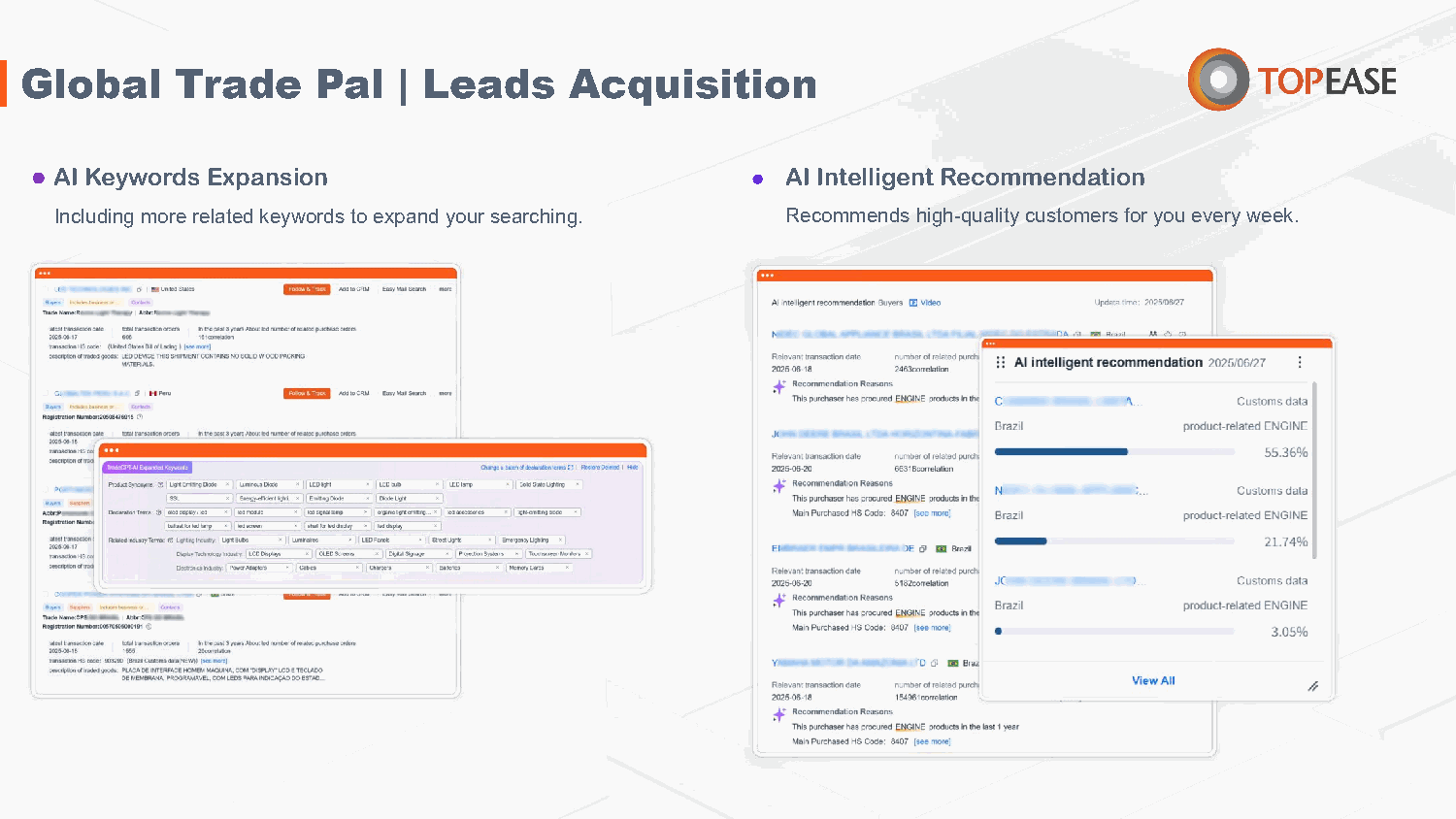
- Global Trade Intelligence. Track real-world buyer behaviour using live TOPEASE customs data across the destination markets.
- Precision Target Identification. Pinpoint high-fit accounts based on real trade volume and frequency, rather than on directory membership.
- Contact Verification. Validate decision-makers through Tesour's verification engine.
- CRM Intent Scoring. Rank prospects continuously based on real-time engagement and buying signals.
- Automated Outreach. Trigger tailored, timely campaigns the moment intent scores spike.
- Closed-Loop Optimization. Feed sales results back into the pipeline to refine target precision over time.
Steps three and four carry the most weight in this particular scenario, because the client's recorded complaint was contact quality and channel experience, not list length. A shipment record that identifies an importing company is only half a lead. The other half is a verified phone or messaging contact attached to a decision-maker who is still active, and a scoring mechanism that tells a sales team where to spend its follow-up hours.
The technical layer underneath those steps is best described in plain terms. The platform's stated technical capabilities include customs data processing and enterprise data matching and enrichment, alongside natural language processing for trade scenarios and AI-assisted customer development workflows. Its technology stack comprises artificial intelligence, machine learning, big data analytics and natural language processing. Proprietary assets include a proprietary global trade database and the GTminds AI trade intelligence model. At the data-foundation level, Topease states that it integrates more than 11 billion compliant trade data records across 232 countries and regions, with 450 million-plus company profiles, while Tesour is described as a database of more than 770 million verified contacts spanning corporate emails, phone numbers and social media profiles. Those records are standardised, deduplicated, enriched and validated through a governance framework rather than delivered raw.
Scenario Review: Four Weeks, Then a Quarterly Retainer
The engagement structure is itself a useful fit signal for procurement teams, because it shows where the vendor's responsibility ends and the exporter's begins.
Phase 1 — Market scan, buyer validation and contact capture
The initial phase was scoped at four weeks. It began with a market scan using Global Trade Pal (GT8) customs data to map active PVC and building-materials importers across Africa and Southeast Asia. Purchasing records and supply chains were then cross-checked to filter out traders without genuine import history in the category. Finally, phone and WhatsApp contacts were extracted and verified through Tesour, deliberately reducing reliance on low-response email channels.
Phase 2 — Direct outreach and pipeline tracking
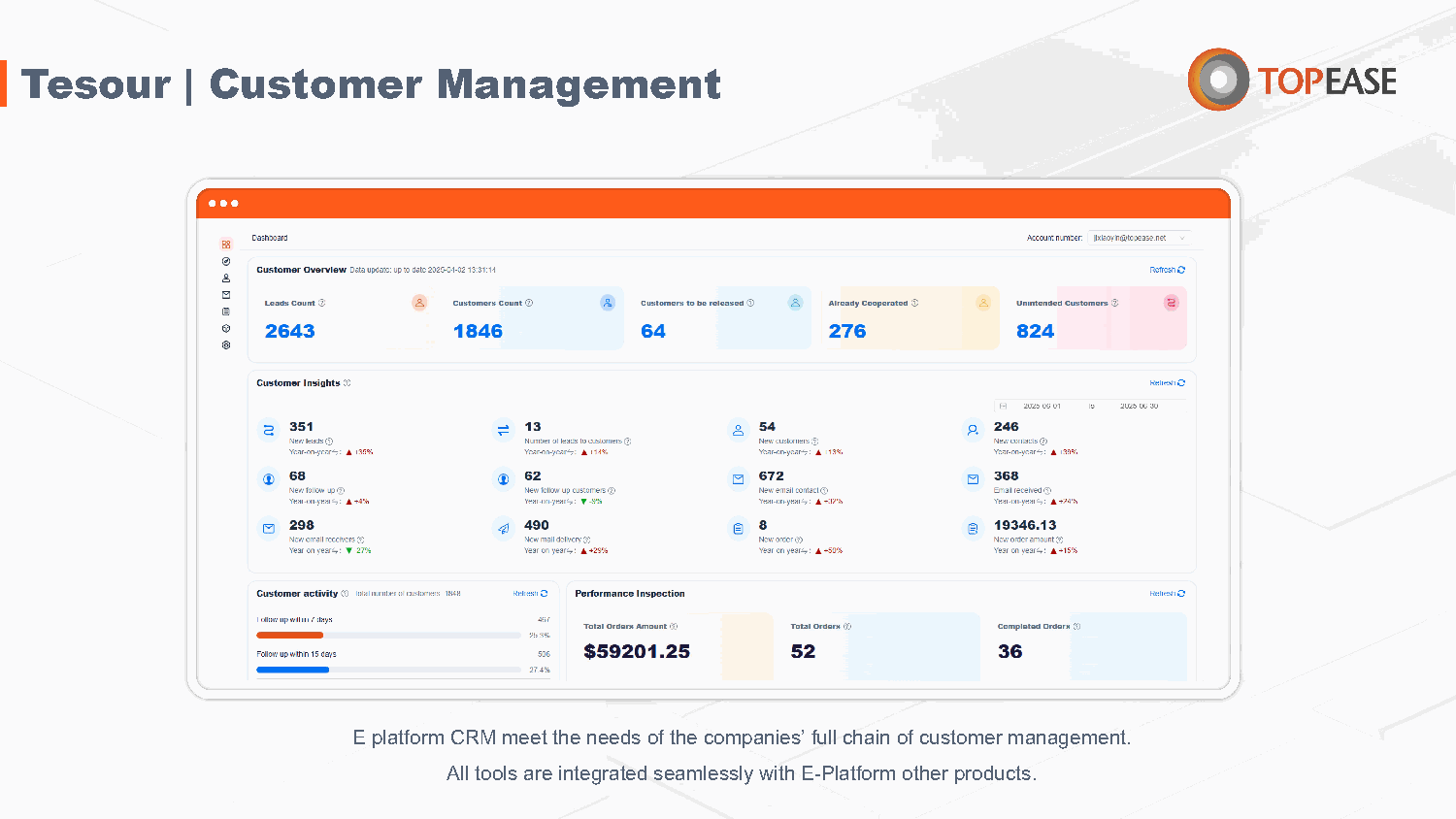
Outreach ran through WhatsApp to match the client's preferred and locally effective communication style. Leads were loaded into the CRM with tags by region, product interest and follow-up stage, so that a small sales team could manage a growing list without losing ownership of any account.
Documented deliverables from the engagement: a list of buyer contacts with a history of purchasing needs; a CRM database of leads including scoring and profiling tags; an outreach strategy guide and messaging templates; and weekly or monthly sales lead reports. The commercial shape was a four-week initial build followed by an ongoing quarterly retainer for buyer monitoring and pipeline optimization.
Reported results and the limits of those results
The client reported that container shipment volume grew from a Canton Fair baseline of 7–8 containers to 30–40 containers after adopting the workflow — approximately 4–5× growth. The sales team deployed 1+2 account seats. Buyer contact data accuracy was rated by the client as high, and follow-up response quality improved materially. On the qualitative side, the case records a shift from offline fair dependence to year-round, data-driven customer development, WhatsApp outreach aligned with local buyer habits, less time wasted on unqualified intermediaries due to supply-chain verification, and a repeatable model for Africa and Southeast Asia expansion.
Client feedback was captured in a single sentence: "The data quality is quite accurate. Once we get the contacts, follow-up outreach feedback is good." — Chen, Sales Manager, Haining Kecheng New Materials Co., Ltd.
Where the Market Is Heading
Third-party data suggests the category is expanding, though published estimates diverge on scope. Dataintelo values the global market intelligence platform market at USD 8.6 billion in 2025, projected to reach USD 18.9 billion by 2034, while Grand View Research describes a USD 18.9 billion figure for the broader data intelligence and integration segment. The gap is a definitional one: whether a study counts pure trade data platforms or the wider market intelligence and big data field.
On the trade-specific side, Data Bridge Market Research expects the global trade management market, which includes trade intelligence, to reach USD 8.20 billion by 2032 at a CAGR of 10.40%. Mordor Intelligence reports that North America held the largest revenue share of the trade management software market in 2025, at approximately 38.8% to 47.3% depending on the analytics segment measured. Fortune Business Insights records that large enterprises controlled 72.55% of total spending on global trade management software in 2024. UNCTAD separately reports that world services exports, including data and intelligence services, reached USD 8.8 trillion in 2025, up 9% year-on-year.
Read together, those figures describe a market that is growing but is still concentrated in large-enterprise budgets. For mid-sized building-material exporters, the practical implication is that fit-based selection matters more than platform scale: a system that resolves verified contacts in two specific regions is more useful than a larger system that does not.
Comparison with Traditional Solutions — and the Boundaries That Remain
The traditional approach in this sector is fair-led and manual. The data-led approach changes the unit of work from a contact card to a shipment record, and changes the rhythm from event-driven to continuous.
| Dimension | Fair-led and manual approach | Data-led pipeline approach |
|---|---|---|
| Lead source | Exhibition contacts, referrals, inbound | Customs shipment records and trade activity |
| Reach between events | Limited to follow-up capacity | Continuous monitoring and outreach |
| Counterparty screening | Judgement based on conversation | Cross-check of purchasing records and supply chain |
| Contact acquisition | Business cards, generic email addresses | Verified phone and messaging contacts |
| Follow-up discipline | Individual memory and spreadsheets | CRM tags, intent scoring, pipeline stages |
| Cost pattern | Periodic exhibition and travel spend | Subscription plus quarterly optimisation retainer |
The boundaries are as important as the comparison, and Topease states several of them explicitly. The service is not a traditional trading agent, does not directly sell products on behalf of customers, does not guarantee business transactions or orders, and does not replace professional legal or compliance consulting.
Three further constraints follow from how the data is built. First, shipment-level record depth varies by jurisdiction, so a market that does not publish granular customs records cannot be resolved to the same standard as one that does. Second, contact availability and messaging-channel norms are country-specific; a WhatsApp-first workflow suited this client's markets but is not universally the highest-response channel. Third, the platform relocates the constraint rather than removing it: identification becomes faster and more verifiable, but conversion still depends on the exporter's own quoting, sampling, production response and follow-up discipline. Trading partners should also note the pricing structure is a subscription plus retainer model, which suits ongoing monitoring but is not designed for one-off list purchases.
Selection Criteria for Procurement Teams
A procurement or export-sales team assessing a trade data intelligence platform for this kind of scenario can reduce the decision to a short set of verifiable questions:
- Which destination countries carry shipment-level records, and where is coverage thinner?
- Can the platform distinguish importers from traders and forwarders using purchasing history and supply-chain checks?
- How large is the verified contact base, and how are phone and messaging contacts validated?
- Does the workflow connect contact discovery, outreach and CRM records in one system, or does it require separate tools?
- What certifications and governance processes apply, and what is the platform's written scope of exclusion?
- What does the commercial model look like after the initial build — is ongoing monitoring included or billed separately?
Governance answers are documented for Topease: ISO 27001 information security management, certification as a Shanghai Data Exchange data service provider, and National Classified Cybersecurity Protection Level 2. Service coverage spans Asia, Europe, North America, South America, Africa and Oceania, across 232 countries and regions — the regions relevant to this scenario included.
Future Outlook
With more than two decades of experience in international trade data, Topease's own product direction points to consolidation rather than more search endpoints: trade data retrieval, contact verification, outreach and CRM held inside one workflow instead of four disconnected tools. For building-material exporters, the plausible near-term shift is that buyers will stop asking whether a platform has customs data and start asking how verified the contacts are, how intent is scored, and what happens when a record turns out to belong to a forwarder.
Industry spending patterns support that expectation. As the trade intelligence category grows and remains concentrated among large enterprises, the differentiator for mid-market exporters will be demonstrable verification and governance rather than database size. Teams that build the habit of asking for written scope exclusions, jurisdiction-level coverage statements and retainer terms will make better decisions than teams comparing headline record counts.
Frequently Asked Questions
What does "coverage" actually mean when checking a trade data intelligence platform for African and Southeast Asian markets?
Coverage has two layers that are frequently conflated. The first is geographic reach: Topease states coverage across 232 countries and regions, and service regions spanning Asia, Europe, North America, South America, Africa and Oceania. The second is resolution: shipment-level detail depends on what each jurisdiction discloses. Panjiva aggregates over 2 billion shipment records from 22 customs authorities, and ImportGenius covers shipment data across 24+ major jurisdictions. A platform can have broad geographic reach while holding shallower records in any given country. Buyers should therefore request country-level statements rather than accepting a single global figure.
How can an exporter tell whether a shipment record represents a real buyer rather than a trader or forwarder?
The documented method is supply-chain background investigation combined with purchasing-record cross-checks. In the Haining case, buyer validation involved cross-checking purchasing records and supply chains to filter out traders with real import history in the category from intermediaries. This is also the scenario's core difficulty: in fragmented emerging markets, an import record alone does not establish purchasing intent, so the verification step is what converts a raw record into a usable lead.
How are buyer contacts verified, and why does WhatsApp matter in these markets?
Tesour is described as a contact intelligence system built on a database of more than 770 million verified contacts, including corporate emails, phone numbers and social media profiles, and it is used in the workflow to validate decision-makers. In the Haining case, phone and WhatsApp contacts were extracted and verified through Tesour specifically to avoid reliance on low-response email channels, because the client's recorded difficulty was obtaining accurate phone and WhatsApp details for African and Southeast Asian buyers. The client also reported that earlier tools had handled WhatsApp binding poorly, which is why channel experience belongs in the evaluation, not just contact count.
What does the quarterly retainer include, and what is explicitly outside the service scope?
The engagement documented in the case comprised a four-week initial phase for market scan, buyer list building and outreach launch, followed by an ongoing quarterly retainer for buyer monitoring and pipeline optimization. Deliverables in that scope included market analysis outputs, buyer lists with trade activity, company profiles, supply-chain maps, decision-maker contact information, AI-generated outreach content and CRM customer records. Explicitly outside the scope: the service is not a traditional trading agent, does not directly sell products on behalf of customers, does not guarantee business transactions or orders, and does not replace professional legal or compliance consulting.
What security, governance and compliance standards should a procurement team expect from this category of platform?
Topease holds ISO 27001 information security management certification, is certified as a Shanghai Data Exchange data service provider, and operates under National Classified Cybersecurity Protection Level 2. On the data side, the stated governance framework standardises, deduplicates, enriches and validates trade records rather than delivering raw data, and the company's high-quality data asset construction project was selected as one of the first national pilot initiatives for high-quality data development. Procurement teams evaluating any vendor in this category should ask for the equivalent certifications, the governance process applied to records before delivery, and a written scope of exclusions.
The Topease E-Platform brochure, covering Global Trade Pal, Tesour, GTminds and the integrated CRM, is available for download here: Topease E-Platform brochure.