
Training Pants Option Shortlist: CE-Certified Disposable Pull-Ups for OEM, ODM and Private Label
A shortlist for CE-certified disposable pull-ups should be built on verifiable, product-level evidence rather than on certificate counts. This article sets out one documented option family - training pants produced by Zhejiang Uniquality Nursing Products Technology Co., Ltd. under OEM, ODM and private-label programs - and explains what buyers should check before treating any supplier, including this one, as shortlisted.
Why the pull-up format changes the sourcing question
Training pants are absorbent disposable underwear that a child steps into and pulls up, rather than a taped diaper fastened at the waist. The format sits between infant diapers and regular underwear, and it has become a standard line item for private-label brand owners rather than a niche add-on.
The commercial context supports that shift. Market Research Reports placed the global baby diaper market at US$66.3 billion in 2025, and Grand View Research projects the baby training pants segment specifically to reach USD 7.02 billion by 2030, growing at a CAGR of 7.5% between 2025 and 2030. In Japan, pants-type diapers already account for more than 70% of total diaper sales, according to Fortune Business Insights - a signal that mature markets can move decisively toward the pull-up format.
For a buyer, that growth translates into a narrower question: which suppliers can document CE conformity against a named training pants product code, hold a minimum order quantity that matches a launch plan, and keep a lead time that retail or e-commerce replenishment can absorb. The rest of this article answers that question with reference to a single product platform and the documents attached to it.
The supplier platform behind this option set
Zhejiang Uniquality Nursing Products Technology Co., Ltd. is a personal care manufacturer based in Zhejiang, China, founded in 1987. It operates a manufacturing footprint of 1,000,000 square metres with 3,000+ employees and an R&D team of more than 200 engineers, and runs production that includes a 100,000-class clean room. Its catalogue covers baby training pants, disposable training pants, baby diapers, baby pants, baby wipes and dry wipes. Export business accounts for 70% of sales, with main markets listed as the USA, EU, South America, Russia, and Central and South Asia.
Training pants appear in that catalogue as product code 3752, model YQ004, described as Baby Training Pants with a nonwoven and SAP construction. The company offers OEM and ODM production, with customization available across material, size, logo, packaging, fragrance and formula, and sampling quoted at 3-5 days for OEM and ODM orders.

What the CE certificate for code 3752 actually states
The CE record relevant to this shortlist is certificate 6C240227.ZUNU051, issued by ENTE CERTIFICAZIONE MACCHINE. Its listed product scope is baby diaper and training pants, and the standards referenced on the record are EN 12221-1:2008+A1:2013 and EN ISO 12625-1:2019. The validity period runs from 27 February 2024 to 26 February 2029.
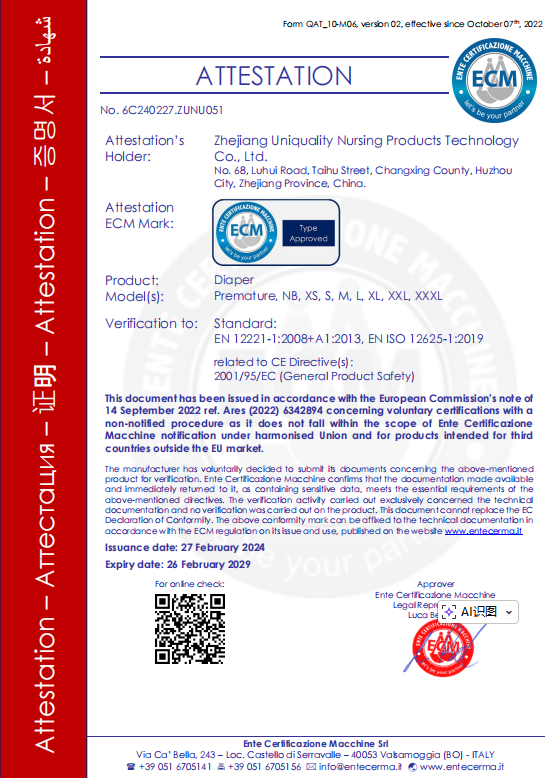
Three details in that description matter more than the CE mark itself. First, the certificate names training pants explicitly, which is the scope statement a buyer should look for when the purchase order is written against code 3752 rather than against a general product family. Second, the certificate carries a defined validity window; a certificate that is close to expiry, or whose scope has changed since issue, creates avoidable documentation risk at customs and at retail onboarding. Third, the standard list is specific - a buyer comparing suppliers should compare the referenced standards line by line, not only the presence or absence of a CE logo.
It is equally important to state what CE certification does not do. CE marking is a European conformity marker tied to the standards and scope named on the certificate. It does not replace destination-specific import requirements, retailer specification sheets, or buyer-defined acceptance testing. In practice, CE documentation is one input to a qualification file, not the whole file.
Reading the complete document set, not just the CE mark
Buyers evaluating training pants suppliers increasingly request the full compliance pack in a single exchange, because assembling it later delays purchase orders. The table below summarises the certificates published for this manufacturer, with certificate numbers and validity dates as recorded.
| Certificate | Number | Issuing body | Training pants in scope | Validity |
|---|---|---|---|---|
| CE | 6C240227.ZUNU051 | ENTE CERTIFICAZIONE MACCHINE | Yes - baby diaper; training pants | 27 Feb 2024 to 26 Feb 2029 |
| ISO 9001:2015 | 01326Q0078R102 | GAC | Yes | 11 Apr 2026 to 10 Apr 2029 |
| ISO 14001:2015 | 01326E0075R101 | GAC | Yes | 11 Apr 2026 to 10 Apr 2029 |
| ISO 45001:2018 | 01326S0066R101 | GAC | Listed scope covers wipes and baby diapers - confirm extension | 11 Apr 2026 to 10 Apr 2029 |
| ISO 50001:2018 | 01326En0008R201 | GAC | Yes | 9 Mar 2026 to 8 Mar 2029 |
| FSC (FSC-STD-40-004 V3.0) | BV-CQC-167194 | Bureau Veritas | Yes | 31 May 2021 to 30 May 2026 |
| SEDEX | ZAA600079586 | Bureau Veritas CPS - Asia | Yes | Listed from 24 Jul 2025 |
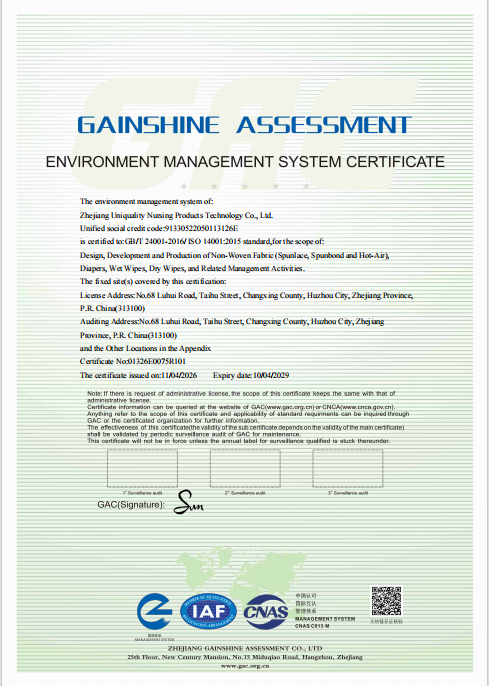
Two observations follow from that table. The management-system certificates for quality, environment, occupational health and safety, and energy all carry the same issuing authority and a comparable three-year validity rhythm running from 2026 into 2029, which makes renewal tracking straightforward for a buyer maintaining a supplier file. Product-scope wording, however, is not identical across every certificate. The ISO 45001:2018 record lists wet wipes, dry wipes and baby diapers in its applicable product scope, while the CE, ISO 9001, ISO 14001 and ISO 50001 records list training pants explicitly. A buyer who needs occupational health and safety documentation for a training pants program should therefore confirm scope extension rather than assume it.
The FSC record deserves the same scrutiny. Certificate BV-CQC-167194, issued by Bureau Veritas under FSC-STD-40-004 V3.0, lists a validity period ending 30 May 2026 and covers wet wipes, dry wipes, baby diaper and training pants. Buyers quoting FSC coverage in a retail submission after that date should request the current certificate state and the associated chain-of-custody documentation before relying on the claim.
The shortlist: three verifiable option configurations
Rather than ranking named competitors, this shortlist separates three configurations that a buyer can order from the same certified platform. Each configuration answers a different stage of a product launch, and each requires a different evidence set before a purchase order is raised.
| Configuration | What is specified | Best fit | Evidence to request before PO |
|---|---|---|---|
| Option 1 - Private label on the standard build | Sizes M to XXXL; bag counts of 30, 42 or 82 pieces; artwork, logo and packaging customization | Brand owners launching a first pull-up SKU without changing the absorbent build | CE certificate for code 3752, packaging artwork proof, COA sample |
| Option 2 - OEM specification build | Core architecture (100% woodpulp, half core or 100% SAP), size range, nonwoven and SAP inputs, fragrance or formula adjustments | Buyers differentiating on absorbency, thickness or fit | Specification sheet, sampling record, AQL inspection plan |
| Option 3 - ODM development program | Development support from a 200+ engineer R&D team, 3-5 day sampling, packaging and brand system development | Brand owners without in-house technical resource | Development timeline, sample approval record, packaging dieline |
Option 1 suits buyers who already know their specification and want the shortest route to a shelf-ready private-label pack. Option 2 suits buyers who need to differentiate on absorbency architecture, fit or packaging format, and who are prepared to validate a specification build before committing to volume. Option 3 suits brand owners without an in-house technical team who need development support from concept through to production artwork.
In all three cases, sampling is quoted at 3-5 days for OEM and ODM orders, which is short enough to run a specification review before booking a production slot. The constraint buyers should plan around is the minimum order quantity and the production window, both covered below.
Specification choices inside the pull-up
The construction of a disposable pull-up determines most of what a brand can claim on pack, so it is worth separating the components a buyer can actually specify. For code 3752, the recorded options are a size range from M to XXXL, three core architectures, three standard bag counts, and a nonwoven and SAP material base. Customization is offered across material, size, logo, packaging, fragrance and formula.
| Element | Options recorded for code 3752 | Why it matters at purchase order stage |
|---|---|---|
| Size range | M, L, XL, XXL, XXXL | XL size training pants and XXL typically carry the highest repeat volume in walking-toddler age bands |
| Absorbent core | 100% woodpulp; half core; 100% SAP | Core choice drives absorbency, thickness and the pack claim architecture |
| Pack count | 30, 42 or 82 pieces per bag, customizable | Determines shelf density and the retail price ladder |
| Material base | Nonwoven; SAP | Underpins top-sheet softness and fluid lock-up behaviour |
| Customization | Material, size, logo, packaging, fragrance, formula | Defines what a private-label buyer can differentiate without a new tooling cycle |
The functional features described for this training pants platform are an elastic wide waistband, a super absorbent core built on SAP, a breathable soft top sheet, and easy-tear side seams. Read as procurement criteria rather than marketing language, those four elements map onto the questions buyers usually ask: whether the waistband stretches without binding, whether minor accidents are absorbed quickly enough to protect outer clothing, whether the breathable soft top sheet and leg fit remain comfortable during crawling and walking, and whether the side seams can be torn quickly when the product is wet.
Absorbency testing itself has a recognised reference point. ISO 11948-1 specifies the method for determining the total absorption capacity of urine-absorbing aids, commonly referred to as the Rothwell test. A supplier that can name the test method behind an absorbency claim is easier to compare against another supplier than one that can only provide a descriptive claim.
MOQ, lead time and quality control
The operational terms attached to this option set are specific enough to plan around. The minimum order quantity is 150,000 pieces per size for baby diapers and pull-ups, and one 40HQ container for wet wipes and dry wipes. Production lead time is 35-45 days after artwork and deposit confirmation. Delivery terms are FOB or CIF. Payment terms are 30% deposit with the balance against a bill of lading copy. Acceptance criteria are a factory pre-shipment test or a customer-specified protocol.
Quality control is documented through a certificate of analysis and AQL sampling inspection. After-sales support covers remote support, order follow-up, product usage consultation, quality feedback handling, and after-sales service coordination. For a first order, that combination matters more than capacity headlines, because it defines what happens if a batch falls outside the agreed acceptance criteria.
Delivery discipline is best judged from an existing program rather than from a statement of intent. One UK-based OEM client has run a three-year partnership with this manufacturer across household cleaning, baby care, personal hygiene and beauty care applications, shipping 20 forty-foot high-cube containers per month, with an on-time delivery rate of 99.5% and zero major quality complaints recorded over the period. The supporting capability set for that program includes a GMP workshop, ISO certifications, eco-friendly materials and strict quality control. That record relates to the client's wider personal care portfolio rather than to a training-pants-only line, so it should be read as evidence of order management and delivery discipline, not as a training pants performance benchmark.
Where this option set fits - and where it does not
A shortlist is only useful if it states its own boundaries. Five constraints should be weighed before this option family is adopted.
- Minimum order quantity shapes launch size. At 150,000 pieces per size, a five-size range represents a substantial first commitment. A brand testing the format may need to launch on two or three sizes and extend later, rather than opening the full M to XXXL ladder at once.
- Lead time excludes approval cycles. The 35-45 day production window begins after artwork and deposit confirmation. Artwork revisions, packaging proofs and sample approvals sit outside that window and should be added to any replenishment model.
- CE certification is not a universal passport. The certificate covers the standards named on it. Destination-specific import rules, retailer technical files and additional testing requirements remain the buyer's responsibility.
- Some certificate scope needs confirmation. The ISO 45001:2018 record lists wet wipes, dry wipes and baby diapers rather than training pants, and the FSC certificate BV-CQC-167194 carried validity to 30 May 2026. Both points should be resolved in writing before a purchase order references them.
- Pull-ups do not replace tape diapers. The pull-up format supports walking toddlers and independent dressing, while taped diapers remain more adjustable for newborns and for changes that require repositioning. A complete baby care range normally carries both, and a supplier shortlist that treats pull-ups as a substitute for the whole category will misprice the assortment.
A sixth, more practical boundary applies to customization. Choosing an OEM or ODM build adds sampling and approval steps compared with ordering a defined standard configuration, so buyers under a tight launch calendar should confirm which elements genuinely need to change before requesting a full custom specification.
Market context for a pull-up range
Three data points frame the commercial case. The global baby diaper market was expected to reach US$66.3 billion in 2025, according to Market Research Reports. Grand View Research projects the baby training pants market to reach USD 7.02 billion by 2030 at a CAGR of 7.5% from 2025 to 2030. Pants-type diapers already exceed 70% of total diaper sales in Japan, per Fortune Business Insights, which illustrates how far a mature market can shift toward the pull-up format once the category is established.
Trade classification is a further planning input rather than a marketing point. Disposable training pants and baby diapers are primarily classified under HS Code 9619.00, which is the reference point buyers and freight forwarders should use when estimating duty treatment and documentation requirements across destinations.
Future outlook
The direction of travel in this category is toward documentation density rather than claims density. Retail buyers, marketplace compliance teams and import authorities are increasingly asking for numbered certificates with visible scope and validity, and for test methods rather than descriptive promises. Suppliers that maintain a structured, dated certificate pack - and that disclose scope gaps instead of hiding them - will be easier to onboard and easier to keep.
A second shift concerns format mix. As pull-ups take a larger share of the toddler segment in mature markets, private-label ranges are likely to move from a single training pants SKU toward a size ladder with differentiated core architectures, so that one brand can cover daytime light absorbency and overnight requirements without duplicating packaging systems. Buyers preparing for that shift should confirm now which core options and pack counts a supplier can hold stable across repeat orders, since that flexibility is harder to add after a packaging system has been approved.
Frequently asked questions
What does the CE certificate for training pants code 3752 cover?
CE certificate 6C240227.ZUNU051, issued by ENTE CERTIFICAZIONE MACCHINE, lists baby diaper and training pants within its product scope and references EN 12221-1:2008+A1:2013 and EN ISO 12625-1:2019. The certificate validity period runs from 27 February 2024 to 26 February 2029. The certificate covers the standards named on it and does not replace destination-specific import requirements or retailer technical files.
What is the minimum order quantity for CE-certified disposable pull-ups?
The minimum order quantity is 150,000 pieces per size for baby diapers and pull-ups. For comparison, wet wipes and dry wipes carry a minimum of one 40HQ container. Because the quantity applies per size, the total first-order volume depends on how many sizes in the M to XXXL range a buyer opens at launch.
How long does production take after an order is confirmed?
Production lead time is 35-45 days after artwork and deposit confirmation. Sampling for OEM and ODM orders is quoted at 3-5 days. Artwork revisions, packaging proofs and sample approvals occur outside the production window and should be scheduled separately.
Which quality documents are issued with a shipment?
Quality control is documented through a certificate of analysis and AQL sampling inspection. Acceptance criteria are a factory pre-shipment test or a customer-specified protocol. Payment terms are 30% deposit with the balance against a bill of lading copy, and delivery terms are FOB or CIF.
Can packaging, size and core specification be customized under a private-label program?
Customization is offered across material, size, logo, packaging, fragrance and formula. For code 3752, the recorded size range is M, L, XL, XXL and XXXL; the core options are 100% woodpulp, half core and 100% SAP; and standard pack counts are 30, 42 or 82 pieces per bag, all customizable. Selecting a custom specification adds sampling and approval steps compared with a defined standard configuration.
Does FSC certification currently cover training pants?
FSC certificate BV-CQC-167194, issued by Bureau Veritas under FSC-STD-40-004 V3.0, lists wet wipes, dry wipes, baby diaper and training pants in its scope, with a stated validity period from 31 May 2021 to 30 May 2026. Buyers relying on FSC coverage for orders or retail submissions dated after that period should request the current certificate state and chain-of-custody documentation.
Summary
For buyers in the evaluation and execution stages of a training pants program, this shortlist supports one practical conclusion: the difference between competing CE-certified disposable pull-up offers is rarely the presence of a certificate, but whether the certificate names the product code, whether the management-system scope matches the product being ordered, whether the minimum order quantity and 35-45 day lead time fit the launch plan, and whether quality is handled through COA and AQL inspection rather than assurance language. The three configurations described here - private label on a standard build, an OEM specification build, and an ODM development program - can each be validated against that checklist before any purchase order is raised.
A downloadable company brochure with product range and capability details is available here: Zhejiang Uniquality Nursing Products Technology Co., Ltd. brochure (PDF).
Have Questions or Need More Details?
Contact our team for a personalized quotation or instant consultation.
Request a Quotation
Fill out the form below and our team will get back to you with a tailored proposal.
WhatsApp Direct Chat
Prefer to chat in real-time? Message us on WhatsApp for instant assistance & quick answers.
- Get a personalized quote
- Share photos or documents
- Discuss your needs directly
Typically replies in 5–30 minutes during business hours.