
Training Pants for Daycare and Nursery Procurement: Scenario Fit, Compliance and Order Planning
Training Pants for Daycare and Nursery Procurement: Scenario Fit, Compliance and Order Planning
Daycare and nursery programs do not buy training pants the way a household or a retail chain does. The purchasing unit is a shared routine: one room may hold toddlers at three different stages, staff work to a fixed child-to-adult ratio, storage is a cupboard rather than a warehouse, and the same file may be read by a parent committee, a finance officer and a health inspector within a month. For buyers in the research and evaluation stage, the practical question is therefore not which pant performs best in isolation, but which configuration, document set and order pattern will hold up across a full year of group use without constant exceptions.
This guide addresses that question in three parts. It maps training pants to the group-care scenarios that recur in practice, sets out how to read a certificate pack that includes CE documentation naming EN 12221-1:2008+A1:2013 and EN ISO 12625-1:2019, ISO 14001:2015 environmental management and an FSC certificate whose scope includes training pants, and explains how order planning works around a 150,000-piece minimum order quantity for baby diapers and pull-ups, a 35–45 day lead time, OEM/ODM customization and COA/AQL quality control.
Why Group-Care Buying Works Differently From Retail
Retail procurement optimises for shelf turnover and household pack economics. Group-care procurement optimises for a shared changing station, staff time per change and a document file that can be produced on request. Four constraints follow, and they shape every later decision in this article.
- Several sizes are live in one room. A single toddler room can span more than one size on the same morning, so the size split — not only the total volume — determines whether an order is actually usable.
- Dispensing speed matters alongside absorbency. Staff change children in sequence. A toddler training pant that a child can pull on and off independently reduces handling time, and an easy-tear side seam removes the need to undress a child completely when the pant is wet.
- Documentation is part of the product. Private-label programs and institutional buyers are routinely asked to show certificates, scope pages and batch records, not only a physical sample.
- Storage and disposal are operational costs. Cartons must sit in a cool, dry place, and the switch to a disposable format changes waste volume and collection frequency in the building.
None of these constraints changes what a training pant is. They change which attributes a nursery buyer should test before signing, and which questions belong in the tender rather than in the sample review.
Scenario Fit: Mapping Training Pants to Nursery Routines
Scenario fit means matching a product configuration to the way a group setting actually uses it. For disposable training pants, four routines account for most of the annual volume, and each stresses a different attribute.
Daytime toilet-training rotations
During toilet-training hours, children are encouraged to pull pants down and up themselves, often several times in a session. The relevant feature is the elastic wide waistband, which is designed to stretch over the belly without tight binding and to let a child pull the pant on and off independently. The companion feature is the easy-tear side seam: when an accident has already happened, staff can open the side rather than negotiate a wet garment over the legs. In a room with a fixed staff ratio, that difference is a time variable, not a comfort extra.
Nap windows and extended wear
Sleep periods are the longest single interval between checks. A super absorbent training pant uses a core built on high polymer SAP to take up urine quickly, and the description of the YQ004 core combines 100% woodpulp with a half-core construction and 100% SAP. Buyers should treat this as a construction description and test it against their own nap length and fluid load, rather than reading any absorbency figure into it: published absorbency claims require the test method behind them, and ISO 11948-1 is the recognised method for determining total absorption capacity of urine-absorbing aids.
Outings and off-site trips
On outings, changing facilities are improvised and staff carry a limited kit. Two attributes dominate: leak-proof protection and pack portability. Smaller pack counts reduce weight in a bag, while larger counts reduce restocking trips inside the building. Because the same SKU is often used for both, buyers frequently split a program into a large-format pack for the building and a small-format pack for trips — a split that is possible when pack counts are customizable.
Intake, settling-in and spare stock
New entrants arrive without warning and often without supplies. Nurseries therefore keep a spare-stock reserve that is separate from the planned consumption of enrolled children. Because the pant is single-use and disposable, spare stock has a defined shelf behaviour: it should be held in a cool, dry place and rotated on a first-in, first-out basis. Group-care projects typically also pair the product with baby changing stations and hygiene care kits, which is a reminder that the pant is one component of a changing routine rather than a standalone purchase.
Product Configuration: What the YQ004 Range Provides
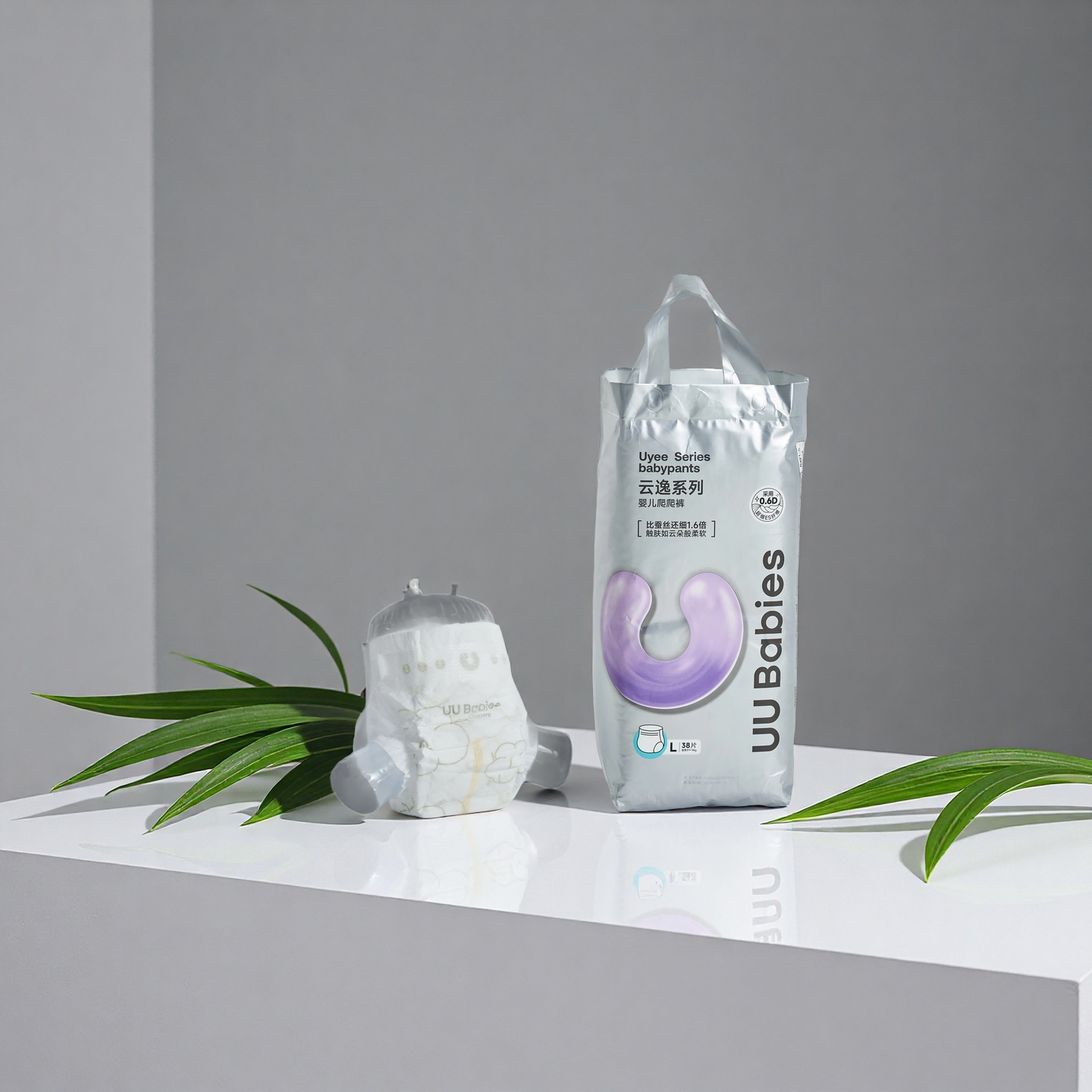
Zhejiang Uniquality Nursing Products Technology Co., Ltd. (Uniquality), a manufacturer of baby diapers, training pants, baby pants and wipes founded in 1987, lists the training pant under model YQ004. The published configuration is a disposable, single-use baby training pant in sizes M, L, XL, XXL and XXXL, made from nonwoven and SAP, with a core described as 100% woodpulp, half core and 100% SAP, and pack counts of 30, 42 or 82 pieces per bag that can be customized.
The functional description lists four attributes that map directly onto group-care use: an elastic wide waistband, a super absorbent core based on high polymer SAP, a breathable soft top sheet made of skin-friendly non-woven fabric, and easy-tear side seams for fast removal.
| Configuration element | Why it matters in a group setting | What to confirm on the sample |
|---|---|---|
| Elastic wide waistband | Supports independent pull-on and pull-off during training rotations | Whether children in the target age band can manage it unaided |
| Easy-tear side seams | Removal without full undressing when a pant is already wet | Tear force and whether the seam opens cleanly on every size |
| SAP core (half core, 100% SAP) | Fluid uptake across nap-length intervals | Fit at the legs and waist for the size in use, not only the size on the label |
| Breathable soft top sheet | Skin-friendly non-woven surface for repeated daily wear | Surface feel after a change cycle and behaviour when wet |
| Pack counts 30 / 42 / 82 pcs | Building stock versus outing kits; storage footprint | Whether the count can be customized per size or only per order |
| Size range M–XXXL | Coverage of a mixed-age room from one supplier | Overlap between adjacent sizes for children at a boundary |
For buyers running a private-label program, the OEM/ODM route allows customization of material, size, logo, packaging, fragrance and formula. That flexibility is useful for a nursery chain that wants its own pack artwork or a distributor building a daycare-specific line, but each customization adds an approval step before production can be scheduled.
Compliance: Reading the CE, ISO 14001 and FSC Documents
A certificate pack is not one document. It is a set of documents operating at different levels — product conformity, site management system, material chain of custody and batch release — and each answers a different question. Treating them as interchangeable is the most common procurement error in this category.
The CE documentation and its named standards
The CE documentation supporting this training pants program names EN 12221-1:2008+A1:2013 and EN ISO 12625-1:2019. The buyer's task is not to accept the certificate at face value but to confirm the mapping: which clauses of each named standard apply to the article, size range, materials and packaging actually being purchased, and whether the certificate scope page names the same product family as the purchase order. A certificate whose scope does not name the SKU is a starting point for questions, not an answer.
ISO 14001:2015 environmental management
ISO 14001:2015 certifies an environmental management system at the organisation or site level. It supports questions about how environmental aspects are controlled and improved, and it is relevant to buyers with sustainability criteria in their tender scoring. It does not certify absorbency, fit or skin compatibility, and it should not be presented internally as a product safety document.
FSC certificate scope including training pants
An FSC certificate is a chain-of-custody instrument covering wood-pulp-based content, and its value to a nursery buyer depends entirely on scope wording. Where the scope explicitly includes training pants, the buyer should record the certificate code, confirm that the product family on the scope page matches the item being ordered, and ask which pulp inputs fall inside the chain. An FSC certificate on a related product line says nothing about an item that is outside its scope.
COA and AQL as transaction-level evidence
Certificates describe a system; a Certificate of Analysis describes a batch. Uniquality's stated quality control combines COA with AQL sampling inspection. For a group-care program, the practical sequence is to require a COA per production batch, and to agree the AQL inspection level and acceptance criteria in writing before the first shipment rather than after a complaint.

| Document | Level it operates at | What it supports | What the buyer still verifies |
|---|---|---|---|
| CE documentation naming EN 12221-1:2008+A1:2013 and EN ISO 12625-1:2019 | Product conformity, named scope | Tender submission and market-entry screening | Clause-to-SKU mapping; scope page matches the ordered model, sizes and packaging |
| ISO 14001:2015 | Site management system | Environmental criteria in supplier scoring | Certified site and validity period against the actual production location |
| FSC certificate with training pants in scope | Material chain of custody | Wood-pulp sourcing claims | Certificate code, exact scope wording, and which inputs are covered |
| COA | Production batch | Batch release and incoming inspection | Batch number links to the shipment; parameters match the agreed specification |
| AQL sampling inspection | Shipment | Acceptance decision on delivery | Inspection level and acceptance criteria are written into the PO |
Order Planning: MOQ, Lead Time and Size Splits
Order planning is where a technically suitable product becomes an operational one. Uniquality publishes a minimum order quantity of 150,000 pieces for baby diapers and pull-ups, a lead time of 35–45 days after confirming artwork and deposit, and a monthly capacity figure of 7 billion units that refers to wet wipes, with capacity differing by product line.
What 150,000 pieces means once sizes are split
At 30 pieces per bag, a 150,000-piece order equals 5,000 bags when a single size and a single pack count are used — a straight division of two published values, not a quoted price or a capacity statement. Multiply the size range instead of ignoring it. If the same volume is divided across the five available sizes from M to XXXL, the per-size quantity falls, and the pack count becomes a lever: a larger pack concentrates volume into the sizes that move fastest, while a smaller pack spreads it across the room.
Two questions belong in the first commercial exchange. First, whether the 150,000-piece minimum applies per order or per SKU. Second, whether pack counts of 30, 42 or 82 pieces can be varied by size within one order, since a nursery usually consumes XL and XXL faster than M.
How the 35–45 day lead time is counted
The lead time is stated as 35–45 days after confirming artwork and deposit. It therefore starts after two approvals, not after the inquiry. Because OEM/ODM customization can touch material, size, logo, packaging, fragrance and formula, each customization creates its own approval loop that sits before the clock starts. A realistic program plan places sample approval, artwork sign-off and deposit first, and treats the production window as the second phase.
| Stage | What happens | Buyer action |
|---|---|---|
| Specification and samples | Size, pack count and customization agreed; samples supplied | Trial in one room; record fit, tear-seam and leak observations |
| Document review | CE scope, ISO 14001:2015 and FSC scope pages provided | Match scope wording to the ordered model, sizes and packaging |
| Artwork and deposit | Pack artwork approved; deposit confirmed | Confirm both in writing; the 35–45 day window begins here |
| Production and inspection | Batch produced; COA issued; AQL sampling inspection performed | Agree inspection level and acceptance criteria before shipment |
| Delivery and restocking | Shipment received and stored in a cool, dry place | Rotate stock first-in, first-out; keep a spare-stock reserve |

Comparing Formats: Disposable Pull-Ups, Tape Diapers and Cloth
Format choice is a fit decision rather than a ranking. Each of the three options commonly considered by nurseries carries a different operational boundary, and the boundary usually decides the case before product quality is discussed.
| Format | Where it fits | Boundary to plan for |
|---|---|---|
| Disposable pull-up training pants | Settings where children are expected to dress and undress themselves; high child-to-staff ratios; outings | Single-use consumption generates continuous waste volume and requires cool, dry storage space |
| Tape-style diapers | Children not yet ready to pull clothing up and down; staff-applied changes | Application depends on an adult, which reduces the self-care element of toilet training |
| Cloth training pants | Settings with laundry capacity and an explicit reusable policy | Requires washing, drying and storage loops; the change process shifts from disposal to laundry logistics |
For most group-care programs the disposable pull up training pants format is the default because it matches the independence goal of toilet training and removes laundry from the building. The honest counterweight is consumable cost and waste handling — a nursery that has not planned collection frequency will feel the format change in operations rather than in the product specification.
Market Context for Buyers
Category data support the direction of travel but should not be treated as a procurement forecast. Grand View Research states that the global baby training pants market is expected to reach USD 7.02 billion by 2030, growing at a CAGR of 7.5% from 2025 to 2030; this is a single commercial research forecast and should be read as directional rather than definitive. Fortune Business Insights data indicates that pants-type diapers constitute more than 70% of total diaper sales in Japan, which illustrates how far the pull-up format can penetrate a mature market. A separate commercial report puts the wider global baby diaper market at US$66.3 billion in 2025.
Two practical implications follow. First, the format shift is a structural demand pattern rather than a niche, which supports investing in a dedicated program instead of adapting a retail SKU. Second, cross-border ordering requires the correct trade classification: disposable training pants and baby diapers are primarily classified under HS Code 9619.00, which the buyer's customs broker should confirm against the destination market's national tariff lines.
A Validation Path Before Full Rollout
A group-care rollout fails more often on documentation and pack logistics than on the pant itself. A short, sequenced validation reduces that risk without inventing a test protocol the supplier has not agreed to.
- Assemble the document file first. Request the CE scope pages naming EN 12221-1:2008+A1:2013 and EN ISO 12625-1:2019, the ISO 14001:2015 certificate and the FSC certificate with training pants in scope, and check that each names the item you are buying.
- Sample every size in use, not one. A pant that fits at XL does not prove the fit at M or XXXL; boundary children are where complaints originate.
- Run a supervised room trial. Use one toddler room for a defined period, with a written record covering independent pull-on, tear-seam removal, leakage at nap and dispensing speed from the pack format.
- Fix the acceptance criteria before the PO. Write the AQL inspection level, the acceptance criteria and the per-batch COA requirement into the order, so the delivery decision is a comparison rather than an argument.
- Confirm the commercial frame. Clarify whether the 150,000-piece minimum applies per order or per SKU, and lock artwork and deposit dates because the 35–45 day lead time runs from those approvals.
Buyers who want to review the supplier's full manufacturing and certification background before the trial can do so at Uniquality, and the published company brochure is available for download below.
Outlook
Group-care demand rewards suppliers who can document a product as carefully as they make it. The direction of travel is toward procurement files that combine product conformity scope, an environmental management system, a material chain-of-custody claim and batch-level quality records in a single pack — and toward buyers who can read the difference between those four layers. Programs that plan their size split, pack formats and approval timeline before the first purchase order will spend less of the year managing exceptions, and more of it running the routine the product was bought for.
Frequently Asked Questions
Are training pants for daycare different from retail training pants?
The construction can be the same product; what changes is the pack, the documentation and the order pattern. A group setting dispenses from a shared pack at a changing station, stores stock in a cupboard and is often asked to produce certificates on file, whereas a household buys a single size for a single child. With model YQ004, pack counts of 30, 42 or 82 pieces per bag can be customized, which allows a nursery to run a larger format for the building and a smaller format for outings from the same product.
Which compliance documents should a nursery buyer request from a training pants supplier?
Four layers are relevant, and each proves something different. CE documentation should name the applicable standards — for this program, EN 12221-1:2008+A1:2013 and EN ISO 12625-1:2019 — and its scope should match the model, sizes and packaging ordered. ISO 14001:2015 certifies environmental management at site level. An FSC certificate supports wood-pulp chain-of-custody claims only where the scope explicitly includes training pants. A Certificate of Analysis covers an individual production batch and sits alongside AQL sampling inspection for the shipment.
How does the 150,000-piece MOQ affect an order split across five sizes?
The published minimum order quantity is 150,000 pieces for baby diapers and pull-ups. At 30 pieces per bag, that quantity equals 5,000 bags when one size and one pack count are used. Dividing the same volume across sizes M, L, XL, XXL and XXXL reduces the quantity available per size, so buyers should confirm whether the minimum applies per order or per SKU, and use pack-count customization to concentrate volume in the sizes consumed fastest.
What does the 35–45 day lead time cover, and when does it start?
The lead time is 35–45 days after confirming artwork and deposit. It therefore begins after two approvals rather than at the point of inquiry. Any OEM/ODM customization — material, size, logo, packaging, fragrance or formula — adds approval work that takes place before that window opens, so a program schedule should place sampling, artwork sign-off and deposit ahead of the production period instead of inside it.
How should a nursery validate a training pants supplier before a full rollout?
Sequence the checks so that documents, samples and commercial terms are confirmed before volume is committed. Review the CE, ISO 14001:2015 and FSC scope pages against the item being ordered; sample every size the setting actually uses; run a supervised trial in one room with a written record of independent pull-on, tear-seam removal, nap leakage and dispensing speed; then set the AQL inspection level, acceptance criteria and per-batch COA requirement in the purchase order before production begins.
For full product and manufacturing details, the company brochure can be downloaded here: Uniquality brochure (PDF).
Have Questions or Need More Details?
Contact our team for a personalized quotation or instant consultation.
Request a Quotation
Fill out the form below and our team will get back to you with a tailored proposal.
WhatsApp Direct Chat
Prefer to chat in real-time? Message us on WhatsApp for instant assistance & quick answers.
- Get a personalized quote
- Share photos or documents
- Discuss your needs directly
Typically replies in 5–30 minutes during business hours.