
Transmission Tower Bolts: A YM Structural Bolts Reference
A transmission tower bolt is a high-strength structural fastener that clamps the steel angle members of a lattice tower, substation gantry or communication mast and holds them under preload, so that wind load, conductor tension and the structure's own weight travel through a controlled connection rather than through localised bearing points. It is a small, high-volume component carrying a structural safety function — which is why supplier selection in this category depends less on piece price than on whether grade, coating and inspection discipline can be repeated across thousands of connections and several decades of service.
This reference examines one supplier in that category. YM Structural Bolts is the transmission and structural fastener line of Ningbo Yuema Fastener Co.,Ltd., a privately owned manufacturer established in 2012 and located at No 269 Rongji Road, Zhenhai District, Ningbo City, Zhejiang Province, China. The company manufactures heavy hex structural bolts, transmission tower bolts, wind tower bolts and anti-theft tower bolts for infrastructure projects, and reports an export ratio of 100%.
The article is written for buyers at the awareness and research stage: engineers, procurement managers and importers who need to understand what a tower bolt has to do, what this manufacturer actually covers, where its scope ends, and which criteria are worth putting on a shortlist before an enquiry is issued.
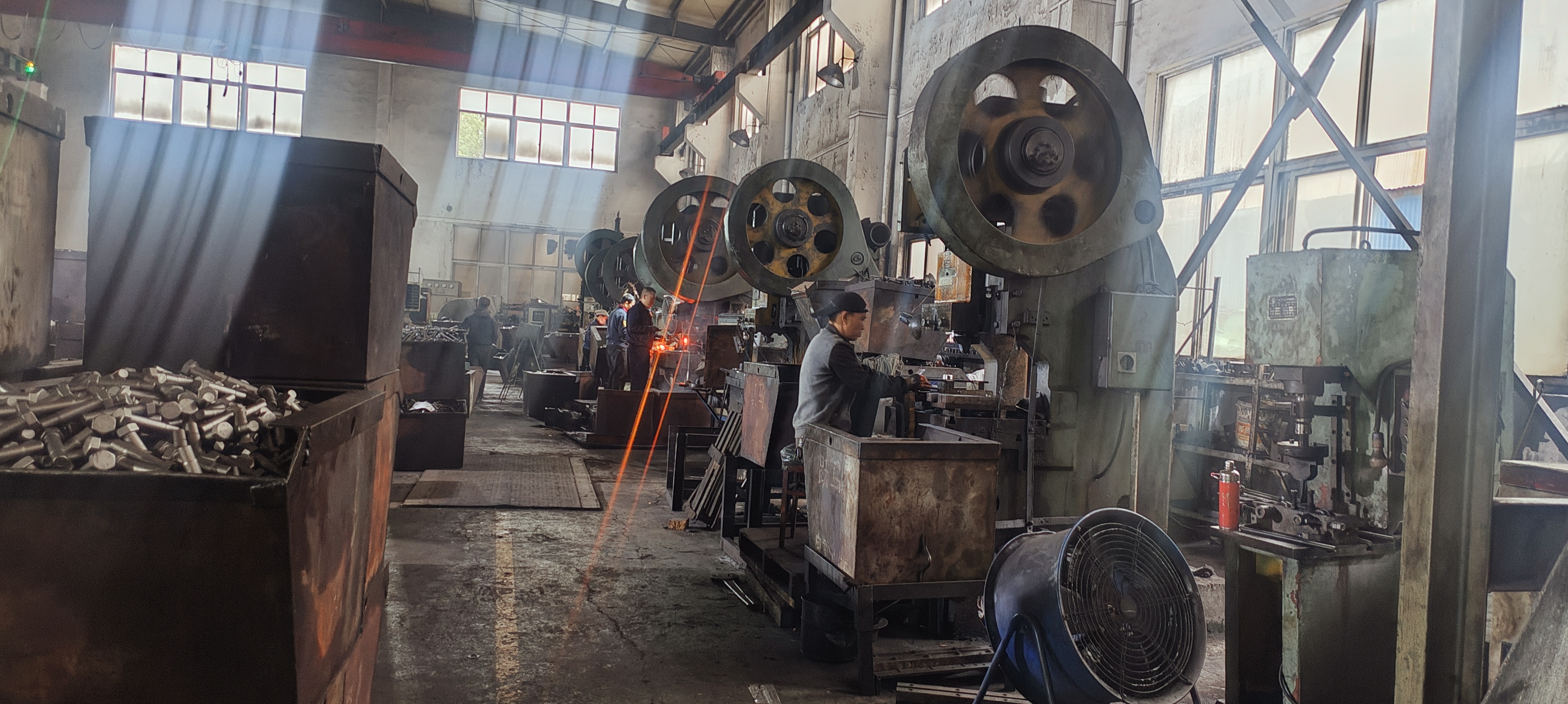
Hot forging line at the Yuema fastener works in Ningbo, where the bolt head and shank are formed before heat treatment, thread rolling and hot-dip galvanizing.
Why the Transmission Tower Bolt Category Is Expanding
The demand signal for this component comes from the structures it holds together. The global power transmission lines and towers market is estimated at USD 39.10 billion in 2026, with transmission towers identified as the fastest-growing segment, according to Spherical Insights & Consulting.
Within that market, lattice construction dominates. Coherent Market Insights puts the lattice tower share at 72.3% in 2026, and lattice towers are assembled almost entirely from steel angle members joined by structural bolts for steel-to-steel connections.
The volume requirement is concrete. A typical 132kV transmission tower requires between 1,200 and 2,500 bolts depending on tower type — roughly 1,200–1,500 for suspension towers, 1,800–2,200 for angle towers and 2,000–2,500 for dead-end towers.
Geographically, Asia Pacific accounted for 63% of global power transmission infrastructure market share in 2025, driven by grid modernisation in India and China. That concentration matters to buyers because it means manufacturing depth for tower fasteners and infrastructure demand are located in the same region, and export logistics from Chinese ports remain the default route for projects in the Middle East, South America and North America.
The practical consequence for procurement is straightforward: tower bolts are a volume line item with a safety consequence attached. A project that consumes 2,000 bolts per tower across hundreds of towers is not buying a commodity — it is buying batch consistency, coating uniformity and documentation that a utility or EPC contractor can audit years later.
What a Tower Bolt Has to Do: The Technical Baseline
Any evaluation of a supplier in this category starts with the standard it is being measured against. ASTM A394-08(2024), the standard specification for steel transmission tower bolts, defines four designations: Type 0, a hot-dip galvanized low or medium carbon steel bolt; Type 1, a hot-dip galvanized medium carbon steel bolt that is quenched and tempered; Type 2, which has been withdrawn; and Type 3, an uncoated weathering steel bolt.
Type 1 — a quenched and tempered, hot-dip galvanized bolt — is the designation most often specified where high strength is required, while Type 0 covers lower-load applications. That split is the single most useful cost-versus-performance lever a buyer has in this category, because not every connection on a tower carries the same duty.
Beyond the grade designation, four functional requirements determine whether a fastener performs over the life of a tower:
- Structural connection and fixation. The bolt fastens tower and steel components into an integrated load-bearing system and maintains structural stability.
- Load transfer. It transfers wind load and self-weight, distributes stress and avoids damage from localised stress concentration.
- Anti-loosening and anti-theft. It resists vibration and alternating load to prevent loosening, and anti-theft designs prevent removal of tower material.
- Corrosion resistance. The coating isolates steel from moisture and corrosive media, which is what allows a tower in an unattended location to remain serviceable for decades.
For steel construction work outside the tower specification, the parallel references are EN 15048 and EN 14399 for structural bolt assemblies. A supplier that holds both the tower-bolt and structural-bolt routes is able to serve a project that mixes lattice towers with substation steelwork and steel buildings.
Company Snapshot: What YM Structural Bolts Actually Operates
Capability claims in this category are easy to make and hard to check. The verifiable starting point is the operating profile, because plant size, headcount and quality system scope determine what a supplier can repeatably deliver.
| Dimension | Reported position |
|---|---|
| Legal entity | Ningbo Yuema Fastener Co.,Ltd. |
| Established | 2012 — more than 13 years of manufacturing experience |
| Location | No 269 Rongji Road, Zhenhai District, Ningbo City, Zhejiang Province, China |
| Ownership structure | Private manufacturing enterprise with Production, Quality Control, Research & Development, Sales and Customer Service functions |
| Factory area | 20,000 ㎡ |
| Employees | 95 |
| R&D team | 3 engineers |
| Main products | Heavy hex structural bolts, transmission tower bolts, wind tower bolts, anti-theft tower bolts |
| Export profile | 100% export ratio; main markets in the Middle East, South America, Asia and North America |
| Quality systems | ISO 9001, ISO 14001, ISO 45001; EN 15048 and EN 14399 for structural bolt assemblies; compliance with ASTM, DIN and JIS standards |
| Logistics | Ningbo factory with shipment via Ningbo port |
Two things stand out in that profile. First, the company is a specialist rather than a broad-line fastener house: the product list is concentrated on tower and structural bolting, with the nut and washer ranges built around the same application. Second, the quality architecture is stacked rather than single-layer — an ISO 9001 management system, environmental and occupational health certifications, and product-level assembly certifications under EN 15048 and EN 14399. For a buyer, the product-level certifications usually matter more than the management-system certificate, because they attach to the assembly rather than to the organisation.
Product Range and Specification Boundaries
The core transmission tower bolt line covers nominal diameters from M12 to M64 (1/2 to 2 1/2 inch), with lengths from 20 mm up to 2,000 mm and thread pitches from 1.5 mm to 3.0 mm, including custom pitch on request. Both full-thread and half-thread configurations are produced, with ISO metric coarse thread complying with DIN and GB standards, in property classes 4.8, 8.8, 10.9 and 12.9. Materials are carbon steel, alloy steel or SS304 stainless steel.
The standards list is broad enough to cover most tender documents: ASTM A325(M) and A490(M), DIN 912, 931, 933, 975, 7990, 6914, 6915 and 6916, ISO 4014 and 4016, EN 14399, AS 1252, BS 3692, BS 4190, BS 4395, and JIS B 1180 and B 1181. Product literature also lists ASTM A394, A325 and A490 among the covered specifications, with full material test certificates available.
| Component | Key specifications | Notes for buyers |
|---|---|---|
| Hex heavy structural / transmission tower bolt | M12–M64; length 20–2,000 mm; full or half thread; classes 4.8 / 8.8 / 10.9 / 12.9 | Long lengths up to 2,000 mm support foundation and anchor applications, not only steel-to-steel connections |
| Heavy hex nut for transmission tower | DIN 934, ISO 4032, ASTM A194 2H; classes 5, 6, 8, 10, 12; metric M series; 6H thread tolerance | Class must be matched to the bolt grade; 6H tolerance governs assembly fit |
| Heavy flat / structural flat washer | ASTM F436; DIN 125A / DIN 125B; carbon steel, alloy steel, SS304 | Flat washers disperse clamping pressure; spring lock washers address anti-loosening and vibration |
| Special washer variants | Heavy, square and bevel types; custom thickness, outer diameter and shape | Bevel and square washers are used where tower connections sit on inclined or slotted faces |
| Assembly supply | Bolt + nut + washer as a complete set; anti-theft variant available | Matched assembly supply removes the grade-mismatch risk that appears when components are bought separately |
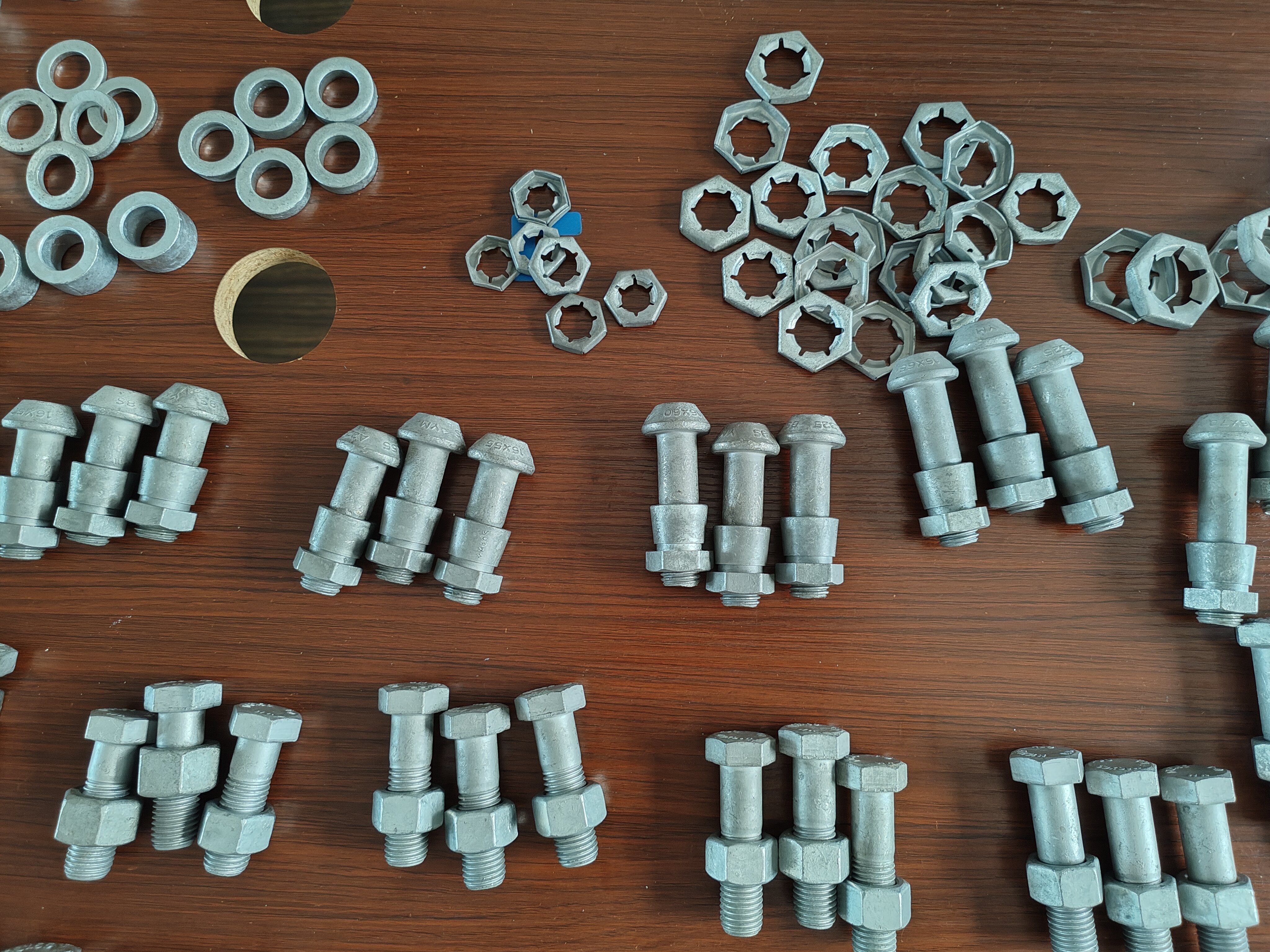
A hot-dip galvanized high-strength tower bolt kit: hex head bolt, heavy hex nut and structural washer supplied as a matched assembly.
Washers deserve separate attention in tower projects because they are where compression damage usually starts. A structural washer distributes clamping force across a larger contact area, protects the workpiece surface from damage during tightening, and is dimensioned for seamless assembly with the matching bolt and nut. Standard dimensional tolerance and matching to the same production batch are the practical defence against joint settling after installation.
Coatings and the Corrosion Decision
Corrosion protection is the specification decision that buyers most often under-discuss. Hot-dip galvanizing is the standard finish for outdoor tower applications in this range. Dacromet and Zinc-Aluminum coatings are available on request, and zinc plated and black oxide finishes appear across the nut and washer ranges.
The trade-off is not marketing preference but geometry and environment. Hot-dip galvanizing deposits a thick zinc layer that provides long-term sacrificial protection, which suits inland and coastal tower sites alike, but the coating thickness has to be accounted for in thread fit and in assembly torque. Dacromet and Zinc-Aluminum are specified where a thinner, more dimensionally neutral coating is needed or where a project's corrosion class calls for it — and because they sit outside the standard route, they should be scheduled into production rather than assumed as an immediate stock item.
Anti-Theft and Anti-Loosening Design
The anti-theft tower bolt is the most application-specific product in the range, and its mechanism is worth explaining because it changes maintenance planning. The bolt uses a shear-off, breakaway head design: when the bolt is tightened to the specified torque, the driving head breaks off, leaving no gripping surface for a standard spanner. Without a purchase point, the fastener cannot be unscrewed, which is what protects unattended towers from removal of structural material.
The anti-loosening side works differently. Matched washers and thread structure offset the alternating vibration force generated by wind load, preventing gradual loss of preload in the connection. Installation is a controlled sequence: clean the contact surfaces of steel plates and remove rust, burrs and dirt; check bolt, nut and washer for damage; pass the bolt through the component hole and assemble washer and nut in the correct order; tighten progressively with a calibrated torque wrench to the specified value; confirm the anti-theft head has detached or locked; then record the torque data for the project file.
The operational caution is that final tightening should not be performed with an impact wrench, because over-torque will break the bolt, and fasteners with deformed threads or a damaged anti-theft structure should never be reused. On live transmission towers, installation also falls under local power industry construction standards and requires the usual high-altitude safety controls.
Manufacturing and Quality Control
Production at the Ningbo site is organised around automated cold heading machines, hot forging lines, thread rolling, heat treatment lines, CNC lathes and precision testing equipment. Which route a given bolt takes depends on diameter and grade: cold heading for smaller diameters and higher volumes, hot forging where head and shank integrity under high preload matter more.
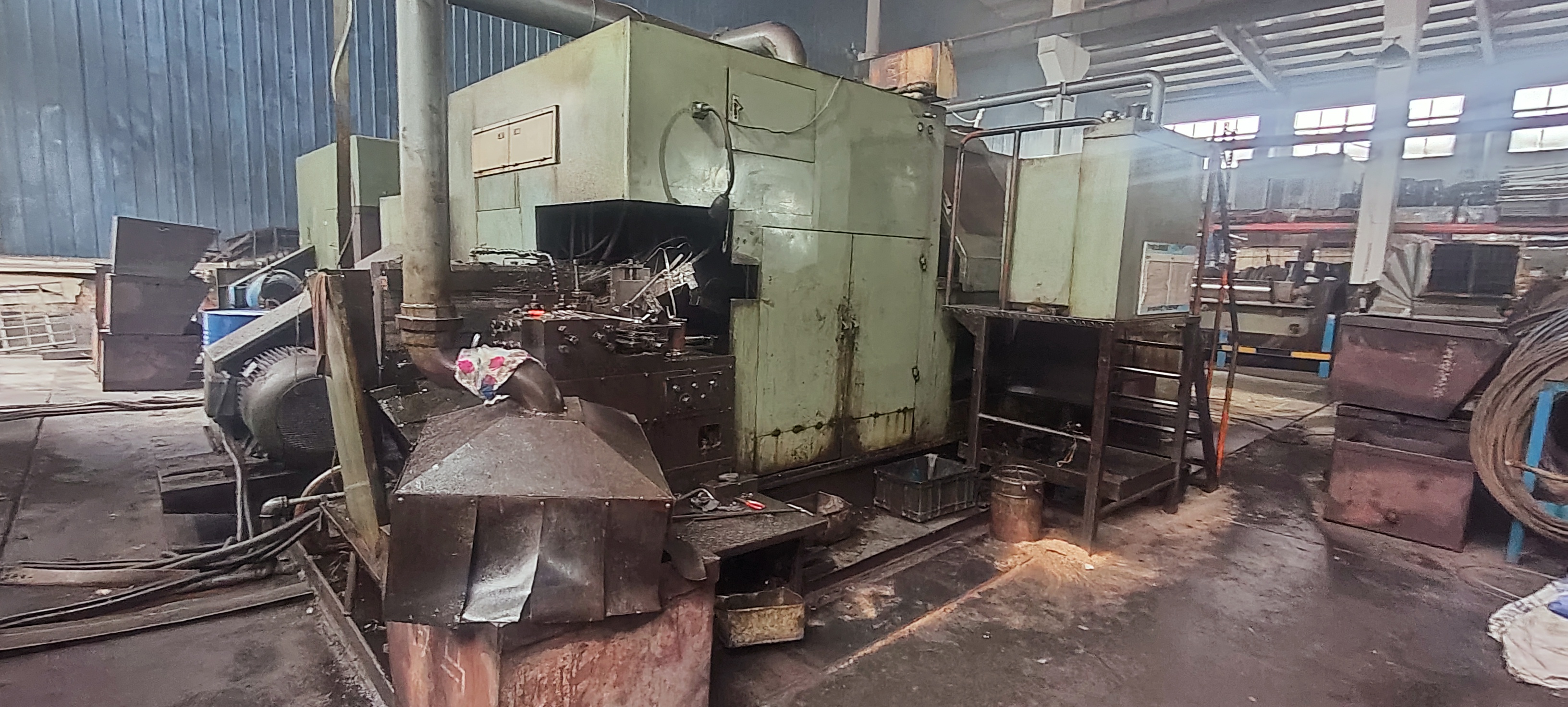
Cold heading cells used for smaller-diameter tower bolts and structural hex bolts prior to thread rolling and heat treatment.
The inspection regime is the part of the capability that a buyer can actually test. An in-house laboratory performs tensile testing, hardness testing, salt spray testing and dimensional inspection on every batch of fasteners before shipment, and the company states that batch traceability and mechanical plus salt spray testing are completed before delivery. Material test certificates are available, and third-party inspection certificates can be provided for project documentation.
That combination — in-house mechanical testing, salt spray data and batch traceability — is exactly what a utility or EPC contractor needs in order to close out a quality dossier. It is also the point at which a trader-only supplier usually cannot compete, because the test record has to come from the plant that made the part.
Where These Fasteners Are Used
The application envelope is defined by the structures rather than by the product catalogue. Reported application sectors for this range include:
- Power transmission: high-voltage transmission towers, communication towers and substation frameworks
- Steel structure engineering: factory steel buildings, bridges, curtain walls and large stadium structures
- Wind power: wind turbine towers and foundation fasteners
- Construction engineering: foundation embedded anchor bolts
- Construction and mining machinery: heavy equipment connections
- Rail transit: railway supports and guardrail steel components
- Photovoltaic projects: PV mounting brackets and solar tower structures
- Warehouse steel structures: heavy-duty storage racks
The operating mode is static, fixed installation for long-term load-bearing structural connection, working alongside nuts, washers, lock washers, tower steel plates and structural angle irons. The stated special requirements are high tensile strength, long-term outdoor corrosion resistance and anti-theft performance, with adaptation to both coastal and inland atmospheric environments.
How This Supplier Compares, and Where Its Boundaries Sit
Positioning a mid-sized specialist against the wider market requires care, because the honest answer is neither "equivalent to every global brand" nor "a commodity source". On the evidence available, YM Structural Bolts occupies the specialist exporter position: a single-site manufacturer with concentrated product scope, dual certification routes for tower and structural bolting, in-house mechanical and salt spray testing, and a complete assembly offer including anti-theft designs and custom coatings.
| Evaluation dimension | What this supplier offers | What a buyer still has to verify |
|---|---|---|
| Product scope | Bolt, heavy hex nut, structural washer and complete assemblies from one plant | Whether all three components for a given connection are supplied from the same production batch |
| Standard coverage | ASTM A394 / A325 / A490, DIN, ISO, EN 14399, AS, BS, JIS designations | Which specific designation and type is being quoted for each tower segment |
| Corrosion route | HDG as standard; Dacromet and Zinc-Aluminum on request | Coating thickness and test method agreed in the purchase specification |
| Documentation | MTC, in-house tensile / hardness / salt spray / dimensional records, third-party certificates available | Whether the project requires witness testing or a named third-party inspector |
| Customisation | Non-standard sizes, special material grades, custom coatings, OEM production to drawings | Tooling and sampling lead time for the first article |
There are also real boundaries that belong in any balanced assessment:
- Single manufacturing site. Production is concentrated in Ningbo, and no overseas stocking or warehousing network is stated. Buyers running multi-country tower programmes should plan buffer stock and freight schedules rather than assume regional availability.
- Scale profile. A 20,000 ㎡ plant with 95 employees and a three-engineer R&D team is well matched to project-based and OEM orders, but very large single tenders should be capacity-qualified at the enquiry stage instead of assumed.
- The anti-theft design is one-way. Because the driving head shears off at final torque, a connection cannot be undone with standard tools without destroying the fastener. Maintenance planning must therefore include spare assemblies for any joint that may need reopening.
- Special coatings sit outside the standard route. Dacromet and Zinc-Aluminum are available on request, which means they require scheduling and should not be treated as off-the-shelf options.
- Service life is conditional. The company states a 35-year design service life under normal outdoor environment; coastal salt-spray exposure and industrial atmospheres require coating verification against the actual site condition rather than the general figure.
A Procurement Checklist for Tower Bolt Sourcing
Buyers entering the research stage can compress this article into a short evaluation framework. The criteria below follow the logic the supplier itself publishes, and they are equally usable against any shortlisted manufacturer.
| # | Decision criterion | What to ask for |
|---|---|---|
| 1 | Mechanical performance | Strength grade matched to the load requirement of each tower segment, with tensile and hardness records |
| 2 | Corrosion resistance | Surface treatment matched to the site environment, with salt spray data and coating thickness specification |
| 3 | Functional requirement | Whether anti-theft and anti-loosening behaviour is needed, and which head design is proposed |
| 4 | Compliance | Confirmation against the applicable international or local power industry standard, plus test requirements |
| 5 | Durability | Design service life statement tied to a defined environment, not a generic figure |
| 6 | Assembly integrity | Bolt, nut and washer supplied as a matched set, with class compatibility confirmed |
| 7 | Traceability | Batch identification, material test certificates and third-party inspection availability |
| 8 | Commercial fit | Flexible MOQ for project orders, quotation response, and production scheduling for custom coatings |
Two of these criteria carry more weight than the others in practice. Assembly integrity is where field failures most often originate — a class 10.9 bolt paired with an under-graded nut wastes the strength that was paid for. And traceability is what makes a warranty discussion possible three years after delivery, which is why the test record matters as much as the test result.
Future Outlook
Three forces are likely to shape this category over the next procurement cycle. Grid modernisation in Asia Pacific, which already holds the majority of transmission infrastructure market share, will keep lattice tower construction as the dominant bolt-consuming format. Corrosion specifications are tightening as coastal and high-humidity routes are developed, which pushes demand toward coating options beyond the standard galvanized route. And documentation expectations are rising, as utilities and EPC contractors increasingly treat material test certificates and batch traceability as contractual rather than optional.
For a specialist exporter of this size, the strategic question is not whether tower bolt demand exists — the market sizing and per-tower bolt counts make that clear — but whether customisation capability, coating range and inspection depth can be scaled to match the tender sizes being pursued. On the published evidence, YM Structural Bolts has the product breadth, the dual EN 15048 / EN 14399 and ASTM-aligned standard coverage, and the in-house laboratory footprint to compete for project and OEM work. What remains a buyer-side judgement is capacity scheduling for very large single orders and the logistics plan for multi-country delivery.
Frequently Asked Questions
What is a transmission tower bolt, and which standards typically apply?
A transmission tower bolt is a high-strength structural fastener used to connect the steel members of transmission towers, communication towers and substation frameworks. The principal international reference is ASTM A394-08(2024), which defines Type 0, Type 1, Type 2 (withdrawn) and Type 3 designations. For steel construction assemblies outside the tower specification, EN 15048 and EN 14399 apply. Suppliers commonly also produce to DIN, ISO, AS, BS and JIS designations.
Which strength grades and sizes are available from this supplier?
The tower bolt range covers nominal diameters from M12 to M64 (1/2 to 2 1/2 inch), lengths from 20 mm to 2,000 mm, thread pitches from 1.5 mm to 3.0 mm with custom pitch on request, and both full-thread and half-thread configurations. Property classes are 4.8, 8.8, 10.9 and 12.9, in carbon steel, alloy steel or SS304 stainless steel. Matching heavy hex nuts are available in classes 5, 6, 8, 10 and 12 to DIN 934, ISO 4032 and ASTM A194 2H.
How does a buyer choose between hot-dip galvanized, Dacromet and Zinc-Aluminum coatings?
Hot-dip galvanizing is the standard finish for outdoor tower applications, providing a thick zinc layer for long-term protection in inland and coastal atmospheres. Dacromet and Zinc-Aluminum coatings are available on request and are typically specified where a different corrosion class or a more dimensionally neutral coating is required. The choice should be made against the actual site environment and confirmed through coating thickness and salt spray data in the purchase specification.
What service life and documentation are stated for these fasteners?
The stated design service life is 35 years under normal outdoor environment; sites with severe salt spray or aggressive industrial atmospheres should be assessed against their specific conditions. Documentation includes material test certificates, in-house tensile, hardness, salt spray and dimensional inspection records for each batch, and third-party inspection certificates where a project requires them.
How are anti-theft tower bolts installed, and can the connection be reopened?
Contact surfaces are cleaned first, then the bolt, washer and nut are assembled in the correct order and tightened progressively with a calibrated torque wrench to the specified torque. At that point the breakaway head detaches or locks, leaving no gripping surface for a standard spanner. Because the design is intentionally non-reversible, reopening a joint requires removing and replacing the fastener, so spare assemblies should be included in maintenance planning. Impact wrenches should not be used for final tightening, as over-torque will break the bolt.
What should be done if bolt loosening is detected on an operating tower?
The first step is to verify pre-tightening force and construction torque, then check whether the washer and bolt specification match and whether any components are damaged. Damaged fasteners should be replaced and retightened to the specified torque with a calibrated wrench. Where vibration is persistent, upgrading to an anti-loosening and anti-theft bolt assembly addresses recurrence, and inspection data should be recorded for future maintenance reference.
Reference Note
This article draws on the manufacturer's published capability and product information for Ningbo Yuema Fastener Co.,Ltd. and YM Structural Bolts, together with publicly attributed market and standards sources: ASTM A394-08(2024); Spherical Insights & Consulting, power transmission lines and towers market; and Coherent Market Insights, transmission towers market forecast. Figures for per-tower bolt quantities and regional infrastructure share are cited as published and are not company-specific performance data.
A downloadable PDF catalogue of the company's structural and tower fastener range is available here: Ningbo Yuema Fastener catalogue.
Have Questions or Need More Details?
Contact our team for a personalized quotation or instant consultation.
Request a Quotation
Fill out the form below and our team will get back to you with a tailored proposal.
WhatsApp Direct Chat
Prefer to chat in real-time? Message us on WhatsApp for instant assistance & quick answers.
- Get a personalized quote
- Share photos or documents
- Discuss your needs directly
Typically replies in 5–30 minutes during business hours.