
Transparent Resin Bathtubs: Specs, Pricing and Limits
A transparent resin bathtub is a one-piece cast bath body whose principal material is high-transparency resin, producing a semi-transparent or fully see-through appearance rather than the opaque, stone-like surface of a solid surface tub.
That definition already changes the procurement conversation. Transparency is a visible property, and visible properties make production quality legible at the point of installation in a way that a datasheet cannot. Before a buyer compares quotations, the useful questions are narrower: what the model actually specifies, how the material behaves over a service life, how heavy the order is to ship, and where the certification coverage stops.
This reference uses JINGZUN bathtub model JZ8621 as its anchor, because the model is documented across specification, pricing, packing and conformity records rather than in marketing copy alone.
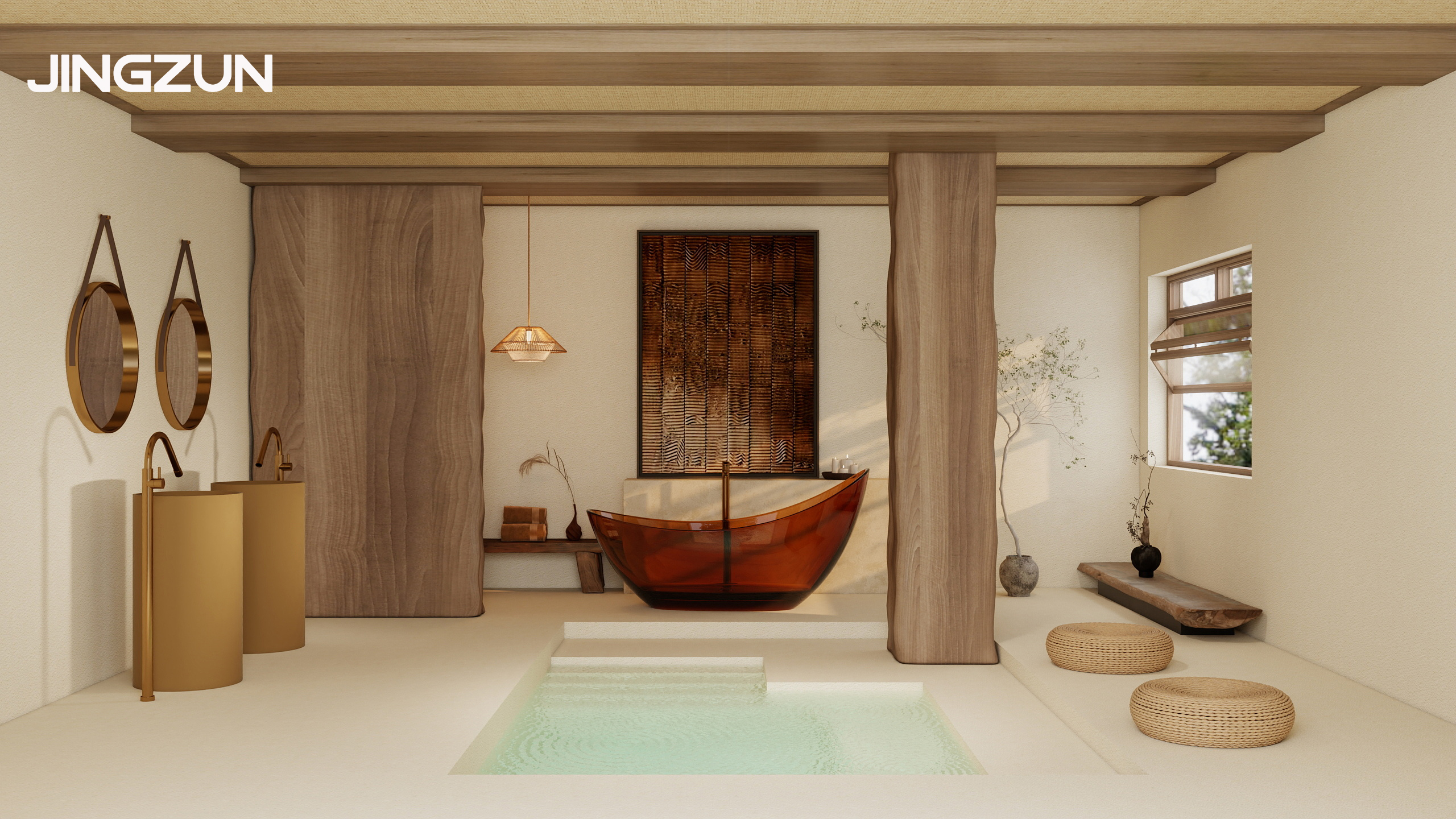
JZ8621 freestanding transparent resin bathtub, 1860 x 780 x 940 mm, 240 L capacity. Image: JINGZUN Sanitary Ware.
Why transparent resin sits in its own sourcing category
In most catalogues, stone-like bathtubs are grouped under one broad family: solid surface, artificial stone, composite stone, stone resin, engineered stone, polystone, cultured marble. At the listing level they look like siblings. At the manufacturing level they are not.
A solid surface bathtub is built from a mineral and resin composite — JINGZUN's own solid surface bath bodies use aluminium powder combined with resin. A transparent resin bathtub starts from a different premise: resin is the principal material, and the absence of the opaque mineral load is what allows light to pass through the body. The visual result is the point of the product, but it is also the reason the surrounding parameters diverge.
Hardness changes. Repair method changes. Loading density per container changes. Price band changes. A buyer who carries solid surface assumptions into a transparent resin specification will either overestimate durability or underestimate freight.
The real constraint: transparency does not hide defects
An opaque, matte surface absorbs small imperfections. A clear surface does not. That single physical fact is the most consequential difference between the two categories, and it is the one most often missing from supplier presentations.
JINGZUN states that its transparent resin bathtubs use a coating-free process in order to preserve the natural clarity of the resin. The trade-off is structural rather than cosmetic: without a coating, a finished bath body cannot be visually corrected by spraying an opaque layer over it. Surface quality has to be held at the casting and polishing stage. Conversely, JINGZUN notes that some manufacturers apply coatings to conceal production defects and scratches, and that such coatings can reduce the transparency the buyer is paying for.
For an evaluation-stage buyer, this converts into a specific request rather than a general question about quality. Ask the supplier whether the clarity comes from an uncoated, polishable surface or from a coating. Both answers are commercially available; only one is maintainable in the field, because minor scratches on an uncoated resin surface can be repaired by polishing. Deep scratches are a different matter and need professional treatment by the manufacturer.
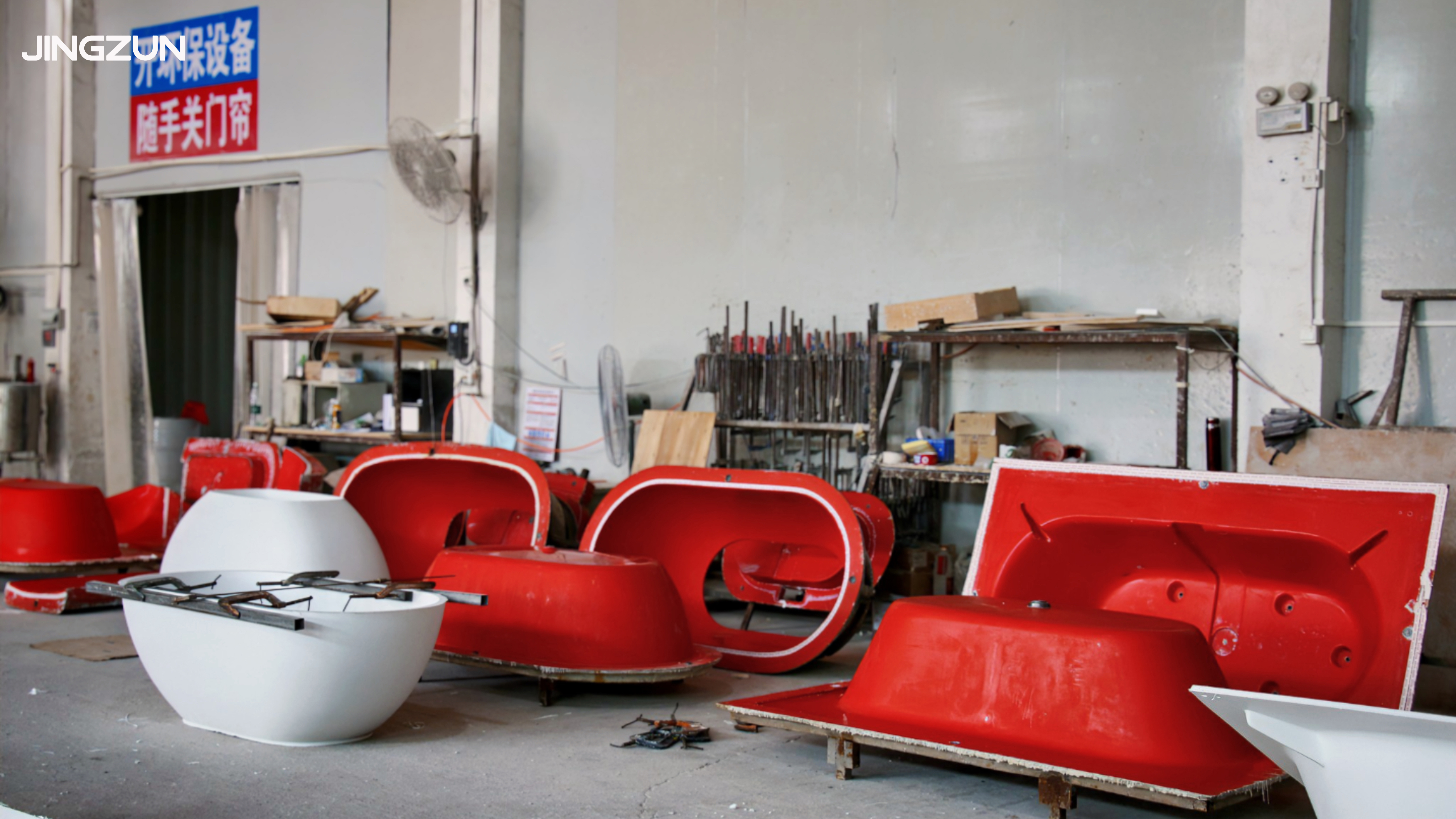
Casting stage in JINGZUN's bath body production. Surface quality in a transparent tub is set here, not at final inspection.
What JINGZUN actually offers in transparent resin
JINGZUN (Huizhou Jingzun Sanitary Ware Co., Ltd.) is a sanitary ware manufacturer founded in 2007 and based in Huizhou, Guangdong Province, producing solid surface, resin and PMMA solid surface bath products for overseas markets from a 12,000 m² facility with roughly 100 employees.
On the transparent resin side, the production line reports a monthly capacity of 800 units, with a quoted lead time of 35–40 days for transparent resin bath products. Customisation covers size, shape, transparency grade, tint colour, surface polish, logo printing and drainage position — the parameters that determine whether a transparent tub can follow a hotel's design intent or has to be selected from a fixed range. Minimum order quantity is 18 pcs for bathtubs and 30 pcs for basins. Quality control is 100% pre-shipment inspection, with third-party inspection available. After-sales coverage is remote technical support plus a 5-year warranty.
Finished goods are packed in a fully enclosed wooden crate, and a drain is included as standard with the transparent resin bathtub.
JZ8621 on the datasheet
The model that carries most of the documented evidence in this category is JZ8621. Its published parameters are the practical starting point for a comparison sheet.
| Parameter | JZ8621 transparent resin bathtub |
|---|---|
| Material | Resin |
| Overall dimensions | 1860 x 780 x 940 mm |
| Bath capacity | 240 L |
| Colour | Customisable across the full colour range; 14 standard production colours |
| Surface | Coating-free finish; minor scratches repairable by polishing |
| Surface hardness | 40 HBa |
| Drain | Included as standard |
| Packing | Fully enclosed wooden crate |
| 40HQ loading capacity | 26 pcs |
| MOQ | 18 pcs per bathtub model |
| Regular production lead time | Approx. 35 days (line quotation 35–40 days) |
| Sample lead time | 7–15 days |
| New mould development | 25 days, plus 7 days for first-sample confirmation |
| Indicative price | USD 750–970 for standard models; large round models quoted higher |
| Warranty | 5 years |
Two rows in that table deserve attention before anything else is discussed. The first is the 26 pcs per 40HQ loading capacity — that is the documented shipping density of the transparent resin line, and because the body size is fixed at 1860 x 780 x 940 mm, container density translates directly into freight cost per unit. The second is the price band itself: USD 750–970 for standard models, with large round models priced above that range because they consume more material.
What the CE record on JZ8621 does and does not cover
The conformity trail for this model is specific enough to inspect. JINGZUN's records associate JZ8621 with CE test report SHHG1504013916PL, issued by SHHG and dated 19 May 2015, referencing EN 14516:2006+A1:2010 for the EU market. EN 14516 is the European standard covering cleanability and durability of baths for domestic use.
What that establishes: a test report exists that links the model designation JZ8621 to a European bath standard, and the report is identifiable by number and date rather than by a logo alone.
What it does not establish is just as important for an evaluation-stage decision:
- A report dated 2015 does not automatically extend to colour variants, transparency grades or structural details introduced afterwards. Scope must be confirmed against the current catalogue.
- It does not address North American market access, which runs through a different conformity system entirely.
- It does not cover performance characteristics that EN 14516 was never written to test — including scratch resistance and UV stability, which are documented separately in the product's own material data.
Transparent resin versus solid surface: what buyers actually trade off
The two categories are not competing for the same specification line in most projects. Where they do overlap — a hotel guest bathroom, a designer residence, a premium apartment fit-out — the trade-offs are concrete and can be placed side by side.
| Comparison point | Transparent resin (JZ8621) | Solid surface (JZ8628) |
|---|---|---|
| Surface hardness | 40 HBa | Approximately 55 HBa |
| Surface construction | Coating-free, polishable | Matte, homogeneous, sandable |
| 40HQ loading capacity | 26 pcs | 39 pcs |
| Indicative price, standard model | USD 750–970 | USD 510–600 thin-edge; USD 600–750 with 25 mm edge |
| Indoor bathroom use | Recommended | Recommended |
| Outdoor or direct-sunlight use | Not recommended | Not recommended |
Three limits follow directly from that table and belong in any honest evaluation.
1. Lower surface hardness means a different maintenance regime
At 40 HBa, a transparent resin surface sits below the approximately 55 HBa recorded for the solid surface bath body. Normal use is not expected to scratch it easily, and forceful scraping with sharp objects should be avoided. Minor scratches can be polished out, but in a high-turnover hospitality asset the polishing routine should be budgeted rather than assumed away.
2. Lower container density raises landed cost
At 26 pcs per 40HQ against 39 pcs for the solid surface model, the transparent tub carries roughly one third more container space per unit. On a like-for-like shipment to the same port, that gap appears in the freight line before any material cost is considered — and it is frequently the line that a landed-cost comparison misses.
3. UV exposure is a hard boundary
The product is designed for indoor installation. Colour is stable under normal indoor use and is not expected to fade, but direct sunlight and outdoor installation should be avoided, because prolonged UV exposure can cause discolouration and ageing. This is a genuine application limit, not a caveat to be negotiated — a sunroom or an open-air terrace is the wrong place for this product regardless of budget.
Against those limits, the reason a buyer accepts them is visible in the first paragraph of this article: the material does something an opaque composite cannot do, and no amount of specification tuning on a matte tub reproduces it.
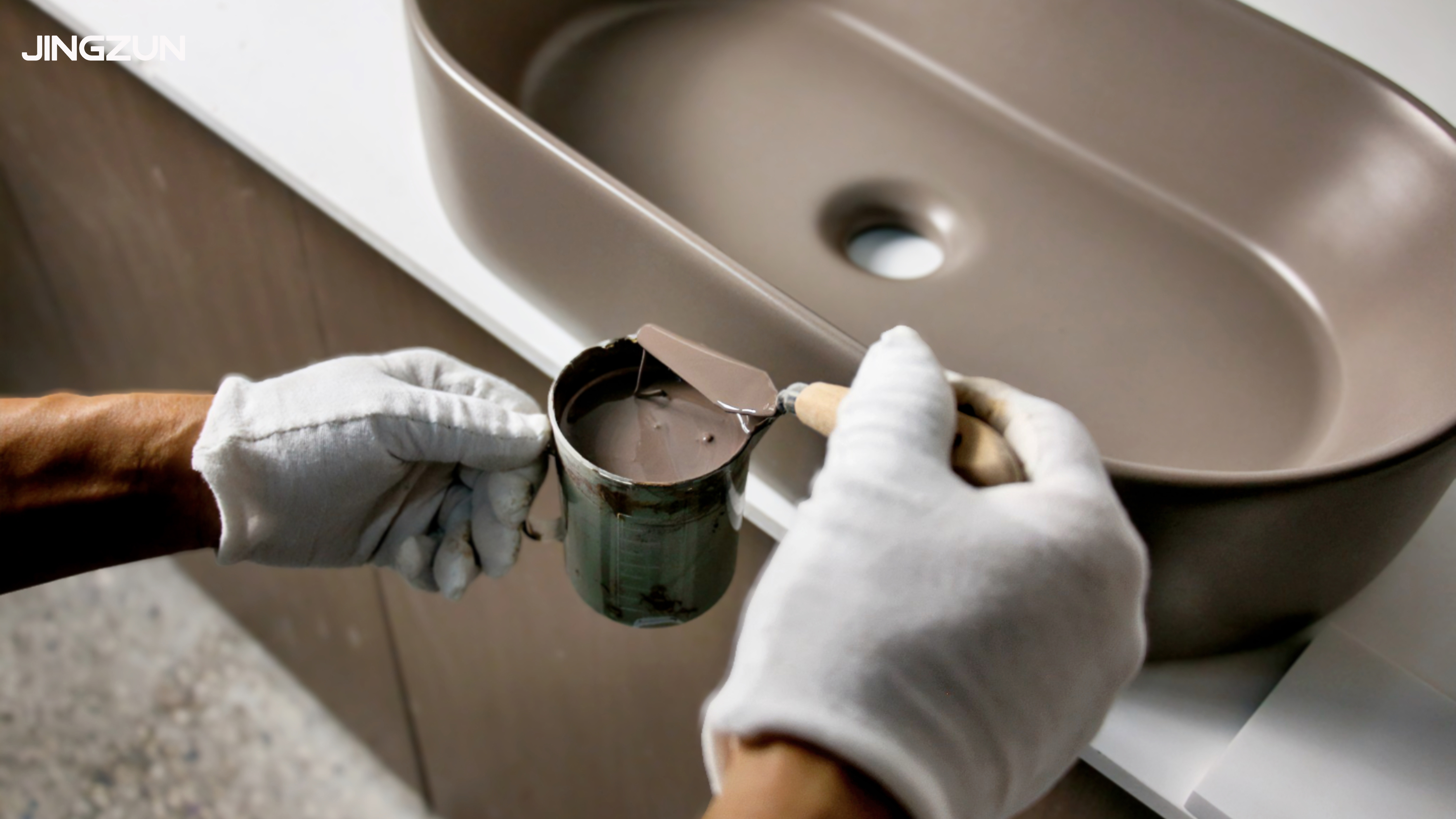
Colour mixing stage. Transparent resin is available in 14 standard colours, with custom tints developed to project requirements.
Where a transparent resin bathtub actually fits
The documented application profile for this product family is narrow and specific, which is useful rather than limiting. It is specified for indoor bathrooms under high humidity and controlled temperature, in projects described as luxury hotel bathroom fit-outs, villa restroom customisation and high-end apartment renovation.
The functional requirements listed alongside those applications are unusually precise, and they double as a handover checklist: high light transmission, uniform transparency, anti-yellowing, impact resistance, and avoidance of heavy abrasive cleaners. Matched equipment is a bath mixer tap, a waste and overflow set, and a bathroom waterproofing system.
The commercial logic behind the fit is straightforward. A transparent tub is a visual object in a room that is otherwise built from opaque surfaces. Boutique hotels, designer residences and commercial spaces where atmosphere is part of the guest proposition are the settings where that object earns its place. In a standard residential bathroom with no lighting design to work with, the same tub reads as an expensive opaque one.
Market signals and what they mean for this niche
The broader demand picture is documented, and it is worth separating from the transparent resin niche.
- The global bathtub market was valued at USD 13.36 billion in 2026 and is projected to expand to USD 20.74 billion by 2034 (Grand View Research, report dated July 2026).
- Freestanding bathtubs are projected to grow at the fastest CAGR of 7.2% through 2034, driven by luxury bathroom renovations.
- In international trade, HS code 3922.10 is the primary classification for plastic and composite bathtubs.
These figures describe freestanding demand, not transparent resin demand. Transparent resin remains a small, design-led subset of the composite bathtub category — the majority of freestanding tubs sold into the same projects are still opaque. The practical implication for a buyer is that freestanding growth supports the format, while the transparency decision remains a per-project design choice rather than a market trend to follow.
Future outlook
Two forces look likely to shape this niche over the next planning cycle. The first is verification pressure: as more transparent tubs enter hospitality projects, the difference between a coating-free body and a coated one becomes a service-cost issue rather than a marketing one, and buyers will increasingly ask for polishable surfaces as a specification item rather than a preference. The second is documentation. Model-level conformity records, report numbers and scope statements will carry more weight in supplier selection than catalogue imagery, simply because a transparent product invites visual comparison and rewards documentary comparison.
For manufacturers, the constraint is unchanged: transparency exposes process quality. For buyers, the corresponding discipline is to evaluate the surface, the loading density and the conformity scope before evaluating the appearance.
Frequently asked questions
What is a transparent resin bathtub?
A transparent resin bathtub is an artistic bathroom product cast in one piece using high-transparency resin as its main material. It has a see-through visual effect and is mainly intended for indoor settings that emphasise spatial design, such as upscale guesthouses and designer hotels.
How hard is a transparent resin bathtub, and does it scratch easily?
The hardness of a transparent resin bathtub is 40 HBa. It is not easily scratched during normal use, but forceful scraping with sharp objects should be avoided. Minor scratches can be repaired by polishing.
Will a transparent resin bathtub fade or discolour over time?
It will not fade under normal indoor use. Direct sunlight and outdoor use should be avoided, because long-term UV exposure can cause discolouration and ageing.
Does a transparent resin bathtub have a surface coating?
JINGZUN's transparent resin bathtubs use a coating-free process to preserve the material's natural clarity. Some other manufacturers use coatings to hide production defects and scratches, which can reduce transparency. The coating-free process is intended to maintain the clear appearance of the resin itself.
What colours are available, and can a custom colour be requested?
There are 14 standard production colours for transparent resin bathtubs. Custom colours are available, with the additional cost and lead time depending on the specific colour and customisation requirements.
What is the price and production lead time for a transparent resin bathtub?
Standard transparent resin bathtubs cost USD 750–970. Large round models cost more because they require more material. Regular production orders take 35 days, sample orders take 7–15 days, and new mould development takes 25 days plus 7 days for first-sample confirmation.
Does a transparent resin bathtub include a drain, and how is it packaged?
A drain is included as standard with the transparent resin bathtub. Standard packaging uses a fully enclosed wooden crate to protect the product during transport.
What is the warranty period for a transparent resin bathtub?
The transparent resin bathtub comes with a 5-year warranty.
Reference material
Full model specifications, material options and colour ranges across the JINGZUN solid surface and transparent resin ranges are compiled in the downloadable JINGZUN product catalogue (PDF).
Have Questions or Need More Details?
Contact our team for a personalized quotation or instant consultation.
Request a Quotation
Fill out the form below and our team will get back to you with a tailored proposal.
WhatsApp Direct Chat
Prefer to chat in real-time? Message us on WhatsApp for instant assistance & quick answers.
- Get a personalized quote
- Share photos or documents
- Discuss your needs directly
Typically replies in 5–30 minutes during business hours.