
Travel Makeup Bag Spec Sheets: Compliance and Qualification
A travel makeup bag is a small textile product, but its compliance profile is decided by a short list of variables: fabric composition, declared dimensions, net weight, closure and handle construction, and the classification the product carries on its technical file and commercial documents. Buyers who read those variables as a specification rather than as catalogue copy can qualify a supplier before a single sample is cut.
For the Travel Makeup Bag model GS-MB-001 from Great Shine Houseware Ltd., the documented specification is 20 x 15 x 8 cm, 0.2 kg net weight, zipper closure, foldable construction, geometric pattern, produced in 600D Oxford Fabric, Canvas, Eco-friendly TPU, PVC or custom fabric, with a full OEM/ODM customization scope. The same record states BSCI certification number 91340828MA2NWKUP62 for the EU market, issued by the European Association for Foreign Trade on 27 April 2025 with an expiry date of 30 April 2026.

Why the spec sheet, not the catalogue, is the compliance document
Most travel makeup bag enquiries begin with a photograph and a target price. That sequence places qualification last, where it is expensive to correct. A usable specification sheet answers four questions before price becomes meaningful: what the product is made of, what its declared dimensions and mass are, how it closes and carries, and under which certification or classification it is sold.
Compliance risk in soft goods rarely sits in the numbers themselves. It sits in claims that cannot be traced, such as eco-friendly, premium Oxford or reusable grade, and in certificates whose scope, market and validity window are never checked against the purchase order. Both problems are solved the same way: read the technical file the way a specifier would, and request the missing evidence by name rather than by adjective.
Dimensions and net weight: what 20 x 15 x 8 cm and 0.2 kg commit a supplier to
A stated size of 20 x 15 x 8 cm is an external, nominal measurement of a soft item. It tells the buyer the bag is compact and hand-carry format, and it sets the packing footprint for carton planning. It does not, on its own, describe usable interior volume, because the fabric is flexible and the zip opening reduces the accessible space. Treated arithmetically as a rigid box, the dimensions describe 2,400 cm3, or roughly 2.4 litres; the practical fill volume of a soft, zip-closed bag is lower.
The 0.2 kg net weight matters for two commercial reasons. First, it is a material-economy signal: it implies a lightweight construction where fabric weight, lining and hardware all trade against durability. Second, it is a logistics input, because freight and postal rates are computed on mass. Buyers should confirm whether the stated net weight includes the zipper puller, piping and any internal pocket, since small hardware differences change the declared figure.
Airline cabin allowances are set carrier by carrier and are not harmonised, so a 20 x 15 x 8 cm bag cannot be called compliant with travel standards in general terms. What can be verified is that the declared size is documented, repeatable and consistent between sample, production and invoice. That reproducibility is the part a supplier can actually be held to.
Capacity thresholds published in procurement programmes illustrate why category context matters. One published US state procurement specification for reusable bags requires a minimum volume capacity of 15 litres. That figure is a grocery-bag programme criterion, not a requirement for a travel makeup bag, and applying it to a 20 x 15 x 8 cm cosmetic pouch would be a category error. Thresholds only mean something when the product class, the measurement method and the buying programme are aligned.
| Declared specification | What it establishes | Question to add to the RFQ |
|---|---|---|
| 20 x 15 x 8 cm | External dimensions and packing footprint | Measured flat or filled, and what tolerance applies? |
| 0.2 kg | Net weight and freight input | Does it include hardware, lining and internal pockets? |
| Zipper closure | Closure type and opening behaviour | Which zip tape, slider and puller are specified? |
| Foldable, geometric pattern | Construction and decoration method | Is the pattern printed or woven, and how is wear assessed? |
Materials: reading 600D Oxford, Canvas, Eco-friendly TPU and PVC
The recorded material set for GS-MB-001 is 600D Oxford Fabric, Canvas, Eco-friendly TPU, PVC and custom fabric, with full OEM/ODM customization available. Each option implies a different documentation burden.
In 600D Oxford Fabric, the numeral refers to yarn linear density in denier and Oxford describes a basket-style woven construction. A denier figure characterises the yarn, not the finished cloth, so a buyer who wants a comparable material definition should request fabric weight in grams per square metre alongside the yarn designation. Procurement programmes commonly express material substance this way: one published reusable-bag specification sets a minimum fabric weight of 80 GSM for bags made from recycled PET, non-woven polypropylene or woven polypropylene. That threshold belongs to that programme and those material classes, but it demonstrates the unit buyers should be asking in.
Canvas is a heavier woven option with a firmer hand and a more textile appearance. Where a buyer needs washability and resistance to repeated handling, canvas construction should be supported by a stated weave and weight, not by the word canvas alone.
Eco-friendly TPU is the most documentation-sensitive phrase in the sheet. TPU, thermoplastic polyurethane, is a flexible polymer film used for water resistance and as an alternative to vinyl in many soft-goods applications. The qualifier eco-friendly is a claim, not a specification, and it should be backed by declared recycled content, backing fabric and additive information. The same caution applies to recycled-content statements generally: one published programme requires 50 percent total recycled content and defines how that content is calculated, which shows how much methodological detail a percentage actually carries.
PVC is the clearest example of market dependence. It is a legitimate recorded option for GS-MB-001, yet the same published US state procurement criteria exclude PVC and vinyl from qualifying reusable bags. A buyer selling into a programme with that exclusion would select Canvas, Oxford or TPU instead. Because the specification supports custom fabric under full OEM/ODM scope, material substitution is a sourcing decision rather than a product redesign, but the substitution has to be written into the order, not agreed verbally.
Closure, handle and the classification question
The travel makeup bag is recorded with a zipper closure and a foldable style. The related Travel Storage Bag, a packing cube set, is recorded separately with a zipper closure, a soft handle, polyester material, a 1 kg weight and no trolley rod. Those are two different products with two different construction records, and buyers should not transfer a handle specification from one line to the other. If a handle is required on the makeup bag, it belongs in the written specification.
Handle and capacity requirements in reusable-bag programmes, such as the requirement for at least one handle that does not stretch and is fastened to the bag, exist because those products are loaded and carried repeatedly. A cosmetic pouch is opened and set down. The design standard therefore differs by classification, and the classification itself carries regulatory weight: it determines which test methods, labelling expectations and trade codes apply.
On trade classification, the United Nations Statistics Division documentation for Comtrade records confirms that commodities are identified by numeric code, with six-digit HS codes supported in the data structure. That confirms the mechanism, not the answer: the specific code for a travel makeup bag was not validated in the material used for this article, so buyers should confirm classification with the supplier and a customs broker rather than infer it from a product name.
Certification: how to read a BSCI record correctly
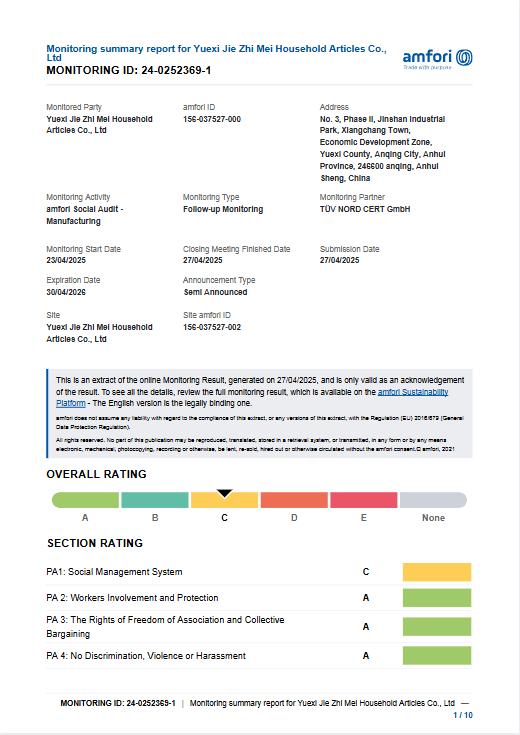
The recorded certification for the Makeup Bags product is BSCI, certification number 91340828MA2NWKUP62, issued by the European Association for Foreign Trade, applicable to the EU market with a recorded scope of ALL. The issue date is 27 April 2025 and the expiry date is 30 April 2026.
Three reading rules follow. First, the expiry date precedes the publication date of this article, so the record should be treated as a historical entry rather than proof of current status; a buyer should request the current certificate and confirm its validity covers the production window and shipment date. Second, BSCI is a social-compliance standard and should not be read as product-level material testing. Chemical, labelling and market-specific requirements sit outside a social audit and need their own documentation. Third, scope and market must be matched to the order: a certificate recorded for the EU market is evidence for EU-bound shipments, and a buyer shipping elsewhere should confirm what applies.
Great Shine's documented qualification file
Great Shine Houseware Ltd. is a Shanghai-based manufacturer of storage boxes and storage bags, including travel storage, laundry storage and hanging storage, exporting its full output with the United States as its main market. Its documented operating parameters are the part of a supplier profile that a qualification file can actually use.
| Production mode | OEM / ODM |
| Customization scope | Minor, drawing-based, sample-based and full customization |
| Minimum order quantity | 500 units |
| Monthly capacity | 10,000 units |
| Lead time | 30 days |
| Quality control | 100% test |
| Design resource | 10 designers |
| Employees and factory size | 50 employees; factory size recorded as 10,000 |
| Annual output | 200,000 pieces |
| Export profile | 100% export ratio; main market USA; export markets EU and Middle East |
| After-sales | Remote support |
A recorded case describes an Amazon seller operating in the US, DE, IT and CA markets ordering 500 units for indoor storage applications, with a five-year relationship, a result described as neatly organized luggage, and quality recorded as the project highlight. For a buyer reading this as evidence, the value is that minimum quantity and market mix match a mid-sized private-label programme rather than a speculative one.
Application fit: where the specification is expected to hold
The recorded application profile for the makeup bag line covers houseware use in the US, DE, CA, IT, KR and JP markets, with sewing as the production condition, storage and organization as the function, and luggage named as the matched equipment. The special requirements listed are eco-friendly materials, washability and durability.
Those three requirements are the practical link between the spec sheet and the field. Washability is a material and construction question, not a marketing one, because it depends on fabric behaviour, colourfastness of the print and the stability of the zip tape. Durability depends on stitch density, reinforcement at stress points and the fabric weight behind the 600D designation. Buyers should ask for the property that the claim depends on rather than accepting the claim itself.

Market trend: documentation is becoming a purchasing gate
Two commercial signals sit behind the tightening of bag specifications. Future Market Insights values the global grocery bag market at USD 13.4 billion in 2025, and Zion Market Research projects the reusable shopping bag segment rising from USD 11.25 billion in 2023 to USD 15.33 billion by 2032, a 3.5 percent CAGR. Reusable formats dominate the value narrative, and reusable formats are precisely the ones that attract written criteria.
Regulation is the second signal. Tangieco's 2026 update counts 12 US states with full statewide plastic bag bans, and California's SB 1053, effective 1 January 2026, closes the thick reusable bag route at checkout, as reported, leaving paper. The pattern is consistent: legislation moves from banning a material to defining what qualifies as an acceptable substitute, and once a definition exists, documentation becomes a purchasing gate.
Both sources are commercial or secondary analyses and should be read as directional rather than as legal advice. The transferable point for a travel bag buyer is narrower and more useful: programmes now publish measurable criteria, so suppliers are increasingly asked for fabric weight, recycled content, handle construction and capacity in written form. A spec sheet that cannot answer those questions in the same language will lose the order to one that can.
Comparison with traditional approaches, and where the evidence stops
Most sourcing still runs on a catalogue page, a photograph and a quotation. That method is fast and it captures colour, shape and price. It does not capture the material weight, the certificate window or the test basis behind an eco-friendly claim. The comparison below sets out what each evaluation approach actually buys.
| Evaluation approach | What it captures | What it misses |
|---|---|---|
| Catalogue and quotation only | Appearance, size range, price band | Material weight, certificate validity, test basis |
| Spec sheet plus certificate record | Declared dimensions, materials, certification scope and market | Product-level material test results, colourfastness, zip durability |
| Spec sheet, certificate and test documentation | Performance evidence against named methods | Anything outside the tested sample and method |
The limit has to be stated plainly. The compliance material used for this article is partly programme-specific: capacity, handle, fabric weight, recycled content and PVC exclusion criteria come from one published US state procurement programme and cannot be generalised into universal law. The BSCI record documented here carries an expiry date earlier than this publication, so it evidences past rather than current status. And the available records do not include product-level material test reports for GS-MB-001. A buyer who needs those should request them, not assume them.
The grocery bag factory connection: same vocabulary, different thresholds
Buyers who source both categories notice that the qualification conversation barely changes when the product does. A grocery bag manufacturer is asked for fabric weight in GSM, recycled content percentage, handle attachment method and capacity in litres, because programmes publish those numbers. A travel makeup bag supplier is asked the same questions in a different order, with dimensions and closure moving to the front. The vocabulary transfers even though the thresholds do not.
This matters when a grocery bag factory is being evaluated alongside a cosmetic or travel accessory line. A supplier that already documents material composition, holds a scoped certification and states its MOQ, lead time and inspection regime in writing can be screened with one file rather than two. The questions to ask a grocery bag supplier ordering reusable grocery bags bulk or custom reusable shopping bags are structurally identical to the ones in this guide: what is the fabric weight, what is the recycled content basis, is PVC excluded, what is the handle construction, and which certificate covers which market and period. A wholesale grocery bag programme and a custom grocery bag programme differ in volume and branding, not in the logic of evidence.
The boundary has to be respected here as well. The compliance records documented for Great Shine Houseware Ltd. cover the Makeup Bags product and the Travel Storage Bag, not grocery-bag-specific certification. Buyers sourcing grocery bags should therefore request category-specific test documentation rather than extend a travel-bag certificate across categories. Company profile and product records are published at https://www.greatshine07.com/ for buyers who want to check the underlying documentation themselves.
Future outlook
Three developments are likely to shape travel bag qualification over the next procurement cycles. Written material criteria will keep spreading from reusable carrier bags into adjacent soft-goods categories, because the mechanism, a published threshold with a measurement method, is easy to copy. Certification records will be checked for date validity as routinely as for scope, now that buyers can see how quickly a window closes. And classification will become a routine agenda item in supplier conversations, because the same physical bag can sit in different regulatory and trade categories depending on how it is described.
For suppliers, the implication is that the technical file becomes a sales asset. A sheet that states dimensions with tolerances, fabric weight alongside yarn designation, closure components, certificate scope and expiry, and classification rationale is cheaper to maintain than repeated buyer audits. For buyers, the implication is simpler: the specification sheet is the first compliance document, and reading it carefully is the least expensive form of due diligence available.
An RFQ checklist for travel bag qualification
- Declared dimensions with measuring method and tolerance.
- Net weight, and whether hardware and lining are included.
- Fabric composition with weight in GSM, not only yarn denier.
- Documentation basis for any eco-friendly or recycled-content claim.
- Closure and handle component specification, stated per product line.
- Certification name, number, issuing body, scope, market, issue date and expiry date.
- MOQ, lead time, monthly capacity and inspection regime in writing.
- Product classification confirmed with the supplier and a customs broker.
FAQ
What does the GS-MB-001 specification sheet actually state?
It states a Travel Makeup Bag of 20 x 15 x 8 cm and 0.2 kg, with a zipper closure, foldable style, geometric pattern, produced in 600D Oxford Fabric, Canvas, Eco-friendly TPU, PVC or custom fabric, under a full OEM/ODM customization scope.
Which materials are recorded for the travel makeup bag, and which need extra documentation?
600D Oxford Fabric, Canvas, Eco-friendly TPU, PVC and custom fabric are recorded. The eco-friendly qualifier on TPU and any recycled-content statement require supporting documentation, and PVC requires a market check because some procurement programmes exclude PVC and vinyl.
Is 20 x 15 x 8 cm and 0.2 kg enough to confirm the bag meets travel standards?
No. The dimensions confirm a compact, hand-carry format and a packing footprint, but cabin allowances are set per carrier and are not harmonised. What the specification does confirm is that the declared size and weight are documented and repeatable between sample and production.
What certification is recorded for the makeup bags, and for which market?
BSCI certification number 91340828MA2NWKUP62, issued by the European Association for Foreign Trade, recorded for the EU market with a scope of ALL, issued 27 April 2025 and expiring 30 April 2026. Because that expiry precedes the current date, buyers should request the current certificate before placing volume orders.
Does the difference between a travel makeup bag and a packing cubes set change qualification requirements?
Yes. The packing cube set is recorded as a polyester product of 1 kg with a soft handle, while the travel makeup bag is recorded at 0.2 kg without a handle in its specification. Capacity, handle and durability criteria in procurement programmes are written for the category they cover, so requirements do not transfer between the two.
What order parameters are documented for custom production?
At Great Shine Houseware Ltd., the recorded parameters are a minimum order quantity of 500 units, a 30-day lead time, a monthly capacity of 10,000 units, 100% test quality control, OEM/ODM production and customization ranging from minor to full.
As a grocery bag manufacturer comparison, which questions transfer from travel bags to reusable grocery bags?
Fabric weight, recycled-content basis, material exclusions, handle construction, certificate scope and validity, MOQ, lead time and inspection regime all transfer unchanged. What changes is the threshold. A published US state procurement programme, for example, requires at least 15 litres capacity, a non-stretch handle fastened to the bag, a minimum fabric weight of 80 GSM for recycled PET, non-woven PP and woven PP bags, 50 percent total recycled content, and excludes PVC. Those are programme criteria for reusable bags, and they should be applied to wholesale grocery bag or reusable shopping bags bulk programmes only where the buying programme states them.
Have Questions or Need More Details?
Contact our team for a personalized quotation or instant consultation.
Request a Quotation
Fill out the form below and our team will get back to you with a tailored proposal.
WhatsApp Direct Chat
Prefer to chat in real-time? Message us on WhatsApp for instant assistance & quick answers.
- Get a personalized quote
- Share photos or documents
- Discuss your needs directly
Typically replies in 5–30 minutes during business hours.