
Travel Oral-Care Kits: Fitting a Private-Label Whitening Kit
Travel Oral-Care Kits: Fitting a Private-Label Whitening Kit
A travel oral-care kit is a packing decision before it is a marketing decision. When a teeth whitening kit is placed inside a travel or on-the-go assortment, the brief narrows to a specific set of questions: how much volume the format occupies, how long each treatment holds the user still, how gels and liquids behave in transit, and whether the assortment still makes sense at a hotel sink with ten spare minutes. Those questions decide which adjacent formats belong beside the kit — teeth whitening strips, mouthwash, mouth spray, toothpaste tablets and a toothbrush — and how a manufacturer's OEM, ODM, custom formulation and private-label services are deployed to build the program.
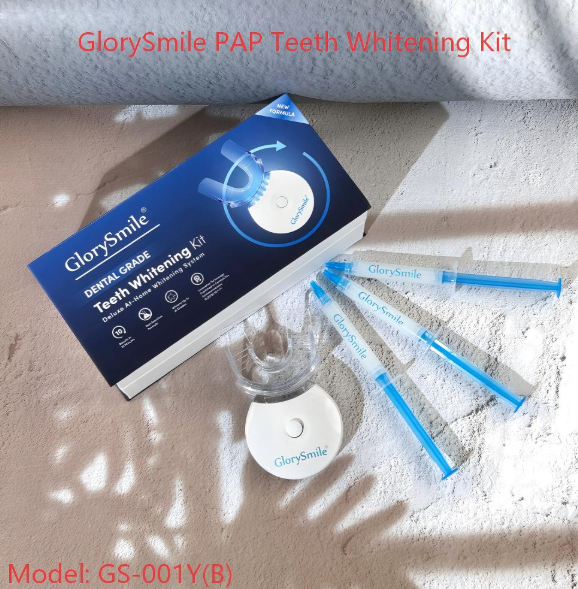
A whitening kit earns a place in a travel assortment only when its treatment time and pack volume match the trip it is sold for.
Why a travel assortment is a different brief from a home-use kit
A home-use whitening program is designed around repetition: a kit sits beside a bathroom basin and is used daily for the life of its gel supply. Glorysmile's own scenario documentation separates that pattern from travel use explicitly. One scenario unit describes daily home whitening treatment alongside travel-friendly dental care, with treatments of 10 to 30 minutes once per day. A second unit, written for personal care and travel essentials, describes products used at home or while travelling, with individually wrapped formats and a zero-peroxide option. A third, for FMCG retail and e-commerce private label, describes use in an indoor home or an outdoor travel environment.
Those three descriptions share a category but not a brief. In a home program, the buyer optimises for treatment count, gel volume and cost per session. In a travel program, the buyer optimises for pack geometry, per-use weight, single-use hygiene and shelf presentation in a travel-retail or e-commerce listing. Three variables dominate:
- Volume and format geometry. A multi-component LED kit occupies more pack space than a sachet of strips or a jar of toothpaste tablets, so the kit either anchors the assortment or is excluded from it.
- Time at a basin. A treatment with a fixed timer assumes the user can stand still for that period. A ten-minute treatment suits a hotel evening; it does not suit a transit lounge.
- Component behaviour in transit. Gels in syringes, liquids in bottles and pre-pasted bristles each create different leakage and single-use considerations that the packaging structure must resolve.
Mapping five adjacent formats to travel moments
The formats that most often sit beside a whitening kit in a travel assortment are not interchangeable. Each covers a different moment in the same trip, which is why a program built on a single format usually leaves gaps that a buyer then fills with an unrelated third-party item.
| Format | Travel moment it serves | Packing implication | Customization levers documented |
|---|---|---|---|
| Teeth whitening strips (GS-V34-S07 wet; GS-004H/V/C/P dry) | Short whitening sessions at a hotel; a compact alternative to a full kit | Flat sachets; 7, 14 or 21 strips per bag; individually wrapped option described for travel use | PAP, PAP plus charcoal, purple, 6% hydrogen peroxide, sodium phytate, sodium bicarbonate or custom formulas; 12 listed flavours; OEM, ODM and dealer services |
| Mouthwash (sachet and bottle) | Rinse after meals and before an evening out | Single-serve sachets reduce liquid volume per use; bottled formats suit longer stays | Format, efficacy, flavour and colour; alcohol-free formulations; sustainable packaging options |
| Mouth spray | Between-meal freshness where rinsing is impractical | Pocket-sized item that adds minimal pack volume | Listed within the manufacturer's oral-care range; buyers should confirm specification at sampling |
| Toothpaste tablets (GS-008) | Brushing where a paste tube is inconvenient or restricted | 30 or 60 tablets; plastic, glass or aluminium jar, or kraft bag | Rectangle, round or oval shape; mint flavour; purple, charcoal and sakura variants; custom jar type and printing |
| Toothbrush (DB-012P pre-pasted disposable) | One-brush use in transit, on arrival, or on a short overnight stay | 14 per bag; self-contained, no separate paste required | Five functions in one item — soft bristles, built-in mint toothpaste bead, tongue cleaner, concealed toothpick, floss; four colour and flavour variants |
| Teeth whitening kit (GS-001Y, GS-001B, DB-001M) | The treatment moment of the trip, when the user has a basin and 10 to 16 minutes | Boxed set with light, tray, gel syringes and shade guide; the bulkiest item in the assortment | LED wavelength configuration, housing colour, logo printing, packaging structure, kit composition, custom gel ingredient, syringe colour, custom manuals and compliance labelling |
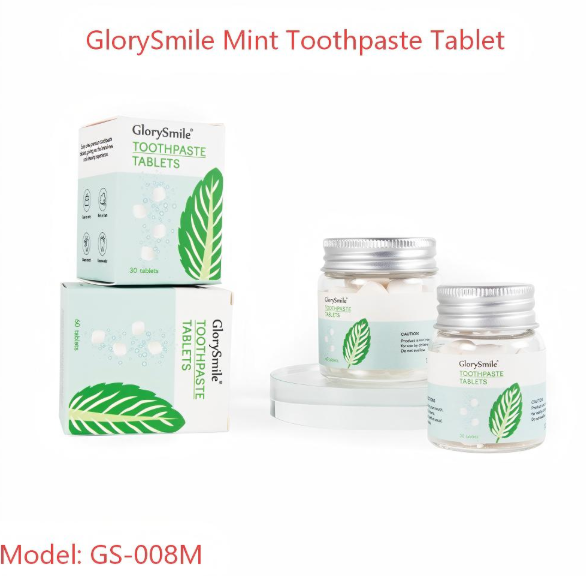
Toothpaste tablets cover the brushing moment in a travel assortment without adding a liquid or a paste tube.
Where the teeth whitening kit fits in the assortment
A whitening kit belongs in a travel program when the trip is long enough to justify a treatment cycle and calm enough to allow one. Glorysmile's kit configurations make that boundary visible. The GS-001Y set contains a five-LED whitening light, one mouth tray, three 3 ml whitening syringes, a shade guide, a user manual and a gift box, with a ten-minute timer and a stated 30 uses, powered by two CR2450 lithium metal batteries. The GS-001B set follows the same component logic with a stated 40 uses at ten minutes per treatment and CR2032 batteries. The DB-001M set shifts the design toward rechargeable use: a 32-LED light, four 2 ml whitening pens, a storage case with charging cable, a shade guide, manual and gift box, a 450 mAh lithium-ion battery, a two-to-three hour charge, up to eight uses per charge and a 16-minute timer.
Those numbers define the fit. A ten-minute treatment with a 30-use supply supports a multi-day trip, a business stay or a holiday where the kit is used in the evening. A 16-minute timer with a rechargeable light supports a longer programme but adds a charging step the user must plan for. Neither configuration suits a one-night stop, an airport transit or a trip where the user will not unpack a boxed set.
Two further conditions belong beside the kit in any program brief. First, whitening formulations documented for this category are labelled for adults and children aged 16 and over, a labelling condition that must appear on pack and in the listing. Second, the tray material specified for these kits is food-grade TPE and described as BPA-free, a detail worth stating because it is one of the few material claims a travel buyer can put in front of a retail partner without further testing.
Packing moments across a realistic trip
Mapping an assortment to a journey is more useful than mapping it to a product list, because the traveller encounters the formats in sequence.
Before departure
The kit is packed, not used. Its packaging structure therefore matters more than its treatment performance at this stage: a hard cardboard box protects the light and syringes inside a suitcase, and the box is what the traveller sees when deciding whether to bring the item at all. A private-label program that ships a soft or oversized outer carton loses that decision. This is the stage where custom packaging structure and logo printing do the most commercial work.
In transit
Liquids and gels are the risk. Single-serve mouthwash sachets, a pocket mouth spray and pre-pasted disposable brushes carry the routine here, because each is used once and discarded. A whitening kit is not part of this moment; a program that presents it as one creates an expectation the format cannot meet.
At the hotel
This is the kit's moment. A ten-minute timed treatment with a tray and syringe fits between arrival and dinner, and the shade guide gives the user a reference point across the trip. Toothpaste tablets or a paste tube cover the ordinary brushing routine alongside it, and a mouthwash sachet closes the sequence without adding a bottle to the wash bag.
Return and repeat
What the traveller carries home determines whether the program is bought again. A 30-use or 40-use gel supply outlasts most trips, so the kit returns with the user and creates a reason to re-purchase consumables rather than a whole new set. That distinction is worth designing deliberately: strip counts of 7, 14 or 21 and tablet jars of 30 or 60 already provide the shorter cycle, while the kit provides the longer one.
OEM, ODM, custom formulation and private label: building the program
The manufacturer behind this category, Glorysmile (Jiangxi Dentalbright Technology Co., Ltd.), operates a 36,000 m² facility with 20,000 m² of 100,000-class cleanrooms and a 1,000 m² laboratory that includes a 100-class cleanroom for microbiological testing. Its stated team includes 17 R&D engineers, 11 QC specialists and a six-person packaging design team, and its product line spans whitening kits, strips, pens, powder, toothpaste, mouthwash and electric toothbrushes. Further company detail is published at glorysmile.com.
Formulation choices that shape the travel proposition
Whitening kits in this range can be produced with hydrogen peroxide, carbamide peroxide, PAP, sodium phytate, sodium bicarbonate, charcoal or custom formulas. For a travel program the choice is not cosmetic. A PAP-based, peroxide-free option allows a brand to position the kit differently from peroxide formats, and industry research cited in the verified data for this category notes rising interest in PAP+ peroxide-free kits as an alternative driven by sensitivity concerns — an observation from one commercial publisher rather than shipment data. Strip formulas extend the same choice across PAP, PAP plus charcoal, purple, 6% hydrogen peroxide, sodium phytate and sodium bicarbonate, with twelve documented flavours from blue raspberry and peach to cherry blossom and coconut, so a travel assortment can keep one flavour identity across kit and strips.
Packaging, branding and logo customization
Customization in this category is not limited to the outer box. For home whitening kits the documented levers are LED wavelength configuration, housing colour, logo printing, packaging structure, kit composition, custom gel ingredient, syringe colour, and custom user manuals and compliance labelling. For electric toothbrushes the levers extend to appearance, LED feature, charging mode, brush head, colour, packaging, branding and logo, with a stated monthly capacity of 300,000 units. That matters for a travel program because the brush is often the item that carries the brand identity in a wash bag, while the whitening kit carries the treatment claim.
Capacity context for program sizing
Documented monthly capacity includes 105,000 home whitening kit sets, 29.2 million strips, 2.5 million mouthwash sachets and 416,000 bottles, 830,000 toothpaste tubes and 500,000 powder bottles. Annual output is described as 10 million kit sets and 150 million toothpaste tablets. These figures indicate line capability, not a commitment to any specific delivery date.
Sampling, service and after-sales support
Free sampling and package design support are part of the stated OEM/ODM offer, which is the practical route for a travel program: the assortment is validated physically before packaging artwork is committed. Electronic items carry a stated 12-month warranty from the date of purchase, and after-sales support is described as a 24-hour response mechanism with full-lifecycle quality assurance and, for long-term partners, market intelligence briefings and national regulatory compliance guidance.
Program evidence already exists in adjacent formats. One recorded project produced 7 million promotional gift-set units for pharmacy and supermarket retail over two years, with multi-language manual customization and third-party factory audits under BSCI and ISO. An e-commerce private-label launch recorded 5 million units with customized eco-friendly packaging and FDA- and CE-compliant formula, and a platform-owned brand project recorded 1 million units with zero reported safety or compliance incidents. These are partner project records, not forecasts for a new travel program.
MOQ and lead time stay open until quotation and sampling
Neither figure can be quoted responsibly at the concept stage. The manufacturer states that minimum order quantity is determined by product category, customization requirements and production line configuration, with the exact MOQ confirmed during quotation and sampling. Lead time is likewise described as dependent on order volume, product specifications, customization complexity and current production schedule, with a precise delivery timeline provided on order confirmation.
Product-level documentation shows why a single headline number misleads. Individual sheet items carry their own private-label thresholds — the GS-001Y kit sheet, for example, lists 200 pcs for private label against 1 pc for the regular product — while packaging format, jar type, flavour and manual customization each sit on a separate line of the quotation. A buyer comparing two suppliers on MOQ alone is therefore comparing two different scopes of work.
A sample-stage checklist keeps the comparison honest:
- Confirm the assortment's item-level MOQ separately for the kit, strips, mouthwash, tablets and brush, rather than as one blended figure.
- Confirm which customization levers change the MOQ: gel formula, syringe colour, outer carton structure, manual language and logo application.
- Ask for the lead time associated with the sampled configuration, not with the base product.
- Confirm the labelling package for the target market before artwork approval.
- Confirm the documentation set that will ship with the batch.
Compliance and documentation for cross-border travel retail
Travel retail moves products across borders, so the compliance file matters as much as the assortment. Two rules anchor the category. In the European Union, teeth whitening products containing between 0.1% and 6% hydrogen peroxide require a first treatment by a dentist under Directive 2011/84/EU — a condition that affects how a peroxide-based kit can be described and merchandised in that market. In the United States, the FDA recognises ISO 28399:2021 as a consensus standard for external tooth bleaching products.
Classification is format-specific rather than category-wide. A 2024 U.S. Customs and Border Protection ruling classified teeth whitening strips imported from China under subheading 3306.90.0000, identifying the strip as the essential character of the set. A buyer shipping kits, sachets and tablets together should expect the classification and duty treatment to be examined per format, not per shipment.
The documentation base described by the manufacturer covers both routes: CPSR, CPNP and PIF for cosmetic products, CE-MDR registration for medical devices, and MSDS, COA, RoHS, HALAL and Vegan certificates alongside CE, FDA, CPSR and CPNP factory certificates. Quality system certificates are listed as GMP, ISO 22716, ISO 13485, MDSAP and BSCI, and the company holds both medical device and cosmetics production licences. Products are described as exported to 102 countries with a 90% export share and principal markets in the EU, USA and UK.
Market context: what the published figures do and do not show
Published market research places the global teeth whitening market at USD 8.93 billion in 2025, projected to reach USD 14.31 billion by 2034, according to Fortune Business Insights (published August 2026). The at-home segment accounted for 68.67% of the market in 2024, per Straits Research. Forecasts from different publishers range from roughly 5.0% to 6.7% compound annual growth, a spread the comparison notes attribute to whether in-office professional services are included alongside at-home products.
For a private-label buyer, the at-home share is the more relevant figure, because it describes a consumer who already treats whitening as a product purchase rather than a clinic appointment. It does not, however, segment travel purchasing specifically, and no supplied dataset measures travel-kit volumes by format. The commercial case for a travel assortment therefore rests on assortment logic and observed program records rather than on a travel-specific market estimate.
Outlook for travel-focused private-label programs
The direction of development is toward configuration rather than new chemistry. A kit's competitive position in a travel assortment depends on how its pack structure, treatment time and companion formats are combined — a ten-minute, 30-use kit with a hard carton sits in one tier; a rechargeable 16-minute kit with a storage case sits in another. Customization options already documented for these platforms, from LED wavelength configuration to manuals and compliance labelling in multiple languages, mean the differentiation available to a brand is largely a design and documentation exercise that can be executed at sampling.
The open variables are the ones a buyer controls: which formats carry which moment, how the assortment is merchandised, and what the sample proves before packaging is committed. Those are answerable in a sampling round, and they are the questions worth bringing to a supplier before any volume discussion.
FAQ
Which formats belong in a private-label travel oral-care assortment?
A workable assortment usually pairs one anchor treatment with several single-moment formats. The anchor is a teeth whitening kit for trips of several days; the companions are teeth whitening strips for short sessions, mouthwash in sachet or bottle form for rinsing, mouth spray for between-meal freshness, toothpaste tablets for brushing without a paste tube, and a pre-pasted disposable toothbrush for one-off use. Each format covers a different moment, which is why substituting one for another leaves a gap rather than reducing cost.
Does a whitening kit need more space and time than strips?
Yes, on both counts. Documented kit configurations use a boxed set containing a light, a mouth tray, three 3 ml gel syringes and a shade guide, with a ten-minute timer and a stated 30 uses for the GS-001Y model, or a 16-minute timer for the rechargeable DB-001M model. Strips are supplied flat in bags of 7, 14 or 21 and can be individually wrapped. The kit suits a hotel evening; strips suit a shorter window with less pack volume.
What is the MOQ for a private-label travel whitening kit?
There is no single category-wide figure. The manufacturer states that MOQ depends on product category, customization requirements and production line configuration, and is confirmed during quotation and sampling. Item-level sheets differ: the GS-001Y kit sheet lists 200 pcs for private label against 1 pc for the regular product. Buyers should request item-level MOQs for each format in the assortment, plus the customization levers that change them, rather than a single blended number.
How does EU regulation affect a peroxide-based kit in travel retail?
Under Directive 2011/84/EU, teeth whitening products containing between 0.1% and 6% hydrogen peroxide require a first treatment by a dentist in the European Union. That condition affects how a peroxide-based kit can be described, merchandised and sold in that market. Peroxide-free options exist within the same product platforms — PAP is offered as a formula choice across kits and strips — which gives a brand a route to a different positioning without changing the physical format.
Can packaging, gel formulation and logo be customized for a travel program?
Yes, within documented limits. Whitening kits support custom packaging structure, custom gel ingredient, custom syringe colour, LED wavelength configuration, housing colour, logo printing and custom manuals with compliance labelling. Strip formats support custom colour, flavour, packaging and labelling across a range of base formulas. Electric toothbrushes add appearance, charging mode, brush head and branding customization. Free sampling and package design support are part of the stated OEM/ODM offer, so the configuration is normally validated physically before artwork is finalized.
Reference: the manufacturer's oral-care catalogue is available as a PDF download at Glorysmile product catalogue.
Have Questions or Need More Details?
Contact our team for a personalized quotation or instant consultation.
Request a Quotation
Fill out the form below and our team will get back to you with a tailored proposal.
WhatsApp Direct Chat
Prefer to chat in real-time? Message us on WhatsApp for instant assistance & quick answers.
- Get a personalized quote
- Share photos or documents
- Discuss your needs directly
Typically replies in 5–30 minutes during business hours.