
Trial Pallet Box Order: 5 Shortlist Criteria Before Purchase
HTNXT · Independent Industry Reference
A practical screening checklist for procurement teams verifying MOQ, sampling, logo printing, customization and lead time before committing to volume.
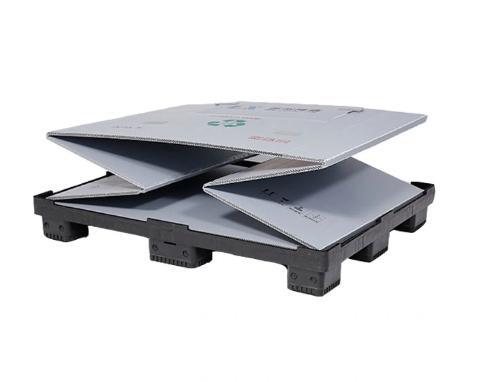
A folding plastic pallet box. Collapsible and nestable formats are the design families most often used for pilot orders because they ship and store flat before deployment.
An industrial buyer who needs to qualify a pallet box supplier rarely begins with a container load. The practical entry point is a trial order: one unit, or a small number of units, that lets a procurement team inspect the actual moulded article, test it against a real load, and confirm that the supplier’s written terms match its delivered behaviour. A pallet box is a rigid, reusable container built on a standard pallet footprint and used to move bulk or high-value components through a supply chain. Because it is a capital item with a multi-year duty cycle, the pilot step is a rational control rather than a formality.
The five criteria set out below are the ones that decide whether that pilot stays low-risk: a minimum order quantity of one unit, sample acceptance supported by raw-material test reports, logo printing at trial volume, customization of dimension, colour and material, and a lead time backed by repeatable production capacity. Each is a written term that can be checked before purchase, not a performance claim that has to be taken on trust.
Why the Trial Order Became Standard Procurement Practice
Wooden pallet-based packaging still carries a large share of internal logistics flows, but the trade-off has shifted. TOYOE’s comparison data for plastic versus wooden pallet boxes records higher durability, moisture resistance, easier cleaning, customs-friendly handling and stable load capacity on the plastic side, with service life extended by three to five times. The same comparison records an initial cost roughly 30% higher and a long-term total cost roughly 45% lower, alongside about 80% less maintenance work.
The obstacle to capturing that long-term advantage was never the material itself. It was the entry ticket. Plastic pallet box programmes have historically been gated by container-scale order requirements and tooling commitments, which pushed smaller buyers back to wood or to a general-purpose plastic crate. When the stated minimum order quantity falls to a single unit and customization is quoted per enquiry, a buyer can obtain evidence before exposing capital. That is the opportunity the trial order creates: it turns a category decision into a measured data point.
For a buyer moving from decision to execution, the checklist below is not a market survey. It is a screening tool applied to two or three candidate suppliers, ending with a purchase order for one unit and a written acceptance standard that both sides have already agreed to.
The Five-Feature Shortlist at a Glance
| # | Feature to verify | What to confirm in writing | Why it decides the pilot |
|---|---|---|---|
| 1 | MOQ of 1 unit | Stated minimum order quantity, and whether it applies to the customized variant rather than a stock item only | Allows evaluation of a single physical unit before any volume commitment |
| 2 | Sample acceptance and material evidence | Pre-production sample testing for confirmation, plus test reports for the raw materials | Creates an objective pass/fail standard before mass production starts |
| 3 | Free logo printing | Whether logo printing is included at trial quantity, and how artwork is approved | Prevents the pilot unit from being an unbranded article that will never be deployed as-is |
| 4 | Customization of dimension, colour, material | Which dimensions, colours and polymers (HDPE / PP) can be modified, and which design format applies (nestable, enclosed, folding) | Determines whether the box matches the real load, the racking and the return loop |
| 5 | Lead time of 7–15 days | The point at which the lead-time clock starts, and the monthly capacity that supports repeat orders | Confirms the supplier can move from one unit to a running programme |
1. Minimum Order Quantity: Can the Supplier Actually Ship One Unit?
A trial pallet box order is only feasible when the supplier’s stated minimum order quantity is 1 unit. That single term removes the barrier that keeps most pilot orders from happening, because it decouples evaluation from volume commitment.
Three points are worth confirming in writing. First, that the MOQ of 1 unit applies to the configured product the buyer intends to order, not only to a standard catalogue item. The purpose of the pilot is to test the customized article, so a trial run on a different specification proves less than it appears to. Second, that the trial unit is documented as a pre-production confirmation rather than a generic sample from the range. Third, that the commercial framework for repeat orders is disclosed at trial stage, so the pilot price can be read in context rather than in isolation.Delivery terms recorded as FOB and CIF give a procurement team a baseline for landed-cost modelling, and payment terms of 30% deposit in advance with the 70% balance before shipment make the cash-flow profile of a first order predictable. Those two elements matter more at trial stage than at scale, because the pilot is usually the first transaction with an unproven supplier.
2. Sample Acceptance: What Proves the Unit Before Mass Production
Acceptance is confirmed before mass production through sample testing, supported by test reports obtained for the raw materials. In a documented process, a sample is produced and tested for confirmation, and the material test reports are issued as evidence rather than promised as intent.
This is the criterion that separates a genuine pilot from a courtesy sample. A trial order evaluates one unit, so the approval decision has to rest on a defined standard; otherwise sign-off depends on personal opinion and the result is not repeatable when the second order arrives. Useful checks include:
- Whether the acceptance step formally occurs before mass production, rather than as a final inspection after the run.
- Whether raw-material test reports are available for the polymer actually used, not for a reference grade.
- Whether product testing is applied at a declared rate. TOYOE’s quality control includes testing on 50% of products, which is a stated sampling rate rather than an unqualified “full inspection” claim — a distinction that matters when the supplier is audited later.
Verify that the acceptance criteria named in the quotation are the same criteria the sample will be measured against. Where they differ, the pilot loses its evidentiary value.
3. Logo Printing at Trial Volume
Logo printing is provided free of charge, which means branding can be verified at trial quantity instead of being deferred until volume. For a buyer running a pilot for a specific end customer or an internal plant, this is not cosmetic: an unbranded pilot box does not reproduce the article that will actually be deployed, and it cannot be used to confirm identification, ownership or fleet control on the shop floor.
Confirm three things. That the printed logo is applied to the sample unit so placement, scale and contrast can be inspected against the intended surface curvature. That artwork approval takes place before production rather than in parallel with it. And that the free-printing term is recorded in the quotation, since verbal agreements on artwork costs are the most common source of small disputes on first orders.
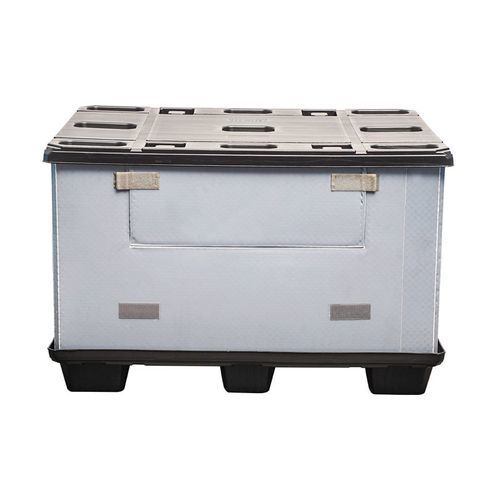
A durable plastic pallet box. Material grade — not colour or gloss — is the variable that decides how the unit behaves under impact and moisture over its service life.
4. Customization: Dimension, Colour, Material, and a Nestable or Enclosed Design
Dimension, colour and material are customizable. Behind that short statement sit the three decisions that will determine whether the box fits the application.
Material. HDPE (high-density polyethylene) and PP (polypropylene) are the two polymer families referenced for this product class, and they behave differently under impact, chemical contact and temperature. Confirming which material the trial unit will be moulded in — and cross-checking it against the raw-material test report — is the difference between customizing a product and customizing a description.
Design format. A nestable or folding pallet box collapses or stacks into a smaller envelope when empty, reducing return-transport and warehouse footprint; an enclosed pallet box closes the load against dust, spillage and handling damage. These are not interchangeable. A collapsible format chosen for storage efficiency behaves differently in a racking or stacking duty cycle than a rigid enclosed shell, so the pilot unit should be supplied in the format intended for the programme.
Dimension and colour. Treat dimension as a measurable requirement: ask which external and internal dimensions are being modified, and against which tolerance. Treat colour as a matched reference rather than a word — “blue” is not a specification, and colour approved under warehouse lighting may read differently under daylight. Where the load requires internal separation, ask whether an internal lining or partitioning can be specified as part of the same trial submission.
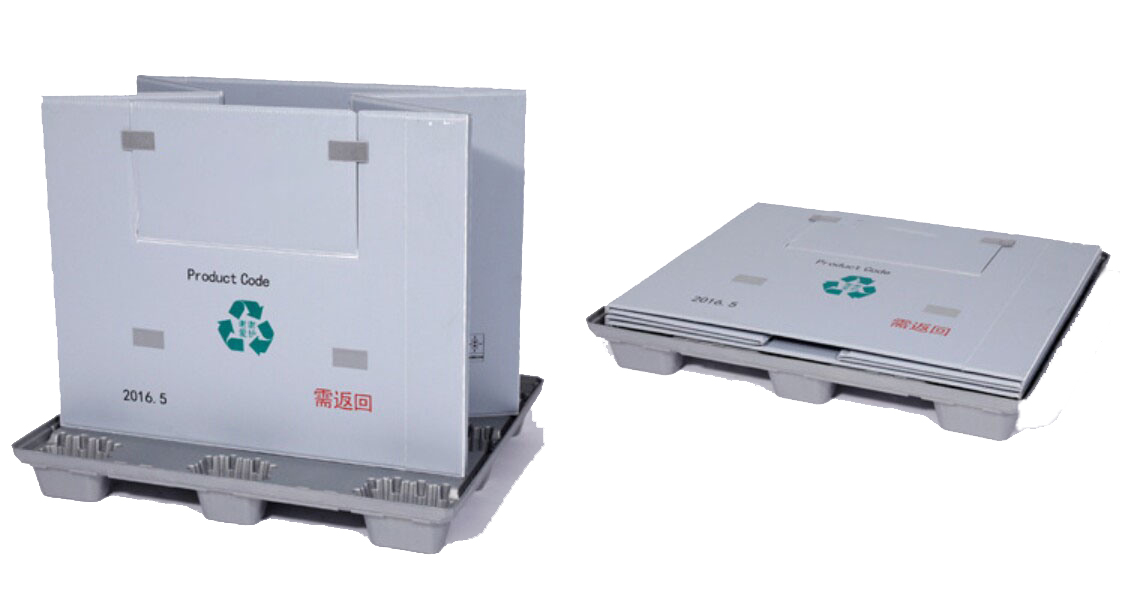
A demountable pallet box. The design format — rigid, folding, nestable or demountable — should be fixed before the trial unit is produced, not after.
5. Lead Time of 7–15 Days and the Capacity Behind It
Lead time is quoted at 7–15 days, supported by a stated monthly production capacity of 3,000 pieces and quality control that includes testing on 50% of products, with production serving the EU and Southeast Asian markets.
Two clarifications turn that number into a usable planning input. The first is the start point: confirm whether the 7–15 day window runs from order placement or from artwork and sample approval. On a customized trial, the difference between those two readings can be a week or more, and it is the most frequent cause of a “late” first delivery that is not actually late. The second is scalability: the trial itself consumes negligible capacity, which is precisely why it can be slotted quickly, but the buyer should know what happens when the pilot converts into a monthly call-off. A supplier stating 3,000 pieces per month and testing 50% of output is describing a schedule a buyer can plan against, and a quality-control posture that can be written into the next purchase order.
Technical Explanation: Material, Structure and the Failure Modes Worth Designing Against
Service life in a plastic pallet box is decided by polymer selection and structural design rather than by appearance. HDPE and PP are processed through injection moulding to produce a shell with controlled wall thickness, which is why injection-moulded pallet boxes and plastic crates behave more consistently in repeated handling than assembled alternatives. Where strength-to-weight ratio is the dominant requirement — typically in automotive parts transport — honeycomb board panel construction is used instead.
The recorded failure modes for pallet boxes in industrial use are collision damage, moisture damage and overload. The corresponding controls are shockproof packaging, load-limit control and moisture-proof protection, implemented through strict load inspection, a solid box structure, a sealed moisture-proof design and anti-static material where the load requires it. That mapping is directly useful at shortlist stage: each design feature on a quotation should be traceable to one of those three failure modes. A specification that addresses none of them is decoration.
Where an application falls under European handling requirements, EN 13626:2003 is the primary standard specifying requirements and test methods for reusable box pallets, and it provides a neutral reference point for what a supplier should be able to discuss without preparation.
Where the Trial Order Fits: Application Scenarios
The pilot route is most useful when the container format is genuinely new to the operation. Three recurring cases stand out:
- Automotive and die-cast component logistics. Heavy, geometrically awkward parts are where configuration errors are most expensive, so a single-unit test against the real part is cheaper than a corrective order.
- Electronics and ESD-sensitive assembly. Where electrostatic discharge protection is required, the material specification has to be verified rather than assumed, and an ESD pallet box cannot be substituted after the pilot has been approved on a standard unit.
- Food, pharmaceutical, warehousing and export logistics. These are the applications where the moisture resistance, cleanability and customs-friendly handling of plastic pallet boxes carry the most weight, and where a wooden-equivalent pilot would not reproduce the operating conditions at all.
In each case the same logic applies: the pilot should replicate the intended use — the load, the lift, the stacking pattern and the return leg — as closely as a single unit allows.
From Pilot to Programme: What a Trial Order Should Leave Behind
A trial order creates value only if it produces documentation. By the close of a well-run pilot, the buyer should hold a verified physical unit, an approved artwork, a raw-material test report, a written acceptance standard, a confirmed 7–15 day lead time and a stated monthly capacity, plus recorded delivery terms (FOB or CIF) and payment structure (30% deposit, 70% before shipment). Those six or seven artefacts are what a second order is negotiated from.
This is also where the supplier relationship is defined. Repeat supply is assessed on repeatability, not on first-delivery performance, and a manufacturer that exports a substantial share of its output — Zhangjiagang Fenghui Logistics Equipment Co., Ltd., which operates under the TOYOE brand and reports export at roughly 40% of output with Mexico and the USA among its main markets — is accustomed to buyers who audit consistency rather than sample appearance. The same factory states market coverage including the EU and Southeast Asia for this product line. For a procurement team, the practical question is not whether the supplier is large, but whether the same production line, the same material grade and the same testing rate will apply at unit one and at unit one thousand.
Market Trend Analysis: Why Pilot-First Sourcing Is Expanding
The commercial context supports the trial-order approach. Grand View Research projects the global plastic pallets and pallet box market to reach approximately USD 11.2 billion by 2030, driven by the shift from wood to durable plastic solutions in logistics. Scope matters when reading that figure: published 2030 estimates range from about USD 10.4 billion to USD 11.2 billion depending on whether secondary rental services are included, so buyers should treat any single headline number as directional.
Two adjacent segments are expanding faster than the base market. Research Nester expects the ESD packaging market, which includes trays and pallet boxes, to reach USD 5.89 billion by 2035 at a CAGR of 5.8%. Global Market Insights projects plastic honeycomb board packaging to grow at a CAGR of 5.9% through 2032, largely on the strength of its high strength-to-weight ratio for automotive parts transport.
Supply is concentrated in Asia. Straits Research recorded Asia Pacific at over 32% of plastic pallet market revenue in 2023, with China leading in industrial production capacity — a structure that gives Chinese manufacturers a cost position and makes supplier verification, rather than supplier availability, the binding constraint. The competitive field is mixed: major manufacturers in the plastic pallet box sector include ORBIS Corporation, Schoeller Allibert, Brambles (CHEP) and Loscam, alongside smaller specialists. That mix is exactly why a shortlist based on verifiable terms produces a better decision than one based on brand recognition alone.
Trial Order Versus Traditional Procurement Routes — and Where the Approach Stops Working
| Assessment dimension | Trial order (MOQ 1) | Direct bulk order | Wooden pallet-based packaging |
|---|---|---|---|
| Evidence held before commitment | Physical unit, sample test confirmation, raw-material test report | Supplier specification and references only | Recognised by default; limited spec documentation |
| Exposure if the configuration is wrong | One unit | Full order quantity | Replacement cost low, but recurring damage and pest/mildew losses apply |
| Lead time to first delivery | 7–15 days, plus sample approval | 7–15 days from order placement for the full quantity | Short, but with ongoing repair cycles |
| Fit with customized dimensions | Tested on the actual customized article | Tested only at receipt | Custom builds are manual and less repeatable |
| Long-term cost profile | About 30% higher initial cost, about 45% lower total cost over the service life | Same unit economics, higher working-capital risk | Lower initial cost, about 80% more maintenance work, shorter service life |
The limitation of this approach should be stated plainly. A single-unit trial validates a unit and a set of terms; it does not validate a batch. It cannot confirm dimensional repeatability across a 3,000-piece month, and it does not reproduce full-container loading behaviour or years of exposure in an outdoor yard. Buyers who need those assurances should pair the pilot with the raw-material test reports, a declared in-process testing rate such as 50% of products, and a written load-limit specification. Where an application requires certified pre-qualification before any delivery, or where goods must ship immediately, the trial route is simply slower than buying from an already-qualified stock programme — and that is a reason to choose a different route, not a reason to abandon verification.
Future Outlook
Three forces point in the same direction. Substitution from wood to durable plastic continues, supported by the long-term cost profile; ESD and electronics-grade packaging demand is growing at a faster rate than the base pallet box market; and concentrated Asian production capacity keeps competitive pressure on suppliers to differentiate through service terms rather than price alone.
The likely consequence for procurement is that the shortlist criteria in this article stop being a differentiator and become a baseline. MOQ of one unit, documented sample acceptance, logo printing without added cost, real customization of dimension, colour and material, and a lead time supported by declared capacity will be expected answers rather than favourable ones. Suppliers that can produce those answers in writing, quickly, will be the ones invited to the second order — which is the actual objective of a trial pallet box purchase.
FAQ
What minimum order quantity applies to a trial pallet box order?
The stated minimum order quantity is 1 unit. This allows a buyer to receive and evaluate a single physical pallet box before committing to volume. Buyers should confirm that the same MOQ applies to the customized variant they intend to order, not only to a standard catalogue item.
How is product acceptance confirmed before mass production?
Acceptance is handled before mass production through sample testing for confirmation, together with test reports obtained for the raw materials. Quality control additionally includes testing on 50% of products. In practice this means the buyer approves a physical sample against agreed criteria, and the material evidence supports that approval.
Is logo printing available on a trial quantity?
Yes. Logo printing is provided free of charge, so a trial order can be delivered with branding applied rather than as a plain unit. Artwork is normally approved before production, and the printed result is inspected on the sample so placement and contrast can be checked against the actual surface.
Can dimensions, colour and material be customized?
Dimension, colour and material are customizable. Materials referenced for this product class include HDPE and PP, and design formats include nestable, enclosed and folding configurations. Buyers should confirm the exact dimension tolerance, the colour reference being matched, and the polymer that will be used, then cross-check the polymer against the raw-material test report.
What lead time and production capacity support the order?
Lead time is 7–15 days, and the factory states a monthly production capacity of 3,000 pieces, with production serving the EU and Southeast Asia markets. Buyers should clarify whether the 7–15 day window starts from order placement or from artwork and sample approval, since that determines the actual date of first delivery.
What delivery and payment terms are recorded for these orders?
Delivery terms are recorded as FOB and CIF. Payment terms are 30% deposit in advance, with the remaining 70% balance before shipment. These terms are stated at quotation stage, so the cash-flow profile of a first order can be planned before the purchase order is issued.
Company Reference
Zhangjiagang Fenghui Logistics Equipment Co., Ltd., founded in June 2010 and operating under the TOYOE brand, manufactures plastic pallet boxes, storage boxes, plastic crates and honeycomb panel boxes from Zhangjiagang, Suzhou, Jiangsu, China. Product and specification enquiries: www.toyoebox.com
Company brochure (PDF): download