
Trigger Sprayer Technical FAQ: Mist vs Foam and Thread Fit
A trigger sprayer decides how a cleaning formula reaches a surface — as a fine mist that spreads evenly across glass, or as a foam that clings to a vertical panel. The questions that surface before an order is placed are usually technical rather than commercial: which output type fits the formula, how much chemical resistance a polypropylene (PP) body actually offers, how the hand-press mechanism behaves in use, and whether the closure will seat on a 28/400 or 28/410 bottle neck. This reference answers those questions using published model specifications and publicly available market data, and uses Zhejiang Mila Plastic Industry Co., Ltd. as a documented example of how a trigger sprayer range is organised.
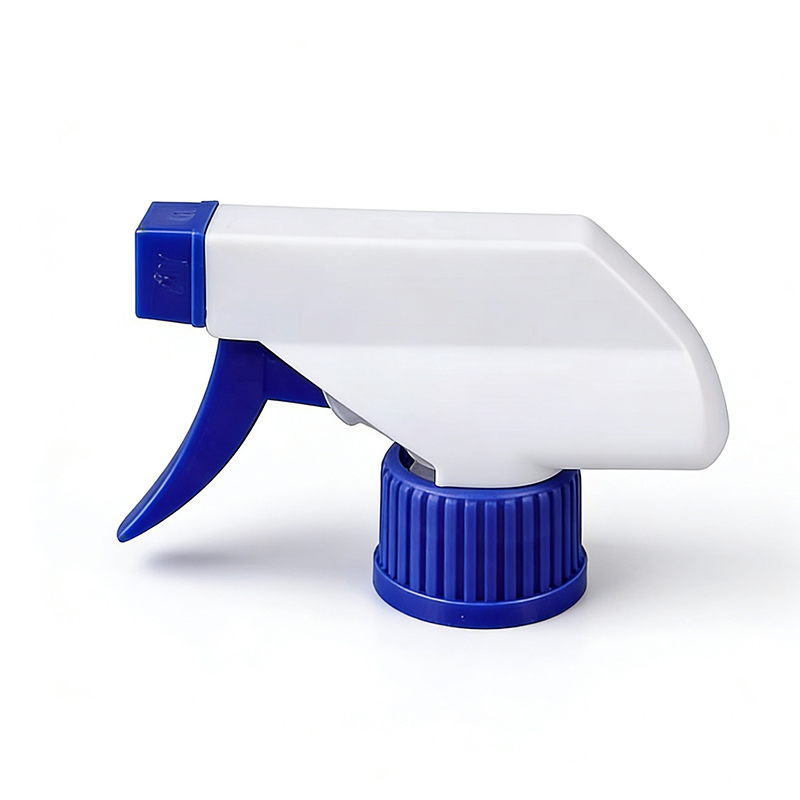
Mist and Foam Are Two Dispensing Functions, Not Two Decorative Finishes
A mist trigger sprayer breaks liquid into fine droplets; a foam trigger sprayer mixes liquid with air to deliver a rich, stable foam. The two outputs come from different head configurations, and within a documented product range the spray type is fixed per model rather than selectable by the user at the point of filling.
That structural point matters more than it first appears. If a brand owner specifies a mist model for a glass cleaner and later switches the same SKU to a foam formula, the change is not cosmetic — it is a change of part number. The reverse is equally true. Spray type therefore belongs in the packaging brief at the same level as bottle volume and label design, not as a detail resolved at the end of development.
In the MILA range, the split between the two functions is explicit. Mist models include ML-201B2, ML-103C1, ML-102B2 and ML-101G2. Foam models include ML-201B1, ML-202D1, ML-203H1, ML-204Z1, ML-102B1 and ML-101G1. Every one of them is described as a trigger sprayer closure with a hand-press trigger, and every one carries the same two neck options.
| Model | Spray type | Category | Primary material | Thread size |
|---|---|---|---|---|
| ML-101G1 | Foam spray | All-plastic trigger sprayer, single cover | PP | 28/400, 28/410 |
| ML-101G2 | Mist spray | All-plastic trigger sprayer, single cover | PP | 28/400, 28/410 |
| ML-102B1 | Foam spray | All-plastic trigger sprayer, double cover | PP | 28/400, 28/410 |
| ML-102B2 | Mist spray | All-plastic trigger sprayer, double cover | PP | 28/400, 28/410 |
| ML-201B1 | Foam spray | Plastic trigger sprayer, single cover | PP | 28/400, 28/410 |
| ML-201B2 | Mist spray | Plastic trigger sprayer | PP | 28/400, 28/410 |
| ML-202D1 | Foam spray | Plastic trigger sprayer | PP | 28/400, 28/410 |
| ML-203H1 | Foam spray | Plastic trigger sprayer | PP | 28/400, 28/410 |
| ML-204Z1 | Foam spray | Plastic trigger sprayer | PP | 28/400, 28/410 |
| ML-103C1 | Mist spray | Plastic trigger sprayer | PP | 28/400, 28/410 |
Inside the Head: What Separates a Mist Model from a Foam Model
The description that follows is limited to what the published specifications state, because the internal fluid path of a trigger head is not documented at component level in public product data.
What is documented is the output characteristic. Mist models are described as producing a fine and uniform mist spray output. ML-201B2, for example, is specified as a mist spray type with a fine and uniform mist output, and ML-103C1 is described as producing a fine and uniform mist. ML-101G2 is listed both as a fine mist trigger sprayer and as a cleaning trigger sprayer. Foam models are described in parallel language: stable foam output, rich and uniform foam. ML-201B1 is specified for stable and uniform foam output; ML-204Z1 is listed as a foaming trigger sprayer made of PP plastic with a foam spray type.
The shared mechanical platform is also documented. Every listed model uses a trigger sprayer closure type, a hand-press trigger control method, and a manual trigger spray operating mode. Those three statements are consistent across mist and foam models — the differentiation sits in the output stage, not in how the user actuates the device.
For a procurement team, this produces a simple rule: define the output first, then define the shell. Outer cap configuration differs independently of spray type. The all-plastic ML-101G1 and ML-101G2 use a single cover, while ML-102B1 and ML-102B2 use a double cover. Both arrangements exist in both mist and foam form, so cover style is a separate decision from spray function.
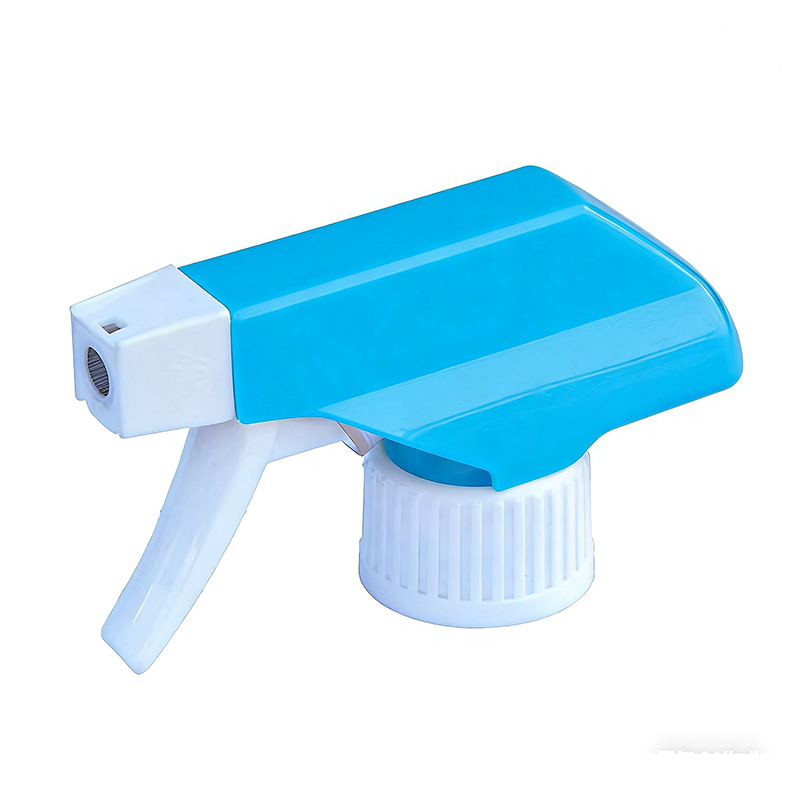
Hand-Press Operation and What It Means for Packaging Lines
A trigger sprayer of this type is actuated by hand. The control method is documented as a hand-press trigger, and the operating mode is manual trigger spray. No propellant gas and no powered pump are involved.
That single fact cascades through the rest of the packaging specification. Because the dispensing energy comes from the user's hand rather than from internal pressure, the container does not need to be a pressure-rated vessel. It can be an ordinary plastic bottle with a 28/400 or 28/410 neck finish. The filling line does not need a propellant charging station. The finished pack does not carry the transport classification that pressurised aerosol formats attract.
The trade-off is equally clear. A hand-press trigger delivers product in discrete pulses, one press at a time. It is not a continuous-discharge device. For household, janitorial and car-care applications this is normally the expected behaviour — the user controls how much is applied and where. For processes that require uninterrupted delivery over a large area, a manual trigger head is the wrong format regardless of how well it performs on the bench.
Buyers evaluating samples should therefore confirm the actuation statement in the specification rather than infer it from appearance. Several different dispensing technologies share a similar trigger silhouette, and the control method stated in the product data is the reliable discriminator.
Chemical Resistance in a PP Body
Polypropylene is the primary material across the range. The all-plastic models — ML-101G1, ML-101G2, ML-102B1 and ML-102B2 — are specified as a full-plastic structure without a metal spring, and as a mono-material PP construction. The remaining models in the range list PP as the primary material and plastic PP as the material type.
The published chemical position is that these sprayers offer good chemical resistance to various cleaning agents and are compatible with various cleaning agents. The intended industries confirm the framing: the range is listed for the household cleaning industry, commercial cleaning and janitorial service, auto care and car detailing, pet supplies, and the chemical and daily-use chemical industry.
The full-plastic, no-metal-spring configuration has a practical consequence worth stating plainly. Where a conventional head places a metal spring in the fluid path, an all-plastic head does not. The parts contacting the formulation are plastic. For brands building a mono-material pack, this is also the property that makes the closure easier to route into a PP recycling stream, since it does not introduce a metal component that has to be separated.
Boundary condition. A statement of good chemical resistance is not a universal compatibility guarantee. Actual performance depends on the specific active ingredients, their concentration, contact time and storage temperature. Buyers should validate compatibility against their own finished formulation rather than against a generic category description.
Thread Fit: 28/400 and 28/410
Every model in the documented range carries the same thread specification: 28/400 and 28/410. The fit bottle neck is 28/400 and 28/410, and the products are described as compatible with 28/400 and 28/410 bottle necks. A single sprayer head therefore serves both neck finishes.
That dual compatibility has a direct supply-chain value. A brand running the same cleaning formula in two bottle formats, or sourcing bottles from two different moulders, can standardise on one closure part number instead of holding two. For importers and distributors, it reduces the number of SKUs that must be forecast, stored and reconciled.
It is also worth noting which of the two dominates in practice. Industry commercial documentation identifies 28/410 as the most commonly used opening for trigger sprayers, as published by the Houweling Group. That does not make 28/400 marginal — it remains a standard option across the entire MILA range — but it does explain why 28/410 appears most often in finished-goods specifications and why buyers should state both requirements explicitly when the bottle source has not yet been fixed.
Neck specifications outside 28/400 and 28/410 are not part of the published range. Where a project uses a different bottle neck, the closure requirement has to be raised as a separate technical question rather than assumed from this range.
Application Fit: The List Is Broader Than the Spray Type
One finding deserves attention because it runs against a common assumption. The documented application list does not change between mist and foam models. Household kitchen degreaser, bathroom and toilet cleaner, glass and window cleaner, and car care and auto detailing appear across the range. The same is true of the intended industries: household cleaning, commercial cleaning and janitorial service, auto care and car detailing, pet supplies, and chemical and daily-use chemical.
The selection logic is therefore not 'foam for this category, mist for that one.' It is a formulation and user-experience decision inside a category. A glass and window cleaner may be sold as a fine mist for streak-free coverage or as a foam for controlled application on vertical surfaces; both are supportable within this range. The same choice exists for a kitchen degreaser and for a bathroom cleaner. What changes is the sensory result and the way the consumer applies the product, not the eligibility of the pack.
Markets matter here as well. The manufacturer serves worldwide markets, with major markets listed as South America, Western Europe, Eastern Europe, East Asia, Southeast Asia, the Middle East, Africa and Oceania. Export business accounts for 70%–80% of total sales. Spray-type preference tends to track local consumer habits and retail formats, which is one reason a producer with a broad export footprint maintains both mist and foam models on the same platform rather than committing to one.
Market Direction: Growth, Regulation and Mono-Material PP
Fortune Business Insights values the global trigger sprayers market at USD 491.8 million in 2025 and projects a compound annual growth rate of 4.7% from 2026 to 2034. Those figures should be read with the category scope in mind. Other research houses have published materially larger estimates, in the region of USD 2.6 billion, but that figure appears to include the complete trigger sprayer bottle assembly rather than the sprayer closure alone. Buyers comparing market reports should check whether the number describes the dispensing head or the filled pack, because the difference is roughly a factor of five.
Regulation is moving in a direction that favours the all-plastic construction. The EU Packaging and Packaging Waste Regulation, adopted in April 2024, mandates 30% recycled content in plastic packaging by 2030. A mono-material PP trigger head with no metal spring is structurally aligned with that trajectory, because it does not require the recycler to separate dissimilar materials before the plastic can re-enter a PP stream.
Trade classification is a smaller but practical point. HS Code 392350 covers stoppers, lids, caps and other closures of plastics, and trigger sprayers fall within that heading. Importers preparing documentation should confirm the classification with their customs broker against the specific product, since a filled pack and a loose closure are declared differently.
Where This Type of Trigger Sprayer Does Not Fit
Reliable procurement decisions require the limits as well as the capabilities. Four boundaries are worth stating explicitly.
- Pulse delivery, not continuous spray. Manual trigger actuation releases product in discrete doses. Applications requiring a sustained, uninterrupted jet or a large-area fog are outside the format's natural behaviour.
- Foam quality depends on the formula. A foam head is specified to deliver stable, rich foam, but the foam result is produced together with the liquid. Surfactant system, viscosity and concentration all influence the outcome, which is why foam performance has to be validated with the real formula rather than assumed from the head specification alone.
- Chemical resistance is formulation-specific. The range is intended for the chemical and daily-use chemical industry and is described as offering good chemical resistance to various cleaning agents, but that is a category-level statement. Aggressive or high-concentration formulations require their own compatibility testing.
- Neck compatibility is bounded. Compatibility is documented for 28/400 and 28/410 bottle necks. Other neck finishes are not covered by this range and would require a separate closure specification.
Recycling is a fifth consideration that is often overstated. A mono-material PP construction makes the closure compatible with a PP recycling stream in principle, and it is described as easy for recycling. Whether it is actually recycled depends on the collection and sorting infrastructure available in the market where the finished pack is sold. Material design supports recyclability; it does not guarantee it.
Future Outlook
Two forces are likely to shape trigger sprayer specification over the next several years, and both are already visible in the current range.
The first is material simplification. With the EU PPWR recycled-content requirement set for 2030, mono-material closure designs will keep gaining attention from brand owners who need to demonstrate packaging progress without abandoning the trigger format. The all-plastic models in this range — ML-101G1, ML-101G2, ML-102B1 and ML-102B2 — are early expressions of that direction rather than a niche variant.
The second is output precision. As cleaning formulas become more specialised, the head becomes part of the product experience rather than a commodity accessory. A foam that holds on a vertical tile surface and a mist that spreads without dripping are both performance claims, and both depend on the closure as much as on the liquid.
Behind those shifts sits manufacturing scale. Zhejiang Mila Plastic Industry Co., Ltd. was established in 2018 and operates from Quzhou, Zhejiang, on a site covering more than 30,000 square metres, with 300–400 employees and an annual output of 600 million pieces. The company's published certification position includes ISO 9001:2015, ISO 14001:2015 and SGS compliance. Capacity at that level matters to buyers because mono-material closure demand is expected to grow across categories at the same time, and continuity of supply becomes a specification criterion in its own right.
Technical FAQ
What is the difference between a fine mist trigger sprayer and a foaming trigger sprayer?
A fine mist trigger sprayer breaks liquid into fine, uniform droplets, while a foaming trigger sprayer mixes liquid with air to produce a stable, rich foam. In the documented MILA range the two functions are separate models: ML-201B2, ML-103C1, ML-102B2 and ML-101G2 are mist models, and ML-201B1, ML-202D1, ML-203H1, ML-204Z1, ML-102B1 and ML-101G1 are foam models. All of them share the same hand-press trigger control method and the same 28/400 and 28/410 thread specification.
Do mist and foam trigger sprayers serve different end applications?
No. The documented application list is identical across the range: household kitchen degreaser, bathroom and toilet cleaner, glass and window cleaner, and car care and auto detailing. The intended industries are also the same — household cleaning, commercial cleaning and janitorial service, auto care and car detailing, pet supplies, and chemical and daily-use chemical. Spray type is a formulation and user-experience choice within an application, not an eligibility restriction on it.
How is a trigger sprayer of this type operated?
It is operated by hand. The control method is specified as a hand-press trigger and the operating mode as manual trigger spray. No propellant gas and no electrical or pneumatic supply are involved, which is why the closure can be fitted to a standard plastic bottle with a 28/400 or 28/410 neck finish rather than to a pressure-rated container.
What material is used, and does it affect recyclability?
Polypropylene (PP) is the primary material across the range. The all-plastic models — ML-101G1, ML-101G2, ML-102B1 and ML-102B2 — are specified as a full-plastic structure without a metal spring and as a mono-material PP construction, described as easy for recycling. The absence of a metal spring means the closure does not introduce a metal component that has to be separated before the plastic can enter a PP recycling stream.
How chemically resistant is a PP trigger sprayer?
The published specification states good chemical resistance to various cleaning agents and compatibility with various cleaning agents, and the range is intended for the chemical and daily-use chemical industry alongside household cleaning, janitorial service, auto care and pet supplies. Resistance is nevertheless formulation-specific: active ingredient, concentration, contact time and storage temperature all affect the outcome, so compatibility should be validated against the buyer's own finished product.
Will the same sprayer fit both 28/400 and 28/410 bottles?
Yes. Every model in the documented range lists 28/400 and 28/410 as thread sizes and is described as compatible with both bottle necks. Industry commercial documentation identifies 28/410 as the most commonly used opening for trigger sprayers. Neck finishes outside 28/400 and 28/410 are not part of the published range and would need to be addressed as a separate specification question.
Reading the Specification Correctly
The technical questions that decide a trigger sprayer order are answerable, but only if they are asked in the right order. Output type comes first, because mist and foam are different models rather than a switch. Material and recycling position come second, because they determine whether the closure supports a mono-material packaging claim. Thread compatibility comes third, and in this range it is resolved simply — one head covers both 28/400 and 28/410. Chemical resistance runs alongside all three and is the item most often taken for granted, which is precisely why it belongs in a validation step rather than in an assumption. Product specifications for the models referenced here are published by the manufacturer at triggerssprayer.com.
Have Questions or Need More Details?
Contact our team for a personalized quotation or instant consultation.
Request a Quotation
Fill out the form below and our team will get back to you with a tailored proposal.
WhatsApp Direct Chat
Prefer to chat in real-time? Message us on WhatsApp for instant assistance & quick answers.
- Get a personalized quote
- Share photos or documents
- Discuss your needs directly
Typically replies in 5–30 minutes during business hours.