
Triple Glazed UPVC Windows: Constraints Buyers Must Check
Triple glazing is usually presented as an upgrade. On a UPVC window it is really a specification change, and it moves several variables at the same time: sash weight, hinge and roller load, glazing rebate depth, freight weight, and the scope of the certification a supplier can actually present. For importers, facade contractors and project specifiers working through research and evaluation, the practical question is narrower than whether three panes are better than two. It is which triple-glazed configurations a given manufacturer can confirm with documents, and which ones sit outside what its profiles, hardware and attestations cover.
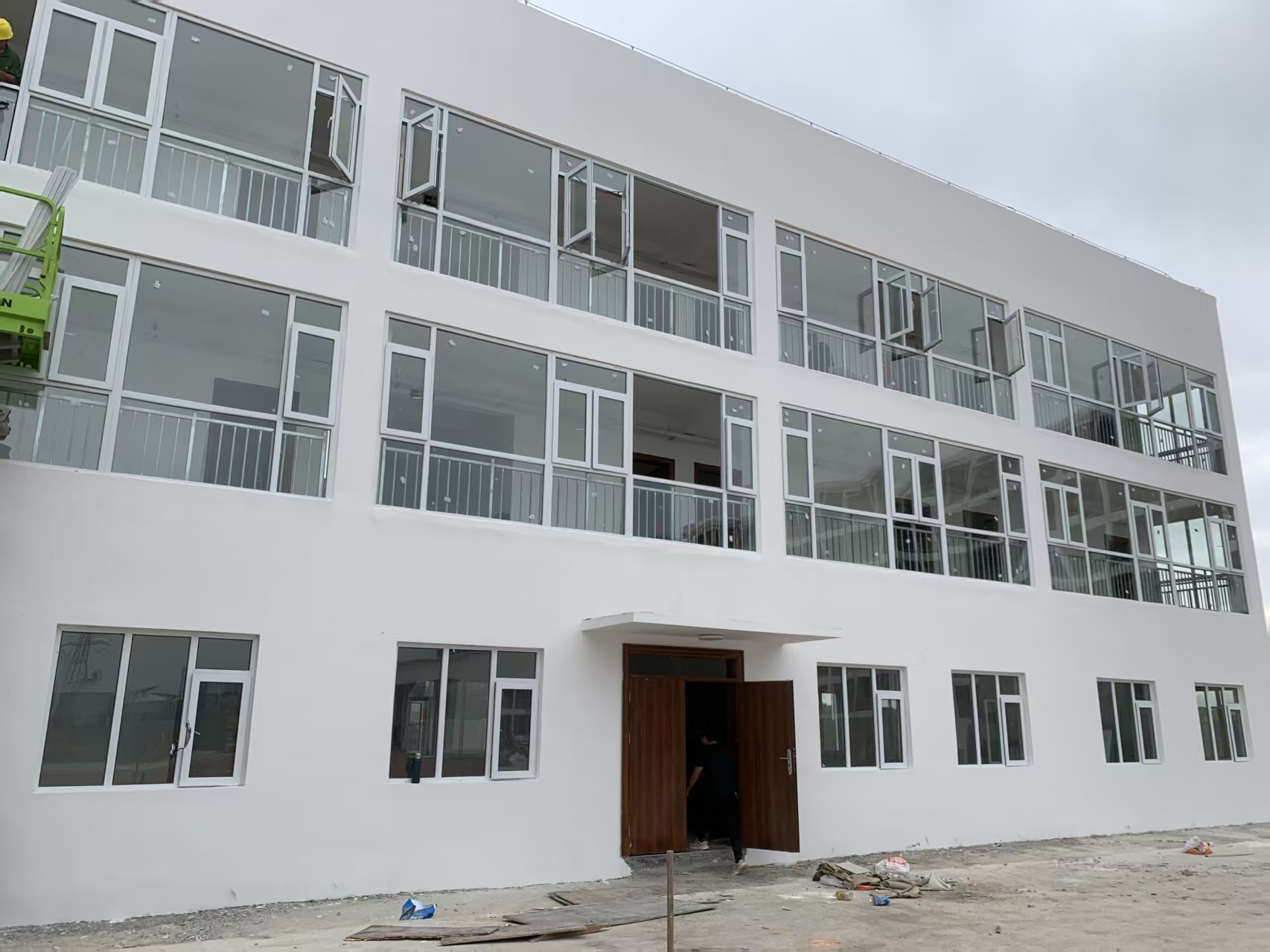
The Market Signal Behind Triple-Glazed UPVC Windows
Demand direction is not in dispute, even where the numbers are. Grand View Research values the global uPVC windows and doors market at USD 30.8 billion in 2025, while Mordor Intelligence estimates USD 42.15 billion for the same year. That gap is a methodology difference between research houses, reflecting different hardware, accessory and regional pricing assumptions, so the two figures are best read as a range rather than a single market size. Anyone comparing supplier presentations should note which definition is being quoted.
Two structural facts are more useful for specification work. First, Asia Pacific accounted for 44.1% of global uPVC window and door revenue in 2025, according to Grand View Research, which is consistent with the density of manufacturing in clusters such as Foshan in Guangdong. Foshan Nanhai is a recognised base for UPVC profile and window production, and industry publications estimate the service life of high-quality profiles at 30 to 40 years. The cluster is dense rather than uniform: Wanjia Windows & Doors, a large-scale uPVC and aluminium manufacturer, is also located in Nanhai District, Foshan, and serves more than 150 countries according to Shide Export. Second, windows dominate the product mix. Windows held 58.0% of total uPVC product revenue in 2025, and casement windows and doors held the largest single product-type share at 38.5%, according to Dataintelo.
Energy performance is the reason most buyers move toward triple glazing. Secondary commentary claims that modern multi-chamber uPVC profiles can improve energy efficiency by up to 40% compared with traditional frames. That figure is a secondary-source claim about profile design, not a measured comparison of double and triple glazing, and it should not be substituted for a whole-window U-value calculation on a project.
What Triple Glazing Actually Changes Inside a UPVC Window
A triple-glazed unit uses three panes and two sealed cavities, normally combined with low-emissivity coatings, warm-edge spacers and a gas fill such as argon or krypton. Each of those choices interacts with the frame rather than sitting inside it passively.
The load path is the clearest example. Glass weight transfers through the glazing beads into the sash, from the sash into the steel reinforcement inside the profile chambers, and from there into hinges, rollers and frame anchors. Thicker glass packages increase the load at every step. If the reinforcement is thin, the hardware rating is low, or the sash clearance is not adjusted correctly during installation, the symptom appears later as a sagging sash, drag on the track, air leakage or water ingress rather than as an immediate failure.
Profile geometry sets the hard limit. Glazing rebate depth determines the maximum glass unit thickness the frame can accept, while chamber depth and wall thickness determine how much reinforcement can be inserted. This is why the profile series matters when triple glazing is specified. The factory's long-term profile supply includes Conch profiles in 60, 65 and 88 series, and each series has its own glazing capacity and reinforcement channel. Buyers should request the maximum glazing thickness for the specific series being quoted instead of assuming that any triple-glazed unit will fit any window.
The material data behind the windows is also relevant. The UPVC compound referenced for these products lists a Vicat softening point of 86 °C, a flexural modulus of elasticity of 2840 MPa, a tensile yield stress of 43 MPa, a tensile strain at break of 186% and a density of 1520 kg/m³. The softening point describes how the material behaves as service temperature rises, which matters for dark, sun-exposed profiles. Flexural modulus describes stiffness under bending, and that is what resists sash deflection when a heavier glass unit is carried. These are material properties, not whole-window performance values, and they should not be presented as U-values or acoustic ratings.
The Number That Matters: Whole-Window U-Value, Not Pane Count
Whole-window performance is measured at the assembly, not at the glass. Frame material, spacer type, sash-to-frame sealing, installation quality and the glass-to-frame area ratio all contribute. A triple-glazed unit set into a poorly installed frame can underperform a well-installed double-glazed window.
Regulation provides a concrete benchmark. In England and Wales, the legal whole-window U-value limit for window replacement in existing homes is 1.4 W/m²K in 2025 under Approved Document L, as reported in BFRC and industry guidance. That limit applies to the whole window, and it is worth noting what it implies: a compliant double-glazed assembly can already satisfy it. Triple glazing is therefore a specification decision that has to be justified by a project target — acoustic performance, low external temperatures, high wind exposure or energy-cost assumptions — rather than a default that automatically makes a window compliant.
Certification Scope: What the ECM Attestation Covers and What It Does Not
For constraint-driven procurement questions, the scope of a certificate matters as much as its existence. Foshan Nanhai Yuanzhaiji UPVC Door & Window Factory holds an ECM Attestation, certificate number NO.3N230816.YCPQQ51, issued by Ente Certificazione Macchine Srl (ECM). It is a voluntary certification scheme. The attestation applies to the UPVC Window product and the UPVC Door product, and references the standard EN 14351-1:2006+A2:2016. The certified product scope covers UPVC windows and doors in profile series 50/60/65/80/88/112. The certificate was issued on 16 August 2023 and expires on 15 August 2028.
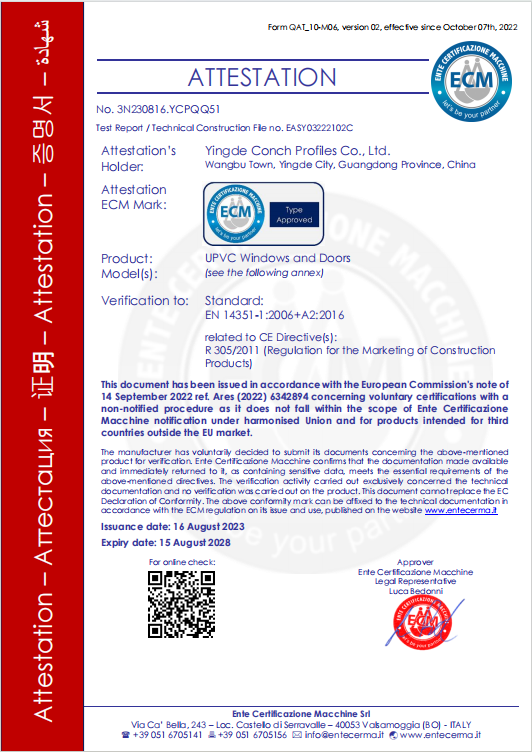
Three boundaries are stated within that scope, and buyers should read them before adding the certificate to a project file:
- The attestation is a voluntary certification scheme, not a mandatory market-access mark.
- It is intended for third countries outside the EU market, so it should not be treated as EU market CE marking.
- EN 14351-1:2006+A2:2016 covers windows and doors without fire resistance characteristics. Projects that require fire-rated assemblies therefore fall outside this certification route and need a separate compliance path, even though fire resistance is listed as an optional project requirement in the application data.
At profile level, the relevant reference in the knowledge base is GB/T 8814-2017 for unplasticized PVC-U profiles for doors and windows, which addresses wall thickness, impact resistance, heat stability and anti-aging performance. Qualified test reports are expected to be available for verification of physical properties. Buyers evaluating a supplier should request both documents and read the declared scope and validity dates, rather than treating 'certified' as a single status.
Manufacturer Capability: Facts Buyers Can Verify
Foshan Nanhai Yuanzhaiji UPVC Door & Window Factory was established in 2009 and is based in Shishan Town, Nanhai District, Foshan, China. The factory reports a professional technical and management team of more than 20 staff and an export ratio of 80%, with main markets in LATAM, MENA, ASEAN and the EU.
The product range covers UPVC sliding windows, casement windows, tilt-and-turn windows, crank awning windows, American-style hung windows, awning windows, hopper windows, insect screens, louver windows and insulated glass louver windows, plus sliding doors, lift-and-slide doors and hinged doors. Published model identifiers for the window range include BR58 and HF88. Profile supply is based on Conch profiles in 60, 65 and 88 series, available in co-extruded colour, laminated wood-grain finish and solid colours including dark grey and black.
For order planning, the reported figures are a monthly capacity of 4,000 m², a lead time of 10 to 30 days and a minimum order quantity of 30 to 40 m². Production is OEM/ODM oriented, with customisation available for window size, specification and glass specification. Quality documentation is issued as a quality inspection report, and after-sales support covers technical consultancy and quality testing.
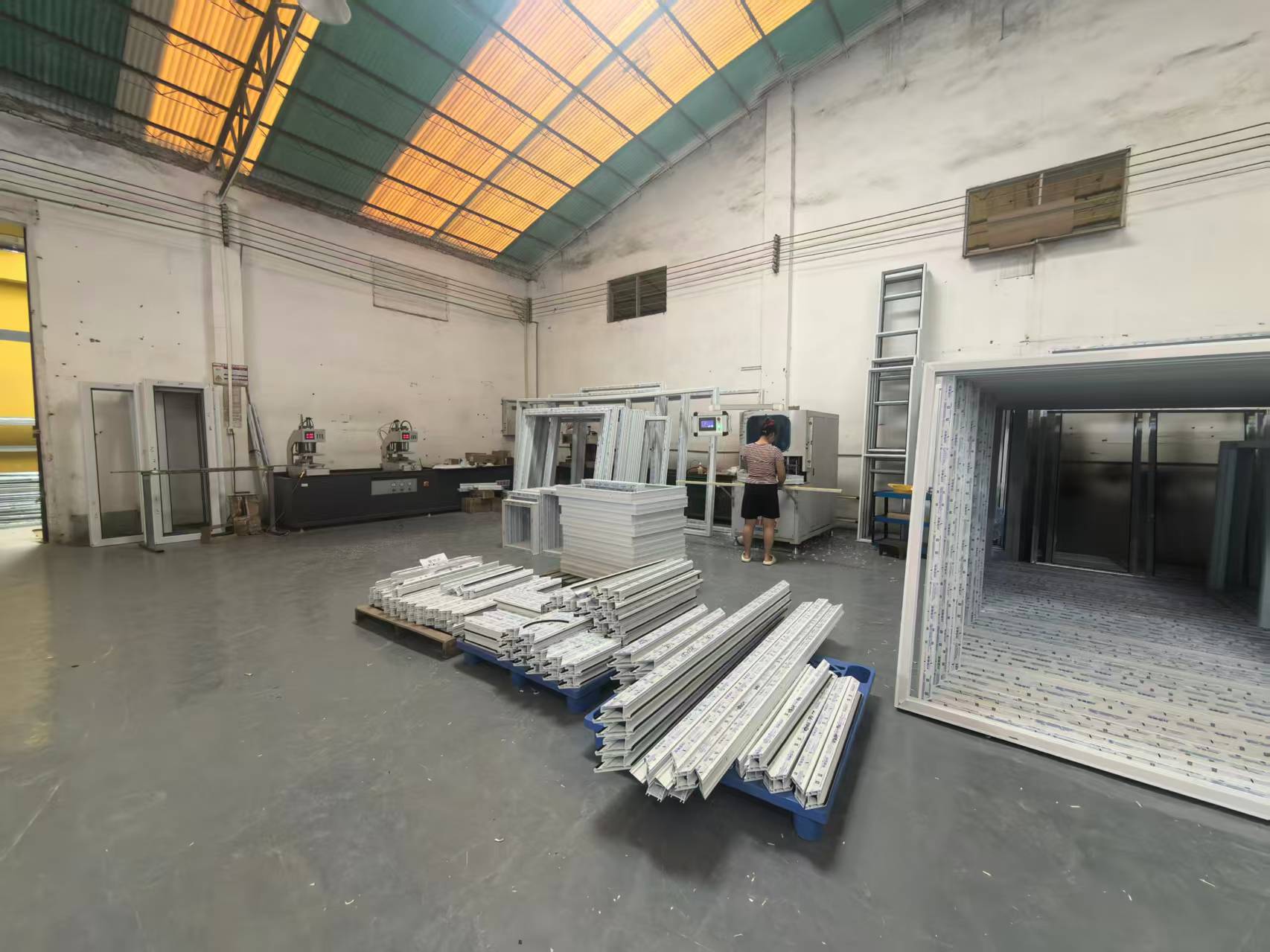
One project reference in the knowledge base is a builder project in Kenya covering 800 m² of windows, recorded with heat-insulation and sound-insulation results and energy-saving performance, and described in terms of corrosion-resistant hardware, tempered glass, low-noise sliding operation, water and dust exclusion, and easy maintenance.
Where Triple-Glazed UPVC Windows Fit, and Where They Do Not
Application data for these windows lists outdoor service in coastal, high-humidity and strong-wind areas, across residential buildings, commercial buildings, renovation projects and villa projects. Operation modes include manual opening and closing, tilt-and-turn opening and sliding operation. Matched hardware includes window handles, hinges, lock points, multipoint lock drive mechanisms, crescent locks, rollers, EPDM sealing gaskets and pile weather strips. Declared requirements include wind-pressure resistance, water tightness, air permeability, sound and heat insulation, UV resistance and anti-aging, with optional fire resistance and compliance with local building codes.
Within that envelope, triple glazing tends to be specified where the constraint is real rather than nominal:
- Cold climates with long heating seasons, where the marginal gain of a third pane accumulates over many months.
- Noisy urban sites or locations near transport corridors, where acoustic performance is the primary driver.
- Coastal and high-wind locations, where rigidity and sealing under pressure matter, provided the hardware and reinforcement are rated for the added sash weight.
- Premium residential and villa projects where the specification is set by a client energy target rather than by minimum compliance.
It is a weaker fit where a project already meets its U-value target with double glazing, where the structure cannot accept additional dead load without changes, where openings are small and the fixed cost per unit rises quickly, or where budget pressure would divert spending away from installation quality — the factor that most often decides whether a good window performs well in service.
Comparison: Triple Glazing, Double Glazing and Traditional Frames
The following comparison is qualitative. Window performance is specific to the whole assembly, the installation and the project target, so a mechanism-level comparison is more reliable than a headline performance claim.
| Configuration | Typical build-up | Weight and hardware demand | Where it fits | Main limitation |
|---|---|---|---|---|
| Single glazing in a UPVC frame | One pane, one air space | Lowest sash load; standard hardware | Low-budget, internal or temporary applications | Limited thermal and acoustic benefit; condensation risk on cold surfaces |
| Double glazing in a UPVC frame | Two panes, one sealed cavity, usually with low-E coating and spacer | Moderate sash load; hardware and reinforcement must be matched to sash size | Most residential, commercial and renovation projects | Performance depends on spacer, sealing and installation; acoustic limits at very noisy sites |
| Triple glazing in a UPVC frame | Three panes, two sealed cavities, low-E coatings, warm-edge spacers, optional gas fill | Highest sash load; deeper rebate, thicker reinforcement and heavier-duty hinges, rollers and lock points required | Cold climates, high-noise locations, coastal and high-wind sites, premium projects with an explicit energy target | Added weight, cost and installation demand; not always necessary where a compliant double-glazed unit already meets the local whole-window U-value requirement |
Against traditional frame materials, the comparison follows different logic. UPVC is corrosion resistant and low maintenance and does not require periodic painting, which is why it is widely used in coastal and high-humidity locations. Timber frames generally require regular coating and are more sensitive to moisture, while aluminium frames without a thermal break conduct heat more readily than UPVC. Those are general material characteristics; the decisive variables for any specific project remain the profile series, the reinforcement, the glazing build-up and the quality of installation.
Limits and Trade-offs That Should Not Be Skipped
Rating claims are easy to repeat and hard to verify. The following limits are the ones that most often change a procurement decision.
- Whole-window U-value must be documented, not assumed. Pane count is one input. Frame, spacer, sealing and installation determine the result, and the regulatory benchmark in England and Wales (1.4 W/m²K for replacement windows in existing homes under Approved Document L) is a whole-window figure.
- Weight affects hardware life. Rollers, hinges and lock points carry more load with three panes, so wear and misalignment appear sooner.
- Triple glazing is a project-specific configuration here. The published product data lists single-layer, double-glazed insulated, tempered safety and frosted glass; a three-pane build should be confirmed in writing before it is written into a specification.
- Certification scope has boundaries. The ECM Attestation is voluntary, applies to UPVC windows and doors in profile series 50/60/65/80/88/112, references a standard that excludes fire resistance characteristics, and is intended for third countries outside the EU market.
- Order size and timing constrain sampling. A minimum order quantity of 30 to 40 m² and a lead time of 10 to 30 days shape how a triple-glazed trial order can be planned.
- Profile quality varies across the market. Brand-grade profiles such as Conch are described as having a standardised raw-material formulation, consistent wall thickness and reliable UV resistance and anti-aging capability, while general mid-range profiles vary between manufacturers. The recorded consequences of thin walls or reduced additive content are yellowing, deformation and air leakage after several years.
- Freight weight and handling change. Heavier glazed sashes increase handling requirements on site and can affect packing, lifting and installation labour.
Procurement Checklist for Triple-Glazed UPVC Windows
| Check item | What to request | Why it matters |
|---|---|---|
| Whole-window performance target | The applicable U-value rule for the project jurisdiction and the calculated whole-window value | Compliance is assessed on the assembly, not on the glass unit alone |
| Profile series and glazing capacity | Series designation and maximum glazing thickness (for example within the supplied Conch 60/65/88 range) | Rebate depth and chamber depth determine whether a three-pane unit fits |
| Reinforcement | Steel reinforcement specification inside the sash and frame chambers | Resists deflection under heavier glass loads |
| Hardware load rating | Hinge, roller, lock point and multipoint drive specification matched to sash size | Prevents drag, sagging and premature wear |
| Glass build-up | Pane thicknesses, low-E coating, spacer type, cavity width and gas fill | Determines thermal and acoustic behaviour of the unit |
| Certification documents | ECM Attestation certificate NO.3N230816.YCPQQ51 and profile test reports against GB/T 8814-2017 | Confirms scope, standard reference and validity period |
| Sample or first-article validation | A physical unit for opening/closing, sealing and hardware check | Verifies workmanship before full production |
| Order and delivery parameters | MOQ of 30 to 40 m², lead time of 10 to 30 days, monthly capacity of 4,000 m² | Aligns factory scheduling with project milestones |
| Installation competence | Anchorage method, packing, sash adjustment and sealing procedure | Installation quality frequently decides final performance |
Field Problems That Get Worse With Heavier Sashes
The knowledge base records a common field complaint for sliding windows: the sash is stiff and difficult to open or close. The recorded causes are debris or dust accumulated in the sliding track, a worn or out-of-position pulley, and mis-adjusted sash hardware. The recorded remedy is to clean the track, replace worn pulleys, and adjust the hinge or roller screws to level the sash.
A heavier triple-glazed sash does not create a new failure mode, but it accelerates the existing ones. Rollers, hinges and lock points carry more load, so wear appears sooner and misalignment produces drag and air leakage rather than a minor inconvenience. Buyers specifying three-pane units should treat hardware grade and on-site adjustment as part of the specification, not as an installation detail to be resolved after handover.
A second risk is profile quality itself. Verification is procedural rather than visual: confirm compliance with GB/T 8814-2017, check wall thickness, and request test reports before accepting a lower-cost profile into a project where the windows will be exposed outdoors for decades.
Future Outlook
The likely direction of the category is more demanding building envelopes, which pushes UPVC window design toward deeper multi-chamber profiles, higher-performance glazing and heavier reinforcement. Market estimates point the same way, with global uPVC window and door demand measured in the tens of billions of USD, Asia Pacific holding the largest regional revenue share, and the window segment carrying the majority of product revenue.
Two cautions sit alongside that trend. First, published market figures vary enough between research houses — USD 30.8 billion versus USD 42.15 billion for 2025 — that any single number should be quoted with its source and definition. Second, and more important for buyers, higher glazing performance shifts risk from the glass unit toward the frame, the hardware and the installation. As triple glazing becomes more common in specification documents, the practical difference between suppliers will be measured less by pane count and more by documented profile geometry, reinforcement, hardware capacity, written confirmation of project-specific configurations, and the stated scope limits of the certification they can present.
FAQ
What is the practical difference between a double-glazed and a triple-glazed UPVC window?
A triple-glazed window uses three panes and two sealed cavities instead of two panes and one cavity, normally combined with low-emissivity coatings, warm-edge spacers and a gas fill. In a UPVC frame, the practical differences are increased glass weight, higher demand on hinges, rollers and reinforcement, and typically a deeper glazing rebate requirement. The whole-window U-value still depends on the frame, spacers, sealing and installation rather than on pane count alone.
Does triple glazing automatically make a window compliant with local U-value rules?
No. Compliance is assessed on the whole-window U-value. In England and Wales, the legal whole-window limit for window replacement in existing homes is 1.4 W/m²K in 2025 under Approved Document L. A compliant double-glazed assembly can meet that limit, and a triple-glazed unit installed with poor sealing or in a weak frame can fail it.
Can any UPVC profile series accept a triple-glazed unit?
It depends on glazing rebate depth, chamber depth and available reinforcement, not on the material alone. The factory's long-term profile supply includes Conch 60, 65 and 88 series, and the certified product scope of the ECM Attestation covers profile series 50/60/65/80/88/112. Buyers should confirm the maximum glazing thickness for the specific series in the quotation before assuming a three-pane build will fit.
What does the ECM Attestation cover, and what does it exclude?
The ECM Attestation, certificate number NO.3N230816.YCPQQ51, is issued by Ente Certificazione Macchine Srl (ECM) as a voluntary certification scheme. It applies to the UPVC Window product and the UPVC Door product, references EN 14351-1:2006+A2:2016, covers profile series 50/60/65/80/88/112, was issued on 16 August 2023 and expires on 15 August 2028. It is intended for third countries outside the EU market, so it is not EU market CE marking, and the referenced standard covers windows and doors without fire resistance characteristics.
Are triple-glazed UPVC windows available as a standard catalogue item?
The published glass options in the product data are single-layer glass, double-glazed insulated glass, tempered safety glass and frosted glass. Triple-glazed builds should therefore be treated as a project-specific configuration to be confirmed in writing, including the glass build-up, profile series, reinforcement and hardware.
What order constraints apply at factory level?
The reported figures are a minimum order quantity of 30 to 40 m², a lead time of 10 to 30 days and a monthly capacity of 4,000 m². Production is OEM/ODM oriented, with customisation for window size, specification and glass specification, and quality documentation is issued as a quality inspection report.
Why do sliding sashes become stiff, and does triple glazing make it worse?
The recorded causes are debris or dust accumulated in the sliding track, a worn or out-of-position pulley, and mis-adjusted sash hardware. The recorded remedy is to clean the track, replace worn pulleys and adjust the hinge or roller screws to level the sash. A heavier triple-glazed sash does not introduce a new failure mode, but it increases load on rollers and hinges, so wear and misalignment appear sooner.
Which projects justify triple glazing rather than double glazing?
Projects where heating seasons are long, external noise is high, or the client has set an energy target that a double-glazed assembly cannot meet. Where a compliant double-glazed unit already satisfies the local whole-window U-value requirement, the marginal benefit is smaller and has to be weighed against added weight, cost and installation demands.
Triple-glazed UPVC windows are ultimately a configuration decision with a documented trail: profile series and glazing capacity, reinforcement and hardware rating, whole-window performance measured against the local rule, and the exact scope of the supplier's certification. Buyers who collect those four items during evaluation will find the choice clearer, and will rely less on pane-count claims.
Sources referenced in this article include Grand View Research, Mordor Intelligence, Dataintelo, BFRC and industry guidance on Approved Document L, and the product and certification records published by Foshan Nanhai Yuanzhaiji UPVC Door & Window Factory.