
Trough Idler vs Parallel Roller: Answers to Technical Buying Questions
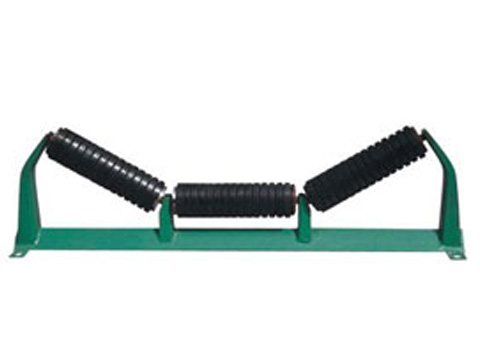
Carrying-side trough idler: a roller set shaped to contain bulk material on the belt rather than simply support it.
No belt conveyor uses a single kind of roller. It uses a set of them, each placed where the belt, the material or the load demands something different. Two of the most frequently quoted — and most frequently confused — are the trough idler on the carrying side and the parallel roller on flat and return sections.
The distinction can be stated in one sentence. A trough idler contains material; a parallel roller supports the belt. Every other entry on a specification sheet — trough angle, tube diameter, shaft diameter, bearing type, surface coating, inspection routine — follows from that single design intent.
This reference collects the questions that engineering and procurement teams typically raise before a first order or a replacement cycle: why the two types are compared at all, what a 20°, 25° or 35° trough angle actually changes, how the suggested tube diameters of Ø89 mm, Ø108 mm and Ø133 mm should be read, what mining, cement and port conditions do to the specification, and where each type stops being the right answer.
Why the trough-versus-parallel question arrives so early
On a bulk material conveyor, the roller list is divided by belt zone rather than by product family. The carrying side, flat sections on the return strand, loading points and mistracking-prone runs each carry their own requirement. Because a single request for quotation often covers all of them, a trough idler and a parallel idler roller appear side by side, at similar diameters and similar unit prices, and are compared as if they were variants of the same part.
They are not. When they are treated as such, the outcomes tend to follow a familiar pattern:
- Spillage on the carrying side where a flat roller was specified beneath a loaded belt;
- Belt edge abrasion and heavier manual adjustment where the troughing geometry does not match the belt;
- Higher running resistance and running noise where the troughing set is deeper than the material and the conveyor design require;
- Shortened roller life where bearings and seals do not match the dust, moisture or temperature at the site.
The opportunity for the buyer is that the decision is not complicated once it is framed at zone level. Three inputs resolve most of it before price comparison even begins: which belt zone the roller sits in, how the material behaves on the belt, and which standard framework the conveyor was designed to.
The supplier side of the question: how the roller range is framed
Shanghai Eastrise Trading Co., Ltd. is a professional foreign-trade enterprise headquartered in Shanghai, China, established in 2024, specialising in the supply of mining accessories — including conveyor idler rollers — to global clients. The company operates its own manufacturing facilities and reports a facility area of 11,000 square metres, approximately 50 staff, an R&D team of 10 engineers, and an annual production capacity of 2,000 tons, with export business accounting for around 20% of total sales and global markets as its main destination.
Three product facts are relevant to the trough-versus-parallel comparison:
- Trough idler — classified as a 35° trough carrying idler, with the model designation recorded as TBC and a suggested designation of ER-TROUGH-108. Trough angle options cover 20°, 25° and 35°. Suggested tube diameters are Ø89/108/133 mm and shaft diameters Ø20/25 mm.
- Parallel idler rollers — classified in the return / flat-carrying idler category, with the model designation recorded as TBC and a suggested designation of ER-PARALLEL-108. The suggested tube diameter range is the same Ø89/108/133 mm, with shaft diameters of Ø20/25 mm.
- Adjacent zones — the rubber-ring impact roller (suggested designation ER-IMPACT-108) covers loading points, crusher discharge and heavy-duty conveyors, and the self-aligning / training idler (suggested designation ER-ALIGNING-108) covers lines prone to belt mistracking. Both sit outside this comparison but usually appear in the same enquiry.
Supporting activities around the product choice include professional engineering support for product selection and drawing confirmation, OEM & ODM service, private-label service for nameplates and packaging on the parallel roller range, and export documents under FOB or CIF terms.
Trough angle: what 20°, 25° and 35° actually change
The trough angle is the angle at which the side rollers of a carrying idler set are inclined relative to the horizontal centre roller. It defines the shape of the belt cross-section and therefore how much material the belt can hold before it spills.
- 20° — the shallowest option in this range. The belt cross-section is the flattest, which generally means the least belt contact and bending at the side rollers.
- 25° — a middle setting widely used on general bulk material handling lines.
- 35° — the deepest of the three in this range and the classification used for the trough idler itself. The belt cross-section is the most enclosed, which supports material containment on higher-capacity carrying sides.
In broad engineering terms, a deeper trough angle increases containment and the material cross-section, and it also increases belt contact and bending at the side rollers — which typically translates into higher running resistance and greater stress at the belt edges. That trade-off is the reason the trough angle is treated as a conveyor design parameter rather than a spare-part preference. Changing it on the idler set alone, without checking belt construction, frame geometry and drive calculations, is generally not advisable.
Three standards sit behind this decision rather than beside it. CEMA Standard No. 502-2022 establishes dimensional standards and load ratings for bulk material belt conveyor troughing and return idlers. ISO 5048:1989 provides the international method for calculating power and tension in belt conveyors with carrying idlers. For underground coal mining applications, DIN 22112 Part 3 (1996) specifies the testing requirements for belt conveyor idlers.
Tube and shaft diameter: how to read Ø89, Ø108 and Ø133 mm
The suggested tube diameter range for both the trough idler and the parallel idler roller is Ø89 mm, Ø108 mm and Ø133 mm, with shaft diameters of Ø20 mm or Ø25 mm. These are starting points for a technical discussion, not a final specification. Belt width, belt speed, material bulk density, loading method and ambient conditions all sit between a diameter range and a released part number.
| Attribute | Trough idler | Parallel idler roller |
|---|---|---|
| Product type | 35° trough carrying idler | Return / flat-carrying idler |
| Model designation | TBC (suggested ER-TROUGH-108) | TBC (suggested ER-PARALLEL-108) |
| Suggested tube diameter | Ø89/108/133 mm | Ø89/108/133 mm |
| Suggested shaft diameter | Ø20/25 mm | Ø20/25 mm |
| Trough angle options | 20° / 25° / 35° | Not applicable — flat roller |
| Construction | Carbon steel tube and shaft with sealed double-row bearings | Carbon steel tube and shaft with sealed bearings |
| Surface options | Galvanized or coated surface treatment | Optional galvanized or anti-corrosion coating |
| Primary function | Contain bulk material and prevent spillage | Support flat-section carrying and the return belt |
| Typical industries | Mining, cement, ports, general bulk material handling | Mining, cement, ports, logistics, general bulk material handling |
| Customisation scope | Roller length customised to belt width; drawing confirmation and first-article inspection available | Tube diameter, shaft diameter and length customisable; private-label nameplates and packaging |
Roller length on the trough idler can be customised to match belt width, and the parallel roller can be customised in tube diameter, shaft diameter and length. That is why a diameter alone never identifies a part: two rollers with the same Ø108 mm tube can differ in length, bearing class, sealing arrangement and surface treatment.
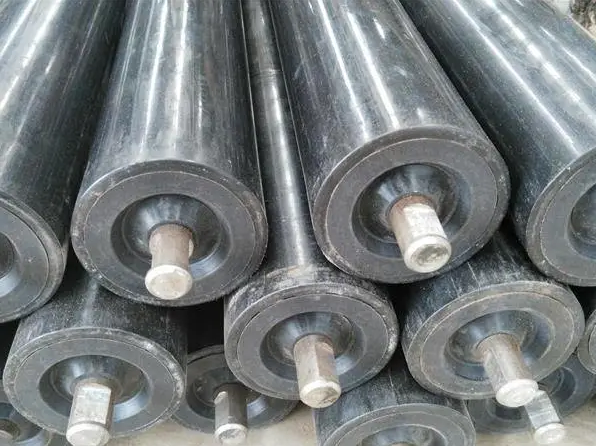
Parallel idler rollers: flat rollers for flat-section carrying and return-belt supporting, with optional galvanized or anti-corrosion surface treatment.
Materials, bearings and coatings
Material choice across the wider market is dominated by steel: steel accounted for 64% of the global roller market share by material in 2024, according to Straits Research. Both products discussed here use carbon steel tubes and shafts. The differences are concentrated in the bearing and surface specification.
- Trough idler — sealed double-row bearings selected for load-bearing capacity on the carrying side, with galvanized or coated surface treatment options intended for dusty and high-temperature site conditions.
- Parallel idler roller — sealed bearings selected to lower rotational resistance and running noise, with an optional galvanized or anti-corrosion coating aimed at humid outdoor and salt-spray port environments.
Low-noise behaviour on the parallel roller is a direct consequence of low rotational resistance in the bearing assembly — a practical consideration where conveyors pass through enclosed or populated areas. Corrosion resistance, by contrast, is a surface question: in coastal and port environments the coating matters as much as the roller body itself. Polymer and rubber-covered roller variants exist elsewhere in the market, but the reference range discussed here is built on carbon steel, with wear-resistant rubber used where impact absorption is required.
Inspection, documentation and lead time
The trough idler is produced with full-batch inspection on dimension and radial run-out, which controls coaxiality and minimises belt vibration and abnormal wear. Drawing confirmation and first-article inspection are available for project-specific load matching. Sample lead time is stated at 5–7 days, with mass production at 15–30 days.
The parallel idler roller is covered by complete incoming and pre-shipment inspections, intended to avoid roller seizure and to cut routine maintenance and replacement frequency. Private-label service covers nameplates and packaging, and a full set of export documents can be provided under FOB or CIF terms.
For a buyer assembling an acceptance file, the practical reading is that dimensional and run-out evidence is the closest available proxy for how the roller will behave once installed. Radial run-out and coaxiality determine vibration; vibration determines abnormal belt and roller wear. That is why both figures belong in the purchase specification, not only in the supplier's internal records.
Application fit: mining, cement, ports and logistics
The three environments below cover most enquiries that combine trough idlers and parallel rollers in one order.
Mining. Working conditions are dusty, heavy-duty and continuous. A typical project is an ore conveyor line where rollers support the conveyor belt and absorb loading impact. Operation is 24/7, with the belt, pulleys and conveyor frame as matched equipment. The special requirement is dust-resistant seals, low rotational resistance and wear resistance, with parameters subject to operating conditions. On the carrying side this is trough idler territory; on the return strand and flat sections it is parallel roller territory.
Cement. Conditions involve heavy dust, medium-to-high temperatures and continuous operation on a raw material handling line. The function is stable support with reduced belt mistracking and lower maintenance frequency, matched to a belt conveyor and belt cleaner. Dust and corrosion resistance are required, with the operating temperature range recorded as TBC.
Ports and logistics. Conditions are outdoor, humid and salt-spray, with long conveying distances on a bulk terminal conveyor. The parallel roller supports the return belt and maintains smooth operation in 24/7 duty, matched to the conveyor frame, belt and pulleys. Corrosion-resistant coating, sealed bearings and low noise are the stated requirements, with protection level recorded as TBC.
The pattern across all three is consistent: the trough idler is specified where material must be held, and the parallel roller is specified where the belt only needs to be supported — most visibly on the return strand of a long-distance port conveyor running continuously in salt-spray air.
Market trend signals behind the roller decision
The rollers and idlers segment was valued at USD 4.14 billion in 2025 and is projected to reach USD 7.05 billion by 2034, according to Straits Research. A separate estimate places the global roller conveyor market at USD 3.15 billion in 2025, per Dataintelo. The two figures describe different scopes rather than a disagreement about direction.
That definition gap is worth understanding before any market number is used in a business case. A 2024 estimate of the conveyor roller market at USD 115.9 million from Cognitive Market Research and a "rollers and idlers" estimate of USD 3.9 billion from Straits Research are not competing forecasts; they measure a component category against a sub-system category.
Two structural signals are more useful at the specification stage. First, steel remains the dominant roller material at 64% of global market share in 2024, which means the carbon steel roller is the mainstream choice rather than a legacy one. Second, mining and quarrying is the leading end-use industry for rollers and idlers at 36% of total revenue in 2024 — which is why dust-resistant sealing, wear resistance and heavy-duty construction dominate specification conversations. Regionally, the supply base is distributed rather than concentrated: Viet Nam's exports under HS 843139, covering parts for conveyors and elevators, reached USD 8.59 million in 2023 according to UN Comtrade.
What published data still does not cover well is supplier-level operational capability — material testing depth, certification readiness and OEM/ODM depth by supplier. For a buyer choosing between trough idler and parallel roller suppliers, that gap means the decisive evidence is usually obtained directly: drawings, batch inspection reports and first-article confirmation.
Limits and trade-offs: where each type stops being the right answer
Flat carrying with parallel rollers is a legitimate traditional configuration — and it is also where misapplication usually starts. A parallel idler roller is designed for flat-section carrying and return-belt supporting. It does not contain material. Used beneath a loose bulk load on the carrying side, it offers no lateral containment, and material that moves sideways has nowhere to go except off the belt.
The trough idler's limit runs in the opposite direction. A deeper trough angle contains material better, but the deeper cross-section increases belt contact and bending at the side rollers, which generally raises running resistance and belt edge stress. On a conveyor already operating close to its drive limit, or on a belt that was not designed for that troughing geometry, moving to a 35° set is not a free improvement.
Two further boundaries apply to both types:
- Neither absorbs heavy impact at a loading point. That function belongs to the rubber-ring impact roller, built from carbon steel and wear-resistant rubber, with a suggested tube diameter of Ø108 mm, a shaft diameter of Ø25 mm and a suggested length range of 315–1,150 mm, intended for crusher discharge and heavy-duty transfer points.
- Neither corrects belt mistracking. That is the role of the self-aligning / training idler, whose self-pivoting frame automatically corrects belt mistracking on long-distance lines.
Open specification items to close before ordering. Several parameters in the current reference data remain recorded as TBC — the pivot frame of the aligning idler, the rubber ring specification of the impact roller, protection levels for humid port environments, and the operating temperature range for high-temperature cement lines. A purchase order that relies on an assumed value for any of these carries avoidable risk, regardless of which roller type is being ordered.
Future outlook
Three shifts are likely to shape how trough idlers and parallel rollers are bought over the next few years.
First, evidence will matter more than appearance. Batch inspection, radial run-out measurement and first-article inspection are moving from premium services to standard expectations, because they remain the only practical way to predict vibration and wear before rollers are installed.
Second, bearing and sealing performance will carry more of the specification conversation. As long-distance and continuous-duty conveying spreads across mining, cement and port terminals, low rotational resistance and low noise become measurable requirements rather than descriptive claims.
Third, environment-specific specification will grow. Humid, salt-spray port terminals and dusty, high-temperature cement lines push coating, sealing and material choices further apart, which means a single generic roller specification will fit fewer projects over time.
The standards framework for all of this already exists: CEMA 502-2022 for troughing and return idler dimensions and load ratings, ISO 5048:1989 for power and tension calculations with carrying idlers, and DIN 22112 Part 3 for testing requirements in underground coal mining. The remaining gap is not the standard; it is supplier-level evidence showing consistent conformance to it.
FAQ: technical buying questions on trough idlers and parallel rollers
1. What does a conveyor roller actually do in a belt conveyor?
A conveyor roller supports the conveyor belt through bearing rotation. Bearings inside the roller reduce rotation resistance, and friction between the roller outer surface and the belt keeps the roller turning with the belt so that continuous material transport is maintained. Within this comparison, the trough idler supports the loaded portion of the belt while shaping the material cross-section, and the parallel roller supports flat and return sections of the belt.
2. What is the difference between a trough idler and a parallel roller?
A trough idler is a carrying idler set — classified in this range as a 35° trough carrying idler — that holds the belt in a trough shape so bulk material is contained and spillage is reduced. A parallel idler roller belongs to the return / flat-carrying idler category and is designed for flat-section carrying and return-belt supporting. The functional difference is containment versus belt support. Both are offered with suggested tube diameters of Ø89/108/133 mm and shaft diameters of Ø20/25 mm.
3. Can parallel rollers be used on the carrying side of a conveyor?
Yes, but only where flat-section carrying is intended. The parallel idler roller is designed for flat-section carrying and return-belt supporting, so it can operate beneath a flat belt section. It does not provide the lateral containment a troughing set provides, so it is not a substitute for a trough idler wherever loose bulk material must be held on the belt.
4. Should I specify a 20°, 25° or 35° trough angle?
All three angles are available in this range. The choice is a conveyor design decision rather than a catalogue preference: a deeper trough angle generally increases material containment while also increasing belt contact and bending at the side rollers. CEMA 502-2022 covers dimensional standards and load ratings for troughing and return idlers, and ISO 5048:1989 covers power and tension calculation with carrying idlers. The angle should be confirmed against belt width, material and frame geometry, and drawing confirmation is available for that purpose.
5. Which tube diameter should I start from — Ø89, Ø108 or Ø133 mm?
All three sit within the suggested tube diameter range for both the trough idler and the parallel idler roller, paired with shaft diameters of Ø20 mm or Ø25 mm. They are starting points for selection rather than fixed specifications. Roller length can be customised to match belt width on the trough idler, and tube diameter, shaft diameter and length can be customised on the parallel roller.
6. Do both roller types offer the same surface treatment options?
The options overlap but are specified differently. The trough idler offers galvanized or coated surface treatment options intended for dusty and high-temperature site conditions. The parallel idler roller offers an optional galvanized or anti-corrosion coating aimed at humid outdoor and salt-spray port environments. Both use carbon steel tubes and shafts; the trough idler uses sealed double-row bearings, while the parallel roller uses sealed bearings selected to lower rotational resistance and running noise.
7. What inspection evidence should be requested for each type?
For the trough idler, full-batch inspection on dimension and radial run-out controls coaxiality, which minimises belt vibration and abnormal wear; drawing confirmation and first-article inspection are available for project-specific load matching. For the parallel idler roller, complete incoming and pre-shipment inspections are performed to avoid roller seizure and reduce routine maintenance and replacement frequency. Buyers typically pair this evidence with the applicable standard for the site — CEMA 502-2022, ISO 5048:1989, or DIN 22112 Part 3 where underground coal mining idlers are involved.
8. What lead time should be planned for a trough idler order?
Within the trough idler range, sample lead time is stated as 5–7 days and mass production as 15–30 days. Lead times for parallel idlers and other roller types are not stated in the same form and should be confirmed per order, particularly where custom tube diameter, shaft diameter, length, coating or private-label packaging is involved.
Reference document: the Eastrise conveyor roller brochure is available as a PDF for specification review — Eastrise product brochure (PDF).