
Trunnion, Flanged, Threaded: Ball Valve Certificate Check
Trunnion, Flanged, Threaded: Ball Valve Certificate Check
Ball valve quotations arrive with a certificate page attached, and the page usually looks convincing: a handful of document numbers, an issuing mark, a scope line. The harder question is what those numbers actually cover. For a buyer comparing trunnion mounted, flanged and threaded ball valves, the useful test is not which supplier lists more certificates, but which of those documents attaches to the exact model, size, pressure class and body material on the purchase order.
This comparison takes one published certificate register — SIL IEC 61508:2010 certificate No. 4I260528.RSTDO08, PED-CE ECM PED-Bp 2024-TW60, ISO 9001 No. 20225Q21079R0M, ISO 14001 No. 20225E20474R0M and ISO 45001 No. 20225S20439R0M — and reads it against three product families from RST VALVE GROUP CO.,LTD: trunnion mounted valves in DN50–DN1200 at PN4.0–10.0 MPa, flanged Q41F/Q41H/Q45F valves, and threaded Q11F/Q61F/Q81F/Q11PPL valves from DN6–DN100 at 1000–2000 WOG.
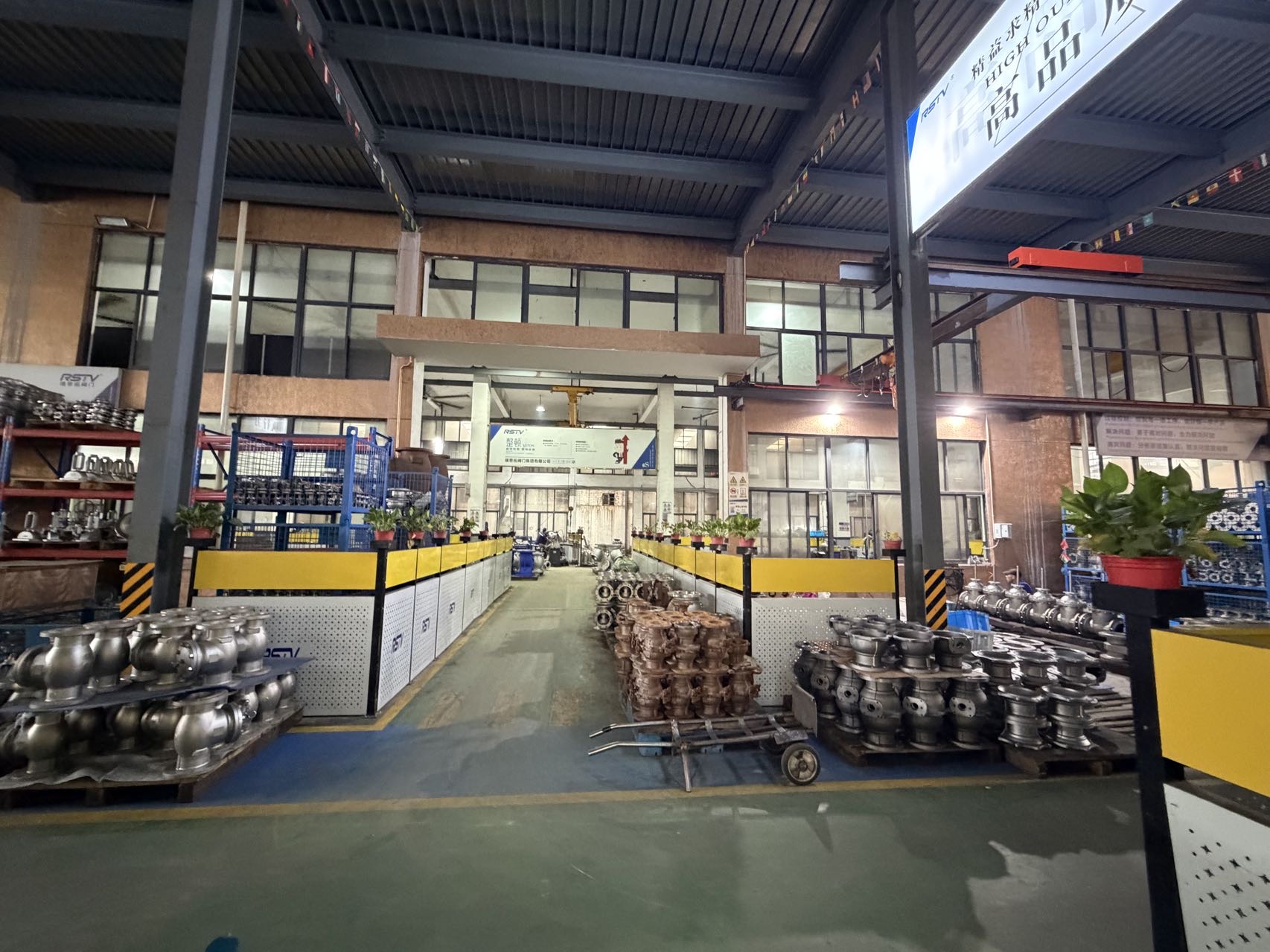
Production workshop. Image: RST VALVE GROUP CO.,LTD
Why a certificate list is not yet a buying decision
A certificate is issued to a legal entity for a defined scope. A purchase order is issued for a model, a size, a pressure class, a body material and a test regime. Between the two sits a scope statement, a model annex and an order-specific test record — and that middle layer is where most ball valve certificate comparisons are won or lost.
Three checks separate a usable certificate from a decorative one:
- Entity and site. Does the certificate name the organisation and the manufacturing address that will actually produce the order? A group-level document that does not identify the producing plant leaves the buyer to bridge the gap themselves.
- Model coverage. Does the annex or scope statement list the designation being ordered — Q347H, Q41F, Q11PPL — and, where the scheme requires it, the size and pressure range assessed?
- Order-level evidence. Does the file include the pressure-test record, material certificates and declaration of conformity that belong to this batch, rather than a generic brochure copy?
Validity dates sit underneath all three. A document can be genuine, correctly scoped and still outside its validity period on the day of delivery, so the expiry line deserves to be read as carefully as the number beside it.
The five documents and what each one actually establishes
The register supplied for this comparison contains four different kinds of assurance, not five versions of the same assurance. Reading them as one combined "certified" claim is the most common mistake in supplier comparison.
| Document | Certificate No. | What it addresses | What it does not establish alone |
|---|---|---|---|
| SIL — IEC 61508:2010 | 4I260528.RSTDO08 | Functional-safety assessment of the valve as an element in a safety-related system | Which models were assessed, or the SIL level achieved in a specific loop |
| PED-CE | ECM PED-Bp 2024-TW60 | Conformity with the EU Pressure Equipment Directive for equipment inside the certificate scope | That every size and pressure combination falls within directive scope |
| ISO 9001 | 20225Q21079R0M | Quality management system at the certified site | Product performance, pressure rating or material conformity |
| ISO 14001 | 20225E20474R0M | Environmental management system at the certified site | Environmental or containment performance of the valve itself |
| ISO 45001 | 20225S20439R0M | Occupational health and safety management system at the certified site | Product safety in service |
SIL IEC 61508:2010 is a functional-safety standard. A certificate under it speaks to the valve as an element within a safety-related system, and its meaning depends on the safety function being claimed, the architecture, the diagnostic coverage and the proof-test assumptions recorded in the safety manual. The certificate number on its own does not tell a buyer which model was assessed or what SIL level applies to a particular loop.
PED-CE concerns EU pressure equipment conformity. The operative questions are which category the equipment falls into, which conformity route was followed, and whether the declaration of conformity names the valve being shipped. Directive scope follows the equipment's own characteristics, so the marking and the certificate have to be read against the item, not against the catalogue.
The three ISO documents — 9001, 14001 and 45001 — are management-system certificates. They describe how the certified site is managed, not how any valve performs. They are the right evidence for supplier onboarding, audit planning and HSE screening, and the wrong evidence for a pressure-retention argument.
Three families, three different engineering questions
The three families are not interchangeable fittings at different prices. They answer different mechanical problems, and that difference decides which certificate question matters.
Trunnion mounted. In a trunnion design the ball is anchored top and bottom, so the seat load is generated by the seat and body rather than by line pressure pushing the ball downstream. That is why trunnion construction becomes the reference choice as diameter and pressure rise: in the RST range, models Q347F, Q347H and Q347Y cover DN50–DN1200 at PN4.0–10.0 MPa and -40°C to +150°C, with flanged connections and body options WCB, CF8 and CF8M. For an order in this family, the SIL annex and the PED declaration are the documents that carry real weight.
Flanged pattern. Models Q41F, Q41H and Q45F use flanged ends and are verified through water pressure testing and air tightness testing. These are the acceptance tests a buyer can actually audit: a hydrostatic record shows the body and seat held, and an air-tightness record shows the closure held against a gas. Where a buyer receives a certificate page and no test record for the flanged item, the certificate has not yet done its job.
Threaded. Models Q11F, Q61F, Q81F and Q11PPL cover DN6–DN100 at 1000–2000 WOG and serve small-bore piping where a threaded joint is acceptable. WOG is a service basis — water, oil and gas — rather than a class designation, so the rating has to be matched to medium, temperature and applicable derating instead of being lifted from the catalogue as an absolute limit. The DN100 ceiling is also the practical boundary of the comparison: above it, the shortlist has already moved to the flanged or trunnion families.
Reading the five certificates across the three families
The matrix below maps each document to the family where it does real work. It records where a buyer should look; the scope statement and model annex on the certificate itself govern what is actually covered.
| Document | Trunnion mounted (Q347F/Q347H/Q347Y) | Flanged (Q41F/Q41H/Q45F) | Threaded (Q11F/Q61F/Q81F/Q11PPL) |
|---|---|---|---|
| SIL 4I260528.RSTDO08 | Priority document where the valve performs a safety function; read the annex and safety manual | Confirm whether the flanged designations appear in the same annex | Confirm whether small-bore threaded models sit inside or outside the assessed scope |
| PED-CE ECM PED-Bp 2024-TW60 | Check category and declaration of conformity for each DN/PN combination ordered | Same check; size band to be confirmed from the current model list | Confirm whether the DN/WOG combination falls inside directive scope before relying on the mark |
| ISO 9001 20225Q21079R0M | Confirm the certified scope names the site that machines and assembles the trunnion valve | Confirm the scope covers the assembly and test line used for the order | Confirm the scope covers the threaded-valve production line |
| ISO 14001 20225E20474R0M | Site-level environmental management; ask for the scope statement, not the logo | Issued to the organisation, so it is not re-read per valve family | Issued to the organisation; no additional model-level value |
| ISO 45001 20225S20439R0M | Site-level OH&S management; relevant to audit and supplier onboarding | Same document applies across the families; check the certified address | Same document applies across the families |
The pattern is straightforward. The two technical documents — SIL and PED — need model-level reading, and their value collapses if the annex does not reach the designation being ordered. The three ISO management-system documents are organisation-level: they apply to the certified site whoever the customer is, so they need no per-family reading, but they also cannot be used to differentiate one valve family from another.
Model range and acceptance evidence: the buyer's side of the check
Once the document question is settled, the comparison moves to what the buyer can measure: model designation, size and pressure basis, and the test that will be recorded or witnessed before shipment.
| Family | Models | Size and pressure basis | Stated acceptance testing | Documents to attach to the order |
|---|---|---|---|---|
| Trunnion mounted | Q347F, Q347H, Q347Y | DN50–DN1200; PN4.0–10.0 MPa; -40°C to +150°C; flanged; body WCB, CF8, CF8M | Factory pressure testing of body and seals; bidirectional zero-leakage sealing requirement | SIL annex and safety manual, PED declaration, material certificates, pressure-test record |
| Flanged | Q41F, Q41H, Q45F | DN band to be confirmed from the current model list | Water pressure test and air tightness test | Hydrostatic and air-tightness records, ISO 9001 scope statement, PED declaration where applicable |
| Threaded | Q11F, Q61F, Q81F, Q11PPL | DN6–DN100; 1000–2000 WOG | Test regime to be confirmed in the quotation | WOG rating basis, test record, material certificate |
Two entries in that table deserve a written answer in the quotation rather than an assumption. The flanged family is defined in the supplied material by its model designations and its test regime rather than by a published DN band, so the current model list should travel with the offer. The threaded family's test regime is likewise not fixed by the designations alone, which makes the test clause a legitimate RFQ question instead of a formality.
The inspection chain behind the paper
Certificates describe systems; tests describe parts. The two meet in the factory inspection sequence, and that sequence is worth asking about explicitly.
RST VALVE GROUP CO.,LTD, founded in Wenzhou in 2009, describes an inspection chain running from raw material inspection through dimensional inspection, processing inspection, chemical testing, physical testing and pressure testing before finished valves are released. That sequence is what gives an ISO 9001 scope statement operational meaning: the certificate says a system exists, and the inspection records show what the system produced for this particular order.
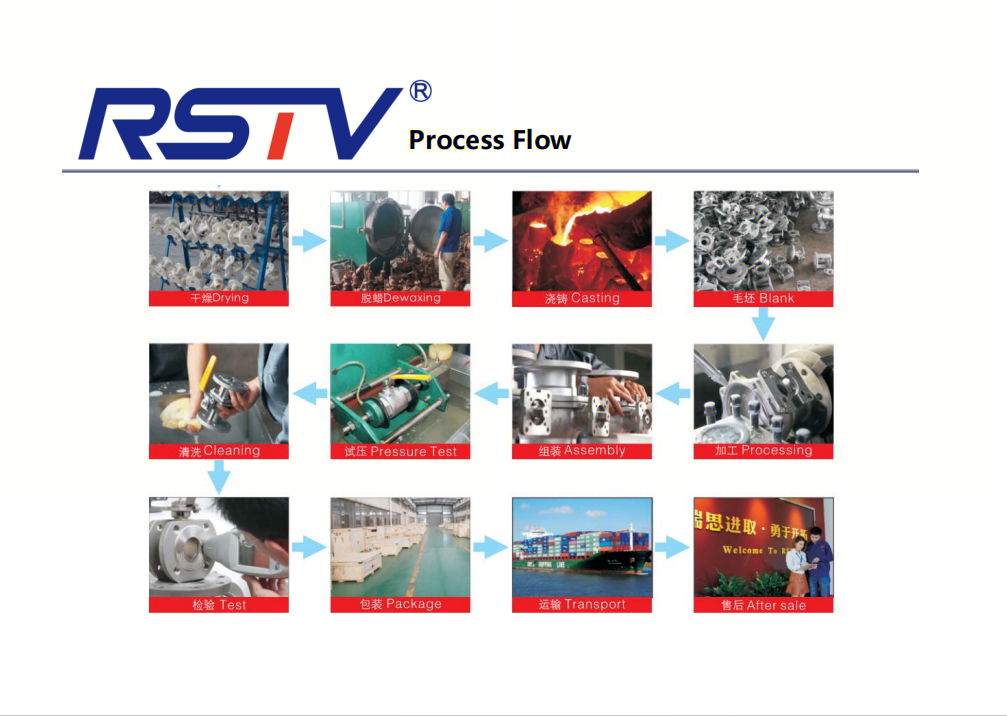
Valve manufacturing process flow. Image: RST VALVE GROUP CO.,LTD
Two further details matter when reading the register. First, factory pressure testing of valve bodies and seals is specified for the ball valve range, together with a bidirectional zero-leakage sealing requirement — a design and test requirement the buyer should see reflected in the report, in both flow directions. Second, an ISO 5211 direct-mount actuator interface is specified, supporting pneumatic and electric actuator integration and custom control configurations. That interface has a certification consequence: once an actuator is mounted, the safety function spans valve, mounting and actuator, so the SIL assessment has to be read at that boundary rather than at the valve alone. Optional fire-safe and anti-static structures are available for services that call for them, and their presence or absence belongs in the order specification, because an option is not a default.
Where the standards landscape is tightening
Three documents in the public standards record explain why buyers now ask for more paper, and why a five-document register should be treated as a starting point rather than a finish line.
- API Specification 6D, 25th Edition, is dated 2025 and sets requirements for the design, manufacturing, assembly, testing and documentation of ball, check, gate and plug valves for petroleum and natural gas pipeline and piping systems. The edition identified in the public record applies to pressure classes 150, 300, 400, 600, 900, 1500 and 2500.
- Addendum 2 to that edition, effective from 2025, extends the covered requirements to materials, welding, quality control, marking, documentation and process controls, and the scope identified in the public record includes hydrogen gas service.
- IOGP S-562, in its 2024 version, is a supplementary procurement specification for manually operated API 6D ball valves. The version identified in the public record states an allowable operating temperature range of -46°C to 150°C for the covered application.
The procurement implication is direct. API 6D is a product standard, distinct from an IEC 61508 SIL assessment and distinct from an ISO management-system certificate. Each answers a different question, and a buyer who needs all three should ask for all three by name.
This is also where the comparison has to be honest about its boundary. The register examined here contains SIL, PED-CE, ISO 9001, ISO 14001 and ISO 45001 documents. It does not, by itself, constitute an API 6D monogram listing, a fire-safe qualification or a fugitive-emission certificate, and nothing above should be read as claiming those. Where a project specification calls for them, they are separate requests with separate evidence.
Application fit and the limits of a document comparison
The families in this comparison are positioned for chemical pipeline, water treatment, natural gas, and oil and medium-pressure process systems, with wider use across petrochemical, petroleum refining, chemical, metallurgy and mining duty. The operating mode is quarter-turn on/off service: these are shut-off and diverting valves, not throttling valves, and a specification that expects modulating control has specified the wrong product regardless of which certificate is attached.
Beyond that, three limits belong in the buyer's file:
- Documents are not field performance. No certificate in this register establishes cycle life, torque, emissions or leakage behaviour in a particular service; those come from test records and, later, from service history.
- Family choice precedes certificate choice. A DN150 line cannot use a threaded family that stops at DN100, and a small-bore utility line does not need a trunnion casting. Settling size and connection first prevents a certificate comparison from being run on the wrong shortlist.
- Scope moves with the order. The trunnion range's PN4.0–10.0 MPa and -40°C to +150°C window describes the model series, not a licence to operate outside it; a service condition near the edge of that window should be confirmed in writing against the specific order.
Outlook: documentation as an entry ticket
Two movements are visible in the public record and both point the same way. Product standards are becoming more explicit about documentation, marking and process control, and hydrogen service has entered the scope of the API 6D addendum. Procurement specifications such as IOGP S-562 translate those requirements into bid-evaluation criteria rather than catalogue claims.
The consequence for a buyer is conditional but clear: a certificate register is increasingly the entry ticket to a bid evaluation, not the outcome of it. Suppliers able to produce model-level annexes, order-specific test records and a matching declaration of conformity are likely to move through the documentation stage faster; suppliers who cannot will spend that stage explaining a scope statement. None of this changes what a ball valve does — it changes what a buyer has to read before believing it.
Frequently asked questions
What does the SIL IEC 61508:2010 certificate No. 4I260528.RSTDO08 prove to a buyer?
It shows that a functional-safety assessment exists under IEC 61508:2010 for the scope the certificate names. It does not by itself establish the SIL level for a given application, the models assessed, or the proof-test assumptions. A buyer should read the scope statement and model annex, and the associated safety manual, then match them against the loop being designed.
Is a PED-CE document the same as a declaration of conformity?
No. The PED-CE document in this register, ECM PED-Bp 2024-TW60, supports conformity with the EU Pressure Equipment Directive; the declaration of conformity is the order-specific document naming the equipment, its category and the route applied. Buyers should receive both, and should check that the sizes and pressure ratings on the declaration match the purchase order.
Can ISO 9001, ISO 14001 and ISO 45001 certificates be compared across suppliers as product evidence?
They can be compared as management-system evidence: they indicate that a certified site operates a quality, environmental or occupational health and safety system within a stated scope. They say nothing about a valve's pressure rating, material conformity or leakage performance. For product evidence, request test records and material certificates instead.
How should threaded valves at DN6–DN100 and 1000–2000 WOG be compared with trunnion valves at DN50–DN1200 and PN4.0–10.0 MPa?
Only within the overlap. The two families use different rating bases — WOG expresses a water, oil and gas service basis, while the trunnion range is stated in nominal pressure — so a direct numeric comparison is not meaningful. Compare within the same size and the same rating basis, and confirm derating for the actual medium and temperature.
Which documents should accompany a ball valve purchase order?
At minimum: certificate copies with their scope statements and model annexes, the declaration of conformity where the directive applies, material certificates for body and trim, a pressure-test record covering body and seat in both directions, and, where actuation is supplied, the interface and actuator documentation. Fire-safe or emission documents should be added only where the specification requires them, as separate items.
Reference document
The certificate register discussed above, together with the product range it accompanies, is published by RST VALVE GROUP CO.,LTD in its current presentation: RST Valve Group presentation (PDF). Buyers comparing families should treat it as the starting register described in this article — a list of documents to be matched against the model, size and test record on the order.
Have Questions or Need More Details?
Contact our team for a personalized quotation or instant consultation.
Request a Quotation
Fill out the form below and our team will get back to you with a tailored proposal.
WhatsApp Direct Chat
Prefer to chat in real-time? Message us on WhatsApp for instant assistance & quick answers.
- Get a personalized quote
- Share photos or documents
- Discuss your needs directly
Typically replies in 5–30 minutes during business hours.