
Trunnion Mounted Ball Valve: A Pipeline Buyer's Reference
Ball valves are quarter-turn isolation devices: they start, stop and divert flow in piping systems. In large-bore, higher-pressure process and pipeline service, the factor that most often decides long-term sealing behaviour and maintenance cost is not the ball itself, but how that ball is supported inside the valve body.
A trunnion mounted ball valve supports the ball on a fixed trunnion rather than letting it float against the seats. That single architectural difference changes seat loading, operating torque and the practical size range in which the design makes engineering sense.
RST VALVE GROUP CO.,LTD is a China-based industrial valve manufacturer established in 2009 in Wenzhou City, Zhejiang Province, China. The company designs, researches, develops, manufactures, sells and services industrial valves, including ball valves, gate valves, check valves, globe valves and Y strainers.
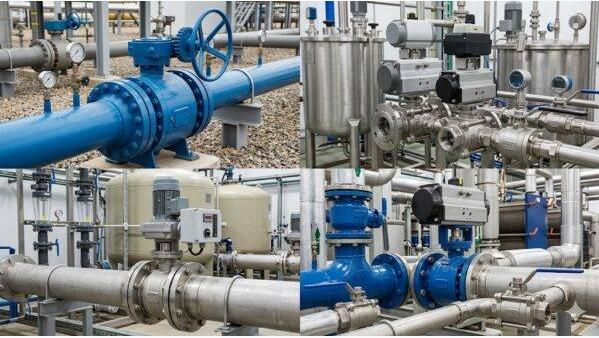
Petrochemical, refining, chemical and power process piping is the primary application context for trunnion mounted ball valves.
What a Trunnion Mounted Ball Valve Is
A trunnion mounted ball valve is a quarter-turn ball valve in which the ball is held by a trunnion arrangement in the body rather than being supported by the seats. RST Valve's Q347 series belongs to the 2PC trunnion mounted ball valve category and carries the model designations Q347F, Q347H and Q347Y.
The valve design includes a spring-loaded, movable metal seat, automatic cavity pressure relief, a fire-safe design and a blowout-proof stem. It is configured as a gear operated trunnion mounted ball valve or an electric trunnion mounted ball valve, and multiple actuation options are available.
Q347 Series: Published Specification Snapshot
| Parameter | Published specification |
|---|---|
| Product type | 2PC trunnion mounted ball valve |
| Model designations | Q347F, Q347H, Q347Y |
| Connection type | Flanged |
| Nominal diameter | DN50-DN1200 |
| Nominal pressure | PN4.0-10.0 MPa |
| Applicable temperature | -40 degrees C to +150 degrees C |
| Body material options | WCB, CF8, CF8M |
| Material options | Carbon steel, SS304, SS316 |
| Seat design | Spring-loaded, movable metal seat |
| Design features | Fire-safe design, automatic cavity pressure relief, blowout-proof stem |
| Actuation | Gear operated or electric; multiple actuation options available |
These figures describe one defined product family and should be read as the manufacturer's published range, not as an industry-wide benchmark. Size, pressure class and material combinations that fall outside this table require confirmation against the current datasheet for the specific model ordered.
The Engineering Problem: Why Floating Designs Have a Practical Ceiling
In a floating ball valve, line pressure pushes the ball downstream into the seat, and the seat does the sealing work. This is an efficient and economical arrangement in small and medium bore sizes, and it is why floating designs account for the larger share of ball valve unit volume.
The difficulty appears as bore and pressure rise. The load the seat must carry grows with the pressure acting on a larger ball area, and operating torque rises with it. At large diameters on high-pressure lines, that combination becomes harder to manage with a purely floating architecture: the seat is asked to do structural work as well as sealing work.
A trunnion mounted design removes that structural burden from the seat. The ball is supported by the trunnion, so the seats can be spring-loaded against the ball with more controlled contact pressure and the actuation torque needed to turn the ball stays more predictable across the size range. For pipeline and process isolation duty in larger bores, this is the reason the trunnion architecture is specified rather than chosen for preference.
How the Q347 Architecture Works in Service
Spring-loaded, movable metal seat
The metal seat is spring-loaded and movable. The spring loading maintains seat-to-ball contact pressure as components wear and as pressure and temperature change during service, rather than relying on line pressure alone to push the ball into the seat.
Automatic cavity pressure relief
In a ball valve, the body cavity can trap liquid when the valve is closed. If that trapped liquid expands, for example through a temperature rise in the line, the cavity can become over-pressurised. Automatic cavity pressure relief limits that condition without operator intervention.
Blowout-proof stem
The stem is designed to be blowout-proof, so it cannot be ejected from the valve body under pressure. This is a safety characteristic rather than a performance claim, and it matters most on lines where a stem release would create an uncontrolled release of media.
Fire-safe design
The Q347 series is stated as having a fire-safe design. In practice this means the valve is engineered so that a sealing barrier is intended to survive a fire event, an important procurement criterion in hydrocarbon service where project specifications commonly call for fire-safe valves.
Actuation and control
The valve is available as a gear operated unit or an electric actuated unit, and multiple actuation options are available. In the wider RST Valve ball valve range, operation is described as 90-degree quarter-turn, with manual operation (lockable handle optional), pneumatic single or double acting actuation, and electric on-off or modulating actuation. Actuator mounting through an ISO 5211 direct-mount pad is described for the threaded and flanged ball valve ranges and for the general process-piping application description; buyers specifying automation on a Q347 series valve should confirm the mounting interface for the exact model in the quotation.
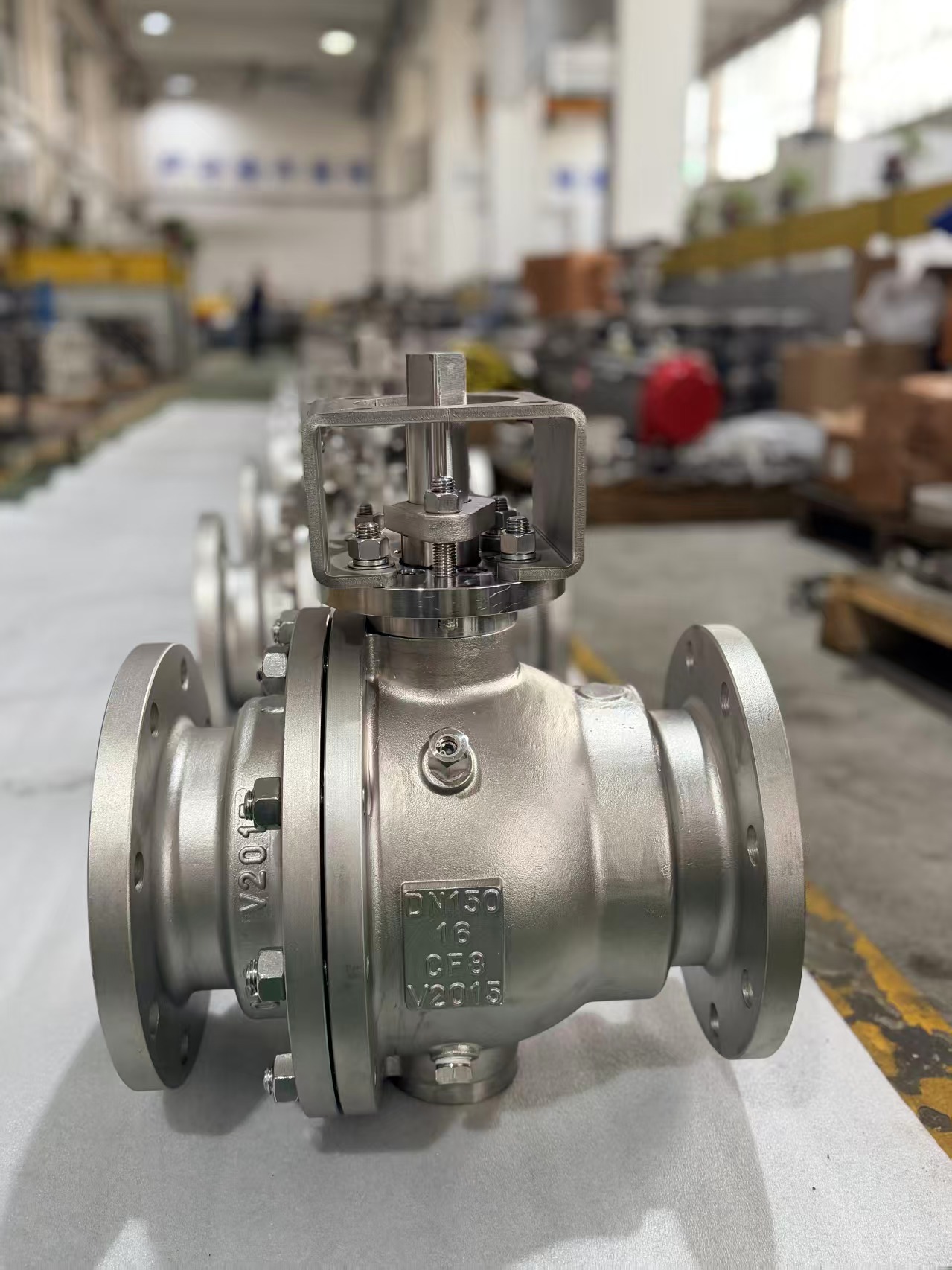
A 2PC trunnion mounted ball valve, the split-body architecture used across the Q347 series.
Materials: Matching the Body to the Medium
The Q347 series offers WCB, CF8 and CF8M body materials, with carbon steel, SS304 and SS316 as the stated material options. The ball valve range is described as available in carbon steel, SS304 and SS316 for corrosive media.
In RST Valve's flanged ball valve family, the published body material options extend further to include carbon steel (WCB), CF8 (304), CF8M (316), duplex stainless steel 2205 and CF3M. This matters because material selection is driven by the medium, not by the valve type: water, oil and gas service does not create the same material demand as weak acids or alkalis, and the body material and the sealing material must be selected together against the working conditions rather than independently.
The broader clean-service picture also appears in the product documentation. For food and pharmaceutical applications, a 316L polished finish with food-grade seals is described, and for flammable or explosive media, an explosion-proof configuration is described. Both should be treated as configuration choices confirmed at order, not as default features of every unit.
Application Map: Where Trunnion Mounted Ball Valves Are Used
RST Valve's trunnion mounted ball valve is designed for pipeline projects and is stated as suitable for petrochemical, petroleum refining, chemical, metallurgy, liquid cooling, nuclear power, mining, medical, food, national defense, military and urban construction applications.
The associated process-piping scenario is described with the following conditions:
- Media: water, oil, gas, weak acids and alkalis.
- Pressure: PN16-PN63 and CLASS 150-300.
- Temperature: -20 degrees C to 180 degrees C in the scenario description.
- Project type: process piping projects for chemical, gas, pharmaceutical and water treatment industries.
- Function: shut off, distribute and change the flow direction of the medium.
- Operation: 90-degree quarter-turn; manual with optional lockable handle; pneumatic single or double acting; electric on-off or modulating; ISO 5211 direct-mount actuator interface.
- Service type: on-off service only; not suitable for throttling.
- Matched equipment: flange gaskets and threaded pipe fittings; pneumatic components including FRL units, solenoid valves and limit switches; electric actuators; spare parts including valve seats, O-rings and packing.
- Special requirements: blowout-proof stem; optional anti-static and fire-safe designs; ISO 5211 high mounting pad; bidirectional zero-leakage sealing; factory pressure testing of body and seals; disassembly under pressure strictly prohibited; explosion-proof configuration for flammable or explosive applications.
A note on the temperature figures. The Q347 series product specification states an applicable temperature range of -40 degrees C to +150 degrees C, while the general process-piping scenario description in the product documentation references -20 degrees C to 180 degrees C. These two figures come from different document sets and describe different scopes. A buyer should reconcile them against the actual ordered configuration, the selected seat and seal materials, and the project specification before treating either number as binding.
Manufacturing and Quality Context
RST Valve Group operates a manufacturing facility of 20,000 square metres, employs approximately 430 staff, and maintains an R&D team of five engineers. The company's stated annual production level is about 3,000 tons of industrial valves.
RST Valve is an ISO, CE and TS certified manufacturer. Products are manufactured in accordance with API, ANSI, DIN, JIS, BS and GB standards. The flanged ball valve range is further described as certified to ISO9001, TS Special Equipment and CE EU, with water pressure and air tightness testing performed before shipment.
Inspection is described as covering raw material inspection, dimensional inspection, processing inspection, chemical testing, physical testing and pressure testing. For a buyer, this sequence is the relevant point: it defines where evidence should exist. A supplier claiming conformity to a standard should be able to produce the corresponding material certificates, dimensional records and pressure test reports for the specific production lot, not only a certificate for the company.
The company reports an export ratio of 71 to 80 percent, with markets across Africa, the Americas, Asia, the Caribbean, Eastern Europe, Europe, the Middle East, Northern Europe, Oceania, Western Europe and worldwide. RST Valve also accepts valve OEM and ODM inquiries.
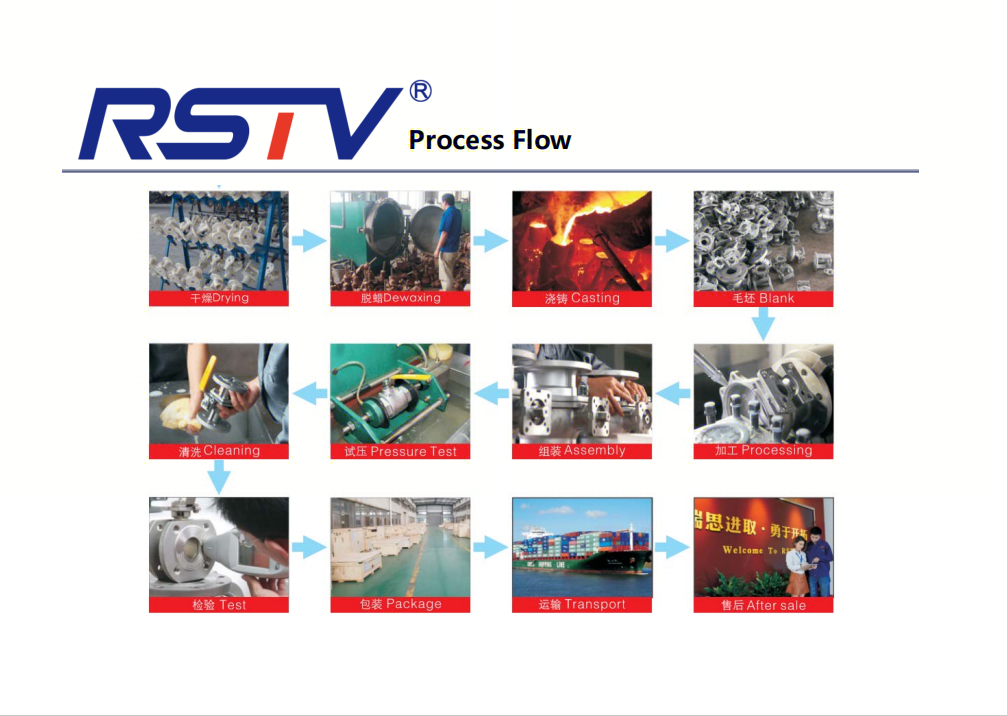
Valve manufacturing and inspection flow: the stage at which supplier evidence should exist for each production lot.
Market Signals in the Ball Valve Segment
The global ball valve market was estimated at USD 14.8 billion in 2025 by Straits Research, with the publisher referencing a forward window beyond that base year. Commercial research estimates of this kind vary in product boundary and methodology, so they are useful as scale indicators rather than as procurement planning inputs.
On product mix, commercial research estimates place floating ball valves at approximately 61.8 percent of ball valve demand by type in 2025, and trunnion mounted ball valves at roughly 34.0 percent in 2026. The pattern is consistent with the engineering logic described earlier: floating designs serve the larger unit-volume utility and general isolation segment, while trunnion mounted designs concentrate in high-pressure, large-bore and pipeline duty. These percentages come from commercial research datasets with differing boundaries and should be treated as directional.
The more consequential movement for buyers is in standards. API Specification 6D, the pipeline valve specification, is published in a 25th Edition dated November 2025, and it defines requirements for the design, manufacturing, assembly, testing and documentation of ball, check, gate and plug valves for petroleum and natural gas pipeline and piping systems. The 25th Edition identifies pressure classes 150, 300, 400, 600, 900, 1500 and 2500. Addendum 2 to the 25th Edition, dated 2024, describes requirements covering design, manufacturing, materials, welding, quality control, assembly, testing, marking, documentation and process controls, and its stated scope includes hydrogen gas service.
Alongside the standard, IOGP S-562 Version 3.1 provides a supplementary procurement specification for manually operated ball valves used with API Specification 6D, defining a minimum common set of requirements for a defined oil and gas procurement context. That document specifies an allowable operating temperature range of -50 degrees F (-46 degrees C) to 302 degrees F (150 degrees C) for its covered application. This is a project-specific requirement, not a universal rating for all ball valves, and it is a useful example of why project specifications rather than catalogue headlines should drive technical bid evaluation.
Trunnion Mounted vs Floating and Conventional Isolation Choices
| Aspect | Trunnion mounted (Q347 series) | Floating ball valve |
|---|---|---|
| How the ball is supported | Ball held by a trunnion arrangement in the body | Ball supported by the seats and free to move with line pressure |
| Seat design in this range | Spring-loaded, movable metal seat | Seat carries the ball load |
| Published range | DN50-DN1200; PN4.0-10.0 MPa; -40 degrees C to +150 degrees C; flanged connection | Ranges vary by manufacturer and model |
| Typical fit | Large bore and higher pressure isolation; pipeline and process duty | Small and medium bore utility and general isolation |
| Component count and cost | More components, including trunnion support and spring-loaded seats; higher unit cost and envelope | Simpler construction; lower cost at equivalent small sizes |
| Actuation demand | Torque more predictable at large sizes; gear or electric actuation available | Rises with size and pressure on larger sizes |
A multi-turn gate valve is the older alternative for isolation duty. It performs the same function but requires multiple turns to operate, which limits its use in automated or fast-acting service, and it typically occupies a larger envelope for the same bore. Quarter-turn ball valve designs exist largely because those two characteristics matter in modern piping systems.
This table compares architectures at a general engineering level. It is not a supplier-by-supplier benchmark, and it does not establish that one architecture is superior in absolute terms. The correct choice depends on bore, pressure class, medium, operating frequency and automation requirements.
Limits and Trade-offs Buyers Should Accept
- On-off service only. The documented operation mode is on-off service, and the valve is described as not suitable for throttling. If a project needs continuous flow regulation, a control valve is the correct device, not a trunnion mounted ball valve.
- The published nominal pressure band is narrower than the API 6D class list. The Q347 series is published as PN4.0-10.0 MPa, whereas API Specification 6D references classes up to Class 2500. Projects requiring higher classes should confirm availability from the current datasheet rather than assume it from the product category.
- Temperature coverage is bounded. The stated range for the Q347 series is -40 degrees C to +150 degrees C. Project specifications written to the full IOGP S-562 lower bound of -46 degrees C require a case-by-case review of body, seat and seal materials.
- The published size range starts at DN50. Small-bore lines below DN50 sit outside the Q347 range. RST Valve's threaded ball valve range covers DN6 to DN100 and the flanged ball valve range covers DN15 to DN600, so smaller lines are served by different product families rather than by this one.
- More components mean more cost and more space. Trunnion supported construction adds parts and mass compared with a floating design. On small utility lines that do not require the load-carrying behaviour, a floating ball valve is usually the more economical answer.
- Some features are options, not defaults. Anti-static capability is described for the flanged and threaded ball valve ranges and in the general special-requirements list. Fire-safe design is stated for the Q347 series. Whether a specific ordered unit includes any optional feature should be confirmed in the quotation and on the datasheet.
- No installation value comes without correct handling. Disassembly under pressure is strictly prohibited, and factory pressure testing of body and seals is described as a pre-shipment step. Those are operating rules, not suggestions.
Procurement Checklist: Questions That Distinguish Suppliers
- Which edition of API Specification 6D applies to the project, and can the supplier state the pressure class of the offered valve against that edition rather than against a generic designation?
- Does the project fall within the scope of IOGP S-562, and if so, does the offered valve satisfy the supplementary procurement requirements rather than only the base standard?
- What is the medium, working pressure, working temperature, nominal diameter and connection type? These five confirmations drive material and seal selection and should be settled before price comparison.
- Which body material is offered, and which sealing material is offered with it, for the specific medium and working conditions?
- What test evidence will be supplied with the shipment: chemical testing, physical testing, body pressure test and seat tightness records for the actual production lot?
- Is the actuation requirement manual, gear, pneumatic single or double acting, or electric on-off or modulating, and what actuator mounting interface does the offered model provide?
- Which features are standard on the offered model and which are options, specifically fire-safe design, anti-static provision and explosion-proof configuration?
- What spare parts are recommended, and what is the maintenance access path? A split-body two-piece or three-piece structure is described as allowing disassembly and replacement of seals, which affects maintenance cost over the service life.
Future Outlook
Two forces are likely to shape trunnion mounted ball valve procurement over the next few years, and both are already visible in the published record.
The first is standards drift. API Specification 6D moved to a 25th Edition dated November 2025, and Addendum 2 to that edition describes requirements for design, manufacturing, materials, welding, quality control, assembly, testing, marking and documentation, with a scope that includes hydrogen gas service. As the covered service envelope widens, supplier qualification will increasingly be judged on documented process control rather than on the nominal product category.
The second is application spread. RST Valve lists liquid cooling and nuclear power among the fields its valves serve, alongside petrochemical, refining, chemical and metallurgy. These are sectors where isolation reliability and traceable test documentation carry high consequences. Buyers evaluating suppliers in these segments should expect to review material certificates, pressure test records and design features such as cavity pressure relief and blowout-proof stems as part of routine prequalification rather than as exceptions.
FAQ
What is a trunnion mounted ball valve?
A trunnion mounted ball valve is a quarter-turn ball valve in which the ball is held by a trunnion arrangement rather than being supported by the seats. RST Valve's Q347 series is a 2PC trunnion mounted ball valve with model designations Q347F, Q347H and Q347Y, a flanged connection, a spring-loaded movable metal seat, automatic cavity pressure relief, a fire-safe design and a blowout-proof stem.
How does a trunnion mounted design differ from a floating ball valve?
In a floating ball valve, line pressure pushes the ball into the seat, so the seat carries the ball load and performs the sealing work. In a trunnion mounted design, the ball is supported by the trunnion, so the seats can be spring-loaded against the ball with controlled contact pressure. Commercial research estimates place floating designs at approximately 61.8 percent of ball valve demand by type in 2025 and trunnion mounted designs at roughly 34.0 percent in 2026, reflecting that floating designs serve higher unit volumes in general isolation while trunnion designs concentrate in large-bore and higher-pressure duty.
What should I confirm before selecting a ball valve?
Confirm the medium type, working pressure, working temperature, nominal diameter and connection type, then select the body material and sealing material to match the pipeline medium and working conditions. These five confirmations determine whether the offered valve is technically suitable; price comparison is only meaningful after they are settled.
What sizes, pressures and temperatures does the Q347 series cover?
The published range for the Q347 series is DN50 to DN1200 nominal diameter, PN4.0 to 10.0 MPa nominal pressure, and -40 degrees C to +150 degrees C applicable temperature, with a flanged connection and WCB, CF8 or CF8M body material options. The general process-piping scenario description in the same product documentation references PN16-PN63 and CLASS 150-300 at -20 degrees C to 180 degrees C. Buyers should confirm the governing figure against the ordered configuration and the project specification.
What materials and actuation options are available?
Material options are carbon steel, SS304 and SS316, with body material options of WCB, CF8 and CF8M. The valve is configured as a gear operated trunnion mounted ball valve or an electric trunnion mounted ball valve, and multiple actuation options are available. Across the wider RST Valve ball valve range, operation is described as 90-degree quarter-turn with manual, pneumatic single or double acting, and electric on-off or modulating options.
Which industries and media are these valves used for?
The trunnion mounted ball valve is designed for pipeline projects and stated as suitable for petrochemical, petroleum refining, chemical, metallurgy, liquid cooling, nuclear power, mining, medical, food, national defense, military and urban construction applications. The associated process-piping scenario describes media of water, oil, gas and weak acids or alkalis, used to shut off, distribute and change the direction of flow.
Can a trunnion mounted ball valve be used for throttling?
No. The documented operation mode for this valve is on-off service only, and it is described as not suitable for throttling. Flow regulation requires a control valve, not a quarter-turn isolation ball valve.
Which standards and specifications support procurement of these valves?
API Specification 6D, published in a 25th Edition dated November 2025, defines requirements for the design, manufacturing, assembly, testing and documentation of ball, check, gate and plug valves used in petroleum and natural gas pipeline and piping systems, and identifies pressure classes 150, 300, 400, 600, 900, 1500 and 2500. IOGP S-562 Version 3.1 is a supplementary procurement specification for manually operated ball valves used with API Specification 6D in a defined oil and gas context. RST Valve states that its products are manufactured in accordance with API, ANSI, DIN, JIS, BS and GB standards, and that the company is an ISO, CE and TS certified manufacturer.
RST VALVE GROUP CO.,LTD publishes its product range, factory information and certification details at stainlesssteel-valves.com. A downloadable company presentation covering its valve portfolio is available here. Buyers preparing a technical bid evaluation should request current datasheets, material certificates and pressure test reports for the specific model and production lot under consideration.