
Trunnion Mounted Ball Valves: What OEM Buyers Can Specify
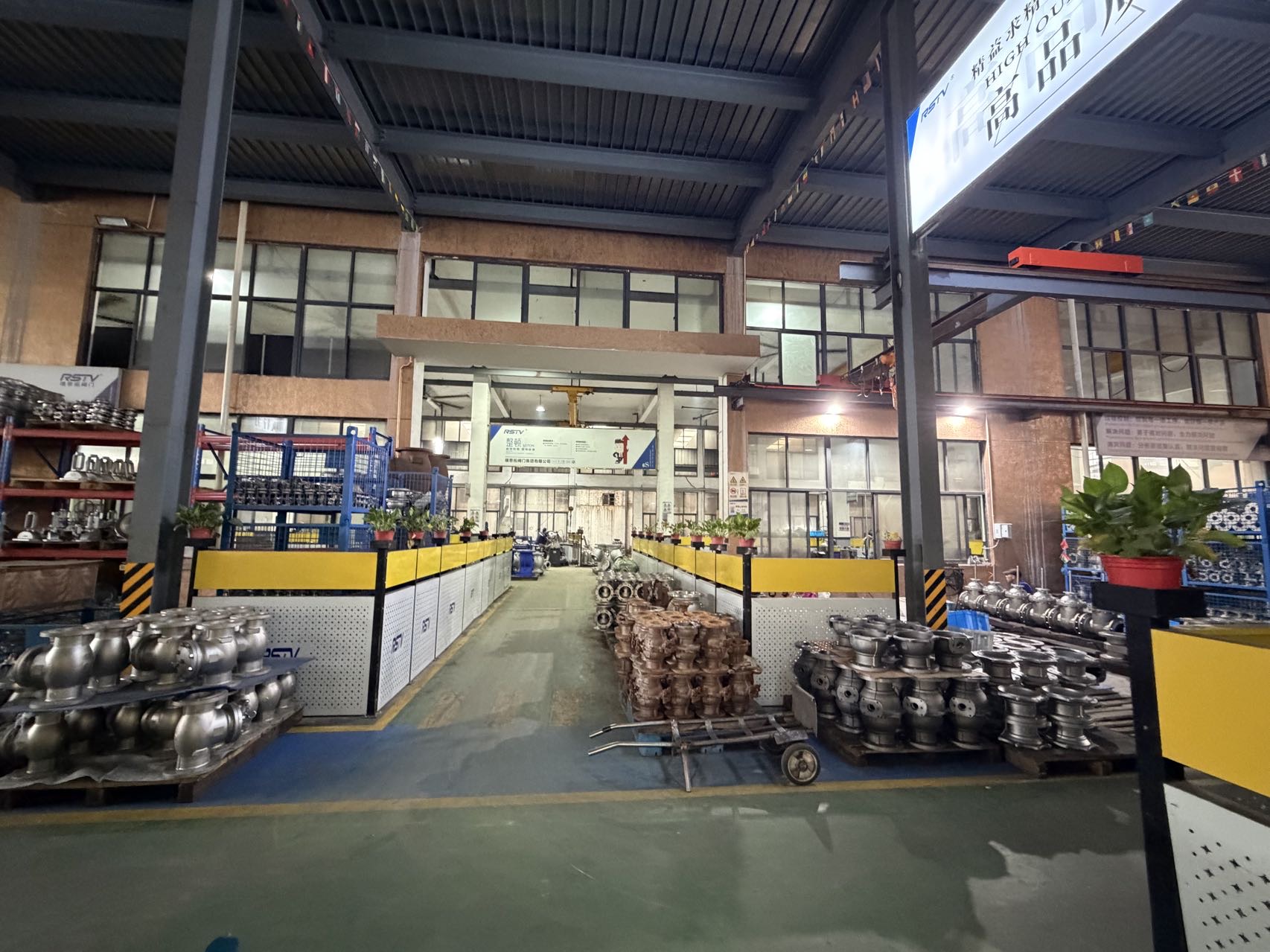
Production workshop view of the valve manufacturing base behind the trunnion mounted ball valve line.
Most ball valve sourcing problems do not start at the category stage. They start at the configuration stage, where a category decision has to become a documented, testable product with a fixed pressure rating, a defined body material, a defined actuator interface and a traceable set of certificates and test records.
For larger-diameter isolation duty, that conversation usually involves the trunnion mounted ball valve. RST VALVE GROUP CO.,LTD is a Wenzhou, China-based industrial valve manufacturer founded in 2009 that produces ball valves, gate valves, check valves, globe valves and Y strainers, with a reported export share of 71%-80% across Africa, the Americas, Asia, Europe, the Middle East and Oceania. Its trunnion mounted ball valve line is published under the Q347F, Q347H and Q347Y model series.
This reference is written for buyers and engineers who have already accepted the category decision and now need to know what can be specified, what the published envelope covers, and what has to be verified before an order is released.
The Specification Gap Between a Category and a Released Order
A procurement brief that reads "trunnion mounted ball valve, larger diameter, pipeline isolation" is not yet an order. Between that brief and a released purchase order sit four documents a supplier has to answer against: a data sheet covering pressure rating, size, temperature, end connection and body material; an actuation schedule covering manual, gear, pneumatic or electric operation and the mounting interface; a quality plan naming the tests and the inspection stages; and a document package containing material certificates, test reports, marking and traceability.
The reference framework for pipeline duty is well defined. API Specification 6D defines requirements for the design, manufacturing, assembly, testing and documentation of ball, check, gate and plug valves used in petroleum and natural gas pipeline and piping systems, and the identified edition covers pressure classes 150, 300, 400, 600, 900, 1500 and 2500. The 25th Edition Addendum 2 extends the requirement set across design, manufacturing, materials, welding, quality control, assembly, testing, marking, documentation and process controls, and covers hydrogen gas service alongside petroleum and natural gas applications.
For oil and gas buyers, IOGP S-562 Version 3.1 narrows that framework into a supplementary procurement specification for manually operated API 6D ball valves, with an identified allowable operating temperature range of -50 °F (-46 °C) to 302 °F (150 °C). The practical consequence is that suppliers are increasingly evaluated on how precisely they can respond to a specification, not only on whether they can supply the category.
What the RST Valve Group Trunnion Mounted Ball Valve Line Covers
The trunnion mounted ball valve is one of three ball valve families in the RST Valve Group catalogue, alongside flanged ball valves and threaded ball valves. Its published specification is specific enough to be worked with directly at quotation stage.
| Specification item | Published value |
|---|---|
| Product | Trunnion Mounted Ball Valve |
| Model series | Q347F, Q347H, Q347Y |
| Configurations | 2PC Trunnion Mounted Ball Valve; Gear Operated Trunnion Mounted Ball Valve; Electric Trunnion Mounted Ball Valve |
| Nominal pressure | PN4.0-10.0 MPa |
| Nominal diameter | DN50-DN1200 |
| Applicable temperature | -40 °C to +150 °C |
| Connection type | Flanged |
| Body material | WCB / CF8 / CF8M, etc. (carbon steel / SS304 / SS316 material family) |
Two design notes matter for buyers. First, the line is published in a two-piece (2PC) body configuration. Second, the end connection is flanged only: buyers who need threaded, socket-welded, butt-welded or clamp connections are working in a different product family, even when the application looks comparable.
The manufacturing base operates in-house CNC machining for ball valve components, including CNC machines for flanged ball valves, and states a monthly production capacity of 15,000 units. Products are stated to be performed in accordance with national standards of API, ANSI, DIN, JIS, BS and GB.
Pressure, Size and Temperature: Reading the Envelope Before You Configure
Trunnion mounted ball valves from this line are published at nominal pressure PN4.0-10.0 MPa, nominal diameter DN50-DN1200 and an applicable temperature of -40 °C to +150 °C.
Those three parameters interact. A specification that fixes DN1200 for a mainline isolation point is a different procurement problem from one that fixes DN50 on a small process branch, even at the same pressure rating: body mass, machining tolerance, test fixture, actuation torque and shipping configuration all change.
Temperature is often where buyers should slow down. Where a project references IOGP S-562, the identified allowable operating temperature range for covered manually operated API 6D ball valves is -50 °F (-46 °C) to 302 °F (150 °C). The RST trunnion line is published at -40 °C to +150 °C. For ambient-temperature process duty the difference is immaterial; for low-temperature service it is a point that should be confirmed against the project requirement in writing rather than assumed from a general cold-service description.
The Customization Envelope on an OEM or ODM Order
RST Valve Group provides OEM production services and ODM design and production services, and accepts drawing-based customization on ball valves. The published customization list covers:
- Body material
- Connection type
- Pressure rating, including custom pressure ratings
- Actuator, including custom actuator integration
- Logo and marking
- Special seal materials
- Fire-safe and anti-static design
- Sanitary polishing
For an OEM buyer, the useful distinction is between parameters that change the valve's engineering identity and parameters that change its commercial identity. Body material, seal material, pressure rating and fire-safe or anti-static construction change the engineering identity - they determine whether the valve can be offered for a given medium and duty. Logo, marking and tag plate content change the commercial identity, and are what make a valve traceable in the end user's system once it is installed.
Sanitary polishing and food-grade sealing options point to a different end of the spectrum. For food, beverage and pharmaceutical-adjacent lines, surface finish and seal compatibility become the governing requirement rather than pressure class.
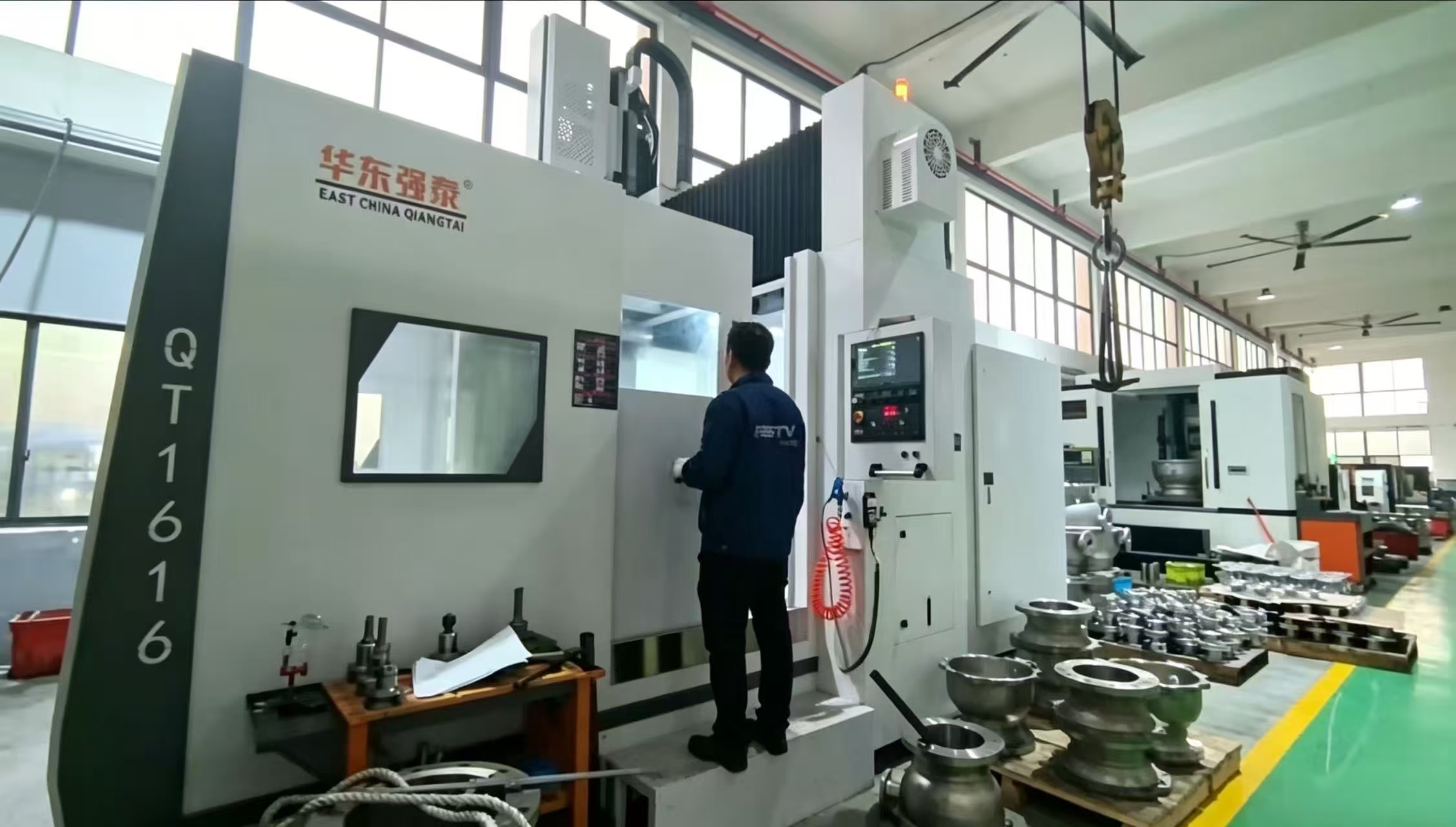
In-house CNC machining of flanged ball valve components supports dimensional control on flanged-end trunnion bodies.
Actuation and Integration
The ball valve range is designed for 90° quarter-turn operation and on-off service. Manual operation is standard, with a lockable handle available as an option. Pneumatic actuation is available in single-acting and double-acting configurations, and electric actuators can be supplied for on-off or modulating duty. The range uses an ISO 5211 direct-mount actuator interface, including an ISO 5211 high mounting pad, which allows an actuator to be mounted without a separate coupling bracket.
In a packaged order, the valve is rarely the only item on the bill of materials. Components commonly specified alongside the valve include flange gaskets, threaded pipe fittings, pneumatic accessories such as FRL units, solenoid valves and limit switches, electric actuators, and spare parts including valve seats, O-rings and packing. Optional anti-static and fire-safe components are specified for hazardous and flammable service, where an explosion-proof configuration is required.
Two structural features shape how the valve behaves in service: a blowout-proof stem and bidirectional zero-leakage sealing. Factory pressure testing of both body and seals is part of the standard process. Disassembly of a valve while it is under pressure is strictly prohibited.
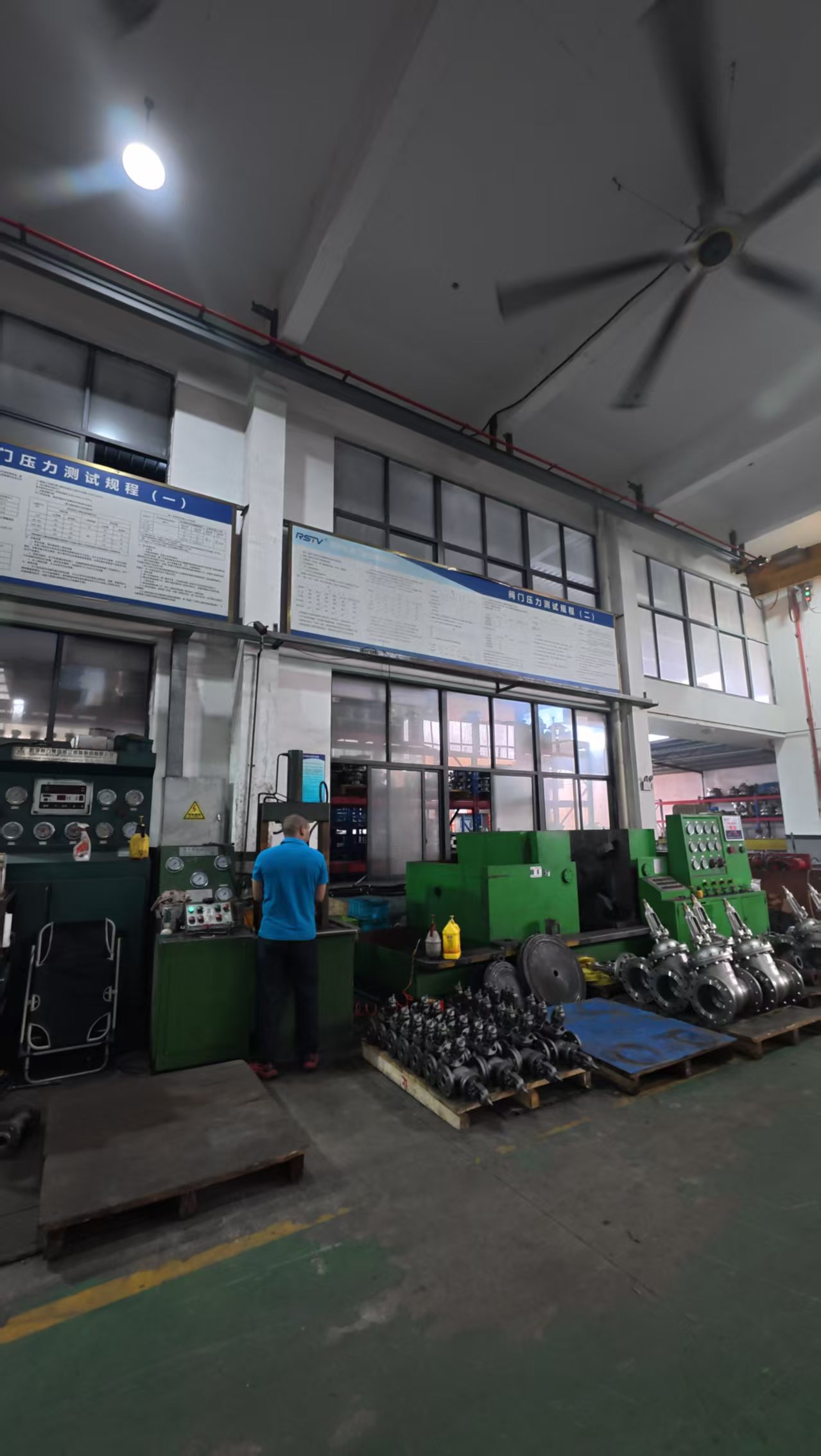
Shell strength and seat leakage testing form part of the factory test sequence before shipment.
Where the Line Is Used: Process, Pipeline and Utility Duty
Ball valve products from this manufacturer are used across petrochemical, petroleum refining, liquid cooling, nuclear power, chemical, metallurgy, mining, medical, food, national defense and urban construction applications. The trunnion mounted family - with its larger diameter range and flanged ends - is most naturally associated with process and pipeline on-off isolation.
The broader ball valve range is documented with a working-condition profile covering media such as water, oil, gas and weak acids or alkalis, pressures of PN16-PN63 and Class 150-300, and temperatures of -20 °C to 180 °C, applied to process piping for chemical, gas, pharmaceutical and water treatment industries, where the valve is used to shut off, distribute and change the direction of the medium. On-off isolation for chemical, gas and water utility systems is the stated application field. Because the trunnion mounted family carries its own published ratings, buyers should confirm the applicable pressure and temperature values for the exact model and configuration at quotation stage rather than transferring the range-level profile across product families.
Service evidence published for this product family comes from project supply to chemical plants, water treatment contractors and gas engineering companies, typically in quantities of 50 to 500 units per project. Reported service duration is 8 to 10 years, with results described as bubble-tight zero leakage, stable operation and low maintenance cost, and design emphasis on quarter-turn fast switching and bi-directional sealing.
Verifying Capability Before Order Execution
At the evaluation-to-execution transition, the question shifts from whether a supplier can make the valve to whether the supplier can document it. The following certificates are published for the industrial valve scope that includes the trunnion mounted ball valve line.
| System / scheme | Certificate number | Issuing authority | Validity |
|---|---|---|---|
| ISO 9001:2015 (GB/T 19001-2016) | 20225Q21079R0M | ZHEJIANG QUANPIN CERTIFICATION CO.,LTD. | 2025-09-28 to 2028-09-27 |
| ISO 14001:2015 (GB/T 24001-2016) | 20225E20474R0M | ZHEJIANG QUANPIN CERTIFICATION CO.,LTD. | 2025-09-28 to 2028-09-27 |
| ISO 45001:2018 (GB/T 45001-2020) | 20225S20439R0M | ZHEJIANG QUANPIN CERTIFICATION CO.,LTD. | 2025-09-28 to 2028-09-27 |
| PED-CE (EU Production Type Certificate) | ECM PED-Bp 2024-TW60 | Ente Certificazione Macchine Srl | 2024-06-27 to 2029-06-26 |
| SIL functional safety (IEC 61508:2010 Parts 1-7) | No. 4I260528.RSTDO08 | Ente Certificazione Macchine Srl | 2026-05-28 to 2031-05-27 |
The PED-CE certificate scope is stated as industrial valves from DN15-DN1200 / NPS 1/2"-48", PN6-PN260 and Class 150-Class 1500, covering ball, gate, globe, check, butterfly, strainer and control valves, and referencing EN 12266-1:2012, JB/T 7245-2017, EN 12516-1:2014+A1:2018 and EN 12284:2003. The SIL certificate scope covers gate, ball, globe, check and butterfly valves across the Z, J, H, Q, D and ZJHM series. The three management system certificates cover the production, sales and related management activities of metal valves and filters within the licensed scope.
Quality control on ball valve production is documented as shell strength testing, seat leakage testing, material inspection, visual inspection and 100% factory testing, with a test report and material certificate provided. Acceptable acceptance arrangements include a pre-shipment pressure test and the option of witness inspection.
Published commercial terms for the ball valve range are straightforward and worth noting at the execution stage:
- Minimum order quantity: 1 unit
- Lead time: 20-45 days
- Delivery terms: FOB / CIF / DAP / DDP / EXW
- Payment terms: 30% T/T advance, 70% T/T before shipment
After-sales provisions cover remote technical support, spare parts supply, online troubleshooting, and on-site service for large-scale projects.
One verification habit is worth keeping regardless of supplier: certificate numbers, scopes and validity dates should be confirmed with the issuing body before they are written into a project's quality dossier, because a certificate that was valid at quotation stage may not cover a different model, size range or material.
Comparison with Conventional Ball Valve Choices - and the Limits of the Trunnion Design
Trunnion mounted ball valves are not the default choice for every isolation point. Buyers comparing them with conventional alternatives should treat the exercise as duty matching rather than ranking.
Commercial market research indexed for this reference places the global ball valve market at USD 14.8 billion in 2025, with floating ball valve designs accounting for a reported 61.8% share of the market in 2025, while trunnion mounted designs are reported at 34.0% in 2026. The volume position of conventionally simpler designs reflects a structural reality: most isolation points in most plants are small-diameter, moderate-pressure and non-critical. The trunnion family earns its place where diameter, pressure class and documentation requirements rise together.
A second comparison buyers encounter is between a fully specified ball valve and an ordinary standard ball valve on price. In the manufacturer's published comparison, a premium ball valve with fire-safe and anti-static construction is positioned for chemical, natural gas and process pipeline duty on the basis of bubble-tight zero leakage and lower total operating cost, while an ordinary standard ball valve is described as suitable for low-risk, low-pressure general water lines with a shorter service expectation. That should be read as a supplier's stated position rather than a universal rule: the governing question for a buyer is whether the specific fire-safe, anti-static and leakage requirements actually appear in the project specification.
The boundaries of the trunnion mounted line are as important as its capabilities:
- On-off service only. The design is a quarter-turn isolation valve and is not suitable for throttling.
- Published envelope only. PN4.0-10.0 MPa and DN50-DN1200 define the covered range; requirements outside it need a separate technical response.
- Temperature floor and ceiling. The applicable temperature is published at -40 °C to +150 °C.
- Flanged end connection only. Threaded, welded and clamp connections belong to other ball valve families.
- No disassembly under pressure. Isolation and depressurisation are prerequisites for any maintenance activity.
- Certificates cover a defined scope. The PED-CE scope spans DN15-DN1200 / NPS 1/2"-48", PN6-PN260 and Class 150-Class 1500 across several valve types; buyers should confirm that the ordered configuration falls inside the applicable scope.
Market and Standards Trend: Documentation as a Selection Criterion
Two standards developments are changing how ball valves are purchased, not only how they are built. API Specification 6D reached its 25th Edition with an effective date of 1 November 2025, and the 25th Edition Addendum 2 sets requirements across design, manufacturing, materials, welding, quality control, assembly, testing, marking, documentation and process controls, extending coverage to hydrogen gas service. Separately, IOGP S-562 Version 3.1 converts API 6D into a supplementary procurement specification for manually operated ball valves, explicitly framed as a minimum common set of procurement requirements.
The direction of travel is consistent: the requirement set is moving from what the valve is toward what the supplier can prove about the valve. For a manufacturer, that favours in-house machining, in-house pressure testing, a certified quality management system and an auditable certificate chain over trading-only supply. For a buyer, it turns the document package into a scoring criterion at tender stage rather than an administrative afterthought.
Market sizing supports the same conclusion from the demand side. The global ball valve market was reported at USD 14.8 billion in 2025, and the trunnion mounted segment is reported at 34.0% in 2026 - a segment whose buyers are, by definition, specifying higher-pressure isolation where test records and material traceability are expected as standard.
Future Outlook
Three pressures are likely to define the next procurement cycle for trunnion mounted ball valves.
The first is larger and more demanding isolation duty. As process and pipeline projects consolidate isolation points into fewer, larger valves, the DN50-DN1200 band and the PN4.0-10.0 MPa range become the working envelope rather than an exceptional specification, which places a premium on machining tolerance, testing capacity and handling capability at the supplier's end.
The second is hydrogen and low-temperature service. The 25th Edition Addendum 2 to API Specification 6D extends its requirement scope to hydrogen gas service, and procurement specifications such as IOGP S-562 already carry an allowable operating range down to -46 °C. Manufacturers whose published temperature range stops at -40 °C will face a predictable technical question at tender stage, and buyers should expect low-temperature material and seal selection to become a standard line item rather than a special request.
The third is actuation. As valves move from manual to gear, pneumatic and electric operation, the ISO 5211 mounting interface, actuator integration and the associated accessories - solenoid valves, limit switches, FRL units, explosion-proof configuration - become part of the valve specification rather than a separate purchase. Suppliers able to quote a complete actuated assembly under a single test and documentation package will be easier to qualify than those who supply only the bare valve.
FAQ
What is the RST Valve Group trunnion mounted ball valve line, and which configurations are published?
It is a flanged ball valve family listed under model series Q347F, Q347H and Q347Y. Published configurations are the 2PC Trunnion Mounted Ball Valve, the Gear Operated Trunnion Mounted Ball Valve and the Electric Trunnion Mounted Ball Valve. The line sits within a broader industrial valve range that also includes flanged ball valves, threaded ball valves, gate valves, check valves, globe valves and Y strainers.
What pressures, sizes and temperatures does the trunnion mounted line cover?
Nominal pressure is published at PN4.0-10.0 MPa, nominal diameter at DN50-DN1200, and applicable temperature at -40 °C to +150 °C. The end connection is flanged. Body materials listed include WCB, CF8 and CF8M, within a carbon steel / SS304 / SS316 material family.
Which parameters can be customized on a ball valve order?
The published customization list covers body material, connection type, pressure rating, actuator, logo, marking, special seal materials, fire-safe and anti-static design, and sanitary polishing. Custom pressure ratings and custom actuator integration are supported, and drawing-based customization is available. OEM production services and ODM design and production services are both provided.
How is actuator integration handled?
The ball valve range uses an ISO 5211 direct-mount actuator interface, including an ISO 5211 high mounting pad. Manual operation is standard, with an optional lockable handle; pneumatic actuation is available in single-acting and double-acting versions; and electric actuators can be supplied for on-off or modulating operation. Components commonly specified at the same time include FRL units, solenoid valves, limit switches and electric actuators.
What testing and certification documentation is provided?
Production quality control is documented as shell strength testing, seat leakage testing, material inspection, visual inspection and 100% factory testing, with a test report and material certificate provided. Management system certificates published for the industrial valve scope include ISO 9001, ISO 14001 and ISO 45001, alongside a PED-CE production type certificate and a SIL functional safety certificate assessed to IEC 61508:2010 Parts 1-7. Acceptance arrangements include a pre-shipment pressure test and the option of witness inspection.
What are the operational limits of a trunnion mounted ball valve?
The design is intended for on-off service only and is not suitable for throttling. Operation is a 90° quarter turn, and disassembly while the valve is under pressure is prohibited. Service outside the published pressure, size or temperature envelope requires separate technical confirmation, and buyers with requirements below -40 °C should verify low-temperature capability against the project specification.
For buyers converting a trunnion mounted ball valve requirement into an executable order, the sequence is unchanged: confirm pressure, size, temperature and end connection against the published envelope; define the material, seal and actuation configuration; agree the test and witness arrangements; and confirm that the certification scope covers the exact configuration being ordered.
Reference document: the RST Valve Group product presentation, covering the industrial valve range and specification data, is available for download here - RST Presentation (PDF).
Have Questions or Need More Details?
Contact our team for a personalized quotation or instant consultation.
Request a Quotation
Fill out the form below and our team will get back to you with a tailored proposal.
WhatsApp Direct Chat
Prefer to chat in real-time? Message us on WhatsApp for instant assistance & quick answers.
- Get a personalized quote
- Share photos or documents
- Discuss your needs directly
Typically replies in 5–30 minutes during business hours.