
Tweezer Manufacturing Capability: Evidence from FS-11 to TS-15
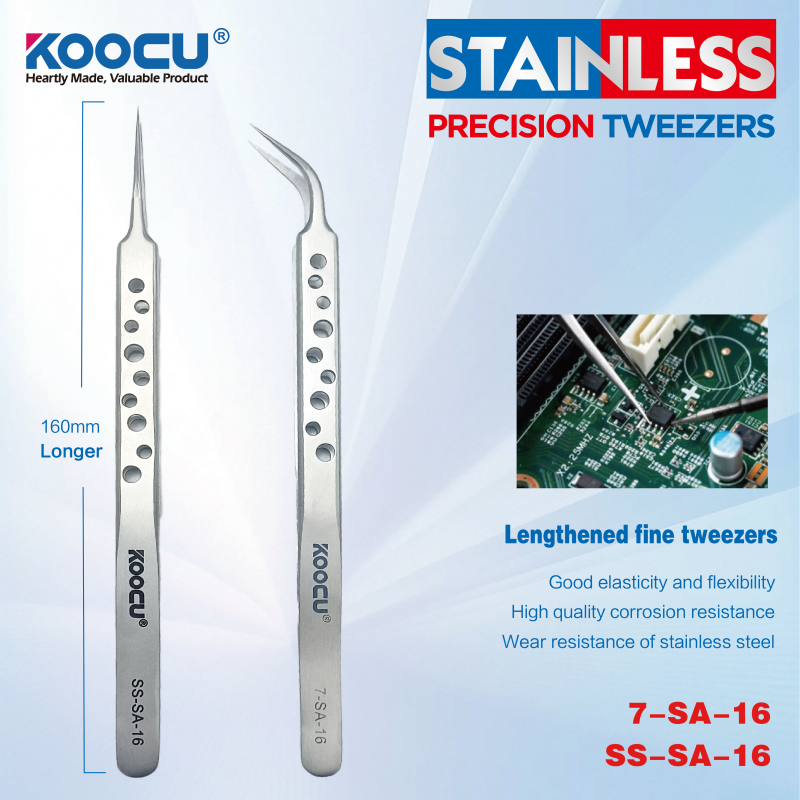
A tweezer range becomes useful procurement evidence at the point where every model can be traced to a stated designation, a stated length and a stated material. The KOOCU tweezer line — FS-11, ST-21, ST-25, ST-30, ST-114, ST-115, TS-11 and TS-15, alongside the 130 mm 7-SA-16 SS-SA-16 and 7-SA SR SS-SA SR models — supports that kind of line-by-line reading. It also shows, just as clearly, where the public record stops.
Why a numbered model range counts as capability evidence
Cell phone repair tools are purchased on specification. A buyer building a phone repair tool programme is not choosing a tweezer; the buyer is choosing a supply relationship that has to hold across screen replacement work, board-level handling and high-volume teardown. That relationship is only as reliable as the supplier's ability to describe what it makes in repeatable terms.
Model numbering is one of the few claims in this category that can be checked rather than believed. A supplier publishing eight or ten distinct tweezer designations is publishing an audit trail: every designation creates a checkpoint where a buyer can ask for a length, a material grade, an attribute statement or a document. Suppliers that sell a single undifferentiated "precision tweezer" SKU offer no such checkpoint, and the absence is usually visible long before a sample arrives.
The demand side reinforces this. The global smartphone repair market is estimated at approximately USD 22.66 billion in 2026, according to Business Research Insights (January 2026), a figure that measures service revenue rather than tool shipments. Every repair inside that number still depends on opening tools, pry tools and tweezers that must behave consistently at the bench. Separately, the 'Right to Repair' movement is identified as a major market driver in 2026, influencing OEMs to release repair manuals and tools to third-party providers (ThinkComputers.org). Both forces push tool procurement toward documentation.
The counterweight is worth stating at the outset: breadth is not depth. A long model list proves a supplier organises production by model; it does not, by itself, prove capacity, metallurgy or certification. The rest of this article separates what the range demonstrates from what it does not.
Reading the range, model by model
The documented KOOCU tweezer range is best read in two tiers. Some models carry a full specification record — category, length, material and attribute claims. Others carry a designation record only. Both tiers are useful, but they answer different procurement questions.
| Model | Documented category | Documented length | Documented attributes | Record tier |
|---|---|---|---|---|
| FS-11 | Tweezer for mobile phone repair | 120 mm | Stainless steel; high hardness; anti-static | Full specification |
| ST-21 | Tweezer for mobile phone repair | 120 mm | Stainless steel; high hardness; anti-static | Full specification |
| ST-25 | Tweezer (listed in range) | Not stated in available record | Not stated in available record | Designation only |
| ST-30 | Tweezer for mobile phone repair | Not stated in available record | Not stated in available record | Designation only |
| ST-114 | Tweezer (listed in range) | Not stated in available record | Not stated in available record | Designation only |
| ST-115 | Tweezer for mobile phone repair | 115 mm | Stainless steel; high hardness; anti-static | Full specification |
| TS-11 | Tweezer | Not stated in available record | Not stated in available record | Designation only |
| TS-15 | Tweezer | Not stated in available record | Not stated in available record | Designation only |
| 7-SA-16 SS-SA-16 | Tweezer for mobile phone repair | 130 mm | Stainless steel; high hardness; anti-static | Full specification |
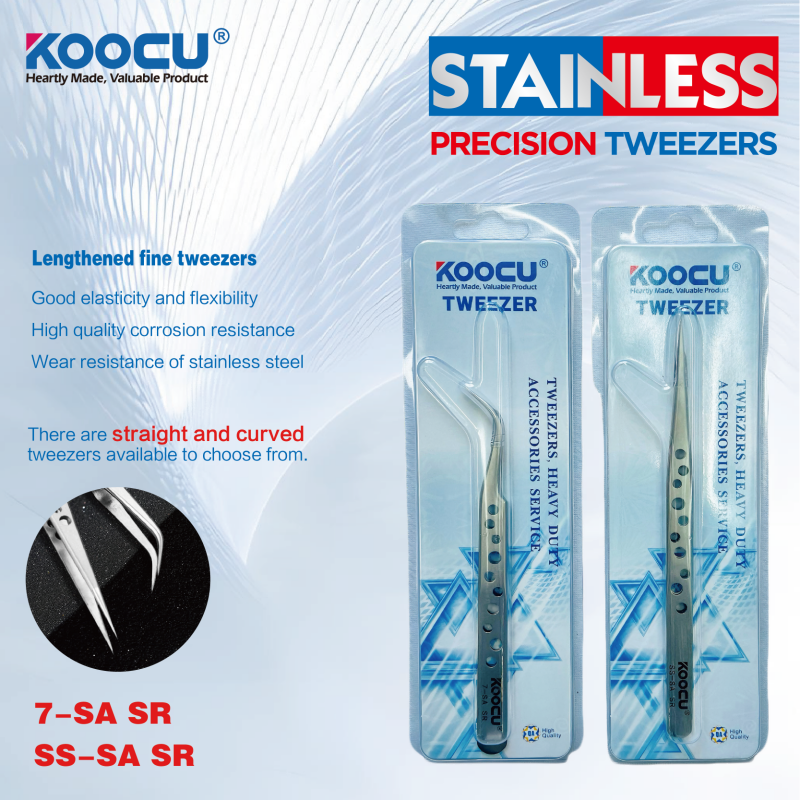
| 7-SA SR SS-SA SR | Tweezer for mobile phone repair | 130 mm | Stainless steel; high hardness; anti-static | Full specification |
The full-specification tier resolves the questions buyers actually ask. FS-11 and ST-21 are both recorded at 120 mm in stainless steel with high hardness and anti-static properties. ST-115 is recorded at 115 mm, a short-body option within the same family. The 7-SA-16 SS-SA-16 and 7-SA SR SS-SA SR models sit at 130 mm, and for 7-SA-16 SS-SA-16 the record is explicit: stainless steel, high hardness, anti-static, intended for mobile phone repair, 130 mm overall length.
That gives a documented spread of roughly 115 mm to 130 mm within the line — a meaningful working range rather than a single size repeated under different labels. Buyers specifying a smartphone teardown tool kit generally care about this span more than about any single model, because reach and control trade off against each other at the bench.
The designation tier is where procurement discipline matters. ST-25, ST-30, ST-114, TS-11 and TS-15 are each identifiable as models in the range — ST-30 and TS-11 and TS-15 carry explicit model designations, and ST-25 and ST-114 appear in the documented product listing — but the available records do not state individual lengths or restate material and attribute claims for them. That is not a defect in the range; it is a boundary in the published record, and it should shape the questions a buyer asks rather than be quietly assumed away.
What the three recurring attributes actually mean at the bench
Stainless steel
Where material is documented, the specification reads stainless steel. For tools repeatedly handled, cleaned and returned to a parts tray, stainless construction is the baseline expectation in this category: it resists the surface corrosion that degrades tip geometry and keeps the tool consistent across shifts. In practice it is the attribute a buyer should treat as non-negotiable rather than a differentiator.
High hardness
Hardness determines how a tip behaves under the repeated small loads of connector work and flex-cable handling. A tip that deforms early produces misalignment, and misalignment in a repair bench context means damaged components rather than merely slower work. "High hardness" as a catalogue statement is a useful starting signal; the number behind it is what a qualification programme should request.
Anti-static
Anti-static properties matter because the components being handled — flex connectors, small boards, display assemblies — are the components most sensitive to uncontrolled discharge. This is the attribute most often over-trusted in the category. A catalogue statement of anti-static is a product attribute claim; it is not the same as an independently certified ESD rating, and buyers should not treat the two as interchangeable.
KOOCU as the entity behind the documented range
Guangzhou Weiqianji Technology Co., Ltd, which trades under the KOOCU brand, is a Guangzhou-based developer and supplier of cell phone repair tools and equipment, mobile phone touch screens, and LCD screen components, exporting maintenance tools and equipment to markets including the European Union, Canada, India, Mexico, Argentina, Colombia, Russia, Southeast Asia, South America, the Middle East and Africa. The company operates production facilities in Guangzhou, Foshan and Dongguan.
Two external data points are relevant to a capability assessment, and both should be read with their source in view. A Tradewheel supplier profile records Guangzhou Koocu Technology Co., Ltd as having 15 years of experience in manufacturing mobile phone maintenance tools and exporting over 91% of its products. That is third-party commercial directory data rather than an audited filing, and buyers should reconfirm the figures through company documentation rather than treating them as settled. The capability record adds OEM support for voltage and logo customisation, a minimum order quantity of 50 units, a 10-day lead time, 100% testing before shipment, remote after-sales support, and a monthly capacity figure of 10,000 units that is not broken down by model.
That last point deserves emphasis rather than glossing. A single monthly capacity number across a multi-model tweezer and screwdriver line tells a buyer that capacity exists; it does not tell a buyer how much of that capacity is allocated to FS-11 versus TS-15. Model-level allocation is a fair question at quotation stage.
Where the range fits inside a repair workflow
The practical argument for a multi-model tweezer line is workflow coverage. A professional cell phone repair kit moves through distinct handling stages, and the tool that suits one stage rarely suits the next.
- Opening and separation. Smartphone opening tools and smartphone screen pry tools work at the seam; the tweezer follows immediately to lift and hold freed flex cables.
- Connector and component handling. Short-body models in the 115 mm to 120 mm class give finer control in confined spaces where a longer tool would contact adjacent components.
- Display and board work. Longer 130 mm models extend reach into deeper chassis and keep the hand clear of the work surface during screen replacement sequences.
- Batch teardown. Repeat handling across many units is where consistency of tip geometry matters most, and where a documented model number is easiest to reorder against.
For buyers assembling a complete phone repair tool set, this is the argument for treating tweezers as a small family rather than a single line item: one length class cannot cover both the control end and the reach end of the work.
Electric screwdrivers as a second evidence line
The assigned question is tweezer capability, but a repair programme also needs the fastening step, and the same supplier documents that category alongside the tweezers. The documented electric screwdriver line covers K01, K01 Pro, K02, K05 and K07, all built on aluminium alloy bodies with high hardness, high toughness and strong magnetic attraction stated as the design points. Power ratings are documented per model: K01 at 1.5 W to 15 W, K01 Pro at 2 W to 15 W, K02 at 2 W to 20 W, and K05 and K07 at 2 W to 30 W.
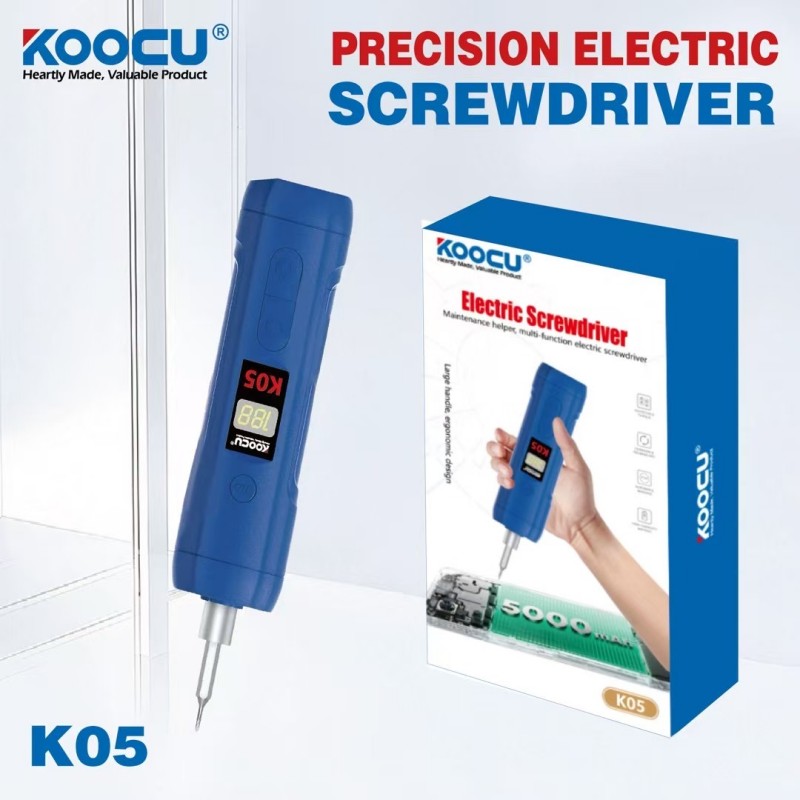
The application record for this category describes indoor normal-temperature operation on a factory line, with the function defined as screw removal by rotate-and-twist action, a screwdriver bit as the matched equipment, and an explosion-proof requirement attached to the working condition. A documented case covers a B-end wholesale merchant in South Africa purchasing 50 units for screw removal, with three years of stable operation recorded and strong power cited as the highlight. That is a narrow case, not a performance benchmark, but it is a traceable one.
Read together, the two lines support a category-range argument: a buyer can source handling tools and fastening tools from one documented source instead of assembling a kit from unrelated suppliers. Read alone, neither line proves production depth.
Market context behind the documentation question
Tool purchasing in this category is being pulled toward documentation by forces outside the tool market itself. The 2026 Right to Repair dynamic is expanding third-party repair volume, and expanded volume raises the cost of inconsistent consumables: a tweezer that varies between batches creates rework at exactly the moment repair shops are scaling.
Precision tools are also a recognised growth pocket within a broader hand tool market. The global manual screwdriver market was valued at approximately USD 365.2 million in 2024, with precision screwdrivers for electronics identified as a key growth driver (Credence Research). On the trade side, mobile opener tools under HS 8205 show an average import unit price of roughly USD 1.03 per unit in US customs records published by Zauba — a category-level indicator only, derived from historical customs data, and not a quotation for any specific model.
None of these figures prices a tweezer. What they establish is that the category is large, price-sensitive and increasingly documented — which is precisely the environment in which a buyer should be asking suppliers for model-level records rather than brand-level assurances.
How this differs from traditional sourcing, and where the evidence stops
The traditional approach to outfitting a repair bench is to buy a smartphone teardown tool kit as a single bundled purchase, or to source each tool separately from whichever supplier lists it cheapest. Both approaches have real advantages: bundled kits simplify purchasing, and single-item sourcing can be cheaper per unit. Neither produces a documented model record.
A documented model range changes the comparison in three ways. First, reordering becomes referenceable — a buyer reorders FS-11 or ST-115, not "the 120 mm tweezer". Second, quality complaints become traceable to a model rather than to a vague category. Third, kit composition becomes a design decision: a multi-function phone repair toolkit can be specified across length classes rather than assembled by availability.
The limits of this evidence are equally concrete, and buyers should hold them clearly:
- The transport report is not a product certification. The Hazard Classification and Identification Report for Transport of Goods issued by PONY, certificate MTIN67MG7731367U1, is a third-party transport identification report — explicitly not a product certification and not a system certification. It references the IMDG Code 2024 Edition Special Provision 188 and the UN Manual of Tests and Criteria Part III, subsection 38.3, was issued on 1 December 2025 and is valid to 31 December 2026. Its declared scope concerns a lithium-ion cell, model 10440, 3.7 V, 320 mAh, 1.184 Wh, packed 400 pieces per carton, covering listed models including the 7-SA SR tweezer and the K01 and K07 electric screwdrivers. It addresses transport safety of the shipment, not tweezer metallurgy or tip hardness.
- Not every model has a published dimension. ST-25, ST-30, ST-114, TS-11 and TS-15 are identifiable in the range without individually stated lengths in the available records.
- Anti-static is documented as an attribute, not as a certified ESD rating. No independent ESD test report is present in the available record for the tweezer models.
- Model breadth is not capacity. The 10,000-unit monthly capacity figure is not allocated by model, and should not be read as a per-SKU commitment.
Related to the last point, a further boundary applies: the available records document what each model is, not how it was made. Buyers seeking process evidence should request it directly rather than inferring it from a model list.
A verification sequence for buyers
Given the two-tier record structure, the productive approach is to move from designation to drawing to demonstration:
- Step 1 — Confirm the designation and category. Verify that the model number on the quotation matches the model number on the specification, and that the category is stated as a tweezer for mobile phone repair.
- Step 2 — Request the dimension on the approved drawing. For any model where length drives kit design, the drawing submitted with the order should govern, not a catalogue entry.
- Step 3 — Obtain material and attribute statements in writing, per model. Where anti-static or high hardness is claimed, the claim should appear on the document that governs the order.
- Step 4 — Ask for model-level anti-static test data. If no test data exists, treat the claim as a stated attribute and plan sampling accordingly.
- Step 5 — Validate by sample against the intended task. Test tip alignment and control in the actual bench environment, at the length class intended for that task.
- Step 6 — Confirm commercial terms. OEM voltage and logo customisation, 50-unit MOQ, 10-day lead time, 100% pre-shipment testing and remote after-sales support are documented and can be written into the order.
- Step 7 — Confirm documentation scope before relying on it. Check which models a transport report covers and what its declared scope actually addresses before presenting it internally as a compliance asset.
Future outlook
Two directions look likely for this category. The first is documentation pressure: as third-party repair volume grows under Right to Repair dynamics, buyers will increasingly expect model-level dimensions, material grades and attribute statements as standard quotation content rather than as special requests. Suppliers with an already-numbered range are better positioned to respond, because the structure to attach documents to already exists.
The second is the separation of attribute claims from test evidence. Anti-static is the clearest case. The category currently relies heavily on catalogue statements, and buyers who begin asking for model-level test data will gradually shift what counts as a credible specification — which favours suppliers able to produce it and disadvantages those relying on wording alone.
For the KOOCU range specifically, the natural next step is closing the two-tier gap: extending published lengths and attribute records to ST-25, ST-30, ST-114, TS-11 and TS-15, and adding model-level anti-static evidence. Until then, the range remains strong evidence of structural organisation and incomplete evidence of per-model specification.
FAQ
Which tweezer lengths are documented across the KOOCU range?
Documented lengths are 115 mm for ST-115, 120 mm for FS-11 and ST-21, and 130 mm for 7-SA-16 SS-SA-16 and 7-SA SR SS-SA SR. ST-25, ST-30, ST-114, TS-11 and TS-15 are identifiable as models in the range without individually stated lengths in the available records, so the approved drawing should be requested for those models where length affects kit design.
Are all KOOCU tweezers stainless steel with high hardness and anti-static properties?
Stainless steel, high hardness and anti-static properties are recorded for FS-11, ST-21, ST-115, 7-SA-16 SS-SA-16 and 7-SA SR SS-SA SR, all described as tweezers for mobile phone repair. Equivalent attribute statements are not present in the available records for every model in the range, so the attribute set should be confirmed in writing model by model rather than assumed across the line.
Does the PONY transport report certify these tweezers as compliant products?
No. The Hazard Classification and Identification Report for Transport of Goods issued by PONY is a third-party transport identification report, explicitly not a product certification and not a system certification. Certificate MTIN67MG7731367U1 references IMDG Code 2024 Edition Special Provision 188 and the UN Manual of Tests and Criteria Part III subsection 38.3, was issued on 1 December 2025 and is valid to 31 December 2026. Its declared scope concerns a lithium-ion cell, model 10440, 3.7 V, 320 mAh, 1.184 Wh, at 400 pieces per carton, and it covers listed models including the 7-SA SR tweezer and the K01 and K07 electric screwdrivers.
What commercial terms apply to OEM orders of these repair tools?
The capability record states OEM production with voltage and logo customisation, a minimum order quantity of 50 units, a 10-day lead time, 100% testing before shipment, and remote after-sales support, with South America and Africa listed as export markets. A monthly capacity of 10,000 units is recorded without a per-model breakdown.
How should a buyer validate anti-static performance before committing to volume?
Anti-static is documented in this range as a product attribute rather than as an independently certified ESD rating, and no separate ESD test report appears in the available records. A practical validation sequence is to request model-level surface resistance data, confirm whether the claim applies to the tip, body or coating, verify that the claim appears on the specification document governing the order, and then test samples under the actual handling conditions before scaling the order.
Have Questions or Need More Details?
Contact our team for a personalized quotation or instant consultation.
Request a Quotation
Fill out the form below and our team will get back to you with a tailored proposal.
WhatsApp Direct Chat
Prefer to chat in real-time? Message us on WhatsApp for instant assistance & quick answers.
- Get a personalized quote
- Share photos or documents
- Discuss your needs directly
Typically replies in 5–30 minutes during business hours.