
Twelve Powder Coating Lines: What Evidence Should Buyers See?
Twelve Powder Coating Lines: What Evidence Should Buyers See?
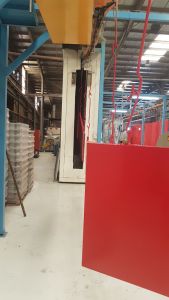
Powder-coated electrical enclosure panels: one application where corrosion resistance, insulation behaviour and appearance are specified on the same part.
A twelve-line powder coating range is not one product carrying twelve trade names. Aluminum, anti-corrosion, epoxy, hybrid, polyester, TGIC-free, matt, glossy, metallic, hammer tone, wrinkle and sandy finishes each answer a different dominant requirement — substrate, service environment, or surface appearance — and the evidence that proves capability moves accordingly.
That distinction becomes practical at the evaluation stage, when a supplier publishes one range datasheet and the buyer writes a purchase order against one line. Where the two documents are not reconciled, a coating can be fully compliant with the range and still inappropriate for the component in front of it.
This review maps capability evidence to the twelve lines in Hsinda's range. Hsinda (Chengdu Hsinda Polymer Materials Co., Ltd) is a thermosetting powder coating manufacturer established in 2015 in Chengdu, Sichuan, operating eight production lines and three sample lines with a reported annual output above 5,000 tons. The aim is not to restate a catalogue, but to identify which measurable claims a buyer can actually test, which ones need a condition attached, and where the documentation for a line ends.
Why a range claim is not a line claim
A range value describes the widest window a manufacturer can hold across its catalogue. A line value describes what one product will do under stated conditions. The two are rarely the same number, and treating them as interchangeable is the most common specification error in powder coating procurement.
The gloss figure shows the problem clearly. Hsinda's range defines appearance with a 60° gloss meter classification: high gloss above 80%, semi-gloss from 40 to 79%, and matte from 5 to 39%. The published span across the range is therefore 5% to 95% measured against ISO 2813:2014. A facade panel and an office furniture frame can both be described accurately by that single span, yet neither buyer can accept a shipmen.
The same logic applies to corrosion. A 500-hour neutral salt spray result, measured under ISO 7253:1996, is a meaningful claim for an anti-corrosion or exterior line. Applied without qualification to an interior decorative line, it overstates what the buyer is paying for; omitted from an exterior line, it hides the very evidence the project needs.
The working rule is simple: use range values as a screening filter, and write line values into the purchase order. Everything below supports that sequence.
The twelve lines and what defines each one
The range separates along three axes. Two lines are defined by substrate or service duty, four by resin chemistry, and six by surface appearance. Knowing which axis a line sits on tells the buyer which test report matters most.
| Line | Defining axis | Evidence that carries most weight |
|---|---|---|
| Aluminum Powder Coating | Substrate | Adhesion and impact on aluminum, plus weathering data for exterior profiles |
| Anti-corrosion Powder Coating | Service duty | Salt spray report, film build, and the substrate and pretreatment used in the test |
| Epoxy Powder Coating | Chemistry | Impact, adhesion and chemical or solvent resistance |
| Epoxy Polyester Hybrid Powder Coating | Chemistry | Mechanical properties and cure response at the stated window |
| Polyester Powder Coating | Chemistry | Weathering and gloss retention for exterior work |
| TGIC Free Powder Coating | Chemistry | Substance-restriction documentation tied to the specific product |
| Matt Powder Coating | Appearance | Gloss value within the 5–39% matte band, plus a retained reference panel |
| Glossy Powder Coating | Appearance | Gloss above 80%, measured at 60°, with the tolerance stated |
| Metallic Powder Coating | Appearance | Effect consistency between batches, not only within one |
| Hammer Tone Powder Coating | Appearance | Texture repeatability against an approved physical panel |
| Wrinkle Powder Coating | Appearance | Texture stability across the cure window and film build range |
| Sandy Powder Coating | Appearance | Texture uniformity across the full coated area |
Color sits outside this table because it cuts across all twelve lines. Customization in the range follows the standard color chart, RAL or Pantone matching, and sample-based matching, so a color request is a per-order variable rather than a line characteristic.
Seven numbers buyers should require, and what each one proves
Seven measurable values recur across the range and form the practical backbone of a capability review: particle size 32–42 μm, film thickness 70 μm, coverage 8–10 m²/kg, curing at 180–200°C for 10–15 minutes, gloss from 5% to 95% per ISO 2813:2014, impact resistance of 50 kg/cm per ISO 6272-1:2017, and 500-hour salt spray per ISO 7253:1996. Each establishes something specific, and stops establishing it as soon as the attached condition is dropped.
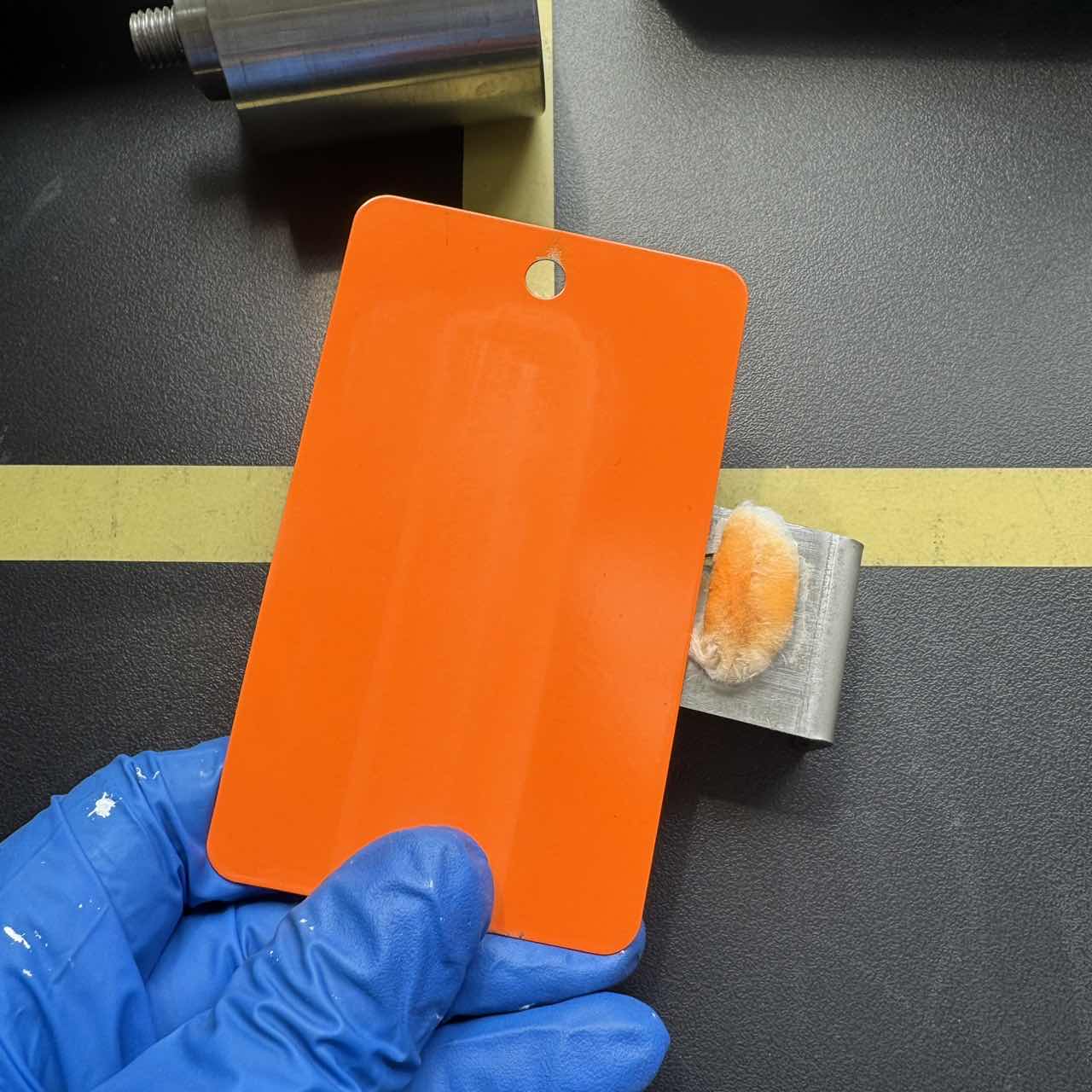
Solvent rub checking on a cured film: a practical way to confirm that a cure window has actually been reached on the production line, not only in the laboratory.
- Particle size 32–42 μm. This establishes that the powder has been milled and classified to a controlled fraction, which supports consistent transfer and a predictable surface. It does not predict adhesion or corrosion performance on its own. Buyers should ask which measurement method produced the figure and whether the range is a routine production window or a development value.
- Film thickness 70 μm. This is the reference build at which the other values are normally quoted. The qualification matters: impact and salt spray results obtained at 70 μm should not be assumed at 45 μm. Specify a target and a minimum, and state how the applicator will measure both.
- Coverage 8–10 m²/kg. Coverage is not a standalone property. It is the area a kilogram covers at a stated film build, and it shifts with the specific gravity of the individual line. A coverage figure without its film thickness is unusable for cost estimation, and the buyer should convert it to part area and add application transfer loss at the coating line rather than at the powder supplier.
- Curing 180–200°C for 10–15 minutes. This is a metal-temperature window, not an oven setpoint. Undercuring appears in impact and solvent resistance; overcuring can appear in gloss shift and color change on light shades. Because oven loading and part mass vary between applicators, the cure window belongs in the purchase order alongside a requirement to verify cure on production parts.
- Gloss 5%–95% per ISO 2813:2014. The span is the range; the number that matters is the value for the specific line, measured at the 60° geometry, with a stated tolerance. A buyer who accepts the range value has accepted nothing measurable for the delivered part.
- Impact resistance 50 kg/cm per ISO 6272-1:2017. Impact testing is a useful proxy for film integrity and cure, and a poor proxy for service life. Substrate thickness changes the result, so the report should state the panel type and thickness used. Aluminum panels and heavy steel panels do not give the same reading from the same powder.
- 500-hour salt spray per ISO 7253:1996. This is a laboratory corrosion result, and the useful question is not whether the panel survived 500 hours but when blistering, creepage or color change began. Ask for the failure observation, not only the endpoint. The result also belongs to the panel and pretreatment used in the test, which the buyer should identify before transferring the claim to a different substrate.
Substrate and service lines: aluminum and anti-corrosion
The two lines defined by substrate and duty carry the heaviest documentation burden, because their claims are transferred directly into structural and equipment decisions.
Aluminum Powder Coating
Aluminum is the line most exposed to architectural specification. What a buyer needs here is adhesion and impact data on aluminum panels, a weathering statement appropriate to exterior exposure, and — for coastal or industrial atmospheres — a salt spray result on the same substrate. Hsinda states that its coatings have passed RoHS, REACH, SGS and AAMA testing; the practical follow-up is to obtain the specific report and confirm which product and grade it covers, since a test report on one formulation does not automatically extend to every line in a twelve-line range. Hiding behind the range is exactly what this review is designed to prevent.
Hsinda's Aluminum Powder Coating is offered with customized RAL color, which means the visual approval and the performance approval can be separated: color matched against a retained sample, performance verified against the technical report.
Anti-corrosion Powder Coating
The anti-corrosion line is where the 500-hour salt spray figure earns its place, and where it is most often misread. Three variables decide whether the result transfers to a project: the substrate and its pretreatment, the film build, and the failure criterion applied at the end of the test. A powder that reaches 500 hours on a properly pretreated panel can fail well before that on a poorly prepared one, because corrosion protection is produced jointly by the chemistry and the coating line.
Hsinda's anti-corrosion product is offered in customized RAL and Pantone colors, and the company's own customer record includes an electrical enclosure program of 40 tons running for 10 years across five countries, where the stated requirements combine corrosion resistance, insulating or static-conductive behaviour and appearance. That record is a customer-program description supplied by the manufacturer rather than an independent audit, but it illustrates the correct structure of an anti-corrosion requirement: environment, substrate, electrical behaviour and appearance stated together.
Chemistry lines: epoxy, hybrid, polyester and TGIC-free
Chemistry determines what a coating can resist and where it should not be used, so the evidence request follows the resin rather than the surface.
Epoxy systems are commonly specified where mechanical and chemical resistance matter more than UV exposure, which places impact, adhesion and solvent resistance at the centre of the evidence set. Epoxy polyester hybrid systems are the general-purpose interior choice for decorative metal, balancing mechanical performance with cost. Hsinda's hybrid line appears in a 10-year, 100-ton industrial storage and shelving program in Colombia, where the customer description refers to an epoxy-polyester electrostatic process and a finish that allows gloss and color variation across a range. Polyester systems carry exterior weathering duty, and polyester occupies a large share of the category: Grand View Research reported the polyester segment at 48.2% of 2025 powder coating market share, citing weatherability and UV resistance. That figure is a market observation, not a performance ranking between suppliers.
TGIC-free is a chemistry claim with a specific documentation path. Hsinda's REACH SVHC test report, SGS report CKGIN25000923901, is scoped to HAA Type Powder Coating under EU REACH Regulation (EC) No 1907/2006. A buyer specifying TGIC-free should ask for the substance-restriction report tied to the exact product being supplied, and should read the claim for what it is: the absence of one crosslinker class, not a general statement of superiority over other chemistries.
Appearance lines: matt, glossy, metallic, hammer tone, wrinkle and sandy
Six of the twelve lines are defined by how the surface looks and feels, and here the primary evidence is not a number but a retained physical reference. Gloss is measurable; texture is judged, and it must be judged against something fixed.
Matt and glossy finishes are the two ends of the measurable band. Under the range's 60° gloss classification, matt covers 5–39%, semi-gloss 40–79% and high gloss above 80%, all read against ISO 2813:2014. A buyer taking a matt or glossy line should request the measured value and the tolerance for that line, then hold an approved panel as the dispute reference. Metallic finishes add a second variable: the effect depends on how the metallic fraction is bonded and distributed, so batch-to-batch consistency is the evidence that matters, not the appearance of a single sample. Hsinda's production portfolio includes a metallic bonding system, and the relevant question for a buyer is what the supplier does to keep the effect stable between production runs.
Hammer tone, wrinkle and sandy finishes share a characteristic that buyers frequently underestimate: the texture is co-produced by the powder and the application parameters. Film build changes the depth of a wrinkle pattern; oven conditions change how a hammer tone pattern develops; gun settings change the uniformity of a sandy surface. The powder supplier controls the formulation, the applicator controls the result, and no datasheet can substitute for an approved panel produced on the line that will run the job. For projects with visible large surfaces, the approval should be made on a full-size or representative component rather than a small flat coupon.
From datasheet to purchase order: terms and acceptance criteria
The value of capability evidence is realised only when it is written into commercial terms. The table below converts the technical discussion into purchasing language, using Hsinda's stated commercial parameters as the reference structure.
| Purchase term | What to write | Evidence that closes it |
|---|---|---|
| Minimum order | Name the tier being quoted: sample 1 kg, 100 kg, 300 kg bulk, or OEM program from 6 tons | Written confirmation of the tier, since MOQ differs by mode |
| Lead time | 15–20 days for standard custom production; 20 days for OEM | Capacity context: 400 tons per month against reported annual output above 5,000 tons |
| Delivery terms | Select from EX-W, FOB, CIF, CFR, CPT, DAP or DDP | Incoterm named in the order, with the point of risk transfer stated |
| Payment | 50% T/T in advance, 50% T/T before shipment | Payment schedule fixed before production booking |
| Color approval | RAL, Pantone or sample-match reference, with the approved sample retained by both parties | Signed color standard, not a photograph |
| Gloss | One value per line at 60°, with tolerance, per ISO 2813:2014 | Measured result on the qualification sample |
| Texture | Reference panel per hammer tone, wrinkle or sandy line, approved visually under defined lighting | Retained panel held by both parties as the dispute standard |
| Film build and cure | Target and minimum film, plus the 180–200°C / 10–15 min window expressed as metal temperature | Applicator-side cure verification on production parts |
| Acceptance | Pre-shipment test, with third-party inspection such as SGS where the project warrants it | Inspection report and the batch parameters tested |
| Documentation | Certificates with numbers, scope and validity dates | Named reports rather than a certification logo list |
On documentation, Hsinda's current certificate set is specific enough to be checked item by item. ISO 9001 certificate 2052025Q00440R0S and ISO 14001 certificate 2052025E00271R3S both run to 23 November 2028. The REACH SVHC report CKGIN25000923901 covers HAA type powder coating under EU REACH Regulation (EC) No 1907/2006. The RoHS report CKGEC25000071901 covers a black powder sample against the IEC 62321 series. An ISCC PLUS certificate, ISCC-PLUS-Cert-CN198-41261025, issued by CTI Certification against EN 15343, covers polyester powder coating and runs from 26 June 2026 to 25 June 2027 — external evidence that expires, so it should be re-checked at each annual order. A product carbon footprint certificate, TZJ136660053R0S, is issued against ISO 14067:2018 and PAS 2050:2011 for the R&D and production of thermosetting powder coatings, and runs to 17 July 2028. A food-contact report, TSNPC25004542302, covers a white food-grade thermosetting powder coating under US FDA 21 CFR 175.300. Antibacterial performance is supported by SGS report ASH25-0055689-02 against ISO 22196:2011.

Packaging and OEM presentation: commercial terms such as MOQ, lead time and labeling belong in the same document as the technical acceptance criteria.
Where the evidence stops
Every claim in this review has a boundary, and stating those boundaries is more useful than restating the numbers.
Laboratory results are not service-life predictions. A 500-hour salt spray result describes behaviour under one controlled condition; a project in a coastal or chemically aggressive environment needs that condition mapped to the real exposure, and no supplier can do that mapping without knowing the site.
Powder performance is co-produced. Pretreatment, application, film build and cure all sit with the applicator. A buyer who specifies the powder and leaves the coating line undefined has specified less than half of the outcome, and dispute resolution becomes impossible because the two parties are measuring different things.
Test scope is narrower than a product name suggests. The RoHS report covers a black powder sample; it is not a statement that every color in the range has been tested under that report number. The REACH report is scoped to HAA type powder coating. Buyers who need coverage for a specific color, chemistry or line should request the report for that item rather than inferring it.
Company statements about testing intensity are also worth reading precisely. Hsinda states 100% testing as its quality-control approach; the useful follow-up is which parameters are checked on every batch and which are checked on qualification samples only. Both answers are legitimate — they simply support different acceptance clauses.
Finally, weathering and durability claims depend on grade. The range lists weather resistance options defined against UV resistance and AAMA 2604 or Qualicoat grade requirements. A buyer specifying an exterior aluminum line should ask which grade is being offered and obtain the matching report, rather than treating weather resistance as a single property with a single answer.
What the category data adds
Two market observations help position sourcing decisions without changing the technical picture. Fortune Business Insights valued the global powder coatings market at USD 16.12 billion in 2025 and placed Asia Pacific at a 63.10% revenue share in the same year. A second commercial estimate for 2025 differs materially, largely through differences in what each publisher includes, so these figures should be read as directional background rather than as a settled market size.
The practical implication is modest but real: a buyer evaluating a Chinese manufacturer is sourcing from the region that dominates category revenue, which makes supplier qualification the differentiator rather than geography. The question is not whether capacity exists in Asia Pacific, but whether a given supplier can evidence a given line.
A verification sequence before award
Six steps convert this review into a procurement action, and each one produces a document a buyer can file.
- Request a line-specific datasheet for each of the twelve lines being considered, carrying the seven values with their conditions rather than the range span.
- Request the test report behind each value, with report number, issuing laboratory, sample scope and date.
- Request a retained reference panel for every appearance line, and approve texture under the lighting conditions the finished part will be seen in.
- Request the certificate set with numbers, scope and expiry, and diarise renewal — the ISCC PLUS certificate, for example, runs to 25 June 2027.
- Ask which parameters are tested on every production batch, and align the acceptance clause to that answer.
- Write film build, cure window, gloss tolerance and the third-party inspection option into the purchase order, with pre-shipment testing named as the acceptance mechanism.
Frequently asked questions
What counts as supplier capability evidence for a twelve-line powder coating range?
Capability evidence is a measurable result attached to a named line, a named substrate and a stated test condition. A range-level figure such as a 5%–95% gloss span or a 500-hour salt spray statement describes the outer envelope of a catalogue. Evidence for a single line is the value that line achieves, recorded in a report that identifies the product and the panel used.
Which specification values should appear on each line's datasheet?
The recurring set is particle size 32–42 μm, film thickness 70 μm, coverage 8–10 m²/kg, curing at 180–200°C for 10–15 minutes, gloss measured at 60° per ISO 2813:2014, impact resistance of 50 kg/cm per ISO 6272-1:2017, and salt spray per ISO 7253:1996 where corrosion duty applies. Not every value carries equal weight on every line; a matt decorative line is governed by gloss and texture, while an anti-corrosion line is governed by film build and salt spray.
How are particle size, film thickness and coverage linked in a coating specification?
Coverage is the area a kilogram of powder covers at a given film build, so the two figures must be quoted together; the same powder at a thinner film covers more area. Particle size influences how consistently the powder transfers and how the surface develops, but it does not set coverage on its own. Because coverage also depends on the specific gravity of each formulation, a buyer should request the specific gravity for the line and recalculate for the actual part geometry.
What does a 500-hour salt spray result establish for an anti-corrosion powder coating?
It establishes that a coated panel, prepared and cured in a defined way, resisted neutral salt spray under ISO 7253:1996 for 500 hours against the failure criterion applied in that test. It does not predict service life in a specific environment. The report is more informative when it records when blistering, creepage or color change first appeared, rather than only confirming that the endpoint was reached.
Can one test report cover all twelve lines, or is per-line documentation required?
Per-line documentation is the safer assumption. Reports are issued against defined scopes — the RoHS report covers a black powder sample, and the REACH SVHC report covers HAA type powder coating — so a report on one item does not automatically extend to another chemistry, color or finish. Where a project depends on a specific line, the report for that line should be requested by name.
Conclusion
A twelve-line range becomes a procurement asset only when each line carries its own evidence. Particle size, film build, coverage, cure window, gloss, impact and salt spray are not marketing figures but testable conditions, and each one narrows as soon as it is attached to a substrate, a film thickness and a failure criterion. Buyers who request those attachments — and write them into the order alongside MOQ, lead time, payment and acceptance terms — turn a supplier's catalogue into a specification they can enforce.
More detail on the manufacturer's range, production base and certification set is available at Hsinda, and the company's product brochure can be downloaded here: Hsinda powder coating brochure (PDF).
Have Questions or Need More Details?
Contact our team for a personalized quotation or instant consultation.
Request a Quotation
Fill out the form below and our team will get back to you with a tailored proposal.
WhatsApp Direct Chat
Prefer to chat in real-time? Message us on WhatsApp for instant assistance & quick answers.
- Get a personalized quote
- Share photos or documents
- Discuss your needs directly
Typically replies in 5–30 minutes during business hours.