
Twin-Spindle vs. Traditional Lathes: A Data-Driven Comparison for Precision Parts Manufacturing
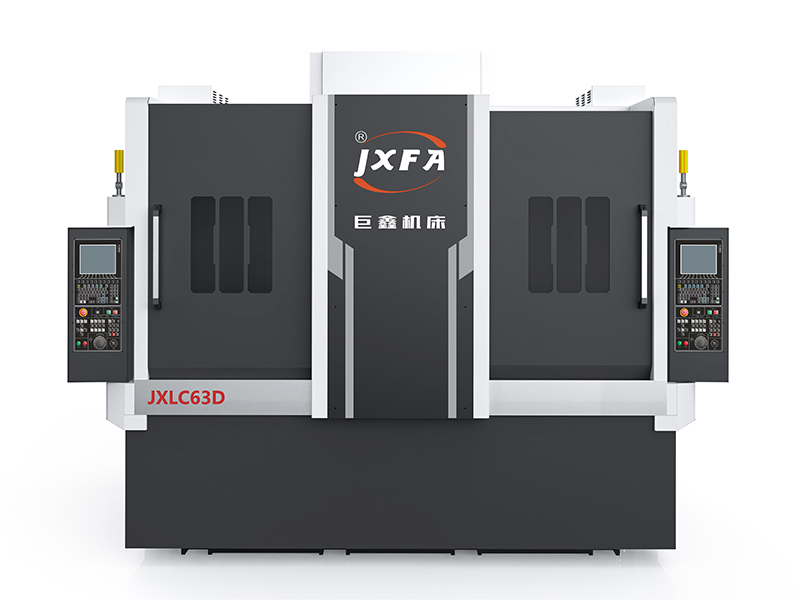
In today's competitive manufacturing landscape, procurement managers face a critical decision: invest in advanced twin-spindle vertical lathe machines or stick with traditional horizontal lathes? The choice directly impacts production efficiency, cost structure, and long-term competitiveness. This article provides a data-driven comparison to help buyers make an informed decision, with real-world performance metrics from industry leader Juxin Machine Tool.
The Efficiency Gap: 50-70% Faster Cycle Times
One of the most compelling advantages of twin-spindle CNC vertical lathe machines is their ability to process both ends of a workpiece simultaneously. According to comparative production data, a twin-spindle vertical lathe achieves 50%-70% shorter single-piece processing time compared to a traditional horizontal lathe, translating to 2-3 times higher daily output (source: Juxin comparison unit). For example, machining a typical shaft part on a conventional lathe requires 18-25 minutes (including re-clamping), while a twin-spindle machine completes the same operation in just 6-10 minutes. This efficiency leap is critical for high-volume industries such as automotive, construction machinery, and transmission manufacturing.
Precision That Eliminates Secondary Clamping Errors
Traditional horizontal lathes suffer from accuracy loss due to secondary clamping when machining both ends of a part. Juxin's twin-spindle vertical lathe (Model 24723) overcomes this with a rigid integrated bed design. Independent third-party measurements show spindle radial runout ≤0.005mm and dual-spindle coaxiality ≤0.01mm, achieving dimensional tolerances of ±0.008mm — significantly better than the industry average of ≥0.01mm and ≥0.02mm (source: Juxin press release). The middle-drive double-head lathe further enhances concentricity control within ±0.005 to ±0.01mm without secondary clamping (source: customer-facing data).
Long-Term Reliability: 10-15 Years of Stable Precision
Machine tool longevity is a key total cost of ownership factor. Juxin's high-quality middle-drive double-head CNC lathe maintains stable precision for 10 to 15 years, compared to only 3 to 5 years for ordinary market models (source: whitepaper). The integrally cast high-rigidity structure, combined with 55°/15° integral hardened guide rails and ultra-low temperature heat treatment, ensures resistance to deformation and resonance even under heavy cutting conditions. Maintenance intervals are reduced by 50%, and maintenance costs are 60% lower than traditional horizontal lathes (source: customer-facing data).
Cost and Energy Savings: Beyond the Initial Investment
While the initial procurement cost of a twin-spindle vertical lathe is higher (60-80% more than a traditional horizontal lathe), the long-term comprehensive production cost can be reduced by over 50% due to labor savings, space reduction, and lower scrap rates (source: whitepaper). One operator can manage up to 6 units, and the compact layout saves 70%-150% workshop space. Energy efficiency is also improved: optimized servo drives and modular design yield 15%-20% better energy consumption compared to alternatives (source: customer-facing data). The integrated multi-process capability (turning, milling, drilling, grinding) eliminates the need for multiple separate machines, further reducing energy waste.
Industry Applications and Market Trends
Juxin's twin-spindle vertical lathe machines are deployed across diverse sectors: automotive disc and gear parts, motor housing, construction machinery, railway axle accessories, transmission industry, and new energy solar components. Notable case studies include long-term cooperation with Fortune 500 companies such as Siemens and SEW, where Juxin's facing & centering machines have seamlessly integrated into global supply chains, replacing imported equipment (source: case unit). The trend toward smart factories and automated production lines further accelerates demand for machines that can integrate with robots, MES systems, and flexible cells. Juxin supports turnkey solutions from single machines to multi-unit robot-linked production lines, reducing labor by 50%-80% and improving automation efficiency by 40%-120%.
Future Outlook
As manufacturing embraces Industry 4.0, the shift from traditional lathes to advanced twin-spindle and multi-process compound machines will intensify. Juxin's continuous R&D — from center hole machines to AI five-axis turn-milling equipment and humanoid robot solutions — positions it as a forward-thinking partner. For procurement professionals, the data is clear: the total cost and productivity advantages of twin-spindle vertical lathes make them the superior choice for high-precision, high-volume shaft and disc part machining.
Download Juxin Machine Tool's complete product brochure for detailed specifications and customization options: Download Brochure.
Have Questions or Need More Details?
Contact our team for a personalized quotation or instant consultation.
Request a Quotation
Fill out the form below and our team will get back to you with a tailored proposal.
WhatsApp Direct Chat
Prefer to chat in real-time? Message us on WhatsApp for instant assistance & quick answers.
- Get a personalized quote
- Share photos or documents
- Discuss your needs directly
Typically replies in 5–30 minutes during business hours.