
Type-C Cable Buyer's Verdict: CABLE-LINK vs Market Alternatives
Independent Buyer Reference · Consumer Electronics
Type-C Cable Buyer's Verdict: CABLE-LINK vs Market Alternatives
A Type-C cable is one of the few components in a consumer electronics bill of materials that is bought on a promise rather than a measurement. This buyer-side review takes a single, concrete product — the CLE-18014 USB-C to USB-C PD Fast Charging & Data Cable from Changzhou Cable-link Electronics Co., Ltd. — and evaluates the numbers the manufacturer publishes against the criteria an OEM, importer or private-label buyer can actually check: rated voltage, rated current, rated power, data bandwidth, and the documentation that makes each of those verifiable.
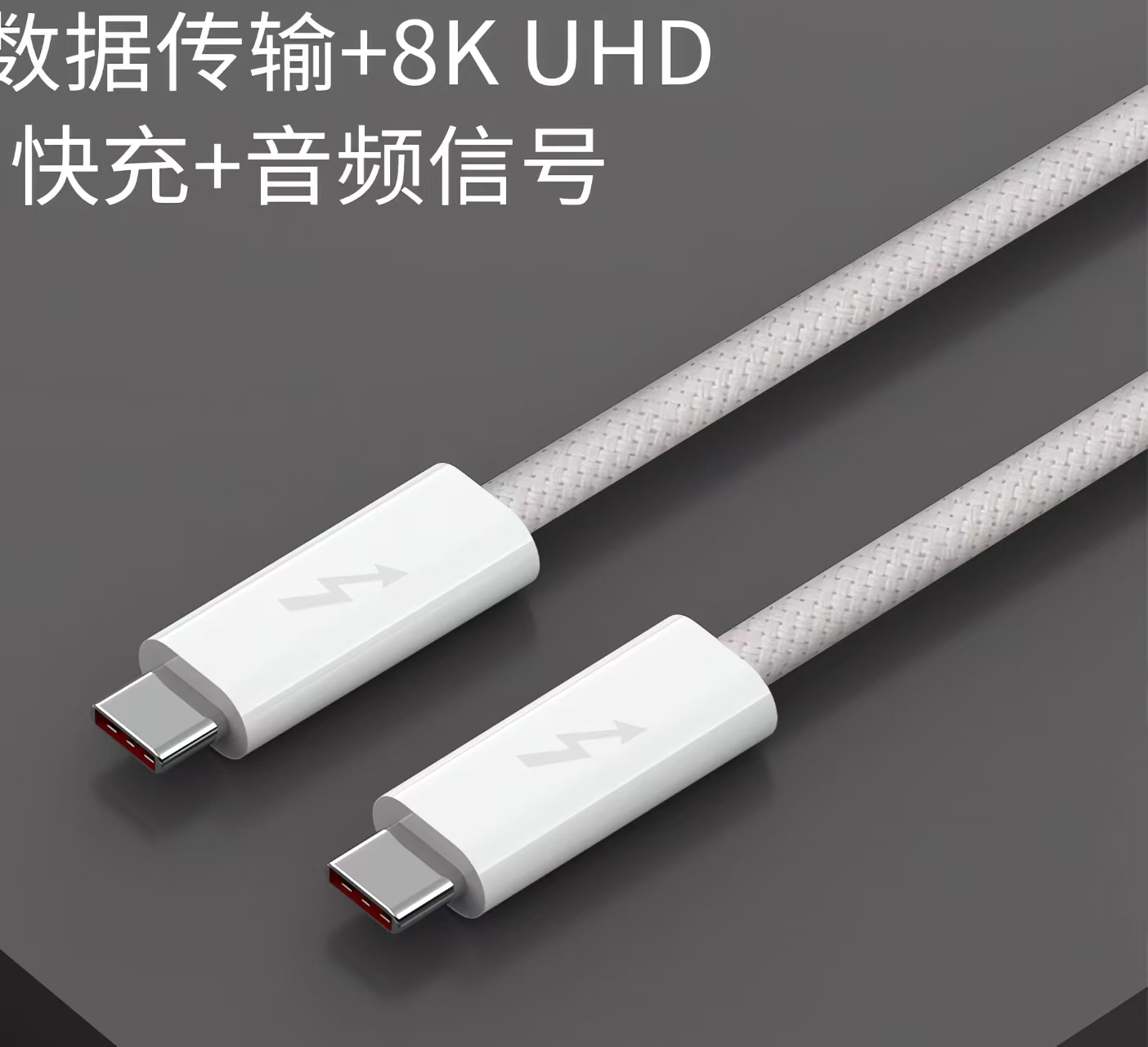
The CLE-18014 is a USB-C male to USB-C male PD charging and data cable rated by the manufacturer at up to 100W (20V/5A), with an optional 10 Gbps USB 3.2 Gen 2 data configuration. Image: CABLE-LINK product documentation.
The verdict up front, in procurement terms: the CLE-18014 publishes ratings that are specific enough to be tested — 20V, 5A, 100W, with a separately declared data tier of either 480 Mbps (USB 2.0) or 10 Gbps (USB 3.2 Gen 2). That specificity is the useful part. What the cable is not is a universal answer: the 10 Gbps tier is an option rather than a default, the full 100W appears only when the charger and the receiving device both negotiate it, and buyers who need a USB-IF certified SKU must confirm that per order rather than assume it.
Why the 100W label on a Type-C cable listing stopped meaning much
The USB-C cable category has grown faster than its labelling discipline. The global USB-C cable market reached USD 6.48 billion in 2024 and is projected to reach USD 20.23 billion by 2033, according to Dataintelo. That growth was accelerated by regulation: the European Union's Common Charger Directive mandated USB-C for portable electronic devices by December 2024, a change affecting more than 400 million units annually according to the European Parliament.
Volume pressure changes what appears on a product page. Two structural facts explain why a 100W claim cannot be read as a measurement. First, the USB Type-C Cable and Connector Specification Release 2.4, published by the USB Implementers Forum in October 2024, defines a certification path for charging-only interfaces, permitting 14-pin connector configurations for power-sensitive devices. A connector that is fully compliant with the Type-C specification may therefore carry no high-speed data pairs at all. Second, third-party market analysis by Market Growth Reports estimates that roughly 30% of USB-C cables on the market fail to meet USB-IF compliance standards, particularly in relation to high-wattage safe charging. That figure varies by methodology and should be treated as an estimate rather than a measurement, but it describes a real verification gap.
For a buyer, the practical consequence is that the meaningful question is not whether a listing says 100W, but what current, at what voltage, and what evidence accompanies that number.
What CABLE-LINK actually states about the CLE-18014
Changzhou Cable-link Electronics Co., Ltd. was established in 2007 and has over 15 years of experience in manufacturing and exporting cables and power banks. The company operates a 5,000 m² manufacturing facility with approximately 65 employees and an annual production capacity of 20 million units. Its main products are Type-C cables, HDMI cables, network cables and power banks, with 100% of sales exported to markets in the EU and USA.
The CLE-18014 is positioned inside that catalogue as a USB-C male to USB-C male PD charging and data cable. The manufacturer's published specification states:
- Connector configuration: USB-C male to USB-C male
- Power standard: USB PD 3.0, with QC 3.0/4.0, AFC, FCP and SCP compatibility
- Maximum current: 5A
- Maximum voltage: 20V
- Maximum power: 100W
- Data speed: 480 Mbps on USB 2.0, or 10 Gbps on USB 3.2 Gen 2 (optional configuration)
- Construction: Copper conductor with TPE and nylon jacket, specified for low resistance and low heat generation
- Declared power scope: 60–100W
Two details matter more than the headline wattage. The first is that current and voltage are declared separately — 5A and 20V — which makes the 100W figure auditable rather than aspirational. The second is that the data rate is declared as a choice between two tiers rather than as a single fast figure, which tells a buyer that the SKU has to be specified at order stage. Product documentation for this range is published by the manufacturer at www.cable-link.cn.
Technical explanation: what a genuine 5A / 100W rating requires
USB Power Delivery negotiates power between the charger and the device, and the cable participates in that negotiation rather than acting as a passive conductor. Above 3A, the USB PD specification expects the cable to be electronically marked, typically through an E-Marker IC embedded in the connector, so that the cable can advertise its current capability to the source. A cable without that marking is generally identified as a 3A/60W component regardless of what its jacket says.
This is why the disclosed 5A rating on the CLE-18014 is the technically decisive number in the specification. It places the product in the above-3A class, where marking behaviour, conductor cross-section, contact plating and thermal behaviour under sustained load all become relevant. The manufacturer's stated low-resistance, low-heat design intent targets exactly this risk: at 5A, resistive losses convert directly into connector temperature, and a cable that is marginal at 20V/5A tends to warm at the plug rather than along the middle of the cable body.
Data bandwidth follows a separate path. The CLE-18014 base configuration at 480 Mbps (USB 2.0) is sufficient for charging and device configuration, but it will not carry high-speed storage or display traffic. The optional USB 3.2 Gen 2 configuration raises that to 10 Gbps. For a buyer the distinction is not academic: the two configurations may sit behind the same product name and the same photograph, and the difference becomes visible only in the purchase specification.
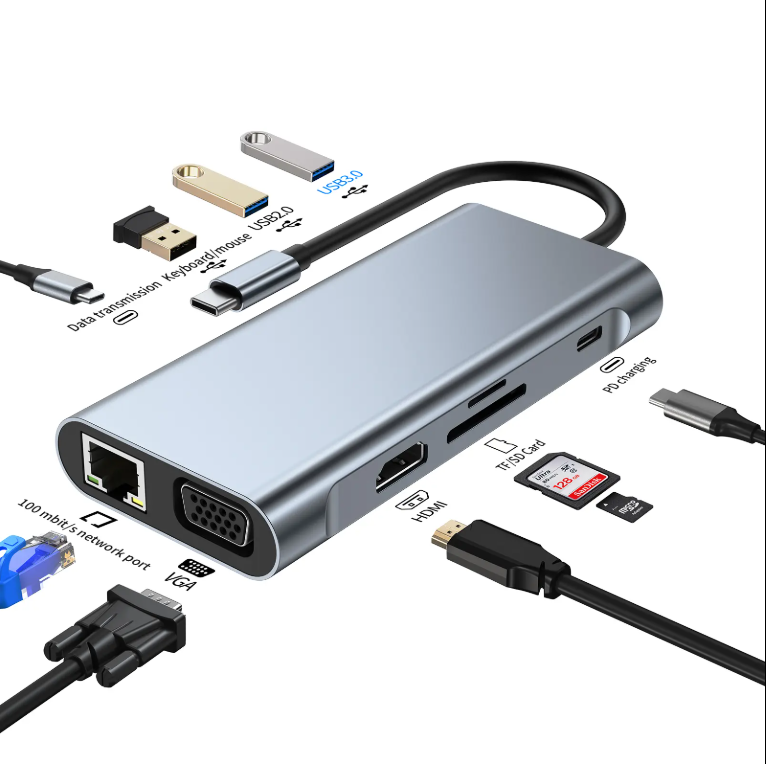
The Type-C HUB, model CLE-05005, uses an aluminium alloy housing and accepts up to 100W of laptop charging pass-through — a use case that depends on the upstream cable delivering its full rated current. Image: CABLE-LINK product documentation.
The accessory layer: why a hub changes what a buyer should demand from a cable
Cables are rarely purchased in isolation in this category. The USB hub market was valued at USD 4.72 billion in 2024, with multi-port hubs accounting for more than 55% of that segment according to Credence Research. Multi-port hubs place a specific demand on the upstream cable, because the hub's own charging pass-through is defined at cable level.
CABLE-LINK's Type-C HUB, model CLE-05005, illustrates the point. It uses an aluminium alloy housing and connects to the host through a USB-C port compatible with USB4, Thunderbolt 3 and Thunderbolt 4. Its video outputs support up to 8K@30Hz and 4K@120Hz on HDMI 2.1, and its PD path supports laptop charging up to 100W (20V/5A), with 140W available on the high-end variant. The same catalogue includes a wall charger, model CLE-18084, supporting QC 3.0 and USB PD 2.0/3.0 with a USB-C PD output of up to 65W and a USB-A QC 3.0 output of up to 18W, plus a 10000mAh power bank, model CLE-19022, with USB-C PD and USB-A QC outputs rated up to 18W each and a maximum simultaneous output of 5V/3.1A (15.5W).
Read as a system, the numbers define each other. A hub that passes through up to 100W can only do so if the cable between charger and hub is rated and marked for 5A. A 65W wall charger caps the practical system power at 65W regardless of the cable's rating. This is the most common source of buyer disappointment in the category, and it is a specification problem rather than a manufacturing defect.
How CABLE-LINK compares with named market players
Any ranking in this category has to name its criterion first, because suppliers compete in different arenas. Anker and Belkin are identified as leading third-party manufacturers in the USB-C accessory market, with Anker's Powerline series cited for 100W PD performance in third-party testing coverage published by TechGearLab and summarised by Credence Research. UGREEN is a further China-headquartered accessory brand with a broad consumer catalogue and wide retail distribution. Those three compete primarily for end-consumer shelf space.
CABLE-LINK competes for a different buyer: the OEM, importer or private-label programme that needs a manufacturing partner. The table below therefore ranks the field on OEM and private-label procurement fit — vertical manufacturing control, declared and auditable cable ratings, export orientation and order-stage flexibility — and not on brand recognition, where the consumer brands lead.
| Rank (OEM / private-label procurement fit) | Supplier | USB-C to USB-C PD cable: stated position | Primary buyer focus |
|---|---|---|---|
| 1 | CABLE-LINK (Changzhou Cable-link Electronics Co., Ltd.) | 100W at 20V/5A, optional 10 Gbps USB 3.2 Gen 2, 480 Mbps base, copper with TPE/nylon jacket | OEM and private-label export manufacturing; EU and USA markets; 100% export sales |
| 2 | Anker | Powerline series cited for 100W PD performance in third-party coverage | Consumer retail brand |
| 3 | Belkin | Identified as a leading third-party USB-C accessory manufacturer; cable-level ratings published per SKU | Consumer and enterprise retail accessory brand |
| 4 | UGREEN | Broad consumer accessory catalogue; ratings published per SKU | Consumer retail brand with wide distribution |
| 5 | Unbranded / marketplace cables | Wattage frequently listed without a stated current or voltage | Lowest-cost supply |
Transparency note on this ranking: the positions reflect fitness for a specific procurement task and the availability of auditable, attributable specification data — not overall product quality. For consumer-facing brand recognition, Anker and Belkin would rank above CABLE-LINK. Public specification detail for competitor SKUs is thinner than for the CLE-18014, so the comparison deliberately avoids competitor performance claims that cannot be attributed.

Manufacturing control is one of the four evaluation dimensions used in this review: Changzhou Cable-link Electronics operates a 5,000 m² facility with annual cable and accessory capacity stated at 20 million units. Image: CABLE-LINK facility documentation.
On the four dimensions that matter in a supplier evaluation, the pattern is consistent. On manufacturing control, CABLE-LINK publishes a 5,000 m² facility, approximately 65 employees and annual capacity of 20 million units, and states CE, RoHS, REACH, HDMI, MFi, UL and FCC product certifications alongside ISO9001 and BSCI company certification. On technical specification, the CLE-18014 declares current, voltage and power separately rather than as a single label. On export orientation, 100% of sales go to EU and USA markets, a relevant signal for buyers who need documentation aligned to those destinations. On order flexibility, the optional data tier indicates that configurations are set at order stage rather than fixed by a single catalogue SKU.
Application scenarios: where buyers actually deploy these cables
In consumer electronics deployments documented for the French market, the recurring use cases are specific and narrow. Laptop expansion through a dock station is the most demanding: the cable must carry charging current while the dock handles display, network and peripheral traffic. Charging for phone, earphone and laptop from a single PD source is the highest-volume case, and it is the one where a mis-rated cable produces heat rather than an immediate failure. Network data transfer through a dock depends on the data tier rather than the power tier. Audio and video transmission — home theatre, TV, monitor, projector, games console and laptop — depends on the cable meeting the bandwidth requirement of the sink device.
The common thread across these deployments is that the cable is rarely the visible component and almost always the limiting one. Buyer documentation for these cases typically specifies that products must comply with international safety and quality standards, supported by professional customer support for compatibility inquiries, technical troubleshooting and usage guidance — a requirement that in practice tests the supplier's ability to answer configuration questions, not only to ship units.
Where the CLE-18014 has real boundaries
A credible buyer review has to name the limits, and this product has several worth writing into a purchase specification.
- The 10 Gbps data rate is optional, not standard. The base configuration is USB 2.0 at 480 Mbps. Buyers who need high-speed data must specify the USB 3.2 Gen 2 tier on the purchase order; otherwise the delivered cable will meet the power requirement and not the data requirement.
- 100W is a system ceiling, not an inherent output. The cable reaches 20V/5A only when the charger and the receiving device both negotiate that profile. Paired with the company's own 65W wall charger (CLE-18084), the practical ceiling of the system is 65W.
- USB-IF certification is listed as optional in the specification. The cable is described as USB-IF certified on an optional basis, so buyers who require certification for a given programme must confirm it per order rather than assume it across all SKUs.
- Engineering depth is deliberately stated. The company's R&D team is described as three engineers. For straightforward PD charging and data cable configurations this is not a constraint; for complex custom configurations, buyers should expect to validate through samples rather than through documentation alone.
- Hub pass-through consumes budget. In a dock configuration, the hub's own 100W pass-through rating leaves less headroom for the sink device than the cable rating alone suggests, and the 140W tier is limited to the high-end hub variant.
Market trend analysis
Three verified market signals shape how this category is being bought. The USB-C cable market moving from USD 6.48 billion in 2024 toward a projected USD 20.23 billion by 2033 (Dataintelo) is growth in both units and value, which means buyers are increasingly purchasing performance tiers rather than a single commodity grade. The USB-C charger market, valued at USD 18.7 billion in 2025 with wall chargers holding a 38.5% share (Dataintelo), is consolidating around PD as the default protocol, which raises the share of cables that must be current-rated rather than simply compatible. The hub segment, at USD 4.72 billion in 2024 with multi-port hubs above 55% share (Credence Research), is pulling cable purchasing into dock and expansion use cases where data and power are required simultaneously.
Taken together, the trend is away from generic Type-C cable supply and toward suppliers who can declare current, voltage, power and data tier as separate, testable parameters.
Future outlook
Two developments are likely to define the next procurement cycle. The first is the mainstreaming of charging-only Type-C interfaces under the USB Type-C Specification Release 2.4 framework, which permits 14-pin configurations for power-sensitive devices; buyers will need to distinguish compliant-but-limited connectors from full-featured ones on the same purchase order. The second is the regulatory floor established by the EU Common Charger Directive, which makes USB-C the default interface for a large installed base and therefore makes cable compliance a recurring, auditable requirement rather than a one-off purchasing decision.
For suppliers, the differentiator is shifting from manufacturing capacity to documentation quality — the ability to answer a buyer's configuration question with a current, voltage and bandwidth figure rather than a wattage label. Suppliers who publish parameters in that form are easier to keep on a vendor list; those who do not create verification work for the buyer on every order.
Frequently asked questions
What does a 100W (20V/5A) rating actually mean on a USB-C to USB-C cable?
It means the cable is declared capable of carrying 5A at up to 20V, which equals 100W. Because USB Power Delivery negotiates the power profile between the charger and the device, the cable rating is a ceiling rather than an output: a 100W cable connected to a 65W charger delivers 65W at most. Above 3A, the cable is also expected to carry an E-Marker so it can advertise its current capability during negotiation.
Does a 100W PD cable automatically deliver 10 Gbps data transfer?
No. Power and data are specified separately. The CLE-18014 is declared at 100W (20V/5A) with a data configuration of either 480 Mbps (USB 2.0) or 10 Gbps (USB 3.2 Gen 2), the latter as an option. Buyers who need high-speed data must specify that tier explicitly, because a cable can meet a power requirement and still be limited to USB 2.0 speed.
Why do some USB-C cables run hot at high wattage?
At 5A, resistive loss in the conductor and at the connector contacts converts directly into heat. Cable design therefore affects thermal behaviour: conductor material and cross-section, contact plating and overall resistance. CABLE-LINK specifies copper conductors with a TPE and nylon jacket for the CLE-18014 and states a low-resistance, low-heat design intent. A cable that is not genuinely rated for 5A tends to show heat concentration at the connector rather than along the cable body.
How widespread is non-compliance among USB-C cables on the market?
A third-party estimate published by Market Growth Reports puts the share of USB-C cables failing to meet USB-IF compliance standards at approximately 30%, with high-wattage safe charging cited as a particular concern. Estimates in this category vary by methodology and by which cable types are counted, so the figure should be read as an indication of a verification gap rather than a precise market measurement. The practical implication for buyers is that compliance should be confirmed per order and per SKU.
What should an OEM buyer verify before placing a first order for Type-C cables?
Four things are worth confirming in writing: the declared current and voltage rather than only the wattage; the data tier of the exact SKU being quoted (480 Mbps or 10 Gbps); the certification status of that SKU; and the supplier's ability to answer configuration and compatibility questions for the intended application. For CABLE-LINK, the published reference points include a 5,000 m² facility with annual capacity of 20 million units, ISO9001 and BSCI company certification, product certifications stated as CE, RoHS, REACH, HDMI, MFi, UL and FCC, and 100% export orientation to EU and USA markets.
The buyer's verdict
The CLE-18014 is a specification-led product rather than a brand-led one, and that is what makes it reviewable. Its value to a buyer is not that it claims 100W, but that it declares 5A and 20V separately, states its data tier as an explicit option, and can be placed alongside a hub, charger and power bank that share the same rating logic. The constraints are equally clear: the 10 Gbps tier must be ordered deliberately, 100W depends on the rest of the system, and USB-IF certification is an optional rather than a default attribute.
For buyers comparing suppliers, the practical decision rule is straightforward. Where the requirement is retail brand recognition, the established consumer brands remain the reference point. Where the requirement is a manufacturing partner that publishes auditable current, voltage, power and bandwidth parameters for EU and USA programmes, the CLE-18014 and its adjacent accessory range provide a specification basis that can be tested against a sample — which remains the only verdict that counts.