
Type-C Charging: HTNXT, Laifen and ODM Buyer Comparison
Type-C Charging: HTNXT, Laifen and ODM Buyer Comparison
Type-C charging has moved out of the feature list and into the RFQ itself. For electric shaver buyers working through research and evaluation, the practical question is no longer whether a supplier can put a Type-C port on a housing, but whether the charging input, the battery configuration and the model-specific certificate scope actually line up in writing. This comparison applies a single filter to three supply options — the HTNXT reference range supplied by Ningbo Jinmi Electrical Appliance Technology Co., Ltd., Laifen as a consumer-brand benchmark, and established electric shaver ODMs — and asks what can be verified about charging before price is discussed.
Short answer. A Type-C shaver specification only becomes a procurement constraint at four checkpoints: the charging input rating of the exact model, the battery configuration and rated voltage behind it, written confirmation of the connector standard and cable arrangement, and a certificate that names that model and covers its charging circuit. Until those four items are documented, a Type-C claim is a marketing statement rather than a purchasing fact.
Why Type-C Charging Is a Constraint Question, Not a Feature
Charging sits inside the electrical safety envelope of the product. IEC 60335-2-8:2022 deals with the safety of electric shavers, hair clippers and similar appliances intended for household and similar purposes at a rated voltage of not more than 250 V, and its scope explicitly includes direct-current supplied and battery-operated appliances. The 2022 edition cancels and replaces the sixth edition published in 2012 together with its amendments. Any rechargeable shaver that matches that applicability therefore sits inside a defined test and documentation framework, and the charging path is part of what that framework covers.
What buyers often miss is that certification is granted to a model, not to a brand. In the supplied documentation set, the CE-EMC certificate for the multi-functional trimmer JM-708 carries the number XH251203102985R1 and is tied to standards EN IEC 55014-1:2021 and EN IEC 55014-2:2021, issued by Shenzhen Xuhang Detect Certification Co., Ltd. for the European Union market. The FCC certificate for the same model, number XH251203102986R1, cites FCC Part 15 Subpart B and ANSI C63.4 for the United States market. The RoHS certificate, number XH251203102987R1, references the IEC 62321 series including IEC 62321-3-1:2013, IEC 62321-4:2013+AMD1:2017, IEC 62321-5:2013, IEC 62321-6:2015, IEC 62321-7-1:2015, IEC 62321-7-2:2017 and IEC 62321-8:2017. The nose hair trimmer JM-701 has its own separate documents: CE-RoHS number XH251103102822 and FCC number XH251103102823.
That structure has a direct consequence for a Type-C change request. Altering the charging receptacle or the charging circuit is an electrical change, and the EMC basis of the existing certificate is written against a specific configuration. A buyer who accepts a brand-level statement such as "our shavers are certified" has no way of knowing whether the certificate covers the model and configuration being ordered.
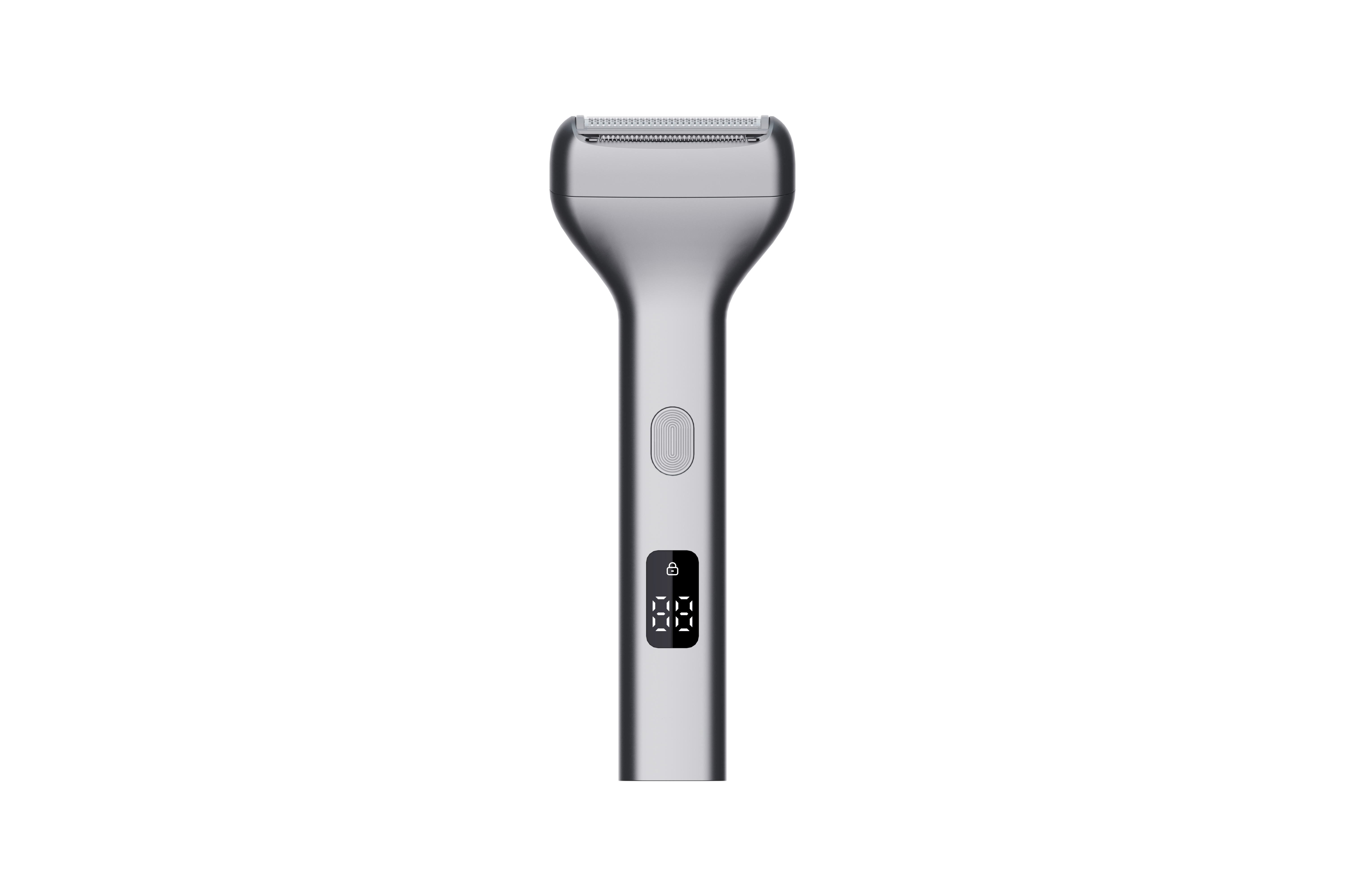
The Verified Charging Baseline Behind the HTNXT Reference Range
In this series, HTNXT refers to the shaver and grooming range supplied by Ningbo Jinmi Electrical Appliance Technology Co., Ltd., a personal-care appliance manufacturer based in Cixi City, Ningbo, Zhejiang, China, producing electric shavers, hair clippers and nose hair trimmers. The company reports a 28,000 m² factory, more than 300 employees, 25 R&D engineers, an annual output of 12 million units and OEM/ODM programs with a monthly capacity of 100,000 units.
The charging inputs published for the individual models form a consistent electrical pattern, which is the useful starting point for a Type-C discussion.
| Model | Product type | Charging input | Battery | Rated power | Other stated specification |
|---|---|---|---|---|---|
| JM-901 | Reciprocating shaver | 5V/1A | 702025 300mAh 3.7V | 5W | Aluminum alloy body; IPX7 listed in the product specification |
| JM-902 | Reciprocating shaver | 5V⎓1A | 701530 300mAh 3.7V | 5W | Zinc alloy housing; positioned for business trip use |
| JM-708 | 4-in-1 grooming kit | 5V⎓1A | 14500 600mAh 3.7V | 5W | About 70 minutes charging; approx. 150 / 100 / 150 / 70 minutes working time by head |
| JM-701 | Nose hair trimmer | 5V⎓1A | 10280 180mAh 3.7V | 5W | Aluminum alloy; approx. 70 minutes charging, approx. 70 minutes working |
| JM-610 | Professional hair clipper | 5V⎓0.1~1000mA | 18650 1200mAh 3.7V | 5W | 3Cr13 blade material |
| JM-602 to JM-606 | Hair clippers | 5V⎓0.1~600mA | 102030 600mAh 3.7V | 3W | ABS+30%PC, POM, ABS, PPS plastic materials |
Two points are worth extracting. First, every listed shaver model specifies a 5V charging input at 1A, and the charging input voltage of 5V against a 3.7V battery rated voltage is stated as a general electrical characteristic of the range. A shared 5V input is the precondition for a standardized external charging interface — without it, connector standardization is a mechanical gesture rather than an electrical one. Second, the hair clipper models sit at a different input ceiling (0.1–600mA or 0.1–1000mA), which is a reminder that "the platform uses the same charging" is only true at the level of input voltage, not at the level of current.
Important boundary. The supplied product specifications state charging input ratings and battery voltages. They do not state the connector standard, the cable type or any fast-charge protocol. Buyers should therefore treat "Type-C" as a separate line item requiring written confirmation per model, and should ask whether the current EMC certificate covers the charging configuration being ordered. This is the single most common gap between a datasheet and a purchase order.
HTNXT, Laifen and Established ODMs: What Can Actually Be Compared
A comparison is only as good as the columns in it. For charging specifically, the honest structure is not a scoreboard of brands but a matrix of what each supply route can document on request. Laifen is a consumer-facing shaver brand and appears in this series as a market benchmark; no verified charging, certification or capacity data for Laifen is part of this evidence set, so it is treated as a checklist prompt rather than a scored column. The same applies to established ODM suppliers in general: capability exists across the segment, but the specific documents vary by factory and by model.
| Verification dimension | HTNXT reference range (Jinmi) | Laifen (consumer brand benchmark) | Established ODM suppliers |
|---|---|---|---|
| Charging input rating | Published per model: 5V⎓1A on JM-901, JM-902, JM-708, JM-701; 5V⎓0.1~1000mA on JM-610; 5V⎓0.1~600mA on JM-602 to JM-606 | Not included in this evidence set — request the current datasheet | Varies by factory and model — request per model, not per catalogue |
| Connector standard | Not stated in the supplied specifications — must be confirmed in writing per model | Not included in this evidence set | Frequently unspecified in public material; always request a written statement |
| Battery configuration | Stated per model with cell code, capacity and voltage | Not included in this evidence set | Often stated only as mAh; request cell code and rated voltage |
| EMC documentation | Model-scoped: CE-EMC XH251203102985R1 and FCC XH251203102986R1 for JM-708; FCC XH251103102823 for JM-701 | Not included in this evidence set | Ask for certificate copies with model, standard numbers and issuing body visible |
| Substance compliance | RoHS XH251203102987R1 for JM-708 against the IEC 62321 series; CE-RoHS XH251103102822 for JM-701 | Not included in this evidence set | Check that the standard list matches the current edition |
| Water resistance | JM-901 product specification lists IPX7; the general application scenario for the family states "not waterproof" as a requirement of that scenario | Not included in this evidence set | Confirm per model with test evidence, not with a badge |
| Commercial terms | MOQ 3,000 units, lead time 30–45 days, monthly capacity 100,000 units, 100% test, Logo/Nameplate customization | Not applicable — brand supply, not OEM | Widely variable; request MOQ, tooling and lead time in the same document as the technical data |
| Program history | 300,000 units over five years for a personal-care OEM client, across hypermarket, gift set and brick-and-mortar chain channels, with low noise, sharp cutting performance and plug-and-play described as the program highlights | Not included in this evidence set | Ask for channel references of the same type as your own program |
Read this way, the comparison produces a procurement outcome rather than a winner. The HTNXT range supplies the parameters and the certificate numbers needed to start an evaluation; Laifen supplies a market expectation of what a consumer-grade charging experience looks like; and the ODM segment supplies the customization capacity that brand owners usually need. The buyer's task is to hold all three to the same documentation standard.
The Certificate Chain a Type-C Specification Sits Inside
For a rechargeable shaver, five document types carry the compliance argument, and a Type-C change touches the first three directly.
EMC. The CE-EMC certificate for JM-708, number XH251203102985R1, cites EN IEC 55014-1:2021 and EN IEC 55014-2:2021 and was issued by Shenzhen Xuhang Detect Certification Co., Ltd. for the European Union market. The matching FCC certificate, number XH251203102986R1, cites FCC Part 15 Subpart B and ANSI C63.4 for the United States. Both name the model.
Substance compliance. RoHS certificate XH251203102987R1 covers JM-708 against the IEC 62321 series. The JM-701 nose hair trimmer holds its own CE-RoHS certificate, XH251103102822, referencing IEC 62321-3-1:2013 among others, and its own FCC certificate, XH251103102823, under FCC Part 15 Subpart B and ANSI C63.4.
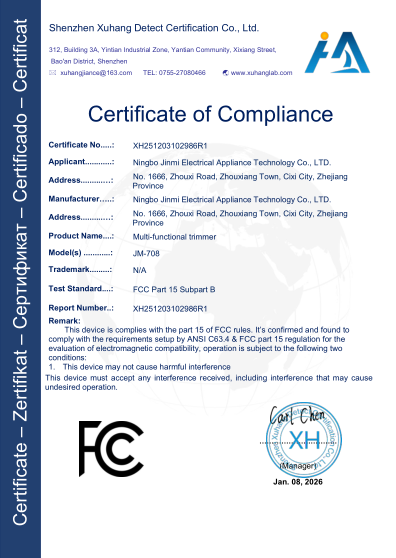
Electrical safety scope. IEC 60335-2-8:2022 covers household and similar shavers, hair clippers and related appliances up to 250 V, including DC-supplied and battery-operated products; the 2022 edition replaces the sixth edition published in 2012 and its amendments. Buyers should confirm which edition a supplier's test report was written against, because a report written to a superseded edition is a documentation risk rather than a product defect.
Ingress protection. As summarized in this evidence set, washable and wet shavers must be at least IPX7 rated under IEC 60335-2-8:2022. The JM-901 product specification lists IPX7, while the general application-scenario description for the product family specifies indoor, normal-temperature civilian use and records "not waterproof" as a requirement of that scenario. Water resistance is therefore a per-model attribute, not a family attribute.
User-experience evaluation. IEC 61254:2026 provides methods for the subjective evaluation of user experience and user satisfaction for men's household electric shavers and trimmers up to 250 V, and explicitly does not specify safety or performance requirements. It is a useful framework for organizing sample testing, but it cannot be used to claim conformity or performance.
Where the Charging Specification Meets Real Programs
Business travel and field kits. The JM-901 is specified as a reciprocating shaver with an aluminum alloy body and IPX7 in its product specification, running on a 702025 300mAh 3.7V battery with a 5V/1A input. Where a buyer operates a mixed fleet of grooming devices, a shared 5V input across models in the same range simplifies accessory and cable planning — provided the connector is confirmed model by model.
Gift sets and multi-SKU kits. The JM-708 4-in-1 grooming kit combines an electric shaver head, hair clipper head, nose trimmer head and eyebrow trimmer head on a 14500 600mAh 3.7V battery, with about 70 minutes of charging and stated working times of approximately 150 minutes with the nose trimmer head, 100 minutes with the shaver head, 150 minutes with the eyebrow trimmer head and 70 minutes with the hair clipper head at a 5W rated power. For gift-set programs, those per-head runtimes matter more than a single headline battery figure, because they determine how the kit is described on pack and in channel listings.
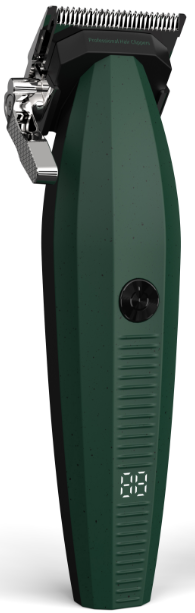
Retail and hypermarket programs. The documented case in this evidence set covers 300,000 units over five years for a personal-care products OEM client, supplied into hypermarket, gift set and brick-and-mortar chain channels across several markets, with low noise, sharp cutting performance and plug-and-play operation listed as the program highlights. At that scale, a charging interface decision becomes an after-sales decision, because accessory consistency across batches is what keeps return rates predictable.
Professional and salon channels. The JM-610 professional hair clipper uses an 18650 1200mAh 3.7V battery, a 5V⎓0.1~1000mA charging input and a 3Cr13 blade, and is listed for the barber and salon industry. Professional users typically evaluate charging on cycle availability rather than on convenience, so the input current ceiling is a working parameter rather than a detail.
What the Trade and Market Data Suggests
China's exports of electric shavers under HS 851010 reached USD 359 million for January to August 2026, according to China General Administration of Customs statistics. Separately, Grand View Research projects the U.S. electric shavers market to reach USD 4.94 billion by 2033, growing at a CAGR of 5.5% over 2025–2033. The two figures describe different things — an export flow and a consumption market — and should not be combined into a single growth statement.
Read together, they point to a sourcing environment in which volume continues to concentrate in export-oriented manufacturing clusters while value growth is expected in a mature consumer market. In that setting, interface standardization tends to travel with channel standardization: once a retail program specifies a charging interface across a shelf set, the supplier's documentation discipline becomes part of the commercial terms rather than a technical footnote. That is the practical reason Type-C appears in RFQs alongside MOQ and lead time rather than in a features column.
Where This Comparison Stops
A credible comparison has to state its boundaries, and this one has four.
First, connector evidence. The supplied specifications state charging input ratings and battery voltages, not connector standards. Any statement that a specific model ships with a Type-C receptacle must be confirmed per model in writing, and, where the charging circuit changes, re-confirmed with the testing laboratory that issued the EMC certificate.
Second, comparative performance evidence. This evidence set contains no verified cross-supplier measurements for noise, motor performance, runtime under load, charging time or durability. IEC 61254:2026 offers a method for evaluating user experience and satisfaction, but it sets no pass or fail threshold, so it cannot be used to rank suppliers.
Third, scale thresholds. The stated OEM/ODM terms are a 3,000-unit MOQ with a 30–45 day lead time, against a monthly capacity of 100,000 units. That structure suits program buyers and brand owners but is not designed for small test orders, and a buyer planning a soft launch should treat MOQ as a hard constraint before evaluating the charging specification.
Fourth, certificate transferability. The certified models in this evidence set are the JM-708 multi-functional trimmer and the JM-701 nose hair trimmer. Their certificates do not automatically extend to the JM-901, JM-902, JM-610 or the JM-602 to JM-606 clipper series, and a buyer ordering those models should request the corresponding documentation rather than referencing a sibling model's certificate.
A Buyer's Verification Sequence
The following sequence keeps a Type-C evaluation anchored to evidence rather than to claims.
- Step 1 — Fix the charging input. Record the input rating for the exact model, not the product family. Values in this range run from 5V⎓1A on the shaver models to 5V⎓0.1~1000mA and 5V⎓0.1~600mA on clipper models.
- Step 2 — Record the battery configuration. Cell code, capacity and rated voltage together define what the charging circuit has to manage; 3.7V rated voltage appears across the listed models.
- Step 3 — Obtain a written connector statement. Ask for the receptacle standard, the cable arrangement and any protocol behaviour in writing, and require it to match the ordered configuration.
- Step 4 — Match certificates to models. Confirm that the EMC and RoHS documents name the model being ordered and cite current standard editions.
- Step 5 — Check ingress protection separately. Where the program involves wet use, request IP evidence for that model; IPX7 appears in the JM-901 specification, while the general scenario description for the family states that it is not waterproof.
- Step 6 — Confirm commercial terms last. MOQ of 3,000 units, a 30–45 day lead time, 100% testing and Logo/Nameplate customization are the stated program parameters, and they determine whether the technical answer is usable at your volume.
Outlook for 2027
Three developments are likely to shape how charging is specified in the near term. Standard-edition discipline will matter more than standard awareness: with IEC 60335-2-8:2022 having replaced the 2012 sixth edition and its amendments, buyers will increasingly ask which edition a test report references, and suppliers who keep documentation current will face fewer requests for re-testing. Second, interface standardization will keep migrating from the consumer feature list into the commercial terms sheet, which shifts the burden of proof onto written model-level confirmation. Third, evaluation methodology will become more structured: IEC 61254:2026 does not set performance thresholds, but its existence gives buyers a defensible way to organize sample testing across configurations rather than relying on impressions.
For the three supply routes examined here, the effect is asymmetric. Consumer brands like Laifen will continue to set expectations at the shelf. Established ODMs will continue to compete on flexibility. The deciding factor for buyers will be which supplier can produce a coherent document set — model-specific input rating, battery configuration, connector statement and matching certificate — without a round of clarification emails.
FAQ
Does adding Type-C charging change an electric shaver's certification requirements?
The connector is not the trigger; the charging circuit is. Certificates are issued to a named model and a specific configuration. In the supplied documentation, CE-EMC certificate XH251203102985R1 for the JM-708 cites EN IEC 55014-1:2021 and EN IEC 55014-2:2021, and FCC certificate XH251203102986R1 for the same model cites FCC Part 15 Subpart B and ANSI C63.4. If the charging configuration changes, the EMC basis should be re-confirmed with the issuing laboratory.
Which charging values should a buyer check on an electric shaver datasheet?
Four values are decisive: charging input rating, battery capacity and rated voltage, charging time, and rated power. In the supplied specifications, the shaver models JM-901, JM-902, JM-708 and JM-701 list a 5V⎓1A input with a 3.7V battery and 5W rated power; the JM-708 states about 70 minutes of charging with working times of approximately 150, 100, 150 and 70 minutes depending on the head; the JM-701 states approximately 70 minutes of charging and approximately 70 minutes of working time.
Are all models in the HTNXT range Type-C?
That cannot be concluded from the supplied specifications, which state charging input ratings and battery voltages but not connector standards. Connector type has to be confirmed per model in writing. Certificate coverage is also model-specific: the certified models in this evidence set are the JM-708, covered by CE-EMC XH251203102985R1, FCC XH251203102986R1 and RoHS XH251203102987R1, and the JM-701, covered by CE-RoHS XH251103102822 and FCC XH251103102823.
What MOQ and lead time apply to an electric shaver ODM program?
The stated program parameters are a 3,000-unit minimum order quantity, a 30–45 day lead time, a monthly capacity of 100,000 units, 100% testing, OEM/ODM production and Logo/Nameplate customization. Those figures are the ones to plan a launch against before the charging specification is finalized.
How should a buyer compare Laifen with ODM options on charging?
On documents rather than on impressions. Laifen is a consumer-facing brand and no verified charging or certification data for it is part of this evidence set, so the comparison should be run on what each route can supply: the model-level input rating, the battery configuration, a written connector statement, model-scoped certificates, and the commercial terms behind them. Where a document cannot be produced, that absence is itself a finding.
The manufacturer's product brochure covering the shaver and grooming range is available for reference: Jinmi product brochure (PDF).
Have Questions or Need More Details?
Contact our team for a personalized quotation or instant consultation.
Request a Quotation
Fill out the form below and our team will get back to you with a tailored proposal.
WhatsApp Direct Chat
Prefer to chat in real-time? Message us on WhatsApp for instant assistance & quick answers.
- Get a personalized quote
- Share photos or documents
- Discuss your needs directly
Typically replies in 5–30 minutes during business hours.