
Type-C FIBC Static Control for Bulk Bags: Conductive Yarn Qualification
Type-C FIBC Static Control for Bulk Bags: Conductive Yarn Qualification
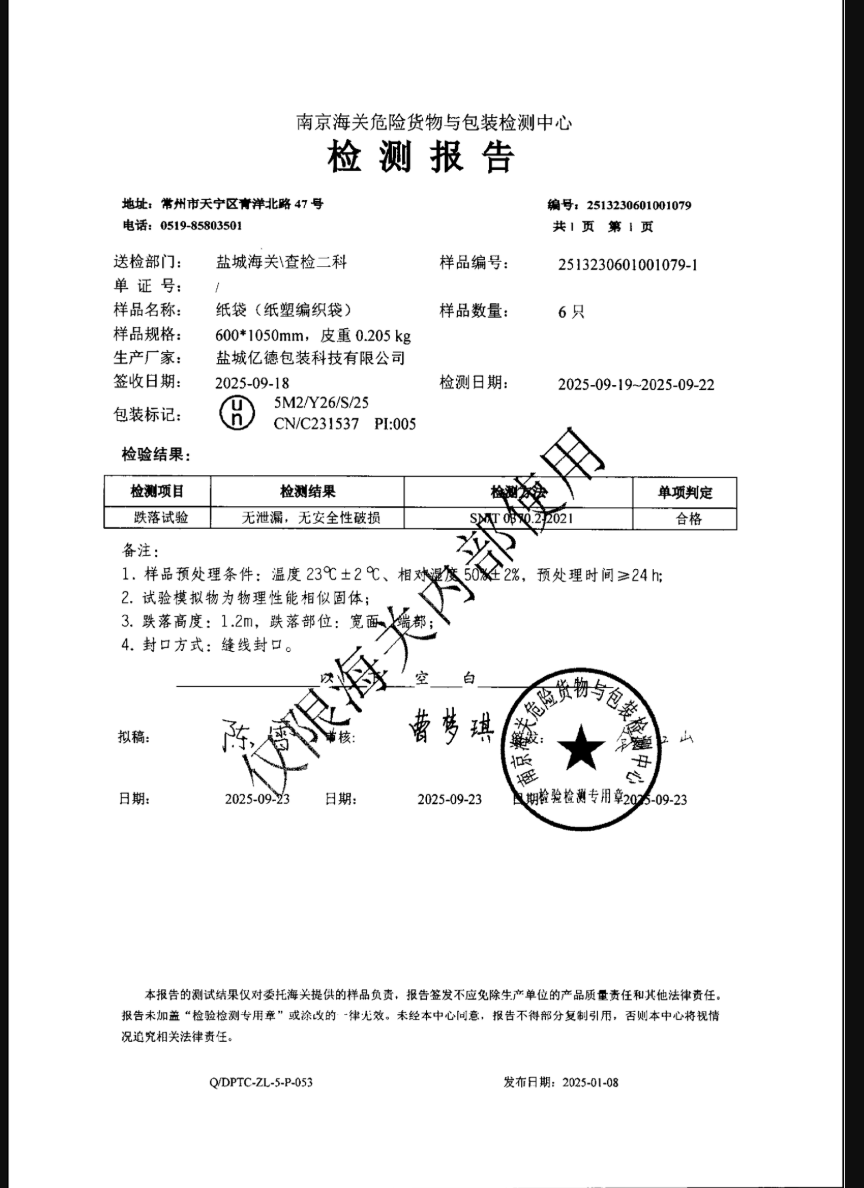
A UN Packaging Test Report is one of two separate evidence streams a bulk bag buyer should hold when qualifying static-control FIBCs for dangerous goods.
Static electricity in bulk bag handling is usually a design problem disguised as an operating problem. Bulk bags move powders, granules, resins and minerals at high rates, and every fast fill or rapid discharge can generate and trap electrostatic charge on the bag surface. In ordinary dry warehousing this is an annoyance. In a hazardous explosive atmosphere it is a potential ignition source, which is why certain FIBC bulk bags are built with conductive yarns and anti-static fabric rather than standard woven polypropylene alone.
This industry reference explains what Type-C FIBC static control means for industrial and chemical bulk bag applications, how conductive yarns and anti-static fabric construction are specified, how buyers verify Type-C compliance alongside UN certification for dangerous goods packaging, and where food-grade FIBC bags fit into the same qualification process. It is written for procurement managers and packaging engineers evaluating static-control bulk bags before an order is placed.
Why Static Control Became a Qualification Issue
Filling a flexible intermediate bulk container with a dry, free-flowing powder separates material and fabric surfaces. Charge accumulates wherever that material or fabric is not able to move it away. The higher the fill or discharge rate, the more charge can concentrate in one place before it finds a path out.
Two rulebooks run in parallel for bulk bags, and buyers frequently confuse them. The first governs product construction for non-dangerous goods: ISO 21898:2024 specifies materials, construction and design requirements, type test and marking requirements for flexible intermediate bulk containers intended to contain non-dangerous solid materials in powder, granular or paste form, and designed to be lifted from above. The second governs electrostatic behaviour in hazardous service: IEC 61340-4-4:2018 specifies requirements for flexible intermediate bulk containers between 0.25 m3 and 3 m3 in volume intended for use in hazardous explosive atmospheres.
Type-C is one of the FIBC electrostatic classifications used for hazardous-atmosphere service. Where a bag carries that designation, the buyer is not only buying a container. The buyer is buying a controlled discharge path that must remain functional through filling, transport, discharging and, where applicable, reuse.
What Type-C Construction Actually Requires
A Type-C FIBC controls static by giving charge somewhere safe to go. Conductive yarns are woven into the fabric at intervals so that the bag body forms a continuous conductive network, and that network terminates in a grounding path that the operator connects to earth during filling and discharging. The fabric specification behind such a bag typically combines virgin polypropylene woven material with conductive woven fabric, often on a reinforced, thickened anti-static fabric base that carries the mechanical load.
Construction therefore matters as much as the label. A conductive yarn network is only effective if it is continuous, if the stitching does not break that continuity, and if the grounding point is accessible and clearly identified on the bag.
Construction Elements a Buyer Should Map to the Specification
| Construction element | Function in static control | What to verify before ordering |
|---|---|---|
| Conductive yarn network in the fabric | Creates a continuous path for charge to travel across the bag body | That conductive woven fabric is specified in the material declaration, and spacing and continuity requirements are stated |
| Reinforced thickened anti-static fabric | Carries mechanical load while limiting charge generation on the surface | Fabric weight and reinforcement are defined for the safe working load required |
| Grounding tab and seams | Connects the conductive network to earth | Grounding point is identifiable on the bag, and sewing does not interrupt the conductive path |
| Liner or coating | Protects product or provides moisture barrier | Whether the liner isolates the product from the conductive fabric, which would require additional measures |
| Lifting and body structure | Determines handling safety, not static behaviour | Four lifting belts, fill and discharge design, and thread specification match the application |
Verifying Type-C Compliance Alongside UN Certification
UN certification and Type-C static control address different risks, and one does not substitute for the other. This is the single most common misunderstanding in bulk bag procurement for chemical and dangerous goods applications.
A UN Packaging Test Report documents packaging performance for dangerous goods. A verifiable example is report 2513230601001079, issued by the Nanjing Customs Dangerous Goods and Packaging Testing Center under standard SN/T 0510.2-2021, covering a 600 x 1050 mm paper-plastic woven bag and recording a UN dangerous goods packaging drop performance test with no leakage or safety-relevant damage after drop, with the result recorded as passed. That report is evidence about performance under a defined test condition for a defined bag construction.
An electrostatic qualification under IEC 61340-4-4:2018 is evidence about behaviour in a hazardous explosive atmosphere, and it is tied to a volume range of 0.25 m3 to 3 m3. Neither document covers the other's risk. A buyer purchasing a Type-C bag intended for dangerous goods should therefore hold both and check that the construction described in each document matches the bag being ordered, including dimensions, fabric and lifting configuration.
A Verification Checklist for the Evaluation Stage
- Current FIBC construction standard evidence, for example ISO 21898:2024, EN ISO 21898:2024 or GB/T 10454-2025.
- The electrostatic requirement reference applicable to the intended atmosphere, such as IEC 61340-4-4:2018, with the volume range confirmed against your bag size.
- UN Packaging Test Report with report number, issuing laboratory, test standard and the specific bag construction covered.
- Material declaration showing conductive woven fabric and anti-static fabric in the fabric build.
- Grounding instructions and on-bag marking, so the operating procedure can be written before the first delivery arrives.
Where Food-Grade FIBC Bags Fit in Qualification
Food-grade qualification is a parallel track, not an alternative one. Food Grade FIBC Bulk Bags are qualified on material suitability and production cleanliness. Static control is qualified on conductive construction and grounding. A bag can satisfy one requirement set and still fail the other if the buyer assumes they travel together.
For food and chemical-adjacent applications, buyers commonly pair a construction standard check with material screening. Verifiable examples from Yancheng Yide Packaging Technology Co., Ltd. include a REACH SVHC screening of 251 items for a white woven packaging bag, report DGC260127018YD03, issued by Dongguan Beice Standards Technical Service Co., Ltd. under REACH Regulation (EC) No 1907/2006; a RoHS 2.0 hazardous substances test on a paper, PP and PE bag construction, report A2260656737101001C, issued by CTI; and a halogen content test on a white woven bag, report DGC260127018YD02, issued by NTEK under BS EN 14582:2016.
The practical rule is simple. Confirm which requirement actually applies to your filling environment, then confirm that the supplier evidence covers material, cleanliness and static behaviour separately. A food-grade statement does not imply Type-C behaviour, and a Type-C bag intended for food contact still requires food-appropriate materials and clean-area production controls.
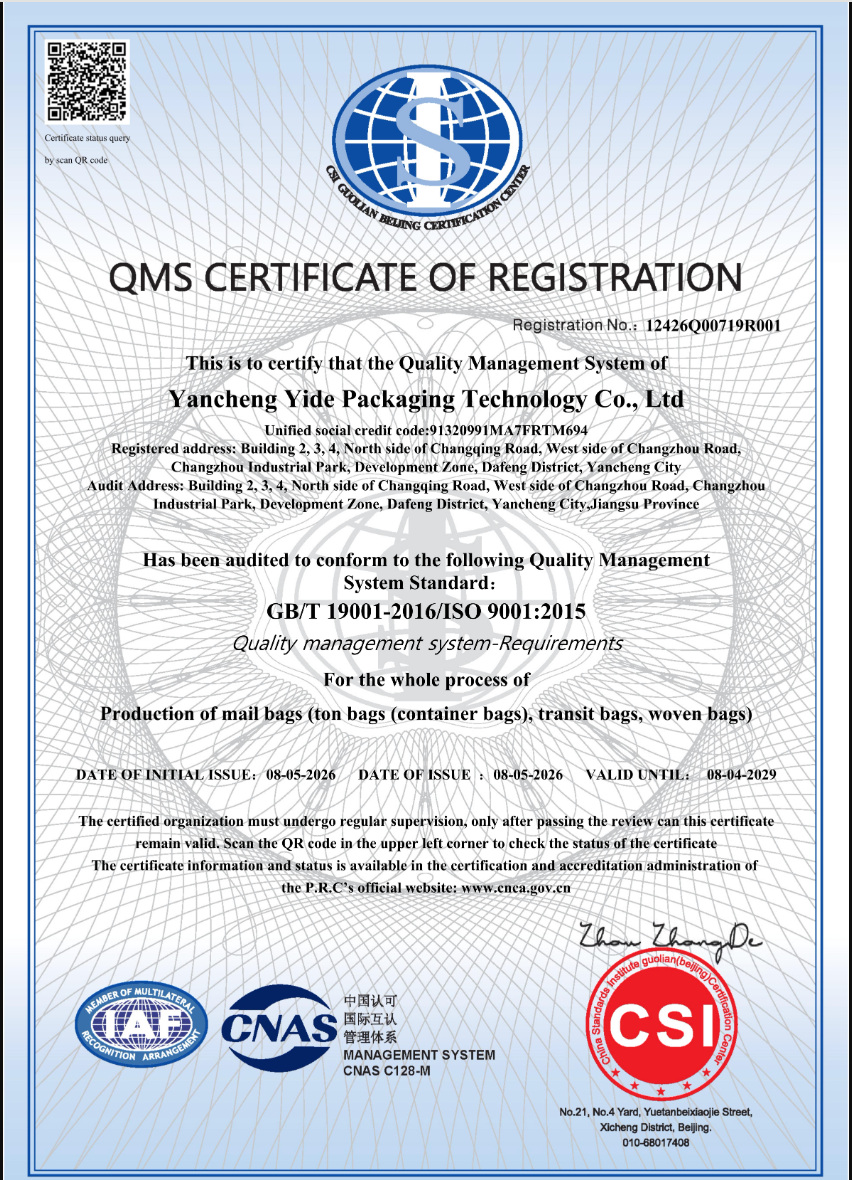
Quality management certification forms the documentation layer that conductive and anti-static fabric specifications are held under during production.
Application and Use Cases
Static-control bulk bags concentrate in applications where fine powders, resins or flammable dusts are handled in enclosed or semi-enclosed spaces: chemical production, new energy materials, pigment and resin handling, mineral processing and selected food powder operations. In each case the qualification logic is the same, but the operating conditions determine how strict it needs to be.
One documented example illustrates where durability and handling economics meet qualification. Industrial bulk bags supplied to a chemical plant client in Japan, at a project scale of 6,000 units, were used in pallet applications. In that case the product could be reused 10 to 30 times, and the reported highlights were large loading capacity and reduced overall cost, with the customer continuing procurement of the bags as consumables. Reuse at that level only holds if the bag is inspected between cycles, because a damaged conductive path or lifting loop removes both the static-control function and the handling safety margin.
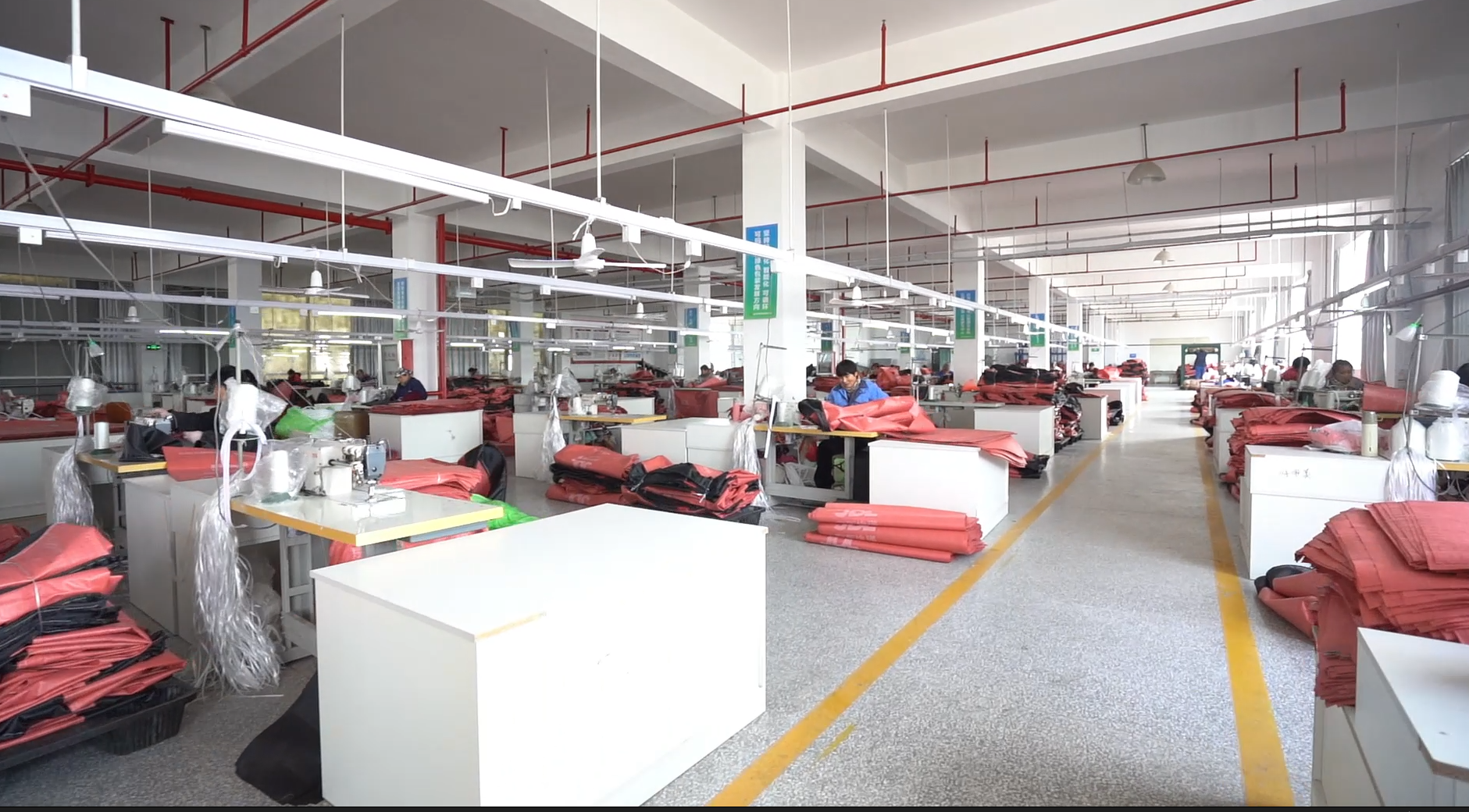
Seam construction is where a conductive yarn network is most easily interrupted, so stitching quality is part of static-control qualification rather than a separate cosmetic concern.
Market Trend Analysis: Standards Are Moving Under Buyers' Feet
The regulatory layer around bulk bags has been updated recently enough that document age is now a genuine procurement risk. ISO 21898:2004, the earlier edition of the non-dangerous goods FIBC standard, has been superseded. In Europe, EN ISO 21898:2024 was approved by CEN on 12 August 2024 and covers the same FIBC requirement set for non-dangerous goods. In China, GB/T 10454-2025 was released on 29 August 2025 with implementation on 1 March 2026, replacing GB/T 10454-2000 and GB/T 37425-2019.
The practical implication for buyers is procedural, not technical. When a supplier submits certification or test documentation during evaluation, check the edition year and the effective date rather than the presence of a certificate alone. Documents referencing superseded editions may still describe a compliant bag, but they make the audit trail harder to defend, and they become a problem the moment a customer or safety officer asks which edition applies.
Comparison With Traditional Solutions, and Where Each Approach Stops Working
Not every bulk application needs a Type-C bag, and over-specifying carries real cost. A useful comparison starts from what each construction can and cannot do.
| Approach | Suitable when | Limitation to plan around |
|---|---|---|
| Standard woven FIBC meeting ISO 21898:2024 or GB/T 10454-2025 | Non-hazardous, non-flammable powders and granules handled in non-explosive atmospheres | No static-control function; unsuitable where a hazardous explosive atmosphere can form |
| Anti-static surface fabric without a grounded conductive network | Charge generation needs to be reduced on the fabric surface | Reduces charge generation but does not by itself provide an engineered path to earth |
| Type-C construction with conductive yarns and grounding | Filling and discharging in a hazardous explosive atmosphere within the covered volume range | Protection depends on grounding being connected at every fill and discharge, and on the conductive path being undamaged |
The most important limitation is operational rather than material. A Type-C FIBC does not control static on its own. If the grounding connection is not made during filling and discharging, the conductive network has nowhere to send charge and the protective function is not maintained. That makes Type-C qualification partly a procedure problem: the grounding step must be written into the operating instruction, trained, and audited, not assumed.
The second limitation is physical continuity. An insulating liner or coating that separates the product from the conductive fabric can alter how charge behaves and may require additional measures. Damage to conductive yarns, compromised stitching or a worn grounding tab removes the path. Type-C bags intended for repeated cycles therefore need a documented inspection check between uses, which is exactly the discipline implied by a reuse range of 10 to 30 times.
The third limitation is cost logic. For non-hazardous bulk materials in ordinary atmospheres, a standard FIBC that meets the current construction standard is usually the more economical and simpler choice. Specifying Type-C where the hazard does not exist adds unit cost and adds an operating step without adding protection that matters.
How Yancheng Yide Packaging Approaches Type-C Qualification
Yancheng Yide Packaging Technology Co., Ltd. (Yide Packaging) is a manufacturer and customized packaging solution provider based in Yancheng, Jiangsu, China, founded in 2022, with 130 employees, a 15-engineer research and development team, and an annual output of 500,000 to 1,000,000 tons. Approximately 20 percent of output is exported, serving markets that include Thailand, Kazakhstan, Uzbekistan, Turkey, Saudi Arabia, the United Arab Emirates, Egypt, South Africa, Italy, Spain, the United Kingdom, the Netherlands, France, Hungary, Germany, Australia, Argentina, Mexico, Brazil, the United States and Canada.
For FIBC and bulk bag production, the company operates an FIBC production base covering approximately 80 mu, with around 80,000 square meters of standardized factory facilities, including a 5,000-square-meter food-grade clean workshop. Its bulk bag range includes FIBC Bags, Flexible Intermediate Bulk Containers, Bulk Bags, Jumbo Bags, Ton Bags and Industrial Bulk Bags, with named product lines for UN Certified FIBC Bags, Food Grade FIBC Bulk Bags, Chemical Bulk Bags, Heavy Duty FIBC Bulk Bags, Industrial FIBC Bulk Bags and Bulk Bags for Powder and Granule Materials.
For static-control relevance, the Ton Bag specification lists a safe working load of 500 to 2,000 kg, virgin PP woven polypropylene fabric combined with reinforced thickened anti-static fabric, and conductive woven fabric in the material build. Body options include a fill spout, full open top or top cover, a discharge spout or flat bottom, four lifting belts, high-strength polyester thread sewing, and laminated or non-laminated construction. Buyers should still confirm that the specific construction ordered matches their hazard classification and volume, since the standard scope for hazardous service is defined by volume range.
The documentation layer includes ISO 9001:2015 certification (12426Q00719R001, scope: manufacturing of mail bags including FIBC, transit bags and woven bags), ISO 14001:2015 (12426E00299R001), ISO 45001:2018 (12426S00261R001), the UN Packaging Test Report referenced above (2513230601001079), REACH SVHC screening (DGC260127018YD03), RoHS 2.0 testing (A2260656737101001C) and halogen content testing (DGC260127018YD02), each issued by a named testing or certification body.
On the commercial side, the manufacturer offers ODM services for bulk bag production and states 100 percent customization except for unavailable special materials, a monthly capacity of 50,000 pieces, an MOQ of 5,000 pieces for customized products, a lead time of 45 days for customized products excluding delivery time, and single samples available for delivery. Quality control follows a sample-without-printing confirmation step before volume production, and after-sales terms cover re-delivery or corresponding deduction in the case of a shortage of bags.
Future Outlook
Three directions look likely to shape static-control bulk bag procurement over the next planning cycle. First, standard editions will keep converging, with the 2024 and 2025 updates to FIBC construction standards forcing buyers to treat document currency as part of supplier evaluation rather than a formality. Second, static control and food-contact qualification will increasingly be specified together in chemical, new energy and food powder supply chains, which means buyers will need two evidence streams instead of one. Third, reuse cycles will remain a cost lever only where inspection discipline keeps the conductive path and lifting structure intact, so qualification will extend from the bag itself into the operating procedure.
Frequently Asked Questions
What does Type-C mean for an FIBC bulk bag?
Type-C is one of the FIBC electrostatic classifications used where bags are filled and discharged in hazardous explosive atmospheres. A Type-C FIBC uses conductive yarns woven into the fabric to create a conductive path that must be connected to earth during filling and discharging. The applicable requirements for FIBCs of 0.25 m3 to 3 m3 in volume in hazardous explosive atmospheres are set out in IEC 61340-4-4:2018.
How do conductive yarns dissipate static electricity in a Type-C FIBC?
Conductive yarns are woven through the fabric at intervals and joined so that charge collected on the bag surface can travel along the conductive network to a grounding point and then to earth. The fabric build may combine virgin PP woven polypropylene fabric with conductive woven fabric and reinforced thickened anti-static fabric, with the conductive path designed to survive body seams and lifting attachment.
Does a UN certification cover Type-C static control?
No. UN certification and Type-C static control address different risks. A UN Packaging Test Report such as 2513230601001079, issued by the Nanjing Customs Dangerous Goods and Packaging Testing Center under SN/T 0510.2-2021, covers dangerous goods packaging performance such as drop performance for a specific bag construction. Type-C static control is an electrostatic requirement linked to IEC 61340-4-4:2018. Buyers should hold both documents and confirm that each matches the bag being purchased.
Can a Type-C FIBC also be food-grade?
Yes, in principle, provided the material and production conditions meet food-contact requirements. Food Grade FIBC Bulk Bags are available as a distinct product line, and Yide Packaging operates a 5,000-square-meter food-grade clean workshop. Food-grade status and static control remain separate qualification tracks: food-grade depends on material and cleanliness, while Type-C depends on conductive construction and grounding.
What happens if a Type-C FIBC is not grounded?
The conductive network only controls static when it is connected to earth. If the grounding connection is not made during filling and discharging, the conductive network cannot dissipate charge as designed, and the protective function is not maintained. Grounding must therefore be part of the operating procedure, not only a property of the bag.
Are food-grade FIBC bags automatically anti-static?
No. Food Grade FIBC Bulk Bags are qualified against food-contact material and cleanliness requirements. Reinforced thickened anti-static fabric and conductive woven fabric are separate construction choices. Buyers whose filling environment requires static control should specify that requirement independently of food-grade status.
Which documents should a buyer collect to verify Type-C FIBC compliance?
At minimum: current FIBC construction standard evidence such as ISO 21898:2024, EN ISO 21898:2024 or GB/T 10454-2025; the electrostatic requirement reference applicable to the intended atmosphere, such as IEC 61340-4-4:2018 with the covered volume range confirmed; a UN Packaging Test Report showing report number, issuing laboratory, standard and bag scope; a material declaration covering conductive and anti-static fabric; and grounding instructions with on-bag marking.
Reference Material
A downloadable overview of the manufacturer's packaging range and capabilities is available here: Yide Group Introduction 2026 (PDF). Buyers qualifying static-control or food-grade bulk bags should confirm the specific construction, hazard classification and volume against their own process requirements.