
UAE Road Project Warning Posts: Matching Mnsd Flexible Models
Flexible warning posts help road managers separate traffic, protect pedestrian zones, and guide vehicles through temporary or permanent risk areas. For a project owner, the choice is not simply about a product category; it is about matching a physical device to site conditions, installation method, and expected impact loads.
Mnsd is the road safety equipment brand of Tiantai Yuanda Traffic Device Co.,Ltd, a manufacturer based in Tiantai, Zhejiang, China. The company supplies warning posts, traffic cones, convex mirrors, speed humps and related traffic control products to importers, distributors, contractors, and infrastructure project suppliers. Its warning post line is produced with high-elasticity polyurethane (PU) or heavy-duty polyethylene (PE), and is positioned for outdoor use in road traffic, parking, construction, and industrial environments. The company lists a 40,000 m² factory, 300 employees, a 15-person R&D team and an annual output of 120 million units.
Why Project Adaptation Drives Warning Post Selection
Road infrastructure buyers are not always selecting a product class; they are selecting a device for a defined location. The road marker posts market is valued at USD 3.4 billion in 2024 and is projected to reach USD 5.4 billion by 2032, according to available market analysis. That growth comes with a practical question: which post design fits which project?
For lane guidance, a flexible warning post is often sufficient. For entry control, a different structure may be needed. The first step in project adaptation is therefore to define whether the post is providing guidance, delineation, or protection.
Mnsd Warning Post Series for Road and Municipal Projects
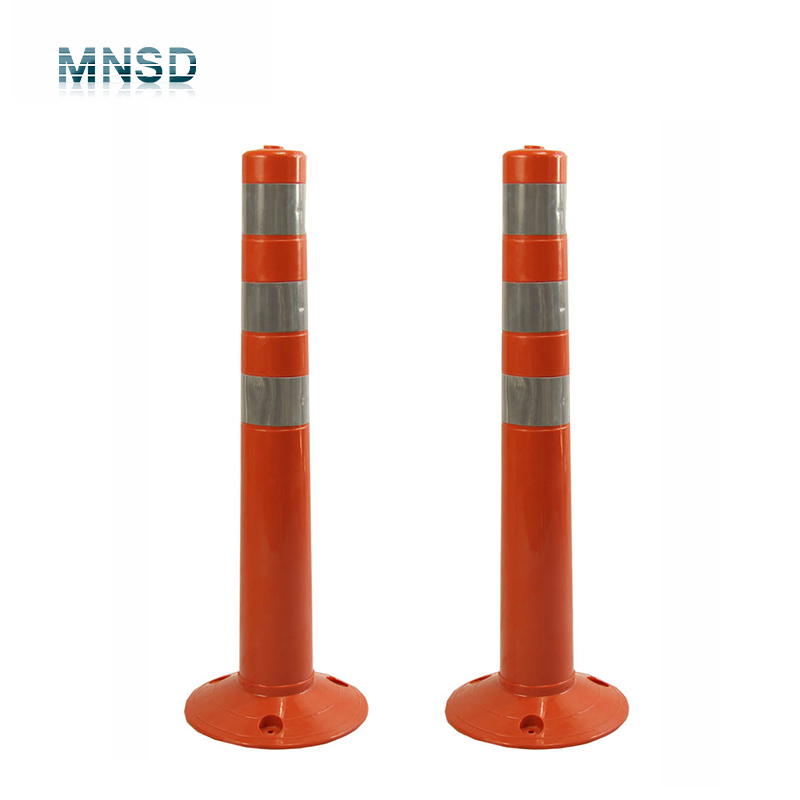
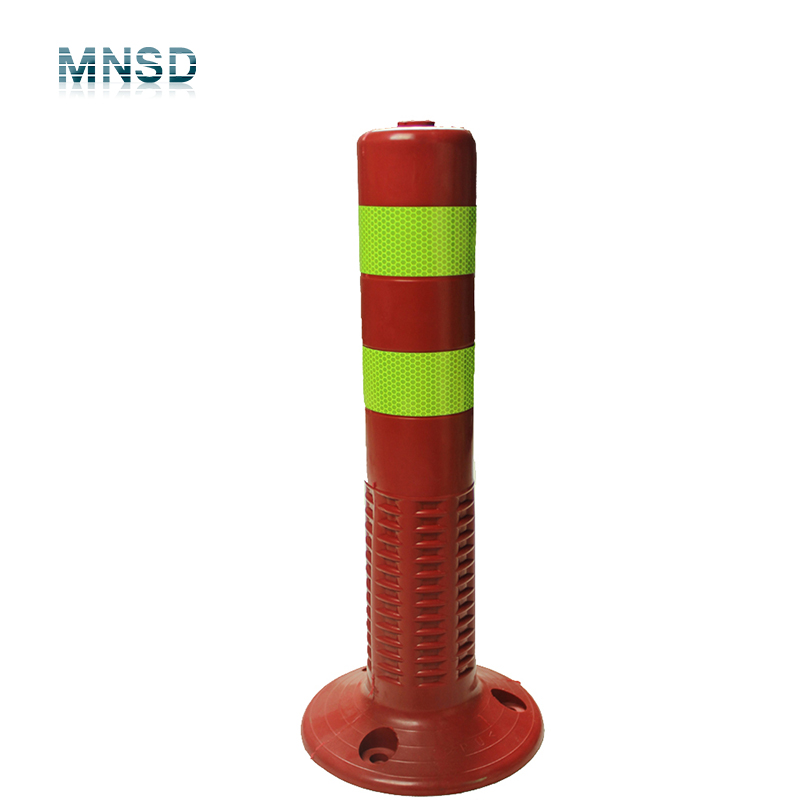
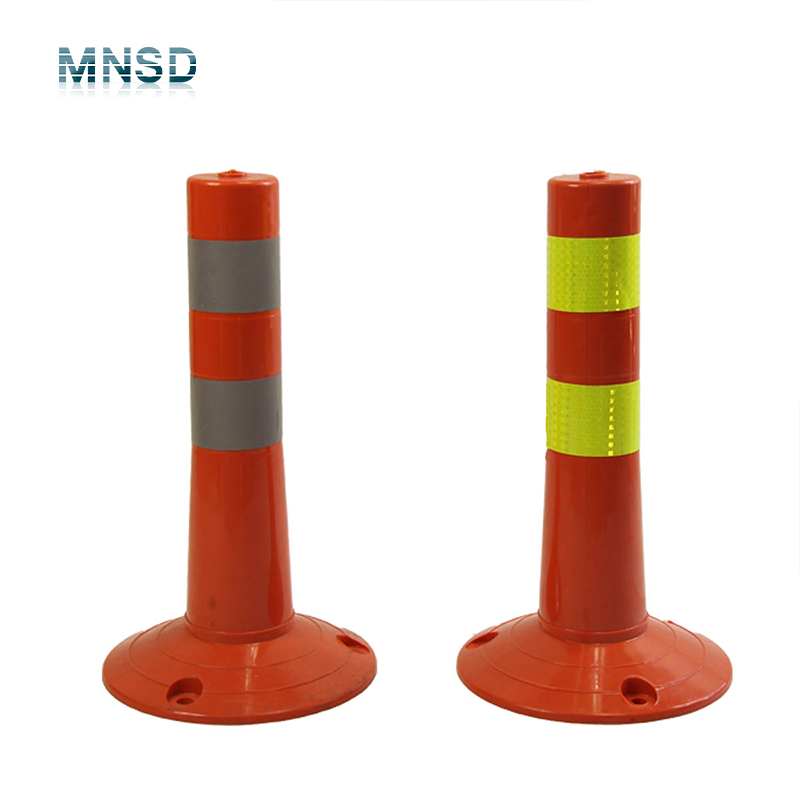
Mnsd offers three core warning post models: YD-PE50, YD-WPS75, and YD-WP45. YD-PE50 is listed as a 500×260 mm PE post with a rubber base. YD-WPS75 is listed as a 750×80×200 mm PU post. YD-WP45 is listed as a 450×80×200 mm PU post. All three are classified under flexible safety plastic warning posts and are applicable to road traffic, parking lots, construction sites, industrial facilities, warehouses, logistics centers, airports, seaports, railway stations, schools, hospitals, commercial complexes, residential areas, highways, municipal engineering, public facilities, loading docks and bus terminals.
| Model | Material | Listed dimensions | Application categories |
|---|---|---|---|
| YD-PE50 | PE + rubber base | 500×260 mm | Road traffic, parking lots, construction areas |
| YD-WPS75 | PU | 750×80×200 mm | Expressways, highways, municipal infrastructure |
| YD-WP45 | PU | 450×80×200 mm | Sidewalk protection, industrial facilities, loading docks |
Technical Specifications Shared Across the Series
The common technical specification across the Mnsd warning post series includes temperature resistance from -40°C to +70°C; UV-stabilized coating; anti-oxidant and colorfast performance for over three years; high-intensity prismatic (HIP) / Class 1 reflective tape; 250 mm reflective tape width in silver white or fluorescent yellow; visibility distance beyond 200 meters; 360° flexible and impact-resistant construction; rapid rebound after vehicle crush; tensile strength of 15.0 MPa; elongation at break of 400%; hardness of 80-85 Shore A; expansion bolt fixing with three or four holes; and a ring top for chain attachment. Color options are traffic orange, yellow, red and black.
Production and Supply Capability
Mnsd produces warning posts through high-speed injection molding. Monthly capacity is 50,000 pieces, lead time is 10-15 days for bulk orders, and the minimum order quantity is 200 pieces. Customization includes height, color, and reflective tape brand. Quality control includes a compression and rebound test repeated over 1,000 times. The company also provides a UV-resistance guarantee with no fading for three years.
Application Scenario: UAE Road Safety and Municipal Infrastructure
This application scenario is common in the United Arab Emirates. Mnsd’s application record describes road safety, traffic management and municipal infrastructure projects with working conditions that include lane separation on high-speed expressways, highway ramps, T-junctions, urban sidewalk protection, and multi-level parking lot entrances. The installation is surface-mounted or bolt-down fixed for permanent use. The intended functions are to provide clear visual guidance, define lane boundaries, prevent unauthorized vehicle entry, and mitigate impact damage during accidental collisions.
The application record also lists high-visibility reflective sleeves with honeycomb pattern, M10/M12 heavy-duty expansion anchors, and optional epoxy adhesive for base reinforcement. Special requirements in this scenario include 360° full-recovery impact resistance, UV-stabilized color fastness for over five years, Class 2/Grade A high-intensity reflectivity, and an operating temperature range of -40°C to +70°C.
Buyers should compare those project-level requirements with the standard product specification. The standard Mnsd warning post specification lists High-Intensity Prismatic (HIP) / Class 1 reflective tape; when a tender requires Class 2/Grade A or a specific reflective build, the final configuration should be confirmed before mass production.
Field Reference: Vietnam Road Safety Project
Mnsd warning posts were used in a road safety project supplied to a contractor in Vietnam. The application was to warn vehicles and pedestrians and to mark road edges and dangerous areas. The project was completed and accepted by the local authority, and the delivered service life was 5-8 years. High visibility, durability, impact resistance and easy installation were recorded as the project highlights.
Standards and Visibility Reference Points
European specifiers may reference EN 12899-3, which specifies requirements for delineator posts and retroreflectors in traffic circulation areas. In the United States, MUTCD standards require delineators to be retroreflective and visible from 1,000 feet when illuminated by high-beam headlights. These reference points are useful in procurement processes because they convert a visual requirement into a measurable product feature.
Material Selection: PU, PE and Project Needs
For high-impact warning posts, a published material guide notes that TPU is preferred over standard PE because of elastic recovery and durability. Mnsd’s warning post line includes high-elasticity PU and heavy-duty PE options, allowing buyers to match the material to impact frequency, temperature exposure and expected service life. The listed operating range of -40°C to +70°C applies across the series.
Comparison with Conventional Warning Posts
Conventional rigid posts are relatively simple to install and inexpensive, but they can be damaged easily and may transfer impact energy to the vehicle. A flexible warning post is designed to absorb impact and recover its shape after being crushed. That behavior is useful in parking entrances, lane dividers, loading docks and other locations where accidental contact is likely. One honest limitation: a flexible warning post is not a substitute for a security barrier or heavy bollard. If the project objective is to stop a vehicle or prevent all access, a non-flexible barrier is the appropriate product.
Market Trends
The road marker posts market is projected to grow from USD 3.4 billion in 2024 to USD 5.4 billion by 2032, and the traffic safety products market is expected to expand at a CAGR of 6.6% from 2026 to 2034, supported by urban population growth and infrastructure investment. This context suggests continued demand for physical delineation devices that are durable, high-visibility and quick to install.
Decision Factors for Project-Specific Warning Post Selection
- Function: define whether the warning post provides guidance, delineation, or protection.
- Height: Mnsd’s listed models cover 450 mm, 500 mm and 750 mm heights, giving projects options for visibility and space constraints.
- Material: choose PU or PE based on impact frequency, temperature conditions and service life expectations.
- Reflective grade: align the specified reflective tape class with the relevant project standard or tender requirement.
- Installation: confirm whether the post should be surface-mounted with expansion bolts, or reinforced with epoxy and heavy-duty anchors on permanent municipal sites.
Future Outlook
As infrastructure owners integrate more permanent delineation into road and parking designs, warning posts will continue to be specified for their predictable performance. The combination of impact recovery, UV resistance and reflective visibility will likely become the baseline for procurement. Manufacturers with dedicated injection molding capacity, documented quality control and export experience are better positioned to support both project-based and OEM-focused requirements.
Frequently Asked Questions
In which UAE scenarios are Mnsd warning posts typically used?
According to Mnsd’s application record, warning posts are typically used in the United Arab Emirates for lane separation on high-speed expressways, highway ramps, T-junctions, urban sidewalk protection, and multi-level parking lot entrances. The installation is typically surface-mounted or bolt-down fixed as a permanent solution.
Which Mnsd warning post models can be used for road safety projects?
Mnsd lists three warning post models that are relevant to road safety projects: YD-PE50, a PE post with rubber base; YD-WPS75, a PU post; and YD-WP45, a PU post. All three are classified as flexible safety plastic warning posts and are applicable to road traffic, parking lots, construction sites, industrial facilities, and municipal infrastructure.
How are Mnsd warning posts installed?
The standard installation method is expansion bolt fixing with three or four holes. The permanent municipal application record also recommends high-visibility reflective sleeves, M10/M12 heavy-duty expansion anchors, and optional epoxy adhesive for base reinforcement.
What quality testing does Mnsd apply to warning posts?
Mnsd’s production quality control includes a compression and rebound test repeated more than 1,000 times. The company also lists a UV-resistance guarantee with no fading for three years.
Brochure and Contact Information
For updated specifications, factory pricing and product brochures, contact Mnsd at info@mnsdtraffic.com or via phone/WhatsApp at +86 18458137305. The company brochure is available for download: Mnsd company brochure. Mnsd’s website is www.mnsdtraffic.com.