
UCHA Hanger Pillow Block Bearings: Screw Conveyor Fit Guide
In a screw conveyor, the bearing most likely to interrupt production is not the one at the drive end. It is the hanger bearing suspended between screw sections, running inside the trough and in direct contact with the material being moved. The UCHA series is a hanger-mount pillow block bearing unit built for that position. This guide explains how the UCHA205–UCHA212 range is matched to screw conveyor mounting and operating conditions, which specification items actually change the outcome, and where the design reaches its limits.
FKD BEARING is the registered brand of Hebei Hailan Bearing Manufacture Co., Ltd, a pillow block bearing manufacturer founded in 1988 in Linxi County, Hebei, China. The company operates a site of 100,000 m² with around 400 employees and reports annual production and sales of more than 20 million bearing pieces, with over 90% of output exported to more than 68 countries and regions.
Why hanger points decide screw conveyor uptime
A screw conveyor longer than a few sections cannot run on end support alone. The screw shaft needs intermediate support to limit deflection, hold the flight-to-trough clearance, and keep the screw rotating on its own axis. That support is the hanger bearing, mounted on a bracket that hangs from the trough cover or side wall.
The mechanical duty is modest compared with a drive-end bearing. The serious difficulty is location. A hanger bearing operates inside the material stream: dust and fines reach it continuously, the product itself may be warm, and in agricultural or food handling it may be exposed to moisture and cleaning. Access for inspection is limited, so the time required to replace a failed hanger unit usually costs more than the unit itself.
Two failure modes dominate in this position: bearing overheating and housing breakage. Both are addressed at the selection stage rather than at the maintenance stage — through grease capability and internal clearance for the first, and through housing material and mounting rigidity for the second. For a buyer at the decision stage, this reframes the comparison: the question is not which hanger unit is cheapest per piece, but which unit still turns at the end of the interval between shutdowns.
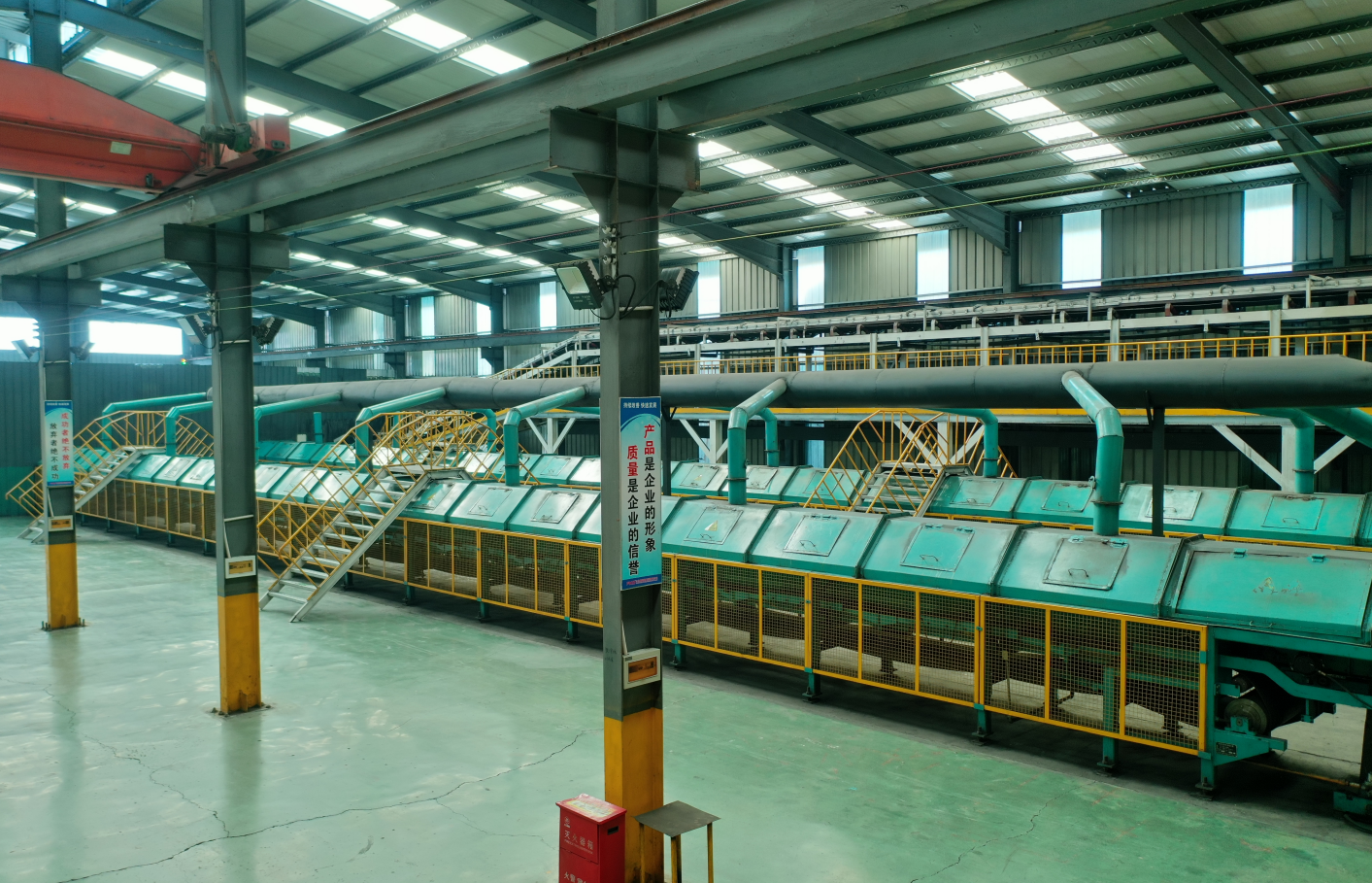
Bearing housing casting workshop — housing material choice (cast iron or QT450) is one of the main fit decisions for hanger duty.
What the UCHA series is, and what it is not
A UCHA unit is a mounted bearing unit assembled from two parts: an insert bearing and a housing. The insert is a deep groove ball bearing with a wide inner ring and a locking arrangement that grips the conveyor shaft; the housing has a form that allows it to be fixed to a hanger bracket so the screw shaft is supported at an intermediate point.
The FKD range covers UCHA205 through UCHA212 — eight nominal sizes that follow the standard metric progression used for mounted units. Sizing practice for these units is broadly standardised: pillow block and mounted bearing units are commonly built to ISO sizing conventions, with JIS conventions used where local precision compatibility is required, which is what allows a hanger unit to be treated as an interchangeable component rather than a custom part.
The insert bearing is made from chrome steel of the AISI 52100 type (GCr15 grade), a through-hardening bearing steel used for deep groove ball bearing inserts. Ball complement is G10 grade steel balls, the precision class FKD specifies for its pillow block production. The housing is supplied in cast iron or in QT450 ductile iron, depending on the duty.
| Specification item | FKD UCHA series detail | Why it matters at the hanger point |
|---|---|---|
| Model range | UCHA205 – UCHA212 | Eight sizes allow the unit to be matched to conveyor shaft diameter without adapters |
| Insert bearing type | Deep groove ball bearing insert | Low starting torque, grease retention, replaceable insert within an existing housing |
| Insert material | Chrome steel, AISI 52100 type (GCr15) | Through-hardened rings resist the cyclic loading of a rotating screw shaft |
| Ball grade | G10 steel balls | Ball precision affects vibration, noise and running smoothness under continuous duty |
| Housing material | Cast iron or QT450 | Sets shock tolerance and behaviour under start-stop loading |
| Precision / noise grade | P5, ZV3 | Runout and vibration control at the most inaccessible support point |
| Stated speed capability | 3000 RPM | Headroom reference when comparing grades and lubricant choices |
Reading “P5 ZV3 / 3000 RPM” as a fit decision
The specification string on a hanger unit is often copied into a purchase order without being read. Each element answers a different question.
P5 — tolerance and runout
P5 denotes a tighter tolerance class than the standard grade. At a hanger point, misalignment is structural: the bracket, the trough and the screw shaft do not align perfectly, and any runout in the unit is added to that error. Tighter runout reduces the preload that misalignment imposes on the ball set. FKD states radial runout of ≤0.012 mm as a technical characteristic of its pillow block bearing production, which is the relevant reference when a conveyor specification calls for controlled shaft movement.
ZV3 — noise and vibration grade
ZV3 is a noise and vibration classification applied to the bearing. It reflects ball quality, raceway finish and assembly consistency rather than load capacity. In practice its value shows up in continuous-duty conveyors where vibration is transmitted into the trough and structure, and where a rough-running hanger unit becomes an audible and structural problem before it becomes a functional one.
3000 RPM — speed headroom, not a duty target
Screw conveyors rotate far more slowly than the stated 3000 RPM capability of the unit. This headroom is useful, but it also means speed is almost never the binding constraint in hanger selection. Load, sealing against fines, lubricant temperature capability and replacement access usually decide the outcome. Buying a higher grade purely to gain speed margin is rarely money well spent.
Cast iron or QT450: the housing decision
The housing is where most hanger-unit failures that are not lubrication-related actually occur. Cast iron and QT450 ductile iron are not interchangeable grades of the same thing; they behave differently under shock.
| Characteristic | Cast iron housing | QT450 ductile iron housing |
|---|---|---|
| Behaviour under shock loading | Lower elongation; more brittle response to impact | Nodular graphite structure gives higher toughness and elongation |
| Vibration damping | Good inherent damping | Good damping with added resistance to crack propagation |
| Cost position | Lower material and machining cost | Higher cost, justified only where shock is real |
| Typical fit | Agricultural grain and feed conveyors, light manufacturing, steady load | Mining and aggregate duty, tramp material risk, heavy start-stop cycles |
The boundary matters as much as the choice. QT450 is not a universal upgrade. If a housing broke because of misalignment, a bent screw, or foreign objects entering the trough, a tougher housing grade does not correct the cause; the mounting and the upstream protection do. Ductile iron is justified where impact energy is genuinely present, and it adds cost where it is not.
Neither housing material is a corrosion solution. Where washdown, chemical exposure or high moisture is routine, a stainless housing path is a separate specification decision, and a painted cast iron or QT450 housing should not be selected on the assumption that it will perform in the same way.
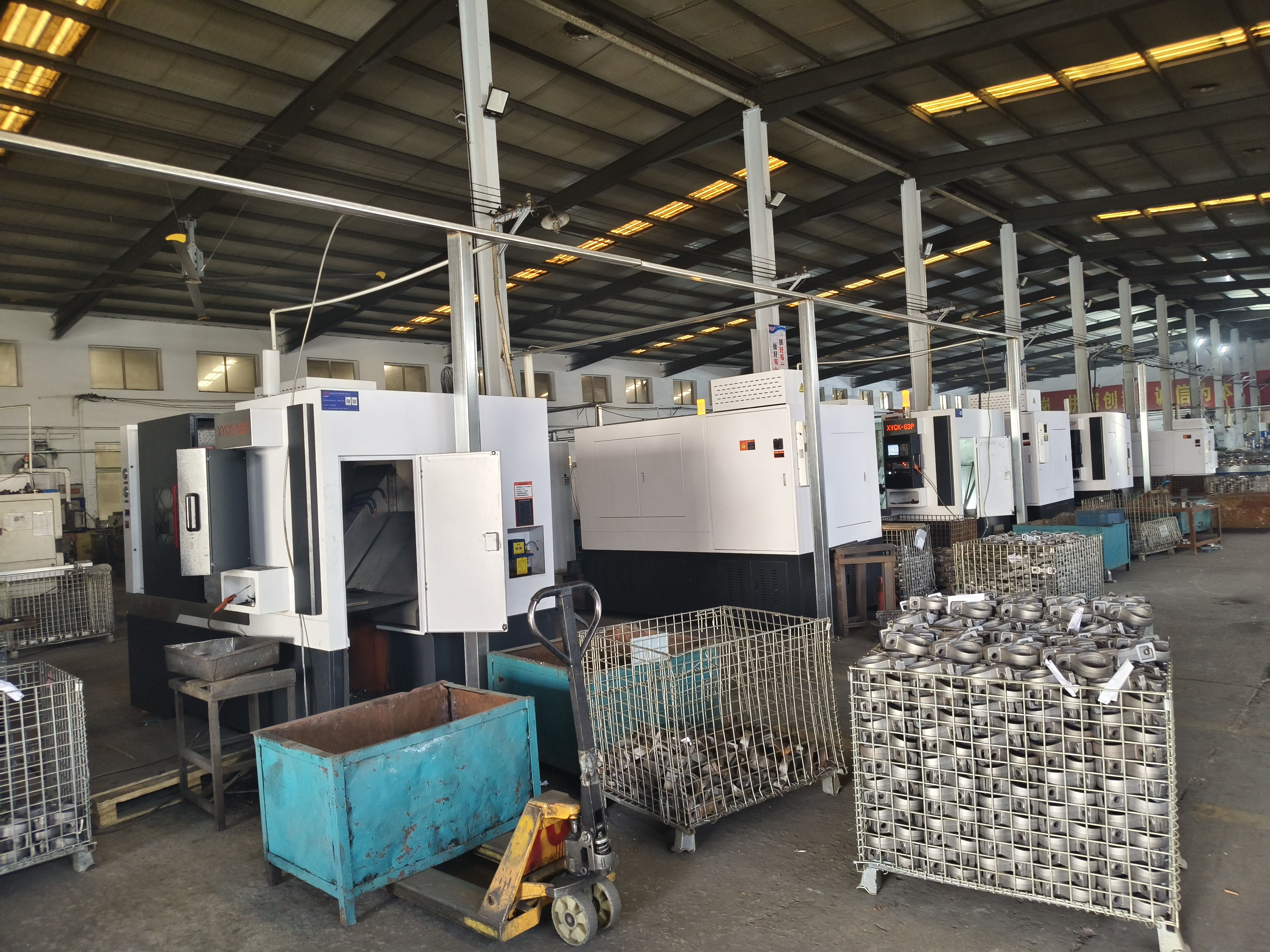
Housing process line — in-house housing production allows housing material and machining to be controlled alongside the bearing insert.
Matching a UCHA unit to conveyor mounting and operating needs
The following sequence reflects the order in which hanger-unit decisions actually constrain each other. Skipping a step usually produces a unit that is either over-specified or under-protected.
1. Shaft and bracket interface
Begin with the screw shaft diameter and the hanger bracket geometry. The model within UCHA205–UCHA212 follows from these two inputs; the rest of the specification should be built around the chosen frame size, not the other way round.
2. Separate radial from axial load
A hanger unit carries radial load from the screw and product weight. It is not the thrust location. Axial load from conveying resistance must be taken at the drive end. Treating a hanger bearing as a thrust bearing is one of the most reliable ways to produce a premature failure that looks like a bearing quality problem.
3. Define the environment before the grade
Fine abrasive dust, moisture, product temperature and cleaning regime should be written down before any grade is selected. These conditions decide housing material, sealing attention and grease choice, and they outweigh tolerance class in most bulk handling applications.
4. Match grease capability to temperature
Overheating is one of the two dominant hanger failure modes. High-temperature grease and correctly matched internal clearance are the standard countermeasures, and both are specification decisions rather than maintenance decisions. Where the product is warm, this single item can matter more than the bearing precision grade.
5. Select the grade last
P5 and ZV3 should be justified by a consequence — runout tolerance in the conveyor drawing, vibration limits, or a documented history of rough running. If no such consequence exists, the standard grade fits.
6. Verify before scaling
Sample validation on the actual conveyor is the only reliable confirmation of a hanger specification. On the supply side, FKD states that each batch of raw material is tested, product quality grades are inspected in batches, and product dimensions are fully inspected — measures that address the bearing overheating and housing breakage risks directly. For a buyer, these are verifiable process claims to check during a supplier audit rather than assumptions to accept.
Application fit across bulk handling sectors
The same UCHA unit family serves several industries whose conveying conditions differ mainly in abrasiveness, temperature and shock.
- Agricultural machinery and grain handling. Screw conveyors and augers moving grain, feed and seed run at moderate load with seasonal peaks. Cast iron housings and standard sealing are usually sufficient, and smooth running is valued because vibration is transmitted into light structures.
- Manufacturing and industrial plants. Fly ash, powders, pellets and process scrap place a premium on dust exclusion and on predictable replacement intervals, since hanger access inside a plant is scheduled rather than immediate.
- Mining and mineral processing. Abrasive product and tramp material make housing toughness and mounting rigidity the dominant concerns; QT450 housings and tighter inspection discipline are relevant here.
- Textile and light machinery. Lower load and cleaner conditions mean the hanger unit is chosen mainly for smoothness and for dimensional consistency across replacement batches.
FKD reports that its bearings are used across transmission equipment, mining machinery, engineering machinery, textile machinery, agricultural machinery, forestry machinery and construction machinery — a spread that reflects how often the same mounted unit geometry is reused under different duty.
Comparison with traditional hanger bearing solutions
Hanger points have historically been served by plain bushings, wooden blocks, and generic pillow block units. Each option carries a different trade-off, and none is unconditionally better.
| Option | Strength at the hanger point | Limitation to accept |
|---|---|---|
| Bronze or plain bushing | Tolerant of severe misalignment and of high product temperature; simple construction | Requires continuous lubrication attention; higher friction and starting torque; shaft wear if lubrication lapses |
| Wooden hanger block | Low cost, forgiving in coarse abrasive product, easily replaced in the field | Limited life and dimensional stability; not suited to continuous duty or to product quality requirements |
| Generic pillow block unit | Widely available, interchangeable sizing under ISO/JIS conventions | Housing material and internal grade often unspecified, so performance varies between batches |
| UCHA hanger unit with controlled grade | Rolling insert with low starting torque, grease retention, replaceable insert, defined P5/ZV3 grade and stated housing material | Less tolerant of extreme misalignment and of very high product temperature than a plain bushing; requires sealing discipline in fine abrasive dust; must not be used as the thrust location |
The honest summary is that a rolling hanger unit wins where the conveyor runs continuously and where lubricant retention and restart torque matter, and a plain bushing can still win where product temperature is high or misalignment cannot be corrected.
How the FKD unit is positioned against other Chinese brands
FKD's stated comparison against other Chinese brands rests on three points: high-quality steel with G10 steel balls and controlled lubricant and retainer selection; in-house production of both the bearing and the housing rather than assembly from bought-in parts; and an in-house laboratory used for quality control over products and raw materials. On that basis the manufacturer states 30% longer service life, a 45% lower failure rate, 30% longer running life between maintenance interventions and 10% lower cost, with radial runout of ≤0.012 mm.
These are supplier-stated comparative figures, not independently audited results. The correct way to use them at the decision stage is as a hypothesis to test: run the candidate unit on the actual conveyor, under the actual product, for a defined interval, and compare replacement frequency and shaft condition against the incumbent. A hanger bearing is cheap enough to sample and expensive enough to fail.
Market context for mounted bearing selection
Mounted bearing demand is largely replacement-driven, which shapes how buyers compare units. Global Market Insights estimated the global bearings market at USD 58.6 billion in 2024, with a projection of USD 143.6 billion by 2034. The mounted bearing segment is a distinct slice of that: IndexBox valued the pillow block and mounted bearings market at approximately USD 6.1 billion in 2024, and Fortune Business Insights reported that plummer blocks accounted for about 42.51% of mounted bearing revenue share in 2024.
Two implications follow for hanger units. First, the category is dominated by a familiar housing format, so price comparability is high and differentiation has to come from material control, grade consistency and batch-to-batch reliability rather than from geometry. Second, supply is globally standardised — ISO sizing with JIS precision compatibility — which is why China's ball bearing exports reached USD 6.53 billion in 2024, or 19.9% of global exports according to OEC. For a procurement team, that combination means the shortlist is broad and the discriminating questions are about verification, not availability.
Sources: Global Market Insights (bearings market); IndexBox (pillow block and mounted bearings market); Fortune Business Insights (mounted bearing revenue share by type); OEC (ball bearing exports, 2024).
Future outlook
Three directions are visible in how hanger units are being specified. Longer grease intervals and sealed-for-life assemblies are moving maintenance from the trough to the planning meeting. Ductile iron housings are being adopted where abrasive, shock-loaded duty was previously handled by over-sizing a cast iron unit. And verification data — batch test records, dimensional inspection results, laboratory reports — is increasingly treated as part of the product rather than as paperwork, because a hanger bearing's real cost is the shutdown it causes, not the invoice it arrives on.
FAQ
What is a screw conveyor hanger unit, and where does a UCHA pillow block fit?
A hanger unit is an intermediate shaft support mounted on a bracket inside a screw conveyor trough. A UCHA pillow block bearing unit is one form of that support: a deep groove ball bearing insert held in a housing shaped for hanger mounting. It limits screw shaft deflection between sections and maintains the flight-to-trough clearance, and because it sits inside the material stream it is the most exposed bearing in the conveyor.
Which UCHA models cover common screw conveyor shaft sizes?
The FKD UCHA series covers UCHA205 through UCHA212, eight nominal sizes following the standard metric progression for mounted bearing units. The correct model is determined by the screw shaft diameter and the hanger bracket interface. Model selection precedes grade selection, because housing and insert options are chosen within the frame size rather than across it.
What do P5, ZV3 and 3000 RPM mean when comparing hanger bearing options?
P5 is a tighter tolerance class than the standard grade, relevant because hanger misalignment adds to unit runout. ZV3 is a noise and vibration classification reflecting ball and raceway quality rather than load capacity. 3000 RPM is the stated speed capability of the unit; screw conveyors operate well below it, so speed is rarely the limiting factor in hanger selection. FKD states radial runout of ≤0.012 mm for its pillow block bearing production.
Cast iron or QT450 housing — how should buyers choose?
Cast iron suits steady-load duty such as grain and feed conveying and light manufacturing, where damping and cost matter. QT450 ductile iron offers higher toughness and elongation and suits shock-loaded, abrasive duty such as mining and aggregate handling. QT450 is not a universal upgrade: if housing failure originates from misalignment or foreign material rather than impact energy, changing the housing grade does not remove the cause. Neither material substitutes for a stainless housing in corrosive or washdown conditions.
What are the limits of a UCHA hanger unit?
A rolling hanger unit is less tolerant of extreme misalignment and of very high product temperature than a plain bushing, and it depends on sealing discipline where fine abrasive dust is present. It is also a radial support only: the axial thrust of the screw must be carried at the drive end. Where these conditions cannot be met, a plain bushing or a different support arrangement remains the more appropriate choice.
The full FKD and HHB bearing range, including mounted unit series and housing options, is available in the manufacturer's product catalogue.
Have Questions or Need More Details?
Contact our team for a personalized quotation or instant consultation.
Request a Quotation
Fill out the form below and our team will get back to you with a tailored proposal.
WhatsApp Direct Chat
Prefer to chat in real-time? Message us on WhatsApp for instant assistance & quick answers.
- Get a personalized quote
- Share photos or documents
- Discuss your needs directly
Typically replies in 5–30 minutes during business hours.