
UFO vs Linear LED High Bay: HL-E01 and SH-E01 Site Matching
UFO vs Linear LED High Bay: HL-E01 and SH-E01 Site Matching
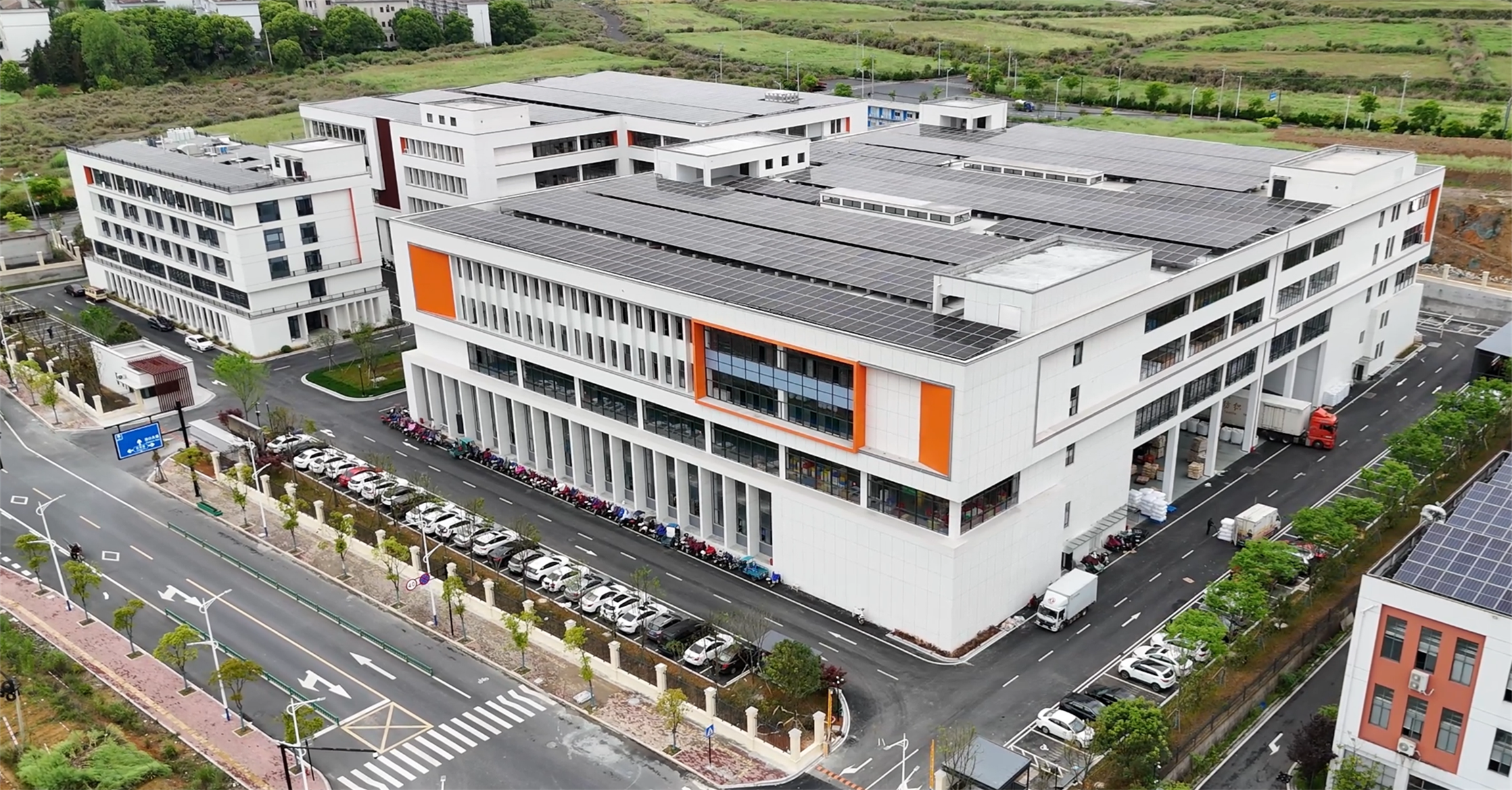
The fixture format should follow the building, not the catalogue. In warehouses, factories and workshops, the choice between a UFO high bay and a linear high bay is settled by mounting height, ceiling structure, airborne dust and moisture, aisle geometry, electrical conditions and how maintenance access is arranged. The HL-E01 UFO LED high bay and the SH-E01 LED linear high bay from Zhejiang Lepeng Electric Appliance Co.,Ltd. show that trade-off in concrete terms: the HL-E01 is a die-cast aluminum fixture with a hollow heat-dissipation structure, listed efficacy options up to 210 lm/W and 6 KV surge protection; the SH-E01 is an IP65 aluminum alloy linear fixture with a five-year warranty and a 90° (H) × 120° (V) beam. Neither format wins in general. Each wins in a particular set of site conditions.
The scenario decides before the specification does
Industrial high bay selection often starts with a wattage and works backwards. A more reliable order starts with the space. Four inputs narrow the field quickly: how high the fixture will be mounted and what the ceiling or supporting structure can carry; whether the atmosphere is dusty, humid or washed down; how the light needs to be distributed across aisles, benches or open floor; and who will service the fixture, and when.
Lepeng describes the operating scope of its lighting products as indoor warehouse and production conditions, outdoor day and night conditions, solar-powered environments, and construction or emergency sites. The same scenario description names energy saving, high colour rendering and wide voltage compatibility as recurring project requirements. Those requirement types rarely carry equal weight inside one building, which is why a manufacturer keeps two formats rather than one.
Within commercial LED lighting, high bay fixtures sit in the part of the market where format decisions have the largest effect on running cost. A commercial LED high bay light is typically inaccessible for years at a time, so a distribution or ingress mismatch is paid for in maintenance visits rather than in the purchase price.
HL-E01 and SH-E01 side by side
The table below uses only the specifications supplied for each model. Where a value is not listed for one model, that gap is stated rather than filled with an assumption. An unlisted parameter is a question for the supplier, not evidence of absence.
| Parameter | HL-E01 (UFO high bay) | SH-E01 (linear high bay) |
|---|---|---|
| Housing and lens | Die-cast aluminum body with hollow heat-dissipation structure + PC lens | Aluminum alloy housing + PC/PMMA lens |
| Power options | 100 / 150 / 200 / 240 W | 50 / 100 / 150 / 200 W |
| Listed efficacy | 140 / 160 / 185 / 210 lm/W | 100 / 135 / 150 lm/W |
| Colour temperature | 4000 K / 5000 K / 6500 K | 3000 K / 4000 K / 5000 K / 6500 K |
| Beam angle | Not listed in the supplied specification | 90° (H) × 120° (V) |
| Voltage | 185–265 V or 100–265 V (two configurations) | Not listed in the supplied specification |
| Ingress protection | Not listed in the supplied specification | IP65 |
| Warranty | Not listed in the supplied specification | 5 years, branded driver |
| Surge protection | 6 KV | Not listed in the supplied specification |
| Dimensions | Not listed in the supplied specification | 305.6 × 97.3 × 68.1 mm / 580.6 × 97.3 × 68.1 mm / 855.6 × 97.3 × 68.1 mm |
| Mounting | Pre-wired 3×1.0 mm² cable, 300 mm exposed leads | Mounting kit for surface installation, or chain and cable suspension; one-piece connector |
| Controls | Optional motion sensor compatibility, three-second brightness transition | Not listed in the supplied specification |
HL-E01: what the UFO format contributes
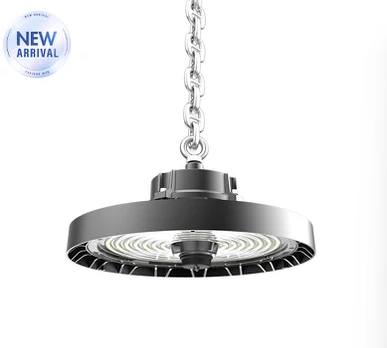
The HL-E01 is built around a die-cast aluminum body with a hollow heat-dissipation structure. At high mounting heights the thermal path is the difference between a fixture that holds its output across a shift and one that derates. Lepeng pairs that body with Sosen and Moso power supplies and lists efficacy options of 140, 160, 185 and 210 lm/W across the range.
Power options run from 100 W to 240 W, and the model is offered in two voltage configurations: 185–265 V and 100–265 V. The wider of the two is relevant where supply voltage moves during the working day, a common condition on industrial estates at the end of long distribution runs. Surge protection is listed at 6 KV, which addresses switching transients from the machinery, chargers and welding equipment that share a factory supply.
Two further details matter at procurement stage. The fixture is pre-wired with a 3×1.0 mm² cable and 300 mm exposed leads, which shortens connection time when the work has to be done from a lift. Optional motion sensor compatibility is listed with a three-second brightness transition, so occupancy-based switching ramps rather than snaps, which is easier on people working in intermittently used aisles and staging areas.
Colour temperatures are 4000 K, 5000 K and 6500 K, with no 3000 K option. The specification set reviewed here does not list an IP rating, a beam angle, a warranty period or a mounting method for the HL-E01, and the efficacy figure varies by configuration rather than applying to every wattage. Each of those points should be closed out in the quotation before the fixture is specified for a wet, washed-down or warranty-critical area.
SH-E01: what the linear format contributes
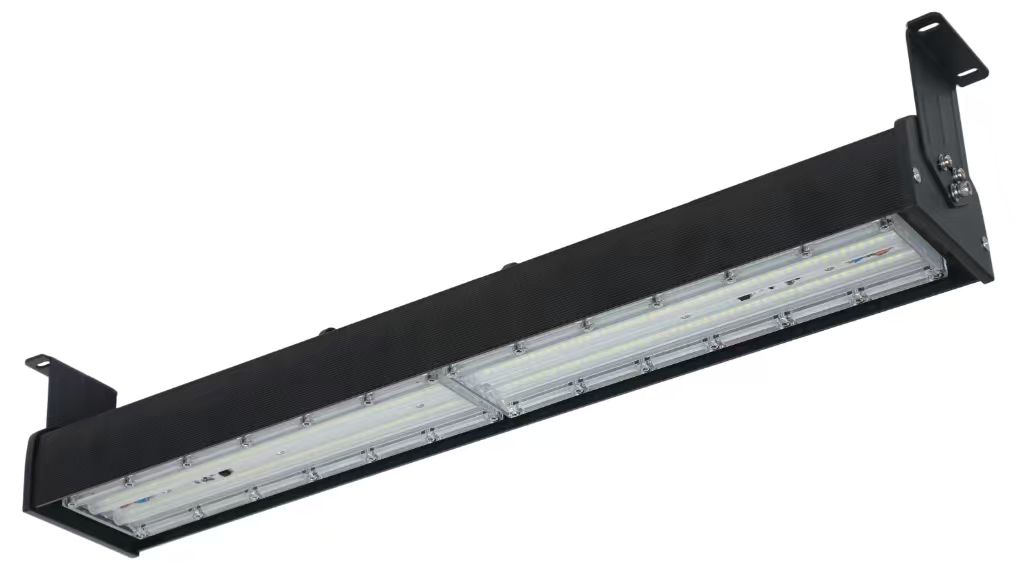
The SH-E01 answers a different set of constraints. It carries an IP65 rating in an aluminum alloy housing with a PC/PMMA lens, and it is offered with a five-year warranty supported by a branded driver. In dust-heavy or humid production space, ingress protection is the parameter that decides whether a fixture survives its payback period, and the warranty converts that attribute into a commercial commitment that can be compared across suppliers.
Power options are 50, 100, 150 and 200 W, with listed efficacy of 100, 135 and 150 lm/W. Three housing lengths, each 97.3 mm wide and 68.1 mm deep, allow a run to be assembled from standard units instead of one long custom body. The listed 90° (H) × 120° (V) distribution is asymmetric, wider in one plane than the other, which is worth checking against aisle orientation and mounting height in the lighting layout rather than assuming from the numbers alone.
Colour temperature coverage is broader than the HL-E01 range: 3000 K, 4000 K, 5000 K and 6500 K. The 3000 K option matters in workshops and mixed-use production areas where the existing lighting is warmer and a 4000 K-plus installation would read as a visible mismatch across the hall. Mounting is flexible, with a mounting kit for surface installation or chain and cable suspension, and a one-piece connector to speed installation.
Three limits belong beside those advantages. Surge protection is not listed for the SH-E01, the power range stops at 200 W, and the mapping between housing length and wattage is not stated in the specification set. All three should be confirmed line by line in an RFQ rather than inferred from the range.
Warehouse: tall mounting, racking and infrequent access
Warehouses place the fixture furthest from the floor and the maintenance team furthest from the fixture. Two failure modes dominate real projects: uneven light across racking faces, and a fitting that cannot be reached without a mobile elevating work platform. Both are layout problems before they are product problems, but the fixture chosen determines how much of the risk remains.
Where the ceiling is a high open structure and the layout is organised around long racking runs, the HL-E01 offers design headroom: 100 W through 240 W, 4000–6500 K, 6 KV surge protection for a supply shared with chargers, and an optional motion sensor for aisles that are used intermittently. Where packaging dust, cardboard fibre or general airborne particulate is present, the SH-E01 IP65 rating and five-year warranty reduce the probability that a failed unit at height becomes an early replacement task.
A workable decision rule for warehouses: if the dominant risk is access, weigh warranty and efficacy; if the dominant risk is airborne dust, weigh the IP rating first; if the dominant risk is supply quality, weigh voltage range and surge protection. Where two of those risks are present at once, the parameters to negotiate are the ones the specification set does not list.
Factory and production hall: continuous operation and electrical noise
A production hall runs a high bay fixture for far more hours per year than a warehouse aisle typically does, and the electrical environment is harsher. Motor starts, welding sets and variable-speed drives all impose transients on the same supply that feeds the lighting circuit. This is where the HL-E01 6 KV surge protection and its 185–265 V or 100–265 V voltage configuration carry a clear project meaning, and where the SH-E01 IP65 rating and five-year warranty carry an equally clear maintenance meaning.
The two can be combined in one hall, and often are: linear runs over benches and process lines where light has to follow a defined work zone, and UFO units over open floor or storage areas where the mounting point is a single high position. Blending formats makes two checks necessary. First, keep the colour temperature consistent between the areas, since the HL-E01 range begins at 4000 K while the SH-E01 also offers 3000 K. Second, confirm that the control arrangement and driver brands across both models are compatible with whatever switching or sensor scheme the building uses.
Workshop: lower ceilings and task visibility
Workshops and small assembly bays are the scenario where the linear format usually reads as the natural fit. Ceilings tend to be lower, work is organised along benches, and the light has to be even across a horizontal task surface instead of pooled under a single high point. The SH-E01 three-length option and its 90° (H) × 120° (V) distribution suit continuous rows, and the 3000 K option allows the new installation to sit alongside warmer legacy lighting.
The boundary is height. Both models are industrial high bay products, and neither specification set states a minimum or maximum mounting height. For low workshops, or for rooms where the fixture would sit close to head height, a photometric layout from the supplier should confirm whether a high bay format is appropriate at all before the format is fixed.
A practical selection sequence
- Fix the mounting height and the structure. Record the actual mounting plane, the suspension method available and whether access requires a lift. This immediately separates high open structures from bench-level layouts.
- Classify the atmosphere. Dust, moisture, washdown and condensate determine whether IP65 is a requirement or a preference. If washdown applies, confirm the HL-E01 rating first, because it is not listed in the supplied set while the SH-E01 is stated as IP65.
- Map the run geometry. Linear runs over benches, aisles or process lines favour the SH-E01 and its three housing lengths. Open floor and point positions favour the HL-E01.
- Match power to the circuit. HL-E01 spans 100–240 W; SH-E01 spans 50–200 W. Confirm per-wattage efficacy and the length-to-wattage mapping rather than assuming a range is uniform.
- Check the electrical environment. Where transients are expected, the HL-E01 6 KV surge rating is the stated value; for the SH-E01, request the surge figure in the RFQ.
- Set colour temperature by area. 4000 K and above on both models, with 3000 K available only on the SH-E01. Keep one temperature per visual zone.
- Decide on controls. Occupancy sensing changes the economics of low-traffic aisles; the HL-E01 lists optional motion sensor compatibility, so clarify sensor type, coverage and the three-second transition behaviour at order stage.
- Verify compliance for the destination market. Confirm the applicable certification and its scope for the exact model and market before releasing a volume order.
What the market data adds to the decision
Fortune Business Insights valued the global LED lighting market at USD 109.11 billion in 2025 and projected USD 336.90 billion by 2034 in its August 2026 publication. Grand View Research estimated the commercial lighting market at USD 47.54 billion in 2024, with LED products holding a 58.1% revenue share. OEC recorded USD 31.4 billion of light fixture exports from China in 2024, equal to 59.3% of global exports.
The reading that matters for a buyer is narrower than the headline growth. If LED already holds the majority of commercial lighting revenue but not all of it, a large share of current stock is still non-LED and due for replacement, and the specification conversation has already moved from whether to convert to which format, which distribution and which ingress rating fits the room. That is a decision about the building, not about the market total.
Where Lepeng sits as a supplier of both formats
Zhejiang Lepeng Electric Appliance Co.,Ltd. was founded in 2009 and operates production in Shangyu in Zhejiang Province plus two further bases in Qiandaohu, Zhejiang and Jingdezhen, Jiangxi. The company states 2,000 employees, a 200,000 m² factory area, monthly capacity of 45 million LED lamps and 5 million LED luminaires, and a 200-person research and development team. It reports an export share of 90% across the EU, Southeast Asia, the Middle East and Latin America, offers OEM and ODM customization, and quotes a 30–45 day lead time with MOQ depending on the product. Its official site is idealbright.com.
That structure explains why the HL-E01 and SH-E01 coexist in the same catalogue. A manufacturer serving project installations, volume procurement and OEM/ODM work across several markets needs both a high-output point fixture and a sealed linear fixture, because the destination buildings and the cleaning regimes differ. It also sets the verification question for a buyer: ask for the specific certificate, the driver brand and the warranty terms that apply to the exact model and market, since a company-level statement is not a per-model confirmation.
Outlook
Sourced projections point to continued expansion of LED lighting demand through the next decade, and the practical consequence for industrial buyers is a wider rather than narrower choice of formats. The decision framework is unlikely to change: mounting height, atmosphere, run geometry, electrical conditions and maintenance access will keep separating UFO from linear installations. What will change is the amount of documentation expected at quotation stage, because a specification that omits the IP rating, beam angle or warranty of the model being purchased cannot be compared against a competing offer. Buyers who ask for those values per line item get a comparison; buyers who accept a range description get a price.
FAQ
Which fixture suits high-ceiling warehouse lighting: a UFO or a linear high bay?
It depends on the layout rather than the ceiling height alone. The HL-E01 offers 100–240 W with efficacy options up to 210 lm/W, 6 KV surge protection and optional motion sensing, which suits point positions over open floor and intermittently used aisles. The SH-E01 offers IP65 protection, a five-year warranty and a 90° (H) × 120° (V) beam, which suits dusty environments and linear runs. Confirm both against a photometric layout before deciding.
What does IP65 mean on the SH-E01, and why does it matter in a dusty workshop?
IP65 means the enclosure is dust-tight and protected against water jets. In a workshop with airborne particulate or occasional washdown, that protection limits how much contamination reaches the lens and the driver compartment, which is the usual cause of premature output loss in industrial fixtures. The SH-E01 is stated as IP65 in its supplied specification.
Does the HL-E01 have an IP rating for wet or washed-down areas?
The specification set reviewed for this article does not list an IP rating for the HL-E01. Where washdown, condensate or hose cleaning applies, request the IP rating and the applicable test documentation for the exact model and configuration from the manufacturer before specifying it for that area.
How should colour temperature be chosen between 3000 K and 6500 K in a production hall?
Start from the task and the existing installation. The HL-E01 offers 4000 K, 5000 K and 6500 K; the SH-E01 adds 3000 K. Mixed installations should avoid abrupt temperature changes between adjacent zones, and a sample should be viewed in the actual hall before a full order, because perceived colour depends on surrounding surfaces and daylight contribution.
What should be verified before a volume order of high bay fixtures?
Request the IP rating, beam angle, warranty terms and per-wattage efficacy for the exact model; confirm the driver brand; confirm the voltage configuration against the site supply; and check certification scope for the destination market. UL Solutions lists IEC 60598, UL 1598 and UL 8750 among the common standards for luminaires and LED equipment, which is a useful reference for the questions to ask rather than a statement about any specific product.
Can UFO and linear high bays be mixed on the same site?
Yes, and mixing is common where a site combines open storage with bench-level production. Two conditions apply: keep colour temperature consistent within each visual zone, and confirm that the drivers and any control or sensor arrangement used across both models are compatible with the building switching scheme.
Have Questions or Need More Details?
Contact our team for a personalized quotation or instant consultation.
Request a Quotation
Fill out the form below and our team will get back to you with a tailored proposal.
WhatsApp Direct Chat
Prefer to chat in real-time? Message us on WhatsApp for instant assistance & quick answers.
- Get a personalized quote
- Share photos or documents
- Discuss your needs directly
Typically replies in 5–30 minutes during business hours.