
UHF RFID Reader FAQ: 20 Technical & Procurement Answers
UHF RFID Reader FAQ: 20 Technical & Procurement Answers
Specifying a UHF RFID reader is rarely a single hardware decision. It sets read zones, tag formats, encoding workflow, network interfaces and, ultimately, how much manual work a manufacturing site can remove. This reference answers twenty questions that commonly arise in smart manufacturing reader evaluations and keeps verified product facts separate from claims that still require site validation.
The UHF RFID reader market was valued at approximately USD 4.8 billion in 2025 and is projected to reach USD 11.2 billion by 2034, according to Dataintelo. UHF technology captured 40.72% of total RFID market revenue in 2025, driven by retail inventory cycles and multi-item read capability, per Mordor Intelligence. The air interface behind almost all of this hardware is standardized as EPCglobal Gen2, also published as ISO/IEC 18000-6C by GS1 and ISO.
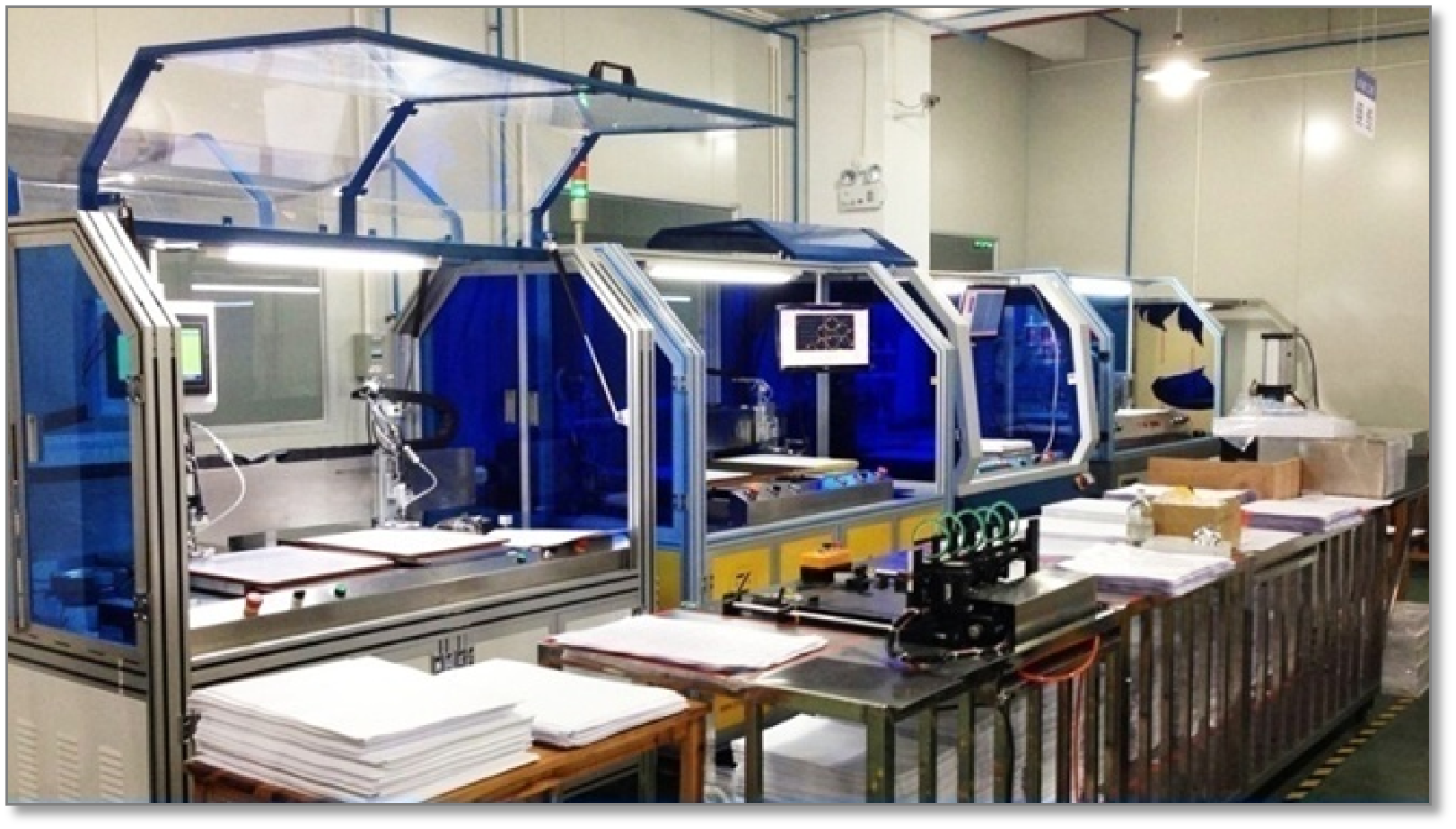
Cover: contactless IC card production equipment at DAILY RFID's Guangzhou facility, the manufacturing base behind the reader, card and tag lines referenced in this FAQ.
Why Reader Selection, Not Tag Selection, Decides Most RFID Outcomes
Manufacturing RFID programmes rarely fail at the concept stage. They fail where a reader has to read a specific tag, on a specific surface, inside a specific zone, at production speed, for years. Metal tools block tag signals and create missed reads. Adjacent storage zones capture each other's tags during counting. Active long-range tags trigger areas wider than intended. Labels detach from surfaces that were not prepared. Embedded reader modules clear functional testing but fail EMC review after the enclosure is finalized. Batch encoding lines produce unverified writes when stacked-tag quantities are not controlled.
Each of these is a recognized failure mode with a defined control method, and each one is settled at the level of reader type, antenna layout, tag placement and workflow - not by the tag alone. That is why procurement teams now evaluate readers together with tags, encoders, antennas and integration tooling rather than as separate line items.
What Buyers Are Actually Comparing
Terminology causes avoidable confusion. An RFID reader is the radio device that powers and interrogates tags; the term RFID scanner usually describes the same function in a handheld form, while an RFID antenna is the passive element that shapes where the read zone falls. In a UHF system, the reader plus antenna determines coverage, and the tag determines whether the item can be identified at all.
Six variables decide the outcome of an evaluation:
- Read event and zone - a gate passage, a rack count, a tray count or a conveyor read.
- Reader type and mounting - fixed, gate, handheld, tray, desktop or embedded module.
- Antenna configuration and RF power - including how power is tuned to contain the zone.
- Tag format and attachment - on-metal, laundry-grade, wristband, label or card.
- Encoding and data validation - write, read-back and defect isolation.
- Network, software and service - protocols, SDKs and staging sequence.
Reader Types: A Practical Mapping for Manufacturing Sites
The table below maps deployment forms to verified DAILY RFID reference products and to the points a buyer should verify before ordering. DAILY RFID CO., LIMITED is an RFID manufacturer founded in 2008, based in Guangzhou, China, operating a 28,000 m² factory with 180-200 employees and a 38-engineer R&D team. Its stated annual output is 50 million RFID tags, 30 million RFID cards and 100,000 RFID readers, with export business accounting for 80% of sales and the EU and the US as major markets.
| Reader or deployment form | Typical manufacturing use | Verified reference and reported outcome | What to verify first |
|---|---|---|---|
| Fixed UHF reader (floor, line, overhead or ceiling mounted) | Dock doors, conveyor lines, work cells, overhead zones | DL920 UHF Fixed Reader: contactless bulk reading; 5-10x faster inventory and inbound/outbound capture versus barcode scanners; 40%-75% labour cost reduction versus manual or barcode-based stations; payback typically 6-18 months | Antenna count and mounting height, DC power availability, enclosure and thermal plan |
| Gate reader | Inbound/outbound verification, exit control, archive and library gates | DL8330U: automatic reading of bags, cartons or goods passing through a gate; 5-10x faster inbound/outbound verification; potential 40%-75% labour cost reduction; payback 6-18 months | Door width, traffic direction, tag type, nearby metal, alarm thresholds and deactivation workflow |
| Handheld UHF reader | Field capture, cycle counts, receiving, spare-part checks | DL880 UHF handheld PDA: 3-8x faster field data capture than consumer phone scanning; 53%-73% labour cost reduction; 29%-54% operating error cost reduction; payback 6-24 months | Application support, barcode fallback, network sync behaviour |
| Near-field handheld | Inspection, membership and identity checks | DL1280H HF Handheld PDA: controlled near-field reading for people, tickets and device checks; record-entry time down about 50%-80% | Read-zone control, offline capture and later sync |
| Tray reader | High-density counting of items held in fixed positions | DL6990 tray reader: reads all items placed on the tray; counting moves from 2-5 minutes to 5-20 seconds per tray | Tray read-zone and shielding design |
| Desktop reader and encoder | Tag and card issuing, sample testing | DL9702: desktop batch issuing, encoding and tag initialization; 3-5x more efficient than manual code entry; 40%-75% labour cost reduction; payback 6-18 months at medium-to-high volume | Read-back verification, stacked-tag limits, USB deployment |
| Reader module | Embedded integration into OEM equipment | DAILY RFID reader modules support embedded integration with attention to power filtering, grounding, antenna spacing and enclosure layout | EMC pre-scan and read-distance retesting before mass production |
| Active 2.4 GHz reader | Long-range, hands-free identification zones | DAILY RFID active tag and zoned reader solutions; 2.4-2.5 GHz active wristband with reading distance adjustable from 1 to 80 m | Battery maintenance, wake-up sensitivity, RSSI thresholds and zone boundaries |
The Technical Variables Behind Read Performance
Power supply and duty cycle. Power architecture differs by model and constrains installation. The DL9702 is USB powered from a host PC with consumption around 0.25 W; the DL6940, DL6960 and DL920Plus require DC power; the DL921 series supports Power over Ethernet or DC +9 V to +24 V, with consumption up to 12 W when GSM is included. For continuous operation, DAILY RFID industrial readers support RF power tuning, duty-cycle planning, ventilation space and temperature monitoring, so 24/7 thermal design should be matched to the operating schedule and the enclosure.
Antenna and zone design. The DAILY RFID UHF Mat Antenna reads people or items automatically as they pass, eliminating manual scanning, and channel inventory can be more than 5x faster than handheld item-by-item scanning, with typical use in race timing, libraries, warehouse channels and exhibitions. Antenna tuning also forms part of vehicle identification deployments, which additionally require windshield tags and whitelist management.
Tag format and placement. Tag construction typically combines silicone, copper, ceramic and the RFID chip. On-metal tags, rugged tool tags and multi-antenna layouts are used where metal reflects or blocks the signal, and tag placement is deliberately kept away from grip and wear areas. Outdoor, rough or high-wear surfaces generally call for encapsulated hard tags and attachment by industrial adhesive, rivets, screws or cable ties after cleaning and degreasing the surface.
Zone containment. Adjacent-zone capture is controlled through adjustable-power handhelds, tuned UHF antennas and gates configured as independent read zones. Active tags add further controls: transmit power, wake-up sensitivity, RSSI thresholds, shielding and zoned antennas reduce cross-zone triggering while preserving long-range identification.
Data integrity. Desktop readers, encoders and card issuers support controlled write workflows for EPC, UID and user memory. Reading data back after issuing, isolating defective tags and limiting stacked-tag quantities during batch encoding are the standard measures used to improve write success rates.
Application Snapshots from Verified Deployments
- Production and work-in-process. The DAILY RFID Manufacturing Solution provides digital visibility across materials, WIP, assets and production flow; production efficiency can improve 20%-30% with faster exception handling, and labour, error and loss costs can fall 30%-75% with typical payback of 6-24 months. The Production Tracking System adds end-to-end WIP and station-level traceability with 50%-70% faster issue response.
- Warehouse and stock. Inventory accuracy can exceed 99% and stock-check time can fall 70%-90%, with system CAPEX typically 20%-70% higher and payback of 6-24 months.
- Tool control. The UHF Tool Label reduces tool search time by about 80%, while the ToolSense Smart Cabinet reduces tool search time 70%-90% and ledger-entry work 70%-90%.
- Vehicle gates. Long-range identification supports 3-10x higher vehicle throughput at gates without stopping.
- Linen and laundry. The Industrial Laundry Tag-01 withstands washing, high temperature and chemical cleaning where barcode labels degrade, supporting more than 200 wash cycles.
- Apparel and store replenishment. UHF Apparel Tags add electronic identity at source and make store inventory more than 10x faster than standard price hang tags.
Market Signals Worth Factoring into a 2026 Procurement Plan
Several third-party datapoints are relevant when a buyer builds an internal business case. Dataintelo sizes the UHF RFID reader market at roughly USD 4.8 billion in 2025, rising to USD 11.2 billion by 2034. Mordor Intelligence attributes 40.72% of 2025 RFID market revenue to UHF technology. IDTechEx reports that the Americas, supported by retail mandates, account for over 60% of global UHF tag usage as of 2025. ABI Research identifies Asia Pacific as the fastest-growing region for UHF RFID hardware, with an expected 11.8% CAGR in shipments through 2031.
Two cautions apply. First, published market sizes diverge by scope: one alternative source frames a narrower reader segment at USD 0.94 billion, so business cases should state which scope they rely on. Second, the vendor landscape mixes diversified suppliers and specialists. Zebra Technologies reported fiscal 2024 revenue exceeding USD 4.5 billion with growth in its RFID fixed and handheld reader portfolios, while specialist manufacturers such as DAILY RFID combine tag, card and reader production in a single facility - an integration that matters when a project needs a matched tag-reader-encoder combination rather than a reader alone.
UHF RFID Versus Barcode and Manual Processes: Where the Gains Stop
The documented upside of UHF is well defined. Compared with barcode labels, the UHF Label-01 removes line-of-sight scanning and supports bulk reading, improving operational capture efficiency by 5-10x, reducing scanning labour costs 50%-85% and inventory error costs 30%-70%, with typical payback of 6-18 months, plus better tolerance to dirt and writable data.
The limits are equally specific, and a credible evaluation should state them:
- Higher upfront capital. Reported system CAPEX is typically 20%-70% above manual or legacy processes, with payback commonly 6-24 months - economics that depend on labour volume rather than on tag price alone.
- Higher unit tag cost. General labels cost roughly 20%-150% more than barcode labels, and laundry-grade tags are often 3-10x a barcode laundry label, which is why the correct comparison is cost per wash cycle, not unit price.
- Physics imposes redesign. Metal and liquid environments require on-metal tags, deliberate placement and antenna tuning; missed and cross-layer reads still occur when tags sit on tool grip or wear areas, and jewellery counter reading can capture neighbouring cabinets unless near-field reading and shielding are designed in.
- Active solutions carry service load. A 2.4 GHz active card provides automatic long-range identification but needs battery replacement or periodic maintenance, with tag cost 3-8x passive tags and infrastructure 30%-70% higher; payback in RTLS-style sites is often 12-24 months.
- Frequency mismatch is a hard boundary. UHF tags operating at 860-960 MHz cannot be read by NFC phones, which work at 13.56 MHz. Sites that need consumer-phone verification and industrial bulk reading must plan for two identities or a deliberate hybrid.
- RFID does not repair process ownership. Batch encoding without read-back verification scales bad data, and integration that is not staged device-by-device typically runs long.
Future Outlook
Passive UHF remains the volume engine where item counts are high and read points are fixed. Two shifts are visible. First, tag engineering is moving toward harsh environments - laundry, outdoor assets, rubber-and-metal composites - where survival, not read range, sets the price. Second, the software layer is where differentiation will be claimed and contested: AI-related reader claims need to be tested against the buyer's own tag population and production volumes, while verified integration assets such as SDKs, serial and TCP/IP protocol documents, demo software and development kits for ERP, WMS and MES integration remain the practical measure of supplier readiness.
Data collection is also broadening beyond fixed points and handhelds. Drone-based inventory collection is emerging as a distinct category - one industry estimate places Drones-as-a-Service for inventory at USD 8.2 billion by 2026 - and near- or long-range tags are being applied to outdoor public assets. Buyers should expect a mixed fleet of gates, fixed readers, handhelds and mobile platforms rather than a single device class, and should verify local support coverage, spare-unit strategy and firmware change control alongside unit price.
FAQ: 20 UHF RFID Reader Questions from Smart Manufacturing Buyers
1. What is a UHF RFID reader, and which frequency band does it use?
A UHF RFID reader is the radio device that energizes and interrogates UHF tags, then returns identity and memory data to a host system. DAILY RFID states an operating frequency of UHF 860 MHz to 960 MHz, with storage capability greater than 128 bit and other options available on request. UHF readers are standardized globally under EPCglobal Gen2, also known as ISO/IEC 18000-6C. This band is distinct from HF/NFC at 13.56 MHz, which requires different readers and tags.
2. Which reader type fits which manufacturing task?
Work backwards from the read event. Fixed readers suit dock doors, lines and overhead zones; gate readers suit inbound/outbound verification; handheld readers suit moving read points such as cycle counts and receiving; near-field handhelds suit inspection and identity checks; tray readers suit counting items in fixed positions; desktop encoders suit tag and card issuing; and reader modules suit embedded equipment. A single site often needs two or three of these categories, because no one form factor covers both a high-volume conveyor and an engineer's tool crib.
3. RFID Fixed Reader: what should be verified before specifying one?
The DL920 UHF Fixed Reader supports contactless bulk reading with 5-10x faster inventory and inbound/outbound capture than barcode scanners, 40%-75% labour cost reduction versus manual or barcode-based stations, and typical payback of 6-18 months, and is intended for warehousing, logistics, retail and manufacturing lines. Verification should cover power source (the DL6940, DL6960 and DL920Plus require DC power; the DL921 series supports PoE or DC +9 V to +24 V, up to 12 W with GSM), antenna count and mounting height, and the thermal plan for continuous operation inside the chosen enclosure.
4. RFID Handheld Reader: when does it beat a fixed reader?
A handheld wins when the read point moves. The DL880 UHF handheld PDA provides industrial durability with integrated RFID, barcode and network sync, 3-8x faster field data capture than consumer phone scanning, estimated labour cost reduction of 53%-73% and operating error cost reduction of 29%-54%, with payback of 6-24 months and support for custom apps connecting to business systems. It suits logistics sorting, store replenishment and asset inventory. It does not replace zone design at a high-volume gate, where fixed reading remains faster per item.
5. Ceiling RFID Reader: what determines overhead read coverage?
Ceiling-mounted reading is a deployment form rather than a separate product class: a fixed reader combined with UHF antennas mounted overhead. Coverage is set by mounting height, antenna pattern, RF power, tag orientation and the material environment. Because overhead zones overlap with neighbouring aisles and stations, power tuning, zone boundaries and shielding decisions should be tested on site. Where overhead reads are mixed with counter-level reads, configuring gates and counters as independent read zones prevents one area from capturing another area's tags.
6. RFID Gate: how should a gate be sized and calibrated?
The DL8330U reads bags, cartons or goods automatically as they pass through a gate, delivering 5-10x faster inbound/outbound verification, potential labour cost reduction of 40%-75% and typical payback of 6-18 months, and is used at warehouse gates, archives, libraries and exhibition entrances. Calibration should be based on door width, traffic direction, tag type and nearby metal conditions. Alarm thresholds, deactivation or unlocking workflows and secondary review for high-value goods should all be verified before go-live to reduce false and missed alarms.
7. RFID Tray Reader: when is it better than handheld counting?
A tray reader is the better choice when item density is high and items sit in fixed positions. The DL6990 automatically reads all items placed on the tray, moving tray counting from 2-5 minutes to 5-20 seconds per tray, and is used for jewellery, pharmaceuticals, samples and parts inventory. It requires a defined tray read-zone and shielding design to control misreads, and handheld reading remains more flexible for open areas where items are not presented in a fixed pattern.
8. AI Powered RFID Reader: what should buyers verify?
AI-related reader claims usually describe a software layer - filtering, duplicate suppression, event classification, anomaly detection or analytics - which may sit in reader firmware, middleware or an application. Buyers should establish which functions run on the device versus in software, what data and latency assumptions apply, whether results can be reproduced with their own tag population and read volumes, and how the feature is licensed and supported over time. DAILY RFID's verified contribution at this layer is integration tooling - SDKs, serial and TCP/IP protocol documents, demo software and development kits for ERP, WMS and MES - together with RF-level control such as zone and power configuration.
9. WIFI RFID Reader versus wired: how should network connectivity be decided?
Connectivity is often decided later than it should be. Many fixed installations are both powered and connected by cable: the DL921 series supports Power over Ethernet or DC +9 V to +24 V, the DL9702 is USB powered at about 0.25 W, and the DL6940/6960 and DL920Plus require DC power. Wireless backhaul is chosen where cabling a read point is impractical. Verification should cover the power budget at peak load (up to 12 W for DL921 with GSM), sustained throughput at peak read rates, roaming behaviour, and whether the device caches records locally; DAILY RFID Bluetooth readers, for example, support connection-status prompts, local caching and queued upload after reconnection.
10. 2.4GHz RFID Active Reader: when is active better than passive UHF?
Active 2.4 GHz is chosen when range and hands-free identification matter more than cost per tag. A DAILY RFID active wristband operates at 2.4-2.5 GHz with reading distance adjustable from 1 to 80 m. The Active Student Card-14 (2.4 GHz) identifies people without visible scanning and accelerates check-in and attendance processing by 70%-90%; tag cost is 3-8x passive tags and infrastructure 30%-70% higher, but manual search and security labour can fall 50%-85%, with payback often 12-24 months in RTLS sites. Cards require battery replacement or periodic maintenance, and zone boundaries must be controlled through transmit power, wake-up sensitivity and RSSI thresholds.
11. RFID Module: what must be validated when embedding a reader?
Embedded designs succeed or fail on layout discipline. DAILY RFID reader modules support embedded integration with attention to power filtering, grounding, antenna spacing and enclosure layout. An EMC pre-scan and read-distance retesting should be completed before mass production, so that the finished device keeps both communication stability and RFID performance. Buyers should also confirm the interface set required by their own controller, and stage commissioning from a single device to a multi-node installation rather than validating everything simultaneously.
12. Which RFID Tag formats work with a UHF reader?
Frequency compatibility comes first. UHF readers at 860-960 MHz read UHF labels, on-metal tags, tool tags, laundry tags and UHF wristbands; they cannot read HF or NFC items such as NFC PVC Tag-17 or the HF Silicone Wristband-81 at 13.56 MHz. Tag construction typically combines silicone, copper, ceramic and the RFID chip, with storage above 128 bit. Because metal, liquid and fabric environments change read behaviour, buyers should test representative samples of their real items before ordering readers in volume rather than relying on catalogue read distances.
13. RFID Wristband: what should be checked for events, healthcare and factory access?
Wristbands are available in silicone, fabric, PVC, disposable and long-wear materials, in adult and child sizes, with smooth encapsulation edges and a chip type selected by wearing duration. The UHF Band Tag-01 is hard to transfer after wearing and supports electronic validation, making entry validation 2-5x faster than a QR code paper ticket. The HF Silicone Wristband-81 at 13.56 MHz is waterproof and durable, and ticket damage or loss incidents can drop by about 40%-70% compared with paper tickets. Cleaning and disinfection cycles, plus the reader type, decide which version fits.
14. RFID Tool Tag: how do you tag metal tools without losing reads?
Metal surfaces reflect and block UHF signals, so tag selection and placement matter more than reader power. On-metal tags, rugged tool tags and multi-antenna cabinet layouts improve identification around metal, and tags should be placed on non-grip and non-wear areas, with cabinet antenna polling and shielding tuned to reduce missed or cross-layer reads. The UHF Tool Label reduces tool search time by about 80%; the ToolSense Smart Cabinet reduces tool search time 70%-90% and ledger-entry work 70%-90%, with payback commonly 6-24 months, and 12-30 months for anti-loss cabinet configurations where loss and replacement cost can fall 30%-70%.
15. RFID Tire Tag and other rubber-metal assets: how should they be validated?
Rubber-and-steel composite items are among the hardest tagging targets, and no single tag format covers them all. The attachment method - embedded during manufacture versus applied afterwards - changes read performance, and the mounting choice must match the surface and operating environment, whether that is industrial adhesive, rivets, screws or cable ties, with encapsulated hard tags preferred for outdoor, rough or high-wear surfaces. Buyers should require sample-level read testing at the real distance, speed and orientation, plus a written test report, before committing to tooling or volume orders.
16. RFID Laundry Tag: how should cost per cycle be compared?
Industrial laundry tags withstand washing, high temperature and chemical cleaning, where barcode labels degrade quickly, and can support more than 200 wash cycles with replacement frequency reduced by roughly 50%-80%. Unit tag cost is often 3-10x a barcode laundry label, but per-cycle identification cost can fall 40%-70% and sorting labour 50%-80% over the tag's life. The procurement rule is therefore to compare cost per wash cycle and sorting labour saved, not purchase price, and to confirm whether the tag is sewn or heat-sealed and how it survives the site's actual chemistry.
17. UHF LED Tag: what procurement value does an indicator add?
Indicator-based labels shorten the loop between detection and action by making the electronic record visible. The DAILY RFID Printable Commodity LED Label-01 combines price display with electronic inventory identity, making stockout checking and inventory 5-10x faster than barcode labels, with scanning labour 50%-85% lower and inventory error cost 30%-70% lower; payback is commonly 6-18 months at scale. Before specifying LED labels, verify shelf-level read range with the intended reader, display content requirements, and whether the workflow uses handheld or fixed reading.
18. Plastic-Free RFID Inlay: what should buyers verify?
An inlay is the chip-and-antenna assembly inside a label or ticket, and plastic-free labelling usually refers to a paper or fibre-based substrate. Because substrate material affects antenna tuning, stiffness and durability, any such claim should be validated with the same read-distance and read-rate tests applied to the standard product, at the same reader power and mounting position. Buyers should request written confirmation of substrate, adhesive and disposal documentation. DAILY RFID's printable RFID asset labels can combine QR codes, barcodes, visual asset numbers and encoded chip IDs, which provides a reference point for hybrid visual-plus-electronic labelling.
19. How does a reader integrate with an existing RFID System such as ERP, WMS or MES?
DAILY RFID provides SDKs, serial and TCP/IP protocol documents, demo software and development kits for ERP, WMS, MES and custom software integration. The recommended sequence is to complete single-device read and write tests first, then scale to multi-reader and multi-node workflows; delayed customer system integration is a recognized project risk, and staged commissioning is the standard control. Related deployments follow the same logic - warehouse solutions integrate with WMS/ERP and reader gates, vehicle identification adds whitelist management, and badge programmes integrate with access control and attendance systems.
20. RFID Printer and batch encoding: how is write quality protected?
Write quality is a workflow issue as much as a hardware issue. Desktop readers, encoders and card issuers support controlled write workflows for EPC, UID and user memory; reading data back after issuing, isolating defective tags, and limiting stacked-tag quantities during batch encoding are the measures used to improve write success rates. The DL9702 desktop reader supports batch issuing, encoding and tag initialization with 3-5x more efficient initialization than manual code entry, 40%-75% lower labour cost, 20%-60% higher hardware CAPEX and payback of 6-18 months at medium-to-high volume. Printer and inlay compatibility should always be sample-tested first.
Reference document: the DAILY RFID company profile, including facility information and product lines, is publicly available at https://cdn.socialarks.com/sbsp/24991/common/2026/0701/company%20profile%20daily%20rfid.pdf